

prEN IEC 63560:2026
(Main)Germicidal equipment - Excimer sources - Safety
- Status
- Not Published
- Publication Date
- 16-Jan-2028
- Technical Committee
- CLC/TC 34 - 'Lamps and related equipment
- Current Stage
- 4020 - Enquiry circulated - Enquiry
- Start Date
- 07-Aug-2026
- Due Date
- 31-Mar-2026
- Completion Date
- 07-Aug-2026

prEN IEC 63560:2026 is a CLC/IEC draft standard for the safety of germicidal excimer sources. It specifies requirements for marking, electrical safety, thermal safety, UV radiation and ozone exposure for excimer sources operated by electronic controlgear on DC supplies up to 1 500 V or AC supplies up to 1 000 V at 50 Hz or 60 Hz. It is written for manufacturers, luminaire designers, test laboratories and others responsible for safe design and use.
What does prEN IEC 63560:2026 specify?
prEN IEC 63560:2026 specifies safety requirements for excimer sources used for germicidal purposes. The introduction notes the emergence of 222 nm excimer sources, but the document uses the general term excimer source without limiting the wavelength.
The document is organized into eight clauses, plus two informative annexes.
| Annex | What it covers |
|---|---|
| Annex A | Drawings of excimer sources, including single-discharge and multiple-discharge configurations |
| Annex B | Information for luminaire design, including temperature, access, UV and water-contact considerations |
What are the key requirements of prEN IEC 63560:2026?
prEN IEC 63560:2026 combines product marking rules with test-based safety limits. In practice, a manufacturer must design the source, choose the controlgear and document the declared values so that the source passes the tests in the standard.
Design and general safety
Clause 4 requires excimer sources to be designed and constructed so that, when used as intended, they present no danger to the user or the surroundings. Compliance is checked with the tests in the document using the designated controlgear. This matters because safety is verified as a complete system, not just on the source alone.
Marking and instructions
Clause 5 requires durable marking on the excimer source, including the mark of origin, model or type reference, UV hazard warning symbol and the actinic UV hazard risk group. The packing or technical literature must also carry the hazard information, servicing warnings, ozone warnings, the designated controlgear reference, maximum temperature, measuring point, installation instructions and rated power. In practice, this is the information that installers and maintenance staff need to avoid misuse.
Electrical safety
Clause 6 covers insulation resistance, electric strength, creepage distance, clearance, functional insulation and accessibility of live parts. The insulation resistance between the electrical connection and any isolated part must be at least 2 MΩ after humidity conditioning, and the electric strength test requires no flash-over or breakdown under the specified test voltage. Clause 6 also sets minimum creepage distances and clearances, gives alternative ways to verify them, and requires that hazardous live parts are not accessible during intended operation.
Thermal safety
Clause 7 requires insulation materials to resist heat and flame. After 168 h at the maximum declared temperature, the source must still pass the electrical tests and show no unsafe deformation or damage. The flame test uses a glow-wire at 650 °C, and the sample must self-extinguish without igniting the tissue paper placed below it. This tells the reader what the material must survive during abnormal heating and fire-risk evaluation.
UV radiation, ozone and material resistance
Clause 8 requires the measured UV irradiance at 200 mm to stay within the actinic UV skin and eye hazard limit for the declared risk group. It also requires the ozone generation rate not to exceed the declared value. Materials exposed to direct or reflected UV-C, and materials used where ozone exposure applies, must withstand those exposures and retain at least 70% of tensile and flexural strength after testing. For electrical insulation materials, the post-UV electric strength test must show no breakdown.
What terms does prEN IEC 63560:2026 define?
prEN IEC 63560:2026 uses terms from IEC 60050-845 and defines excimer source as a radiation source based on dielectric barrier discharge through a noble gas containing excited dimeric molecules.
- Actinic UV hazard risk group - the IEC 62471 classification used to state the UV skin and eye hazard level and the related marking.
- Controlgear - the designated electronic power/control unit used to operate the excimer source during normal use and compliance testing.
- PTI (Proof Tracking Index) - the material property used in the creepage-distance table to group insulating materials by tracking resistance.
- PPE (personal protective equipment) - eye and skin protection needed for use, maintenance and servicing.
- Ozone free - a declaration that affects whether the ozone-exposure material requirement in Clause 8 applies.
Who uses prEN IEC 63560:2026?
prEN IEC 63560:2026 is used by excimer source manufacturers, luminaire designers, system integrators, test laboratories and safety or quality teams. Buyers and specifiers in germicidal and sterilizing equipment applications use it to check that a source has the right markings, declared limits and test evidence before acceptance.
What changed in prEN IEC 63560:2026 from the previous edition?
prEN IEC 63560:2026 supersedes 34/1423/CD and 34/1445/CC. The title was changed from “Excimer sources for germicidal purpose - Safety specifications” to “Germicidal equipment - Excimer sources - Safety”.
Which standards are used with prEN IEC 63560:2026?
prEN IEC 63560:2026 refers to these standards for definitions, test methods and classification:
- IEC 60050-845 - terminology basis for the defined terms
- IEC 60243 (all parts) - electric strength test methods for insulating materials
- IEC 60695-2-10 - glow-wire apparatus and procedure for the flame test
- IEC 61032:1997 - test probe B for checking access to live parts
- IEC 62471 - photobiological safety and actinic UV hazard risk group
- IEC 62368-1:2023 - an alternative electric-strength route for functional insulation
- IEC 63561 - ozone production measurement from UV-C radiation sources and luminaires
- ISO 1431-1:2024 - ozone cracking exposure for rubber materials
- ISO 178 and ISO 527 (all parts) - flexural and tensile property checks after exposure
- IEC 60664-1:2020 and IEC 60664-4:2005 - creepage, clearance and insulation-coordination values used in the tables and notes
What does the prEN IEC 63560:2026 document contain?
prEN IEC 63560:2026 contains marking requirements, humidity-based insulation resistance testing, dielectric strength testing, creepage and clearance tables, accessibility checks with a test finger, heat ageing, glow-wire flame testing, UV hazard measurement, ozone generation measurement and material-exposure tests. It also includes tables for minimum creepage distances and clearances, a schematic figure for insulation-resistance measurement, a UV hazard symbol, and informative annexes with source drawings and luminaire-design guidance.
Frequently Asked Questions
prEN IEC 63560:2026 is a draft published by CLC. Its full title is "Germicidal equipment - Excimer sources - Safety". This standard covers: Germicidal equipment - Excimer sources - Safety
Germicidal equipment - Excimer sources - Safety
prEN IEC 63560:2026 is associated with the following European legislation: EU Directives/Regulations: 2014/35/EU; Standardization Mandates: M/511. When a standard is cited in the Official Journal of the European Union, products manufactured in conformity with it benefit from a presumption of conformity with the essential requirements of the corresponding EU directive or regulation.
prEN IEC 63560:2026 is available in PDF format for immediate download after purchase. The document can be added to your cart and obtained through the secure checkout process. Digital delivery ensures instant access to the complete standard document.
Standards Content (Sample)
SLOVENSKI STANDARD
01-oktober-2026
Germicidna oprema - Ekscimerni viri - Varnost
Germicidal equipment - Excimer sources - Safety
Ta slovenski standard je istoveten z: prEN IEC 63560:2026
ICS:
11.080.10 Sterilizacijska oprema Sterilizing equipment
2003-01.Slovenski inštitut za standardizacijo. Razmnoževanje celote ali delov tega standarda ni dovoljeno.
34/1461/CDV
COMMITTEE DRAFT FOR VOTE (CDV)
PROJECT NUMBER:
IEC 63560 ED1
DATE OF CIRCULATION: CLOSING DATE FOR VOTING:
2026-08-07 2026-10-30
SUPERSEDES DOCUMENTS:
34/1423/CD, 34/1445/CC
IEC TC 34 : LIGHTING
SECRETARIAT: SECRETARY:
United Kingdom Mr Petar Luzajic
OF INTEREST TO THE FOLLOWING COMMITTEES: HORIZONTAL FUNCTION(S):
ASPECTS CONCERNED:
Safety
SUBMITTED FOR CENELEC PARALLEL VOTING NOT SUBMITTED FOR CENELEC PARALLEL VOTING
Attention IEC-CENELEC parallel voting
The attention of IEC National Committees, members of
CENELEC, is drawn to the fact that this Committee Draft
for Vote (CDV) is submitted for parallel voting.
The CENELEC members are invited to vote through the
CENELEC online voting system.
This document is still under study and subject to change. It should not be used for reference purposes.
Recipients of this document are invited to submit, with their comments, notification of any relevant patent rights of
which they are aware and to provide supporting documentation.
Recipients of this document are invited to submit, with their comments, notification of any relevant “In Some
Countries” clauses to be included should this proposal proceed. Recipients are reminded that the CDV stage is the
final stage for submitting ISC clauses. (SEE AC/22/2007 OR NEW GUIDANCE DOC).
TITLE:
Germicidal equipment - Excimer sources - Safety
PROPOSED STABILITY DATE: 2030
NOTE FROM TC/SC OFFICERS:
As agreed, the title has been changed from "Excimer sources for germicidal purpose - Safety
specifications" to "Germicidal equipment - Excimer sources - Safety".
download this electronic file, to make a copy and to print out the content for the sole purpose of preparing National
Committee positions. You may not copy or "mirror" the file or printed version of the document, o r any part of it,
for any other purpose without permission in writing from IEC.
IEC CDV 63560 © IEC 2026
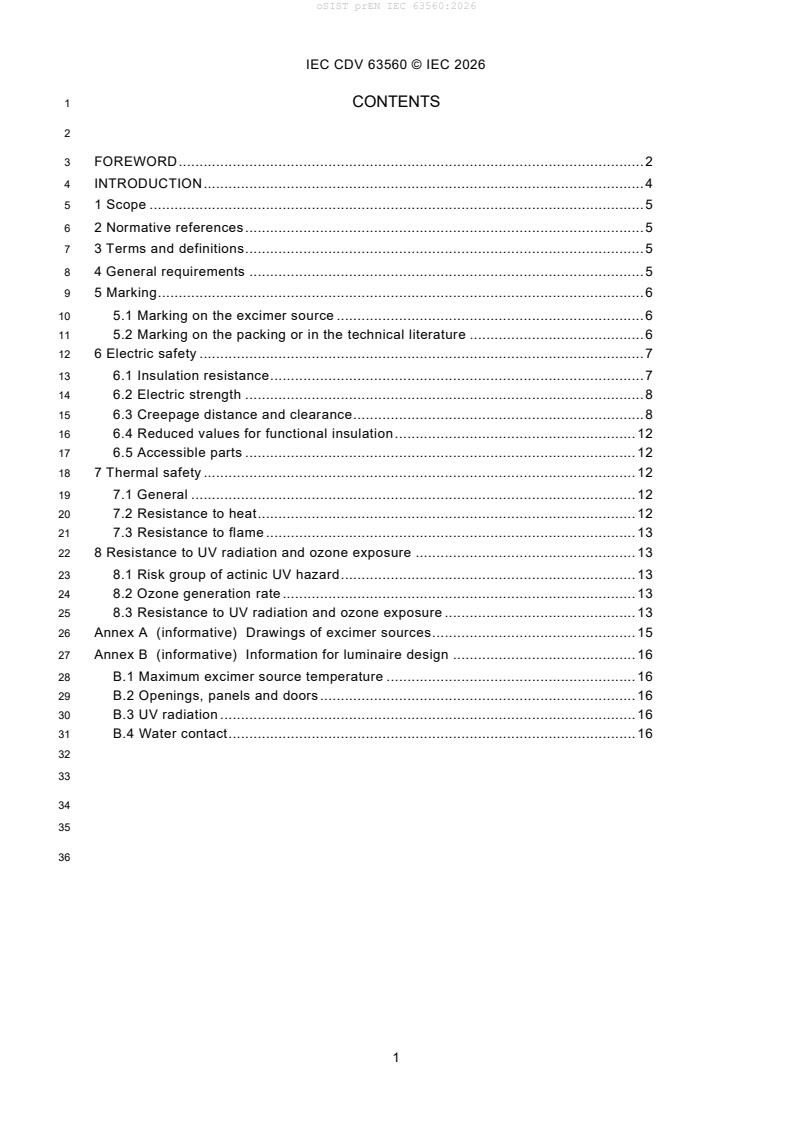
1 CONTENTS
3 FOREWORD . 2
4 INTRODUCTION . 4
5 1 Scope . 5
6 2 Normative references . 5
7 3 Terms and definitions . 5
8 4 General requirements . 5
9 5 Marking . 6
10 5.1 Marking on the excimer source . 6
11 5.2 Marking on the packing or in the technical literature . 6
12 6 Electric safety . 7
13 6.1 Insulation resistance. 7
14 6.2 Electric strength . 8
15 6.3 Creepage distance and clearance. 8
16 6.4 Reduced values for functional insulation . 12
17 6.5 Accessible parts . 12
18 7 Thermal safety . 12
19 7.1 General . 12
20 7.2 Resistance to heat . 12
21 7.3 Resistance to flame . 13
22 8 Resistance to UV radiation and ozone exposure . 13
23 8.1 Risk group of actinic UV hazard . 13
24 8.2 Ozone generation rate . 13
25 8.3 Resistance to UV radiation and ozone exposure . 13
26 Annex A (informative) Drawings of excimer sources . 15
27 Annex B (informative) Information for luminaire design . 16
28 B.1 Maximum excimer source temperature . 16
29 B.2 Openings, panels and doors . 16
30 B.3 UV radiation . 16
31 B.4 Water contact . 16
IEC CDV 63560 © IEC 2026
37 INTERNATIONAL ELECTROTECHNICAL COMMISSION
38 ____________
40 Germicidal equipment - Excimer sources - Safety
42 FOREWORD
43 1) The International Electrotechnical Commission (IEC) is a worldwide organization for standardization comprising
44 all national electrotechnical committees (IEC National Committees). The object of IEC is to promote international
45 co-operation on all questions concerning standardization in the electrical and electronic fields. To this end and
46 in addition to other activities, IEC publishes International Standards, Technical Specifications, Technical Reports,
47 Publicly Available Specifications (PAS) and Guides (hereafter referred to as “IEC Publication(s)”). Their
48 preparation is entrusted to technical committees; any IEC National Committee interested in the subject dealt with
49 may participate in this preparatory work. International, governmental and non-governmental organizations liaising
50 with the IEC also participate in this preparation. IEC collaborates closely with the International Organization for
51 Standardization (ISO) in accordance with conditions determined by agreement between the two organizations.
52 2) The formal decisions or agreements of IEC on technical matters express, as nearly as possible, an international
53 consensus of opinion on the relevant subjects since each technical committee has representation from all
54 interested IEC National Committees.
55 3) IEC Publications have the form of recommendations for international use and are accepted by IEC National
56 Committees in that sense. While all reasonable efforts are made to ensure that the technical content of IEC
57 Publications is accurate, IEC cannot be held responsible for the way in which they are used or for any
58 misinterpretation by any end user.
59 4) In order to promote international uniformity, IEC National Committees undertake to apply IEC Publications
60 transparently to the maximum extent possible in their national and regional publications. Any divergence between
61 any IEC Publication and the corresponding national or regional publication shall be clearly indicated in the latter.
62 5) IEC itself does not provide any attestation of conformity. Independent certification bodies provide conformity
63 assessment services and, in some areas, access to IEC marks of conformity. IEC is not responsible for any
64 services carried out by independent certification bodies.
65 6) All users should ensure that they have the latest edition of this publication.
66 7) No liability shall attach to IEC or its directors, employees, servants or agents including individual experts and
67 members of its technical committees and IEC National Committees for any personal injury, property damage or
68 other damage of any nature whatsoever, whether direct or indirect, or for costs (including legal fees) and
69 expenses arising out of the publication, use of, or reliance upon, this IEC Publication or any other IEC
70 Publications.
71 8) Attention is drawn to the Normative references cited in this publication. Use of the referenced publications is
72 indispensable for the correct application of this publication.
73 9) Attention is drawn to the possibility that some of the elements of this IEC Publication may be the subject of patent
74 rights. IEC shall not be held responsible for identifying any or all such patent rights.
75 IEC 63560 has been prepared by IEC technical committee 34: Lighting. It is an International
76 Standard.
77 The text of this International Standard is based on the following documents:
Draft Report on voting
XX/XX/FDIS XX/XX/RVD
79 Full information on the voting for its approval can be found in the report on voting indicated in
80 the above table.
81 The language used for the development of this International Standard is English.
82 This document was drafted in accordance with ISO/IEC Directives, Part 2, and developed in
83 accordance with ISO/IEC Directives, Part 1 and ISO/IEC Directives, IEC Supplement, available
84 at www.iec.ch/members_experts/refdocs. The main document types developed by IEC are
85 described in greater detail at www.iec.ch/publications.
86 The committee has decided that the contents of this document will remain unchanged until the
87 stability date indicated on the IEC website under webstore.iec.ch in the data related to the
88 specific document. At this date, the document will be
IEC CDV 63560 © IEC 2026
89 • reconfirmed,
90 • withdrawn,
91 • replaced by a revised edition, or
92 • amended.
IEC CDV 63560 © IEC 2026
94 INTRODUCTION
95 This document acknowledges the emerging of 222 nm excimer sources for germicidal purpose
96 and the need for the safety specification.
97 The provisions in this document represent the technical knowledge of experts from the field of
98 the UV radiation for germicidal purpose, and are developed with the safety of other type s of UV
99 radiation sources for germicidal purpose, e.g., low pressure mercury sources for germicidal
100 purpose.
101 As a product safety document, it is not necessary to limit the wavelength to be only for 222nm.
102 “Excimer source” without wavelength limitation is then used for the purpose of this document.
IEC CDV 63560 © IEC 2026
104 Germicidal equipment - Excimer sources - Safety
106 1 Scope
107 This document specifies safety requirements for excimer sources operated by electronic
108 controlgear for use on DC supplies up to 1 500 V or on AC supplies up to 1 000 V at 50 Hz or
109 60 Hz used for germicidal purposes.
110 2 Normative references
111 The following documents are referred to in the text in such a way that some or all of their content
112 constitutes requirements of this document. For dated references, only the edition cited applies.
113 For undated references, the latest edition of the referenced document (including any
114 amendments) applies.
115 IEC 60243 (all parts), Electric strength of insulating materials - Test methods
116 IEC 60695-2-10, Fire hazard testing - Part 2-10: Glowing/hot-wire based test methods -
117 Glow-wire apparatus and common test procedure
118 IEC 61032:1997, Protection of persons and equipment by enclosures - Probes for
119 verification
120 IEC 62471, Photobiological safety of lamps and lamp systems
121 IEC 62368-1:2023 Audio/video, information and communication technology equipment -
122 Part 1: Safety requirements
123 IEC 63561, Measurement of ozone production from UV-C radiation sources and luminaires
124 ISO 1431-1:2024, Rubber, vulcanized or thermoplastic — Resistance to ozone cracking —
125 Part 1: Static and dynamic strain testing
126 ISO 178, Plastics — Determination of tensile properties
127 ISO 527 (all parts), Plastics — Determination of flexural properties
128 3 Terms and definitions
129 For the purposes of this document, the terms and definitions given in IEC 60050-845, and the
130 following apply.
131 ISO and IEC maintain terminology databases for use in standardization at the following
132 addresses:
133 • ISO Online browsing platform: available at https://www.iso.org/obp
134 • IEC Electropedia: available at https://www.electropedia.org
135 3.1
136 excimer source
137 radiation source based on dielectric barrier discharge through a noble gas containing excited
138 dimeric molecules
139 Note 1 to entry: Examples of excimer source designs are given in Annex A.
140 Note 2 to entry: Examples of excimer lamps are KrCl or KrBr excimer lamps.
141 4 General requirements
142 Excimer sources shall be designed and constructed so that when used as intended they present
143 no danger to the user or the surroundings.
IEC CDV 63560 © IEC 2026
144 Compliance is checked by carrying out the tests specified in this document with the excimer
145 source powered by the designated type of controlgear by the manufacturer or responsible
146 vendor.
147 Note Information for luminaire design is given in Annex B.
148 5 Marking
149 5.1 Marking on the excimer source
150 The following information shall be legibly and durably marked on the excimer source:
151 a) mark of origin;
152 NOTE This can take the form of a trademark, the name of the manufacturer or the responsible vendor
153 b) model number or type reference of the manufacturer;
154 c) UV hazard warning given in Figure 1;
159 (IEC 60417-6040:2010-08-27)
160 Figure 1 –UV hazard symbol
162 d) risk group of the actinic UV hazard according to IEC 62471;
163 Compliance is checked by the following:
164 – Presence and legibility of the marking is checked by visual inspection;
165 – The durability of the marking is checked by trying to remove it by rubbing lightly for 15 s
166 with a piece of cloth soaked with water. The marking on the excimer source shall remain
167 legible and correctly positioned after the test.
168 5.2 Marking on the packing or in the technical literature
169 The following information shall be given on the packing or in the instructions for use:
170 a) risk group of the actinic UV hazard according to IEC 62471;
171 b) instructional safeguards “WARNING: Turn off the source before opening or removing any
172 shielding” and “WARNING: Use UV radiation personal protective equipment (PPE) such as
173 eye and skin protection during use, maintenance and servicing”;
174 c) procedures to be used by persons other than a qualified agent;
175 d) warning label as specified in IEC 63535 according to the risk group of the excimer source;
176 e) the cap design, if applic
...