

prEN IEC 60598-2-5:2026
(Main)Luminaires - Part 2-5: Particular requirements - Floodlights
- Status
- Not Published
- Publication Date
- 08-Feb-2028
- Technical Committee
- CLC/TC 34 - 'Lamps and related equipment
- Current Stage
- 4020 - Enquiry circulated - Enquiry
- Start Date
- 04-Sep-2026
- Due Date
- 19-Dec-2025
- Completion Date
- 04-Sep-2026

prEN IEC 60598-2-5:2026 is a draft standard from the International Electrotechnical Commission (IEC) for floodlights in the Luminaires series. It specifies particular safety and construction requirements for floodlights used with electric light sources on supply voltages not exceeding 1 000 V, and it is intended for manufacturers, test laboratories, certification bodies, and anyone preparing product instructions or technical files.
What does prEN IEC 60598-2-5:2026 specify?
prEN IEC 60598-2-5:2026 specifies the particular requirements for floodlights and is used together with IEC 60598-1. Clause 1 limits the document to floodlights for use with electric light sources on supply voltages not exceeding 1 000 V, and the note in Clause 3 makes clear that “luminaire” in this part means floodlight(s).
The document is organized as a Part 2-5 to the IEC 60598 series. It adds or modifies Part 1 requirements through Clauses 4 to 17, and it includes one informative annex for retesting decisions.
| Annex | What it covers |
|---|---|
| Annex AAA | Schedule of amended clauses with more serious or critical requirements that may require product retesting |
What are the key requirements of prEN IEC 60598-2-5:2026?
prEN IEC 60598-2-5:2026 keeps the general framework of IEC 60598-1, then adds floodlight-specific requirements for installation, outdoor use, mechanical strength, glass covers, and thermal performance. For a manufacturer or test lab, the main task is to check the floodlight against the added clauses and to follow the clause order set by this part.
Application of Part 1 and test sequence
Clause 4 says that if a floodlight has already been assessed to the previous edition, full type testing is not needed again unless the amended clauses in Annex AAA are involved. Clause 4.102 also fixes the order in which the clauses are applied, which matters because test sequence can affect results.
For floodlights with an IP classification greater than IP20, Clause 4 requires the endurance and moisture-related tests to be run in a defined order. In practice, that means laboratories must not rearrange the test plan casually.
Marking and installation information
Clause 6.101 requires installation instructions to state the operating position if it is not universal, the mass and overall dimensions, the largest projected area exposed to wind force, whether the luminaire is suitable for indoor use, and the maximum mounting height above ground level.
This matters because the installer needs the correct mounting position, the right support, and the right wind-load assumptions. It also ties directly to the glass-cover and thermal requirements.
Construction, attachment, and wind resistance
Clause 7 requires outdoor luminaires to have moisture protection at least equivalent to IPX3. It also requires lamp supports, lamp position adjustment, light-controlling components, and attachment means to be suitable for normal use and to keep parts in the correct position.
For outdoor luminaires above ground level, the attachment must withstand wind speeds related to mounting height, and the static wind-force test is carried out with the luminaire mounted as instructed. Clause 7 also requires protection against parts becoming dislodged, and some higher-mounted parts need extra protection if a fixing fails.
Glass covers and impact protection
Clause 7.107 adds a mounting-height-based approach to glass covers. Below 5 m, no extra glass-cover requirement applies; at 5 m and above, the cover must either fracture into small pieces, have high impact shock resistance, or retain fragments by another protective method.
The document gives separate test methods for small-piece fracture and high-impact resistant glass. For high-impact glass, it uses impact testing with IEC 62262 and IEC/TR 62696, and the glass must withstand the specified impacts without breaking at the weakest point.
Thermal performance
Clause 14.101 changes how temperature results are interpreted for outdoor floodlights by allowing a temperature deduction for natural air movement. Clause 14.102 requires glass covers to remain within declared thermal limits, including the maximum temperature difference across the glass.
That means thermal checks are not just about the luminaire body. The glass itself must stay within its permitted range during use.
What terms does prEN IEC 60598-2-5:2026 define?
- Floodlight - A luminaire for lighting a scene or object so that its illuminance is much higher than the surroundings.
- Luminaire - In this part, the term is used to mean floodlight(s).
- Mounting height - The height above ground level used to determine marking, wind loading, and glass-cover requirements.
- IPX3 - The minimum moisture protection level required here for luminaires intended for outdoor use.
- IK code - The impact-protection classification used with IEC 62262 for high-impact resistant glass covers.
- Part 1 - IEC 60598-1, the general requirements and tests that this part is used with.
Who uses prEN IEC 60598-2-5:2026?
Manufacturers of floodlights use prEN IEC 60598-2-5:2026 to design products, choose materials, and prepare installation instructions. Test laboratories use it to plan type tests, glass breakage tests, wind-force checks, and thermal assessments.
Certification bodies and compliance teams use it to judge whether a floodlight can be assessed against the latest requirements. Specifiers, buyers, and maintenance teams use it to understand what information must be available for safe mounting and use, especially for outdoor installations.
What changed in prEN IEC 60598-2-5:2026 from the previous edition?
prEN IEC 60598-2-5:2026 is the fourth edition and cancels and replaces the third edition published in 2015. The document states these main changes:
- Clause structure and numbering were aligned with IEC 60598-1.
- Glass breakage tests were made more detailed.
- The wind-force test was reviewed and aligned with IEC 60598-2-3.
- The installation information for mounting height was modified.
- The requirements for high impact glass were modified.
- Subclause 7.107.3 is listed in Annex AAA as more onerous than the previous edition and may trigger retesting.
Which standards are used with prEN IEC 60598-2-5:2026?
| Standard | Contribution |
|---|---|
| IEC 60598-1:2024 | General requirements and tests used with this part |
| IEC 60068-2-75 | Hammer test method for mechanical impact testing |
| IEC 62262:2002 | IK code for impact protection of enclosures |
| IEC 62262:2002/AMD1:2021 | Amendment used with the IK code reference |
| IEC/TR 62696 | Guidance for applying the IK code in this context |
What does the prEN IEC 60598-2-5:2026 document contain?
The document contains Clauses 1 to 17, covering scope, references, terms, general requirements, classification, marking, construction, wiring, earthing, shock protection, ingress protection, insulation, creepage distances, endurance, heat, fire, tracking, and terminals. It also contains Annex AAA, which identifies clauses with more serious or critical changes that may affect product retesting.
It includes Figure 1 for the static wind-force test and Figures 2 and 3 for the glass-particle counting method after fracture. The body text also describes test set-ups, inspection checks, and the conditions used for glass cover impact and thermal evaluations, so the document can support design review, type testing, and certification update work.
Relations
- Effective Date
- 23-Apr-2024
Get Certified
Connect with accredited certification bodies for this standard

IMQ S.p.A. (Certification)
Italian electrical product certification.

SLG Prüf- und Zertifizierungs GmbH
German testing and certification body.

UL Solutions
Global safety science company with testing, inspection and certification.
Sponsored listings
Frequently Asked Questions
prEN IEC 60598-2-5:2026 is a draft published by CLC. Its full title is "Luminaires - Part 2-5: Particular requirements - Floodlights". This standard covers: Luminaires - Part 2-5: Particular requirements - Floodlights
Luminaires - Part 2-5: Particular requirements - Floodlights
prEN IEC 60598-2-5:2026 is classified under the following ICS (International Classification for Standards) categories: 29.140.40 - Luminaires. The ICS classification helps identify the subject area and facilitates finding related standards.
prEN IEC 60598-2-5:2026 has the following relationships with other standards: It is inter standard links to EN 60598-2-5:2015. Understanding these relationships helps ensure you are using the most current and applicable version of the standard.
prEN IEC 60598-2-5:2026 is associated with the following European legislation: EU Directives/Regulations: 2014/35/EU; Standardization Mandates: M/511. When a standard is cited in the Official Journal of the European Union, products manufactured in conformity with it benefit from a presumption of conformity with the essential requirements of the corresponding EU directive or regulation.
prEN IEC 60598-2-5:2026 is available in PDF format for immediate download after purchase. The document can be added to your cart and obtained through the secure checkout process. Digital delivery ensures instant access to the complete standard document.
Standards Content (Sample)
SLOVENSKI STANDARD
01-november-2026
Svetilke - 2-5. del: Posebne zahteve - Žarometi in sojniki
Luminaires - Part 2-5: Particular requirements - Floodlights
Leuchten - Teil 2-5: Besondere Anforderungen - Scheinwerfer
Luminaires - Partie 2-5: Exigences particulières - Projecteurs
Ta slovenski standard je istoveten z: prEN IEC 60598-2-5:2026
ICS:
29.140.40 Svetila Luminaires
2003-01.Slovenski inštitut za standardizacijo. Razmnoževanje celote ali delov tega standarda ni dovoljeno.
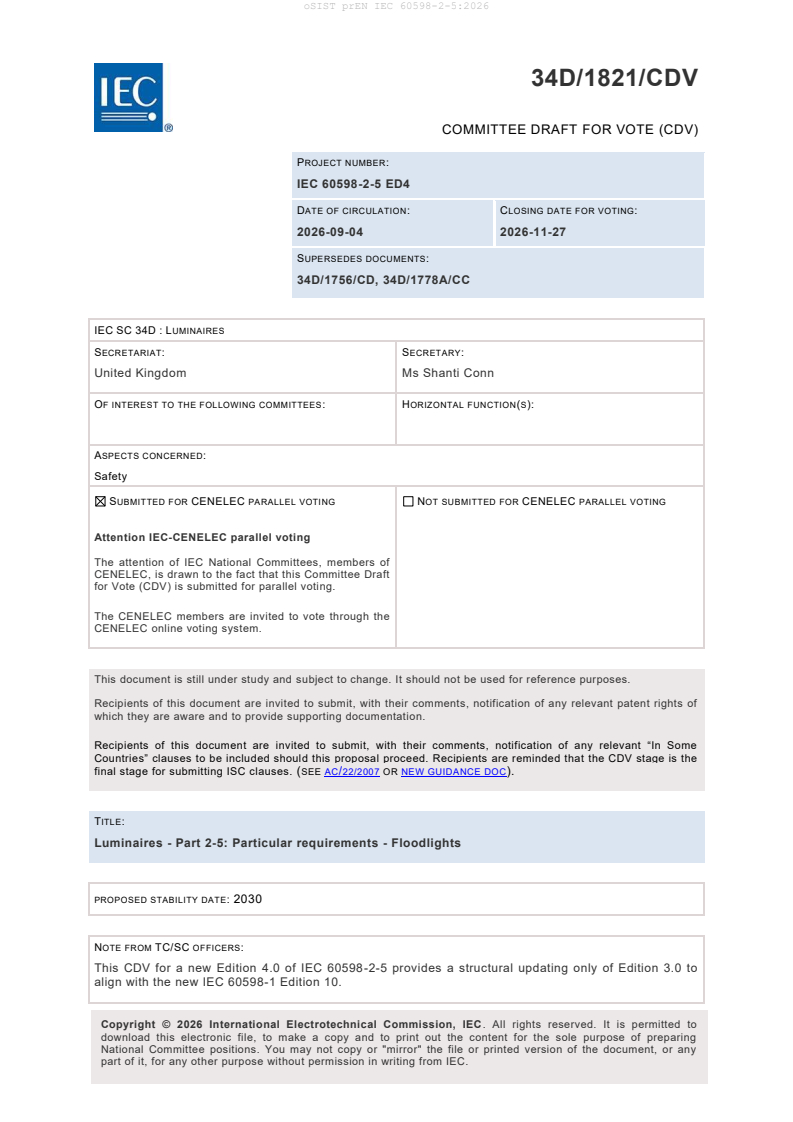
34D/1821/CDV
COMMITTEE DRAFT FOR VOTE (CDV)
PROJECT NUMBER:
IEC 60598-2-5 ED4
DATE OF CIRCULATION: CLOSING DATE FOR VOTING:
2026-09-04 2026-11-27
SUPERSEDES DOCUMENTS:
34D/1756/CD, 34D/1778A/CC
IEC SC 34D : LUMINAIRES
SECRETARIAT: SECRETARY:
United Kingdom Ms Shanti Conn
OF INTEREST TO THE FOLLOWING COMMITTEES: HORIZONTAL FUNCTION(S):
ASPECTS CONCERNED:
Safety
SUBMITTED FOR CENELEC PARALLEL VOTING NOT SUBMITTED FOR CENELEC PARALLEL VOTING
Attention IEC-CENELEC parallel voting
The attention of IEC National Committees, members of
CENELEC, is drawn to the fact that this Committee Draft
for Vote (CDV) is submitted for parallel voting.
The CENELEC members are invited to vote through the
CENELEC online voting system.
This document is still under study and subject to change. It should not be used for reference purposes.
Recipients of this document are invited to submit, with their comments, notification of any relevant patent rights of
which they are aware and to provide supporting documentation.
Recipients of this document are invited to submit, with their comments, notification of any relevant “In Some
Countries” clauses to be included should this proposal proceed. Recipients are reminded that the CDV stage is the
final stage for submitting ISC clauses. (SEE AC/22/2007 OR NEW GUIDANCE DOC).
TITLE:
Luminaires - Part 2-5: Particular requirements - Floodlights
PROPOSED STABILITY DATE: 2030
NOTE FROM TC/SC OFFICERS:
This CDV for a new Edition 4.0 of IEC 60598-2-5 provides a structural updating only of Edition 3.0 to
align with the new IEC 60598-1 Edition 10.
download this electronic file, to make a copy and to print out the content for the sole purpose of preparing
National Committee positions. You may not copy or "mirror" the file or printed version of the document, or any
part of it, for any other purpose without permission in writing from IEC.
IEC CDV 60598-2-5 © IEC 2026
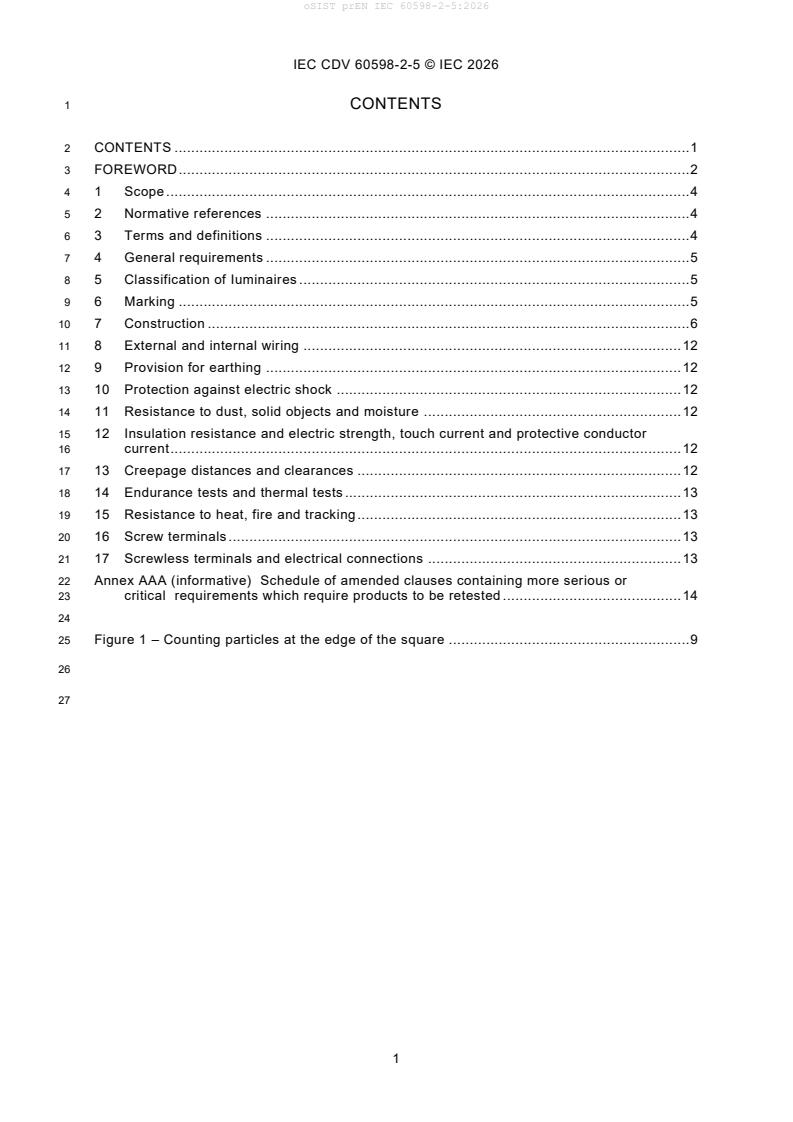
1 CONTENTS
2 CONTENTS . 1
3 FOREWORD . 2
4 1 Scope . 4
5 2 Normative references . 4
6 3 Terms and definitions . 4
7 4 General requirements . 5
8 5 Classification of Iuminaires . 5
9 6 Marking . 5
10 7 Construction . 6
11 8 External and internal wiring . 12
12 9 Provision for earthing . 12
13 10 Protection against electric shock . 12
14 11 Resistance to dust, solid objects and moisture . 12
15 12 Insulation resistance and electric strength, touch current and protective conductor
16 current . 12
17 13 Creepage distances and clearances . 12
18 14 Endurance tests and thermal tests . 13
19 15 Resistance to heat, fire and tracking . 13
20 16 Screw terminals . 13
21 17 Screwless terminals and electrical connections . 13
22 Annex AAA (informative) Schedule of amended clauses containing more serious or
23 critical requirements which require products to be retested . 14
25 Figure 1 – Counting particles at the edge of the square . 9
IEC CDV 60598-2-5 © IEC 2026
28 INTERNATIONAL ELECTROTECHNICAL COMMISSION
29 ____________
31 LUMINAIRES –
33 Part 2-5: Particular requirements – Floodlights
37 FOREWORD
38 1) The International Electrotechnical Commission (IEC) is a worldwide organization for standardization comprising
39 all national electrotechnical committees (IEC National Committees). The object of IEC is to promote
40 international co-operation on all questions concerning standardization in the electrical and electronic fields. To
41 this end and in addition to other activities, IEC publishes International Standards, Technical Specifications,
42 Technical Reports, Publicly Available Specifications (PAS) and Guides (hereafter referred to as "IEC
43 Publication(s)"). Their preparation is entrusted to technical committees; any IEC National Committee interested
44 in the subject dealt with may participate in this preparatory work. International, governmental and non -
45 governmental organizations liaising with the IEC also participate in this preparation. IEC collaborates closely
46 with the International Organization for Standardization (ISO) in accordance with conditions determined by
47 agreement between the two organizations.
48 2) The formal decisions or agreements of IEC on technical matters express, as nearly as possible, an international
49 consensus of opinion on the relevant subjects since each technical committee has representation from all
50 interested IEC National Committees.
51 3) IEC Publications have the form of recommendations for international use and are accepted by IEC National
52 Committees in that sense. While all reasonable efforts are made to ensure that the technical content of IEC
53 Publications is accurate, IEC cannot be held responsible for the way in which they are used or for any
54 misinterpretation by any end user.
55 4) In order to promote international uniformity, IEC National Committees undertake to apply IEC Publications
56 transparently to the maximum extent possible in their national and regional publications. Any divergence
57 between any IEC Publication and the corresponding national or regional publication shall be clearly indicated in
58 the latter.
59 5) IEC itself does not provide any attestation of conformity. Independent certification bodies provide conformity
60 assessment services and, in some areas, access to IEC marks of conformity. IEC is not responsible for any
61 services carried out by independent certification bodies.
62 6) All users should ensure that they have the latest edition of this publication.
63 7) No liability shall attach to IEC or its directors, employees, servants or agents including individual experts and
64 members of its technical committees and IEC National Committees for any personal injury, property damage or
65 other damage of any nature whatsoever, whether direct or indirect, or for costs (including legal fees) and
66 expenses arising out of the publication, use of, or reliance upon, this IEC Publication or any other IEC
67 Publications.
68 8) Attention is drawn to the Normative references cited in this publication. Use of the referenced publications is
69 indispensable for the correct application of this publication.
70 9) IEC draws attention to the possibility that the implementation of this document may involve the use of (a)
71 patent(s). IEC [takes no position concerning the evidence, validity or applicability of any claimed patent rights
72 in respect thereof. As of the date of publication of this document, IEC had not received notice of (a) patent(s),
73 which may be required to implement this document. However, implementers are cautioned that this may not
74 represent the latest information, which may be obtained from the patent database available at
75 https://patents.iec.ch. IEC shall not be held responsible for identifying any or all such patent rights.
77 IEC 60598-2-5 has been prepared by subcommittee 34D: Luminaires, of IEC technical
78 committee 34: Lighting. It is an International Standard.
79 This fourth edition cancels and replaces the third edition, published in 2015. This edition
80 constitutes a technical revision.
81 This edition includes the following significant technical changes with respect to the previous
82 edition:
83 a) the clause numbers and structure have been aligned with those of IEC 60598-1;
IEC CDV 60598-2-5 © IEC 2026
84 b) more detailed glass breakage tests have been added;
85 c) wind force test has been reviewed and aligned with IEC 60598-2-3;
86 d) requirement for the information about the mounting height has been modified .
87 e) requirements for high impact glass has been modified. Subclause 7.107.3 is now listed in
88 Annex AAA being considered more onerous compared with the last edition.
90 The text of this International Standard is based on the following documents:
Draft Report on voting
XX/XX/FDIS XX/XX/RVD
92 Full information on the voting for its approval can be found in the report on voting indicated in
93 the above table.
94 The language used for the development of this International Standard is English.
95 This document was drafted in accordance with ISO/IEC Directives, Part 2, and developed in
96 accordance with ISO/IEC Directives, Part 1 and ISO/IEC Directives, IEC Supplement, and the
97 ISO/IEC Directives, JTC 1 Supplement available at www.iec.ch/members_experts/refdocs.
98 The main document types developed by IEC are described in greater detail at
99 www.iec.ch/publications.
100 This Part 2-5 is to be used in conjunction with the latest edition of IEC 60598-1 and its
101 amendment(s). It was established on the basis of the tenth edition (2024) of that standard.
102 NOTE When “Part 1” is mentioned in this document, it refers to IEC 60598 -1.
103 Where this document states "addition", "modification" or "replacement", the relevant text of
104 Part 1 is to be adapted accordingly.
105 Subclauses additional to those in Part 1 are numbered starting from 101; supplementary
106 annexes are entitled AAA, AAB, etc.
107 A list of all parts in the IEC 60598 series, published under the general title Luminaires can be
108 found on the IEC website.
109 The committee has decided that the contents of this document will remain unchanged until the
110 stability date indicated on the IEC website under webstore.iec.ch in the data related to the
111 specific document. At this date, the document will be
112 • reconfirmed,
113 • withdrawn,
114 • replaced by a revised edition, or
115 • amended.
IEC CDV 60598-2-5 © IEC 2026
119 LUMINAIRES –
121 Part 2-5: Particular requirements – Floodlights
125 1 Scope
126 This part of IEC 60598 specifies requirements for floodlights for use with electric light sources
127 on supply voltages not exceeding 1 000 V.
128 NOTE Where the term “luminaire” is used within this document it means floodlight(s).
130 2 Normative references
131 This clause of Part 1 applies with the following additions:
132 IEC 60068-2-75, Environmental testing – Part 2-75: Tests – Test Eh: Hammer tests
133 IEC 60598-1: 2024, Luminaires – Part 1: General requirements and tests
134 IEC 62262:2002, Degrees of protection provided by enclosures for electrical equipment
135 against external mechanical impacts (IK code)
136 IEC 62262:2002/AMD1:2021
137 IEC/TR 62696, Luminaires – Application of the IK code IEC62262
138 3 Terms and definitions
139 For the purposes of this document , the terms and definitions given in Part 1, applies with the
140 following additions:
141 ISO and IEC maintain terminology databases for use in standardization at the following
142 addresses:
143 • IEC Electropedia: available at https://www.electropedia.org/
144 • ISO Online browsing platform: available at https://www.iso.org/obp3.101
146 3.101
147 floodlight
148 luminaire for lighting of a scene or an object, in order to increase considerably its illuminance
149 relative to its surroundings.
150 Note 1 to entry: The difference in illumination between the subject and its surroundings may, alternatively, be
151 achieved by colour.
152 Note 2 to entry: A floodlight can be for either exterior or interior use or for both.
153 Note 3 to entry: This definition is derived from IEV definitions: IEC 60050-845:2020, 845-29-021, IEC 60050-
154 845:2020, 845-30-030 and IEC 60050-845:2020, 845-30-033.
IEC CDV 60598-2-5 © IEC 2026
157 4 General requirements
158 This Clause of Part 1 applies with the following additions:
159 4.101 General
160 For assessment of luminaires already assessed in accordance with the previous edition of this
161 document, full type testing is not necessary, and the product and the previous test results are
162 reviewed only against any amended clauses listed in Annex AAA.
163 4.102 Sequence of clauses
164 The clauses according to this document shall be applied in the following order:
165 5 Classification of luminaires
166 6 Marking
167 7 Construction
168 13 Creepage distances and clearances
169 9 Provisions for earthing
170 16 Screw terminals
171 17 Screwless terminals and electrical connections
172 8 External and internal wiring
173 10 Protection against electric shock
174 14 Endurance tests and thermal tests
175 11 Resistance to dust, solid objects and moisture
176 12 Insulation resistance and electric strength, touch current and protective conductor
177 current
178 15 Resistance to heat, fire and tracking
179 For luminaires with
...