

prEN 50776:2026
(Main)Recyclability of smartphones, mobile phones other than smartphones, cordless phones and slate tablets
- Abstract
EN providing detailed technical specifications of the measurement methods and calculations for the recyclability of smartphones, mobile phones other than smartphones, cordless phones and slate tablets.
- Status
- Not Published
- Publication Date
- 11-Jan-2028
- Technical Committee
- CLC/TC 100X - Audio, video and multimedia systems and equipment and related sub-systems
- Drafting Committee
- WG 03 - Ecophones

prEN 50776:2026, published by CLC, is a draft European Standard for measuring the recyclability of smartphones, mobile phones other than smartphones, cordless phones and slate tablets. It specifies how to determine product material content, calculate a recyclability rate, and report the result for manufacturers, suppliers and assessors working on these products.
What does prEN 50776:2026 specify?
prEN 50776:2026 specifies measurement methods and calculations for the recyclability of smartphones, mobile phones other than smartphones, cordless phones and slate tablets. In practice, it gives a common way to turn product material data into a recyclability rate that can be compared across products.
The document is organized into:
- Clause 1 - Scope
- Clause 2 - Normative references
- Clause 3 - Terms, definitions and abbreviations
- Clause 4 - Measurement and calculation of the recyclability rate
- Clause 5 - Reporting recyclability rates
- Annex A - Recyclability factors
- Annex ZZ - Relationship with Commission Regulation (EU) 2023/1670
Annex A is normative and contains the factor values used in the calculation. Annex ZZ is informative and connects the standard to the ecodesign framework.
What are the key requirements of prEN 50776:2026?
Clause 4 is the technical core of prEN 50776:2026. It sets out how to establish material content, how to treat the end-of-life scenario, and how to calculate the final recyclability rate in mass percent.
How material content is established
Clause 4.2 allows product material content to be based on manufacturer and supplier information, including partial material declarations and CAD drawings or design specifications. That matters because assessments often begin with design and supply-chain data rather than laboratory work.
Supplier information is only used after checking its completeness and trustworthiness. In practice, the assessor has to decide whether the data is good enough to support the calculation.
When testing is used
Clause 4.3 allows analytical testing when supplied information is missing, incomplete or not trustworthy. The product may need to be dismantled first, so the assessor can identify smaller parts and material groups.
Every identified material is mapped to the corresponding entry in Annex A. If a material has no entry, it is treated as contributing 0 % to the recyclability-rate numerator, but its mass still remains in the total product mass. That keeps the calculation tied to the whole product, not just the listed materials.
End-of-life scenario and calculation
Clause 4.4 uses a reference end-of-life scenario with three fractions:
- battery
- mono-material parts
- all other parts
The battery is assumed to go to battery recycling, mono-material parts to plastics, steel or non-ferrous metals recycling, and all other parts to precious metal smelting. This gives one common basis for comparing products.
Clause 4.5 calculates the recyclability rate as a mass-based weighted result using the recyclability factors from Annex A. Materials not listed in Annex A do not contribute to the numerator, but their mass still counts in the total product mass. For practice, this means the result reflects both the product’s composition and the factor assigned to each material.
Reporting
Clause 5 requires the recyclability assessment to be documented so a third party can verify the result. The report includes the assessor, date and place, the product scope and model identifier, the material data and method used, the recyclability factors applied, the calculated rate, key assumptions, and the references used.
What terms does prEN 50776:2026 define?
- mono-material part - a part made of one material only, such as a single alloy or polymer compound, with no other substances or materials that change that definition.
- part - a hardware, firmware or software constituent of a product; for this document, firmware and software are not relevant.
- mobile phone - a cordless handheld device designed for long-range voice communication over a cellular or satellite network and used mainly on battery.
- smartphone - a mobile phone with wireless internet use, a handheld operating system and an integrated touch screen in the defined size range.
- cordless phone - a handheld device for long-range voice communication over a landline network through a base station.
- slate tablet - a portable device with a touch display, no integrated keyboard, wireless connection, internal battery and a mobile-platform operating system.
- recyclability - the compatibility of the product’s constituent materials and parts with recycling processes.
- MCD - material content declaration, the structured declaration approach used to describe product material content.
Who uses prEN 50776:2026?
prEN 50776:2026 is used by manufacturers, component and material suppliers, recyclability assessors, test laboratories, and compliance teams. It is also relevant for buyers and quality managers who need a documented recyclability rate for product comparison, design review or ecodesign work.
It is especially useful for teams that:
- build phones or tablets
- collect material declarations from suppliers
- verify material content by testing
- prepare assessment reports for regulatory or customer use
- compare product designs on recyclability performance
Which standards are used with prEN 50776:2026?
The document points to related standards and references used in material declaration, testing and factor selection:
- EN IEC 82474-1 - a general material declaration standard used as a model for partial material declarations.
- IPC 1752 - another material declaration format named for supplier information.
- EN IEC 62321 (all parts) - used for determining certain substances in electrotechnical products when analytical testing is needed.
- EN 45555:2019 - provides broader recyclability and recoverability assessment context, and is cited as the source for the term “part”.
- Ecoreport tool - manual - one of the sources for recyclability factors in Annex A.
- Directive 2008/98/EC and Commission Regulation (EU) 2023/1670 - provide the EU waste and ecodesign framework linked to Annex ZZ.
What does the prEN 50776:2026 document contain?
prEN 50776:2026 contains a calculation method, a reporting structure, and a normative factor table. Clause 4 gives the material-data approach, the end-of-life scenario and the recyclability formula. Clause 5 gives the minimum contents of the assessment report so the result can be checked.
Annex A provides the recyclability factors used in the calculation, including entries for battery materials, metals and plastics. Annex ZZ provides the relationship to the ecodesign requirements of Commission Regulation (EU) 2023/1670.
The document is therefore aimed at practical assessment work: data collection, verification, calculation and reporting.
Get Certified
Connect with accredited certification bodies for this standard

ANCE
Mexican certification and testing association.

CIS Institut d.o.o.
Personal Protective Equipment (PPE) certification body. Notified Body NB-2890 for EU Regulation 2016/425 PPE.

Intertek Slovenia
Intertek testing, inspection, and certification services in Slovenia.
Sponsored listings
Frequently Asked Questions
prEN 50776:2026 is a draft published by CLC. Its full title is "Recyclability of smartphones, mobile phones other than smartphones, cordless phones and slate tablets". This standard covers: EN providing detailed technical specifications of the measurement methods and calculations for the recyclability of smartphones, mobile phones other than smartphones, cordless phones and slate tablets.
EN providing detailed technical specifications of the measurement methods and calculations for the recyclability of smartphones, mobile phones other than smartphones, cordless phones and slate tablets.
prEN 50776:2026 is classified under the following ICS (International Classification for Standards) categories: 13.030.50 - Recycling; 33.070.99 - Other mobile services. The ICS classification helps identify the subject area and facilitates finding related standards.
prEN 50776:2026 is associated with the following European legislation: EU Directives/Regulations: 2023/1670, 2023/1670/EU; Standardization Mandates: M/608. When a standard is cited in the Official Journal of the European Union, products manufactured in conformity with it benefit from a presumption of conformity with the essential requirements of the corresponding EU directive or regulation.
prEN 50776:2026 is available in PDF format for immediate download after purchase. The document can be added to your cart and obtained through the secure checkout process. Digital delivery ensures instant access to the complete standard document.
Standards Content (Sample)
SLOVENSKI STANDARD
01-december-2026
Reciklabilnost pametnih telefonov, mobilnih telefonov, ki niso pametni telefoni,
brezžičnih telefonov in tabličnih računalnikov
Recyclability of smartphones, mobile phones other than smartphones, cordless phones
and slate tablets
Ta slovenski standard je istoveten z: prEN 50776:2026
ICS:
13.030.50 Recikliranje Recycling
33.040.01 Telekomunikacijski sistemi Telecommunication systems
na splošno in general
2003-01.Slovenski inštitut za standardizacijo. Razmnoževanje celote ali delov tega standarda ni dovoljeno.
EUROPEAN STANDARD DRAFT
prEN 50776
NORME EUROPÉENNE
EUROPÄISCHE NORM
November 2026
ICS 13.030.50; 33.070.99 -
English Version
Recyclability of smartphones, mobile phones other than
smartphones, cordless phones and slate tablets
To be completed To be completed
This draft European Standard is submitted to CENELEC members for enquiry.
Deadline for CENELEC: 2027-02-19.
It has been drawn up by CLC/TC 100X.
If this draft becomes a European Standard, CENELEC members are bound to comply with the CEN/CENELEC Internal Regulations which
stipulate the conditions for giving this European Standard the status of a national standard without any alteration.
This draft European Standard was established by CENELEC in three official versions (English, French, German).
A version in any other language made by translation under the responsibility of a CENELEC member into its own language and notified to
the CEN-CENELEC Management Centre has the same status as the official versions.
CENELEC members are the national electrotechnical committees of Austria, Belgium, Bulgaria, Croatia, Cyprus, the Czech Republic,
Denmark, Estonia, Finland, France, Germany, Greece, Hungary, Iceland, Ireland, Italy, Latvia, Lithuania, Luxembourg, Malta, the
Netherlands, Norway, Poland, Portugal, Republic of North Macedonia, Romania, Serbia, Slovakia, Slovenia, Spain, Sweden, Switzerland,
Türkiye and the United Kingdom.
Recipients of this draft are invited to submit, with their comments, notification of any relevant patent rights of which they are aware and to
provide supporting documentation.
Warning : This document is not a European Standard. It is distributed for review and comments. It is subject to change without notice and
shall not be referred to as a European Standard.
European Committee for Electrotechnical Standardization
Comité Européen de Normalisation Electrotechnique
Europäisches Komitee für Elektrotechnische Normung
CEN-CENELEC Management Centre: Rue de la Science 23, B-1040 Brussels
© 2026 CENELEC All rights of exploitation in any form and by any means reserved worldwide for CENELEC Members.
Project: 82593 Ref. No. prEN 50776:2026 E
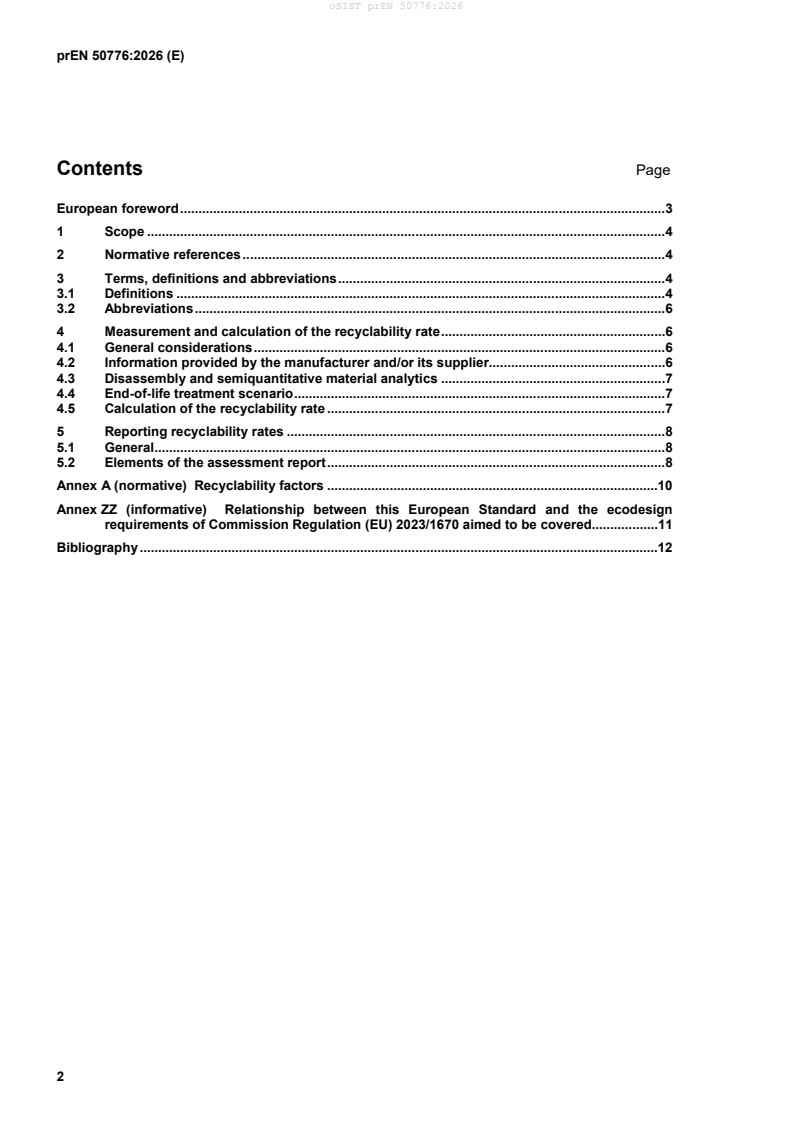
Contents Page
European foreword . 3
1 Scope . 4
2 Normative references . 4
3 Terms, definitions and abbreviations . 4
3.1 Definitions . 4
3.2 Abbreviations . 6
4 Measurement and calculation of the recyclability rate . 6
4.1 General considerations . 6
4.2 Information provided by the manufacturer and/or its supplier. 6
4.3 Disassembly and semiquantitative material analytics . 7
4.4 End-of-life treatment scenario . 7
4.5 Calculation of the recyclability rate . 7
5 Reporting recyclability rates . 8
5.1 General . 8
5.2 Elements of the assessment report . 8
Annex A (normative) Recyclability factors .10
Annex ZZ (informative) Relationship between this European Standard and the ecodesign
requirements of Commission Regulation (EU) 2023/1670 aimed to be covered.11
Bibliography .12
European foreword
This document (prEN 50776:2026) has been prepared by CLC/TC 100X “Audio, video and multimedia systems
and equipment and related sub-systems”.
This document is currently submitted to the Enquiry.
The following dates are proposed:
• latest date by which the existence of this (doa) dav + 6 months
document has to be announced at national
level
• latest date by which this document has to be (dop) dav + 12 months
implemented at national level by publication of
an identical national standard or by
endorsement
• latest date by which the national standards (dow) dav + 36 months
conflicting with this document have to be (to be confirmed or
withdrawn modified when voting)
This document has been prepared under a standardization request addressed to CENELEC by the European
Commission. The Standing Committee of the EFTA States subsequently approves these requests for its
Member States.
For the relationship with EU Legislation, see informative Annex ZZ, which is an integral part of this document.
1 Scope
This document specifies measurement methods and calculations for the recyclability of smartphones, mobile
phones other than smartphones, cordless phones and slate tablets.
When relevant, these measurement methods and calculations can also be applied to other audio, video and
multimedia systems and equipment.
2 Normative references
There are no normative references in this document.
3 Terms, definitions and abbreviations
For the purposes of this document, the following terms, definitions and abbreviations apply.
ISO and IEC maintain terminology databases for use in standardization at the following addresses:
— ISO Online browsing platform: available at https://www.iso.org/obp
— IEC Electropedia: available at https://www.electropedia.org/
3.1 Definitions
3.1.1
mono-material part
part made of a single material, such as an alloy or polymer compound
Note 1 to entry: No other substances or materials whatsoever are contained, including adhesives, labels, surface coating of
any other kind than the base material, fasteners made of a different material (e.g. screws and thread inserts), which remain
typically attached to the part after removal.
Note 2 to entry: Co-moulded parts made of different materials per se do not meet the definition of a mono-material part.
Note 3 to entry: In the case of polymer parts, additives that are homogeneously dispersed within the polymer matrix, such
as stabilizers or colourants, are permissible, provided the base polymer class is retained and the additive does not prevent
the part from being processed in established plastics recycling processes (as it can be the case for flame retardants). Plastic
parts containing materials or substances that form a distinct layer or phase within or on the part do not qualify as mono-
material parts, even where such materials have the same base polymer.
3.1.2
part
hardware, firmware or software constituent of a product
Note 1 to entry: Firmware and software are not relevant for the purpose of this document.
Note 2 to entry: A part can also be an accessory (or part therof) shipped with the product.
[SOURCE: EN 45555:2019, 3.1.9, modified – Note 2 to entry added.]
3.1.3
mobile phone
cordless handheld electronic device, which has the following characteristics:
(a) it is designed for long-range voice communication over either a cellular telecommunications network or a
satellitebased telecommunications network, requiring a SIM card, eSIM or similar means to identify the
connected parties;
(b) it is designed for battery mode usage, and connection to mains via an external power supply and/or wireless
power transmission is mainly for battery charging purposes;
(c) it is not designed to be worn on the wrist
[SOURCE: Article 2 of Regulation (EU) 2023/1670]
3.1.4
smartphone
mobile phone, which has the following characteristics:
(a) it is characterised by wireless network connection, mobile use of internet services, an operating system
optimised for handheld use and the ability to accept original and third-party software applications;
(b) it has an integrated touch screen display with a viewable diagonal size of 10,16 centimetres (or 4,0 inches)
or more, but less than 17,78 centimetres (or 7,0 inches);
(c) where the device has a foldable display or has more than one display, at least one of the displays falls into
the size range in either opened or closed mode
[SOURCE: Article 2 of Regulation (EU) 2023/1670]
3.1.5
cordless phone
cordless handheld electronic device which has the following characteristics:
(a) it is designed for long-range voice communication over a landline telecommunications network;
(b) it is connected to a base station through a radio interface;
(c) it is designed for battery mode usage, while connection to mains via an external power supply is mainly for
battery charging purposes
[SOURCE: Article 2 of Regulation (EU) 2023/1670]
3.1.6
base station
device that acts as the bridge between the network connection (telephone or Internet connection) and one or
several cordless phone handsets, but does not provide router functionality for any other devices. A base station
typically provides also the build-in charging cradle to recharge the handset
[SOURCE: Article 2 of Regulation (EU) 2023/1670]
3.1.7
charging cradle
device that acts as the charging unit for a single cordless phone handset, but does not provide network
connection functionality
[SOURCE: Article 2 of Regulation (EU) 2023/1670]
3.1.8
slate tablet
device that is designed for portability and has the following characteristics:
(a) it has an integrated touch-sensitive display with a viewable diagonal size greater than or equal to 17,78
centimetres (or 7,0 inches) and less than 44,20 centimetres (or 17,4 inches);
(b) it does not have an integrated, physically attached keyboard in its designed configuration;
(c) it primarily relies on a wireless network connection;
(d) it is powered by an internal battery and is not intended to work without battery;
(e) it is placed on the market with an operating system designed for mobile platforms, identical or analogous to
smartphones
[SOURCE: Article 2 of Regulation (EU) 2023/1670]
3.1.9
disassembly
process whereby a product is taken apart in such a way that it could subsequently be reassembled and made
operational
3.1.10
recyclability
compatibility of the constituent materials and parts of a product with recycling processes
Note 1 to entry: In line with the Waste Framework Directive [6], 'recycling' means any recovery operati
...