

prEN IEC 62321-15:2026
(Main)Determination of certain substances in electrotechnical products - Part 15: Tebrabromobisphenol A (TBBPA) in plastics by liquid chromatography-mass spectrometry (LC-MS)
- Status
- Not Published
- Publication Date
- 09-Mar-2028
- Technical Committee
- CLC/TC 111X - Environment
- Current Stage
- 4020 - Enquiry circulated - Enquiry
- Start Date
- 21-Aug-2026
- Due Date
- 29-Nov-2024
- Completion Date
- 21-Aug-2026

prEN IEC 62321-15:2026 is a draft IEC standard in the IEC 62321 series for determining Tetrabromobisphenol A (TBBPA) in plastics from electrotechnical products. It specifies an LC-MS method for quantitative analysis and includes an informative GC-MS method for screening, so laboratories can measure TBBPA in a consistent way across electrical and electronic product materials.
What does prEN IEC 62321-15:2026 specify?
prEN IEC 62321-15:2026 specifies the technique for determining TBBPA in plastics used in electrotechnical products. The main, normative method is liquid chromatography-mass spectrometry (LC-MS); gas chromatography-mass spectrometry (GC-MS) is given only in an informative annex as a screening option.
The document is organized into 12 clauses covering the full laboratory workflow, from scope and references through sampling, extraction, calibration, calculation, precision, quality control, and the test report. It also has three informative annexes with an alternative GC-MS method, chromatogram examples, and interlaboratory study results.
| Annex | What it covers |
|---|---|
| Annex A | Informative GC-MS method for TBBPA in plastics |
| Annex B | Informative examples of chromatograms at suggested conditions |
| Annex C | Informative results of an international interlaboratory study |
The methods were evaluated for EPS, XPS, PP, Epoxy and ABS, over concentrations from 30 mg/kg to 100 000 mg/kg. That matters in practice because results are supported for those material types and ranges, while other materials or ranges need separate validation.
What are the key requirements of prEN IEC 62321-15:2026?
The LC-MS procedure is built around extraction, calibration, quantification and quality control. In practice, a lab has to control sample preparation, keep blanks low, verify calibration performance, and confirm that the instrument stays in control during a sequence.
Sampling and extraction
Clause 7 recommends manual cutting or cryogenic grinding with liquid nitrogen cooling in line with IEC 62321-2. Samples should be reduced to small pieces, ideally about 500 µm, or cut to about 2 mm cubes if grinding is not possible. This matters because fine and consistent particle size improves extraction and makes results more repeatable.
Clause 8.2 uses a 0.5 g test portion, extracted with 10 mL of internal standard solution in an ultrasonic bath at 60 °C for about one hour or until dissolved. After cooling, methanol is added to precipitate the polymer, the mixture rests, and the extract is filtered through a 0.45 µm PTFE filter before LC-MS analysis. Brown or amber glass is required to reduce UV-related degradation or debromination.
LC-MS operating conditions
Clause 8.3 gives example LC-MS conditions, including a C18 column, selected-ion monitoring and negative atmospheric pressure ionization. The document states that systems may need optimization, but the example conditions show the type of separation and detector settings expected for reliable TBBPA measurement. For a buyer or lab, this tells you the method is targeted at routine LC-MS equipment rather than specialized instrumentation.
Calibration and quantification
Clause 8.5 requires a calibration curve with at least five calibration solutions and a linear regression fit with an RSD of 15% or less. Quantification uses the ratio of the TBBPA signal to the internal standard signal, which reduces the effect of injection and instrument variability. If the sample result falls outside the calibration range, the sample must be diluted and re-run.
The internal standard concentration is kept constant, and the standard solutions are prepared from TBBPA reference material listed in Table 2. This is important because the method depends on a stable response ratio, not just a single peak height or area.
Quality assurance and quality control
Clause 11 requires a blank with each sequence, matrix spikes on one sample per sequence or every ten samples, and a continuing calibration check standard after every tenth sample and at the end of each set. The acceptable recovery window for spikes and CCC is 70% to 130%. That means the method is not just about getting a result once - it also defines ongoing checks that show the run is still valid.
Clause 11 also requires monitoring the internal standard response. If it falls below 50% or above 150% of the average, the sample is out of control and must be re-analyzed. Retention time for the analyte must stay within ±20 s of the calibration standards, which helps confirm that the detected peak is really TBBPA.
Detection and reporting limits
Clause 11.3 requires an MDL study before analysis and whenever the method or instrument changes. The method detection limit shall be 30 mg/kg or lower, and the reporting limit shall be at least three times the MDL, stated here as 90 mg/kg. In practice, this tells a lab how low it can credibly report TBBPA and whether the method needs additional concentration or cleanup steps.
Precision and reporting
Clause 10 gives repeatability and reproducibility data from interlaboratory studies, with separate statistics for LC-MS. These values are useful when assessing whether the method is fit for quality control, supplier verification, or compliance work. Clause 12 points the user to the test report requirements in IEC 62321-1.
What terms does prEN IEC 62321-15:2026 define?
- plastic - A material based on a high polymer that can be shaped by flow during processing; the note excludes elastomeric materials from this definition.
- polymer - A substance made of repeated constitutional units that gives properties that do not change markedly when a few units are added or removed.
- blank - A test run through the same procedure as the sample, but without the sample, used to measure contamination from the method itself.
- LC-MS - Liquid chromatography-mass spectrometry, the normative analytical technique used for TBBPA determination in this document.
- TBBPA - Tetrabromobisphenol A, the target substance measured in plastics from electrotechnical products.
- IS - Internal standard, added to help calculate recovery and correct for analytical variation.
- MDL - Method detection limit, the lowest concentration that can be measured and reported with the stated confidence in a given matrix.
- CCC - Continuing calibration check, an unextracted mid-range calibrant run as a sample to confirm the calibration remains valid.
Who uses prEN IEC 62321-15:2026?
prEN IEC 62321-15:2026 is used by laboratories that test plastics from electrical and electronic products for TBBPA content. It is also relevant to environmental and product-standard committees that need a horizontal test method they can reference in product documentation.
In practice, the main users are:
- analytical laboratories running LC-MS or GC-MS screening
- quality managers verifying supplier materials
- compliance teams checking regulated substances in plastics
- manufacturers of electrotechnical products and components
- standards committees preparing product or environmental publications
The document is especially useful where a consistent method is needed for EPS, XPS, PP, Epoxy and ABS materials.
Which standards are used with prEN IEC 62321-15:2026?
The normative references are IEC 62321-1 and IEC 62321-2. IEC 62321-1 provides the introduction, overview and test report basis used by this part, while IEC 62321-2 provides the disassembly, disjunction and mechanical sample preparation approach referenced for sampling.
The text also points to IEC 62321-3-1 and IEC 62321-3-2 when bromine measurement is used to support sample handling decisions. ISO 472 and ISO 1382 are cited as the sources for the definitions of plastic and polymer used in Clause 3.
What does the prEN IEC 62321-15:2026 document contain?
The document contains a full LC-MS test method, from sampling through calculation and reporting. It gives reagent lists, apparatus requirements, example instrument settings, calibrant information, calibration rules and the equations used to calculate TBBPA concentration in the sample extract and in the material.
It also contains practical quality-control instructions, including blanks, matrix spikes, CCC checks, internal-standard monitoring, retention-time checks and MDL determination. Annex A adds an alternative GC-MS screening procedure with its own reagent list, apparatus, reference masses and example conditions.
Annex B provides chromatogram and mass-spectrum examples for LC-MS and GC-MS at the suggested conditions. Annex C presents interlaboratory study results and precision statistics, which help users judge method performance for routine testing and method verification.
Get Certified
Connect with accredited certification bodies for this standard

TÜV Rheinland
TÜV Rheinland is a leading international provider of technical services.

TÜV SÜD
TÜV SÜD is a trusted partner of choice for safety, security and sustainability solutions.

BSI Group
BSI (British Standards Institution) is the business standards company that helps organizations make excellence a habit.
Sponsored listings
Frequently Asked Questions
prEN IEC 62321-15:2026 is a draft published by CLC. Its full title is "Determination of certain substances in electrotechnical products - Part 15: Tebrabromobisphenol A (TBBPA) in plastics by liquid chromatography-mass spectrometry (LC-MS)". This standard covers: Determination of certain substances in electrotechnical products - Part 15: Tebrabromobisphenol A (TBBPA) in plastics by liquid chromatography-mass spectrometry (LC-MS)
Determination of certain substances in electrotechnical products - Part 15: Tebrabromobisphenol A (TBBPA) in plastics by liquid chromatography-mass spectrometry (LC-MS)
prEN IEC 62321-15:2026 is classified under the following ICS (International Classification for Standards) categories: 13.020.01 - Environment and environmental protection in general; 43.040.10 - Electrical and electronic equipment. The ICS classification helps identify the subject area and facilitates finding related standards.
prEN IEC 62321-15:2026 is available in PDF format for immediate download after purchase. The document can be added to your cart and obtained through the secure checkout process. Digital delivery ensures instant access to the complete standard document.
Standards Content (Sample)
SLOVENSKI STANDARD
01-oktober-2026
Določevanje posameznih snovi v elektrotehničnih izdelkih - 15. del:
Tetrabromobisfenol A (TBBPA) v plastiki z uporabo tekočinske kromatografije-
masne spektrometrije (LC-MS)
Determination of certain substances in electrotechnical products - Part 15:
Tebrabromobisphenol A (TBBPA) in plastics by liquid chromatography-mass
spectrometry (LC-MS)
Ta slovenski standard je istoveten z: prEN IEC 62321-15:2026
ICS:
29.020 Elektrotehnika na splošno Electrical engineering in
general
31.020 Elektronske komponente na Electronic components in
splošno general
71.040.50 Fizikalnokemijske analitske Physicochemical methods of
metode analysis
2003-01.Slovenski inštitut za standardizacijo. Razmnoževanje celote ali delov tega standarda ni dovoljeno.
111/901/CDV
COMMITTEE DRAFT FOR VOTE (CDV)
PROJECT NUMBER:
IEC 62321-15 ED1
DATE OF CIRCULATION: CLOSING DATE FOR VOTING:
2026-08-21 2026-11-13
SUPERSEDES DOCUMENTS:
111/789/CD, 111/893/CC
IEC TC 111 : ENVIRONMENTAL STANDARDIZATION FOR ELECTRICAL AND ELECTRONIC PRODUCTS AND SYSTEMS
SECRETARIAT: SECRETARY:
Italy Mr Alfonso Sturchio
OF INTEREST TO THE FOLLOWING COMMITTEES: HORIZONTAL FUNCTION(S):
TC 2,TC 9,TC 18,TC 20,TC 21,TC 23,TC 34,SC 34D,TC TC 111 Horizontal Basic Environment - Test methods
59,TC 62,SC 65B,TC 80,TC 82,TC 88,TC 91,TC 100,TC
121,TC 124,TC 125
ASPECTS CONCERNED:
Environment
SUBMITTED FOR CENELEC PARALLEL VOTING NOT SUBMITTED FOR CENELEC PARALLEL VOTING
Attention IEC-CENELEC parallel voting
The attention of IEC National Committees, members of
CENELEC, is drawn to the fact that this Committee Draft for
Vote (CDV) is submitted for parallel voting.
The CENELEC members are invited to vote through the
CENELEC online voting system.
This document is still under study and subject to change. It should not be used for reference purposes.
Recipients of this document are invited to submit, with their comments, notification of any relevant patent rights of which t hey
are aware and to provide supporting documentation.
Recipients of this document are invited to submit, with their comments, notification of any relevant “In Some Countries”
clauses to be included should this proposal proceed. Recipients are reminded that the CDV stage is the final stage for
submitting ISC clauses. (SEE AC/22/2007 OR NEW GUIDANCE DOC).
TITLE:
Determination of certain substances in electrotechnical products - Part 15: Tebrabromobisphenol A
(TBBPA) in plastics by liquid chromatography-mass spectrometry (LC-MS)
PROPOSED STABILITY DATE: 2032
NOTE FROM TC/SC OFFICERS:
electronic file, to make a copy and to print out the content for the sole purpose of preparing National Committee positions.
You may not copy or "mirror" the file or printed version of the document, or any part of it, for any other purpose without
permission in writing from IEC.
IEC CDV 62321-15 ED1 © IEC 2026
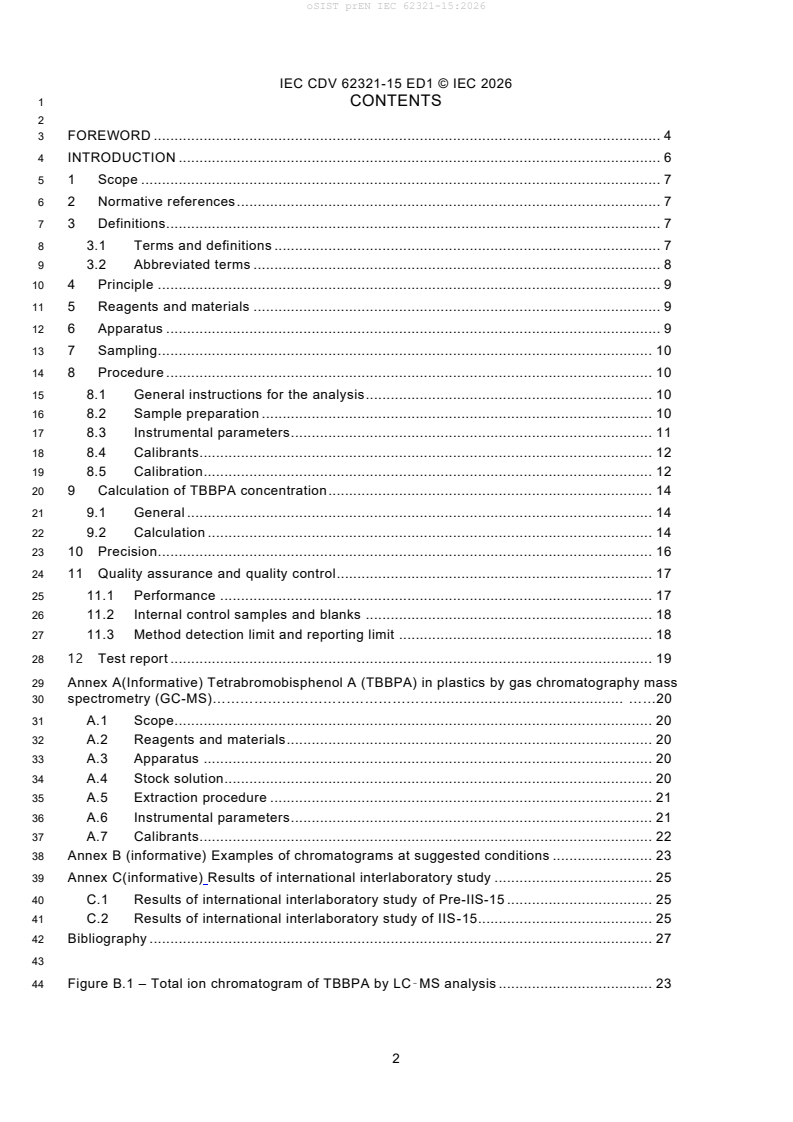
1 CONTENTS
3 FOREWORD . 4
4 INTRODUCTION . 6
5 1 Scope . 7
6 2 Normative references . 7
7 3 Definitions. 7
8 3.1 Terms and definitions . 7
9 3.2 Abbreviated terms . 8
10 4 Principle . 9
11 5 Reagents and materials . 9
12 6 Apparatus . 9
13 7 Sampling. 10
14 8 Procedure . 10
15 8.1 General instructions for the analysis. 10
16 8.2 Sample preparation . 10
17 8.3 Instrumental parameters . 11
18 8.4 Calibrants. 12
19 8.5 Calibration. 12
20 9 Calculation of TBBPA concentration . 14
21 9.1 General . 14
22 9.2 Calculation . 14
23 10 Precision . 16
24 11 Quality assurance and quality control . 17
25 11.1 Performance . 17
26 11.2 Internal control samples and blanks . 18
27 11.3 Method detection limit and reporting limit . 18
28 12 Test report . 19
29 Annex A(Informative) Tetrabromobisphenol A (TBBPA) in plastics by gas chromatography mass
30 spectrometry (GC-MS)…………………………………………. ……20
31 A.1 Scope. 20
32 A.2 Reagents and materials . 20
33 A.3 Apparatus . 20
34 A.4 Stock solution. 20
35 A.5 Extraction procedure . 21
36 A.6 Instrumental parameters . 21
37 A.7 Calibrants. 22
38 Annex B (informative) Examples of chromatograms at suggested conditions . 23
39 Annex C(informative) Results of international interlaboratory study . 25
40 C.1 Results of international interlaboratory study of Pre-IIS-15 . 25
41 C.2 Results of international interlaboratory study of IIS-15 . 25
42 Bibliography . 27
44 Figure B.1 – Total ion chromatogram of TBBPA by LC‑MS analysis . 23
IEC CDV 62321-15 ED1 © IEC 2026
45 Figure B.2 – Mass spectrum of TBBPA by LC‑MS analysis . 23
46 Figure B.3 – Total ion chromatogram of TBBPA by GC‑MS analysis . 24
47 Figure B.4 – Mass spectrum of TBBPA by GC‑MS analysis . 24
48 Table 1 – Measurement conditions of LC-MS . 11
49 Table 2 – CAS numbers of TBBPA reference materials . 12
50 Table 3 – Calibration solutions of TBBPA . 13
51 Table 4. Pre– IIS 15 repeatability and reproducibility (LC-MS) . 16
52 Table 5 – IIS 15 repeatability and reproducibility (LC-MS) . 17
53 Table A.1 - Measurement conditions of GC-MS method. 21
54 Table A.2 - Reference masses for the quantification of TBBPA . 21
55 Table A.3 – CAS numbers of TBBPA reference materials . 22
56 Table C.1 – Statistical data for GC‑MS and LC-MS . 25
57 Table C.2 – Mean results and recovery rates for TBBPA using LC‑MS . 25
58 Table C.3 – Mean results and recovery rates for TBBPA using GC-MS . 25
IEC CDV 62321-15 ED1 © IEC 2026
61 FOREWORD
62 1) The International Electrotechnical Commission (IEC) is a worldwide organization for standardization comprising all national
63 electrotechnical committees (IEC National Committees). The object of IEC is to promote international co -operation on all
64 questions concerning standardization in the electrical and electronic fields. To this end and in addition to other activities ,
65 IEC publishes International Standards, Technical Specifications, Technical Reports, Publicly Available Specifications (PAS)
66 and Guides (hereafter referred to as “IEC Publication(s)”). Their preparation is entrusted to technical committees; any IEC
67 National Committee interested in the subject dealt with may participate in this preparatory work. International,
68 governmental and non-governmental organizations liaising with the IEC also participate in this preparation. IEC
69 collaborates closely with the International Organization for Standardization (ISO) in accordance with conditions determined
70 by agreement between the two organizations.
71 2) The formal decisions or agreements of IEC on technical matters express, as nearly as possible, an international consensus
72 of opinion on the relevant subjects since each technical committee has representation from all interested IEC National
73 Committees.
74 3) IEC Publications have the form of recommendations for international use and are accepted by IEC National Committees in
75 that sense. While all reasonable efforts are made to ensure that the technical content of IEC Publications is accurate, IEC
76 cannot be held responsible for the way in which they are used or for any misinterpretation by any end user.
77 4) In order to promote international uniformity, IEC National Committees undertake to apply IEC Publications transparently to
78 the maximum extent possible in their national and regional publications. Any divergence between any IEC Publication and
79 the corresponding national or regional publication shall be clearly indicated in the latter.
80 5) IEC itself does not provide any attestation of conformity. Independent certification bodies provide conformity assessment
81 services and, in some areas, access to IEC marks of conformity. IEC is not responsible for any services carried out by
82 independent certification bodies.
83 6) All users should ensure that they have the latest edition of this publication.
84 7) No liability shall attach to IEC or its directors, employees, servants or agents including individual experts and members of
85 its technical committees and IEC National Committees for any personal injury, property damage or other damage to any
86 nature whatsoever, whether direct or indirect, or for costs (including legal fees) and expenses arising out of the publicatio n,
87 use of, or reliance upon, this IEC Publication or any other IEC Publications.
88 8) Attention is drawn to the Normative references cited in this publication. Use of the referenced publications is indispensable
89 for the correct application of this publication.
90 9) Attention is drawn to the possibility that some of the elements of this IEC Publication may be the subject of patent rights.
91 IEC shall not be held responsible for identifying any or all such patent rights.
IEC CDV 62321-15 ED1 © IEC 2026
92 International Standard IEC 62321-15 has been prepared by IEC technical committee 111: Environmental
93 standardization for electrical and electronic products and systems.
94 The text of this International Standard is based on the following documents:
FDIS Report on voting Report on voting
XX/XX/FDIS XX/XX/RVD
95 Full information on the voting for the approval of this International Standard can be found in the report
96 on voting indicated in the above table.
97 This document has been drafted in accordance with the ISO/IEC Directives, Part 2.
98 The committee has decided that the contents of this document will remain unchanged until the stability
99 date indicated on the IEC website under "http://webstore.iec.ch" in the data related to the specific
100 document. At this date, the document will be
101 – reconfirmed,
102 – withdrawn,
103 – replaced by a revised edition, or
104 – amended.
105 The National Committees are requested to note that for this document the stability date is 2030.
106 THIS TEXT IS INCLUDED FOR THE INFORMATION OF THE NATIONAL COMMITTEES AND WILL BE DELETED AT THE
107 PUBLICATION STAGE.
IEC CDV 62321-15 ED1 © IEC 2026
109 INTRODUCTION
110 The widespread use of electrotechnical products has drawn increased attention to their impact on the
111 environment. In many countries this has resulted in the adoption of regulations affecting wastes,
112 substances and energy use of electrotechnical products.
113 The use of certain substances in electrotechnical products is a source of concern in current and
114 proposed regional legislation.
115 The purpose of the IEC 62321 series is therefore to provide test methods that will allow the
116 electrotechnical industry to determine the levels of certain substances of concern in electrotechnical
117 products on a consistent global basis.
118 This standard described a test method for the determination of Tetrabromobisphenol A (TBBPA) in ele
119 ctrotechnical products.
120 WARNING — Persons using this International Standard should be familiar with normal laboratory
121 practice. This International Standard does not purport to address all of the safety problems, if any,
122 associated with its use. It is the responsibility of the user to establish appropriate safety and health
123 practices and to ensure compliance with any national regulatory conditions
IEC CDV 62321-15 ED1 © IEC 2026
126 DETERMINATION OF CERTAIN SUBSTANCES
127 IN ELECTROTECHNICAL PRODUCTS —
129 Part 15: Tetrabromobisphenol A (TBBPA) in plastics by liquid
130 chromatography mass spectrometry (LC-MS)
132 1 Scope
133 This International Standard specifies the technique for the determination of tetrabromobisphenol A
134 (TBBPA) in plastics of electrotechnical products.
135 The liquid chromatography mass spectrometry (LC-MS) test methods are described in the normative
136 part of this standard. The LC-MS methods are suitable for the determination of TBBPA in plastics of
137 electrotechnical products. A method using gas chromatography-mass spectrometry (GC-MS) is given in
138 informative Annex A.
139 These test methods have been evaluated for use with EPS (expanded polystyrene), XPS
140 (extruded polystyrene), PP(Polypropylene), Epoxy and ABS (acrylonitrile butadiene styrene) within
141 concentrations ranging from 30 mg/kg to 100 000 mg/kg. The use of these methods for other types of
142 materials or concentration ranges outside those specified above have not been evaluated.
143 This document is a basic environment horizontal publication focusing on test methods and is primarily
144 intended for use by committees in the preparation of publications within the area of environment in
145 accordance with the principles laid down in IEC Guide 123. Wherever applicable, it is the responsibility
146 of committees to make use of environment basic publications in the preparation of their environment
147 group and product publications. Committees can apply this document directly to products when they do
148 not develop a product publication in the area of environment.
149 2 Normative references
150 The following referenced documents are indispensable for the application of this document. For dated
151 references, only the edition cited applies. For undated references, the latest edition of the referenced
152 document (including any amendments) applies.
153 IEC 62321-1, Determination of certain substances in electrotechnical products - Part 1: Introduction and
154 overview
155 IEC 62321-2, Determination of certain substances in electrotechnical products - Part 2: Disassembly,
156 disjunction and mechanical sample preparation
158 3 Definitions
159 3.1 Terms and definitions
160 For the purposes of this document, the following terms and definitions apply.
161 ISO and IEC maintain terminological databases for use in standardization at the following addresses:
162 - IEC Electropedia: available at https://www.electropedia.org
IEC CDV 62321-15 ED1 © IEC 2026
163 - ISO Online browsing platform: available at https://www.iso.org/obp
165 3.1.1 plastic
166 material that contains as an essential ingredient a high polymer and which, at some stage in its processing into
167 finished products, can be shaped by flow.
168 [SOURCE: ISO 472:2013, 2.702]
169 Note 1 to entry Elastomeric materials, which are also shaped by flow, are not considered to be plastics.
170 Note 2 to entry In some countries, particularly the United Kingdom, the term “plastics” is used in the singular form as well as the plural form.
172 3.1.2 polymer
173 a substance composed of molecules characterized by the multiple repetitions of one or more species of
174 atoms or groups of atoms (constitutional units) linked to each other in amounts sufficient to provide a
175 set of properties that do not vary markedly with the addition or removal of one or a few of the
176 constitutional units.
177 [SOURCE: ISO 1382:2020, 3.369]
179 3.1.3 blank
180 test following the same procedures and conditions as the sample test without a sample, which enables
181 quantification of the contamination in the test.
183 3.2 Abbreviated terms
ACN Acetonitrile
Br Bromine
CCC Continuing calibration check
EI Electron Ionization
ID Internal diameter
IS Internal standard
LC-MS Liquid chromatography-mass spectrometry
MDL Method detection limit
PTFE Polytetrafluoroethylene
QC Quality control
RSD Relative standard deviation
TBBPA Tetrabromobisphenol A
THF Tetrahydrofuran
N
Nitrogen
BPC Bisphenol C
IEC CDV 62321-15 ED1 © IEC 2026
185 4 Principle
186 The test samples are extracted using an ultrasonic bath. The analysis is carried out by liquid
187 chromatography separation and mass spectrometry determination. These techniques are suitable to
188 determinate TBBPA quantitatively.
190 5 Reagents and materials
191 All reagent chemicals shall be tested for contamination and blank values prior to application.
192 a) Tetrahydrofuran (THF) (guaranteed reagent, purity of greater than a volume fraction of 99 %).
193 b) Acetonitrile (ACN) (guaranteed reagent, purity of greater than a volume fraction of 99 %).
194 c) Methanol (guaranteed reagent, purity of greater than a volume fraction of 99 %).
195 d) Calibrants tetrabromobisphenol A (guaranteed reagent, purity of greater than a volume fraction of
196 99 %, prepared in the same solution as the extraction solvent): see 8.4
197 e) Helium (purity of greater than a volume fraction of 99,999 %).
198 f) Internal standard used to calculate recovery (e.g. BPC)
200 6 Apparatus
201 The following items shall be used for the analysis:
202 a) Analytical balance capable of measuring accurately to 0,000 1 g.
203 b) 10 ml, 20 ml, 500 ml, 1 000 ml volumetric flasks.
204 c) Aluminium foil.
205 d) Ultrasonic bath.
206 e) 50 ml amber vial
207 f) Pasteur pipette.
208 g) 2,0 ml sample vials and a screw cap with polytetrafluoroethylene (PTFE) gasket or, depending on
209 the analytical system, a comparable sample receptacle.
210 h) Milling equipment.
211 i) 0,45 µm PTFE filter membrane.
IEC CDV 62321-15 ED1 © IEC 2026
212 j) Centrifuge; with over 3 000 rpm
213 k) High-performance liquid chromatograph (HPLC) system equipped with a mass spectrometry
214 detector.
215 l) Stationary phase: C18, 150 mm 2,1 mm ID (internal diameter), 3,5 µm, or equivalent.
216 7 Sampling
217 Manual cutting or cryogenic grinding/milling with liquid nitrogen cooling is recommended to be performed
218 in accordance with IEC 62321-2.
219 The sample shall be ground into pieces as small as 500 µm in diameter. Cryogenic grinding with liquid
220 N cooling is recommended. Reference polymer materials shall also be ground in the same way.
221 If the grinder cannot be used, the sample shall be cut into pieces of ca. 2 mm x 2 mm x 2 mm.
223 NOTE For a composite plastic that is made from more than one material, but cannot be separated mechanically, the
224 concentration of TBBPA can be determined for the composite material. As it cannot be confirmed which of the constituent
225 plastics is the source of the TBBPA.
227 NOTE KTL-RM113-05-1 (ABS pellet containing TBBPA at 50 to 150 g/kg) and KTL-RM113-05-2 (ABS pellet containing TBBPA
228 at 5 to 15 g/kg) are examples of commercially available reference polymer materials.
230 8 Procedure
231 8.1 General instructions for the analysis
232 The following general instructions shall be followed:
233 In order to reduce blank values, ensure the cleanliness of all glass by heating it to 450 °C for at least
234 30 min. To avoid decomposition and/or debromination of TBBPA by UV (ultraviolet) light during
235 extraction and analysis, glass equipment made from brown or amber glass shall be used.
236 NOTE If no brown or amber glass is available, aluminium foil can be used for protection from light.
237 If the amount of Br in the sample (When measuring the amount of Br in a sample using XRF (X-ray
238 fluorescence analysis), it is recommended to carry out the measurement in accordance with IEC 62321 -
239 3-1, and when measuring using C-IC (combustion-ion chromatography), it is recommended to carry out
240 the measurement in accordance with IEC 62321-3-2) is considerably above the 0,05 % (w/w) range, it
241 will be necessary to carry out the analysis using an adjusted sample size or by repeating the analysis
242 using an extract that has been appropriately diluted prior to internal standard addition.
244 8.2 Sample preparation
245 8.2.1 Stock solution
246 a) Internal standard: 3 µg/ml in Tetrahydrofuran (e.g. BPC)
IEC CDV 62321-15 ED1 © IEC 2026
247 b) Dilution solution: 10 ml of internal standard (8.2.1 a) in 20 ml of methanol
248 c) Standard solution: Prepare a standard solution containing TBBPA in Dilution solution (8.2.1 b) at a
249 concentration of 1 000 µg/ml.
250 8.2.2 Extraction procedure
252 a) Weigh 0,5 g of the sample to the nearest 0,000 1 g into a suitable glass vessel.
253 b) Quantitatively add 10 ml of IS solution (8.2.1 a), and put the sample in an ultrasonic bath at 60 °C
254 for approximately one hour or until dissolved.
255 NOTE An ultrasonic extractor with temperature control can be used.
256 c) After cooling to room temperature, slowly add 20 mL of methanol dropwise to precipitate the resin
257 portion of the polymer from the solution.
258 d) Allow the solution/sample mixture to rest for 30 min at room temperature (the precipitated polymer
259 resin will settle in the solution) and separate the precipitated polymer from the solution. (When
260 necessary, use centrifuge (6. j) for 10 min at 3 000 rpm to precipitate the sample matrix to the bottom.
261 e) Filter the sample solution through a 0,45 µm syringe filter (6.i) and transfer into a vial (6.g) for LC‑MS
262 analysis
264 8.3 Instrumental parameters
265 8.3.1 LC-MS method
266 Different conditions can be necessary to optimize a specific LC-MS system to achieve effective
267 separation of TBBPA and meet the QC and MDL requirements. The parameters given in Table 1 have
268 been found suitable and are provided as an example:
270 Table 1 – Measurement conditions of LC-MS
LC
Stop time 30 min
Injection volume 2 μl
Solvent program Iso-gradient (A:B=3:7)
a
Liquid phase A 2 mmol/l ammonium acetate
Liquid phas
...