

IEC 60095-8:2026
(Main)Lead-acid starter batteries - Part 8: 12V Batteries used in automobiles for auxiliary or backup purposes
- Abstract
IEC 60095-8:2026 is applicable to lead acid batteries with a nominal voltage of 12 V, for automobile passenger cars applications, used as auxiliary energy storage and power source in vehicles, but not featuring the classical function of engine starting or cranking. This includes applications in battery-electric vehicles, as well as in vehicles with an internal combustion engine (ICE) that is started by another (12 V, 48 V or high-volt) battery. This document can be used for batteries with auxiliary or backup purposes.
This document specifies:
– the general requirements; and
– the essential functional characteristics, relevant test methods and results required for several classes of batteries in accordance with:
• the general type of application;
• the type of product; and
• the categories as defined in 4.1.
- Status
- Published
- Publication Date
- 12-Oct-2026
- Technical Committee
- TC 21 - Secondary cells and batteries
- Drafting Committee
- WG 2 - TC 21/WG 2
- Current Stage
- PPUB - Publication issued
- Start Date
- 13-Oct-2026
- Completion Date
- 30-Oct-2026
IEC 60095-8:2026 is an International Electrotechnical Commission (IEC) International Standard for lead-acid starter batteries used as 12 V auxiliary or backup batteries in automobile passenger car applications. It specifies general requirements, functional characteristics, test methods and reported results for batteries that support vehicle loads and power supply without performing classical engine starting or cranking. The document is aimed at battery manufacturers, vehicle OEMs, test laboratories and buyers who need to qualify 12 V support batteries for battery-electric vehicles, hybrid-electric vehicles, plug-in hybrid electric vehicles and similar vehicle architectures.
What does IEC 60095-8:2026 specify?
IEC 60095-8:2026 specifies how 12 V lead-acid batteries for auxiliary or backup use are identified, tested and classified for automobile passenger cars. The scope includes batteries used as auxiliary energy storage and power source in vehicles, including battery-electric vehicles and vehicles whose internal combustion engine is started by another battery.
The document is organized into clauses on scope, references, terms, categories, delivery condition, general requirements, functional characteristics, test conditions, test methods and requirements. It ends with informative annexes that explain reporting, pulse power characterization and charge recovery.
| Annex | What it covers |
|---|---|
| A | Result reporting template |
| B | Background, interpretation and mapping guidance for Pulse Power Characterization (PPC) |
| C | Background, interpretation and reporting guidance for charge recovery testing |
What are the key requirements of IEC 60095-8:2026?
IEC 60095-8:2026 is built around category-based qualification. Clause 4 groups batteries into three application categories, so a supplier has to decide whether the battery is a central-storage battery, a backup battery, or an auxiliary battery for start-stop or micro-hybrid use before choosing the test path and endurance level.
Identification, labelling and fit
Clause 6 requires the battery to carry the manufacturer or supplier name, nominal voltage, capacity or reserve capacity and nominal high rate current CCA, plus a production date code and safety and recycling labelling. Dedicated auxiliary or backup batteries are marked with “(AUX)” near the rated CCA value. In practice, this makes the battery identifiable on the line, in service and during field claims, and it helps separate dedicated auxiliary products from batteries intended for starter use.
Clause 6.2 also ties polarity marking and fastening features to IEC 60095-2 when battery dimensions are defined there. That matters because the battery has to fit the vehicle tray and connect correctly without rework.
Initial preparation and test sequence
Clause 8 sets the preparation rules before testing. Samples are tested not later than 60 days after production, and charging is done by the method given in Table 1, with a defined fully charged condition and a rest period before testing. The same clause also splits the test sequence for general-use automotive batteries and dedicated auxiliary or backup batteries.
That split matters in practice: a battery already qualified for starter use under IEC 60095-1 or IEC 60095-6 can be qualified for auxiliary or backup use with only the sequence shown for battery No. 7 in Table 2, while a dedicated auxiliary or backup battery follows the tailored sequence in Table 2. This keeps the qualification plan aligned with the intended use instead of forcing a full starter-battery test program.
Power and energy performance
Clause 7 and Clause 9 cover the key performance checks: 20 h capacity or reserve capacity, cranking performance for auxiliary or backup use, PPC, charge acceptance, charge recovery, endurance, charge retention, electrolyte retention, vibration resistance and water consumption. The document treats high-rate discharge performance as the indicator for power capability, while PPC is used to represent the short pulse loads that auxiliary and backup batteries see in vehicles.
The PPC method is one of the most important parts of the standard. Clause 9.4 requires testing at beginning of life and end of life, at room temperature and low temperature, with options for Category 1 only or for Categories 2 and 3 only. In practice, this shows whether the battery can supply short high-power loads at partial state of charge, which is closer to real vehicle use than a traditional cranking-only test.
Recovery after discharge
Clause 9.6 and Clause 10.4 define charge recovery at -18 °C. The battery is first brought to a discharged condition that simulates parked or quiescent use, then charged while pulse checks track both state-of-charge recovery and state-of-function recovery. For vehicle engineers, this is the test that shows how quickly the 12 V system can regain usable power after low-voltage drain in cold conditions.
Endurance and ageing
Clause 9.7 contains the endurance tests: corrosion, 50 % DoD cycling, an optional endurance cycle test for some categories, and a 17.5 % DoD cycling test. Clause 10 links those tests to the category and endurance level, so the required cycling severity depends on the battery application. This is important for design validation because it checks not only peak power, but also how the battery survives repeated use, storage and recharge patterns over life.
Reporting
Clause 10.5 points to Annex A for reporting format. That gives manufacturers and laboratories a common way to record the measured values, test sequence and pass or fail outcome, which is useful for customer approval and traceability.
What terms does IEC 60095-8:2026 define?
- BOL (beginning of life) - the initial performance state used for the first PPC characterization before endurance ageing.
- EOL (end of life) - the performance state checked after endurance testing to show retained power capability.
- DoD (depth of discharge) - the portion of nominal capacity removed in a cycle, used to describe how hard the battery is cycled.
- PPC (Pulse Power Characterization) - a sequence of short discharge pulses used to measure power capability at partial state of charge and low temperature.
- PSOC (partial state of charge) - a state where the battery is operated below full charge, which is common in auxiliary and backup use.
- SOF (state of function) - the short-term usable power capability of the battery for vehicle functions.
- RC (reserve capacity) - the reserve-capacity-based energy rating used alongside 20 h capacity.
Who uses IEC 60095-8:2026?
IEC 60095-8:2026 is used by battery manufacturers, automotive OEMs, test laboratories and quality or purchasing teams. Manufacturers use it to design and mark batteries, OEMs use it to specify support batteries for BEV, HEV, PHEV, ICE start-stop and similar architectures, and test labs use it to run qualification and endurance tests. Buyers and quality managers use it to compare category, endurance level and reporting results across suppliers.
Which standards are used with IEC 60095-8:2026?
IEC 60095-8:2026 relies on four named references for terminology, dimensions and related test methods.
- IEC 60050-482 - provides the vocabulary for primary and secondary cells and batteries.
- IEC 60095-1:2018 - provides general requirements and methods of test for lead-acid starter batteries, and several clauses and test methods are used by reference.
- IEC 60095-2 - provides battery dimensions and terminal dimensions and marking.
- IEC 60095-6:2019 - provides requirements for batteries for micro-cycle applications, which are used when determining qualification routes for some general-use batteries.
What does the IEC 60095-8:2026 document contain?
IEC 60095-8:2026 contains the full test structure for 12 V auxiliary and backup lead-acid batteries, including capacity checks, a short cranking-performance check, PPC sequences, charge recovery, endurance cycling, retention tests and vibration and water-consumption tests. It also contains the category logic and the requirement tables that tie each application type to the relevant performance level.
The document includes reporting and interpretation material in its annexes. Annex A gives a reporting template, Annex B explains the background and mapping logic for PPC, and Annex C explains charge recovery test development and the meaning of the recovery plots.
Clause 9 is the main test-method section, and it includes the detailed sequences, test conditions and result measurements used for laboratory verification, type approval and customer qualification.
Get Certified
Connect with accredited certification bodies for this standard

IMQ S.p.A. (Certification)
Italian electrical product certification.

SLG Prüf- und Zertifizierungs GmbH
German testing and certification body.

UL Solutions
Global safety science company with testing, inspection and certification.
Sponsored listings
Frequently Asked Questions
IEC 60095-8:2026 is a standard published by the International Electrotechnical Commission (IEC). Its full title is "Lead-acid starter batteries - Part 8: 12V Batteries used in automobiles for auxiliary or backup purposes". This standard covers: IEC 60095-8:2026 is applicable to lead acid batteries with a nominal voltage of 12 V, for automobile passenger cars applications, used as auxiliary energy storage and power source in vehicles, but not featuring the classical function of engine starting or cranking. This includes applications in battery-electric vehicles, as well as in vehicles with an internal combustion engine (ICE) that is started by another (12 V, 48 V or high-volt) battery. This document can be used for batteries with auxiliary or backup purposes. This document specifies: – the general requirements; and – the essential functional characteristics, relevant test methods and results required for several classes of batteries in accordance with: • the general type of application; • the type of product; and • the categories as defined in 4.1.
IEC 60095-8:2026 is applicable to lead acid batteries with a nominal voltage of 12 V, for automobile passenger cars applications, used as auxiliary energy storage and power source in vehicles, but not featuring the classical function of engine starting or cranking. This includes applications in battery-electric vehicles, as well as in vehicles with an internal combustion engine (ICE) that is started by another (12 V, 48 V or high-volt) battery. This document can be used for batteries with auxiliary or backup purposes. This document specifies: – the general requirements; and – the essential functional characteristics, relevant test methods and results required for several classes of batteries in accordance with: • the general type of application; • the type of product; and • the categories as defined in 4.1.
IEC 60095-8:2026 is classified under the following ICS (International Classification for Standards) categories: 29.220.20 - Acid secondary cells and batteries. The ICS classification helps identify the subject area and facilitates finding related standards.
IEC 60095-8:2026 is available in PDF format for immediate download after purchase. The document can be added to your cart and obtained through the secure checkout process. Digital delivery ensures instant access to the complete standard document.
Standards Content (Sample)
IEC 60095-8 ®
Edition 1.0 2026-10
INTERNATIONAL
STANDARD
Lead-acid starter batteries -
Part 8: 12V Batteries used in automobiles for auxiliary or backup purposes
ICS 29.220.20 ISBN 978-2-8327-1545-1
All rights reserved. Unless otherwise specified, no part of this publication may be reproduced or utilized in any form or
by any means, electronic or mechanical, including photocopying and microfilm, without permission in writing from either
IEC or IEC's member National Committee in the country of the requester. If you have any questions about IEC copyright
or have an enquiry about obtaining additional rights to this publication, please contact the address below or your local
IEC member National Committee for further information.
IEC Secretariat Tel.: +41 22 919 02 11
3, rue de Varembé info@iec.ch
CH-1211 Geneva 20 www.iec.ch
Switzerland
About the IEC
The International Electrotechnical Commission (IEC) is the leading global organization that prepares and publishes
International Standards for all electrical, electronic and related technologies.
About IEC publications
The technical content of IEC publications is kept under constant review by the IEC. Please make sure that you have the
latest edition, a corrigendum or an amendment might have been published.
IEC publications search - IEC Products & Services Portal - products.iec.ch
webstore.iec.ch/advsearchform Discover our powerful search engine and read freely all the
The advanced search enables to find IEC publications by a publications previews, graphical symbols and the glossary.
variety of criteria (reference number, text, technical With a subscription you will always have access to up to date
committee, …). It also gives information on projects, content tailored to your needs.
replaced and withdrawn publications.
Electropedia - www.electropedia.org
The world's leading online dictionary on electrotechnology,
IEC Just Published - webstore.iec.ch/justpublished
Stay up to date on all new IEC publications. Just Published containing more than 22 500 terminological entries in English
details all new publications released. Available online and and French, with equivalent terms in 25 additional languages.
once a month by email. Also known as the International Electrotechnical Vocabulary
(IEV) online.
IEC Customer Service Centre - webstore.iec.ch/csc
If you wish to give us your feedback on this publication or
need further assistance, please contact the Customer
Service Centre: sales@iec.ch.
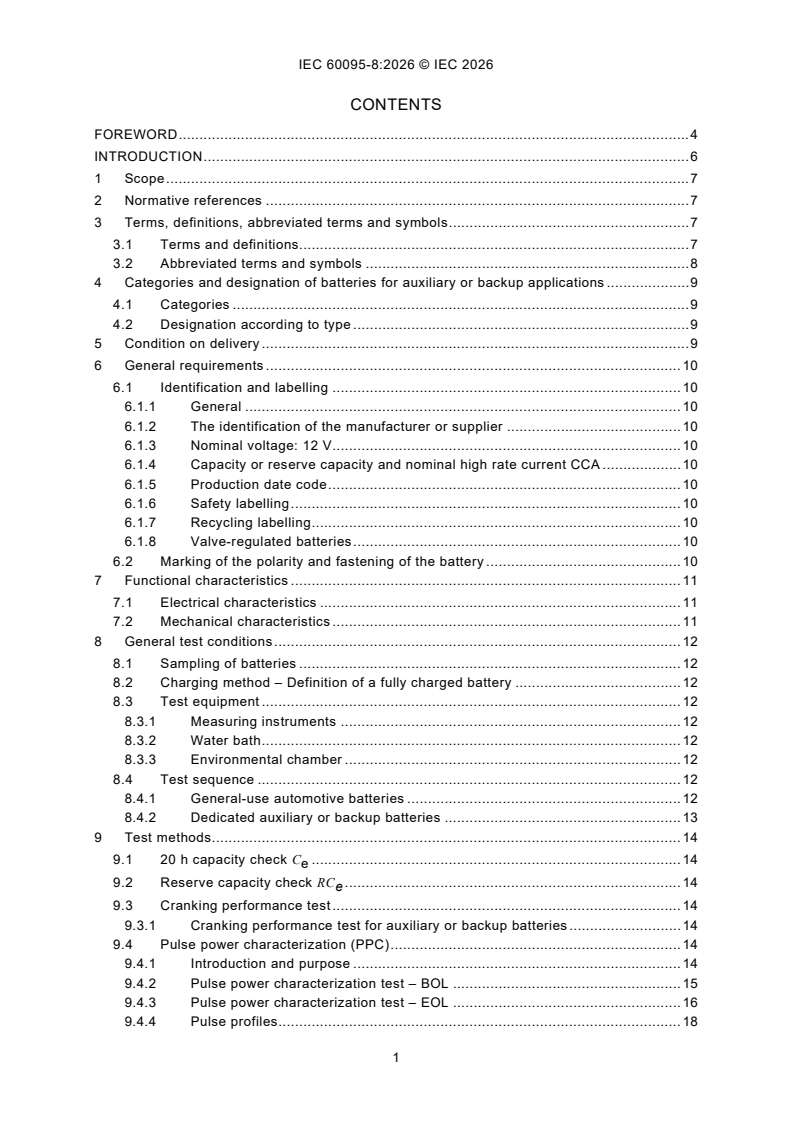
CONTENTS
FOREWORD . 4
INTRODUCTION . 6
1 Scope . 7
2 Normative references . 7
3 Terms, definitions, abbreviated terms and symbols . 7
3.1 Terms and definitions. 7
3.2 Abbreviated terms and symbols . 8
4 Categories and designation of batteries for auxiliary or backup applications . 9
4.1 Categories . 9
4.2 Designation according to type . 9
5 Condition on delivery . 9
6 General requirements . 10
6.1 Identification and labelling . 10
6.1.1 General . 10
6.1.2 The identification of the manufacturer or supplier . 10
6.1.3 Nominal voltage: 12 V . 10
6.1.4 Capacity or reserve capacity and nominal high rate current CCA . 10
6.1.5 Production date code . 10
6.1.6 Safety labelling . 10
6.1.7 Recycling labelling . 10
6.1.8 Valve-regulated batteries . 10
6.2 Marking of the polarity and fastening of the battery . 10
7 Functional characteristics . 11
7.1 Electrical characteristics . 11
7.2 Mechanical characteristics . 11
8 General test conditions . 12
8.1 Sampling of batteries . 12
8.2 Charging method – Definition of a fully charged battery . 12
8.3 Test equipment . 12
8.3.1 Measuring instruments . 12
8.3.2 Water bath . 12
8.3.3 Environmental chamber . 12
8.4 Test sequence . 12
8.4.1 General-use automotive batteries . 12
8.4.2 Dedicated auxiliary or backup batteries . 13
9 Test methods . 14
9.1 20 h capacity check C . 14
e
9.2 Reserve capacity check RC . 14
e
9.3 Cranking performance test . 14
9.3.1 Cranking performance test for auxiliary or backup batteries . 14
9.4 Pulse power characterization (PPC) . 14
9.4.1 Introduction and purpose . 14
9.4.2 Pulse power characterization test – BOL . 15
9.4.3 Pulse power characterization test – EOL . 16
9.4.4 Pulse profiles . 18
9.5 Charge acceptance test at 0 °C . 20
9.6 Charge recovery test at -18 °C . 20
9.7 Endurance test for batteries . 23
9.7.1 Corrosion test . 23
9.7.2 Cycling test 50 % DoD . 23
9.7.3 Optional endurance cycle test (applicable only to Categories 1C, 2 and
3) . 24
9.7.4 Cycling test 17,5 % DoD . 25
9.8 Charge retention test . 26
9.9 Electrolyte retention test . 26
9.10 Vibration resistance test . 26
9.11 Water consumption test . 26
9.12 High temperature durability test (informative only) . 26
10 Requirements . 27
10.1 General automotive batteries . 27
10.2 Dedicated auxiliary or backup batteries . 27
10.3 Requirements for PPC test . 28
10.3.1 Fixed voltage requirements for relative discharge rates (if PP1 is used): . 28
10.3.2 Voltage requirements to be calculated for each fixed current pulse (if
PP2 is used) . 29
10.4 Requirements for charge recovery test . 29
10.5 Results reporting format . 29
Annex A (informative) Result reporting . 30
Annex B (informative) Information on pulse power characterization (PPC) . 35
B.1 Rationale and background information . 35
B.2 Determination of PPC requirements . 38
B.3 Recommendations for power performance mapping . 39
B.3.1 General . 39
B.3.2 T-loop procedure with SOC preconditioning at nominal conditions . 41
B.3.3 SOC-loop procedure with stepwise SOC preconditioning target
temperature . 44
Annex C (informative) Information on charge recovery (CR) testing . 47
C.1 General . 47
C.2 Determination of CR requirements . 49
C.3 Transfer to other operating conditions . 49
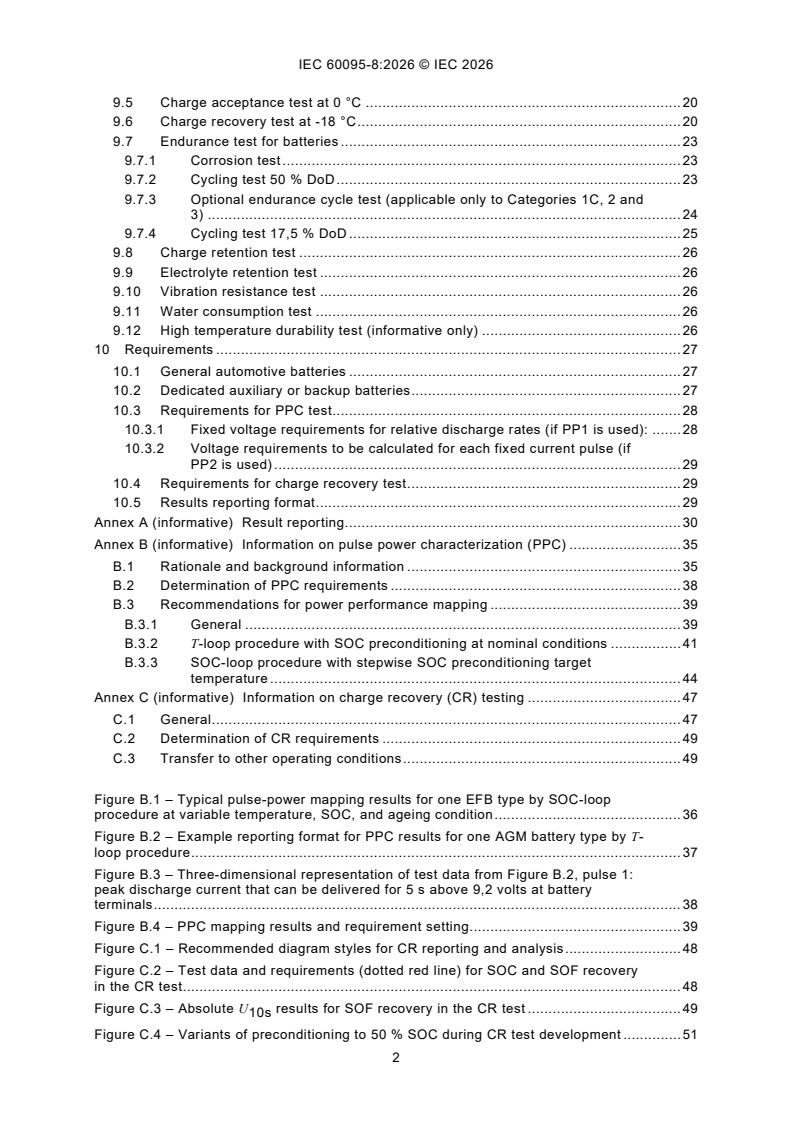
Figure B.1 – Typical pulse-power mapping results for one EFB type by SOC-loop
procedure at variable temperature, SOC, and ageing condition . 36
Figure B.2 – Example reporting format for PPC results for one AGM battery type by T-
loop procedure . 37
Figure B.3 – Three-dimensional representation of test data from Figure B.2, pulse 1:
peak discharge current that can be delivered for 5 s above 9,2 volts at battery
terminals . 38
Figure B.4 – PPC mapping results and requirement setting . 39
Figure C.1 – Recommended diagram styles for CR reporting and analysis . 48
Figure C.2 – Test data and requirements (dotted red line) for SOC and SOF recovery
in the CR test . 48
Figure C.3 – Absolute U results for SOF recovery in the CR test . 49
10s
Figure C.4 – Variants of preconditioning to 50 % SOC during CR test development . 51
Figure C.5 – Correlation of "CR-weekend -18 °C" results with other CR test results . 52
Table 1 – Charging method . 12
Table 2 – Test sequence . 13
Table 3 – PPC at beginning of life (BOL) – Categories 1, 2 and 3 . 15
Table 4 – PPC at beginning of life (BOL) – Category 1 . 16
Table 5 – PPC at beginning of life (BOL) – Categories 2 and 3 . 16
Table 6 – PPC at end of life (EOL) – Categories 1, 2 and 3 . 17
Table 7 – PPC at end of life (EOL) – Category 1 . 18
Table 8 – PPC at end of life (EOL) – Categories 2 and 3 . 18
Table 9 – Pulse profile PP1 . 19
Table 10 – PPC procedure option PP2 . 20
Table 11 – Charge recovery (CR) test with continuous 72 h discharge phase . 21
Table 12 – Charge recovery (CR) test with pulsed 72 h discharge phase . 22
Table 13 – Endurance 50 % DoD – Cycling part . 24
Table 14 – Optional endurance cycle test . 25
Table 15 – Endurance 17,5 % DoD – Cycling units . 26
Table 16 – Summary of requirements – General automotive batteries . 27
Table 17 – Summary of requirements Category (CAT) 1, 2 and 3 . 28
Table 18 – PPC requirements (PP1): Beginning of life (BOL) . 28
Table 19 – PPC requirements (PP1): End of life (EOL) . 28
Table 20 – PPC requirements (PP2): Beginning of life (BOL) . 29
Table 21 – PPC requirements (PP2): End of life (EOL) . 29
Table 22 – Charge recovery requirements . 29
Table A.1 – Template for result reporting . 30
Table B.1 – T-loop pulse power mapping – SOC sequence . 42
Table B.2 – T-loop pulse power mapping – Temperature loop sequence . 43
Table B.3 – T-loop pulse power mapping – PP5 pulse sequence . 44
Table B.4 – SOC-loop pulse power characterization – SOC sequence at one
temperature . 45
Table B.5 – Pulse power characterization – PP2 pulse sequence . 46
INTERNATIONAL ELECTROTECHNICAL COMMISSION
____________
Lead-acid starter batteries -
Part 8: 12 V Batteries used in automobiles
for auxiliary or backup purposes
FOREWORD
1) The International Electrotechnical Commission (IEC) is a worldwide organization for standardization comprising
all national electrotechnical committees (IEC National Committees). The object of IEC is to promote international
co-operation on all questions concerning standardization in the electrical and electronic fields. To this end and
in addition to other activities, IEC publishes International Standards, Technical Specifications, Technical Reports,
Publicly Available Specifications (PAS) and Guides (hereafter referred to as "IEC Publication(s)"). Their
preparation is entrusted to technical committees; any IEC National Committee interested in the subject dealt with
may participate in this preparatory work. International, governmental and non-governmental organizations liaising
with the IEC also participate in this preparation. IEC collaborates closely with the International Organization for
Standardization (ISO) in accordance with conditions determined by agreement between the two organizations.
2) The formal decisions or agreements of IEC on technical matters express, as nearly as possible, an international
consensus of opinion on the relevant subjects since each technical committee has representation from all
interested IEC National Committees.
3) IEC Publications have the form of recommendations for international use and are accepted by IEC National
Committees in that sense. While all reasonable efforts are made to ensure that the technical content of IEC
Publications is accurate, IEC cannot be held responsible for the way in which they are used or for any
misinterpretation by any end user.
4) In order to promote international uniformity, IEC National Committees undertake to apply IEC Publications
transparently to the maximum extent possible in their national and regional publications. Any divergence between
any IEC Publication and the corresponding national or regional publication shall be clearly indicated in the latter.
5) IEC itself does not provide any attestation of conformity. Independent certification bodies provide conformity
assessment services and, in some areas, access to IEC marks of conformity. IEC is not responsible for any
services carried out by independent certification bodies.
6) All users should ensure that they have the latest edition of this publication.
7) No liability shall attach to IEC or its directors, employees, servants or agents including individual experts and
members of its technical committees and IEC National Committees for any personal injury, property damage or
other damage of any nature whatsoever, whether direct or indirect, or for costs (including legal fees) and
expenses arising out of the publication, use of, or reliance upon, this IEC Publication or any other IEC
Publications.
8) Attention is drawn to the Normative references cited in this publication. Use of the referenced publications is
indispensable for the correct application of this publication.
9) IEC draws attention to the possibility that the implementation of this document may involve the use of (a)
patent(s). IEC takes no position concerning the evidence, validity or applicability of any claimed patent rights in
respect thereof. As of the date of publication of this document, IEC had not received notice of (a) patent(s), which
may be required to implement this document. However, implementers are cautioned that this may not represent
the latest information, which may be obtained from the patent database available at https://patents.iec.ch. IEC
shall not be held responsible for identifying any or all such patent rights.
IEC 60095-8 has been prepared by IEC technical committee 21: Secondary cells and batteries.
It is an International Standard.
The text of this International Standard is based on the following documents:
Draft Report on voting
21/1307/FDIS 21/1321/RVD
Full information on the voting for its approval can be found in the report on voting indicated in
the above table.
The language used for the development of this International Standard is English.
This document was drafted in accordance with ISO/IEC Directives, Part 2, and developed in
accordance with ISO/IEC Directives, Part 1 and ISO/IEC Directives, IEC Supplement, available
at www.iec.ch/members_experts/refdocs. The main document types developed by IEC are
described in greater detail at www.iec.ch/publications.
A list of all the parts in the IEC 60095 series, published under the general title Lead-acid starter
batteries, can be found on the IEC website.
The committee has decided that the contents of this document will remain unchanged until the
stability date indicated on the IEC website under webstore.iec.ch in the data related to the
specific document. At this date, the document will be
– reconfirmed,
– withdrawn, or
– revised.
INTRODUCTION
With the growth of electrified vehicles (xEV), many 12 V batteries in automobiles are not (or not
regularly) used for cranking or starting engines: In battery-electric vehicles, there is no engine.
In hybrid-electric vehicles, depending on powertrain topology, the electric machine can start the
combustion engine utilizing power by the traction battery. Additional functionalities like the ones
related to functional safety (e.g. in case of disruption of 12 V supply from the main high voltage
energy system) require new test methods, particularly for power capability and charge recovery,
as well as potential different ageing mechanisms related to different usage profiles. For example,
the 12 V system is operated for significantly more hours per month than in a conventional car
with internal combustion engine under the same driving usage, adding the on-plug time during
which the traction battery is recharged, and potentially kept at standby for grid-connected
storage functions.
Current production vehicles, including some internal combustion engine (ICE) start-stop
vehicles, but mainly xEVs, such as hybrid electric vehicles (HEVs), plug-in hybrid electric
vehicles (PHEVs) and battery electric vehicles (BEVs), already feature one or more 12 V
support batteries and are expected to be equipped with such batteries as long as a 12 V power
supply system forms part of the vehicle electrical system.
1 Scope
This part of IEC 60095 is applicable to lead acid batteries with a nominal voltage of 12 V, for
automobile passenger cars applications, used as auxiliary energy storage and power source in
vehicles, but not featuring the classical function of engine starting or cranking. This includes
applications in battery-electric vehicles, as well as in vehicles with an internal combustion
engine (ICE) that is started by another (12 V, 48 V or high-volt) battery. This document can be
used for batteries with auxiliary or backup purposes.
This document specifies:
– the general requirements; and
– the essential functional characteristics, relevant test methods and results required for
several classes of batteries in accordance with:
• the general type of application;
• the type of product; and
• the categories as defined in 4.1.
2 Normative references
The following documents are referred to in the text in such a way that some or all of their content
constitutes requirements of this document. For dated references, only the edition cited applies.
For undated references, the latest edition of the referenced document (including any
amendments) applies.
IEC 60050-482, International Electrotechnical Vocabulary (IEV) - Part 482: Primary and
secondary cells and batteries
IEC 60095-1:2018, Lead-acid starter batteries - Part 1: General requirements and methods of
test
IEC 60095-2, Lead-acid starter batteries - Part 2: Dimensions of batteries and dimensions and
marking of terminals
IEC 60095-6:2019, Lead-acid starter batteries - Part 6: Batteries for micro-cycle applications
3 Terms, definitions, abbreviated terms and symbols
3.1 Terms and definitions
For the purposes of this document, the terms and definitions given in IEC 60050-482,
IEC 60095-1, IEC 60095-6 apply.
ISO and IEC maintain terminology databases for use in standardization at the following
addresses:
– IEC Electropedia: available at https://www.electropedia.org/
– ISO Online browsing platform: available at https://www.iso.org/obp
3.2 Abbreviated terms and symbols
BEV battery electric vehicle
BOL beginning of life
C effective capacity [Ah]
e
CF charge factor
CHA charge battery; to be charged with given parameters
C nominal capacity [Ah]
n
CR charge recovery
C recharged capacity [Ah]
rch
DCH discharge battery; to be discharged with given parameters
DoD depth of discharge [% of C ]
n
EN European Standard (Euro Norm) created by CENELEC (European Committee for
Electrotechnical Standardization)
EOL end of life
EOS end of step
HEV hybrid electric vehicle
I discharge current for cranking [A]
CC
ICE internal combustion engine
I nominal discharge current [A], I [A] = C [Ah]/20 [h]
n n n
PAU pause; no charging or discharging but measurement of voltage as required. If the
battery is connected to the test unit, there shall be no quiescent current
PHEV plug-in hybrid electric vehicle
PPC Pulse Power Characterization
PP1 pulse profile 1 in accordance with Table 9
PP2 pulse profile 2 in accordance with Table 10
PSOC partial state of charge
Q charged capacity [Ah]
CHA
RC effective reserve capacity
e
RC nominal reserve capacity (discharge with a fixed current of 25 A to U = 10,5 V)
n
internal resistance [Ω]
R
i
RPT repeat; instruction to repeat certain steps several times
SoC state of charge
SOF state-of-function
U charging voltage [V]
c
U voltage at the end of discharge step [V]
EOD
xEV electrified vehicle
4 Categories and designation of batteries for auxiliary or backup applications
4.1 Categories
Batteries defined for auxiliary or backup purposes relate to vehicle applications that are highly
diverse and subject to rapid technical change. However, they can typically be associated with
one of the following three categories:
– Category (1): 12 V central-storage (main) battery, with most functions of modern automotive
batteries except engine starting. These functions typically include low and medium rate
power supply during parking, pre-trip vehicle activation, after-trip vehicle system shutdown,
and software updates that can require the high-volt system to be shut down temporarily.
Further, the 12 V central storage battery has a role in stabilizing the system voltage and can
supply, regularly or in case of overload or failure of the primary 12 V supply, high power to
peak loads during vehicle driving operation. Emergency power support can be required in
system architectures where such functionality is not supported by any additional dedicated
energy and power source. Sizing such batteries typically considers capacity (or energy)
requirements as well as high-rate discharge current (or power) requirements. As 12 V
batteries in electric vehicles can be recharged by the traction battery while parking, and as
cold-cranking performance is not a requirement, they are often downsized.
When a downsized battery is subjected to cyclic use, the relative depth of discharge (DoD)
of each individual cycle will be larger in per-cent of nominal capacity, and the annual cyclic
throughput requirement will be a larger multiple of the nominal capacity. In consequence,
the downsized battery for the same absolute cycling duty will face more stringent cycle-life
requirements, compared to a starter or micro-hybrid battery in an ICE vehicle with otherwise
identical electrical loads. Following the above consideration, this document defines three
endurance requirement levels (1A), (1B), (1C), allowing to specify batteries meeting
capacity turnover as predicted by the OEM for specific applications and system designs.
– Category (2): 12 V backup battery that is stabilizing voltage and providing emergency power
for a sensitive – often safety relevant – electrical component or portion of the power supply
system. Such batteries are often disconnected from the 12 V loads when alternator or dc/dc
converter are not feeding the 12 V system, protecting them from discharge while parking
etc. In such cases, the operating state-of-charge (SOC) range can be narrow (and close to
fully charged)
Requirements for category (2) will take into account limited capacity throughput during life
and appropriate voltage response when supporting high-rate discharge currents.
NOTE This document does not provide safety requirements
– Category (3): 12 V auxiliary batteries in start-stop or micro-hybrid vehicles that stabilize
system voltage during engine restart, which would be powered out of the 12 V starter
battery. This application is similar to the backup case described above, but battery discharge
occurs frequently during normal operation and is not safety relevant.
Requirements for category (3) shall take into account limited capacity throughput and power.
4.2 Designation according to type
IEC 60095-1:2018, Subclause 4.1, is applicable
5 Condition on delivery
IEC 60095-1:2018, Clause 5, is applicable
6 General requirements
6.1 Identification and labelling
6.1.1 General
Batteries in accordance with this document shall bear the following characteristics on at least
the top or one of their four sides.
6.1.2 The identification of the manufacturer or supplier
The name of the manufacturer or supplier shall be indicated.
6.1.3 Nominal voltage: 12 V
The nominal voltage of 12 V shall be indicated.
6.1.4 Capacity or reserve capacity and nominal high rate current CCA
6.1.4.1 General-use automotive batteries
IEC 60095-1:2018, 6.1.4, is applicable for batteries that are qualified for starter application in
accordance with IEC 60095-1 or IEC 60095-6 and shall be qualified for additional use in
auxiliary or backup applications.
6.1.4.2 Dedicated auxiliary or backup batteries
Batteries designed specifically for auxiliary or backup applications shall carry indications of
capacity and CCA in line with IEC 60095-1:2018, 6.1.4. For batteries dedicated to auxiliary or
backup applications, "(AUX)" should be added near the rated CCA value.
NOTE The CCA rating remains the indicator of power performance for such 12 V batteries in automobiles that are
not designed to crank engines. To enable application-specific design optimization, this document defines a shorter
cranking performance test for such batteries that will be combined with a new, more application-specific pulse-power
performance characterization (PPC) test. Though backward-compatible to a first-order approximation, the
designation "(AUX)" clarifies that a full cold-cranking test in accordance with IEC 60095-1 is not required.
6.1.5 Production date code
Batteries shall be marked with the date of production. This can be part of a more complex code.
6.1.6 Safety labelling
IEC 60095-1:2018, 6.1.6, is applicable
6.1.7 Recycling labelling
IEC 60095-1:2018, 6.1.7, is applicable
6.1.8 Valve-regulated batteries
IEC 60095-1:2018, 6.1.8, is applicable
6.2 Marking of the polarity and fastening of the battery
For batteries whose dimensions are defined by IEC 60095-2, the terminals shall be identified
in accordance with the requirements of IEC 60095-2. Where batteries are fastened to the
vehicle by means of integral parts (e.g. bottom ledges), these parts shall comply with the
requirements of IEC 60095-2.
7 Functional characteristics
7.1 Electrical characteristics
7.1.1 The 20 h capacity, the reserve capacity and the charge retention are defined in IEC
60095-1:2018.
The high-rate discharge performance is defined by the discharge current I , as indicated by
cc
the manufacturer, which a battery can supply in accordance with 9.3. Engine-cranking not being
a requested function, the test result shall be used as an indicator of general power performance
and as a parameter for the Pulse Power Characterization (PPC) procedure.
7.1.2 The capacity is defined for a temperature of 25 °C ± 2 °C. It may be indicated by the
manufacturer as either:
– nominal 20 h capacity C ; or
– nominal reserve capacity RC .
n
C and RC are defined in IEC 60095-1:2018, 7.1.2.
20 n
7.1.3 The Pulse Power Characterization (PPC) is a sequence of short pulses at
progressively increasing currents, executed at partial state of charge (PSOC) and low
temperature:
– at the beginning of life, as part of the initial characteristics sequence;
– at the end of life or when the specification target (number of cycles, number of units) of the
intended performance level is achieved, proving minimum power performance is maintained
throughout specified endurance.
– See Annex B for further information on the background and interpretation of test results.
7.1.4 The charge acceptance (at 0 °C) defined in IEC 60095-1:2018, 7.1.3.
7.1.5 The charge recovery (at -18 °C) is the ability of the battery to restore vehicle-target
levels of both energy (state of charge) and discharge power (state of function), starting from a
slow-discharged condition. See Annex C for further information on the background and
interpretation of test results.
7.1.6 The charge retention is defined in IEC 60095-1:2018, 7.1.4.
7.1.7 The endurance test consists in the following parts:
– The corrosion test represents the ability of a battery to perform repeated overcharge/storage
periods.
– The cycling test 50 % DoD represents the ability of a battery to perform repeated discharge
and recharge cycles and long rest periods on open circuit. This ability shall be tested by a
series of cycles and rest periods under specified conditions after which the cold cranking or
the capacity performances shall be determined.
– The optional endurance cycle test represents the ability to perform significantly high number
of shallow charge or recharge cycles at a relatively high state of charge.
– The cycling test 17,5 % DoD represents the ability to deliver energy under high cyclic
conditions in a partially discharged state of charge.
– The water consumption is defined in IEC 60095-1:2018, 7.1.6.
7.2 Mechanical characteristics
The vibration resistance and the electrolyte retention are defined in IEC 60095-1:2018.
8 General test conditions
8.1 Sampling of batteries
Samples shall be tested not later than 60 days after production date of the manufacturer
8.2 Charging method – Definition of a fully charged battery
Batteries shall be considered fully charged if they have undergone the charging procedures.
Prior to the first capacity test, the battery charge shall be limited to 16 h.
Unless otherwise specified by the battery manufacturer, batteries tested in accordance with this
document shall be charged in accordance with Table 1.
Table 1 – Charging method
Battery type Voltage Current Time Remarks
U
c
a
Flooded batteries 5 I
16,00 V ± 0,05 V 24 h (16 h)
n
a
Valve-regulated batteries VRLA 5 I
14,80 V ± 0,05 V
24 h (16 h)
n
a
A charging time of 16 h is sufficient after a cranking performance test and prior to first capacity check.
All charges shall be performed with batteries in a water bath at 25 °C ± 2 °C. After completion
of charging, the battery shall rest 1 h to 5 h unless otherwise specified in the test procedures
that refer to 8.2.
8.3 Test equipment
8.3.1 Measuring instruments
Measuring instruments is defined in IEC 60095-1:2018, 8.3.1.
8.3.2 Water bath
Water bath is defined in IEC 60095-1:2018, 8.3.2.
8.3.3 Environmental chamber
Environmental chamber is defined in IEC 60095-1:2018, 8.3.3
8.4 Test sequence
8.4.1 General-use automotive batteries
Batteries that are qualified for starter application in accordance with IEC 60095-1 or IEC 60095-
6 may be qualified for additional use in auxiliary or backup applications by testing only the
sequence shown for battery No.7 of Table 2 in this document.
Rationale: One and the same automotive battery type may be used in starter battery
applications as well as in auxiliary or backup applications. For such cases, incremental test
effort following the present document is minimized.
8.4.2 Dedicated auxiliary or backup batteries
As an alternative to amending existing starter battery test plans, an auxiliary or backup battery
may be tested in accordance with Table 2. No additional tests or requirements in accordance
with IEC 60095-1 or IEC 60095-6 apply in this case.
Rationale: Auxiliary or backup applications impose different requirements to batteries compared
to traditional starter batteries, particularly regarding performance and sizing for discharge
power (lower rates at higher voltage allowance), but also for charge recovery (on a time scale
of minutes to hours) as opposed to dynamic charge acceptance (for recuperation events lasting
seconds or tens of seconds). Consequently, their design may be optimized away from legacy
starter battery design rules. The test matrix for dedicated auxiliary or backup batteries is tailored
for the new applications, and several typical requirement levels are suggested (see 10.2).
Table 2 – Test sequence
Battery
Step Test Reference
No. 1 No. 2 No. 3 No. 4 No. 5 No. 6 No. 7
1 Initial charge prior to test 8.2 ✓ ✓ ✓ ✓ ✓ ✓ ✓
First 20 h capacity C or RC
2 9.1 or 9.2
✓ ✓ ✓ ✓ ✓ ✓ ✓
e e
3 CCA AUX 9.3.1 ✓ ✓ ✓ ✓ ✓ ✓ ✓
Second 20 h capacity C or
e
4 9.1 or 9.2
(✓) ✓ (✓) (✓) (✓) (✓) (✓)
RC
e
5 CCA AUX 9.3.1 (✓) ✓ (✓) (✓) (✓) (✓) (✓)
Third 20 h capacity C or
e
6 9.1 or 9.2
(✓) ✓ (✓) (✓) (✓) (✓) (✓)
RC
e
7 CCA AUX 9.3.1 (✓) (✓) (✓) (✓) (✓) (✓)
8 Charge acceptance test 9.5 ✓
9 Charge Recovery test 9.6 ✓
PPC BOL - Pulse Power
10 9.4.2 ♦
✓ ✓ ✓
Characterization
11 Corrosion test 9.7.1 ✓
12 Cycling test 17,5 % DoD 9.7.4
✓
Cycling test 50 % DoD or
13 9.7.2 or 9.7.3 ✓
Optional endurance cycle
test
14 Charge retention 9.8 ✓
15 Electrolyte retention 9.9 ✓
16 Vibration resistance 9.10 ✓
17 Water consumption 9.11 ✓
PPC EOL - Pulse Power
18 9.4.3 ✓ ✓ ✓
Characterization
Key
✓ Test to be fulfilled.
(✓) Test to be fulfilled only if the previous identical test carried out failed.
♦ Test mandatory for dedicated auxiliary and backup batteries and recommended for general-use batteries.
9 Test methods
9.1 20 h capacity check C
e
This test is defined in IEC 60095-1:2018, 9.1.
9.2 Reserve capacity check RC
e
This test is defined in IEC 60095-1:2018, 9.2.
9.3 Cranking performance test
9.3.1 Cranking performance test for auxiliary or backup batteries
After a rest period of 24 h to 72 h following preparation in accordance with 8.2, the battery shall
be placed in a cooling environmental chamber with (forced) air circulation at a temperature of
−18 °C ± 1 °C until the temperature of the middle cells has reached −18 °C ± 1 °C.
It is generally accepted that the required temperature will be achieved after a minimum period
of 24 h in the cooling environmental chamber.
The battery shall then be discharged, either within or outside the cooling chamber, within 2 min
after the end of the cooling period with a current I (see 7.1.1). This current shall be kept
cc
constant to within ±0,5 % during the discharge.
After 10 s discharge, the terminal voltage U shall be recorded.
10s
It is recommended to continue the cold cranking test as defined by one of the procedures in
IEC 60095-1, to obtain information about t or U .
6V 30s
NOTE For dedicated auxiliary or backup batteries, it is sufficient to perform this short (10 s) test in conjunction with
Pulse power characterization. By contrast, any of the full duration cranking performance tests as defined in
IEC 60095-1:2018, 9.3.1. is valid for general-use automotive batteries.
9.4 Pulse power characterization (PPC)
9.4.1 Introduction and purpose
As auxiliary or backup batteries are not typically used for engine cranking, traditional cold-
cranking tests (compare with 9.3) can be insufficient to characterize their power performance.
Moreover, they can prevent certain design optimizations for dedicated auxiliary or backup
battery types. Typical non-starter peak loads will draw fractions of rated cold-cranking current
only but require battery voltages well above 7,2 V or 7,5 V for a few seconds or fractions of a
second, usually at partial state of charge. See Annex B for further information on the
background and interpretation of test results.
The PPC test procedure aims at power performance verification as relevant for auxiliary or
backup applications.
During the entire test procedure:
– the battery shall be placed either in a water bath or in an environmental chamber when the
test temperature is set to 25 °C;
– tests at -18 °C shall be conducted with the battery placed in an environmental chamber in
accordance with 8.3.3.
9.4.2 Pulse power characterization test – BOL
The test applied at beginning of life consists of two parts: a characterization performed at full
state of charge and room temperature, and one at partial state of charge and low temperature.
Test shall be carried out on batteries which have been charged in accordance with 8.2, followed
by a rest period of 24 h to 72 h. The test structure shall be defined in accordance with one of
the three following options, where PP1 and PP2 refer to one of the procedures defined in 9.4.4:
a) A comprehensive procedure covering applications within all three Categories (1, 2 and 3) is
specified in Table 3.
b) If a battery is to be qualified only for applications in Category 1, the shorter procedure
specified in Table 4 may be selected as an alternative.
c) If a battery is to be qualified only for applications in Categories 2 or 3, or both, the shorter
procedure specified in Table 5 may be selected as an alternative.
NOTE The procedure defined in Table 3 is recommended, as it provides complete information for auxiliary and
backup battery applications. If the application scope for a given battery type is restricted and test duration is critical,
the procedures specified in Table 4 or Table 5 can be selected, subject to agreement with the customer.
Table 3 – PPC at beginning of life (BOL) – Categories 1, 2 and 3
Structure No. Step T/°C t U/V I/A Description
PP1
Table 9 or Table 10 at specified temperature
01 25
in column T/°C, 100 % SOC
or PP2
I Discharge by 20 % of C in 4 h
02 DCH 25 4 h > 10,5
n n
Min. 8 h
...