

IEC 60300-3-3:2017
(Main)Dependability management - Part 3-3: Application guide - Life cycle costing
General Information
- Abstract
IEC 60300-3-3:2017 establishes a general introduction to the concept of life cycle costing and covers all applications. Although costs incurred over the life cycle consist of many contributing elements, this document particularly highlights the costs associated with the dependability of an item. This forms part of an overall dependability management programme as described in IEC 60300-1. Guidance is provided on life cycle costing for use by managers, engineers, finance staff, and contractors; it is also intended to assist those who may be required to specify and commission such activities when undertaken by others. This third edition cancels and replaces the second edition published in 2004. This edition constitutes a technical revision. This edition includes the following significant technical changes with respect to the previous edition:
- addition of a complete analysis process;
- greater reference to international accounting practices;
- increased discussion of financial concepts.
- Status
- Published
- Publication Date
- 26-Jan-2017
- Technical Committee
- TC 56 - Dependability
- Drafting Committee
- MT 9 - TC 56/MT 9
- Current Stage
- PPUB - Publication issued
- Start Date
- 27-Jan-2017
- Completion Date
- 24-Feb-2017
Overview
IEC 60300-3-3:2017 is an international standard focused on dependability management with a specific emphasis on life cycle costing (LCC). This third edition provides a comprehensive application guide designed to support managers, engineers, finance professionals, and contractors in effectively evaluating the total costs associated with the entire life cycle of products or systems. With particular attention to dependability-related costs, this standard forms a critical part of an overarching dependability management program as established in IEC 60300-1.
The document updates and replaces the 2004 edition, introducing a complete life cycle costing analysis process, deeper integration of international accounting practices, and expanded insights into financial concepts. It serves as an essential framework for organizations aiming to optimize economic decisions by understanding the full financial impact of their assets across development, utilization, and retirement phases.
Key Topics
Life Cycle Costing Concepts
IEC 60300-3-3 defines objectives and applications of LCC, emphasizing the inclusion of dependability factors that influence maintenance, repair, and operational costs over time.Comprehensive LCC Process
The standard describes a structured step-by-step approach to life cycle costing, including:- Establishing organizational context and identifying alternatives
- Planning the analysis with clear scope, tasks, and constraints
- Defining methodologies, cost breakdown structures, and areas of uncertainty
- Performing detailed cost estimation, data collection, sensitivity analysis, and results review
- Documenting and finalizing the analysis with recommended follow-up actions
Financial and Accounting Integration
Guidance includes alignment with generally accepted accounting principles (GAAP), financial evaluation techniques such as discounted cash flow (DCF), internal rate of return (IRR), and addressing aspects like taxation, inflation, and opportunity costs.Cost Breakdown Structure Across Life Cycle Stages
The standard elaborates costs by life stages such as concept, development, realization, utilization, enhancement, and retirement, enabling precise identification of cost drivers.Estimating and Evaluating Cost Elements
Various methods for cost estimation are provided, including parametric, analogous, and engineering approaches, supported by illustrative examples to aid practical implementation.Intangible and Financial Risk Considerations
It also discusses evaluating intangible costs and liabilities related to warranties and financial risks, contributing to a holistic view of total cost ownership.
Applications
IEC 60300-3-3:2017 is highly relevant for organizations seeking to improve dependability through informed financial planning and cost management. Key applications include:
Asset Management and Investment Decisions
Facilitates selecting the most cost-effective options by comparing alternatives based on total life cycle costs rather than upfront expenditures.Project and System Design
Helps engineering teams incorporate cost implications of dependability features early to optimize product performance and supportability.Maintenance and Operations Planning
Enables finance and operational staff to forecast and control costs related to repairs, spares, and downtime, improving budgeting accuracy.Procurement and Contract Management
Assists in defining specifications and commissioning life cycle costing analyses from external contractors to align costs with organizational goals.Risk Management
Supports identifying and mitigating financial risks connected to warranties, liabilities, and changing economic conditions throughout the asset lifespan.
Related Standards
IEC 60300-1: Dependability Management - Part 1: Generic Guidelines
Provides the foundational dependability management framework complementary to this LCC guide.ISO 15686-5: Buildings and Constructed Assets - Service Life Planning - Life Cycle Costing
Shares similar principles in life cycle cost evaluation, particularly applicable in construction and infrastructure contexts.ISO 14040: Environmental Management - Life Cycle Assessment (LCA)
While focused on environmental impacts, this standard often complements LCC studies by assessing sustainability factors.
Keywords: IEC 60300-3-3, life cycle costing, dependability management, LCC process, financial evaluation, cost breakdown structure, asset management, total cost of ownership, dependability costs, financial risk, international standards.
Relations
- Revises
IEC 60300-3-3:2004 - Dependability management - Part 3-3: Application guide - Life cycle costing - Effective Date
- 05-Sep-2023
Get Certified
Connect with accredited certification bodies for this standard

IMQ S.p.A. (Certification)
Italian electrical product certification.

SLG Prüf- und Zertifizierungs GmbH
German testing and certification body.

UL Solutions
Global safety science company with testing, inspection and certification.
Sponsored listings
Frequently Asked Questions
IEC 60300-3-3:2017 is a standard published by the International Electrotechnical Commission (IEC). Its full title is "Dependability management - Part 3-3: Application guide - Life cycle costing". This standard covers: IEC 60300-3-3:2017 establishes a general introduction to the concept of life cycle costing and covers all applications. Although costs incurred over the life cycle consist of many contributing elements, this document particularly highlights the costs associated with the dependability of an item. This forms part of an overall dependability management programme as described in IEC 60300-1. Guidance is provided on life cycle costing for use by managers, engineers, finance staff, and contractors; it is also intended to assist those who may be required to specify and commission such activities when undertaken by others. This third edition cancels and replaces the second edition published in 2004. This edition constitutes a technical revision. This edition includes the following significant technical changes with respect to the previous edition: - addition of a complete analysis process; - greater reference to international accounting practices; - increased discussion of financial concepts.
IEC 60300-3-3:2017 establishes a general introduction to the concept of life cycle costing and covers all applications. Although costs incurred over the life cycle consist of many contributing elements, this document particularly highlights the costs associated with the dependability of an item. This forms part of an overall dependability management programme as described in IEC 60300-1. Guidance is provided on life cycle costing for use by managers, engineers, finance staff, and contractors; it is also intended to assist those who may be required to specify and commission such activities when undertaken by others. This third edition cancels and replaces the second edition published in 2004. This edition constitutes a technical revision. This edition includes the following significant technical changes with respect to the previous edition: - addition of a complete analysis process; - greater reference to international accounting practices; - increased discussion of financial concepts.
IEC 60300-3-3:2017 is classified under the following ICS (International Classification for Standards) categories: 21.020 - Characteristics and design of machines, apparatus, equipment; 29.120.50 - Fuses and other overcurrent protection devices. The ICS classification helps identify the subject area and facilitates finding related standards.
IEC 60300-3-3:2017 has the following relationships with other standards: It is inter standard links to IEC 60300-3-3:2004. Understanding these relationships helps ensure you are using the most current and applicable version of the standard.
IEC 60300-3-3:2017 is available in PDF format for immediate download after purchase. The document can be added to your cart and obtained through the secure checkout process. Digital delivery ensures instant access to the complete standard document.
Standards Content (Sample)
IEC 60300-3-3 ®
Edition 3.0 2017-01
INTERNATIONAL
STANDARD
NORME
INTERNATIONALE
colour
inside
Dependability management –
Part 3-3: Application guide – Life cycle costing
Gestion de la sûreté de fonctionnement –
Partie 3-3: Guide d’application – Évaluation du coût du cycle de vie
All rights reserved. Unless otherwise specified, no part of this publication may be reproduced or utilized in any form
or by any means, electronic or mechanical, including photocopying and microfilm, without permission in writing from
either IEC or IEC's member National Committee in the country of the requester. If you have any questions about IEC
copyright or have an enquiry about obtaining additional rights to this publication, please contact the address below or
your local IEC member National Committee for further information.
Droits de reproduction réservés. Sauf indication contraire, aucune partie de cette publication ne peut être reproduite
ni utilisée sous quelque forme que ce soit et par aucun procédé, électronique ou mécanique, y compris la photocopie
et les microfilms, sans l'accord écrit de l'IEC ou du Comité national de l'IEC du pays du demandeur. Si vous avez des
questions sur le copyright de l'IEC ou si vous désirez obtenir des droits supplémentaires sur cette publication, utilisez
les coordonnées ci-après ou contactez le Comité national de l'IEC de votre pays de résidence.
IEC Central Office Tel.: +41 22 919 02 11
3, rue de Varembé Fax: +41 22 919 03 00
CH-1211 Geneva 20 info@iec.ch
Switzerland www.iec.ch
About the IEC
The International Electrotechnical Commission (IEC) is the leading global organization that prepares and publishes
International Standards for all electrical, electronic and related technologies.
About IEC publications
The technical content of IEC publications is kept under constant review by the IEC. Please make sure that you have the
latest edition, a corrigenda or an amendment might have been published.
IEC Catalogue - webstore.iec.ch/catalogue Electropedia - www.electropedia.org
The stand-alone application for consulting the entire The world's leading online dictionary of electronic and
bibliographical information on IEC International Standards, electrical terms containing 20 000 terms and definitions in
Technical Specifications, Technical Reports and other English and French, with equivalent terms in 16 additional
documents. Available for PC, Mac OS, Android Tablets and languages. Also known as the International Electrotechnical
iPad. Vocabulary (IEV) online.
IEC publications search - www.iec.ch/searchpub IEC Glossary - std.iec.ch/glossary
The advanced search enables to find IEC publications by a 65 000 electrotechnical terminology entries in English and
variety of criteria (reference number, text, technical French extracted from the Terms and Definitions clause of
committee,…). It also gives information on projects, replaced IEC publications issued since 2002. Some entries have been
and withdrawn publications. collected from earlier publications of IEC TC 37, 77, 86 and
CISPR.
IEC Just Published - webstore.iec.ch/justpublished
Stay up to date on all new IEC publications. Just Published IEC Customer Service Centre - webstore.iec.ch/csc
details all new publications released. Available online and If you wish to give us your feedback on this publication or
also once a month by email. need further assistance, please contact the Customer Service
Centre: csc@iec.ch.
A propos de l'IEC
La Commission Electrotechnique Internationale (IEC) est la première organisation mondiale qui élabore et publie des
Normes internationales pour tout ce qui a trait à l'électricité, à l'électronique et aux technologies apparentées.
A propos des publications IEC
Le contenu technique des publications IEC est constamment revu. Veuillez vous assurer que vous possédez l’édition la
plus récente, un corrigendum ou amendement peut avoir été publié.
Catalogue IEC - webstore.iec.ch/catalogue Electropedia - www.electropedia.org
Application autonome pour consulter tous les renseignements
Le premier dictionnaire en ligne de termes électroniques et
bibliographiques sur les Normes internationales,
électriques. Il contient 20 000 termes et définitions en anglais
Spécifications techniques, Rapports techniques et autres
et en français, ainsi que les termes équivalents dans 16
documents de l'IEC. Disponible pour PC, Mac OS, tablettes
langues additionnelles. Egalement appelé Vocabulaire
Android et iPad.
Electrotechnique International (IEV) en ligne.
Recherche de publications IEC - www.iec.ch/searchpub
Glossaire IEC - std.iec.ch/glossary
65 000 entrées terminologiques électrotechniques, en anglais
La recherche avancée permet de trouver des publications IEC
en utilisant différents critères (numéro de référence, texte, et en français, extraites des articles Termes et Définitions des
comité d’études,…). Elle donne aussi des informations sur les publications IEC parues depuis 2002. Plus certaines entrées
projets et les publications remplacées ou retirées. antérieures extraites des publications des CE 37, 77, 86 et
CISPR de l'IEC.
IEC Just Published - webstore.iec.ch/justpublished
Service Clients - webstore.iec.ch/csc
Restez informé sur les nouvelles publications IEC. Just
Published détaille les nouvelles publications parues. Si vous désirez nous donner des commentaires sur cette
Disponible en ligne et aussi une fois par mois par email. publication ou si vous avez des questions contactez-nous:
csc@iec.ch.
IEC 60300-3-3 ®
Edition 3.0 2017-01
INTERNATIONAL
STANDARD
NORME
INTERNATIONALE
colour
inside
Dependability management –
Part 3-3: Application guide – Life cycle costing
Gestion de la sûreté de fonctionnement –
Partie 3-3: Guide d’application – Évaluation du coût du cycle de vie
INTERNATIONAL
ELECTROTECHNICAL
COMMISSION
COMMISSION
ELECTROTECHNIQUE
INTERNATIONALE
ICS 21.020 ISBN 978-2-8322-3886-8
– 2 – IEC 60300-3-3:2017 © IEC 2017
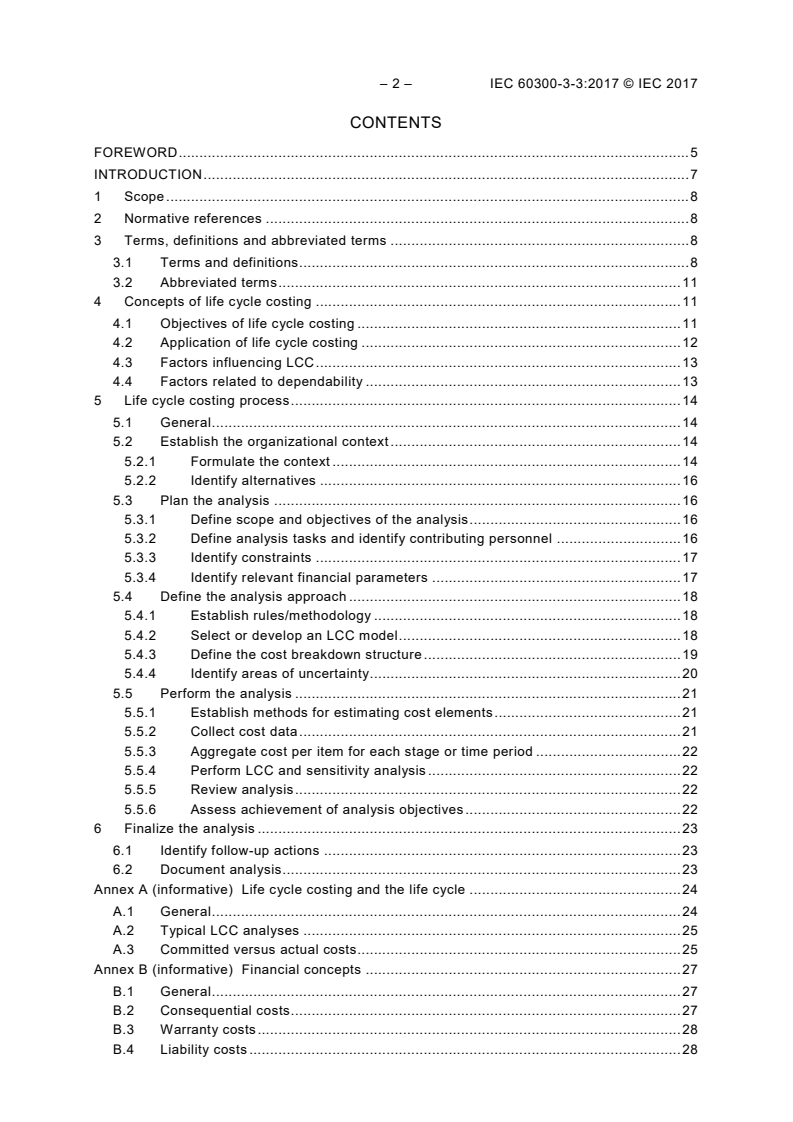
CONTENTS
FOREWORD . 5
INTRODUCTION . 7
1 Scope . 8
2 Normative references . 8
3 Terms, definitions and abbreviated terms . 8
3.1 Terms and definitions . 8
3.2 Abbreviated terms . 11
4 Concepts of life cycle costing . 11
4.1 Objectives of life cycle costing . 11
4.2 Application of life cycle costing . 12
4.3 Factors influencing LCC . 13
4.4 Factors related to dependability . 13
5 Life cycle costing process . 14
5.1 General . 14
5.2 Establish the organizational context . 14
5.2.1 Formulate the context . 14
5.2.2 Identify alternatives . 16
5.3 Plan the analysis . 16
5.3.1 Define scope and objectives of the analysis . 16
5.3.2 Define analysis tasks and identify contributing personnel . 16
5.3.3 Identify constraints . 17
5.3.4 Identify relevant financial parameters . 17
5.4 Define the analysis approach . 18
5.4.1 Establish rules/methodology . 18
5.4.2 Select or develop an LCC model . 18
5.4.3 Define the cost breakdown structure . 19
5.4.4 Identify areas of uncertainty . 20
5.5 Perform the analysis . 21
5.5.1 Establish methods for estimating cost elements . 21
5.5.2 Collect cost data . 21
5.5.3 Aggregate cost per item for each stage or time period . 22
5.5.4 Perform LCC and sensitivity analysis . 22
5.5.5 Review analysis . 22
5.5.6 Assess achievement of analysis objectives . 22
6 Finalize the analysis . 23
6.1 Identify follow-up actions . 23
6.2 Document analysis . 23
Annex A (informative) Life cycle costing and the life cycle . 24
A.1 General . 24
A.2 Typical LCC analyses . 25
A.3 Committed versus actual costs . 25
Annex B (informative) Financial concepts . 27
B.1 General . 27
B.2 Consequential costs . 27
B.3 Warranty costs . 28
B.4 Liability costs . 28
B.5 Opportunity costs, discounting, inflation and taxation . 29
B.5.1 General . 29
B.5.2 Opportunity costs. 29
B.5.3 Taxation . 29
B.5.4 Exchange rate . 29
B.5.5 Generally accepted accounting principles . 29
Annex C (informative) Application of financial evaluation techniques . 30
C.1 General . 30
C.2 Discounted cash flow (DCF) . 30
C.3 Internal rate of return (IRR) . 30
C.4 Depreciation and amortization . 30
C.5 Cost-benefit analysis . 30
C.6 Time value of money . 31
Annex D (informative) Cost breakdown structures by life cycle stage . 32
D.1 General . 32
D.2 Life cycle stage cost element . 32
D.2.1 General . 32
D.2.2 Concept . 32
D.2.3 Development . 32
D.2.4 Realization . 33
D.2.5 Utilization . 33
D.2.6 Enhancement . 34
D.2.7 Retirement . 34
D.3 Cost element explanation . 34
D.3.1 General . 34
D.3.2 Project management . 35
D.3.3 Engineering . 35
D.3.4 Producibility engineering and planning . 35
D.3.5 Manufacturing . 35
D.3.6 Facilities . 35
D.3.7 Support and test equipment . 35
D.3.8 Initial training . 35
D.3.9 Initial spares and repair parts . 35
D.3.10 Consumables . 35
D.3.11 Contractor services . 35
Annex E (informative) Evaluating intangibles . 36
E.1 General . 36
E.2 Intangibles . 36
E.3 Valuing methods . 37
Annex F (informative) Methods for estimating cost elements . 38
F.1 General . 38
F.2 Parametric cost method . 38
F.3 Analogous cost method . 40
F.4 Engineering cost method . 40
Annex G (informative) Example of LCC comparison . 42
G.1 General . 42
G.2 Simple example of LCC comparison . 42
G.2.1 General . 42
– 4 – IEC 60300-3-3:2017 © IEC 2017
G.2.2 Configuration option 1 . 42
G.2.3 Configuration option 2 . 42
G.2.4 Configuration option 3 . 42
G.2.5 Configuration option 4 . 43
G.2.6 LCC calculation . 43
Bibliography . 44
Figure 1 – Life cycle costing process . 15
Figure 2 – Cost breakdown structure concept . 19
Figure A.1 – Typical analyses across the life cycle . 25
Figure A.2 – Example of committed and actual costs . 26
Figure F.1 – Potential sources of costs . 38
Figure F.2 – Example of cost elements used in a parametric cost analysis . 39
Table G.1 – Summary of LCC comparison . 43
INTERNATIONAL ELECTROTECHNICAL COMMISSION
____________
DEPENDABILITY MANAGEMENT –
Part 3-3: Application guide – Life cycle costing
FOREWORD
1) The International Electrotechnical Commission (IEC) is a worldwide organization for standardization comprising
all national electrotechnical committees (IEC National Committees). The object of IEC is to promote
international co-operation on all questions concerning standardization in the electrical and electronic fields. To
this end and in addition to other activities, IEC publishes International Standards, Technical Specifications,
Technical Reports, Publicly Available Specifications (PAS) and Guides (hereafter referred to as “IEC
Publication(s)”). Their preparation is entrusted to technical committees; any IEC National Committee interested
in the subject dealt with may participate in this preparatory work. International, governmental and non-
governmental organizations liaising with the IEC also participate in this preparation. IEC collaborates closely
with the International Organization for Standardization (ISO) in accordance with conditions determined by
agreement between the two organizations.
2) The formal decisions or agreements of IEC on technical matters express, as nearly as possible, an international
consensus of opinion on the relevant subjects since each technical committee has representation from all
interested IEC National Committees.
3) IEC Publications have the form of recommendations for international use and are accepted by IEC National
Committees in that sense. While all reasonable efforts are made to ensure that the technical content of IEC
Publications is accurate, IEC cannot be held responsible for the way in which they are used or for any
misinterpretation by any end user.
4) In order to promote international uniformity, IEC National Committees undertake to apply IEC Publications
transparently to the maximum extent possible in their national and regional publications. Any divergence
between any IEC Publication and the corresponding national or regional publication shall be clearly indicated in
the latter.
5) IEC itself does not provide any attestation of conformity. Independent certification bodies provide conformity
assessment services and, in some areas, access to IEC marks of conformity. IEC is not responsible for any
services carried out by independent certification bodies.
6) All users should ensure that they have the latest edition of this publication.
7) No liability shall attach to IEC or its directors, employees, servants or agents including individual experts and
members of its technical committees and IEC National Committees for any personal injury, property damage or
other damage of any nature whatsoever, whether direct or indirect, or for costs (including legal fees) and
expenses arising out of the publication, use of, or reliance upon, this IEC Publication or any other IEC
Publications.
8) Attention is drawn to the Normative references cited in this publication. Use of the referenced publications is
indispensable for the correct application of this publication.
9) Attention is drawn to the possibility that some of the elements of this IEC Publication may be the subject of
patent rights. IEC shall not be held responsible for identifying any or all such patent rights.
International Standard IEC 60300-3-3 has been prepared by the IEC technical committee 56:
Dependability.
This third edition cancels and replaces the second edition published in 2004. This edition
constitutes a technical revision.
This edition includes the following significant technical changes with respect to the previous
edition:
a) addition of a complete analysis process;
b) greater reference to international accounting practices;
c) increased discussion of financial concepts.
– 6 – IEC 60300-3-3:2017 © IEC 2017
The text of this standard is based on the following documents:
FDIS Report on voting
56/1713/FDIS 56/1720/RVD
Full information on the voting for the approval of this standard can be found in the report on
voting indicated in the above table.
This publication has been drafted in accordance with the ISO/IEC Directives, Part 2.
A list of all parts in the IEC 60300 series, published under the general title Dependability
management, can be found on the IEC website.
The committee has decided that the contents of this publication will remain unchanged until
the stability date indicated on the IEC web site under "http://webstore.iec.ch" in the data
related to the specific publication. At this date, the publication will be
• reconfirmed,
• withdrawn,
• replaced by a revised edition, or
• amended.
IMPORTANT – The 'colour inside' logo on the cover page of this publication indicates
that it contains colours which are considered to be useful for the correct
understanding of its contents. Users should therefore print this document using a
colour printer.
INTRODUCTION
Life cycle costing is the process of performing an economic analysis to assess the cost of an
item over a portion, or all, of its life cycle in order to make decisions that will minimize the
total cost of ownership while still meeting stakeholder requirements. Generally, an
organization may only be able to, or need to, evaluate cost for a portion of the total life of an
item. Across the life of any item, decisions involving a trade-off between current and future
costs will be necessary. This trade-off process will be enhanced by defining the short and
long term implications of feasible expenditure decisions.
The principal use of this document is to compare one alternative system solution to another
where future cost of ownership comprising maintenance, operations, enhancement and
disposal actions is significant and require a balance between the cost of acquisition and the
residual unrealized risk of ownership. Such a balance is achieved by technical and monetary
assessments that take into account varying outcomes of availability, reliability, maintainability
and supportability. Life cycle costing can also provide essential data to develop budgetary
estimates.
This document is also intended to assist those who may be required to specify, commission
and manage such activities when undertaken by others.
The highest value from life cycle costing is achieved early in the life of an item when many
configuration options are possible and influence on future costs the greatest. Studies have
shown that life cycle costs are mostly committed and the opportunity for affordable change is
progressively reduced as item detailed design is approached.
Life cycle costing comprises only expense elements, which may be tangible or intangible;
revenue or value outcomes are not included. Costs comprise all expected future expenditure
including financial allowance for residual risk. Value outcomes, such as revenue, are analysed
in the subsequent financial or economic trade-off analysis that use the results of the life cycle
cost analysis.
Analysis outcomes are often presented as a single figure representing all future expenditures
at a single point in time. The analysis may also be presented as a future cost profile without
inclusion of the time value of money. However, as future costs are uncertain in both
approaches, the analysis may also be presented as a probability distribution to highlight any
potential sensitivity of the outcome to that uncertainty.
When assessing the impacts of potential options, analysts may need to cost intangible
outcomes such as safety exposure, loss of public amenity or damage to corporate image. The
use of multi-attribute rank ordering or semi-quantitative matrixes are not applicable for
assessing these impacts as life cycle costing has a quantitative outcome of cost, namely: life
cycle cost (LCC). Many quantitative techniques, such as “willingness to pay” or “choice
modelling” have been developed and are often applied to assure all direct consequences are
included in the analysis.
The approach defined in this document recognizes that life cycle costing has been applied for
many decades across many industries, some of which have developed their own set of terms
and language. An organization may adapt the terms used in this document to their context of
use to ensure that the intent of this document is achieved.
– 8 – IEC 60300-3-3:2017 © IEC 2017
DEPENDABILITY MANAGEMENT –
Part 3-3: Application guide – Life cycle costing
1 Scope
This part of IEC 60300 establishes a general introduction to the concept of life cycle costing
and covers all applications. Although costs incurred over the life cycle consist of many
contributing elements, this document particularly highlights the costs associated with the
dependability of an item. This forms part of an overall dependability management programme
as described in IEC 60300-1 [1] .
Guidance is provided on life cycle costing for use by managers, engineers, finance staff, and
contractors; it is also intended to assist those who may be required to specify and commission
such activities when undertaken by others.
2 Normative references
There are no normative references in this document.
3 Terms, definitions and abbreviated terms
3.1 Terms and definitions
For the purposes of this document, the following terms and definitions apply.
ISO and IEC maintain terminological databases for use in standardization at the following
addresses:
• IEC Electropedia: available at http://www.electropedia.org/
• ISO Online browsing platform: available at http://www.iso.org/obp
3.1.1
acquisition cost
initial cost of developing and realizing an item so it can be utilized and placed into service
3.1.2
amortization
paying off of debt with a fixed repayment schedule in regular instalments over a period of time
Note 1 to entry: Amortization is also defined as the spreading out of capital expenses for intangible assets over a
specific period of time (usually over the asset's useful life) for accounting and tax purposes.
3.1.3
base date
fixed point in time set as the common cost reference
3.1.4
cost breakdown structure
framework of cost elements so that they can be distinctly defined and estimated
_____________
Numbers in square brackets refer to the Bibliography.
3.1.5
cost driver
cost element that has a major influence on the life cycle cost
3.1.6
cost element
component of life cycle cost for which cost data are, or can be, collected
3.1.7
depreciation
method of allocating the cost of a tangible asset over its useful life
3.1.8
discount rate
factor or rate reflecting the time value of money that is used to convert cash flows occurring at
different times to a base date
3.1.9
intangible item
identifiable non-monetary item without physical substance
Note 1 to entry: The item is separable, that is, is capable of being separated or divided from the entity and sold,
transferred, licensed, rented or exchanged, either individually or together with a related contract, asset or liability.
Note 2 to entry: The item arises from contractual or other legal rights, regardless of whether those rights are
transferable or separable from the entity or from other rights and obligations.
Note 3 to entry: An intangible item is recognised if, and only if:
• it is probable that the expected future economic benefits that are attributable to the asset will flow to the entity,
• the cost of the asset can be measured reliably.
[SOURCE: IAS 38]
3.1.10
item
subject being considered
Note 1 to entry: The item may be an individual part, component, device, functional unit, equipment, subsystem, or
system.
Note 2 to entry: The item may consist of hardware, software, people or any combination thereof.
Note 3 to entry: The item is often comprised of elements that may each be individually considered. See sub item
(192-01-02) and indenture level (192-01-05) in IEC 60050-192:2015.
[SOURCE: IEC 60050-192:2015, 192-01-01, modified — Notes 4 and 5 deleted]
3.1.11
liability cost
cost associated with actual or alleged non-compliance with statutory or contractual obligations
3.1.12
life cycle
series of identifiable stages through which an item goes, from its conception to disposal
EXAMPLE A typical system lifecycle consists of: concept and definition; design and development; construction,
installation and commissioning; operation and maintenance; mid-life upgrading, or life extension; and
decommissioning and disposal.
Note 1 to entry: The stages identified will vary with the application.
[SOURCE: IEC 60050-192:2015, 192-01-09]
– 10 – IEC 60300-3-3:2017 © IEC 2017
3.1.13
life cycle cost
whole life cost
LCC
total cost incurred during the life cycle
Note 1 to entry: See also life cycle costing (3.1.14).
[SOURCE: IEC 60050-192:2015, 192-01-10]
3.1.14
life cycle costing
process of economic analysis to assess the cost of an item over its life cycle or a portion
thereof
[SOURCE: IEC 60050-192:2015, 192-11-11]
3.1.15
mean operating time to failure
MTTF
expectation of the operating time to failure
Note 1 to entry: In the case of non-repairable items with an exponential distribution of times to failure (i.e. a
constant failure rate) the MTTF is numerically equal to the reciprocal of the failure rate. This is also true for
repairable items if after restoration they can be considered to be "as-good-as-new".
Note 2 to entry: See also operating time to failure (IEC 60050-192:2015, 192-05-01).
[SOURCE: IEC 60050-192:2015, 192-05-11]
3.1.16
mean operating time between failures
MTBF
MOTBF
expectation of the duration of the operating time between failures
Note 1 to entry: Mean operating time between failures should only be applied to repairable items. For non-
repairable items, see mean operating time to failure (3.1.15).
[SOURCE: IEC 60050-192:2015, 192-05-13]
3.1.17
ownership cost
total cost of utilizing an item including all operating, maintenance and unrealized risk costs
until the end of its life cycle
3.1.18
time value of money
measurement of the difference between future and the present-day value of monies
3.1.19
useful life
time interval, from first use until user requirements are no longer met, due to
economics of operation and maintenance, or obsolescence
Note 1 to entry: In this context, “first use” excludes testing activities prior to hand-over of the item to the end-
user.
[SOURCE: IEC 60050-192:2015, 192-02-27]
3.2 Abbreviated terms
Abbreviated term Definition
CBS cost breakdown structure
CU currency unit
DCF discounted cash flow
GAAP generally accepted accounting procedures
IASB International Accounting Standards Board
IFRS international financial reporting standards
IRR internal rate of return
kCU 1 000 currency units (CU)
LCC life cycle cost
LORA level of repair analysis
MTBF mean operational time between failures
MTTF mean time to failure
NPV net present value
VAT value added tax
4 Concepts of life cycle costing
4.1 Objectives of life cycle costing
The objective of life cycle costing is to assist decision-makers in selecting the most
appropriate alternative options at any time throughout the life cycle of an item. The life cycle
cost analysis only adds value when it informs decision-making. Whether a supplier is aiming
to penetrate a new competitive market or a purchaser is looking to buy a new item, life cycle
costing can provide important data and guidance information enabling decision-makers to
evaluate available options. These activities should form part of a dependability management
programme as described in IEC 60300-1 [1].
In the context of the life cycle, options can be evaluated in terms of their relative cost,
timescale, performance, dependability or other considerations. Options can also be evaluated
in terms of design concepts, such as the benefits of economy-of-scale savings resulting from
commonality in design and structure, or whether to invest in an improvement programme.
Where there are few or no options, the analysis can also provide essential data to develop
budgetary estimates for the utilization stage, or decisions to bid (or not) for new work.
When defining the objectives of an analysis, it is important to decide if a comprehensive
analysis or a more limited one should be performed. The purpose of life cycle costing may
relate to evaluation of alternatives, financial planning or, as is often the case, situations where
both are required.
When life cycle cost analysis is used in financial planning, the full range of costs may have to
be considered. This is usually a detailed analysis where there will be less uncertainty and
greater accuracy in the results, but extensive and accurate input data will be required.
If the intent of the analysis is to evaluate alternatives, only cost elements that relate to the
comparison need be included. This is usually a comparative analysis where less input data
will be needed, but will provide less accuracy and only a relative ranking of options.
The life cycle cost analysis can be beneficially performed by a supplier, manufacturer, sales
organization, commissioning authority or installer. It can also be performed by the purchaser,
user, operator, paymaster, maintainer, or decommissioning authority. It is important to be
– 12 – IEC 60300-3-3:2017 © IEC 2017
aware of the perception of the analysis task by the relevant authority (or authorities), and to
be clear about the purpose and objectives of the analysis. Given the different interested
parties that may benefit from the analyses, for the sake of simplicity, in this document the
parties involved can be divided into the categories of suppliers and purchasers.
4.2 Application of life cycle costing
The methods described in this document may be applied throughout the life cycle of an item
for making decisions regarding trade-offs between performance, cost and schedule, for
applications such as:
• project planning;
• budgeting and funding;
• acquisition processes;
• feasibility studies;
• concept development;
• selection of alternative design solutions;
• assessment of remaining life;
• comparison between new system acquisition and renovation of a current system.
An understanding of the life cycle of an item and the activities that are performed during each
stage is fundamental to the application of life cycle costing. It is also essential that there is a
clear understanding of the relationship of these activities to performance, safety,
dependability and other characteristics that contribute to life cycle costs. Annex A describes
the major life cycle stages and aspects of life cycle costing appropriate to each.
It is common practice to identify the costs associated with specific life cycle stages in order to
ensure that any trade-off studies are relevant to that stage or stages. The number of stages
considered and the detail in which they are analysed is application specific both in terms of
the item under study and the context in which it is being analysed. The identification of
suitable stages and levels of analysis detail should therefore form part of the analysis plan
and may result in multiple analyses.
Decisions will often include the trade-off between short and long-term expenditure, such as:
• item reliability and the ongoing cost for preventive and corrective maintenance;
• item maintainability, supportability and future cost for preventive and corrective
maintenance;
• item performance and cost of future operation, for example: passive building insulation
and future cost for active temperature control.
The boundary of each life cycle stage should be clearly defined in order to ensure consistency
of approach and that meaningful results can be obtained to achieve the objectives set for that
stage.
Life cycle costs can be divided into those that are associated with acquiring the item and
subsequently those required to exercise ownership. An important consideration when planning
to perform life cycle cost analysis is that costs are largely committed or determined during
acquisition even if the actual costs only occur later during the ownership stage. This is
illustrated in Annex A.
Examples of life cycle costing include:
• broad assessment of alternative operational concepts of a system subject to full scale
engineering development;
• assessment of alternative technologies during design;
• assessment of alternative commercial items to procure in a system by trade-off studies
between reliability, maintainability, supportability and cost;
• costing of alternative maintenance concepts and associated strategies applied to achieve
business objectives;
• assessment of potential internal trade-offs in provision of integrated support (personnel,
spares, training, facilities, etc.) necessary to achieve cost effective availability;
• assessment of the medium and long term implications of changes to short term
expenditure.
4.3 Factors influencing LCC
The greatest effect on LCC can be achieved during the initial stages of the life cycle,
particularly the concept and development stages. Design practices should therefore recognize
that, as the design becomes established, improving the LCC is increasingly difficult and
costly.
The characteristics of an item are established during the concept and development stage
when the fundamental need for that item is scoped. This need is made more specific in a set
of requirements, which are further converted into a detailed specification. Decisions made as
to how the requirement is to be met, including constraints, determine to a great extent the
eventual LCC.
Factors that influence the LCC of an item are closely linked to the requirements that are to be
satisfied. Examples of these include, but are not limited to requirements for:
• dependability;
• safety;
• regulations;
• physical operating environment;
• environmental impact;
• financial performance;
• expected duration of use;
• obsolescence management.
4.4 Factors related to dependability
Dependability plays a major role in the LCC of an item; the attributes of dependability which
affect LCC vary with the stage of the life cycle. Options can be evaluated in terms of
availability, reliability, maintainability, supportability or other dependability-related
considerations.
The first aspect of dependability that is considered is usually the required reliability of the
system and the reliability of its components. If the required reliability is not feasible,
redundancy may have to be part of the design in which case the acquisition cost will usually
increase. Improved reliability can result in a major benefit in LCC by reducing operating and
maintenance costs although this usually entails a higher acquisition cost.
Improved maintainability has a similar impact on LCC through lower operating and
maintenance costs and improved availability through reduced downtime. Adequate
supportability by means of available, efficient and cost-effective maintenance support and
logistics usually improves the LCC of an item.
Dependability considerations should be an integral part of the design process and LCC
evaluations. These considerations should be critically reviewed when preparing item
specifications and be regularly evaluated throughout the design stages in order to optimize
system design and the LCC.
– 14 – IEC 60300-3-3:2017 © IEC 2017
Often the analysis will support the trade-off between acquisition and utilization costs. One
instance of such a trade-off analysis is the level of repair analysis (LORA) which aims to
identify the optimum maintenance approach and maintainability design by addressing factors
such as the maintenance concept, maintenance locations, internal and external maintenance
providers and spare parts provisioning.
5 Life cycle costing process
5.1 General
The life cycle costing process is shown in Figure 1. The major steps in the process are to:
• establish the organizational context;
• plan the analysis;
• define the analysis approach;
• perform the analysis;
• finalize the analysis.
Each of these activities is discussed in detail in the following subclauses. The manner
...