

IEC 63000:2016
(Main)Technical documentation for the assessment of electrical and electronic products with respect to the restriction of hazardous substances
General Information
- Abstract
IEC 63000:2016 specifies the technical documentation that the manufacturer compiles in order to declare compliance with the applicable substance restrictions
- Status
- Published
- Publication Date
- 13-Jan-2022
- Technical Committee
- TC 111 - Environmental standardization for electrical and electronic products and systems
- Drafting Committee
- PT 63000 - TC 111/PT 63000
- Current Stage
- PPUB - Publication issued
- Start Date
- 04-Oct-2016
- Completion Date
- 31-Dec-2016
Buy Documents
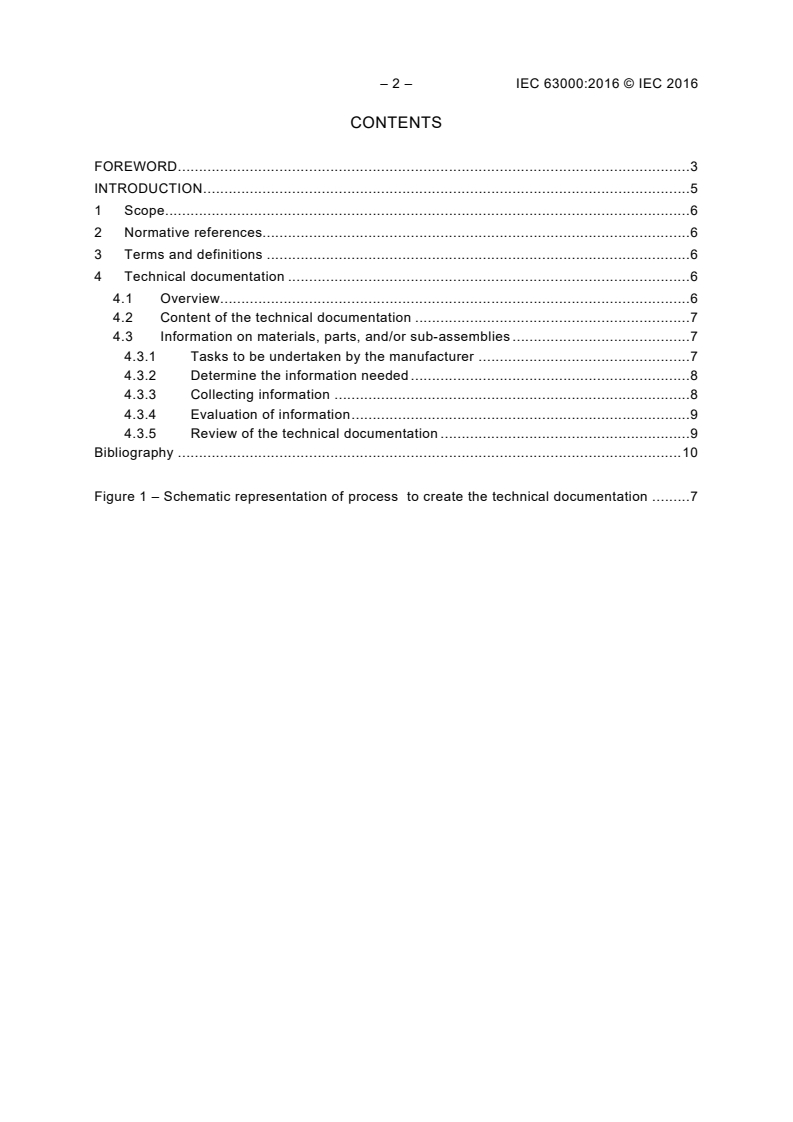
IEC 63000:2016 - Technical documentation for the assessment of electrical and electronic products with respect to the restriction of hazardous substances Released:10/4/2016

IEC 63000:2016+AMD1:2022 CSV - Technical documentation for the assessment of electrical and electronic products with respect to the restriction of hazardous substances Released:1/14/2022

IEC 63000:2016+AMD1:2022 CSV - Technical documentation for the assessment of electrical and electronic products with respect to the restriction of hazardous substances
Overview
IEC 63000:2016 is an international standard published by the International Electrotechnical Commission (IEC) that defines the technical documentation requirements for the assessment of electrical and electronic products regarding the restriction of hazardous substances. The standard primarily aims to assist manufacturers in compiling the necessary documentation to demonstrate compliance with applicable substance restrictions.
Electrical and electronic products often contain hazardous substances that are regulated under various international, regional, and national laws-such as the European Union's RoHS Directive. Since it is impractical for manufacturers to test every component and material individually, IEC 63000 provides a structured approach for manufacturers to work with suppliers and compile reliable evidence of compliance.
Key Topics
Purpose and Scope
IEC 63000 specifies the structure and content of technical documentation that manufacturers need to maintain to declare that their products meet the relevant hazardous substance restrictions. It excludes documentation directly related to the manufacturer’s management system.Required Documentation Elements
The technical documentation must include:- A general description of the product and its intended use (which affects applicable exemptions).
- Documentation for all materials, parts, and sub-assemblies related to the product.
- Information linking the documentation to specific product components.
- A list of standards or technical specifications referenced in preparing the documentation.
Documentation Process
Manufacturers should execute four key tasks:- Determine the information needed, focusing on the probability of restricted substances and supplier trustworthiness.
- Collect information from suppliers, material declarations, and analytical tests.
- Evaluate the quality and trustworthiness of the collected data before including it in the documentation.
- Keep the documentation up to date, ensuring its validity throughout the product lifecycle.
Focus on Supplier Collaboration
The standard emphasizes collaboration with suppliers through declarations and contractual agreements to build trustworthy technical evidence without direct testing of every component.
Applications
IEC 63000:2016 is highly relevant for manufacturers and organizations involved in the design, production, and marketing of electrical and electronic equipment worldwide. Its practical applications include:
Compliance with Substance Restrictions
Helps manufacturers comply with RoHS, REACH, and other hazardous substance regulations by establishing a structured compliance documentation process.Supply Chain Management
Facilitates communication and information exchange between manufacturers and their suppliers about material content and restricted substances.Product Safety and Market Access
Enables enterprises to provide legally defensible technical documentation as evidence of compliance, aiding in market access and regulatory inspections.Environmental and Corporate Responsibility
Supports manufacturers in minimizing the environmental impact of hazardous substances and promoting sustainable product design.
Related Standards
IEC 63000 complements and references other key standards in the field of hazardous substance management for electrical and electronic products, including:
- IEC 62321 (all parts) – Methods for the determination of certain substances in electrotechnical products.
- IEC 62474:2018 – Material declaration standard for products of, and for, the electrotechnical industry.
- EN 50581:2012 – European standard supporting the RoHS Directive, on which IEC 63000 is based.
By aligning with these standards, IEC 63000 provides a coherent framework facilitating global regulatory compliance and harmonization across the electrotechnical sector.
Keywords: IEC 63000, hazardous substances, electrical product compliance, technical documentation, RoHS, restricted substances, electrotechnical products, supplier declarations, environmental regulations, product safety standards.
Relations
- Effective Date
- 05-Sep-2023
Buy Documents
IEC 63000:2016 - Technical documentation for the assessment of electrical and electronic products with respect to the restriction of hazardous substances Released:10/4/2016
IEC 63000:2016+AMD1:2022 CSV - Technical documentation for the assessment of electrical and electronic products with respect to the restriction of hazardous substances Released:1/14/2022
IEC 63000:2016+AMD1:2022 CSV - Technical documentation for the assessment of electrical and electronic products with respect to the restriction of hazardous substances
Get Certified
Connect with accredited certification bodies for this standard

CIS Institut d.o.o.
Personal Protective Equipment (PPE) certification body. Notified Body NB-2890 for EU Regulation 2016/425 PPE.

Kiwa BDA Testing
Building and construction product certification.
Kmetijski inštitut Slovenije
Agricultural Institute of Slovenia. Soil testing, plant health, agricultural product analysis.
Sponsored listings
Frequently Asked Questions
IEC 63000:2016 is a standard published by the International Electrotechnical Commission (IEC). Its full title is "Technical documentation for the assessment of electrical and electronic products with respect to the restriction of hazardous substances". This standard covers: IEC 63000:2016 specifies the technical documentation that the manufacturer compiles in order to declare compliance with the applicable substance restrictions
IEC 63000:2016 specifies the technical documentation that the manufacturer compiles in order to declare compliance with the applicable substance restrictions
IEC 63000:2016 is classified under the following ICS (International Classification for Standards) categories: 01.040.01 - Generalities. Terminology. Standardization. Documentation (Vocabularies); 13.030.10 - Solid wastes; 31.020 - Electronic components in general. The ICS classification helps identify the subject area and facilitates finding related standards.
IEC 63000:2016 has the following relationships with other standards: It is inter standard links to IEC 63000:2016/AMD1:2022. Understanding these relationships helps ensure you are using the most current and applicable version of the standard.
IEC 63000:2016 is available in PDF format for immediate download after purchase. The document can be added to your cart and obtained through the secure checkout process. Digital delivery ensures instant access to the complete standard document.
Standards Content (Sample)
IEC 63000 ®
Edition 1.0 2016-10
INTERNATIONAL
STANDARD
NORME
INTERNATIONALE
Technical documentation for the assessment of electrical and electronic
products with respect to the restriction of hazardous substances
Documentation technique pour l'évaluation des produits électriques et
électroniques par rapport à la restriction des substances dangereuses
All rights reserved. Unless otherwise specified, no part of this publication may be reproduced or utilized in any form
or by any means, electronic or mechanical, including photocopying and microfilm, without permission in writing from
either IEC or IEC's member National Committee in the country of the requester. If you have any questions about IEC
copyright or have an enquiry about obtaining additional rights to this publication, please contact the address below or
your local IEC member National Committee for further information.
Droits de reproduction réservés. Sauf indication contraire, aucune partie de cette publication ne peut être reproduite
ni utilisée sous quelque forme que ce soit et par aucun procédé, électronique ou mécanique, y compris la photocopie
et les microfilms, sans l'accord écrit de l'IEC ou du Comité national de l'IEC du pays du demandeur. Si vous avez des
questions sur le copyright de l'IEC ou si vous désirez obtenir des droits supplémentaires sur cette publication, utilisez
les coordonnées ci-après ou contactez le Comité national de l'IEC de votre pays de résidence.
IEC Central Office Tel.: +41 22 919 02 11
3, rue de Varembé Fax: +41 22 919 03 00
CH-1211 Geneva 20 info@iec.ch
Switzerland www.iec.ch
About the IEC
The International Electrotechnical Commission (IEC) is the leading global organization that prepares and publishes
International Standards for all electrical, electronic and related technologies.
About IEC publications
The technical content of IEC publications is kept under constant review by the IEC. Please make sure that you have the
latest edition, a corrigenda or an amendment might have been published.
IEC Catalogue - webstore.iec.ch/catalogue Electropedia - www.electropedia.org
The stand-alone application for consulting the entire The world's leading online dictionary of electronic and
bibliographical information on IEC International Standards, electrical terms containing 20 000 terms and definitions in
Technical Specifications, Technical Reports and other English and French, with equivalent terms in 15 additional
documents. Available for PC, Mac OS, Android Tablets and languages. Also known as the International Electrotechnical
iPad. Vocabulary (IEV) online.
IEC publications search - www.iec.ch/searchpub IEC Glossary - std.iec.ch/glossary
The advanced search enables to find IEC publications by a 65 000 electrotechnical terminology entries in English and
variety of criteria (reference number, text, technical French extracted from the Terms and Definitions clause of
committee,…). It also gives information on projects, replaced IEC publications issued since 2002. Some entries have been
and withdrawn publications. collected from earlier publications of IEC TC 37, 77, 86 and
CISPR.
IEC Just Published - webstore.iec.ch/justpublished
Stay up to date on all new IEC publications. Just Published IEC Customer Service Centre - webstore.iec.ch/csc
details all new publications released. Available online and If you wish to give us your feedback on this publication or
also once a month by email. need further assistance, please contact the Customer Service
Centre: csc@iec.ch.
A propos de l'IEC
La Commission Electrotechnique Internationale (IEC) est la première organisation mondiale qui élabore et publie des
Normes internationales pour tout ce qui a trait à l'électricité, à l'électronique et aux technologies apparentées.
A propos des publications IEC
Le contenu technique des publications IEC est constamment revu. Veuillez vous assurer que vous possédez l’édition la
plus récente, un corrigendum ou amendement peut avoir été publié.
Catalogue IEC - webstore.iec.ch/catalogue Electropedia - www.electropedia.org
Application autonome pour consulter tous les renseignements
Le premier dictionnaire en ligne de termes électroniques et
bibliographiques sur les Normes internationales,
électriques. Il contient 20 000 termes et définitions en anglais
Spécifications techniques, Rapports techniques et autres
et en français, ainsi que les termes équivalents dans 15
documents de l'IEC. Disponible pour PC, Mac OS, tablettes
langues additionnelles. Egalement appelé Vocabulaire
Android et iPad.
Electrotechnique International (IEV) en ligne.
Recherche de publications IEC - www.iec.ch/searchpub
Glossaire IEC - std.iec.ch/glossary
La recherche avancée permet de trouver des publications IEC 65 000 entrées terminologiques électrotechniques, en anglais
en utilisant différents critères (numéro de référence, texte, et en français, extraites des articles Termes et Définitions des
comité d’études,…). Elle donne aussi des informations sur les publications IEC parues depuis 2002. Plus certaines entrées
projets et les publications remplacées ou retirées. antérieures extraites des publications des CE 37, 77, 86 et
CISPR de l'IEC.
IEC Just Published - webstore.iec.ch/justpublished
Service Clients - webstore.iec.ch/csc
Restez informé sur les nouvelles publications IEC. Just
Published détaille les nouvelles publications parues. Si vous désirez nous donner des commentaires sur cette
Disponible en ligne et aussi une fois par mois par email. publication ou si vous avez des questions contactez-nous:
csc@iec.ch.
IEC 63000 ®
Edition 1.0 2016-10
INTERNATIONAL
STANDARD
NORME
INTERNATIONALE
Technical documentation for the assessment of electrical and electronic
products with respect to the restriction of hazardous substances
Documentation technique pour l'évaluation des produits électriques et
électroniques par rapport à la restriction des substances dangereuses
INTERNATIONAL
ELECTROTECHNICAL
COMMISSION
COMMISSION
ELECTROTECHNIQUE
INTERNATIONALE
ICS 01.040.01; 13.030.10; 31.020 ISBN 978-2-8322-3649-9
– 2 – IEC 63000:2016 © IEC 2016
CONTENTS
FOREWORD . 3
INTRODUCTION . 5
1 Scope . 6
2 Normative references. 6
3 Terms and definitions . 6
4 Technical documentation . 6
4.1 Overview. 6
4.2 Content of the technical documentation . 7
4.3 Information on materials, parts, and/or sub-assemblies . 7
4.3.1 Tasks to be undertaken by the manufacturer . 7
4.3.2 Determine the information needed . 8
4.3.3 Collecting information . 8
4.3.4 Evaluation of information . 9
4.3.5 Review of the technical documentation . 9
Bibliography . 10
Figure 1 – Schematic representation of process to create the technical documentation . 7
INTERNATIONAL ELECTROTECHNICAL COMMISSION
____________
TECHNICAL DOCUMENTATION FOR THE ASSESSMENT
OF ELECTRICAL AND ELECTRONIC PRODUCTS WITH RESPECT
TO THE RESTRICTION OF HAZARDOUS SUBSTANCES
FOREWORD
1) The International Electrotechnical Commission (IEC) is a worldwide organization for standardization comprising
all national electrotechnical committees (IEC National Committees). The object of IEC is to promote
international co-operation on all questions concerning standardization in the electrical and electronic fields. To
this end and in addition to other activities, IEC publishes International Standards, Technical Specifications,
Technical Reports, Publicly Available Specifications (PAS) and Guides (hereafter referred to as “IEC
Publication(s)”). Their preparation is entrusted to technical committees; any IEC National Committee interested
in the subject dealt with may participate in this preparatory work. International, governmental and non-
governmental organizations liaising with the IEC also participate in this preparation. IEC collaborates closely
with the International Organization for Standardization (ISO) in accordance with conditions determined by
agreement between the two organizations.
2) The formal decisions or agreements of IEC on technical matters express, as nearly as possible, an international
consensus of opinion on the relevant subjects since each technical committee has representation from all
interested IEC National Committees.
3) IEC Publications have the form of recommendations for international use and are accepted by IEC National
Committees in that sense. While all reasonable efforts are made to ensure that the technical content of IEC
Publications is accurate, IEC cannot be held responsible for the way in which they are used or for any
misinterpretation by any end user.
4) In order to promote international uniformity, IEC National Committees undertake to apply IEC Publications
transparently to the maximum extent possible in their national and regional publications. Any divergence
between any IEC Publication and the corresponding national or regional publication shall be clearly indicated in
the latter.
5) IEC itself does not provide any attestation of conformity. Independent certification bodies provide conformity
assessment services and, in some areas, access to IEC marks of conformity. IEC is not responsible for any
services carried out by independent certification bodies.
6) All users should ensure that they have the latest edition of this publication.
7) No liability shall attach to IEC or its directors, employees, servants or agents including individual experts and
members of its technical committees and IEC National Committees for any personal injury, property damage or
other damage of any nature whatsoever, whether direct or indirect, or for costs (including legal fees) and
expenses arising out of the publication, use of, or reliance upon, this IEC Publication or any other IEC
Publications.
8) Attention is drawn to the Normative references cited in this publication. Use of the referenced publications is
indispensable for the correct application of this publication.
9) Attention is drawn to the possibility that some of the elements of this IEC Publication may be the subject of
patent rights. IEC shall not be held responsible for identifying any or all such patent rights.
International Standard IEC 63000 has been prepared by technical committee
111:Environmental standardization for electrical and electronic products and systems.
The text of this International Standard is based on the following documents:
CDV Report on voting
111/413/CDV 111/434/RVC
Full information on the voting for the approval of this International Standard can be found in
the report on voting indicated in the above table.
This document has been drafted in accordance with the ISO/IEC Directives, Part 2.
– 4 – IEC 63000:2016 © IEC 2016
The committee has decided that the contents of this document will remain unchanged until the
stability date indicated on the IEC website under "http://webstore.iec.ch" in the data related to
the specific document. At this date, the document will be
• reconfirmed,
• withdrawn,
• replaced by a revised edition, or
• amended.
INTRODUCTION
Certain substances contained in electrical and electronic products are restricted by legislation
and/or customer specifications. Manufacturers of final products therefore need to be able to
demonstrate that their products meet the applicable substance restrictions.
For those restrictions that apply at the component or material level, it is impractical for
manufacturers of electrical and electronic products to undertake their own testing of all
materials contained in the final assembled product. Instead, manufacturers work with their
suppliers to manage compliance and compile technical documentation as evidence of
compliance. This approach is well recognised by both industry and enforcement authorities.
The aim of this document is to specify the technical documentation that the manufacturer
needs to compile in order to declare compliance with the applicable substance restrictions,
under various substance regulations worldwide.
This document is based on European Standard EN 50581:2012, which supports Directive
2011/65/EU of the European Parliament and of the Council of 8 June 2011 on the restriction
of the use of certain hazardous substances in electrical and electronic equipment (RoHS).
– 6 – IEC 63000:2016 © IEC 2016
TECHNICAL DOCUMENTATION FOR THE ASSESSMENT
OF ELECTRICAL AND ELECTRONIC PRODUCTS WITH RESPECT
TO THE RESTRICTION OF HAZARDOUS SUBSTANCES
1 Scope
This document specifies the technical documentation that the manufacturer compiles in order
to declare compliance with the applicable substance restrictions.
The documentation of the manufacturer’s management system is outside the scope of this
document.
2 Normative references
The following documents are referred to in the text in such a way that some or all of their
content constitutes requirements of this document. For dated references, only the edition
cited applies. For undated references, the latest edition of the referenced document (including
any amendments) applies.
IEC 62321 (all parts), Determination of certain substances in electrotechnical products
IEC 62474:2012, Material declaration for products of and for the electrotechnical industry
3 Terms and definitions
For the purposes of this document, the following terms and definitions apply.
ISO and IEC maintain terminological databases for use in standardization at the following
addresses:
• IEC Electropedia: available at http://www.electropedia.org/
• ISO Online browsing platform: available at http://www.iso.org/obp
3.1
restricted substance
substance which is limited in its use in a product, sub-assembly, part or material
3.2
manufacturer
natural or legal person who manufactures a product or has a product designed or
manufactured, and markets that product under his name or trademark
3.3
supplier
organisation that provides the manufacturer with materials, parts and/or sub-assemblies
4 Technical documentation
4.1 Overview
The manufacturer shall compile technical documentation to demonstrate that electrical and
electronic products comply with substance restrictions (see 4.2 and 4.3).
4.2 Content of the technical documentation
The technical documentation shall include at least the following elements:
• a general description of the product;
NOTE The description of the product together with its intended use is one of the factors that determines which
exemptions (if any) apply.
• documents for materials, parts, and/or sub-assemblies (see 4.3);
• information showing the relationship between the technical documents identified in 4.3 and
the corresponding materials, parts and/or sub-assemblies in the product;
• list of standards and/or other technical specifications that have been used to establish the
technical documents identified in 4.3 , or to which such documents refer.
4.3 Information on materials, parts, and/or sub-assemblies
4.3.1 Tasks to be undertaken by the manufacturer
The manufacturer shall undertake the following four tasks:
• determine the information needed (see 4.3.2);
• collect the information (see 4.3.3);
• evaluate the information with regard to its quality and trustworthiness and decide whether
to include it in the technical documentation (see 4.3.4);
• ensure that the technical documentation remains valid (see 4.3.5).
Figure 1 shows the process to create the technical documentation:
Supplier and material
See 4.3.2
assessment
Supplier
declarations and/or Material Analytical test
See 4.3.3
contractual
ceclarations results
agreements
Documents for materials, parts, and/or sub-assemblies
Evaluation of quality
See 4.3.4
and trustworthiness
Content of the technical documentation
List of standards and/or
Information showing the
other technical
relationship between the
specifications that have
Documents for materials, documents and the
General description of been used to establish
parts, and/or sub- corresponding materials,
the product the technical documents
assemblies parts and/or sub-
mentioned in 4.3, or to
assemblies in the
which such documents
product
refer
IEC
Figure 1 – Schematic representation of process
to create the technical documentation
AND/OR
AND/OR
– 8 – IEC 63000:2016 © IEC 2016
4.3.2 Determine the information needed
The types of technical documents (see 4.3.3) that are required for materials, parts and/or sub-
assemblies shall be based on the manufacturer’s assessment of:
a) the probability of restricted substances being present, in materials, parts or sub-
assemblies, and
b) the trustworthiness of the supplier.
Materials that are added during the production process (such as solder, paint, adhesives)
shall also be considered as part of the assessment.
When undertaking the assessment of the probability of restricted substances being present
(see item a) the manufacturer may apply technical judgement, as some substances are
unlikely to be contained in certain materials (e.g. organic substances in metals). Such
technical judgement should be based on technical information available via the
electrical/electronic industry, or a literature investigation of the materials/parts used in
electrical/electronic products. Additional information that may be used when undertaking the
assessment includes material types typically used in the part or sub-assembly, and the
historical likelihood of restricted substances being present in each material type.
When undertaking the trustworthiness assessment of the supplier (see item b) the
manufacturer may apply:
• historical experience with the supplier organization;
• results of previous supplier inspections or audits.
NOTE The assessment and its associated procedures can form part of a quality management system or
equivalent.
4.3.3 Collecting information
As a result of the manufacturer’s assessment, the following documents on materials, parts,
and/or sub-assemblies shall be collected:
a) Supplier declarations and/or contractual agreements, such as:
– Supplier declarations, confirming that the restricted substance content of the specified
material, part, or sub-assembly is within the permitted levels and identifying any
exemptions that have been applied;
– Signed contracts confirming that the manufacturer’s specification for the maximum
content of restricted substances in a material, part, or sub-assembly is fulfilled.
– Such declarations or agreements shall cover a specific material, part and/or sub-
assembly, or a specific range of materials, parts and/or sub-assemblies.
and/or
b) Material declarations:
– Material declarations providing information on specific substance content and
identifying any exemptions that have been applied.
– The material declaration content should meet the requirements specified in
IEC 62474:2012, 4.2.3 for the applicable substances.
NOTE The use of standards for such declarations helps ensure consistent and cost-effective flow of
information throughout the supply chain.
and/or
c) Analytical test results:
– Analytical test results using the methods described or referenced in the IEC 62321
series.
4.3.4 Evaluation of information
The manufacturer shall establish procedures that shall be used to evaluate the documents
described in 4.3.3 in order to determine their quality and trustworthi
...
IEC 63000 ®
Edition 1.1 2022-01
CONSOLIDATED VERSION
INTERNATIONAL
STANDARD
NORME
INTERNATIONALE
colour
inside
Technical documentation for the assessment of electrical and electronic
products with respect to the restriction of hazardous substances
Documentation technique pour l'évaluation des produits électriques et
électroniques par rapport à la restriction des substances dangereuses
All rights reserved. Unless otherwise specified, no part of this publication may be reproduced or utilized in any form
or by any means, electronic or mechanical, including photocopying and microfilm, without permission in writing from
either IEC or IEC's member National Committee in the country of the requester. If you have any questions about IEC
copyright or have an enquiry about obtaining additional rights to this publication, please contact the address below or
your local IEC member National Committee for further information.
Droits de reproduction réservés. Sauf indication contraire, aucune partie de cette publication ne peut être reproduite
ni utilisée sous quelque forme que ce soit et par aucun procédé, électronique ou mécanique, y compris la photocopie
et les microfilms, sans l'accord écrit de l'IEC ou du Comité national de l'IEC du pays du demandeur. Si vous avez des
questions sur le copyright de l'IEC ou si vous désirez obtenir des droits supplémentaires sur cette publication, utilisez
les coordonnées ci-après ou contactez le Comité national de l'IEC de votre pays de résidence.
IEC Secretariat Tel.: +41 22 919 02 11
3, rue de Varembé info@iec.ch
CH-1211 Geneva 20 www.iec.ch
Switzerland
About the IEC
The International Electrotechnical Commission (IEC) is the leading global organization that prepares and publishes
International Standards for all electrical, electronic and related technologies.
About IEC publications
The technical content of IEC publications is kept under constant review by the IEC. Please make sure that you have the
latest edition, a corrigendum or an amendment might have been published.
IEC publications search - webstore.iec.ch/advsearchform IEC Products & Services Portal - products.iec.ch
The advanced search enables to find IEC publications by a Discover our powerful search engine and read freely all the
variety of criteria (reference number, text, technical publications previews. With a subscription you will always
committee, …). It also gives information on projects, replaced have access to up to date content tailored to your needs.
and withdrawn publications.
Electropedia - www.electropedia.org
IEC Just Published - webstore.iec.ch/justpublished
The world's leading online dictionary on electrotechnology,
Stay up to date on all new IEC publications. Just Published
containing more than 22 300 terminological entries in English
details all new publications released. Available online and
and French, with equivalent terms in 19 additional languages.
once a month by email.
Also known as the International Electrotechnical Vocabulary
(IEV) online.
IEC Customer Service Centre - webstore.iec.ch/csc
If you wish to give us your feedback on this publication or
need further assistance, please contact the Customer Service
Centre: sales@iec.ch.
A propos de l'IEC
La Commission Electrotechnique Internationale (IEC) est la première organisation mondiale qui élabore et publie des
Normes internationales pour tout ce qui a trait à l'électricité, à l'électronique et aux technologies apparentées.
A propos des publications IEC
Le contenu technique des publications IEC est constamment revu. Veuillez vous assurer que vous possédez l’édition la
plus récente, un corrigendum ou amendement peut avoir été publié.
Recherche de publications IEC - IEC Products & Services Portal - products.iec.ch
webstore.iec.ch/advsearchform Découvrez notre puissant moteur de recherche et consultez
La recherche avancée permet de trouver des publications IEC gratuitement tous les aperçus des publications. Avec un
en utilisant différents critères (numéro de référence, texte, abonnement, vous aurez toujours accès à un contenu à jour
comité d’études, …). Elle donne aussi des informations sur adapté à vos besoins.
les projets et les publications remplacées ou retirées.
Electropedia - www.electropedia.org
IEC Just Published - webstore.iec.ch/justpublished
Le premier dictionnaire d'électrotechnologie en ligne au
Restez informé sur les nouvelles publications IEC. Just
monde, avec plus de 22 300 articles terminologiques en
Published détaille les nouvelles publications parues.
anglais et en français, ainsi que les termes équivalents dans
Disponible en ligne et une fois par mois par email.
19 langues additionnelles. Egalement appelé Vocabulaire
Electrotechnique International (IEV) en ligne.
Service Clients - webstore.iec.ch/csc
Si vous désirez nous donner des commentaires sur cette
publication ou si vous avez des questions contactez-nous:
sales@iec.ch.
IEC 63000 ®
Edition 1.1 2022-01
CONSOLIDATED VERSION
INTERNATIONAL
STANDARD
NORME
INTERNATIONALE
colour
inside
Technical documentation for the assessment of electrical and electronic
products with respect to the restriction of hazardous substances
Documentation technique pour l'évaluation des produits électriques et
électroniques par rapport à la restriction des substances dangereuses
INTERNATIONAL
ELECTROTECHNICAL
COMMISSION
COMMISSION
ELECTROTECHNIQUE
INTERNATIONALE
ICS 01.040.01; 13.030.10; 31.020 ISBN 978-2-8322-1069-7
IEC 63000 ®
Edition 1.1 2022-01
CONSOLIDATED VERSION
REDLINE VERSION
VERSION REDLINE
colour
inside
Technical documentation for the assessment of electrical and electronic
products with respect to the restriction of hazardous substances
Documentation technique pour l'évaluation des produits électriques et
électroniques par rapport à la restriction des substances dangereuses
– 2 – IEC 63000:2016+AMD1:2022 CSV
© IEC 2022
CONTENTS
FOREWORD . 3
INTRODUCTION . 5
1 Scope . 6
2 Normative references . 6
3 Terms and definitions . 6
4 Technical documentation . 7
4.1 Overview. 7
4.2 Content of the technical documentation . 7
4.3 Information on materials, parts, and/or sub-assemblies . 7
4.3.1 Tasks to be undertaken by the manufacturer . 7
4.3.2 Determine the information needed . 8
4.3.3 Collecting information . 9
4.3.4 Evaluation of information . 9
4.3.5 Review of the technical documentation . 9
Bibliography . 11
Figure 1 – Schematic representation of process to create the technical documentation. 8
© IEC 2022
INTERNATIONAL ELECTROTECHNICAL COMMISSION
____________
TECHNICAL DOCUMENTATION FOR THE ASSESSMENT
OF ELECTRICAL AND ELECTRONIC PRODUCTS WITH RESPECT
TO THE RESTRICTION OF HAZARDOUS SUBSTANCES
FOREWORD
1) The International Electrotechnical Commission (IEC) is a worldwide organization for standardization comprising
all national electrotechnical committees (IEC National Committees). The object of IEC is to promote
international co-operation on all questions concerning standardization in the electrical and electronic fields. To
this end and in addition to other activities, IEC publishes International Standards, Technical Specifications,
Technical Reports, Publicly Available Specifications (PAS) and Guides (hereafter referred to as “IEC
Publication(s)”). Their preparation is entrusted to technical committees; any IEC National Committee interested
in the subject dealt with may participate in this preparatory work. International, governmental and non-
governmental organizations liaising with the IEC also participate in this preparation. IEC collaborates closely
with the International Organization for Standardization (ISO) in accordance with conditions determined by
agreement between the two organizations.
2) The formal decisions or agreements of IEC on technical matters express, as nearly as possible, an international
consensus of opinion on the relevant subjects since each technical committee has representation from all
interested IEC National Committees.
3) IEC Publications have the form of recommendations for international use and are accepted by IEC National
Committees in that sense. While all reasonable efforts are made to ensure that the technical content of IEC
Publications is accurate, IEC cannot be held responsible for the way in which they are used or for any
misinterpretation by any end user.
4) In order to promote international uniformity, IEC National Committees undertake to apply IEC Publications
transparently to the maximum extent possible in their national and regional publications. Any divergence
between any IEC Publication and the corresponding national or regional publication shall be clearly indicated in
the latter.
5) IEC itself does not provide any attestation of conformity. Independent certification bodies provide conformity
assessment services and, in some areas, access to IEC marks of conformity. IEC is not responsible for any
services carried out by independent certification bodies.
6) All users should ensure that they have the latest edition of this publication.
7) No liability shall attach to IEC or its directors, employees, servants or agents including individual experts and
members of its technical committees and IEC National Committees for any personal injury, property damage or
other damage of any nature whatsoever, whether direct or indirect, or for costs (including legal fees) and
expenses arising out of the publication, use of, or reliance upon, this IEC Publication or any other IEC
Publications.
8) Attention is drawn to the Normative references cited in this publication. Use of the referenced publications is
indispensable for the correct application of this publication.
9) Attention is drawn to the possibility that some of the elements of this IEC Publication may be the subject of
patent rights. IEC shall not be held responsible for identifying any or all such patent rights.
This consolidated version of the official IEC Standard and its amendment has been
prepared for user convenience.
IEC 63000 edition 1.1 contains the first edition (2016-10) [documents 111/413/CDV and
111/434/RVC] and its amendment 1 (2022-01) [documents 111/578/CDV and
111/614/RVC].
In this Redline version, a vertical line in the margin shows where the technical content
is modified by amendment 1. Additions are in green text, deletions are in strikethrough
red text. A separate Final version with all changes accepted is available in this
publication.
– 4 – IEC 63000:2016+AMD1:2022 CSV
© IEC 2022
International Standard IEC 63000 has been prepared by technical committee
111:Environmental standardization for electrical and electronic products and systems.
This document has been drafted in accordance with the ISO/IEC Directives, Part 2.
The committee has decided that the contents of the base publication and its amendment will
remain unchanged until the stability date indicated on the IEC web site under webstore.iec.ch
in the data related to the specific publication. At this date, the publication will be
• reconfirmed,
• withdrawn,
• replaced by a revised edition, or
• amended.
IMPORTANT – The 'colour inside' logo on the cover page of this publication indicates
that it contains colours which are considered to be useful for the correct
understanding of its contents. Users should therefore print this document using a
colour printer.
© IEC 2022
INTRODUCTION
Certain substances contained in electrical and electronic products are restricted by legislation
and/or customer specifications. Manufacturers of final products therefore need to be able to
demonstrate that their products meet the applicable substance restrictions.
For those restrictions that apply at the component or material level, it is impractical for
manufacturers of electrical and electronic products to undertake their own testing of all
materials contained in the final assembled product. Instead, manufacturers work with their
suppliers to manage compliance and compile technical documentation as evidence of
compliance. This approach is well recognised by both industry and enforcement authorities.
The aim of this document is to specify the technical documentation that the manufacturer
needs to compile in order to declare compliance with the applicable substance restrictions,
under various substance regulations worldwide.
This document is based on European Standard EN 50581:2012, which supports Directive
2011/65/EU of the European Parliament and of the Council of 8 June 2011 on the restriction
of the use of certain hazardous substances in electrical and electronic equipment (RoHS).
– 6 – IEC 63000:2016+AMD1:2022 CSV
© IEC 2022
TECHNICAL DOCUMENTATION FOR THE ASSESSMENT
OF ELECTRICAL AND ELECTRONIC PRODUCTS WITH RESPECT
TO THE RESTRICTION OF HAZARDOUS SUBSTANCES
1 Scope
This document specifies the technical documentation that the manufacturer compiles in order
to declare compliance with the applicable substance restrictions.
The documentation of the manufacturer’s management system is outside the scope of this
document.
2 Normative references
The following documents are referred to in the text in such a way that some or all of their
content constitutes requirements of this document. For dated references, only the edition
cited applies. For undated references, the latest edition of the referenced document (including
any amendments) applies.
IEC 62321 (all parts), Determination of certain substances in electrotechnical products
IEC 62474:20122018, Material declaration for products of and for the electrotechnical industry
IEC 62474:2018/AMD1:2020
3 Terms and definitions
For the purposes of this document, the following terms and definitions apply.
ISO and IEC maintain terminological databases for use in standardization at the following
addresses:
• IEC Electropedia: available at http://www.electropedia.org/
• ISO Online browsing platform: available at http://www.iso.org/obp
3.1
restricted substance
substance which is limited in its use in a product, sub-assembly, part or material
3.2
manufacturer
natural or legal person who manufactures a product or has a product designed or
manufactured, and markets that product under his name or trademark
3.3
supplier
organisation that provides the manufacturer with materials, parts and/or sub-assemblies
© IEC 2022
4 Technical documentation
4.1 Overview
The manufacturer shall compile technical documentation to demonstrate that electrical and
electronic products comply with substance restrictions (see 4.2 and 4.3).
4.2 Content of the technical documentation
The technical documentation shall include at least the following elements:
• a general description of the product;
NOTE The description of the product together with its intended use is one of the factors that determines which
exemptions (if any) apply.
• documents for materials, parts, and/or sub-assemblies (see 4.3);
• information showing the relationship between the technical documents identified in 4.3 and
the corresponding materials, parts and/or sub-assemblies in the product;
• list of standards and/or other technical specifications that have been used to establish the
technical documents identified in 4.3 , or to which such documents refer.
4.3 Information on materials, parts, and/or sub-assemblies
4.3.1 Tasks to be undertaken by the manufacturer
The manufacturer shall undertake the following four tasks:
• determine the information needed (see 4.3.2);
• collect the information (see 4.3.3);
• evaluate the information with regard to its quality and trustworthiness and decide whether
to include it in the technical documentation (see 4.3.4);
• ensure that the technical documentation remains valid (see 4.3.5).
Figure 1 shows the process to create the technical documentation:
– 8 – IEC 63000:2016+AMD1:2022 CSV
© IEC 2022
Supplier and material
See 4.3.2
assessment
Supplier
declarations and/or Material Analytical test
See 4.3.3
contractual
ceclarations results
agreements
Documents for materials, parts, and/or sub-assemblies
Evaluation of quality
See 4.3.4
and trustworthiness
Content of the technical documentation
List of standards and/or
Information showing the
other technical
relationship between the
specifications that have
Documents for materials, documents and the
General description of been used to establish
parts, and/or sub- corresponding materials,
the product the technical documents
assemblies parts and/or sub-
mentioned in 4.3, or to
assemblies in the
which such documents
product
refer
IEC
Figure 1 – Schematic representation of process
to create the technical documentation
4.3.2 Determine the information needed
The types of technical documents (see 4.3.3) that are required for materials, parts and/or sub-
assemblies shall be based on the manufacturer’s assessment of:
a) the probability of restricted substances being present, in materials, parts or sub-
assemblies, and
b) the trustworthiness of the supplier.
Materials that are added during the production process (such as solder, paint, adhesives)
shall also be considered as part of the assessment.
When undertaking the assessment of the probability of restricted substances being present
(see item a) the manufacturer may apply technical judgement, as some substances are
unlikely to be contained in certain materials (e.g. organic substances in metals). Such
technical judgement should be based on technical information available via the
electrical/electronic industry, or a literature investigation of the materials/parts used in
electrical/electronic products. Additional information that may be used when undertaking the
assessment includes material types typically used in the part or sub-assembly, and the
historical likelihood of restricted substances being present in each material type.
When undertaking the trustworthiness assessment of the supplier (see item b) the
manufacturer may apply:
• historical experience with the supplier organization;
• results of previous supplier inspections or audits.
NOTE The assessment and its associated procedures can form part of a quality management system or
equivalent.
AND/OR
AND/OR
© IEC 2022
4.3.3 Collecting information
As a result of the manufacturer’s assessment, the following documents on materials, parts,
and/or sub-assemblies shall be collected:
a) Supplier declarations and/or contractual agreements, such as:
– Supplier declarations, confirming that the restricted substance content of the specified
material, part, or sub-assembly is within the permitted levels and identifying any
exemptions that have been applied;
– Signed contracts confirming that the manufacturer’s specification for the maximum
content of restricted substances in a material, part, or sub-assembly is fulfilled.
– Such declarations or agreements shall cover a specific material, part and/or sub-
assembly, or a specific range of materials, parts and/or sub-assemblies.
and/or
b) Material declarations:
– Material declarations providing information on specific substance content and
identifying any exemptions that have been applied.
– The material declaration content should meet the requirements specified in
IEC 62474:2012, 4.2.3 IEC 62474:2018 and IEC 62474:2018/AMD1:2020, 4.4.2 (for a
declaration for compliance) or 4.5.4 (for a composition declaration) for the applicable
substances.
NOTE The use of standards for such declarations helps ensure consistent and cost-effective flow of
information throughout the supply chain.
and/or
c) Analytical test results:
– Analytical test results using the methods described or referenced in the IEC 62321
series.
4.3.4 Evaluation of information
The manufacturer shall establish procedures that shall be used to evaluate the documents
described in 4.3.3 in order to determine their quality and trustworthiness.
NOTE 1 IEC TR 62476 provides a framework for the use of internationally accepted standards, tools and
practices to evaluate electrical and electronic products with respect to restricted substances.
The manufacturer shall evaluate, in accordance with these procedures, the source and
content of each document received in order to determine whether or not the material, part, or
sub-assembly meets the specified substance restrictions.
NOTE 2 Aspects such as the origin of the document, contact information, responsibility of the named person or
signatory, and date can be considered when evaluating the source and content.
This evaluation will enable the manufacturer to decide whether the documents provide
sufficient evidence of compliance to justify their inclusion in the technical documentation.
If a particular document is:
• considered to be of sufficient quality and trustworthiness, then it shall be included in the
technical documentation;
• not considered to be of sufficient quality or trustworthiness, then the manufacturer shall
determine what further actions are necessary – possible actions include requesting
additional information from the supplier or undertaking his own substance analysis.
4.3.5 Review of the technical documentation
The manufacturer shall:
– 10 – IEC 63000:2016+AMD1:2022 CSV
© IEC 2022
• perform a periodic review of the documents contained in the technical documentation to
ensure that they are still valid;
• ensure that the technical documentation reflects any changes to materials, parts or sub-
assemblies in accordance with 4.3.3.
© IEC 2022
Bibliography
IEC 62430:20092019, Environmentally conscious design for electrical and electronic products
– Principles, requirements and guidance
IEC TR 62476:2010, Guidance for evaluation of products with respect to substance use
restrictions in electrical and electronic products
IEC 62542:2013, Environmental standardization for electrical and electronic products and
systems – Glossary of terms
ISO 9001, Quality management systems – Requirements
ISO 14001, Environmental management systems – Requirements with guidance for use
___________
– 12 – IEC 63000:2016+AMD1:2022 CSV
© IEC 2022
SOMMAIRE
AVANT-PROPOS . 13
INTRODUCTION . 15
1 Domaine d'application . 16
2 Références normatives . 16
3 Termes et définitions . 16
4 Documentation technique . 17
4.1 Vue d'ensemble . 17
4.2 Contenu de la documentation technique. 17
4.3 Information sur les matériaux, les parties et/ou les sous-ensembles . 17
4.3.1 Tâches à la charge du fabricant . 17
4.3.2 Déterminer les informations nécessaires . 18
4.3.3 Collecte des informations . 19
4.3.4 Évaluation de l’information . 19
4.3.5 Révision de la documentation technique . 20
Bibliographie . 21
Figure 1 – Représentation schématique du processus d’élaboration de la
documentation technique . 18
© IEC 2022
COMMISSION ÉLECTROTECHNIQUE INTERNATIONALE
____________
DOCUMENTATION TECHNIQUE POUR L'ÉVALUATION DES PRODUITS
ÉLECTRIQUES ET ÉLECTRONIQUES PAR RAPPORT À LA RESTRICTION
DES SUBSTANCES DANGEREUSES
AVANT-PROPOS
1) La Commission Electrotechnique Internationale (IEC) est une organisation mondiale de normalisation
composée de l'ensemble des comités électrotechniques nationaux (Comités nationaux de l’IEC). L’IEC a pour
objet de favoriser la coopération internationale pour toutes les questions de normalisation dans les domaines
de l'électricité et de l'électronique. A cet effet, l’IEC – entre autres activités – publie des Normes
internationales, des Spécifications techniques, des Rapports techniques, des Spécifications accessibles au
public (PAS) et des Guides (ci-après dénommés "Publication(s) de l’IEC"). Leur élaboration est confiée à des
comités d'études, aux travaux desquels tout Comité national intéressé par le sujet traité peut participer. Les
organisations internationales, gouvernementales et non gouvernementales, en liaison avec l’IEC, participent
également aux travaux. L’IEC collabore étroitement avec l'Organisation Internationale de Normalisation (ISO),
selon des conditions fixées par accord entre les deux organisations.
2) Les décisions ou accords officiels de l’IEC concernant les questions techniques représentent, dans la mesure
du possible, un accord international sur les sujets étudiés, étant donné que les Comités nationaux de l’IEC
intéressés sont représentés dans chaque comité d’études.
3) Les Publications de l’IEC se présentent sous la forme de recommandations internationales et sont agréées
comme telles par les Comités nationaux de l’IEC. Tous les efforts raisonnables sont entrepris afin que l’IEC
s'assure de l'exactitude du contenu technique de ses publications; l’IEC ne peut pas être tenue responsable de
l'éventuelle mauvaise utilisation ou interprétation qui en est faite par un quelconque utilisateur final.
4) Dans le but d'encourager l'uniformité internationale, les Comités nationaux de l’IEC s'engagent, dans toute la
mesure possible, à appliquer de façon transparente les Publications de l’IEC dans leurs publications nationales
et régionales. Toutes divergences entre toutes Publications de l’IEC et toutes publications nationales ou
régionales correspondantes doivent être indiquées en termes clairs dans ces dernières.
5) L’IEC elle-même ne fournit aucune attestation de conformité. Des organismes de certification indépendants
fournissent des services d'évaluation de conformité et, dans certains secteurs, accèdent aux marques de
conformité de l’IEC. L’IEC n'est responsable d'aucun des services effectués par les organismes de certification
indépendants.
6) Tous les utilisateurs doivent s'assurer qu'ils sont en possession de la dernière édition de cette publication.
7) Aucune responsabilité ne doit être imputée à l’IEC, à ses administrateurs, employés, auxiliaires ou
mandataires, y compris ses experts particuliers et les membres de ses comités d'études et des Comités
nationaux de l’IEC, pour tout préjudice causé en cas de dommages corporels et matériels, ou de tout autre
dommage de quelque nature que ce soit, directe ou indirecte, ou pour supporter les coûts (y compris les frais
de justice) et les dépenses découlant de la publication ou de l'utilisation de cette Publication de l’IEC ou de
toute autre Publication de l’IEC, ou au crédit qui lui est accordé.
8) L'attention est attirée sur les références normatives citées dans cette publication. L'utilisation de publications
référencées est obligatoire pour une application correcte de la présente publication.
9) L’attention est attirée sur le fait que certains des éléments de la présente Publication de l’IEC peuvent faire
l’objet de droits de brevet. L’IEC ne saurait être tenue pour responsable de ne pas avoir identifié de tels droits
de brevets et de ne pas avoir signalé leur existence.
Cette version consolidée de la Norme IEC officielle et de son amendement a été
préparée pour la commodité de l'utilisateur.
L’IEC 63000 édition 1.1 contient la première édition (2016-10) [documents 111/413/CDV
et 111/434/RVC] et son amendement 1 (2022-01) [documents 111/578/CDV et
111/614/RVC].
Dans cette version Redline, une ligne verticale dans la marge indique où le contenu
technique est modifié par l'amendement 1. Les ajouts sont en vert, les suppressions
sont en rouge, barrées. Une version Finale avec toutes les modifications acceptées est
disponible dans cette publication.
– 14 – IEC 63000:2016+AMD1:2022 CSV
© IEC 2022
La Norme internationale IEC 63000 a été établie par le comité d'études 111 de l’IEC:
Normalisation environnementale pour les produits et les systèmes électriques et
électroniques.
Ce document a été rédigé selon les Directives ISO/IEC, Partie 2.
Le comité a décidé que le contenu de la publication de base et de son amendement ne sera
pas modifié avant la date de stabilité indiquée sur le site web de l’IEC sous webstore.iec.ch
dans les données relatives à la publication recherchée. A cette date, la publication sera
• reconduite,
• supprimée,
• remplacée par une édition révisée, ou
• amendée.
IMPORTANT – Le logo "colour inside" qui se trouve sur la page de couverture de cette
publication indique qu'elle contient des couleurs qui sont considérées comme utiles à
une bonne compréhension de son contenu. Les utilisateurs devraient, par conséquent,
imprimer cette publication en utilisant une imprimante couleur.
© IEC 2022
INTRODUCTION
Certaines substances contenues dans les produits électriques et électroniques sont soumises
à des limitations par la législation et/ou par des spécifications clients. Les fabricants de
produits finis doivent donc pouvoir démontrer que leurs produits respectent les limitations en
vigueur sur les substances concernées.
Pour les limitations qui s'appliquent au niveau des composants et des matériaux, il est donc
impossible pour les fabricants de produits électriques et électroniques d'entreprendre leurs
propres essais sur tous les matériaux contenus dans le produit fini et assemblé. Pour
remédier à cela, les fabricants travaillent avec leurs fournisseurs pour gérer la conformité et
rassemblent des documents techniques pour attester de la conformité. Cette approche est
bien reconnue tant par l'industrie que par les autorités de contrôle.
Le but du présent document est de spécifier la documentation technique que le fabricant doit
rassembler afin de déclarer qu'il est en conformité avec les limitations en vigueur pour
certaines substances dans le cadre des différentes législations applicables dans le monde.
Le présent document est basé sur la Norme européenne EN 50581:2012 qui vient à l'appui de
la directive 2011/65/EU du Parlement européen et du Conseil du 8 juin 2011 sur la limitation
de l'utilisation de certaines substances dangereuses dans les équipements électriques et
électroniques (RoHS).
– 16 – IEC 63000:2016+AMD1:2022 CSV
© IEC 2022
DOCUMENTATION TECHNIQUE POUR L'ÉVALUATION DES PRODUITS
ÉLECTRIQUES ET ÉLECTRONIQUES PAR RAPPORT À LA RESTRICTION
DES SUBSTANCES DANGEREUSES
1 Domaine d'application
Le présent document spécifie la documentation technique que le fabricant rassemble pour
déclarer qu'il est en conformité avec les limitations en vigueur pour certaines substances.
La documentation du système de management du fabricant est exclue du domaine
d'application du présent document.
2 Références normatives
Les documents suivants cités dans le texte constituent, pour tout ou partie de leur contenu,
des exigences du présent document. Pour les références datées, seule l’édition citée
s’applique. Pour les références non datées, la dernière édition du document de référence
s'applique (y compris les éventuels amendements).
IEC 62321 (toutes les parties), Détermination de certaines substances dans les produits
électrotechniques
IEC 62474:20122018, Déclaration de matière pour des produits de et pour l'industrie
électrotechnique
IEC 62474:2018/AMD1:2020
3 Termes et définitions
Pour les besoins du présent document, les termes et définitions suivants s'appliquent.
L'ISO et l'IEC tiennent à jour des bases de données terminologiques destinées à être utilisées
en normalisation, consultables aux adresses suivantes:
• IEC Electropedia: disponible à l'adresse http://www.electropedia.org/
• ISO Online browsing platform: disponible à l'adresse http://www.iso.org/obp
3.1
substance soumise à limitations
substance soumise à une limite d'utilisation dans un produit, un de ses sous-ensembles une
de ses parties ou ses matériaux
3.2
fabricant
toute personne physique ou morale qui fabrique un produit ou fait concevoir ou fabriquer un
produit pour le commercialiser sous son propre nom ou sa propre marque
3.3
fournisseur
organisme qui fournit des matériaux, des parties et/ou des sous-ensembles au fabricant
© IEC 2022
4 Documentation technique
4.1 Vue d'ensemble
Le fabricant doit rassembler une documentation technique pour démontrer que ses produits
électriques et électroniques sont conformes aux limitations applicables à certaines
substances (voir 4.2 et 4.3).
4.2 Contenu de la documentation technique
La documentation technique doit au moins inclure les éléments suivants:
• une description générale du produit;
NOTE La description du produit avec son utilisation prévue est l'un des facteurs qui déterminent les (éventuelles)
exemptions qui s'appliquent.
• les documents relatifs aux matériaux, aux parties, et/ou aux sous-ensembles (voir 4.3);
• les informations présentant la relation entre les documents techniques identifiés en 4.3 et
les matériaux, parties et/ou sous-ensembles correspondants dans le produit;
• la liste des normes et/ou des autres spécifications techniques qui ont servi à établir les
documents techniques identifiés en 4.3, ou auxquels ces documents font référence.
4.3 Information sur les matériaux, les parties et/ou les sous-ensembles
4.3.1 Tâches à la charge du fabricant
Le fabricant doit se charger d'effectuer les quatre tâches suivantes:
• déterminer les informations nécessaires (voir 4.3.2);
• collecter les informations (voir 4.3.3);
• évaluer la qualité et la fiabilité des informations et décider de les inclure ou non dans la
documentation technique (voir 4.3.4);
• s'assurer que la documentation technique reste valide (voir 4.3.5).
La Figure 1 présente le processus d’élaboration de la documentation technique:
– 18 – IEC 63000:2016+AMD1:2022 CSV
© IEC 2022
Évaluation des fournisseurs
Voir 4.3.2
et des matériaux
Déclarations des
Déclarations Résultats
fournisseurs
relatives aux d'essais Voir 4.3.3
et/ou accords
matériaux analytiques
contractuels
Documents relatifs aux matériaux, aux parties et/ou aux sous-ensembles
Évaluation de la qualité
Voir 4.3.4
et de la fiabilité
Contenu de la documentation technique
Informations présentant Liste des normes et/ou
la relation entre les des autres spécifications
Documents pour les documents et les techniques qui ont servi
Description générale matériaux, les parties matériaux, les parties à établir les documents
du produit et/ou les et/ou les techniques identifiés
sous-ensembles sous-ensembles au 4.3, ou auxquels ces
correspondants dans documents techniques
le produit font référence
IEC
Figure 1 – Représentation schématique du processus
d’élaboration de la documentation technique
4.3.2 Déterminer les informations nécessaires
Les types de documents techniques (voir 4.3.3) exigés pour les matériaux, les parties et/ou
les sous-ensembles doivent se fonder sur l'évaluation faite par le fabricant concernant:
a) la probabilité de présence de substances soumises à des limitations dans les matériaux,
les parties ou les sous-ensembles, et
b) la fiabilité du fournisseur.
Les matériaux qui sont ajoutés pendant le processus de production (tels que les produits de
soudure, la peinture, les substances adhésives) doivent également être pris en compte dans
l'évaluation.
Lorsqu'il entreprend d'évaluer la probabilité de présence de substances soumises à des
limitations (voir point a)), le fabricant est autorisé à faire preuve de discernement technique,
étant donné que certaines substances sont peu susceptibles d'entrer dans la composition de
certains types de matériaux (par exemple, des substances organiques dans des métaux). Il
convient que ce jugement technique soit fondé sur des informations techniques disponibles
auprès de l'industrie électrique et électronique ou contenues dans des documents techniques
concernant les matériaux et parties utilisés dans les produits électriques et électroniques.
Parmi les informations complémentaires qui peuvent être utilisées lors de l'évaluation, il y a
les types de matériaux utilisés normalement dans la partie ou le sous-ensemble et la
probabilité au vu des connaissances acquises dans le passé que des substances soumises à
des limitations sont présentes dans chaque type de matériau.
Lorsque le fabricant entreprend l'évaluation de la fiabilité du fournisseur (voir point b)), il peut
se fonder sur:
ET/OU
ET/OU
© IEC 2022
• l'historique de la collaboration avec l'organisme fournisseur;
• les résultats des inspections ou des audits antérieurs pour le fournisseur concerné.
NOTE L'évaluation et les procédures associées peuvent faire partie d'un système de management de la qualité
ou d'un système équivalent.
4.3.3 Collecte des informations
A l'issue de l'évaluation du fabricant, les documents suivants relatifs aux matériaux, aux
parties ou aux sous-ensembles doivent être collectés:
a) les déclarations des fournisseurs et/ou accords contractuels, tels que:
– les déclarations des fournisseurs confirmant que les substances soumises à des
limitations contenues dans les matériaux, les parties ou les sous-ensembles restent
dans les limites autorisées et identifiant toutes les exemptions qui ont été appliquées;
– les contrats signés confirmant que les spécifications du fabricant sur le contenu
maximum en substances soumises à limitations dans les matériaux, les parties ou les
sous-ensembles sont respectées.
– De tels accords ou déclarations doivent couvrir un matériau, une partie ou un sous-
ensemble particulier ou une de leurs gammes particulières.
et/ou
b) les déclarations relatives aux matériaux:
– les déclarations relatives aux matériaux fournissant des informations sur le contenu en
substances particulières et identifiant les exemptions qui ont été appliquées.
– Il convient que le contenu de la déclaration concernant les matériaux satisfasse aux
exigences spécifiées dans l'IEC 62474:2012, 4.2.3 IEC 62474:2018 et
l'IEC 62474:2018/AMD1:2020, au 4.4.2 (pour une déclaration pour conformité) ou au
4.5.4 (pour une déclaration de composition) pour les substances concernées.
NOTE L'utilisation de normes pour de telles déclarations permet d'assurer un flux d'informations cohérent et
peu couteux tout au long de la chaîne d’approvisionnement.
et/ou
c) les résultats d'essais analytiques:
– les résultats d'essais analytiques qui utilisent des méthodes décrites ou référencées
dans la série IEC 62321.
4.3.4 Évaluation de l’information
Le fabricant doit établir des procédures qui doivent être utilisées pour évaluer les documents
décrits en 4.3.3 afin de déterminer leur qualité et leur fiabilité.
NOTE 1 L'IEC TR 62476 donne un cadre pour l'utilisation des normes, des outils et des pratiques acceptés au
niveau international, pour évaluer les produits électriques et électroniques en ce qui concerne les substances
soumises à limitations.
Le fabricant doit évaluer, conformément à ces procédures, la source et le contenu de chaque
document reçu afin de déterminer si les matériaux, les parties, les parties ou les sous-
ensembles respectent les restrictions relatives aux substances spécifiées.
NOTE 2 Lors de l'évaluation de la source et du contenu, des aspects comme l'origine du document, les
informations de contact, la responsabilité de la personne nommée ou du signataire et la date peuvent être pris en
compte.
Cette évaluation permettra au fabricant de décider si les documents fournissent des preuves
de conformité suffisantes pour justifier leur intégration dans la documentation technique.
Si un document particulier:
– 20 – IEC 63000:2016+AMD1:2022 CSV
© IEC 2022
• est considéré comme fiable et de qualité suffisante, il doit être intégré dans la
documentation technique,
• n'est pas considéré comme fiable ou de qualité suffisante, le fabricant doit alors
déterminer quelles seront les actions supplémentaires nécessaires. Il est possible de
demander des informations complémentaires au fournisseur ou d'entreprendre sa propre
analyse de la substance.
4.3.5 Révision de la documentation technique
Le fabricant doit:
• réaliser une revue périodique des documents contenus dans la documentation technique
pour s'assurer qu'ils sont toujours valides;
• s'assurer que la documentation technique reflète toute modification de matériau, de pa
...
IEC 63000 ®
Edition 1.1 2022-01
CONSOLIDATED VERSION
INTERNATIONAL
STANDARD
NORME
INTERNATIONALE
colour
inside
Technical documentation for the assessment of electrical and electronic
products with respect to the restriction of hazardous substances
Documentation technique pour l'évaluation des produits électriques et
électroniques par rapport à la restriction des substances dangereuses
All rights reserved. Unless otherwise specified, no part of this publication may be reproduced or utilized in any form
or by any means, electronic or mechanical, including photocopying and microfilm, without permission in writing from
either IEC or IEC's member National Committee in the country of the requester. If you have any questions about IEC
copyright or have an enquiry about obtaining additional rights to this publication, please contact the address below or
your local IEC member National Committee for further information.
Droits de reproduction réservés. Sauf indication contraire, aucune partie de cette publication ne peut être reproduite
ni utilisée sous quelque forme que ce soit et par aucun procédé, électronique ou mécanique, y compris la photocopie
et les microfilms, sans l'accord écrit de l'IEC ou du Comité national de l'IEC du pays du demandeur. Si vous avez des
questions sur le copyright de l'IEC ou si vous désirez obtenir des droits supplémentaires sur cette publication, utilisez
les coordonnées ci-après ou contactez le Comité national de l'IEC de votre pays de résidence.
IEC Secretariat Tel.: +41 22 919 02 11
3, rue de Varembé info@iec.ch
CH-1211 Geneva 20 www.iec.ch
Switzerland
About the IEC
The International Electrotechnical Commission (IEC) is the leading global organization that prepares and publishes
International Standards for all electrical, electronic and related technologies.
About IEC publications
The technical content of IEC publications is kept under constant review by the IEC. Please make sure that you have the
latest edition, a corrigendum or an amendment might have been published.
IEC publications search - webstore.iec.ch/advsearchform IEC Products & Services Portal - products.iec.ch
The advanced search enables to find IEC publications by a Discover our powerful search engine and read freely all the
variety of criteria (reference number, text, technical publications previews. With a subscription you will always
committee, …). It also gives information on projects, replaced have access to up to date content tailored to your needs.
and withdrawn publications.
Electropedia - www.electropedia.org
IEC Just Published - webstore.iec.ch/justpublished
The world's leading online dictionary on electrotechnology,
Stay up to date on all new IEC publications. Just Published
containing more than 22 300 terminological entries in English
details all new publications released. Available online and
and French, with equivalent terms in 19 additional languages.
once a month by email.
Also known as the International Electrotechnical Vocabulary
(IEV) online.
IEC Customer Service Centre - webstore.iec.ch/csc
If you wish to give us your feedback on this publication or
need further assistance, please contact the Customer Service
Centre: sales@iec.ch.
A propos de l'IEC
La Commission Electrotechnique Internationale (IEC) est la première organisation mondiale qui élabore et publie des
Normes internationales pour tout ce qui a trait à l'électricité, à l'électronique et aux technologies apparentées.
A propos des publications IEC
Le contenu technique des publications IEC est constamment revu. Veuillez vous assurer que vous possédez l’édition la
plus récente, un corrigendum ou amendement peut avoir été publié.
Recherche de publications IEC - IEC Products & Services Portal - products.iec.ch
webstore.iec.ch/advsearchform Découvrez notre puissant moteur de recherche et consultez
La recherche avancée permet de trouver des publications IEC gratuitement tous les aperçus des publications. Avec un
en utilisant différents critères (numéro de référence, texte, abonnement, vous aurez toujours accès à un contenu à jour
comité d’études, …). Elle donne aussi des informations sur adapté à vos besoins.
les projets et les publications remplacées ou retirées.
Electropedia - www.electropedia.org
IEC Just Published - webstore.iec.ch/justpublished
Le premier dictionnaire d'électrotechnologie en ligne au
Restez informé sur les nouvelles publications IEC. Just
monde, avec plus de 22 300 articles terminologiques en
Published détaille les nouvelles publications parues.
anglais et en français, ainsi que les termes équivalents dans
Disponible en ligne et une fois par mois par email.
19 langues additionnelles. Egalement appelé Vocabulaire
Electrotechnique International (IEV) en ligne.
Service Clients - webstore.iec.ch/csc
Si vous désirez nous donner des commentaires sur cette
publication ou si vous avez des questions contactez-nous:
sales@iec.ch.
IEC 63000 ®
Edition 1.1 2022-01
CONSOLIDATED VERSION
INTERNATIONAL
STANDARD
NORME
INTERNATIONALE
colour
inside
Technical documentation for the assessment of electrical and electronic
products with respect to the restriction of hazardous substances
Documentation technique pour l'évaluation des produits électriques et
électroniques par rapport à la restriction des substances dangereuses
INTERNATIONAL
ELECTROTECHNICAL
COMMISSION
COMMISSION
ELECTROTECHNIQUE
INTERNATIONALE
ICS 01.040.01; 13.030.10; 31.020 ISBN 978-2-8322-1069-7
IEC 63000 ®
Edition 1.1 2022-01
CONSOLIDATED VERSION
REDLINE VERSION
VERSION REDLINE
colour
inside
Technical documentation for the assessment of electrical and electronic
products with respect to the restriction of hazardous substances
Documentation technique pour l'évaluation des produits électriques et
électroniques par rapport à la restriction des substances dangereuses
– 2 – IEC 63000:2016+AMD1:2022 CSV
© IEC 2022
CONTENTS
FOREWORD . 3
INTRODUCTION . 5
1 Scope . 6
2 Normative references . 6
3 Terms and definitions . 6
4 Technical documentation . 7
4.1 Overview. 7
4.2 Content of the technical documentation . 7
4.3 Information on materials, parts, and/or sub-assemblies . 7
4.3.1 Tasks to be undertaken by the manufacturer . 7
4.3.2 Determine the information needed . 8
4.3.3 Collecting information . 9
4.3.4 Evaluation of information . 9
4.3.5 Review of the technical documentation . 9
Bibliography . 11
Figure 1 – Schematic representation of process to create the technical documentation. 8
© IEC 2022
INTERNATIONAL ELECTROTECHNICAL COMMISSION
____________
TECHNICAL DOCUMENTATION FOR THE ASSESSMENT
OF ELECTRICAL AND ELECTRONIC PRODUCTS WITH RESPECT
TO THE RESTRICTION OF HAZARDOUS SUBSTANCES
FOREWORD
1) The International Electrotechnical Commission (IEC) is a worldwide organization for standardization comprising
all national electrotechnical committees (IEC National Committees). The object of IEC is to promote
international co-operation on all questions concerning standardization in the electrical and electronic fields. To
this end and in addition to other activities, IEC publishes International Standards, Technical Specifications,
Technical Reports, Publicly Available Specifications (PAS) and Guides (hereafter referred to as “IEC
Publication(s)”). Their preparation is entrusted to technical committees; any IEC National Committee interested
in the subject dealt with may participate in this preparatory work. International, governmental and non-
governmental organizations liaising with the IEC also participate in this preparation. IEC collaborates closely
with the International Organization for Standardization (ISO) in accordance with conditions determined by
agreement between the two organizations.
2) The formal decisions or agreements of IEC on technical matters express, as nearly as possible, an international
consensus of opinion on the relevant subjects since each technical committee has representation from all
interested IEC National Committees.
3) IEC Publications have the form of recommendations for international use and are accepted by IEC National
Committees in that sense. While all reasonable efforts are made to ensure that the technical content of IEC
Publications is accurate, IEC cannot be held responsible for the way in which they are used or for any
misinterpretation by any end user.
4) In order to promote international uniformity, IEC National Committees undertake to apply IEC Publications
transparently to the maximum extent possible in their national and regional publications. Any divergence
between any IEC Publication and the corresponding national or regional publication shall be clearly indicated in
the latter.
5) IEC itself does not provide any attestation of conformity. Independent certification bodies provide conformity
assessment services and, in some areas, access to IEC marks of conformity. IEC is not responsible for any
services carried out by independent certification bodies.
6) All users should ensure that they have the latest edition of this publication.
7) No liability shall attach to IEC or its directors, employees, servants or agents including individual experts and
members of its technical committees and IEC National Committees for any personal injury, property damage or
other damage of any nature whatsoever, whether direct or indirect, or for costs (including legal fees) and
expenses arising out of the publication, use of, or reliance upon, this IEC Publication or any other IEC
Publications.
8) Attention is drawn to the Normative references cited in this publication. Use of the referenced publications is
indispensable for the correct application of this publication.
9) Attention is drawn to the possibility that some of the elements of this IEC Publication may be the subject of
patent rights. IEC shall not be held responsible for identifying any or all such patent rights.
This consolidated version of the official IEC Standard and its amendment has been
prepared for user convenience.
IEC 63000 edition 1.1 contains the first edition (2016-10) [documents 111/413/CDV and
111/434/RVC] and its amendment 1 (2022-01) [documents 111/578/CDV and
111/614/RVC].
In this Redline version, a vertical line in the margin shows where the technical content
is modified by amendment 1. Additions are in green text, deletions are in strikethrough
red text. A separate Final version with all changes accepted is available in this
publication.
– 4 – IEC 63000:2016+AMD1:2022 CSV
© IEC 2022
International Standard IEC 63000 has been prepared by technical committee
111:Environmental standardization for electrical and electronic products and systems.
This document has been drafted in accordance with the ISO/IEC Directives, Part 2.
The committee has decided that the contents of the base publication and its amendment will
remain unchanged until the stability date indicated on the IEC web site under webstore.iec.ch
in the data related to the specific publication. At this date, the publication will be
• reconfirmed,
• withdrawn,
• replaced by a revised edition, or
• amended.
IMPORTANT – The 'colour inside' logo on the cover page of this publication indicates
that it contains colours which are considered to be useful for the correct
understanding of its contents. Users should therefore print this document using a
colour printer.
© IEC 2022
INTRODUCTION
Certain substances contained in electrical and electronic products are restricted by legislation
and/or customer specifications. Manufacturers of final products therefore need to be able to
demonstrate that their products meet the applicable substance restrictions.
For those restrictions that apply at the component or material level, it is impractical for
manufacturers of electrical and electronic products to undertake their own testing of all
materials contained in the final assembled product. Instead, manufacturers work with their
suppliers to manage compliance and compile technical documentation as evidence of
compliance. This approach is well recognised by both industry and enforcement authorities.
The aim of this document is to specify the technical documentation that the manufacturer
needs to compile in order to declare compliance with the applicable substance restrictions,
under various substance regulations worldwide.
This document is based on European Standard EN 50581:2012, which supports Directive
2011/65/EU of the European Parliament and of the Council of 8 June 2011 on the restriction
of the use of certain hazardous substances in electrical and electronic equipment (RoHS).
– 6 – IEC 63000:2016+AMD1:2022 CSV
© IEC 2022
TECHNICAL DOCUMENTATION FOR THE ASSESSMENT
OF ELECTRICAL AND ELECTRONIC PRODUCTS WITH RESPECT
TO THE RESTRICTION OF HAZARDOUS SUBSTANCES
1 Scope
This document specifies the technical documentation that the manufacturer compiles in order
to declare compliance with the applicable substance restrictions.
The documentation of the manufacturer’s management system is outside the scope of this
document.
2 Normative references
The following documents are referred to in the text in such a way that some or all of their
content constitutes requirements of this document. For dated references, only the edition
cited applies. For undated references, the latest edition of the referenced document (including
any amendments) applies.
IEC 62321 (all parts), Determination of certain substances in electrotechnical products
IEC 62474:20122018, Material declaration for products of and for the electrotechnical industry
IEC 62474:2018/AMD1:2020
3 Terms and definitions
For the purposes of this document, the following terms and definitions apply.
ISO and IEC maintain terminological databases for use in standardization at the following
addresses:
• IEC Electropedia: available at http://www.electropedia.org/
• ISO Online browsing platform: available at http://www.iso.org/obp
3.1
restricted substance
substance which is limited in its use in a product, sub-assembly, part or material
3.2
manufacturer
natural or legal person who manufactures a product or has a product designed or
manufactured, and markets that product under his name or trademark
3.3
supplier
organisation that provides the manufacturer with materials, parts and/or sub-assemblies
© IEC 2022
4 Technical documentation
4.1 Overview
The manufacturer shall compile technical documentation to demonstrate that electrical and
electronic products comply with substance restrictions (see 4.2 and 4.3).
4.2 Content of the technical documentation
The technical documentation shall include at least the following elements:
• a general description of the product;
NOTE The description of the product together with its intended use is one of the factors that determines which
exemptions (if any) apply.
• documents for materials, parts, and/or sub-assemblies (see 4.3);
• information showing the relationship between the technical documents identified in 4.3 and
the corresponding materials, parts and/or sub-assemblies in the product;
• list of standards and/or other technical specifications that have been used to establish the
technical documents identified in 4.3 , or to which such documents refer.
4.3 Information on materials, parts, and/or sub-assemblies
4.3.1 Tasks to be undertaken by the manufacturer
The manufacturer shall undertake the following four tasks:
• determine the information needed (see 4.3.2);
• collect the information (see 4.3.3);
• evaluate the information with regard to its quality and trustworthiness and decide whether
to include it in the technical documentation (see 4.3.4);
• ensure that the technical documentation remains valid (see 4.3.5).
Figure 1 shows the process to create the technical documentation:
– 8 – IEC 63000:2016+AMD1:2022 CSV
© IEC 2022
Supplier and material
See 4.3.2
assessment
Supplier
declarations and/or Material Analytical test
See 4.3.3
contractual
ceclarations results
agreements
Documents for materials, parts, and/or sub-assemblies
Evaluation of quality
See 4.3.4
and trustworthiness
Content of the technical documentation
List of standards and/or
Information showing the
other technical
relationship between the
specifications that have
Documents for materials, documents and the
General description of been used to establish
parts, and/or sub- corresponding materials,
the product the technical documents
assemblies parts and/or sub-
mentioned in 4.3, or to
assemblies in the
which such documents
product
refer
IEC
Figure 1 – Schematic representation of process
to create the technical documentation
4.3.2 Determine the information needed
The types of technical documents (see 4.3.3) that are required for materials, parts and/or sub-
assemblies shall be based on the manufacturer’s assessment of:
a) the probability of restricted substances being present, in materials, parts or sub-
assemblies, and
b) the trustworthiness of the supplier.
Materials that are added during the production process (such as solder, paint, adhesives)
shall also be considered as part of the assessment.
When undertaking the assessment of the probability of restricted substances being present
(see item a) the manufacturer may apply technical judgement, as some substances are
unlikely to be contained in certain materials (e.g. organic substances in metals). Such
technical judgement should be based on technical information available via the
electrical/electronic industry, or a literature investigation of the materials/parts used in
electrical/electronic products. Additional information that may be used when undertaking the
assessment includes material types typically used in the part or sub-assembly, and the
historical likelihood of restricted substances being present in each material type.
When undertaking the trustworthiness assessment of the supplier (see item b) the
manufacturer may apply:
• historical experience with the supplier organization;
• results of previous supplier inspections or audits.
NOTE The assessment and its associated procedures can form part of a quality management system or
equivalent.
AND/OR
AND/OR
© IEC 2022
4.3.3 Collecting information
As a result of the manufacturer’s assessment, the following documents on materials, parts,
and/or sub-assemblies shall be collected:
a) Supplier declarations and/or contractual agreements, such as:
– Supplier declarations, confirming that the restricted substance content of the specified
material, part, or sub-assembly is within the permitted levels and identifying any
exemptions that have been applied;
– Signed contracts confirming that the manufacturer’s specification for the maximum
content of restricted substances in a material, part, or sub-assembly is fulfilled.
– Such declarations or agreements shall cover a specific material, part and/or sub-
assembly, or a specific range of materials, parts and/or sub-assemblies.
and/or
b) Material declarations:
– Material declarations providing information on specific substance content and
identifying any exemptions that have been applied.
– The material declaration content should meet the requirements specified in
IEC 62474:2012, 4.2.3 IEC 62474:2018 and IEC 62474:2018/AMD1:2020, 4.4.2 (for a
declaration for compliance) or 4.5.4 (for a composition declaration) for the applicable
substances.
NOTE The use of standards for such declarations helps ensure consistent and cost-effective flow of
information throughout the supply chain.
and/or
c) Analytical test results:
– Analytical test results using the methods described or referenced in the IEC 62321
series.
4.3.4 Evaluation of information
The manufacturer shall establish procedures that shall be used to evaluate the documents
described in 4.3.3 in order to determine their quality and trustworthiness.
NOTE 1 IEC TR 62476 provides a framework for the use of internationally accepted standards, tools and
practices to evaluate electrical and electronic products with respect to restricted substances.
The manufacturer shall evaluate, in accordance with these procedures, the source and
content of each document received in order to determine whether or not the material, part, or
sub-assembly meets the specified substance restrictions.
NOTE 2 Aspects such as the origin of the document, contact information, responsibility of the named person or
signatory, and date can be considered when evaluating the source and content.
This evaluation will enable the manufacturer to decide whether the documents provide
sufficient evidence of compliance to justify their inclusion in the technical documentation.
If a particular document is:
• considered to be of sufficient quality and trustworthiness, then it shall be included in the
technical documentation;
• not considered to be of sufficient quality or trustworthiness, then the manufacturer shall
determine what further actions are necessary – possible actions include requesting
additional information from the supplier or undertaking his own substance analysis.
4.3.5 Review of the technical documentation
The manufacturer shall:
– 10 – IEC 63000:2016+AMD1:2022 CSV
© IEC 2022
• perform a periodic review of the documents contained in the technical documentation to
ensure that they are still valid;
• ensure that the technical documentation reflects any changes to materials, parts or sub-
assemblies in accordance with 4.3.3.
© IEC 2022
Bibliography
IEC 62430:20092019, Environmentally conscious design for electrical and electronic products
– Principles, requirements and guidance
IEC TR 62476:2010, Guidance for evaluation of products with respect to substance use
restrictions in electrical and electronic products
IEC 62542:2013, Environmental standardization for electrical and electronic products and
systems – Glossary of terms
ISO 9001, Quality management systems – Requirements
ISO 14001, Environmental management systems – Requirements with guidance for use
___________
– 12 – IEC 63000:2016+AMD1:2022 CSV
© IEC 2022
SOMMAIRE
AVANT-PROPOS . 13
INTRODUCTION . 15
1 Domaine d'application . 16
2 Références normatives . 16
3 Termes et définitions . 16
4 Documentation technique . 17
4.1 Vue d'ensemble . 17
4.2 Contenu de la documentation technique. 17
4.3 Information sur les matériaux, les parties et/ou les sous-ensembles . 17
4.3.1 Tâches à la charge du fabricant . 17
4.3.2 Déterminer les informations nécessaires . 18
4.3.3 Collecte des informations . 19
4.3.4 Évaluation de l’information . 19
4.3.5 Révision de la documentation technique . 20
Bibliographie . 21
Figure 1 – Représentation schématique du processus d’élaboration de la
documentation technique . 18
© IEC 2022
COMMISSION ÉLECTROTECHNIQUE INTERNATIONALE
____________
DOCUMENTATION TECHNIQUE POUR L'ÉVALUATION DES PRODUITS
ÉLECTRIQUES ET ÉLECTRONIQUES PAR RAPPORT À LA RESTRICTION
DES SUBSTANCES DANGEREUSES
AVANT-PROPOS
1) La Commission Electrotechnique Internationale (IEC) est une organisation mondiale de normalisation
composée de l'ensemble des comités électrotechniques nationaux (Comités nationaux de l’IEC). L’IEC a pour
objet de favoriser la coopération internationale pour toutes les questions de normalisation dans les domaines
de l'électricité et de l'électronique. A cet effet, l’IEC – entre autres activités – publie des Normes
internationales, des Spécifications techniques, des Rapports techniques, des Spécifications accessibles au
public (PAS) et des Guides (ci-après dénommés "Publication(s) de l’IEC"). Leur élaboration est confiée à des
comités d'études, aux travaux desquels tout Comité national intéressé par le sujet traité peut participer. Les
organisations internationales, gouvernementales et non gouvernementales, en liaison avec l’IEC, participent
également aux travaux. L’IEC collabore étroitement avec l'Organisation Internationale de Normalisation (ISO),
selon des conditions fixées par accord entre les deux organisations.
2) Les décisions ou accords officiels de l’IEC concernant les questions techniques représentent, dans la mesure
du possible, un accord international sur les sujets étudiés, étant donné que les Comités nationaux de l’IEC
intéressés sont représentés dans chaque comité d’études.
3) Les Publications de l’IEC se présentent sous la forme de recommandations internationales et sont agréées
comme telles par les Comités nationaux de l’IEC. Tous les efforts raisonnables sont entrepris afin que l’IEC
s'assure de l'exactitude du contenu technique de ses publications; l’IEC ne peut pas être tenue responsable de
l'éventuelle mauvaise utilisation ou interprétation qui en est faite par un quelconque utilisateur final.
4) Dans le but d'encourager l'uniformité internationale, les Comités nationaux de l’IEC s'engagent, dans toute la
mesure possible, à appliquer de façon transparente les Publications de l’IEC dans leurs publications nationales
et régionales. Toutes divergences entre toutes Publications de l’IEC et toutes publications nationales ou
régionales correspondantes doivent être indiquées en termes clairs dans ces dernières.
5) L’IEC elle-même ne fournit aucune attestation de conformité. Des organismes de certification indépendants
fournissent des services d'évaluation de conformité et, dans certains secteurs, accèdent aux marques de
conformité de l’IEC. L’IEC n'est responsable d'aucun des services effectués par les organismes de certification
indépendants.
6) Tous les utilisateurs doivent s'assurer qu'ils sont en possession de la dernière édition de cette publication.
7) Aucune responsabilité ne doit être imputée à l’IEC, à ses administrateurs, employés, auxiliaires ou
mandataires, y compris ses experts particuliers et les membres de ses comités d'études et des Comités
nationaux de l’IEC, pour tout préjudice causé en cas de dommages corporels et matériels, ou de tout autre
dommage de quelque nature que ce soit, directe ou indirecte, ou pour supporter les coûts (y compris les frais
de justice) et les dépenses découlant de la publication ou de l'utilisation de cette Publication de l’IEC ou de
toute autre Publication de l’IEC, ou au crédit qui lui est accordé.
8) L'attention est attirée sur les références normatives citées dans cette publication. L'utilisation de publications
référencées est obligatoire pour une application correcte de la présente publication.
9) L’attention est attirée sur le fait que certains des éléments de la présente Publication de l’IEC peuvent faire
l’objet de droits de brevet. L’IEC ne saurait être tenue pour responsable de ne pas avoir identifié de tels droits
de brevets et de ne pas avoir signalé leur existence.
Cette version consolidée de la Norme IEC officielle et de son amendement a été
préparée pour la commodité de l'utilisateur.
L’IEC 63000 édition 1.1 contient la première édition (2016-10) [documents 111/413/CDV
et 111/434/RVC] et son amendement 1 (2022-01) [documents 111/578/CDV et
111/614/RVC].
Dans cette version Redline, une ligne verticale dans la marge indique où le contenu
technique est modifié par l'amendement 1. Les ajouts sont en vert, les suppressions
sont en rouge, barrées. Une version Finale avec toutes les modifications acceptées est
disponible dans cette publication.
– 14 – IEC 63000:2016+AMD1:2022 CSV
© IEC 2022
La Norme internationale IEC 63000 a été établie par le comité d'études 111 de l’IEC:
Normalisation environnementale pour les produits et les systèmes électriques et
électroniques.
Ce document a été rédigé selon les Directives ISO/IEC, Partie 2.
Le comité a décidé que le contenu de la publication de base et de son amendement ne sera
pas modifié avant la date de stabilité indiquée sur le site web de l’IEC sous webstore.iec.ch
dans les données relatives à la publication recherchée. A cette date, la publication sera
• reconduite,
• supprimée,
• remplacée par une édition révisée, ou
• amendée.
IMPORTANT – Le logo "colour inside" qui se trouve sur la page de couverture de cette
publication indique qu'elle contient des couleurs qui sont considérées comme utiles à
une bonne compréhension de son contenu. Les utilisateurs devraient, par conséquent,
imprimer cette publication en utilisant une imprimante couleur.
© IEC 2022
INTRODUCTION
Certaines substances contenues dans les produits électriques et électroniques sont soumises
à des limitations par la législation et/ou par des spécifications clients. Les fabricants de
produits finis doivent donc pouvoir démontrer que leurs produits respectent les limitations en
vigueur sur les substances concernées.
Pour les limitations qui s'appliquent au niveau des composants et des matériaux, il est donc
impossible pour les fabricants de produits électriques et électroniques d'entreprendre leurs
propres essais sur tous les matériaux contenus dans le produit fini et assemblé. Pour
remédier à cela, les fabricants travaillent avec leurs fournisseurs pour gérer la conformité et
rassemblent des documents techniques pour attester de la conformité. Cette approche est
bien reconnue tant par l'industrie que par les autorités de contrôle.
Le but du présent document est de spécifier la documentation technique que le fabricant doit
rassembler afin de déclarer qu'il est en conformité avec les limitations en vigueur pour
certaines substances dans le cadre des différentes législations applicables dans le monde.
Le présent document est basé sur la Norme européenne EN 50581:2012 qui vient à l'appui de
la directive 2011/65/EU du Parlement européen et du Conseil du 8 juin 2011 sur la limitation
de l'utilisation de certaines substances dangereuses dans les équipements électriques et
électroniques (RoHS).
– 16 – IEC 63000:2016+AMD1:2022 CSV
© IEC 2022
DOCUMENTATION TECHNIQUE POUR L'ÉVALUATION DES PRODUITS
ÉLECTRIQUES ET ÉLECTRONIQUES PAR RAPPORT À LA RESTRICTION
DES SUBSTANCES DANGEREUSES
1 Domaine d'application
Le présent document spécifie la documentation technique que le fabricant rassemble pour
déclarer qu'il est en conformité avec les limitations en vigueur pour certaines substances.
La documentation du système de management du fabricant est exclue du domaine
d'application du présent document.
2 Références normatives
Les documents suivants cités dans le texte constituent, pour tout ou partie de leur contenu,
des exigences du présent document. Pour les références datées, seule l’édition citée
s’applique. Pour les références non datées, la dernière édition du document de référence
s'applique (y compris les éventuels amendements).
IEC 62321 (toutes les parties), Détermination de certaines substances dans les produits
électrotechniques
IEC 62474:20122018, Déclaration de matière pour des produits de et pour l'industrie
électrotechnique
IEC 62474:2018/AMD1:2020
3 Termes et définitions
Pour les besoins du présent document, les termes et définitions suivants s'appliquent.
L'ISO et l'IEC tiennent à jour des bases de données terminologiques destinées à être utilisées
en normalisation, consultables aux adresses suivantes:
• IEC Electropedia: disponible à l'adresse http://www.electropedia.org/
• ISO Online browsing platform: disponible à l'adresse http://www.iso.org/obp
3.1
substance soumise à limitations
substance soumise à une limite d'utilisation dans un produit, un de ses sous-ensembles une
de ses parties ou ses matériaux
3.2
fabricant
toute personne physique ou morale qui fabrique un produit ou fait concevoir ou fabriquer un
produit pour le commercialiser sous son propre nom ou sa propre marque
3.3
fournisseur
organisme qui fournit des matériaux, des parties et/ou des sous-ensembles au fabricant
© IEC 2022
4 Documentation technique
4.1 Vue d'ensemble
Le fabricant doit rassembler une documentation technique pour démontrer que ses produits
électriques et électroniques sont conformes aux limitations applicables à certaines
substances (voir 4.2 et 4.3).
4.2 Contenu de la documentation technique
La documentation technique doit au moins inclure les éléments suivants:
• une description générale du produit;
NOTE La description du produit avec son utilisation prévue est l'un des facteurs qui déterminent les (éventuelles)
exemptions qui s'appliquent.
• les documents relatifs aux matériaux, aux parties, et/ou aux sous-ensembles (voir 4.3);
• les informations présentant la relation entre les documents techniques identifiés en 4.3 et
les matériaux, parties et/ou sous-ensembles correspondants dans le produit;
• la liste des normes et/ou des autres spécifications techniques qui ont servi à établir les
documents techniques identifiés en 4.3, ou auxquels ces documents font référence.
4.3 Information sur les matériaux, les parties et/ou les sous-ensembles
4.3.1 Tâches à la charge du fabricant
Le fabricant doit se charger d'effectuer les quatre tâches suivantes:
• déterminer les informations nécessaires (voir 4.3.2);
• collecter les informations (voir 4.3.3);
• évaluer la qualité et la fiabilité des informations et décider de les inclure ou non dans la
documentation technique (voir 4.3.4);
• s'assurer que la documentation technique reste valide (voir 4.3.5).
La Figure 1 présente le processus d’élaboration de la documentation technique:
– 18 – IEC 63000:2016+AMD1:2022 CSV
© IEC 2022
Évaluation des fournisseurs
Voir 4.3.2
et des matériaux
Déclarations des
Déclarations Résultats
fournisseurs
relatives aux d'essais Voir 4.3.3
et/ou accords
matériaux analytiques
contractuels
Documents relatifs aux matériaux, aux parties et/ou aux sous-ensembles
Évaluation de la qualité
Voir 4.3.4
et de la fiabilité
Contenu de la documentation technique
Informations présentant Liste des normes et/ou
la relation entre les des autres spécifications
Documents pour les documents et les techniques qui ont servi
Description générale matériaux, les parties matériaux, les parties à établir les documents
du produit et/ou les et/ou les techniques identifiés
sous-ensembles sous-ensembles au 4.3, ou auxquels ces
correspondants dans documents techniques
le produit font référence
IEC
Figure 1 – Représentation schématique du processus
d’élaboration de la documentation technique
4.3.2 Déterminer les informations nécessaires
Les types de documents techniques (voir 4.3.3) exigés pour les matériaux, les parties et/ou
les sous-ensembles doivent se fonder sur l'évaluation faite par le fabricant concernant:
a) la probabilité de présence de substances soumises à des limitations dans les matériaux,
les parties ou les sous-ensembles, et
b) la fiabilité du fournisseur.
Les matériaux qui sont ajoutés pendant le processus de production (tels que les produits de
soudure, la peinture, les substances adhésives) doivent également être pris en compte dans
l'évaluation.
Lorsqu'il entreprend d'évaluer la probabilité de présence de substances soumises à des
limitations (voir point a)), le fabricant est autorisé à faire preuve de discernement technique,
étant donné que certaines substances sont peu susceptibles d'entrer dans la composition de
certains types de matériaux (par exemple, des substances organiques dans des métaux). Il
convient que ce jugement technique soit fondé sur des informations techniques disponibles
auprès de l'industrie électrique et électronique ou contenues dans des documents techniques
concernant les matériaux et parties utilisés dans les produits électriques et électroniques.
Parmi les informations complémentaires qui peuvent être utilisées lors de l'évaluation, il y a
les types de matériaux utilisés normalement dans la partie ou le sous-ensemble et la
probabilité au vu des connaissances acquises dans le passé que des substances soumises à
des limitations sont présentes dans chaque type de matériau.
Lorsque le fabricant entreprend l'évaluation de la fiabilité du fournisseur (voir point b)), il peut
se fonder sur:
ET/OU
ET/OU
© IEC 2022
• l'historique de la collaboration avec l'organisme fournisseur;
• les résultats des inspections ou des audits antérieurs pour le fournisseur concerné.
NOTE L'évaluation et les procédures associées peuvent faire partie d'un système de management de la qualité
ou d'un système équivalent.
4.3.3 Collecte des informations
A l'issue de l'évaluation du fabricant, les documents suivants relatifs aux matériaux, aux
parties ou aux sous-ensembles doivent être collectés:
a) les déclarations des fournisseurs et/ou accords contractuels, tels que:
– les déclarations des fournisseurs confirmant que les substances soumises à des
limitations contenues dans les matériaux, les parties ou les sous-ensembles restent
dans les limites autorisées et identifiant toutes les exemptions qui ont été appliquées;
– les contrats signés confirmant que les spécifications du fabricant sur le contenu
maximum en substances soumises à limitations dans les matériaux, les parties ou les
sous-ensembles sont respectées.
– De tels accords ou déclarations doivent couvrir un matériau, une partie ou un sous-
ensemble particulier ou une de leurs gammes particulières.
et/ou
b) les déclarations relatives aux matériaux:
– les déclarations relatives aux matériaux fournissant des informations sur le contenu en
substances particulières et identifiant les exemptions qui ont été appliquées.
– Il convient que le contenu de la déclaration concernant les matériaux satisfasse aux
exigences spécifiées dans l'IEC 62474:2012, 4.2.3 IEC 62474:2018 et
l'IEC 62474:2018/AMD1:2020, au 4.4.2 (pour une déclaration pour conformité) ou au
4.5.4 (pour une déclaration de composition) pour les substances concernées.
NOTE L'utilisation de normes pour de telles déclarations permet d'assurer un flux d'informations cohérent et
peu couteux tout au long de la chaîne d’approvisionnement.
et/ou
c) les résultats d'essais analytiques:
– les résultats d'essais analytiques qui utilisent des méthodes décrites ou référencées
dans la série IEC 62321.
4.3.4 Évaluation de l’information
Le fabricant doit établir des procédures qui doivent être utilisées pour évaluer les documents
décrits en 4.3.3 afin de déterminer leur qualité et leur fiabilité.
NOTE 1 L'IEC TR 62476 donne un cadre pour l'utilisation des normes, des outils et des pratiques acceptés au
niveau international, pour évaluer les produits électriques et électroniques en ce qui concerne les substances
soumises à limitations.
Le fabricant doit évaluer, conformément à ces procédures, la source et le contenu de chaque
document reçu afin de déterminer si les matériaux, les parties, les parties ou les sous-
ensembles respectent les restrictions relatives aux substances spécifiées.
NOTE 2 Lors de l'évaluation de la source et du contenu, des aspects comme l'origine du document, les
informations de contact, la responsabilité de la personne nommée ou du signataire et la date peuvent être pris en
compte.
Cette évaluation permettra au fabricant de décider si les documents fournissent des preuves
de conformité suffisantes pour justifier leur intégration dans la documentation technique.
Si un document particulier:
– 20 – IEC 63000:2016+AMD1:2022 CSV
© IEC 2022
• est considéré comme fiable et de qualité suffisante, il doit être intégré dans la
documentation technique,
• n'est pas considéré comme fiable ou de qualité suffisante, le fabricant doit alors
déterminer quelles seront les actions supplémentaires nécessaires. Il est possible de
demander des informations complémentaires au fournisseur ou d'entreprendre sa propre
analyse de la substance.
4.3.5 Révision de la documentation technique
Le fabricant doit:
• réaliser une revue périodique des documents contenus dans la documentation technique
pour s'assurer qu'ils sont toujours valides;
• s'assurer que la documentation technique reflète toute modification de matériau, de pa
...