


IEC TR 60825-8:2022
(Main)Safety of laser products - Part 8: Guidelines for the safe use of lasers on humans
Safety of laser products - Part 8: Guidelines for the safe use of lasers on humans
IEC 60825:2022, which is a Technical Report, serves as a guide to the employer, the responsible person, the laser safety officer, the laser user and other persons involved, on the safe use of lasers and laser equipment classified as laser class 1C, 3B or 4 in interventional applications of laser beams on humans, excluding use of consumer products. This document explains the control measures recommended for the safety of the laser user, patients, clients, staff, maintenance personnel and others. Engineering controls which form part of the laser equipment or the installation are also briefly described to provide an understanding of the general principles of protection.
General Information
- Status
- Published
- Publication Date
- 13-Sep-2022
- Technical Committee
- TC 76 - Optical radiation safety and laser equipment
- Drafting Committee
- WG 4 - TC 76/WG 4
- Current Stage
- PPUB - Publication issued
- Start Date
- 14-Sep-2022
- Completion Date
- 13-Sep-2022
Relations
- Effective Date
- 05-Sep-2023
Overview
IEC TR 60825-8:2022 - "Safety of laser products – Part 8: Guidelines for the safe use of lasers on humans" - is a Technical Report from the IEC that provides practical guidance for the safe interventional use of lasers classified as laser class 1C, 3B or 4 on humans. It is intended for employers, the responsible person, laser safety officers (LSOs), laser users, maintenance staff and others involved in clinical and non‑consumer interventional applications. The report explains recommended control measures, basic engineering protections and procedural safeguards to protect patients, staff and bystanders.
Key topics and requirements
- Hazards and preventive measures
- Eye hazards and selection/usage of laser protective eyewear for personnel and patients
- Skin protection and strategies to prevent thermal injury
- Fire risk, combustion of endogenous gases and airway fire mitigation
- Management of hazardous plumes and smoke evacuation systems
- Administrative controls
- Roles and duties of the Laser Safety Officer (LSO)
- Incident and accident reporting, medical examination and follow‑up
- Maintenance, inspection schedules and quality assurance tests
- Training and competency
- Recommended content and frequency for laser safety training for operators and support staff
- Laser environment and engineering controls
- Definition and management of the laser controlled area
- Access controls, warning signs, illuminated indicators, door interlocks
- Brief descriptions of built‑in engineering controls and laser delivery systems
- Supporting guidance
- Informative annexes: biological effects, window shielding, installation checklists, inspection schedules and application‑specific safety issues
Practical applications and who uses this standard
IEC TR 60825-8:2022 is primarily used in interventional settings where lasers are applied to humans - for example in surgical suites, ophthalmology, dermatology, cosmetic/aesthetic clinics and other clinical treatment areas. Key users include:
- Employers and facility managers developing laser safety programs
- Laser Safety Officers (LSOs) creating policies, risk assessments and incident procedures
- Clinicians and laser operators implementing safe work practices
- Biomedical engineers and maintenance personnel performing inspections and QA
- Regulators and safety auditors evaluating compliance with recommended controls
Related standards
- Part of the IEC 60825 series (laser product safety family). Organizations implementing IEC TR 60825-8:2022 should also consult other parts of the IEC 60825 series and applicable national medical device and occupational safety regulations for complete compliance.
Keywords: IEC TR 60825-8:2022, Safety of laser products, laser safety, laser use on humans, laser protective eyewear, Laser Safety Officer, interventional laser applications, class 1C 3B 4.
Frequently Asked Questions
IEC TR 60825-8:2022 is a technical report published by the International Electrotechnical Commission (IEC). Its full title is "Safety of laser products - Part 8: Guidelines for the safe use of lasers on humans". This standard covers: IEC 60825:2022, which is a Technical Report, serves as a guide to the employer, the responsible person, the laser safety officer, the laser user and other persons involved, on the safe use of lasers and laser equipment classified as laser class 1C, 3B or 4 in interventional applications of laser beams on humans, excluding use of consumer products. This document explains the control measures recommended for the safety of the laser user, patients, clients, staff, maintenance personnel and others. Engineering controls which form part of the laser equipment or the installation are also briefly described to provide an understanding of the general principles of protection.
IEC 60825:2022, which is a Technical Report, serves as a guide to the employer, the responsible person, the laser safety officer, the laser user and other persons involved, on the safe use of lasers and laser equipment classified as laser class 1C, 3B or 4 in interventional applications of laser beams on humans, excluding use of consumer products. This document explains the control measures recommended for the safety of the laser user, patients, clients, staff, maintenance personnel and others. Engineering controls which form part of the laser equipment or the installation are also briefly described to provide an understanding of the general principles of protection.
IEC TR 60825-8:2022 is classified under the following ICS (International Classification for Standards) categories: 11.040.99 - Other medical equipment; 31.260 - Optoelectronics. Laser equipment. The ICS classification helps identify the subject area and facilitates finding related standards.
IEC TR 60825-8:2022 has the following relationships with other standards: It is inter standard links to IEC TR 60825-8:2006. Understanding these relationships helps ensure you are using the most current and applicable version of the standard.
You can purchase IEC TR 60825-8:2022 directly from iTeh Standards. The document is available in PDF format and is delivered instantly after payment. Add the standard to your cart and complete the secure checkout process. iTeh Standards is an authorized distributor of IEC standards.
Standards Content (Sample)
IEC TR 60825-8 ®
Edition 3.0 2022-09
TECHNICAL
REPORT
Safety of laser products –
Part 8: Guidelines for the safe use of lasers on humans
All rights reserved. Unless otherwise specified, no part of this publication may be reproduced or utilized in any form
or by any means, electronic or mechanical, including photocopying and microfilm, without permission in writing from
either IEC or IEC's member National Committee in the country of the requester. If you have any questions about IEC
copyright or have an enquiry about obtaining additional rights to this publication, please contact the address below or
your local IEC member National Committee for further information.
IEC Secretariat Tel.: +41 22 919 02 11
3, rue de Varembé info@iec.ch
CH-1211 Geneva 20 www.iec.ch
Switzerland
About the IEC
The International Electrotechnical Commission (IEC) is the leading global organization that prepares and publishes
International Standards for all electrical, electronic and related technologies.
About IEC publications
The technical content of IEC publications is kept under constant review by the IEC. Please make sure that you have the
latest edition, a corrigendum or an amendment might have been published.
IEC publications search - webstore.iec.ch/advsearchform IEC Products & Services Portal - products.iec.ch
The advanced search enables to find IEC publications by a Discover our powerful search engine and read freely all the
variety of criteria (reference number, text, technical publications previews. With a subscription you will always have
committee, …). It also gives information on projects, replaced access to up to date content tailored to your needs.
and withdrawn publications.
Electropedia - www.electropedia.org
IEC Just Published - webstore.iec.ch/justpublished
The world's leading online dictionary on electrotechnology,
Stay up to date on all new IEC publications. Just Published
containing more than 22 300 terminological entries in English
details all new publications released. Available online and once
and French, with equivalent terms in 19 additional languages.
a month by email.
Also known as the International Electrotechnical Vocabulary
(IEV) online.
IEC Customer Service Centre - webstore.iec.ch/csc
If you wish to give us your feedback on this publication or need
further assistance, please contact the Customer Service
Centre: sales@iec.ch.
IEC TR 60825-8 ®
Edition 3.0 2022-08
TECHNICAL
REPORT
Safety of laser products –
Part 8: Guidelines for the safe use of lasers on humans
INTERNATIONAL
ELECTROTECHNICAL
COMMISSION
ICS 11.040.99; 31.260 ISBN 978-2-8322-5285-7
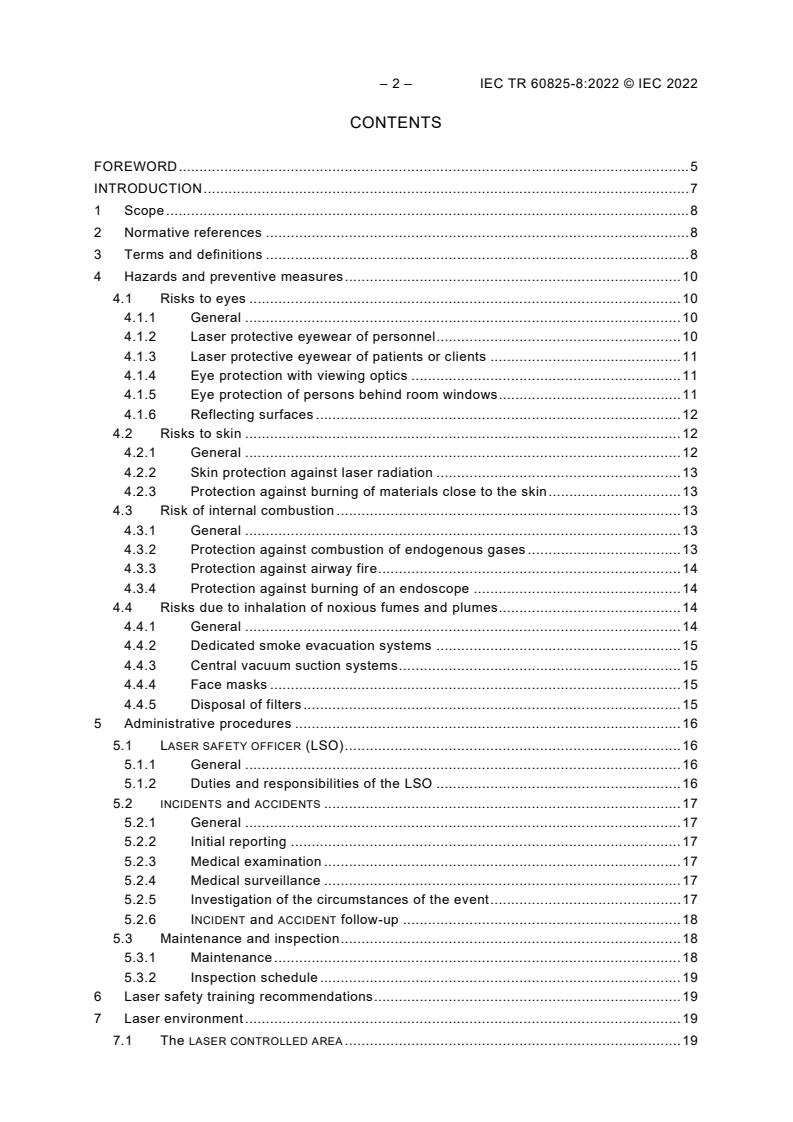
– 2 – IEC TR 60825-8:2022 © IEC 2022
CONTENTS
FOREWORD . 5
INTRODUCTION . 7
1 Scope . 8
2 Normative references . 8
3 Terms and definitions . 8
4 Hazards and preventive measures . 10
4.1 Risks to eyes . 10
4.1.1 General . 10
4.1.2 Laser protective eyewear of personnel . 10
4.1.3 Laser protective eyewear of patients or clients . 11
4.1.4 Eye protection with viewing optics . 11
4.1.5 Eye protection of persons behind room windows . 11
4.1.6 Reflecting surfaces . 12
4.2 Risks to skin . 12
4.2.1 General . 12
4.2.2 Skin protection against laser radiation . 13
4.2.3 Protection against burning of materials close to the skin . 13
4.3 Risk of internal combustion . 13
4.3.1 General . 13
4.3.2 Protection against combustion of endogenous gases . 13
4.3.3 Protection against airway fire . 14
4.3.4 Protection against burning of an endoscope . 14
4.4 Risks due to inhalation of noxious fumes and plumes. 14
4.4.1 General . 14
4.4.2 Dedicated smoke evacuation systems . 15
4.4.3 Central vacuum suction systems . 15
4.4.4 Face masks . 15
4.4.5 Disposal of filters . 15
5 Administrative procedures . 16
5.1 LASER SAFETY OFFICER (LSO) . 16
5.1.1 General . 16
5.1.2 Duties and responsibilities of the LSO . 16
5.2 INCIDENTS and ACCIDENTS . 17
5.2.1 General . 17
5.2.2 Initial reporting . 17
5.2.3 Medical examination . 17
5.2.4 Medical surveillance . 17
5.2.5 Investigation of the circumstances of the event . 17
5.2.6 INCIDENT and ACCIDENT follow-up . 18
5.3 Maintenance and inspection . 18
5.3.1 Maintenance . 18
5.3.2 Inspection schedule . 19
6 Laser safety training recommendations . 19
7 Laser environment . 19
7.1 The LASER CONTROLLED AREA . 19
7.2 Access controls. 19
7.2.1 General . 19
7.2.2 Warning signs . 19
7.2.3 Illuminated warning indicators . 20
7.2.4 Door switches and interlocks . 20
7.3 Fire protection policy. 20
Annex A (informative) Biological effects, hazards, laser equipment technology . 21
A.1 Biological effects and hazards . 21
A.1.1 General . 21
A.1.2 Hazards to the eye . 22
A.1.3 Hazards to the skin . 23
A.1.4 Determination of NOHD . 24
A.2 Laser applications . 24
A.2.1 General . 24
A.2.2 Area of application . 24
A.2.3 Types of application . 24
A.3 Laser equipment technology . 25
A.3.1 Laser radiation sources . 25
A.3.2 Laser radiation delivery systems . 25
Annex B (informative) Window shielding . 29
B.1 General . 29
B.2 Laser wavelength . 29
B.3 Resistance to fire and heat . 29
B.4 Removable attachments . 29
Annex C (informative) Checklist for laser installation. 31
C.1 General . 31
C.2 Identify . 31
C.3 Determine relevant information . 31
C.3.1 Details of laser . 31
C.3.2 Other hazards . 31
C.3.3 Application . 31
C.3.4 Life cycle . 31
C.4 Risk assessment . 32
C.4.1 General . 32
C.4.2 Laser beam . 32
C.4.3 Non-laser hazards . 32
C.5 Treatment unit . 32
C.6 Authorization and training of personnel . 33
C.7 Operating procedures . 33
C.7.1 Pre-use testing . 33
C.7.2 INCIDENT procedure . 33
C.8 Annual audit . 33
C.8.1 Installation . 33
C.8.2 Risk assessment . 33
Annex D (informative) Laser safety training. 34
Annex E (informative) Inspection schedule . 35
E.1 General . 35
E.2 Quality assurance (QA) tests . 35
– 4 – IEC TR 60825-8:2022 © IEC 2022
E.2.1 General . 35
E.2.2 Cables . 35
E.2.3 Emergency switches . 36
E.2.4 Interlocks . 36
E.2.5 Indicators . 36
E.2.6 Beam RADIANT POWER or pulse energy . 36
E.2.7 Articulated arm . 36
E.2.8 Beam coincidence . 36
E.2.9 Optical fibres . 36
E.2.10 Aiming beam. 37
E.2.11 Calibration of the RADIANT POWER (see also E.2.6) . 37
E.2.12 Specialized accessories . 37
E.2.13 Protective eyewear . 37
E.3 Preventive maintenance . 37
E.3.1 General . 37
E.3.2 Cleaning and disinfection . 38
E.3.3 Preventive maintenance checklist . 38
E.3.4 Checks prior to use . 38
Annex F (informative) Safety issues in laser applications . 40
F.1 General . 40
F.2 Use of optical fibres . 40
F.2.1 General . 40
F.2.2 Hazard summary . 40
F.2.3 Precautions . 40
F.3 Use of flexible endoscopes . 41
F.3.1 General . 41
F.3.2 Hazard summary . 41
F.3.3 Precautions . 41
F.4 Use of lasers with rigid endoscopes, microscopes and colposcopes . 42
F.4.1 General . 42
F.4.2 Hazard summary . 42
F.4.3 Precautions . 42
F.5 Use of lasers with free hand manipulation capability . 42
F.5.1 General . 42
F.5.2 Hazard summary . 42
F.5.3 Precautions . 43
F.6 Use of lasers in eye surgery . 43
F.6.1 Hazard summary . 43
F.6.2 Precautions . 43
F.7 Use of lasers in conjunction with anaesthesia . 43
F.7.1 Hazard summary . 43
F.7.2 Precautions . 43
Bibliography . 45
Table A.1 – Summary of pathological effects associated with excessive exposure
to light . 22
Table D.1 – List of training items and allocation to persons involved (arbitrary order) . 34
Table E.1 – Inspection schedule . 35
INTERNATIONAL ELECTROTECHNICAL COMMISSION
____________
SAFETY OF LASER PRODUCTS –
Part 8: Guidelines for the safe use of lasers on humans
FOREWORD
1) The International Electrotechnical Commission (IEC) is a worldwide organization for standardization comprising
all national electrotechnical committees (IEC National Committees). The object of IEC is to promote international
co-operation on all questions concerning standardization in the electrical and electronic fields. To this end and
in addition to other activities, IEC publishes International Standards, Technical Specifications, Technical Reports,
Publicly Available Specifications (PAS) and Guides (hereafter referred to as "IEC Publication(s)"). Their
preparation is entrusted to technical committees; any IEC National Committee interested in the subject dealt with
may participate in this preparatory work. International, governmental and non-governmental organizations liaising
with the IEC also participate in this preparation. IEC collaborates closely with the International Organization for
Standardization (ISO) in accordance with conditions determined by agreement between the two organizations.
2) The formal decisions or agreements of IEC on technical matters express, as nearly as possible, an international
consensus of opinion on the relevant subjects since each technical committee has representation from all
interested IEC National Committees.
3) IEC Publications have the form of recommendations for international use and are accepted by IEC National
Committees in that sense. While all reasonable efforts are made to ensure that the technical content of IEC
Publications is accurate, IEC cannot be held responsible for the way in which they are used or for any
misinterpretation by any end user.
4) In order to promote international uniformity, IEC National Committees undertake to apply IEC Publications
transparently to the maximum extent possible in their national and regional publications. Any divergence between
any IEC Publication and the corresponding national or regional publication shall be clearly indicated in the latter.
5) IEC itself does not provide any attestation of conformity. Independent certification bodies provide conformity
assessment services and, in some areas, access to IEC marks of conformity. IEC is not responsible for any
services carried out by independent certification bodies.
6) All users should ensure that they have the latest edition of this publication.
7) No liability shall attach to IEC or its directors, employees, servants or agents including individual experts and
members of its technical committees and IEC National Committees for any personal injury, property damage or
other damage of any nature whatsoever, whether direct or indirect, or for costs (including legal fees) and
expenses arising out of the publication, use of, or reliance upon, this IEC Publication or any other IEC
Publications.
8) Attention is drawn to the Normative references cited in this publication. Use of the referenced publications is
indispensable for the correct application of this publication.
9) Attention is drawn to the possibility that some of the elements of this IEC Publication may be the subject of patent
rights. IEC shall not be held responsible for identifying any or all such patent rights.
IEC TR 60825-8 has been prepared by IEC technical committee 76: Optical radiation safety and
laser equipment. It is a Technical Report.
This third edition cancels and replaces the second edition published in 2006. This edition
constitutes a technical revision.
This edition includes the following significant technical changes with respect to the previous
edition.
a) Recent medical laser equipment classified as laser class 1C is now included. Equipment of
laser class 1C incorporates sensors which ensure good contact, so that laser emission into
free space is inhibited.
b) More emphasis is given to protective eyewear of patients or clients, to the burning of
materials close to the skin and to collateral hazards such as from internal or external fire
and from noxious gases.
c) General technical update.
– 6 – IEC TR 60825-8:2022 © IEC 2022
The text of this Technical Report is based on the following documents:
Draft Report on voting
76/640/DTR 76/658/RVDTR
Full information on the voting for its approval can be found in the report on voting indicated in
the above table.
The language used for the development of this Technical Report is English.
Terms written in small capitals in this document are defined in Clause 3.
A list of all parts in the IEC 60825 series, published under the general title Safety of laser
products, can be found on the IEC website.
This document was drafted in accordance with ISO/IEC Directives, Part 2, and developed in
accordance with ISO/IEC Directives, Part 1 and ISO/IEC Directives, IEC Supplement, available
at www.iec.ch/members_experts/refdocs. The main document types developed by IEC are
described in greater detail at www.iec.ch/publications.
The committee has decided that the contents of this document will remain unchanged until the
stability date indicated on the IEC website under webstore.iec.ch in the data related to the
specific document. At this date, the document will be
• reconfirmed,
• withdrawn,
• replaced by a revised edition, or
• amended.
INTRODUCTION
Lasers emit visible or invisible optical radiation or both. In some cases, this radiation is a parallel
beam with almost no divergence. This means that the inherently high IRRADIANCE of the laser is
maintained over considerable distances. Due to the laser irradiation properties, injuries to the
eye and skin can occur. Annex A includes descriptions of laser systems and some medical
applications.
Lasers present hazards to anyone present during the operation of the laser. Serious risks of
injury, particularly to the eye, or undesired effects can result from lack of protective measures,
the use of faulty laser equipment, misdirected beams or inappropriate laser controls or settings.
Lasers which are used in contact mode on the skin may be classified as laser class 1C. These
laser systems incorporate safety means which ensure that laser radiation can only be emitted
if the interlocks detect good contact with the skin so that free space emission above the AEL of
class 1 is prohibited. When used correctly, class 1C laser systems are considered safe for the
eyes.
This document is intended to give direction as to how aspects of laser safety are incorporated
into medical laser practice. It is not intended to take precedence over existing or proposed
national guidance. However, where none exists, this document is intended to provide helpful
information.
Although the LASER USER has direct responsibility for safety during laser use, the employer,
referred to in this document as RESPONSIBLE PERSON, bears the responsibility for the setting up
of a framework for the safe use of the system. A LASER SAFETY OFFICER (LSO) can be appointed
to provide expert advice to the RESPONSIBLE PERSON and all personnel concerned with the laser
operation. This document emphasizes the need for appropriate laser safety training for all staff
involved in providing practical guidance on installation, operation, maintenance and servicing.
– 8 – IEC TR 60825-8:2022 © IEC 2022
SAFETY OF LASER PRODUCTS –
Part 8: Guidelines for the safe use of lasers on humans
1 Scope
This part of IEC 60825, which is a Technical Report, serves as a guide to the employer, the
RESPONSIBLE PERSON, the LASER SAFETY OFFICER, the LASER USER and other persons involved,
on the safe use of lasers and laser equipment classified as laser class 1C, 3B or 4 in
interventional applications of laser beams on humans, excluding use of consumer products.
NOTE Premises where lasers are used include, but are not limited to, health-care facilities, dental-care practices,
physiotherapy, beauty-care and cosmetic facilities.
This document explains the control measures recommended for the safety of the LASER USER,
patients, clients, staff, maintenance personnel and others. Engineering controls which form part
of the laser equipment or the installation are also briefly described to provide an understanding
of the general principles of protection.
The subject areas covered in this document include
– BEAM DELIVERY SYSTEMS;
– biological effects of laser radiation;
– reporting of ACCIDENTS and dangerous situations, and
– checklists.
The object of this document is to enhance the protection of persons from laser radiation and
other associated hazards by providing guidance on how to establish safety procedures,
precautions and user control measures.
Medically relevant advice such as about treatment indications, counter-indications, patient or
client condition, medical or beauty-care treatment procedures, patch testing, medication,
adverse tissue or skin conditions and follow-up controls is beyond the scope of this document.
2 Normative references
There are no normative references in this document.
3 Terms and definitions
For the purposes of this document, the following terms and definitions apply.
3.1
accident
unforeseen situation which results in an injury to any individual
3.2
beam delivery system
mechanism or device which delivers the laser output to the target site
EXAMPLE fibre optics, handpiece, micromanipulator, scanning device
3.3
incident
potentially dangerous situation which could result in an injury to any individual
3.4
irradiance
RADIANT POWER per unit irradiated area
−2
Note 1 to entry: IRRADIANCE is expressed in W⋅m .
3.5
laser controlled area
area where laser safety controls apply
3.6
laser user
user
person who controls the delivery of the laser radiation
Note 1 to entry: An assistant may control the settings such as output level, timing and stand-by or ready functions.
The responsibility for the treatment is however with the USER. When in this document any action is attributed to the
USER, it should also be understood that the action is performed by an assistant under the responsibility of the USER.
3.7
laser safety officer
LSO
person who is knowledgeable in the evaluation and control of laser hazards and has
responsibility for oversight of the control of laser hazards
Note 1 to entry: Functions and responsibilities of the LSO are regulated differently in different countries.
3.8
maximum permissible exposure
MPE
maximum level of radiation to which, under normal circumstances, persons can be exposed
without suffering permanent adverse effects
3.9
nominal ocular hazard area
NOHA
area within which the IRRADIANCE or RADIANT EXPOSURE can exceed the MPE
[SOURCE: IEC 60825-1:2014 [3], 3.64, modified – In the definition, "exceeds the appropriate
corneal maximum permissible exposure (MPE), including the possibility of accidental
misdirection of the laser beam" has been replaced by "can exceed the MPE".]
3.10
nominal ocular hazard distance
NOHD
distance from the output aperture beyond which the IRRADIANCE or RADIANT EXPOSURE remains
below the MPE
[SOURCE: IEC 60825-1:2014 [3], 3.65, modified – In the definition, "beam" has been deleted
and "appropriate corneal maximum permissible exposure (MPE)" has been replaced by "MPE".]
3.11
pulse duration
time increment measured between the half-peak power points at the leading and trailing edges
of a pulse
– 10 – IEC TR 60825-8:2022 © IEC 2022
[SOURCE: IEC 60825-1:2014 [3], 3.69]
3.12
radiant exposure
radiant energy per unit irradiated area
Note 1 to entry: For the purpose of this document, the area of the spot size on the target tissue is considered to be
the irradiated area which receives the RADIANT ENERGY. A spatially uneven distribution of the RADIANT ENERGY across
−2
ADIANT EXPOSURE is expressed in J⋅m .
the spot is neglected. See also IEC 60826-1:2014, 3,73. R
3.13
radiant power
power emitted, transferred or received in the form of radiation
Note 1 to entry: RADIANT POWER is expressed in W.
[SOURCE: IEC 60825-1:2014 [3], 3.74]
3.14
remote interlock connector
connector which permits the connection of external controls placed apart from other
components of the laser product
Note 1 to entry: Medical laser equipment usually has a REMOTE INTERLOCK CONNECTOR incorporated which is used
to attach an external switch or door switch which interrupts the laser emission when activated.
[SOURCE: IEC 60825-1:2014 [3], 3.76]
3.15
responsible person
person legally responsible for assuring safe working conditions
Note 1 to entry: The RESPONSIBLE PERSON is usually the owner of the premises, the Chief Executive Officer (CEO)
or a person in a leading position who is liable in case of an ACCIDENT in the premises.
4 Hazards and preventive measures
4.1 Risks to eyes
4.1.1 General
The eye is at risk of injury from laser radiation exceeding the MAXIMUM PERMISSIBLE EXPOSURE
(MPE). Laser radiation at wavelengths between 400 nm and 1 400 nm is focused onto the retina
resulting in permanent damage to vision. Refer to Annex A.
Any person who is present within the NOHA should be protected against unintended laser
exposure above the MPE.
Laser equipment of laser class 1C is considered safe for the eyes, as the accessible emission
is stopped or reduced to the accessible emission limits of class 1 when the laser applicator is
removed from contact with the skin or tissue. Lasers of class 1C have no NOHA. However, the
eye of the patient or client is at risk from the incorporated laser, when the laser is applied to an
area which is close to the eye.
4.1.2 Laser protective eyewear of personnel
Unless there is no reasonably foreseeable risk (as assessed by the LSO) that any person can
be exposed to laser radiation exceeding the MPE, eye protection specifically designed for the
wavelength(s) and output in use should be worn in addition to any other controls that are in
place. Eyewear should be selected and approved by the LSO. When the eyes of any person
including the treated individual are within the NOHA, then the appropriate eye protection should
be selected.
Laser protective eyewear should conform with ISO 19818-1 .
NOTE Information on safety eyewear can be found in the manufacturer's documentation.
In addition to the required marking according to eyewear standards and when different lasers
are available, an unambiguous and robust method of marking the laser safety eyewear should
be employed to ensure that there is a clear link to the laser in use and wavelength (if selectable)
for which it has been specified. The type of marking should be sufficiently permanent.
Subclause 4.1.2 does not apply to lasers of class 1C.
4.1.3 Laser protective eyewear of patients or clients
Patient eye protection can include corneoscleral eye shields (see the manufacturer's instruction
for use for possible risks), overlay external eye shields, moistened opaque cotton, pads or
towels, eye protectors, and laser protective eyewear (glasses, spectacles or goggles).
Protective eyewear should be chosen which reduces the radiant energy below the MPE.
More information can be found in ISO/TR 22463 [5] .
Laser devices of class 1C incorporate engineering controls which prevent hazardous eye
exposure to the USER and to personnel. However, the technical engineering controls possibly
do not prevent eye damage to the patient when the laser is applied to a skin area close to the
patient's or client's eye.
The extent of the NOHA will vary according to the type of laser used and the optical properties
of the applicators used. Positioning of the treatment setting in a part of the treatment room can
reduce the risk of exposure to errant beams.
4.1.4 Eye protection with viewing optics
When using viewing optics such as microscopes, colposcopes, slit lamps and other optical
devices, the person(s) looking through the eyepiece(s) should be protected with a suitable filter
or a shutter fitted to reduce the risk from radiation reflected through the vision channel. In case
of monocular optics, consideration should be given to protecting the unshielded eye.
The use of a video endoscope can overcome the problems of reflected radiation in the viewing
optics; however, it is still advisable for all persons present to wear eye protection when there is
a risk of fibre breakage, or possible firing of the laser when the fibre is retracted from the
endoscope. A risk assessment should be undertaken.
4.1.5 Eye protection of persons behind room windows
When the NOMINAL OCULAR HAZARD DISTANCE (NOHD) extends further than the nearest window,
and the wavelength of the laser is less than 2 500 nm, protection should be provided to persons
behind the window. Persons behind windows can be adequately protected by means of a
window barrier which reduces transmission to a value below the MPE. Window barriers should
meet infection control standards. For carbon dioxide lasers or other lasers which emit at wave-
lengths longer than approximately 2 500 nm, glass or plastics can provide sufficient absorption.
Windows and shields should provide sufficient protection against the maximum IRRADIANCE for
––––––––––
EN 207 [2] and ANSI Z136.7 [1] are current standards in use, although new safety eyewear conforms with
ISO 19818-1 [9].
Numbers in square brackets refer to the Bibliography.
– 12 – IEC TR 60825-8:2022 © IEC 2022
the exposure duration likely to be encountered in normal use, as identified in the risk
assessment carried out by the LSO.
For more information, see Annex B.
4.1.6 Reflecting surfaces
Reflections from glossy surfaces such as surgical instruments, mirrors, shiny jewellery,
lubricating or cooling gels or tissue surfaces can be hazardous, particularly to the unprotected
eyes. Depending on the wavelength and beam configuration, diffuse reflection of radiation from
class 4 lasers from the irradiated tissue can also be hazardous. The probability for inadvertent
exposure by reflected light should be assessed, for example in the case that eye protection is
inadequate or is not worn or is temporarily put aside. Technical means for minimizing this
probability may consist of the following:
d) Wall and ceiling surface or texture
The surface of the wall and ceiling should be chosen such that specular reflections are
minimized. A matt finish of any colour will minimize specular reflections.
e) Room equipment
Glossy surfaces are found with windows, cupboards, vent frames, sterilization cases, X-ray
viewing screens, video monitors, operating room lights, etc. Glossy surfaces reflect laser
radiation unexpectedly and unpredictably. Unless concave in shape, glossy surfaces do not
normally present a risk greater than that already present within the LASER CONTROLLED AREA.
The checklist as described in Annex C may be used.
f) Instrumentation
Care should be taken to prevent the unintentional reflection of the laser beam from an
instrument. If the laser beam is likely to hit an instrument, for instance when it is placed in
the beam path or adjacent to it, any such instruments should have a roughened surface to
diffuse the beam. Instruments which have convex shape with radii in the millimetre range
are suitable too as they also diverge the beam.
The USER should be aware that a rough surface which does not specular reflect visible light
reflects long-wavelength infra-red laser radiation such as that from a carbon dioxide laser.
Black or dark-coloured instruments become hot when the absorbed radiant energy is
sufficiently high, causing unintended patient burns. These instruments can also be
significantly reflective at infra-red wavelengths. When working in the upper respiratory
digestive tract, the USER should consider that a reflected beam or a hot instrument can
perforate the endotracheal tube, possibly igniting it, with the risk of a severe endotracheal
fire, see also 4.3.3 and Annex F.
Instruments with reflective surfaces are sometimes used to deflect the laser output onto an
otherwise inaccessible operating site. Mirrors or other reflective devices should be checked for
suitability at the laser wavelength and laser output employed.
When using laser equipment of laser class 1C, reflecting surfaces are of no concern.
4.2 Risks to skin
4.2.1 General
Depending on the radiation parameters of errant beam exposure, skin damage can occur such
as erythema, burns, blistering, and scarring. Besides the fire hazard, a collateral skin burn of
personnel, of the patient or the client can be caused by the ignition of material.
NOTE Risks to the skin of the patient or client due to unsuitable skin treatment parameters or other adverse
treatment conditions are not covered in 4.2.
4.2.2 Skin protection against laser radiation
Treatment procedures should be determined which minimize the probability for unintended skin
exposure of personnel to the treatment beam or errant or reflected radiation.
In cutaneous application, when manipulation of the tissue is necessary, protective measures
should be considered such as tongue depressors, templates or wet gauze.
4.2.3 Protection against burning of materials close to the skin
The LSO should recommend or approve the use of appropriate non-flammable or fire-retardant
materials as determined by the risk assessment. The LSO should consider using patient covers
such as drapes which are claimed by the manufacturer to be laser resistant.
NOTE Laser-resistant drapes usually conform with ISO 11810 [7].
Lasers can produce sufficient energy to ignite flammable materials particularly in an oxygen-
enriched environment. Oxygen can possibly accumulate under patient drapes or covers.
USER
Any new agent used with a laser should be checked for flammability before use. The
should consider the use of non-flammable agents (e.g. water-based). If the use of flammable
agents cannot be avoided, the drying times determined by the manufacturer should be adhered
to, allowing complete dispersal of the agent to take place.
Dry or flammable materials, including sponges, gauze pads and swabs, located near the
operating field should be moistened and then kept moistened with saline or sterile water,
throughout the use of class 4 laser equipment due to the risk of fire. Prior to releasing or placing
the delivery systems (handpiece, fibre, etc.) on the instrumentation table, the laser should be
set to stand-by mode, to avoid unintended irradiation and ignition. If available, the storage
means, as provided by the manufacturer, should be used. The delivery system should always
be under direct control of the USER. Placement of the unprotected delivery system directly on
the patient should be avoided.
Protective measures may include
a) use of wet drapes and materials to protect tissues adjacent to the target site, or in the path
of the beam;
b) if oxygen is likely to accumulate under covers or cloths, changing the location of oxygen
exhaust or providing means for ventilation;
c) eliminating flammable solutions and preparations from the target site;
d) adherence to manufacturer's drying times of skin preparations and solutions;
e) all staff be knowledgeable of location and operation of fire extinguisher appropriate for
electrical equipment and flammable materials;
f) availability of water or saline that is easily accessible to the LASER USER.
4.3 Risk of internal combustion
4.3.1 General
Fire hazards within the patient body cavities are associated with the presence of combustible
material, oxygen and energy which is capable of ignition.
4.3.2 Protection against combustion of endogenous gases
To avoid combustion of endogenous gases like methane in the gastro-intestinal tract, localized
ventilation and gas scavenging techniques should be employed.
– 14 – IEC TR 60825-8:2022 © IE
...
Questions, Comments and Discussion
Ask us and Technical Secretary will try to provide an answer. You can facilitate discussion about the standard in here.
Loading comments...