


IEC 62282-8-101:2020
(Main)Fuel cell technologies - Part 8-101: Energy storage systems using fuel cell modules in reverse mode - Test procedures for the performance of solid oxide single cells and stacks, including reversible operation
Fuel cell technologies - Part 8-101: Energy storage systems using fuel cell modules in reverse mode - Test procedures for the performance of solid oxide single cells and stacks, including reversible operation
IEC 62282-8-101:2020 addresses solid oxide cell (SOC) and stack assembly unit(s). It provides for testing systems, instruments and measuring methods to test the performance of SOC cell/stack assembly units for energy storage purposes. It assesses performance in fuel cell mode, in electrolysis mode and/or in reversible operation.
This document is intended for data exchanges in commercial transactions between cell/stack manufacturers and system developers or for acquiring data on a cell or stack in order to estimate the performance of a system based on it. Users of this document may selectively execute test items suitable for their purposes from those described in this document. Users can also substitute selected test methods of this document with equivalent test methods of IEC TS 62282-7-2 for SOC operation in fuel cell mode only.
Technologies des piles à combustible - Partie 8-101: Système de stockage de l’énergie utilisant des modules à piles à combustible en mode inversé - Procédures d'essai pour la performance des cellules élémentaires et des piles à oxyde solide, comprenant le fonctionnement reversible
l'IEC 62282-8-101:2020 traite des entités d'assemblage de cellules/piles à oxyde solide (SOC). Elle fournit des méthodes de mesure et des instruments aux systèmes afin de soumettre à l’essai la performance des entités d’assemblage de cellules/piles SOC en matière de stockage de l’énergie. Elle évalue la performance des piles à combustible, des piles à électrolyse et/ou en fonctionnement réversible.
Le présent document est destiné à être utilisé pour les échanges de données des transactions commerciales entre les fabricants de cellules/piles et les développeurs système, ou pour l’acquisition de données relatives à une cellule ou une pile permettant d’estimer la performance d’un système qui se base sur cette cellule/pile. Les utilisateurs du présent document peuvent choisir les éléments d’essai à exécuter selon leurs objectifs à partir de ceux décrits dans le présent document. Les utilisateurs peuvent également substituer les méthodes d’essai choisies dans le présent document avec des méthodes d’essai équivalentes données dans l'IEC TS 62282-7-2 pour les SOC fonctionnant en mode combustible seulement.
General Information
- Status
- Published
- Publication Date
- 17-Feb-2020
- Technical Committee
- TC 105 - Fuel cell technologies
- Drafting Committee
- MT 206 - TC 105/MT 206
- Current Stage
- PPUB - Publication issued
- Start Date
- 18-Feb-2020
- Completion Date
- 10-Jan-2020
Overview
IEC 62282-8-101:2020 is an international standard published by the International Electrotechnical Commission (IEC) that defines test procedures for solid oxide single cells and stacks used in energy storage systems with fuel cell modules operating in reverse mode, including reversible operation. This standard specifically addresses solid oxide cells (SOCs) and their stack assembly units, providing methodologies for assessing performance in fuel cell mode, electrolysis mode, or both, making it crucial for reversible energy storage solutions utilizing fuel cell technology.
The document serves as a comprehensive guideline for system developers and manufacturers of fuel cell modules, ensuring accurate, reliable, and standardized testing processes for evaluating SOC-based energy storage systems. Its application enhances data exchange capabilities and commercial transactions by enabling consistent performance evaluation metrics across the industry.
Key Topics
- Scope of Testing: Covers performance tests for solid oxide single cells and stack assemblies in multiple operation modes-fuel cell, electrolysis, and reversible modes.
- Test Environment and Safety: Defines the necessary conditions and general safety requirements for conducting tests, including gas flow control, thermal management, and electrical supply provisions.
- Measurement Methods: Details suitable instruments and measurement techniques for parameters such as gas flow rates, temperature, voltage, current, compression force, and impedance.
- Test Procedures: Includes detailed methods for:
- Current-voltage characteristics testing
- Effective reactant utilization measurement
- Durability assessments
- Temperature sensitivity evaluations
- Electrochemical impedance spectroscopy for resistance component analysis
- Cycling durability through current and thermal cycling tests
- Performance testing under pressurized conditions
- Data Handling: Guidance on data acquisition, stabilization times, measurement uncertainties, and post-processing of results for robust and reproducible test outcomes.
- Reporting: Requirements for test reporting that cover descriptions of test units, conditions, data, and uncertainty evaluations.
Applications
IEC 62282-8-101:2020 is essential for stakeholders involved in the development, manufacturing, and testing of solid oxide fuel cells and stacks used in advanced energy storage systems. Key practical applications include:
- Energy Storage Systems: Evaluating the performance of SOC modules in systems where fuel cells operate reversibly to store and deliver energy efficiently.
- Commercial Transactions: Facilitating data exchange between cell/stack manufacturers and system integrators with standardized performance metrics.
- System Design and Optimization: Providing reliable test data to estimate system-level performance based on tested cell or stack characteristics.
- Quality Control and Certification: Supporting product quality assurance through consistent and objective test procedures.
- Research and Development: Enabling comparative studies of cell and stack technologies under various operational modes and conditions.
Related Standards
- IEC TS 62282-7-2: Covers test methods for solid oxide cells operating solely in fuel cell mode, which may be used as substitutes for some test methods in IEC 62282-8-101:2020.
- Other IEC Fuel Cell Standards: The broader IEC 62282 series addresses other aspects of fuel cell technologies, including system integration, safety, and efficiency metrics, complementing the test procedures in IEC 62282-8-101.
- International Electrotechnical Vocabulary (IEV): Provides consistent terminology and definitions used across IEC standards related to electrotechnology and fuel cells.
By aligning with IEC 62282-8-101:2020, energy storage solution developers and manufacturers ensure their SOC modules meet global benchmarks for performance evaluation, enabling innovation and commercialization of reversible fuel cell technologies.

IEC 62282-8-101:2020 - Fuel cell technologies - Part 8-101: Energy storage systems using fuel cell modules in reverse mode - Test procedures for the performance of solid oxide single cells and stacks, including reversible operation
Frequently Asked Questions
IEC 62282-8-101:2020 is a standard published by the International Electrotechnical Commission (IEC). Its full title is "Fuel cell technologies - Part 8-101: Energy storage systems using fuel cell modules in reverse mode - Test procedures for the performance of solid oxide single cells and stacks, including reversible operation". This standard covers: IEC 62282-8-101:2020 addresses solid oxide cell (SOC) and stack assembly unit(s). It provides for testing systems, instruments and measuring methods to test the performance of SOC cell/stack assembly units for energy storage purposes. It assesses performance in fuel cell mode, in electrolysis mode and/or in reversible operation. This document is intended for data exchanges in commercial transactions between cell/stack manufacturers and system developers or for acquiring data on a cell or stack in order to estimate the performance of a system based on it. Users of this document may selectively execute test items suitable for their purposes from those described in this document. Users can also substitute selected test methods of this document with equivalent test methods of IEC TS 62282-7-2 for SOC operation in fuel cell mode only.
IEC 62282-8-101:2020 addresses solid oxide cell (SOC) and stack assembly unit(s). It provides for testing systems, instruments and measuring methods to test the performance of SOC cell/stack assembly units for energy storage purposes. It assesses performance in fuel cell mode, in electrolysis mode and/or in reversible operation. This document is intended for data exchanges in commercial transactions between cell/stack manufacturers and system developers or for acquiring data on a cell or stack in order to estimate the performance of a system based on it. Users of this document may selectively execute test items suitable for their purposes from those described in this document. Users can also substitute selected test methods of this document with equivalent test methods of IEC TS 62282-7-2 for SOC operation in fuel cell mode only.
IEC 62282-8-101:2020 is classified under the following ICS (International Classification for Standards) categories: 27.070 - Fuel cells; 33.180.01 - Fibre optic systems in general. The ICS classification helps identify the subject area and facilitates finding related standards.
You can purchase IEC 62282-8-101:2020 directly from iTeh Standards. The document is available in PDF format and is delivered instantly after payment. Add the standard to your cart and complete the secure checkout process. iTeh Standards is an authorized distributor of IEC standards.
Standards Content (Sample)
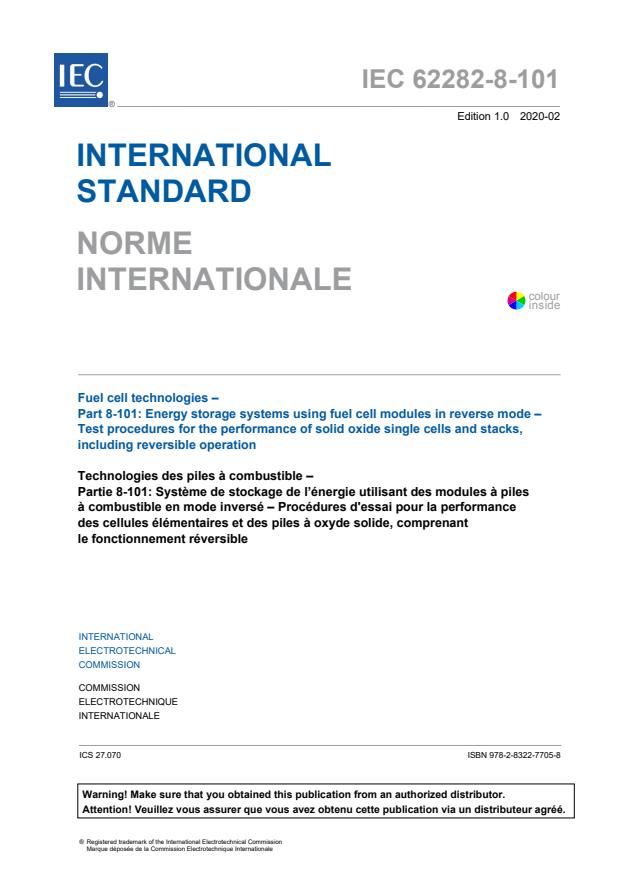
IEC 62282-8-101 ®
Edition 1.0 2020-02
INTERNATIONAL
STANDARD
NORME
INTERNATIONALE
colour
inside
Fuel cell technologies –
Part 8-101: Energy storage systems using fuel cell modules in reverse mode –
Test procedures for the performance of solid oxide single cells and stacks,
including reversible operation
Technologies des piles à combustible –
Partie 8-101: Système de stockage de l’énergie utilisant des modules à piles
à combustible en mode inversé – Procédures d'essai pour la performance
des cellules élémentaires et des piles à oxyde solide, comprenant
le fonctionnement réversible
All rights reserved. Unless otherwise specified, no part of this publication may be reproduced or utilized in any form
or by any means, electronic or mechanical, including photocopying and microfilm, without permission in writing from
either IEC or IEC's member National Committee in the country of the requester. If you have any questions about IEC
copyright or have an enquiry about obtaining additional rights to this publication, please contact the address below or
your local IEC member National Committee for further information.
Droits de reproduction réservés. Sauf indication contraire, aucune partie de cette publication ne peut être reproduite
ni utilisée sous quelque forme que ce soit et par aucun procédé, électronique ou mécanique, y compris la photocopie
et les microfilms, sans l'accord écrit de l'IEC ou du Comité national de l'IEC du pays du demandeur. Si vous avez des
questions sur le copyright de l'IEC ou si vous désirez obtenir des droits supplémentaires sur cette publication, utilisez
les coordonnées ci-après ou contactez le Comité national de l'IEC de votre pays de résidence.
IEC Central Office Tel.: +41 22 919 02 11
3, rue de Varembé info@iec.ch
CH-1211 Geneva 20 www.iec.ch
Switzerland
About the IEC
The International Electrotechnical Commission (IEC) is the leading global organization that prepares and publishes
International Standards for all electrical, electronic and related technologies.
About IEC publications
The technical content of IEC publications is kept under constant review by the IEC. Please make sure that you have the
latest edition, a corrigendum or an amendment might have been published.
IEC publications search - webstore.iec.ch/advsearchform Electropedia - www.electropedia.org
The advanced search enables to find IEC publications by a The world's leading online dictionary on electrotechnology,
variety of criteria (reference number, text, technical containing more than 22 000 terminological entries in English
committee,…). It also gives information on projects, replaced and French, with equivalent terms in 16 additional languages.
and withdrawn publications. Also known as the International Electrotechnical Vocabulary
(IEV) online.
IEC Just Published - webstore.iec.ch/justpublished
Stay up to date on all new IEC publications. Just Published IEC Glossary - std.iec.ch/glossary
details all new publications released. Available online and 67 000 electrotechnical terminology entries in English and
once a month by email. French extracted from the Terms and Definitions clause of
IEC publications issued since 2002. Some entries have been
IEC Customer Service Centre - webstore.iec.ch/csc collected from earlier publications of IEC TC 37, 77, 86 and
If you wish to give us your feedback on this publication or CISPR.
need further assistance, please contact the Customer Service
Centre: sales@iec.ch.
A propos de l'IEC
La Commission Electrotechnique Internationale (IEC) est la première organisation mondiale qui élabore et publie des
Normes internationales pour tout ce qui a trait à l'électricité, à l'électronique et aux technologies apparentées.
A propos des publications IEC
Le contenu technique des publications IEC est constamment revu. Veuillez vous assurer que vous possédez l’édition la
plus récente, un corrigendum ou amendement peut avoir été publié.
Recherche de publications IEC - Electropedia - www.electropedia.org
webstore.iec.ch/advsearchform Le premier dictionnaire d'électrotechnologie en ligne au
La recherche avancée permet de trouver des publications IEC monde, avec plus de 22 000 articles terminologiques en
en utilisant différents critères (numéro de référence, texte, anglais et en français, ainsi que les termes équivalents dans
comité d’études,…). Elle donne aussi des informations sur les 16 langues additionnelles. Egalement appelé Vocabulaire
projets et les publications remplacées ou retirées. Electrotechnique International (IEV) en ligne.
IEC Just Published - webstore.iec.ch/justpublished Glossaire IEC - std.iec.ch/glossary
Restez informé sur les nouvelles publications IEC. Just 67 000 entrées terminologiques électrotechniques, en anglais
Published détaille les nouvelles publications parues. et en français, extraites des articles Termes et Définitions des
Disponible en ligne et une fois par mois par email. publications IEC parues depuis 2002. Plus certaines entrées
antérieures extraites des publications des CE 37, 77, 86 et
Service Clients - webstore.iec.ch/csc CISPR de l'IEC.
Si vous désirez nous donner des commentaires sur cette
publication ou si vous avez des questions contactez-nous:
sales@iec.ch.
IEC 62282-8-101 ®
Edition 1.0 2020-02
INTERNATIONAL
STANDARD
NORME
INTERNATIONALE
colour
inside
Fuel cell technologies –
Part 8-101: Energy storage systems using fuel cell modules in reverse mode –
Test procedures for the performance of solid oxide single cells and stacks,
including reversible operation
Technologies des piles à combustible –
Partie 8-101: Système de stockage de l’énergie utilisant des modules à piles
à combustible en mode inversé – Procédures d'essai pour la performance
des cellules élémentaires et des piles à oxyde solide, comprenant
le fonctionnement réversible
INTERNATIONAL
ELECTROTECHNICAL
COMMISSION
COMMISSION
ELECTROTECHNIQUE
INTERNATIONALE
ICS 27.070 ISBN 978-2-8322-7705-8
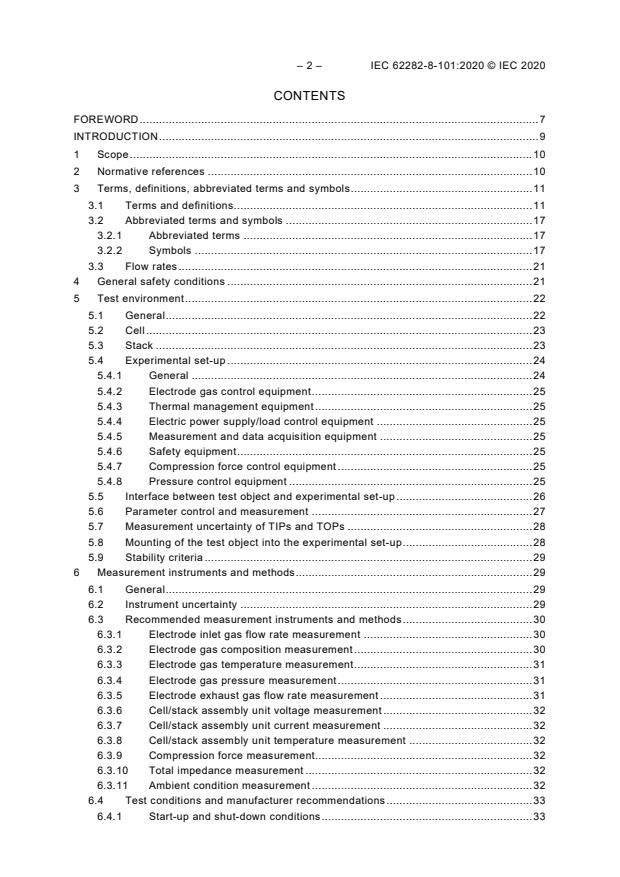
– 2 – IEC 62282-8-101:2020 © IEC 2020
CONTENTS
FOREWORD . 7
INTRODUCTION . 9
1 Scope . 10
2 Normative references . 10
3 Terms, definitions, abbreviated terms and symbols . 11
3.1 Terms and definitions . 11
3.2 Abbreviated terms and symbols . 17
3.2.1 Abbreviated terms . 17
3.2.2 Symbols . 17
3.3 Flow rates . 21
4 General safety conditions . 21
5 Test environment . 22
5.1 General . 22
5.2 Cell . 23
5.3 Stack . 23
5.4 Experimental set-up . 24
5.4.1 General . 24
5.4.2 Electrode gas control equipment . 25
5.4.3 Thermal management equipment . 25
5.4.4 Electric power supply/load control equipment . 25
5.4.5 Measurement and data acquisition equipment . 25
5.4.6 Safety equipment . 25
5.4.7 Compression force control equipment . 25
5.4.8 Pressure control equipment . 25
5.5 Interface between test object and experimental set-up . 26
5.6 Parameter control and measurement . 27
5.7 Measurement uncertainty of TIPs and TOPs . 28
5.8 Mounting of the test object into the experimental set-up . 28
5.9 Stability criteria . 29
6 Measurement instruments and methods . 29
6.1 General . 29
6.2 Instrument uncertainty . 29
6.3 Recommended measurement instruments and methods . 30
6.3.1 Electrode inlet gas flow rate measurement . 30
6.3.2 Electrode gas composition measurement . 30
6.3.3 Electrode gas temperature measurement . 31
6.3.4 Electrode gas pressure measurement . 31
6.3.5 Electrode exhaust gas flow rate measurement . 31
6.3.6 Cell/stack assembly unit voltage measurement . 32
6.3.7 Cell/stack assembly unit current measurement . 32
6.3.8 Cell/stack assembly unit temperature measurement . 32
6.3.9 Compression force measurement. 32
6.3.10 Total impedance measurement . 32
6.3.11 Ambient condition measurement . 32
6.4 Test conditions and manufacturer recommendations . 33
6.4.1 Start-up and shut-down conditions . 33
6.4.2 Range of test conditions . 33
6.4.3 Stabilization, initialization conditions and stable state . 33
6.4.4 Dwell time, equilibration time, acquisition time . 33
6.5 Data acquisition method . 34
7 Test procedures and computation of results. 34
7.1 General . 34
7.2 Current-voltage characteristics test . 34
7.2.1 Objective of this test . 34
7.2.2 Test method . 34
7.2.3 Data post-processing . 35
7.3 Effective reactant utilization test . 35
7.3.1 Objective of this test . 35
7.3.2 Test method . 35
7.3.3 Data post-processing . 36
7.4 Durability test . 36
7.4.1 Objective of this test . 36
7.4.2 Test method . 37
7.4.3 Data post-processing . 37
7.5 Temperature sensitivity test . 37
7.5.1 Objective of this test . 37
7.5.2 Test method . 38
7.5.3 Data post-processing . 38
7.6 Separation of resistance components test via electrochemical impedance
spectroscopy . 39
7.6.1 Objective of this test . 39
7.6.2 Test method . 39
7.6.3 Data post-processing . 40
7.7 Current cycling durability test . 40
7.7.1 Objective of this test . 40
7.7.2 Test method . 41
7.7.3 Data post-processing . 41
7.8 Thermal cycling test . 41
7.8.1 Objective . 41
7.8.2 Test method . 41
7.8.3 Data post-processing . 42
7.9 Pressurized test . 42
7.9.1 Objective of this test . 42
7.9.2 Test method . 42
7.9.3 Data post-processing . 43
8 Test report . 43
8.1 General . 43
8.2 Report items . 43
8.3 Test unit data description . 43
8.4 Test condition description . 44
8.5 Test data description . 44
8.6 Uncertainty evaluation . 44
Annex A (normative) Detailed test procedures . 45
A.1 Test objective . 45
A.2 Test set-up . 45
– 4 – IEC 62282-8-101:2020 © IEC 2020
A.3 Current-voltage characteristics test (7.2). 46
A.3.1 Test input parameters (TIPs) . 46
A.3.2 Test output parameters (TOPs) . 46
A.3.3 Derived quantities . 47
A.3.4 Measurement of current-voltage characteristics . 47
A.4 Effective reactant utilization test (7.3) . 49
A.4.1 Test input parameters (TIPs) . 49
A.4.2 Test output parameters (TOPs) . 51
A.4.3 Derived quantities . 51
A.4.4 Measurement of effective reactant utilization . 52
A.5 Durability test (7.4) . 53
A.5.1 Test input parameters (TIPs) . 53
A.5.2 Test output parameters (TOPs) . 53
A.5.3 Derived quantities . 54
A.5.4 Measurement of durability . 54
A.6 Temperature sensitivity test (7.5) . 55
A.6.1 Test input parameters (TIPs) . 55
A.6.2 Test output parameters (TOPs) . 56
A.6.3 Derived quantities . 56
A.6.4 Measurement of temperature sensitivity . 57
A.7 Separation of resistance components test via electrochemical impedance
spectroscopy (7.6) . 58
A.7.1 Test input parameters (TIPs) . 58
A.7.2 Test output parameters (TOPs) . 58
A.7.3 Derived quantities . 59
A.7.4 Measurement of resistance components via EIS . 59
A.7.5 Measuring range of frequencies . 59
A.8 Current cycling durability test (7.7). 60
A.8.1 Test input parameters (TIPs) . 60
A.8.2 Test output parameters (TOPs) . 60
A.8.3 Derived quantities . 61
A.8.4 Measurement of current cycling durability . 61
A.9 Thermal cycling test (7.8) . 64
A.9.1 Test input parameters (TIPs) . 64
A.9.2 Test output parameters (TOPs) . 65
A.9.3 Derived quantities . 65
A.9.4 Measurement of thermal cycling . 66
A.10 Pressurized test (7.9) . 68
A.10.1 Test input parameters (TIPs) . 68
A.10.2 Test output parameters (TOPs) . 69
A.10.3 Derived quantities . 69
A.10.4 Measurement of pressurized test . 69
Annex B (informative) Guidelines for electrochemical impedance spectroscopy (EIS) . 71
B.1 General principles . 71
B.2 EIS test equipment and set-up . 72
B.3 Representation of results . 73
B.4 Analysis and simulation of data . 75
Annex C (normative) Formulae for calculation of utilization values . 76
C.1 Generic formulae . 76
C.2 Degradation . 76
C.3 Area-specific resistance (ASR) . 77
C.4 Temperatures . 77
Bibliography . 78
Figure 1 – Exploded schematic representation of a planar-type single cell test object
consisting of a SOC in a cell housing . 23
Figure 2 – Schematic representation of a planar-geometry SOC stack test object with N
RU including supporting structure (top and bottom plates) . 24
Figure 3 – Schematic representation of a test environment for a SOC cell/stack
assembly unit . 24
Figure 4 – Test environment with interfaces between SOC cell and experimental set-up . 26
Figure 5 – Test environment with interfaces between SOC stack and experimental
set‑up . 27
Figure A.1 – Qualitative representation of TIPs when carrying out a current-voltage
characteristics test for combined (SOFC and SOEC) operation . 48
Figure A.2 – Schematic representation of the current-voltage characteristics test
procedure for two consecutive set points k and k + 1 . 48
Figure A.3 – Schematic representation of a J-V curve in both electrolysis and fuel cell
modes . 49
Figure A.4 – Qualitative representation of TIPs when carrying out an effective reactant
utilization test varying the negative electrode reactant flow rate (q ), consisting
V,neg,in
of hydrogen and nitrogen . 52
Figure A.5 – Qualitative representation of TIPswhen carrying out a durability test (in
galvanostatic mode) . 55
Figure A.6 – Qualitative representation of TIPs when carrying out a temperature
sensitivity test . 57
Figure A.7 – Qualitative representation of TIPs when carrying out a current cycling
durability test . 63
Figure A.8 – Current profile of a SOEC system with fast switch on/off at thermoneutral
conditions . 64
Figure A.9 – Current profile of a SOEC system with fast switch on/off at exothermal
conditions . 64
Figure A.10 – Current profile of a load-following SOEC system and thermoneutral
conditions . 64
Figure A.11 – Current profile of a load-following SOEC system and exothermal
conditions . 64
Figure A.12 – General evolution of TIPs during test: continuous thermal cycling above
600 °C (in this case with zero electric current) . 67
Figure A.13 – General evolution of TIPs during test: thermal cycling below 600 °C with
gas and current changes (coupling with operation at constant current for instance) . 68
Figure B.1 – Input/output signals during electrochemical impedance spectroscopy
(EIS) of a solid oxide fuel/electrolysis cell . 72
Figure B.2 – Test set-up for electrochemical impedance spectroscopy of a planar solid
oxide fuel cell/electrolysis stack with 5 RUs . 73
Figure B.3 – Bode plot representing the modulus of impedance and phase angle
against excitation frequency . 74
Figure B.4 – Nyquist plot, representing conjugate imaginary part against real part of
impedance . 75
– 6 – IEC 62282-8-101:2020 © IEC 2020
Table 1 – Symbols . 18
Table 2 – Stability criteria for TIPs and TOPs as a reference . 29
Table 3 – Instrument uncertainty for each quantity to be measured . 30
Table A.1 – Test input parameters (TIPs) for current-voltage characteristics test . 46
Table A.2 – Test output parameters (TOPs) for current-voltage characteristics test . 47
Table A.3 – Derived quantities for current-voltage characteristics test . 47
Table A.4 – Test input parameters (TIPs) for negative electrode reactant utilization test . 50
Table A.5 – Test input parameters (TIPs) for positive electrode reactant utilization test . 50
Table A.6 – Test output parameters (TOPs) for effective reactant utilization test . 51
Table A.7 – Derived quantities for effective reactant utilization test . 52
Table A.8 – Test input parameters (TIPs) for durability test . 53
Table A.9 – Test output parameters (TOPs) for durability test . 54
Table A.10 – Derived quantities for constant load durability test . 54
Table A.11 – Test input parameters (TIPs) for temperature sensitivity test . 55
Table A.12 – Test output parameters (TOPs) for temperature sensitivity test . 56
Table A.13 – Derived quantities for temperature sensitivity test . 56
Table A.14 – Test input parameters (TIPs) for EIS test . 58
Table A.15 – Test output parameters (TOPs) for EIS test . 59
Table A.16 – Derived quantities for EIS test . 59
Table A.17 – Test input parameters (TIPs) for current cycling durability test within a
single operating mode (fuel cell or electrolysis) . 60
Table A.18 – Test input parameters (TIPs) for current cycling durability test covering
both operating modes (fuel cell and electrolysis) . 60
Table A.19 – Test output parameters (TOPs) for current cycling durability test . 61
Table A.20 – Derived quantities for current cycling durability test . 61
Table A.21 – Test input parameters (TIPs) for thermal cycling . 65
Table A.22 – Test output parameters (TOPs) for thermal cycling . 65
Table A.23 – Derived quantities for thermal cycling test . 66
Table A.24 – Test input parameters (TIPs) for pressurized testing . 69
Table A.25 – Test output parameters (TOPs) for pressurized testing. 69
Table A.26 – Derived quantities for pressurized test . 69
Table C.1 – Generic formulae . 76
INTERNATIONAL ELECTROTECHNICAL COMMISSION
____________
FUEL CELL TECHNOLOGIES –
Part 8-101: Energy storage systems using fuel cell modules
in reverse mode – Test procedures for the performance of solid oxide
single cells and stacks, including reversible operation
FOREWORD
1) The International Electrotechnical Commission (IEC) is a worldwide organization for standardization comprising
all national electrotechnical committees (IEC National Committees). The object of IEC is to promote international
co-operation on all questions concerning standardization in the electrical and electronic fields. To this end and
in addition to other activities, IEC publishes International Standards, Technical Specifications, Technical Reports,
Publicly Available Specifications (PAS) and Guides (hereafter referred to as "IEC Publication(s)"). Their
preparation is entrusted to technical committees; any IEC National Committee interested in the subject dealt with
may participate in this preparatory work. International, governmental and non-governmental organizations liaising
with the IEC also participate in this preparation. IEC collaborates closely with the International Organization for
Standardization (ISO) in accordance with conditions determined by agreement between the two organizations.
2) The formal decisions or agreements of IEC on technical matters express, as nearly as possible, an international
consensus of opinion on the relevant subjects since each technical committee has representation from all
interested IEC National Committees.
3) IEC Publications have the form of recommendations for international use and are accepted by IEC National
Committees in that sense. While all reasonable efforts are made to ensure that the technical content of IEC
Publications is accurate, IEC cannot be held responsible for the way in which they are used or for any
misinterpretation by any end user.
4) In order to promote international uniformity, IEC National Committees undertake to apply IEC Publications
transparently to the maximum extent possible in their national and regional publications. Any divergence between
any IEC Publication and the corresponding national or regional publication shall be clearly indicated in the latter.
5) IEC itself does not provide any attestation of conformity. Independent certification bodies provide conformity
assessment services and, in some areas, access to IEC marks of conformity. IEC is not responsible for any
services carried out by independent certification bodies.
6) All users should ensure that they have the latest edition of this publication.
7) No liability shall attach to IEC or its directors, employees, servants or agents including individual experts and
members of its technical committees and IEC National Committees for any personal injury, property damage or
other damage of any nature whatsoever, whether direct or indirect, or for costs (including legal fees) and
expenses arising out of the publication, use of, or reliance upon, this IEC Publication or any other IEC Publications.
8) Attention is drawn to the Normative references cited in this publication. Use of the referenced publications is
indispensable for the correct application of this publication.
9) Attention is drawn to the possibility that some of the elements of this IEC Publication may be the subject of patent
rights. IEC shall not be held responsible for identifying any or all such patent rights.
International Standard IEC 62282-8-101 has been prepared by IEC technical committee 105:
Fuel cell technologies.
The text of this International Standard is based on the following documents:
FDIS Report on voting
105/765/FDIS 105/779/RVD
Full information on the voting for the approval of this International Standard can be found in the
report on voting indicated in the above table.
This document has been drafted in accordance with the ISO/IEC Directives, Part 2.
A list of all parts in the IEC 62282 series, published under the general title Fuel cell technologies,
can be found on the IEC website.
– 8 – IEC 62282-8-101:2020 © IEC 2020
The committee has decided that the contents of this document will remain unchanged until the
stability date indicated on the IEC website under "http://webstore.iec.ch" in the data related to
the specific document. At this date, the document will be
• reconfirmed,
• withdrawn,
• replaced by a revised edition, or
• amended.
IMPORTANT – The 'colour inside' logo on the cover page of this publication indicates
that it contains colours which are considered to be useful for the correct understanding
of its contents. Users should therefore print this document using a colour printer.
INTRODUCTION
This document describes test methods for a single cell or stack (denoted as "cell/stack"
hereafter) that are intended for application to energy storage systems using solid oxide fuel
cells (SOFC) in combination with solid oxide electrolysis cells (SOEC), or directly using
reversible solid oxide cells (Re-SOC, see Note in Clause 1). The test methods aim to provide
guidelines for the characterization of real-time performance and durability of the cell/stack.
SOFC, SOEC and Re-SOC have a broad range of geometries (e.g. planar, tubular and their
variations) and size. As such, in general, peripherals like current collectors and gas manifolds
are unique to each cell or stack and are often incorporated into a cell or stack to form one
integrated unit. In addition, they tend to have a significant effect on the power generation
characteristics of the cell or stack. This document therefore introduces as its subject "cell/stack
assembly units", which are defined as those units containing not only a cell or a stack but also
peripherals.
This document is generally applicable to all types or geometries of SOFC, SOEC and Re-SOC,
unless where explicitly mentioned.
IEC 62282-8 (all parts) aims to develop performance test methods for power storage and
buffering systems based on electrochemical modules (combining electrolysis and fuel cells, in
particular reversible fuel cells), taking into consideration both options of re-electrification and
substance (and heat) production for sustainable integration of renewable energy sources.
Under the general title "Energy storage systems using fuel cell modules in reverse mode", the
IEC 62282-8 series will consist of the following parts:
• IEC 62282-8-101: Test procedures for the performance of solid oxide single cells and stacks,
including reversible operation
• IEC 62282-8-102: Test procedures for the performance of single cells and stacks with proton
exchange membranes, including reversible operation
• IEC 62282-8-103 : Alkaline single cell and stack performance including reversible operation
• IEC 62282-8-201: Test procedures for the performance of power-to-power systems
• IEC 62282-8-202 : Power-to-power systems – Safety
• IEC 62282-8-300 series : Power-to-substance systems
As a priority dictated by the emerging needs for industry and opportunities for technological
development, IEC 62282-8-101, IEC 62282-8-102 and IEC 62282-8-201 have been initiated
jointly and as a priority. These documents are presented as a package to highlight the need for
an integrated approach as regards the system application (i.e. a solution for energy storage)
and its fundamental constituent components (i.e. fuel cells operated in reverse or reversible
mode).
IEC 62282-8-103, IEC 62282-8-202 and IEC 62282-8-300 (all parts) are suggested but are left
for initiation at a later stage.
___________
Under consideration.
Under consideration.
Under consideration.
– 10 – IEC 62282-8-101:2020 © IEC 2020
FUEL CELL TECHNOLOGIES –
Part 8-101: Energy storage systems using fuel cell modules
in reverse mode – Test procedures for the performance of solid oxide
single cells and stacks, including reversible operation
1 Scope
This part of IEC 62282 addresses solid oxide cell (SOC) and stack assembly unit(s). It provides
for testing systems, instruments and measuring methods to test the performance of SOC
cell/stack assembly units for energy storage purposes. It assesses performance in fuel cell
mode, in electrolysis mode and/or in reversible operation.
This document is not applicable to small button cells that are designed for SOC material testing
and provide no practical means of reactant utilization measurement, or to single-chamber SOC.
This document is not intended to be applied to fuel cell/stack assembly units for power
generation purposes only, since this is covered in IEC TS 62282-7-2. Therefore, test methods
are not included in this document that are applicable to fuel cell mode only and that are already
described in IEC TS 62282-7-2.
This document is intended for data exchanges in commercial transactions between cell/stack
manufacturers and system developers or for acquiring data on a cell or stack in order to estimate
the performance of a system based on it. Users of this document may selectively execute test
items suitable for their purposes from those described in this document. Users can also
substitute selected test methods of this document with equivalent test methods of IEC TS
62282-7-2 for SOC operation in fuel cell mode only.
NOTE 1 In the context of this document, the term "reversible" does not refer to the thermodynamic meaning of an
ideal process. It is common practice in the fuel cell community to call the operation mode of a solid oxide cell that
alternates between fuel cell mode and electrolysis mode "reversible".
NOTE 2 This document considers only steam electrolysis. Other reactants in electrolysis mode can be used,
provided appropriate measures are taken for handling the specific reactants and products, and the guidelines as
regards the measurement, control and post-test analysis of results are adapted accordingly.
2 Normative references
The following documents are referred to in the text in such a way that some or all of their content
constitutes requirements of this document. For dated references, only the edition cited applies.
For undated references, the latest edition of the referenced document (including any
amendments) applies.
IEC 60050-485, International Electrotechnical Vocabulary – Part 485: Fuel cell technologies
(available at www.electropedia.org)
IEC 61515:2016, Mineral insulated metal-sheathed thermocouple cables and thermocouples
IEC 60584-1, Thermocouples – Part 1: EMF specifications and tolerances
IEC 60584-3, Thermocouples – Part 3: Extension and compensating cables – Tolerances and
identification system
ISO 5168, Measurement of fluid flow – Procedures for the evaluation of uncertainties
ISO 6141, Gas analysis – Contents of certificates for calibration gas mixtures
ISO 6142-1, Gas analysis – Preparation of calibration gas mixtures – Part 1: Gravimetric
method for Class I mixtures
ISO 6143, Gas analysis – Comparison methods for determining and checking the composition
of calibration gas mixtures
ISO 6145-7, Gas analysis – Preparation of calibration gas mixtures using dynamic volumetric
methods – Part 7: Thermal mass-flow controllers
ISO 6974 (all parts), Natural gas – Determination of composition with defined uncertainty by
gas chromatography
ISO 7066-2, Assessment of uncertainty in the calibration and use of flow measurement devices
– Part 2: Non-linear calibration relationships
ISO 8756, Air quality – Handling of temperature, pressure and humidity data
3 Terms, definitions, abbreviated terms and symbols
3.1 Terms and definitions
For the purposes of this document, the terms and definitions given in IEC 60050-485 and the
following a
...
The IEC 62282-8-101:2020 standard is a comprehensive document that addresses the testing procedures for solid oxide cell (SOC) and stack assembly units specifically designed for energy storage systems leveraging fuel cell technologies. Its primary scope encompasses the evaluation of performance in various operational modes-fuel cell mode, electrolysis mode, and reversible operation-making it a crucial reference for developers and manufacturers working in this field. One of the significant strengths of this standard is its focus on providing standardized test procedures, which ensures consistency and reliability in the performance assessment of SOC cells and stacks. The inclusion of specific testing systems, instruments, and measuring methodologies streamlines the process for manufacturers and system developers, enhancing the credibility of performance evaluations across the industry. This facilitates meaningful data exchanges in commercial transactions, fostering trust between cell/stack manufacturers and system developers. Furthermore, the flexibility inherent in IEC 62282-8-101:2020 allows users to selectively implement test items that are relevant to their specific operational requirements. This adaptability ensures that different stakeholders can tailor their testing approaches without compromising on the standard's integrity. Additionally, the option to substitute test methods with those outlined in IEC TS 62282-7-2 for SOC operation in fuel cell mode further broadens the applicability of the standard, enhancing its relevance in practical scenarios. Overall, the IEC 62282-8-101:2020 standard plays a vital role in advancing the field of fuel cell technologies by establishing robust testing frameworks for energy storage systems. Its clear articulation of procedures and methodologies equips users with the needed tools to accurately assess performance, thereby driving innovation and efficiency in the deployment of solid oxide cells and stacks in various applications.
IEC 62282-8-101:2020 표준은 고체 산화물 전지(SOC) 및 스택 조립 유닛의 성능을 검증하기 위한 중요한 테스트 절차를 제공합니다. 이 표준의 범위는 에너지 저장 시스템에서 연료 전지 모드, 전해조 모드 및 가역 작동에서의 성능을 평가하는 데 중점을 두고 있습니다. 특히, SOC 셀 및 스택 조립 유닛의 성능을 측정하는 시스템과 기구, 측정 방법을 상세히 규명하여 적용성을 높이고 있습니다. 이 표준의 강점은 상업적 거래에서 셀 및 스택 제조업체와 시스템 개발자 간의 데이터 교환을 용이하게 한다는 점입니다. 이는 각 사용자들이 자신의 목적에 맞는 테스트 항목을 선택적으로 수행할 수 있도록 하여, 실용성과 효율성을 증대시킵니다. 또한, 연료 전지 모드에서만 SOC 작동을 위한 IEC TS 62282-7-2의 동등한 테스트 방법으로 교체 가능하다는 점은 다양한 테스트 접근 방식을 허용하여 사용자의 필요에 부합하는 유연성을 제공합니다. IEC 62282-8-101:2020은 고체 산화물 셀 및 스택의 성능을 평가하는 데 있어 신뢰할 수 있는 기준을 제시하며, 연료 전지 기술의 발전과 에너지 저장 시스템의 효율적인 운영을 지원하는 데에 큰 기여를 하고 있습니다. 이 표준은 현시점에서 에너지 저장 분야에서의 연구 및 개발에 필수적이며, 지속 가능한 에너지 솔루션 확보를 위한 중요한 자원으로 자리잡고 있습니다.
IEC 62282-8-101:2020は、固体酸化物セル(SOC)およびスタックアセンブリユニットに関する標準であり、エネルギー貯蔵システムにおける燃料電池モジュールの逆モードを利用した性能試験手順を提供します。この標準は、SOCセルおよびスタックアセンブリユニットの性能をテストするためのシステム、機器、測定方法を網羅しており、燃料電池モード、電解モード、または可逆運転における性能を評価します。 この文書は、セル/スタックメーカーとシステム開発者間の商業取引におけるデータ交換を目的とし、特定のセルまたはスタックに関するデータを取得することで、基にしたシステムの性能を推定するためのものであります。IEC 62282-8-101:2020は、エネルギー貯蔵の分野における固体酸化物技術に特化しており、ユーザーが目的に応じた試験項目を選択して実施できる柔軟性を提供します。また、ユーザーは、燃料電池モードにおけるSOC運転のためのIEC TS 62282-7-2に記載された同等の試験方法と選択した試験方法を置き換えることも可能です。 この標準の強みは、その広範な適用範囲と明確な試験手続きにあります。エネルギー貯蔵技術の進展に伴い、SOCセルおよびスタックの性能の正確な評価が求められる中で、IEC 62282-8-101:2020は、業界の要望に応えるための重要な文書となっています。また、可逆運転のテスト手続きも含まれているため、より高い効率と利用可能性を求める現代のエネルギーシステムにおいて、その関連性も高いです。 したがって、IEC 62282-8-101:2020は、燃料電池技術の進化に対応し、業界のニーズに合致した確かな基準を提供する、非常に重要かつ有用な標準であると言えます。
Questions, Comments and Discussion
Ask us and Technical Secretary will try to provide an answer. You can facilitate discussion about the standard in here.
Loading comments...