

IEC TR 62660-4:2017
(Main)Secondary lithium-ion cells for the propulsion of electric road vehicles - Part 4: Candidate alternative test methods for the internal short circuit test of IEC 62660-3
General Information
- Abstract
IEC TR 62660-4:2017(E) provides the test data on the candidate alternative test methods for the internal short circuit test according to 6.4.4.2.2 of IEC 62660-3:2016. The internal short circuit test in this document is intended to simulate an internal short circuit of a cell caused by the contamination of conductive particle, and to verify the safety performance of the cell under such conditions.
This document is applicable to the secondary lithium-ion cells and cell blocks used for propulsion of electric vehicles (EV) including battery electric vehicles (BEV) and hybrid electric vehicles (HEV).
This document does not cover cylindrical cells.
- Status
- Withdrawn
- Publication Date
- 12-Feb-2017
- Withdrawal Date
- 30-Jul-2026
- Technical Committee
- TC 21 - Secondary cells and batteries
- Current Stage
- WPUB - Publication withdrawn
- Start Date
- 31-Jul-2026
- Completion Date
- 31-Jul-2026
Buy Documents
IEC TR 62660-4:2017 - Secondary lithium-ion cells for the propulsion of electric road vehicles - Part 4: Candidate alternative test methods for the internal short circuit test of IEC 62660-3 Released:2/13/2017
Overview
IEC TR 62660-4:2017 is a Technical Report from the IEC that provides candidate alternative test methods for the internal short circuit (ISC) test referenced in IEC 62660-3:2016. Its purpose is to supply test data and practical procedures to simulate an internal short circuit caused by conductive-particle contamination inside secondary lithium‑ion cells and cell blocks used for the propulsion of electric road vehicles (EV), including BEV and HEV. The report is intended for pouch and prismatic chemistries (note: cylindrical cells are excluded).
Key topics and requirements
- Scope and applicability: Alternative ISC methods to supplement the IEC 62660-3 ISC requirement (6.4.4.2.2), applicable to cells and cell blocks for vehicle propulsion.
- Test method structure: Detailed sections for test preparation, test set-up, test execution, and acceptance criteria. A recommended specifications table and examples of test setups are provided.
- Example apparatus and setups: Illustrative setups (e.g., ceramic nail with Ni tip) and wiring/measurement schematics are included to demonstrate practical implementations.
- Data and evaluation: Annex A contains test data, voltage and temperature plots, and tabulated ISC test results to support method validation and interpretation.
- Safety and facility requirements: Tests are to be carried out in facilities capable of containing hazardous reactions (up to explosion) with trained personnel; alternative methods are intended where the IEC 62619 open‑cell procedure may be impractical.
- General provisions: Conditions under which alternative methods may be used must be agreed between customer and supplier (e.g., ensuring case deformation does not thermally/electrically bias the ISC).
Applications and who uses it
IEC TR 62660-4 is primarily useful for:
- Battery manufacturers validating cell safety against internal contamination-driven short circuits.
- Automotive OEMs and battery pack integrators specifying supplier acceptance tests for EV/HEV propulsion cells.
- Independent test laboratories implementing alternative ISC protocols where disassembly-based methods are undesirable.
- Safety engineers and certification bodies seeking documented test data and accepted alternative procedures to complement IEC 62660-3 compliance strategies.
Practical uses include method selection and validation, test-lab protocol development, supplier–customer agreements on acceptable ISC procedures, and risk assessment for cell-level failure modes.
Related standards
- IEC 62660-3:2016 - Secondary lithium‑ion cells for propulsion of electric road vehicles - Part 3: Safety requirements (reference for ISC requirements).
- IEC 62619:2017 - Safety requirements for secondary lithium cells and batteries (basis for the original ISC method).
Keywords: IEC TR 62660-4:2017, internal short circuit test, lithium-ion cells, EV battery safety, alternative test methods, IEC 62660-3, IEC 62619.
Buy Documents
IEC TR 62660-4:2017 - Secondary lithium-ion cells for the propulsion of electric road vehicles - Part 4: Candidate alternative test methods for the internal short circuit test of IEC 62660-3 Released:2/13/2017
Get Certified
Connect with accredited certification bodies for this standard

IMQ S.p.A. (Certification)
Italian electrical product certification.

SLG Prüf- und Zertifizierungs GmbH
German testing and certification body.

UL Solutions
Global safety science company with testing, inspection and certification.
Sponsored listings
Frequently Asked Questions
IEC TR 62660-4:2017 is a technical report published by the International Electrotechnical Commission (IEC). Its full title is "Secondary lithium-ion cells for the propulsion of electric road vehicles - Part 4: Candidate alternative test methods for the internal short circuit test of IEC 62660-3". This standard covers: IEC TR 62660-4:2017(E) provides the test data on the candidate alternative test methods for the internal short circuit test according to 6.4.4.2.2 of IEC 62660-3:2016. The internal short circuit test in this document is intended to simulate an internal short circuit of a cell caused by the contamination of conductive particle, and to verify the safety performance of the cell under such conditions. This document is applicable to the secondary lithium-ion cells and cell blocks used for propulsion of electric vehicles (EV) including battery electric vehicles (BEV) and hybrid electric vehicles (HEV). This document does not cover cylindrical cells.
IEC TR 62660-4:2017(E) provides the test data on the candidate alternative test methods for the internal short circuit test according to 6.4.4.2.2 of IEC 62660-3:2016. The internal short circuit test in this document is intended to simulate an internal short circuit of a cell caused by the contamination of conductive particle, and to verify the safety performance of the cell under such conditions. This document is applicable to the secondary lithium-ion cells and cell blocks used for propulsion of electric vehicles (EV) including battery electric vehicles (BEV) and hybrid electric vehicles (HEV). This document does not cover cylindrical cells.
IEC TR 62660-4:2017 is classified under the following ICS (International Classification for Standards) categories: 29.220.20 - Acid secondary cells and batteries. The ICS classification helps identify the subject area and facilitates finding related standards.
IEC TR 62660-4:2017 is available in PDF format for immediate download after purchase. The document can be added to your cart and obtained through the secure checkout process. Digital delivery ensures instant access to the complete standard document.
Standards Content (Sample)
IEC TR 62660-4 ®
Edition 1.0 2017-02
TECHNICAL
REPORT
colour
inside
Secondary lithium-ion cells for the propulsion of electric road vehicles –
Part 4: Candidate alternative test methods for the internal short circuit test of
IEC 62660-3
All rights reserved. Unless otherwise specified, no part of this publication may be reproduced or utilized in any form
or by any means, electronic or mechanical, including photocopying and microfilm, without permission in writing from
either IEC or IEC's member National Committee in the country of the requester. If you have any questions about IEC
copyright or have an enquiry about obtaining additional rights to this publication, please contact the address below or
your local IEC member National Committee for further information.
IEC Central Office Tel.: +41 22 919 02 11
3, rue de Varembé Fax: +41 22 919 03 00
CH-1211 Geneva 20 info@iec.ch
Switzerland www.iec.ch
About the IEC
The International Electrotechnical Commission (IEC) is the leading global organization that prepares and publishes
International Standards for all electrical, electronic and related technologies.
About IEC publications
The technical content of IEC publications is kept under constant review by the IEC. Please make sure that you have the
latest edition, a corrigenda or an amendment might have been published.
IEC Catalogue - webstore.iec.ch/catalogue Electropedia - www.electropedia.org
The stand-alone application for consulting the entire The world's leading online dictionary of electronic and
bibliographical information on IEC International Standards, electrical terms containing 20 000 terms and definitions in
Technical Specifications, Technical Reports and other English and French, with equivalent terms in 15 additional
documents. Available for PC, Mac OS, Android Tablets and languages. Also known as the International Electrotechnical
iPad. Vocabulary (IEV) online.
IEC publications search - www.iec.ch/searchpub IEC Glossary - std.iec.ch/glossary
The advanced search enables to find IEC publications by a 65 000 electrotechnical terminology entries in English and
variety of criteria (reference number, text, technical French extracted from the Terms and Definitions clause of
committee,…). It also gives information on projects, replaced IEC publications issued since 2002. Some entries have been
and withdrawn publications. collected from earlier publications of IEC TC 37, 77, 86 and
CISPR.
IEC Just Published - webstore.iec.ch/justpublished
Stay up to date on all new IEC publications. Just Published IEC Customer Service Centre - webstore.iec.ch/csc
details all new publications released. Available online and If you wish to give us your feedback on this publication or
also once a month by email. need further assistance, please contact the Customer Service
Centre: csc@iec.ch.
IEC TR 62660-4 ®
Edition 1.0 2017-02
TECHNICAL
REPORT
colour
inside
Secondary lithium-ion cells for the propulsion of electric road vehicles –
Part 4: Candidate alternative test methods for the internal short circuit test of
IEC 62660-3
INTERNATIONAL
ELECTROTECHNICAL
COMMISSION
ICS 29.220.20 ISBN 978-2-8322-3715-1
– 2 – IEC TR 62660-4:2017 © IEC 2017
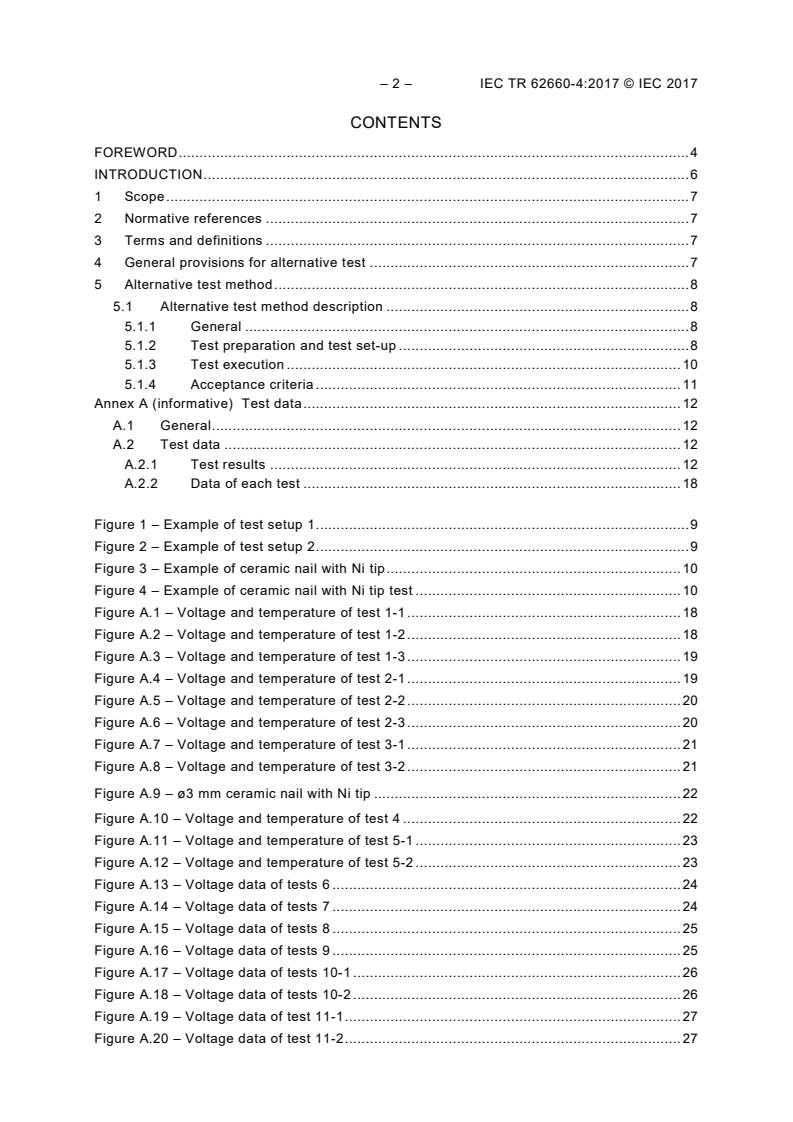
CONTENTS
FOREWORD . 4
INTRODUCTION . 6
1 Scope . 7
2 Normative references . 7
3 Terms and definitions . 7
4 General provisions for alternative test . 7
5 Alternative test method . 8
5.1 Alternative test method description . 8
5.1.1 General . 8
5.1.2 Test preparation and test set-up . 8
5.1.3 Test execution . 10
5.1.4 Acceptance criteria . 11
Annex A (informative) Test data . 12
A.1 General . 12
A.2 Test data . 12
A.2.1 Test results . 12
A.2.2 Data of each test . 18
Figure 1 – Example of test setup 1 . 9
Figure 2 – Example of test setup 2 . 9
Figure 3 – Example of ceramic nail with Ni tip . 10
Figure 4 – Example of ceramic nail with Ni tip test . 10
Figure A.1 – Voltage and temperature of test 1-1 . 18
Figure A.2 – Voltage and temperature of test 1-2 . 18
Figure A.3 – Voltage and temperature of test 1-3 . 19
Figure A.4 – Voltage and temperature of test 2-1 . 19
Figure A.5 – Voltage and temperature of test 2-2 . 20
Figure A.6 – Voltage and temperature of test 2-3 . 20
Figure A.7 – Voltage and temperature of test 3-1 . 21
Figure A.8 – Voltage and temperature of test 3-2 . 21
Figure A.9 – ø3 mm ceramic nail with Ni tip . 22
Figure A.10 – Voltage and temperature of test 4 . 22
Figure A.11 – Voltage and temperature of test 5-1 . 23
Figure A.12 – Voltage and temperature of test 5-2 . 23
Figure A.13 – Voltage data of tests 6 . 24
Figure A.14 – Voltage data of tests 7 . 24
Figure A.15 – Voltage data of tests 8 . 25
Figure A.16 – Voltage data of tests 9 . 25
Figure A.17 – Voltage data of tests 10-1 . 26
Figure A.18 – Voltage data of tests 10-2 . 26
Figure A.19 – Voltage data of test 11-1 . 27
Figure A.20 – Voltage data of test 11-2 . 27
Figure A.21 – Voltage data of test 12-1 . 28
Figure A.22 – Voltage data of test 12-2 . 28
Figure A.23 – Voltage data of test 12-3 . 28
Figure A.24 – Voltage data of test 12-4 . 29
Figure A.25 – Voltage data of test 12-5 . 29
Figure A.26 – Voltage data of test 12-6 . 29
Figure A.27 – Voltage data of test 12-7 . 30
Figure A.28 – Voltage data of test 13 . 30
Figure A.29 – Voltage data of test 14-1 . 31
Figure A.30 – Voltage data of test 14-2 . 31
Figure A.31 – Voltage data of test 14-3 . 31
Figure A.32 – Voltage data of test 14-4 . 32
Figure A.33 – Voltage data of test 14-5 . 32
Figure A.34 – Voltage data of tests 15 . 33
Figure A.35 – Voltage data of tests 16 . 34
Table 1 – Recommended test specifications . 8
Table A.1 – Internal short circuit test results . 13
– 4 – IEC TR 62660-4:2017 © IEC 2017
INTERNATIONAL ELECTROTECHNICAL COMMISSION
____________
SECONDARY LITHIUM-ION CELLS FOR THE PROPULSION
OF ELECTRIC ROAD VEHICLES –
Part 4: Candidate alternative test methods
for the internal short circuit test of IEC 62660-3
FOREWORD
1) The International Electrotechnical Commission (IEC) is a worldwide organization for standardization comprising
all national electrotechnical committees (IEC National Committees). The object of IEC is to promote
international co-operation on all questions concerning standardization in the electrical and electronic fields. To
this end and in addition to other activities, IEC publishes International Standards, Technical Specifications,
Technical Reports, Publicly Available Specifications (PAS) and Guides (hereafter referred to as “IEC
Publication(s)”). Their preparation is entrusted to technical committees; any IEC National Committee interested
in the subject dealt with may participate in this preparatory work. International, governmental and non-
governmental organizations liaising with the IEC also participate in this preparation. IEC collaborates closely
with the International Organization for Standardization (ISO) in accordance with conditions determined by
agreement between the two organizations.
2) The formal decisions or agreements of IEC on technical matters express, as nearly as possible, an international
consensus of opinion on the relevant subjects since each technical committee has representation from all
interested IEC National Committees.
3) IEC Publications have the form of recommendations for international use and are accepted by IEC National
Committees in that sense. While all reasonable efforts are made to ensure that the technical content of IEC
Publications is accurate, IEC cannot be held responsible for the way in which they are used or for any
misinterpretation by any end user.
4) In order to promote international uniformity, IEC National Committees undertake to apply IEC Publications
transparently to the maximum extent possible in their national and regional publications. Any divergence
between any IEC Publication and the corresponding national or regional publication shall be clearly indicated in
the latter.
5) IEC itself does not provide any attestation of conformity. Independent certification bodies provide conformity
assessment services and, in some areas, access to IEC marks of conformity. IEC is not responsible for any
services carried out by independent certification bodies.
6) All users should ensure that they have the latest edition of this publication.
7) No liability shall attach to IEC or its directors, employees, servants or agents including individual experts and
members of its technical committees and IEC National Committees for any personal injury, property damage or
other damage of any nature whatsoever, whether direct or indirect, or for costs (including legal fees) and
expenses arising out of the publication, use of, or reliance upon, this IEC Publication or any other IEC
Publications.
8) Attention is drawn to the Normative references cited in this publication. Use of the referenced publications is
indispensable for the correct application of this publication.
9) Attention is drawn to the possibility that some of the elements of this IEC Publication may be the subject of
patent rights. IEC shall not be held responsible for identifying any or all such patent rights.
The main task of IEC technical committees is to prepare International Standards. However, a
technical committee may propose the publication of a Technical Report when it has collected
data of a different kind from that which is normally published as an International Standard, for
example "state of the art".
IEC TR 62660-4, which is a Technical Report, has been prepared by IEC technical committee
21: Secondary cells and batteries.
The text of this Technical Report is based on the following documents:
Enquiry draft Report on voting
21/891/DTR 21/899/RVC
Full information on the voting for the approval of this Technical Report can be found in the
report on voting indicated in the above table.
This document has been drafted in accordance with the ISO/IEC Directives, Part 2.
A list of all parts in the IEC 62660 series, published under the general title Secondary lithium-
ion cells for the propulsion of electric road vehicles, can be found on the IEC website.
The committee has decided that the contents of this document will remain unchanged until the
stability date indicated on the IEC website under "http://webstore.iec.ch" in the data related to
the specific document. At this date, the document will be
• reconfirmed,
• withdrawn,
• replaced by a revised edition, or
• amended.
A bilingual version of this publication may be issued at a later date.
IMPORTANT – The 'colour inside' logo on the cover page of this publication indicates
that it contains colours which are considered to be useful for the correct
understanding of its contents. Users should therefore print this document using a
colour printer.
– 6 – IEC TR 62660-4:2017 © IEC 2017
INTRODUCTION
IEC 62660-3 provides the test procedures and acceptance criteria for safety performance of
secondary lithium-ion cells and cell blocks used for propulsion of electric vehicles (EV)
including battery electric vehicles (BEV) and hybrid electric vehicles (HEV). IEC 62660-3
specifies the internal short circuit test to simulate an internal short circuit of a cell caused by
the contamination of conductive particle, based on IEC 62619. Because the test method
based on IEC 62619 requires opening of the cell and care to be taken, the industry needs
alternative test methods that could also be applied under certain conditions. This document
provides candidates of alternative test procedures.
NOTE This test is to be conducted in a facility suitable to contain the potential for hazardous reactions up to and
including an explosion and with staff trained to manage the risks.
SECONDARY LITHIUM-ION CELLS FOR THE PROPULSION
OF ELECTRIC ROAD VEHICLES –
Part 4: Candidate alternative test methods
for the internal short circuit test of IEC 62660-3
1 Scope
This Part of IEC 62660 provides the test data on the candidate alternative test methods for
the internal short circuit test according to 6.4.4.2.2 of IEC 62660-3:2016. The internal short
circuit test in this document is intended to simulate an internal short circuit of a cell caused by
the contamination of conductive particle, and to verify the safety performance of the cell under
such conditions.
This document is applicable to the secondary lithium-ion cells and cell blocks used for
propulsion of electric vehicles (EV) including battery electric vehicles (BEV) and hybrid
electric vehicles (HEV).
NOTE This document does not cover cylindrical cells.
2 Normative references
The following documents are referred to in the text in such a way that some or all of their
content constitutes requirements of this document. For dated references, only the edition
cited applies. For undated references, the latest edition of the referenced document (including
any amendments) applies.
IEC 62619:2017, Secondary cells and batteries containing alkaline or other non-acid
electrolytes – Safety requirements for secondary lithium cells and batteries, for use in
industrial applications
IEC 62660-3:2016, Secondary lithium-ion cells for the propulsion of electric road vehicles –
Part 3: Safety requirements
3 Terms and definitions
For the purposes of this document, the terms and definitions given in IEC 62660-3 apply.
ISO and IEC maintain terminological databases for use in standardization at the following
addresses:
• IEC Electropedia: available at http://www.electropedia.org/
• ISO Online browsing platform: available at http://www.iso.org/obp.
4 General provisions for alternative test
The internal short circuit test is specified in 6.4.4.2.1 of IEC 62660-3:2016. The other test
methods to simulate the internal short circuit of cell caused by the contamination of
conductive particle may be selected if the following criteria are satisfied, and agreed between
the customer and the supplier:
– 8 – IEC TR 62660-4:2017 © IEC 2017
a) The case deformation shall not affect the short circuit event of cell thermally or electrically.
The energy shall not be dispersed by any short circuit other than the interelectrode short
circuit.
b) One layer internal short circuit between positive and negative electrode shall be simulated
(target).
c) Approximately the same short circuited area as that of 7.3.2 b) of IEC 62619:2017 shall be
simulated.
d) The short circuited locations in the cell shall be the same as described in 6.4.4.2.1 of
IEC 62660-3:2016.
e) The test shall be repeatable (see Table 1 of IEC 62619:2017).
The detailed test conditions and parameters of an alternative test shall be adjusted before the
test according to the agreement between the customer and the cell manufacturer, so that the
above criteria can be satisfied. The test result shall be evaluated by the disassembly of the
cell, X-ray observation, etc.
If the test result shows more than one layer internal short circuit, or larger short circuited area,
the test may be deemed as valid alternative test, provided that the acceptance criteria in
6.4.4.3 of IEC 62660-3:2016 are satisfied. The failure in an alternative test does not mean the
failure in the test according to 6.4.4.2.1 of IEC 62660-3:2016, because the test condition of
the alternative test may be more severe than the prescribed criteria.
NOTE In case the internal short circuit cannot be simulated, the test is invalid and the test data are reported.
5 Alternative test method
5.1 Alternative test method description
5.1.1 General
This subclause describes the test method of the indentation induced internal short circuit test
as a candidate of alternative test methods in Clause 4. Table 1 provides the recommended
test specifications of the test.
Table 1 – Recommended test specifications
Item Recommendation
Test temperature (temperature of the test bench and cell) 25 °C ± 5 °C
State of charge (SOC) of the cell Maximum SOC specified by the cell manufacturer
Press speed 0,1 mm/s or less
Press speed accuracy ± 0,01 mm/s
Position stability after pressurizing ± 0,02 mm
Maximum pressurizing capability 1 000 N or more
Pressure measuring method Directly measured with a load cell
Pressure measuring period 5 ms or less
Temperature measuring period 1 s or less
Voltage measuring period 5 ms or less
Time to stop the indenter after voltage drop is detected 100 ms or less
5.1.2 Test preparation and test set-up
5.1.2.1 Cell preparation
For flat or pouch cell, no preparation is needed.
For prismatic cell with hard casing, casing could be thinned or removed by an appropriate
method recommended by the cell manufacturer. Thinning or removal of casing should be
conducted before the charging of cell and SOC adjustment. This operation should be
conducted taking all the safety measures needed.
5.1.2.2 Test setup
The cell should be held in a manner not to move during the test. The cell should be
electrically isolated from test bench.
A flat or pouch cell requires a fixation device. Figure 1 and Figure 2 show examples of the
fixation device.
Press equipment
Load cell
Restraint
6 mm nonwoven fiberglass
(compressed to 3 mm)
Cell
Indenter
3 mm PTFE
IEC
Figure 1 – Example of test setup 1
Rubber sheet
Cell
Bakelite
IEC
Figure 2 – Example of test setup 2
5.1.2.3 Indenter device
5.1.2.3.1 General
Two types of indenter device, as defined in 5.1.2.3.2 and 5.1.2.3.3 are proposed in this
alternative test method.
5.1.2.3.2 Type 1: 3 mm ceramic nail
Type 1 indenter is a ceramic nail having a diameter of 3 mm ± 0,2 mm. The angle of the nail
tip should be 45° ± 3°. Figure 1 shows an example of the ceramic nail's orientation to the cell
electrode layers during the press.
– 10 – IEC TR 62660-4:2017 © IEC 2017
5.1.2.3.3 Type 2: 1 mm ceramic nail with Ni tip
Type 2 indenter is a ceramic nail having a diameter of 1 mm ± 0,1 mm with a nickel (Ni) tip of
0,35 mm in height. The angle of the Ni nail tip should be between 28° and 45°. See Figure 3
and Figure 4.
A ceramic nail with a Ni tip is suitable for a prismatic cell with a hard casing and a flat or
pouch cell.
The test using the Type 1 indenter is not applicable to the cells of which the casing is used as
a part of the electrodes. If the casing is removed, this test may be applicable.
Dimensions in millimetres
ø1 ±0,1
30°
IEC
Figure 3 – Example of ceramic nail with Ni tip
IEC
Figure 4 – Example of ceramic nail with Ni tip test
5.1.3 Test execution
The test should be conducted as follows:
a) Prepare the cell in accordance with 5.1.2.1.
0,35 ±0,05
b) Adjust the SOC of the cell in accordance with 5.3 of IEC 62660-3:2016, at the maximum
SOC specified by the cell manufacturer.
c) Fix the cell to the test setup in accordance with 5.1.2.2. The indenter device should be
selected according to 5.1.2.3, based on the agreement between the customer and the
supplier. The indenter should be placed perpendicular to the electrode layers of the cell.
The cell or the indenter should move along this perpendicular axis. The indentation
location should be the same as IEC 62660-3:2016.
d) Press the indenter to the cell, or press the cell up to the indenter, with a constant velocity
of less than 0,1 mm/s. Displacement of the indenter should be stopped when a voltage
drop of at least 5 mV is detected. It is acceptable to use a voltage drop of less than 5 mV
if a high accuracy voltage meter is used and the actual short location can be confirmed
with an inspection of the internal short location after the test. The accuracy of the voltage
meter should be reported. If the voltage drop of at least 5 mV is not detected until the
indenter is depressed to half the thickness of a cell, the test should be stopped and
considered as invalid, and the test should be conducted once again.
e) After the indentation stops, the indenter should remain in place until the end of the
observation period. During the test, the cell voltage, the force of the press, the
displacement of the press and the temperature of the cell should be recorded. The cell
temperature should be measured on the surface of the cell, at a distance of less than
25 mm from the centre of the indentation. Sampling time for voltage and pressure
recording should be 5 ms or less. Sampling time for other parameters recording should be
1 s or less.
5.1.4 Acceptance criteria
During the test and within 1 h of observation, the cell should exhibit no evidence of fire or
explosion.
– 12 – IEC TR 62660-4:2017 © IEC 2017
Annex A
(informative)
Test data
A.1 General
This annex provides information on the result of tests conducted according to Clause 5, and
of relevant comparison tests.
The reproducibility of each test result is confirmed on several cell designs. Further test data
need to be evaluated with cells that failed the test in 6.4.4.2.1 of IEC 62660-3:2016, etc.
A.2 Test data
A.2.1 Test results
Table A.1 shows the result of internal short circuit tests on several types of cells, using the
indenters in 5.1.2.3, and other types of indenters for comparison. The forced internal short
circuit (FISC) test in 6.4.4.2.1 of IEC 62660-3:2016 is also conducted as comparison test.
All cells in Table A.1 exhibited no evidence of fire or explosion, and met the acceptance
criteria in 5.1.4.
In most of the tests except FISC test, the number of short circuited layers is larger than one
layer, and also varies among the same cells.
Further data of each test are shown in A.2.2.
IEC TR 62660-4:2016 © IEC 2016 – 13 –
Table A.1 – Internal short circuit test results
Test Indenter type Cell Chemistry Type of cell Press Target Test result
No. or FISC or Capacity and case speed voltage
or Application thic
...