

ISO 11683:1997
(Main)Packaging — Tactile warnings of danger — Requirements
General Information
- Abstract
- Status
- Published
- Publication Date
- 29-Oct-1997
- Technical Committee
- ISO/TC 122 - Packaging
- Drafting Committee
- ISO/TC 122 - Packaging
- Current Stage
- 9093 - International Standard confirmed
- Start Date
- 12-Nov-2024
- Completion Date
- 29-Aug-2026
Buy Documents
ISO 11683:1997 - Packaging — Tactile warnings of danger — Requirements Released:8/27/1998
ISO 11683:1997 - Emballages — Indications tactiles de danger — Exigences Released:8/27/1998
Overview
ISO 11683:1997, Packaging - Tactile warnings of danger - Requirements is an international standard specifying the requirements for tactile warnings on packaging containing certain dangerous substances and preparations. The standard aims to promote safety and accessibility for blind and visually impaired users by establishing clear, consistent tactile indicators directly on primary packaging. These tactile symbols serve as crucial accident-prevention tools, enabling at-risk individuals to identify hazardous contents through touch.
Key Topics
- Tactile Warning Symbols: The standard details tactile symbols, primarily a raised equilateral triangle, or, where space is limited, configurations such as three raised dots or a smaller triangle. These symbols are designed to be easily recognizable by touch.
- Dimensions and Shapes: ISO 11683 specifies dimensions for the tactile symbols to ensure both recognizability and usability across various packaging types and sizes.
- Placement and Location: Guidelines ensure that tactile warnings are consistently positioned on the handling surface of packaging-where people are most likely to touch the container during use-to maximize accessibility.
- Durability: Tactile warnings must remain intact and detectable throughout the expected lifecycle of the package, even under normal handling conditions.
- Exclusivity of Use: Tactile warnings as specified are reserved solely for packaging that contains dangerous substances as regulated by legislative authorities, reducing misidentification and confusion.
Applications
ISO 11683:1997 delivers practical value across a range of sectors involving the packaging and distribution of hazardous materials, particularly where safety for visually impaired users is a concern:
- Consumer Products: Used on cleaning chemicals, solvents, garden pesticides, and other regulated hazardous substances to alert users to potential dangers.
- Industrial Packaging: Essential for chemicals packaged in drums, bottles, cartridges, and tubes handled by workers, supporting workplace safety compliance.
- Healthcare and Pharmaceuticals: Applied to medical substances with hazardous properties, aiding safe usage among visually impaired professionals and end-users.
- Gas Cartridges and Aerosols: Special provisions for packaging shapes, actuators, and gas containers ensure tactile warnings are present even in specialized formats.
- Small and Non-Standard Packaging: Accommodations for reduced symbol sizes and layout flexibility ensure compliance on compact containers and unconventional shapes.
By implementing ISO 11683 tactile warnings, organizations enhance accessibility, meet regulatory requirements, and demonstrate a commitment to inclusive design, benefiting both end-users and handlers.
Related Standards
Consideration of ISO 11683:1997 may also include reference and compliance with other relevant standards, such as:
- EN 417:1992 - Non-refillable metallic gas cartridges: Addresses marking and safety for gas cartridges, with specific cross-references for tactile indicators.
- Accessibility and Safety Standards: International guidelines for accessible design, such as ISO 21542 for building accessibility or ISO 2869 for package labeling, may complement tactile warning strategies.
- Packaging Terminology Standards: ISO 21067 defines key vocabulary for packaging, offering clarity in conjunction with tactile warning requirements.
- Global Regulatory Guidelines: National and regional regulations governing the labeling and packaging of dangerous goods often incorporate or refer to ISO 11683 specifications for tactile symbols.
Keywords: ISO 11683, tactile warning, packaging safety, dangerous substances, accessible packaging, raised symbols, accident prevention, visually impaired, packaging standards, hazardous materials.
Relations
- Consolidates
EN ISO 11683:1997 - Packaging - Tactile warnings of danger - Requirements (ISO 11683:1997) - Effective Date
- 12-Feb-2026
- Effective Date
- 15-Apr-2008
Buy Documents
ISO 11683:1997 - Packaging — Tactile warnings of danger — Requirements Released:8/27/1998
ISO 11683:1997 - Emballages — Indications tactiles de danger — Exigences Released:8/27/1998
Get Certified
Connect with accredited certification bodies for this standard

BSI Group
BSI (British Standards Institution) is the business standards company that helps organizations make excellence a habit.

TÜV Rheinland
TÜV Rheinland is a leading international provider of technical services.

TÜV SÜD
TÜV SÜD is a trusted partner of choice for safety, security and sustainability solutions.
Sponsored listings
Frequently Asked Questions
ISO 11683:1997 is a standard published by the International Organization for Standardization (ISO). Its full title is "Packaging — Tactile warnings of danger — Requirements". This standard covers: Cette norme internationale spécifie les exigences d'une indication tactile de danger pour les emballages destinés à contenir certaines substances et préparations dangereuses. Pour éviter toute confusion d'interprétation, l'indication tactile de danger n'est apposée que sur les emballages couverts par la réglementation en vigueur sur les substances et préparations dangereuses. Cette norme ne spécifie pas les substances et les préparations dangereuses destinées à être contenues dans les emballages munis d'une indication tactile de danger. Elles doivent être spécifiées par les autorités réglementaires.
Cette norme internationale spécifie les exigences d'une indication tactile de danger pour les emballages destinés à contenir certaines substances et préparations dangereuses. Pour éviter toute confusion d'interprétation, l'indication tactile de danger n'est apposée que sur les emballages couverts par la réglementation en vigueur sur les substances et préparations dangereuses. Cette norme ne spécifie pas les substances et les préparations dangereuses destinées à être contenues dans les emballages munis d'une indication tactile de danger. Elles doivent être spécifiées par les autorités réglementaires.
ISO 11683:1997 is classified under the following ICS (International Classification for Standards) categories: 11.180.30 - Aids for blind or partially sighted people; 55.020 - Packaging and distribution of goods in general. The ICS classification helps identify the subject area and facilitates finding related standards.
ISO 11683:1997 has the following relationships with other standards: It is inter standard links to EN ISO 11683:1997, ISO 11683:1993. Understanding these relationships helps ensure you are using the most current and applicable version of the standard.
ISO 11683:1997 is available in PDF format for immediate download after purchase. The document can be added to your cart and obtained through the secure checkout process. Digital delivery ensures instant access to the complete standard document.
Standards Content (Sample)
INTERNATIONAL ISO
STANDARD 11683
Second edition
1997-10-01
Corrected and reprinted
1998-09-01
Packaging — Tactile warnings of danger —
Requirements
Emballages — Indications tactiles de danger — Exigences
A
Reference number
©
ISO
Foreword
ISO (the International Organization for Standardization) is a worldwide
federation of national standards bodies (ISO member bodies). The work of
preparing International Standards is normally carried out through ISO
technical committees. Each member body interested in a subject for which
a technical committee has been established has the right to be represented
on that committee. International organizations, governmental and non-
governmental, in liaison with ISO, also take part in the work. ISO
collaborates closely with the International Electrotechnical Commission
(IEC) on all matters of electrotechnical standardization.
Draft International Standards adopted by the technical committees are
circulated to the member bodies for voting. Publication as an International
Standard requires approval by at least 75 % of the member bodies casting
a vote.
International Standard ISO 11683 was prepared by the European
Committee for Standardization (CEN) in collaboration with ISO Technical
Committee TC 122, Packaging, in accordance with the Agreement on
technical cooperation between ISO and CEN (Vienna Agreement).
This second edition cancels and replaces the first edition
(ISO 11683:1993), which has been technically revised.
© ISO 1997
All rights reserved. Unless otherwise specified, no part of this publication may be reproduced
or utilized in any form or by any means, electronic or mechanical, including photocopying and
microfilm, without permission in writing from the publisher.
International Organization for Standardization
Case postale 56 • CH-1211 Genève 20 • Switzerland
Internet central@iso.ch
X.400 c=ch; a=400net; p=iso; o=isocs; s=central
Printed in Switzerland
ii
©
ISO
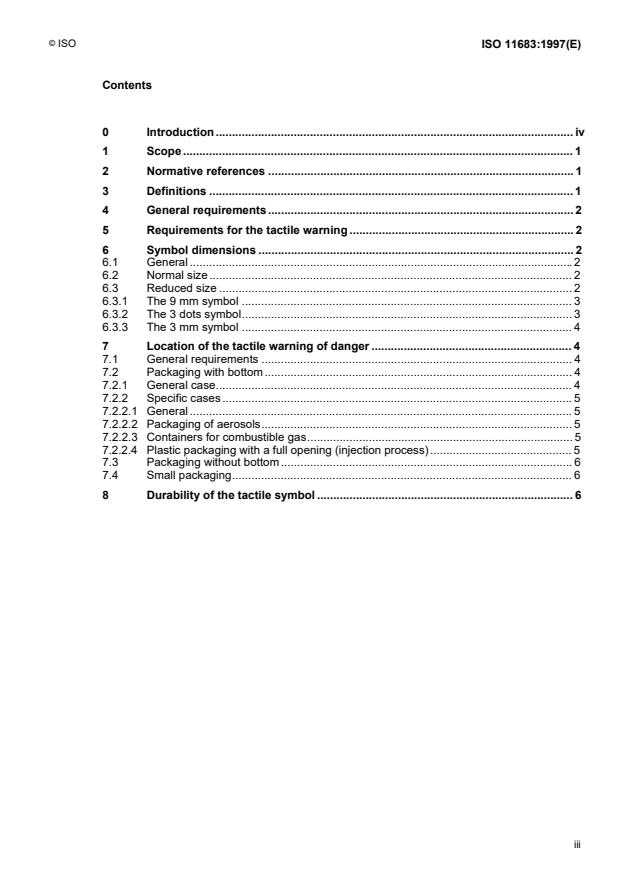
Contents
0 Introduction. iv
1 Scope . 1
2 Normative references . 1
3 Definitions . 1
4 General requirements . 2
5 Requirements for the tactile warning . 2
6 Symbol dimensions . 2
6.1 General .2
6.2 Normal size . 2
6.3 Reduced size . 2
6.3.1 The 9 mm symbol . 3
6.3.2 The 3 dots symbol. 3
6.3.3 The 3 mm symbol . 4
7 Location of the tactile warning of danger . 4
7.1 General requirements . 4
7.2 Packaging with bottom. 4
7.2.1 General case. 4
7.2.2 Specific cases . 5
7.2.2.1 General . 5
7.2.2.2 Packaging of aerosols. 5
7.2.2.3 Containers for combustible gas. 5
7.2.2.4 Plastic packaging with a full opening (injection process) . 5
7.3 Packaging without bottom . 6
7.4 Small packaging. 6
8 Durability of the tactile symbol . 6
iii
©
ISO
Foreword
The text of EN ISO 11683:1997 has been prepared by Technical Committee CEN/TC 261
,
"Packaging", the secretariat of which is held by AFNOR in collaboration with Technical
Committee ISO/TC 122 "Packaging".
This European Standard supersedes EN 272:1989.
The significant technical differences are the following :
- addition of reduced size of symbol.
This European Standard shall be given the status of a national standard, either by publication
of an identical text or by endorsement, at the latest by April 1998, and conflicting national
standards shall be withdrawn at the latest by April 1998.
According to the CEN/CENELEC Internal Regulations, the national standards organizations of
the following countries are bound to implement this European Standard: Austria, Belgium,
Czech Republic, Denmark, Finland, France, Germany, Greece, Iceland, Ireland, Italy,
Luxembourg, Netherlands, Norway, Portugal, Spain, Sweden, Switzerland and the United
Kingdom.
0 Introduction
When blind and visually handicapped persons handle a package, it is difficult or impossible for
them to ascertain whether it contains harmless or dangerous substances or preparations.
This problem may be solved by :
- providing packages which contain dangerous substances or preparations, with a tactile
warning of danger in accordance with this standard ;
- teaching blind and visually handicapped persons the meaning and the positioning of the
tactile warning of danger on the package.
This standard specifies a tactile warning which in its form is normally a raised equilateral
triangle, reduced to 3 raised dots where there is not enough space on the package for the
triangle.
For blind and visually handicapped persons, the tactile warning of danger is simple in its
presentation, is as consistant as possible in its location, makes the teaching and learning
process easy and provides a guarantee of recognition.
iv
©
ISO
1 Scope
This standard specifies the requirements for a tactile warning of danger on packagings which
contain certain dangerous substances and preparations.
To prevent confusion in interpretation, the tactile warning of danger is affixed only on packages
covered by the regulations in force on the dangerous substances and preparations.
This standard does not specify the dangerous substances and preparations to be contained in
packagings with a tactile warning of danger. These are to be specified by legislative authorities.
2 Normative references
This standard incorporates by dated or undated reference, provisions from other publications.
These normative references are cited at the appropriate places in the text and the publications
are listed hereafter. For dated re
...
NORME ISO
INTERNATIONALE 11683
Deuxième édition
1997-10-01
Corrigée et réimprimée
1998-09-01
Emballages — Indications tactiles de
danger — Exigences
Packaging — Tactile warnings of danger — Requirements
A
Numéro de référence
Avant-propos
L'ISO (Organisation internationale de normalisation) est une fédération
mondiale d'organismes nationaux de normalisation (comités membres de
l'ISO). L'élaboration des Normes internationales est en général confiée aux
comités techniques de l'ISO. Chaque comité membre intéressé par une
étude a le droit de faire partie du comité technique créé à cet effet. Les
organisations internationales, gouvernementales et non gouvernementales,
en liaison avec l'ISO participent également aux travaux. L'ISO collabore
étroitement avec la Commission électrotechnique internationale (CEI) en
ce qui concerne la normalisation électrotechnique.
Les projets de Normes internationales adoptés par les comités techniques
sont soumis aux comités membres pour vote. Leur publication comme
Normes internationales requiert l'approbation de 75 % au moins des
comités membres votants.
La Norme internationale ISO 11683 a été élaborée par le Comité européen
de normalisation (CEN) en collaboration avec le comité technique
ISO/TC 122, Emballages, conformément à l'Accord de coopération techni-
que entre l'ISO et le CEN (Accord de Vienne).
Cette deuxième édition annule et remplace la première édition
(ISO 11683:1993), dont elle constitue une révision technique.
© ISO 1997
Droits de reproduction réservés. Sauf prescription différente, aucune partie de cette publi-
cation ne peut être reproduite ni utilisée sous quelque forme que ce soit et par aucun pro-
cédé, électronique ou mécanique, y compris la photocopie et les microfilms, sans l'accord
écrit de l'éditeur.
Organisation internationale de normalisation
Case postale 56 • CH-1211 Genève 20 • Suisse
Internet central@iso.ch
X.400 c=ch; a=400net; p=iso; o=isocs; s=central
Imprimé en Suisse
ii
©
ISO
Sommaire
0 Introduction.iv
1 Domaine d'application.1
2 Références normatives .1
3 Définitions.1
4 Exigences générales .2
5 Exigences pour l'indication tactile .2
6 Dimensions du symbole.2
6.1 Généralités .2
6.2 Dimensions normales .3
6.3 Dimensions réduites .3
6.3.1 Symbole de 9 mm.3
6.3.2 Symbole 3 points .4
6.3.3 Symbole de 3 mm.4
7 Emplacement de l'indication tactile de danger .4
7.1 Exigences générales .4
7.2 Emballages avec base.5
7.2.1 Cas général .5
7.2.2 Cas particuliers.5
7.2.2.1 Généralités .5
7.2.2.2 Emballage des aérosols.5
7.2.2.3 Conteneurs de gaz combustibles.5
7.2.2.4 Emballage plastique à large ouverture (procédé par injection) .6
7.3 Emballages sans base.6
7.4 Petits emballages .6
8 Durée de vie de l'indication tactile .6
iii
©
ISO
Avant-propos
Le texte de l’EN ISO 11683:1997 a été élaboré par le Comité Technique CEN/TC 261
"Emballage" dont le secrétariat est tenu par l'AFNOR, en collaboration avec le Comité
Technique ISO/TC 122 "Emballages".
La présente norme européenne remplace l'EN 272:1989.
Les différences techniques significatives sont les suivantes :
- addition de tailles réduites de symboles.
Cette norme européenne devra recevoir le statut de norme nationale, soit par publication d'un
texte identique, soit par entérinement, au plus tard en avril 1998, et toutes les normes
nationales en contradiction devront être retirées au plus tard en avril 1998.
Selon le Règlement Intérieur du CEN/CENELEC, les instituts de normalisation nationaux des
pays suivants sont tenus de mettre cette norme européenne en application: Allemagne,
Autriche, Belgique, Danemark, Espagne, Finlande, France, Grèce, Irlande, Islande, Italie,
Luxembourg, Norvège, Pays-Bas, Portugal, République Tchèque, Royaume-Uni, Suède et
Suisse.
0 Introduction
Lorsque les personnes aveugles et handicapées de la vue manipulent un emballage, il leur est
difficile ou impossible de s'assurer que l'emballage contient des substances ou préparations
inoffensives ou dangereuses.
Ce problème peut être résolu en :
- prévoyant pour un emballage contenant des substances ou préparations dangereuses,
une indication tactile de danger conforme à la présente norme ;
- apprenant aux personnes aveugles et handicapées de la vue, la signification et
l'emplacement de l'indication tactile de danger sur l'emballage.
Cette norme spécifie une indication tactile qui dans sa forme est normalement un triangle en
relief, équilatéral, réduit à trois points en relief lorsque l'emballage n'offre pas la surface
nécessaire pour un triangle.
Pour les personnes aveugles et handicapées de la vue, l'indication tactile de danger est simple
par sa conception, est aussi consistante que possible dans son emplacement, facilite le
processus d'information et d'éducation et procure une garantie d'identification.
iv
©
ISO
1 Domaine d'application
Cette norme spécifie les exigences d'une indication tactile de danger pour les emballages
destinés à contenir certaines substances et préparations dangereuses.
Pour éviter toute confusion d'interprétation, l'indication tactile de danger n'est apposée que
sur les emballages couverts par la réglementation en vigueur sur les substances et
préparations dangereuses.
Cette norme ne spécifie pas les substances et les préparations dangereuses destinées à être
contenues dans les emballages munis d'une indication tactile de danger. Elles doivent être
spécifiées par les autorités réglementaires.
2 Référence normative
Cette norme comporte par référence datée ou non datée des dispositions d'autres
publications. Ces références normatives sont citées aux endroits appropriés dans le texte et
les publications sont énumérées ci-après. Pour les références datées, les amendements ou
révisions ultérieurs de l'une quelconque de ces publications ne s'appliquent à cette norme que
s'ils y ont été incorporés par amendement ou révision. Pour les références non datées, la
dernière édition
...