

ISO 25553-1:2026
(Main)Ageing societies — Framework for smart multigenerational neighbourhoods — Part 1: Requirements and recommendations
- Abstract
This document provides requirements and guidance for the planning, development, implementation and evaluation of smart multigenerational neighbourhoods. It establishes a framework for neighbourhoods to deploy enabling systems that actively support, adapt to and care for people of different ages and abilities as their needs change across the life course, enhancing wellbeing and addressing long-term pressures related to ageing, health, care and community resilience. This document applies to both new developments and the enhancement, regeneration and retrofitting of existing neighbourhoods and real estate. It is intended for use by public authorities, investors, planners, developers, designers, service and technology providers, systems integrators, and community and civic organisations involved in neighbourhood planning, delivery and long-term stewardship.
- Status
- Published
- Publication Date
- 03-Jun-2026
- Technical Committee
- ISO/TC 314 - Ageing societies
- Drafting Committee
- ISO/TC 314 - Ageing societies
- Current Stage
- 6060 - International Standard published
- Start Date
- 04-Jun-2026
- Due Date
- 06-May-2026
- Completion Date
- 04-Jun-2026

ISO 25553-1:2026 is the first edition of an International Standard from ISO on smart multigenerational neighbourhoods (SMNs). It specifies requirements and recommendations for planning, development, implementation and evaluation, so it is aimed at the people and organisations that shape neighbourhoods over time: public authorities, investors, planners, developers, designers, service and technology providers, systems integrators, and community and civic organisations.
What does ISO 25553-1:2026 specify?
ISO 25553-1:2026 specifies a framework for organising neighbourhoods so they can support people of different ages and abilities across the life course. It applies to new developments as well as the enhancement, regeneration and retrofitting of existing neighbourhoods and real estate.
The document is structured as a system-level guide. After the scope, terms and abbreviated terms, it moves through development, collaboration, social innovation, ethical governance, learning and employment, investment and digital platforms, inclusive design, planning and placemaking, regeneration, public spaces, housing and dwelling design, retrofitting, resilience, digital infrastructure, secure digital ecosystems, cognitive health and care services, decentralised care, mobility, shared learning, and a closing section on SMNs as long-term places of care and continuity.
Key topics covered across the clauses include:
- Clause 4 - development of an SMN, including diversity of human characteristics, universal design (UD), inclusive design (ID), flexibility and wellbeing
- Clause 5 - multi-stakeholder collaboration models, community engagement, accountability and global adaptability
- Clauses 7-9 - ethical governance, lifelong learning, investment and digital platforms
- Clauses 10-12 - inclusive design, planning, placemaking and monitoring
- Clauses 14-16 - public spaces, housing and retrofitting
- Clauses 17-23 - resilience, digital infrastructure, care, mobility and intergenerational learning
What are the key requirements of ISO 25553-1:2026?
ISO 25553-1:2026 sets out a people-centred neighbourhood framework in which planning, services, digital systems and governance work together. In practice, it asks organisations to design for changing needs over time, not only for current use.
Design for diverse people and everyday life
Clause 4 requires SMN neighbourhood design to consider a wide range of human characteristics and functions, including physical, sensory, cognitive, neurodiverse, psychosocial and age-related factors. It also points to practical design considerations such as UD, ID, integration of diverse domains, intergenerational active involvement, design with nature, flexibility and quality of life. For practitioners, this means accessibility and usability need to be built into the whole neighbourhood, not added later as a separate feature.
Build collaboration, accountability and ethical governance
Clause 5 requires structured collaboration between public and private sectors, civil society and other stakeholders, and it highlights the Penta Helix model. It also calls for accessible participation, conflict-resolution, broad-based consensus-building, shared success metrics and an accountability framework. Clause 7 adds ethical governance built on human accountability, autonomy and transparent stewardship. In practice, this means projects need clear roles, open decision-making and ways to address data, technology and participation issues fairly.
Plan for learning, work, services and investment
Clauses 8 and 9 connect SMNs to lifelong learning, second careers, digital literacy, inclusive employment, sustainable business models and investment structures. The document supports neighbourhood learning hubs, home-based entrepreneurship, blended finance, social enterprises, green bonds and social impact bonds where appropriate. It also requires digital platforms for neighbourhood management with transparency, interoperability and accountability. For buyers and developers, this means an SMN is not just a physical project - it also needs a workable operating and funding model.
Use inclusive design, measurable goals and evidence
Clause 10 requires a structured co-creation process for inclusive design, with community demographics mapped and objectives defined collaboratively. It also asks for assessment of smart technologies, including performance, reliability, ease of use and maturity at home and neighbourhood level. Clauses 11 and 12 extend this into participatory planning, community needs assessments, integrated public spaces, site allocation, training, local plan integration, and monitoring with qualitative and quantitative indicators. In practice, teams should define outcomes early and then test whether design and technology choices actually support them.
Design housing, public space and regeneration for mixed-age communities
Clauses 14 to 16 focus on walkability, third places, greening, blue spaces, public art, housing mix, universal and inclusive housing design, supported neighbourhood living, vertical neighbourhoods, specialist housing, and retrofitting. Clause 15 also stresses safety, mixed-use integration, accessible and adaptable dwellings, and the relationship between public, private and shared space. Clause 16 makes clear that existing neighbourhoods and buildings are part of the framework, not just new-build projects. In practice, this pushes projects toward mixed-use, accessible, adaptable places that can change with residents’ needs.
Provide resilience and secure digital foundations
Clause 17 treats resilience as a social and systemic capability, not only a technical one, and it includes climate resilience for ageing populations. Clauses 18 and 19 require digital plumbing, reliable connectivity, future-ready physical pathways, low-latency local processing, redundancy, secure data exchange, privacy and security by design, and sustainable digital ecosystems using tools such as APIs, AI and digital twins. For implementers, this means the neighbourhood needs a stable digital backbone before advanced services can work reliably.
Decentralise care, mobility and intergenerational learning
Clauses 20 to 23 extend the framework into cognitive health and care services, neighbourhood-based health and social care, dementia-inclusive environments, palliative care, inclusive mobility, micromobility, participatory monitoring, childcare, youth engagement and intergenerational shared spaces. The standard frames mobility as a basis for autonomy and participation, and care as something that can be embedded in homes, hubs and local networks. In practice, this means support should be local, connected and designed around daily life rather than only around institutions.
What terms does ISO 25553-1:2026 define?
ISO 25553-1:2026 defines its core language in Clause 3 and uses a short set of abbreviations throughout.
- Multigenerational - relating to more than one generation, with approaches that support inclusivity, accessibility and active participation for people of all ages and abilities.
- Neighbourhood - a geographical area where residents share proximity and common circumstances, often with local facilities and a locally understood sense of community.
- Smart multigenerational neighbourhood (SMN) - the neighbourhood model used in this document, built around coordinated support, adaptability and care across the life course.
- Universal design (UD) - a design approach used in the document to make environments usable by the widest range of people possible.
- Inclusive design (ID) - a design approach that shapes places and services around varied human needs and contexts.
- Artificial intelligence (AI) - used in the document for digital systems, analysis, monitoring and adaptive services.
- Application programming interface (API) - a digital interface used for connecting systems and enabling interoperability.
- World Health Organization (WHO) and United Nations Environment Programme (UNEP) - organisations referenced in the document in connection with health, housing and sustainable neighbourhood thinking.
Who uses ISO 25553-1:2026?
ISO 25553-1:2026 is written for public authorities, investors, planners, developers, designers, service and technology providers, systems integrators, and community and civic organisations. It is also relevant to planning authorities, housing providers, mobility planners, health and social care providers, and digital platform operators.
In practice, these users apply the standard when they are setting neighbourhood strategy, preparing development briefs, planning regeneration, choosing housing typologies, designing public realm and mobility systems, or defining governance and operating models. It is particularly relevant where projects need to work across housing, health, care, digital infrastructure and community participation.
Which standards are used with ISO 25553-1:2026?
ISO 25553-1:2026 names several supporting standards and related documents to consider alongside it.
- ISO 37105 - noted as a descriptive framework for cities and communities that can support local interpretation of neighbourhood-scale planning.
- ISO 37120
- ISO 21542
- ISO 9241-210
- ISO/IEC Guide 71 (CEN/CENELEC Guide 6)
- ISO 37101 - identified in Clause 20 as a standard to take into consideration.
- ISO 21929-1 - also identified in Clause 20 as a standard to take into consideration.
The document uses these references to show that SMNs sit alongside broader city, accessibility, human-centred design and sustainability guidance.
What does the ISO 25553-1:2026 document contain?
ISO 25553-1:2026 contains a clause-based framework with requirements, recommendations, notes and supporting narrative across Clauses 1 to 24, plus a bibliography. It includes at least one referenced figure in Clause 5 for the Penta Helix collaboration model.
The document also contains structured topics that support planning and implementation, such as community engagement methods, accountability mechanisms, co-creation processes, community needs assessments, monitoring and assessment frameworks, and participatory evaluation. It covers design considerations for housing, public space, digital infrastructure, care services, mobility and intergenerational programmes.
Rather than worked numerical examples or formulas, the document focuses on methods, governance arrangements, design principles and system relationships. That makes it useful for setting project requirements, checking delivery plans, and aligning neighbourhood-scale work across disciplines.
Get Certified
Connect with accredited certification bodies for this standard

BSI Group
BSI (British Standards Institution) is the business standards company that helps organizations make excellence a habit.

Bureau Veritas
Bureau Veritas is a world leader in laboratory testing, inspection and certification services.

DNV
DNV is an independent assurance and risk management provider.
Sponsored listings
Frequently Asked Questions
ISO 25553-1:2026 is a standard published by the International Organization for Standardization (ISO). Its full title is "Ageing societies — Framework for smart multigenerational neighbourhoods — Part 1: Requirements and recommendations". This standard covers: This document provides requirements and guidance for the planning, development, implementation and evaluation of smart multigenerational neighbourhoods. It establishes a framework for neighbourhoods to deploy enabling systems that actively support, adapt to and care for people of different ages and abilities as their needs change across the life course, enhancing wellbeing and addressing long-term pressures related to ageing, health, care and community resilience. This document applies to both new developments and the enhancement, regeneration and retrofitting of existing neighbourhoods and real estate. It is intended for use by public authorities, investors, planners, developers, designers, service and technology providers, systems integrators, and community and civic organisations involved in neighbourhood planning, delivery and long-term stewardship.
This document provides requirements and guidance for the planning, development, implementation and evaluation of smart multigenerational neighbourhoods. It establishes a framework for neighbourhoods to deploy enabling systems that actively support, adapt to and care for people of different ages and abilities as their needs change across the life course, enhancing wellbeing and addressing long-term pressures related to ageing, health, care and community resilience. This document applies to both new developments and the enhancement, regeneration and retrofitting of existing neighbourhoods and real estate. It is intended for use by public authorities, investors, planners, developers, designers, service and technology providers, systems integrators, and community and civic organisations involved in neighbourhood planning, delivery and long-term stewardship.
ISO 25553-1:2026 is classified under the following ICS (International Classification for Standards) categories: 03.080.30 - Services for consumers; 13.020.20 - Environmental economics. Sustainability. The ICS classification helps identify the subject area and facilitates finding related standards.
ISO 25553-1:2026 is available in PDF format for immediate download after purchase. The document can be added to your cart and obtained through the secure checkout process. Digital delivery ensures instant access to the complete standard document.
Standards Content (Sample)
International
Standard
ISO 25553-1
First edition
Ageing societies — Framework
2026-06
for smart multigenerational
neighbourhoods —
Part 1:
Requirements and
recommendations
Vieillissement de la population — Cadre pour les quartiers
multigénérationnels intelligents —
Partie 1: Exigences et recommandations
Reference number
© ISO 2026
All rights reserved. Unless otherwise specified, or required in the context of its implementation, no part of this publication may
be reproduced or utilized otherwise in any form or by any means, electronic or mechanical, including photocopying, or posting on
the internet or an intranet, without prior written permission. Permission can be requested from either ISO at the address below
or ISO’s member body in the country of the requester.
ISO copyright office
CP 401 • Ch. de Blandonnet 8
CH-1214 Vernier, Geneva
Phone: +41 22 749 01 11
Email: copyright@iso.org
Website: www.iso.org
Published in Switzerland
ii
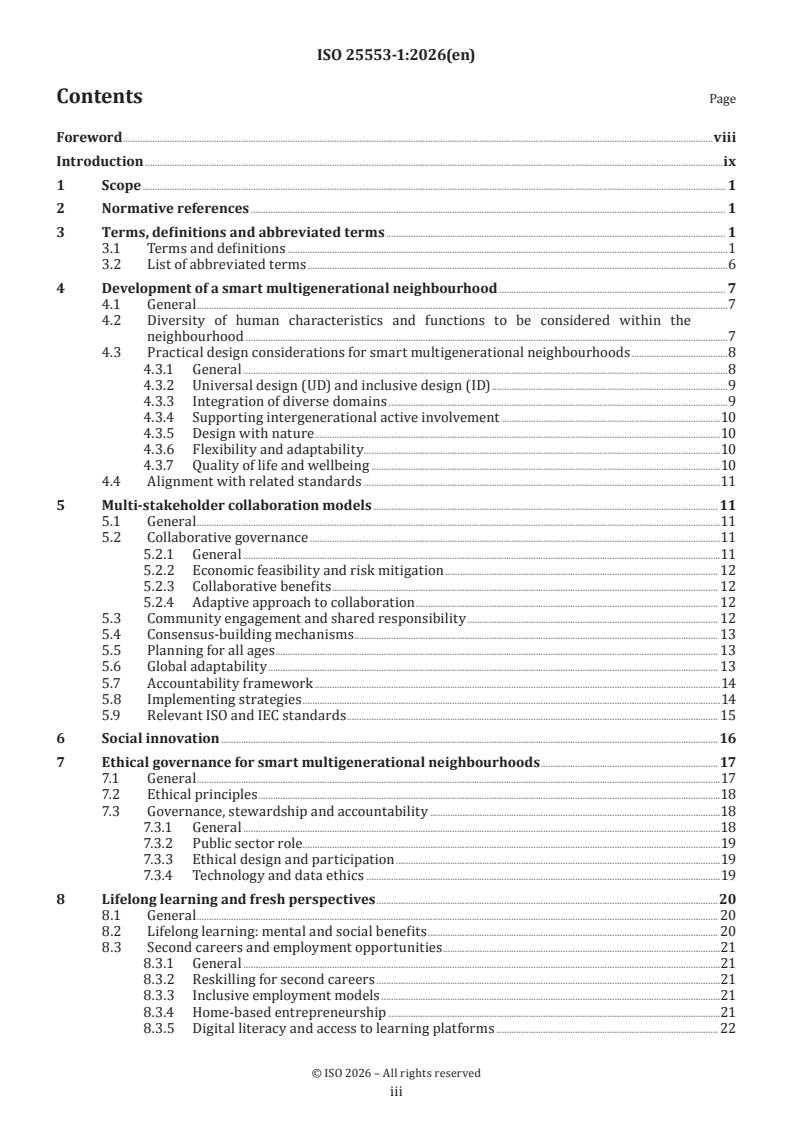
Contents Page
Foreword .viii
Introduction .ix
1 Scope . 1
2 Normative references . 1
3 Terms, definitions and abbreviated terms . 1
3.1 Terms and definitions .1
3.2 List of abbreviated terms .6
4 Development of a smart multigenerational neighbourhood . 7
4.1 General .7
4.2 Diversity of human characteristics and functions to be considered within the
neighbourhood .7
4.3 Practical design considerations for smart multigenerational neighbourhoods .8
4.3.1 General .8
4.3.2 Universal design (UD) and inclusive design (ID) .9
4.3.3 Integration of diverse domains .9
4.3.4 Supporting intergenerational active involvement .10
4.3.5 Design with nature .10
4.3.6 Flexibility and adaptability .10
4.3.7 Quality of life and wellbeing .10
4.4 Alignment with related standards .11
5 Multi-stakeholder collaboration models .11
5.1 General .11
5.2 Collaborative governance .11
5.2.1 General .11
5.2.2 Economic feasibility and risk mitigation . 12
5.2.3 Collaborative benefits . 12
5.2.4 Adaptive approach to collaboration . 12
5.3 Community engagement and shared responsibility . 12
5.4 Consensus-building mechanisms. 13
5.5 Planning for all ages . 13
5.6 Global adaptability . 13
5.7 Accountability framework .14
5.8 Implementing strategies .14
5.9 Relevant ISO and IEC standards . 15
6 Social innovation .16
7 Ethical governance for smart multigenerational neighbourhoods . 17
7.1 General .17
7.2 Ethical principles .18
7.3 Governance, stewardship and accountability .18
7.3.1 General .18
7.3.2 Public sector role.19
7.3.3 Ethical design and participation .19
7.3.4 Technology and data ethics .19
8 Lifelong learning and fresh perspectives .20
8.1 General . 20
8.2 Lifelong learning: mental and social benefits . 20
8.3 Second careers and employment opportunities .21
8.3.1 General .21
8.3.2 Reskilling for second careers .21
8.3.3 Inclusive employment models .21
8.3.4 Home-based entrepreneurship .21
8.3.5 Digital literacy and access to learning platforms . 22
iii
8.3.6 Access to e-learning platforms . 22
8.3.7 Fostering intergenerational learning and community engagement . 22
8.3.8 Community participation and active involvement . 22
9 Building sustainable neighbourhoods: services, governance and investment .23
9.1 General . 23
9.2 Bridging the financial gap . 23
9.3 Encouraging innovation and investment . 23
9.4 Sustainable business models .24
9.5 Innovative financial instruments .24
9.6 Digital platforms for neighbourhood management .24
10 Design for life.25
10.1 General . 25
10.2 Structured co-creation process for inclusive design . 25
10.3 Community goals and metrics definition . 25
10.4 Assessment of smart technologies . 26
10.5 Adaptability for diverse contexts . 26
10.6 Leveraging compatible standards and guidelines .27
11 Planning and design .27
11.1 General .27
11.2 Collaborative and inclusive planning process . 28
11.3 Collective decision-making . 28
11.4 Participatory planning and integrated neighbourhood development . 28
11.5 Leveraging compatible standards and guidelines . 29
12 Planning and placemaking .29
12.1 General . 29
12.2 Consistent planning definitions and categories . 29
12.3 Community needs assessments. 30
12.4 Integrated public spaces and services . 30
12.5 Site allocation for diverse housing and infrastructure . 30
12.6 Streamlined planning processes .31
12.7 Training and capacity building .31
12.8 Incentives, innovation and shared learning ecosystems .31
12.9 Local plan integration .32
12.10 Monitoring and assessment .32
12.11 Alignment with compatible standards and guidelines . 33
13 Regeneration for smart multigenerational neighbourhoods .33
14 Creating inclusive public spaces for connection and community .34
14.1 Overview . 34
14.2 Walkability . 34
14.2.1 General . 34
14.2.2 Third places . 35
14.2.3 Greening: definition and importance. 35
14.2.4 Blue spaces: definition and importance . 36
14.2.5 Space making: empowering residents to shape their environment . 36
14.2.6 Public art: enriching neighbourhood life through cultural expression . 36
15 Key neighbourhood and dwelling design considerations .37
15.1 Respecting and enhancing existing context .37
15.2 Safety and security . 38
15.3 Built environment . 38
15.4 Mixed-use integration . 39
15.5 Design requirements and recommendations for housing . 40
15.5.1 General . 40
15.5.2 New multigenerational living arrangements . 40
15.5.3 Multigenerational community design .41
15.5.4 Dwellings: mix .42
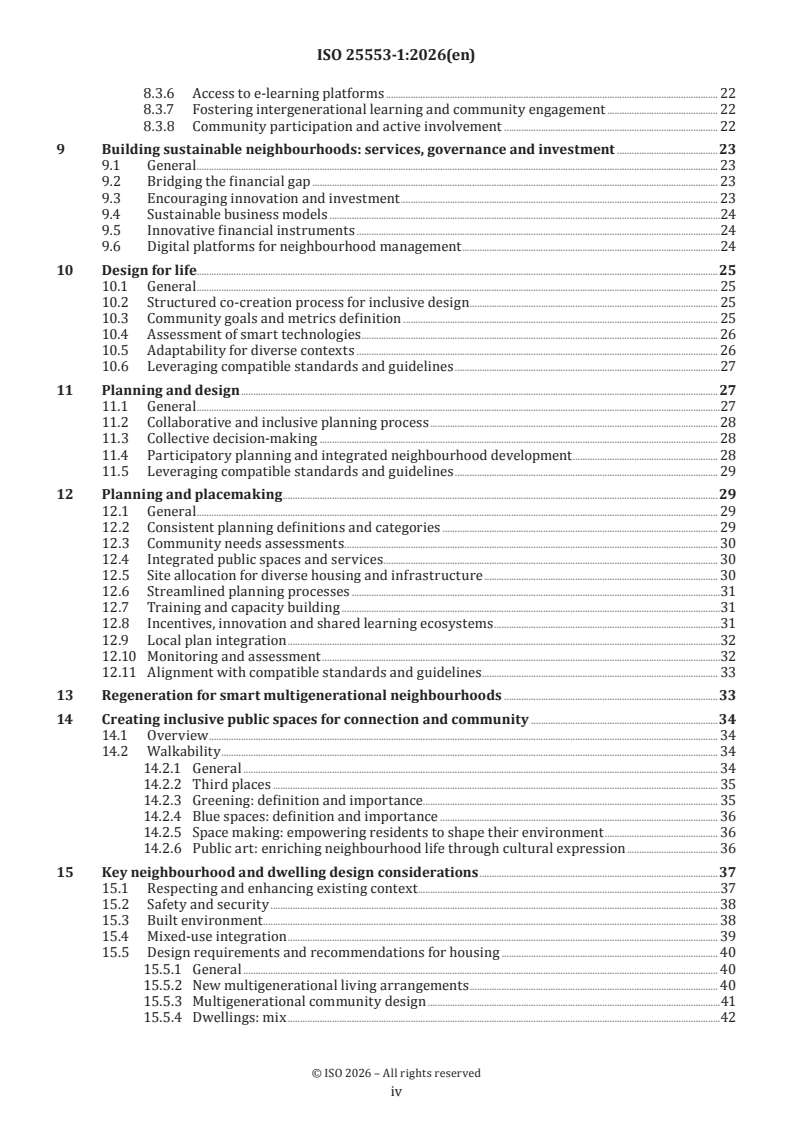
iv
15.5.5 Dwellings: universal and inclusive design .43
15.5.6 Accessible and adaptable housing design principles . 44
15.6 Hybrid and inclusive supported neighbourhood living .45
15.7 Design considerations for vertical neighbourhoods .45
15.7.1 General .45
15.7.2 Mobility, accessibility and safety in vertical neighbourhoods . 46
15.7.3 Green spaces and mental wellbeing in high-density settings . 46
15.7.4 Mental wellbeing, crowding and privacy in vertical environments . 46
15.7.5 Social connection, security and emergency preparedness .47
15.7.6 Cognitive, cultural, and spiritual inclusion .47
15.8 Specialist housing .47
15.8.1 General .47
15.8.2 Provision, integration and neighbourhood connection .47
15.8.3 Specialist housing design – placemaking, adaptability, and wellbeing . 48
16 Retrofitting and remodelling towards smart multigenerational neighbourhoods .49
17 Design for resilience . 51
17.1 General .51
17.2 Operationalisation of resilience .51
17.3 Climate resilience for ageing populations .52
18 Digital infrastructure as the foundation for smart multigenerational neighbourhoods .52
18.1 General .52
18.2 Establishing digital plumbing . 53
18.3 Digital plumbing in practice . 54
18.4 Moving beyond connectivity: towards cognitive neighbourhoods . 54
19 Secure, inclusive and sustainable digital ecosystems .55
20 Smart infrastructure as a foundation for cognitive health and care services .57
20.1 General .57
20.2 Designing for cognitive health and care services.57
20.3 Cognitive neighbourhood infrastructure . 58
20.3.1 Digital hubs and cognitive systems . 58
20.3.2 Seamless community connectivity . 58
20.3.3 Robotic systems for health and social support . 58
20.3.4 Data integration and interoperability .59
20.3.5 Public health as an active entity .59
20.3.6 Intelligent energy systems for cognitive neighbourhoods .59
20.4 In-home and personal technologies in cognitive contexts . 60
20.4.1 General . 60
20.4.2 AI-driven health monitoring . 60
20.4.3 Robotics and ambient intelligence .61
20.4.4 Home automation for wellbeing .61
20.5 Wearable health technologies in cognitive contexts .62
20.5.1 General .62
20.5.2 AI-enabled wearables and predictive insights .62
20.5.3 Wearable robotics for enhanced mobility .62
20.6 Data flow, cognitive analysis and management .62
20.6.1 General .62
20.6.2 Data exchange for cognitive processing . 63
20.6.3 Privacy, security, and ethical AI standards . 63
20.7 Ensuring a future-ready, cognitive environment . 63
20.7.1 General . 63
20.7.2 Scalable and adaptable cognitive infrastructure . 63
20.7.3 Continuous learning and feedback integration . 64
20.7.4 Active stakeholder involvement . 64
20.8 Requirements in other standards . 64
21 Decentralising neighbourhood-based health and social care .64
21.1 General . 64
v
21.2 Empowering social care: a blueprint for a digital age . 65
21.3 Key principles for empowering social care in the digital age . 65
21.3.1 Community-centric approach . 65
21.3.2 Inclusivity and accessibility . 66
21.3.3 Integrated systems for community wellbeing . 66
21.3.4 Public health as a shared resource.67
21.3.5 Focus on preventative measures .67
21.3.6 Digital empowerment for care providers .67
21.3.7 Person-centred care for all ages and abilities .67
21.3.8 Ethics, privacy and trust . 68
21.3.9 Collaborative community involvement . 68
21.3.10 Collaborative models for risk-sharing and sustainability . 68
21.3.11 Telecare and telehealth in context . . 69
21.4 Decentralised medical procedures and community-based care . 69
21.4.1 General . 69
21.4.2 Virtual wards . 69
21.4.3 Neighbourhood-based health and wellbeing hubs .70
21.5 Neighbourhood-based care environments .71
21.5.1 General .71
21.5.2 Neighbourhood-embedded care environments. 72
21.5.3 Adaptive and connected living settings . 72
21.5.4 Optimising existing assets for sustainable transformation . 73
21.5.5 Neighbourhood health centres: Integrated community hubs .74
21.5.6 Community empowerment and social participation .74
21.5.7 Digitally enabled, localised care . 75
21.5.8 Accessibility and inclusivity.76
21.5.9 Preventative and population health focus .76
21.5.10 Community-driven design and flexibility . 77
21.6 Dementia-inclusive environments . 77
21.7 Redefining palliative care in the community . 78
21.7.1 General . 78
21.7.2 Designing for dignity and comfort . 79
21.7.3 Technology-enabled, person-centred support . 79
21.7.4 Engaging families, caregivers and the community . 80
21.7.5 Normalising end-of-life as part of life . 80
22 Reframing mobility for all .81
22.1 General . 81
22.2 Designing inclusive mobility ecosystems . 82
22.3 Digital and intelligent mobility infrastructure . 82
22.4 Community co-creation and evaluation . 83
22.5 Empowering micromobility . 84
22.6 Foundational mobility infrastructure . 85
22.7 Accessible parking and drop-off zones . 85
22.8 Mobility for independence and social connection . 86
22.9 Sustainable and environmentally responsible mobility . 86
22.10 Safety and road design . 87
22.11 Participatory monitoring of mobility safety and usability . 87
23 Bridging generations: a blueprint for shared learning .88
23.1 General . 88
23.2 Childcare and community learning settings . 88
23.3 Youth engagement and intergenerational connection . 89
23.4 Intergenerational shared spaces and programmes . 89
24 SMNs: cultivating neighbourhoods that care ‒ for life .90
24.1 General . 90
24.2 Neighbourhoods built for strength, shaped to adapt . 90
24.3 Cognitive housing and disruptive models of care . 90
24.4 Neighbourhood-powered innovation .91
vi
24.5 Investing in places people believe in.91
24.6 Enabling continuity of living .91
Bibliography .92
vii
Foreword
ISO (the International Organization for Standardization) is a worldwide federation of national standards
bodies (ISO member bodies). The work of preparing International Standards is normally carried out through
ISO technical committees. Each member body interested in a subject for which a technical committee
has been established has the right to be represented on that committee. International organizations,
governmental and non-governmental, in liaison with ISO, also take part in the work. ISO collaborates closely
with the International Electrotechnical Commission (IEC) on all matters of electrotechnical standardization.
The procedures used to develop this document and those intended for its further maintenance are described
in the ISO/IEC Directives, Part 1. In particular, the different approval criteria needed for the different types
of ISO documents shall be noted. This document was drafted in accordance with the editorial rules of the
ISO/IEC Directives, Part 2 (see www.iso.org/directives).
ISO draws attention to the possibility that the implementation of this document may involve the use of (a)
patent(s). ISO takes no position concerning the evidence, validity or applicability of any claimed patent
rights in respect thereof. As of the date of publication of this document, ISO had not received notice of (a)
patent(s) which may be required to implement this document. However, implementers are cautioned that
this may not represent the latest information, which may be obtained from the patent database available at
www.iso.org/patents. ISO shall not be held responsible for identifying any or all such patent rights.
Any trade name used in this document is information given for the convenience of users and does not
constitute an endorsement.
For an explanation of the voluntary nature of standards, the meaning of ISO specific terms and expressions
related to conformity assessment, as well as information about ISO’s adherence to the World Trade
Organization (WTO) principles in the Technical Barriers to Trade (TBT), see www.iso.org/iso/foreword.html.
This document was prepared by Technical Committee ISO/TC 314, Ageing societies.
Any feedback or questions on this document shall be directed to the user’s national standards body. A
complete listing of these bodies can be found at www.iso.org/members.html.
viii
Introduction
0.1 General
In 1929, Clarence A. Perry’s Neighbourhood Unit Concept introduced a new way of organising life for an
industrialising society. At a time of rapid urban growth, Perry reorganised cities around people, bringing
schools, services, and public space together within walking distance. This simple but powerful idea shaped
how communities functioned for much of the twentieth century.
Nearly a hundred years later, societies across the world are entering a moment of comparable consequence.
People are living longer than ever before, often with needs that change gradually over time and cut across
health, housing, care, and community life. By 2050, more than two billion people will be aged 60 and over,
while those aged 80 and above will have tripled. At the same time, the World Health Organization reports
that one in six people globally experiences loneliness, a factor now recognised as having profound impact
...