

ISO/TR 23583:2026
(Main)Sulfur corrosion test method of copper winding in electric field for power equipment
- Abstract
This document specifies the assessment of copper winding sulfur corrosion in power equipment. It is applicable to the sulfur corrosion resistance testing of copper windings in newly installed and in-service power equipment.
- Status
- Published
- Publication Date
- 26-Oct-2026
- Technical Committee
- ISO/TC 156 - Corrosion of metals and alloys
- Drafting Committee
- ISO/TC 156/WG 9 - Corrosion testing of materials for power generation
- Current Stage
- 6060 - International Standard published
- Start Date
- 27-Oct-2026
- Completion Date
- 27-Oct-2026
ISO/TR 23583 is an ISO Technical Report on a sulfur corrosion test method for copper winding in electric field for power equipment. It specifies how to prepare the winding specimen, how to set up and run the test, and how to judge sulfur corrosion resistance for newly installed and in-service power equipment.
What does ISO/TR 23583 specify?
ISO/TR 23583 specifies a test method for assessing sulfur corrosion of copper windings used in power equipment. The document is organized into clauses on scope, terms, general regulation, specimen preparation, instruments and equipment, test preparation, test procedures, and evaluation, followed by a bibliography.
The method is built around a pig-tail model made from copper winding and insulating paper, which is then exposed to oil containing corrosive sulfur under controlled temperature and electric field conditions. In practice, that means the test is meant to reflect how the winding behaves in oil-filled equipment rather than only in a simple laboratory corrosion test.
What are the key requirements of ISO/TR 23583?
Clause 4 sets the basic test concept: prepare a pig-tail specimen, immerse it in oil containing corrosive sulfides, apply a specified temperature and electric field strength, then assess corrosion both visually and by measuring copper in the insulating oil. This matters because the document ties the result to both surface damage and dissolved copper, not to one indicator alone.
Specimen materials and assembly
Clause 5.1 uses transformer copper windings conforming to GB/T 6451, and Clause 5.3 uses transformer insulating paper conforming to GB/T 6451. Clause 5.2 uses insulating oil conforming to IEC 60296, and Clause 5.4 introduces dibenzyl disulfide (DBDS) as the sulfur compound used in the test oil. In practice, the test depends on using the specified winding, paper, oil, and sulfur source so the result is comparable.
Test equipment
Clause 6 lists the required equipment: a thermostatic oil tank, a vacuum drying immersion oil tank, an electric heating experimental tank, a DC/AC power supply, and a plasma coupled atomic emission spectrometer. This gives the reader the full equipment set needed to prepare the specimen, simulate operating conditions, and measure copper content.
Test preparation
Clause 7.1 forms the paper-wrapped winding into a pig-tail model to prevent discharge during pressurization. Clause 7.2 dries the specimen in vacuum, and Clause 7.3 immerses it in degassed insulating oil with DBDS, then removes air with nitrogen before the specimen is kept immersed under controlled conditions. In practice, these steps remove moisture and air so the corrosion test focuses on the oil and electric field effects.
Test procedure
Clause 8.1 heats the specimen, connects it to a DC or AC power source, and applies the test electric field for a minimum duration. Clause 8.2 requires cooling to room temperature before the winding is removed. This sequence matters because the specimen is judged after exposure under hot, energized conditions similar to service.
Evaluation
Clause 9.1 provides qualitative evaluation from the macroscopic corrosion morphology of the copper winding, with reference to ASTM D 1275B. Clauses 9.2 and 9.3 use copper content in the insulating oil, measured by ICP-AES, to classify resistance into levels from excellent to poor. In practice, users get both a visual corrosion check and a quantitative severity grade.
What terms does ISO/TR 23583 define?
- Copper content - the mass fraction of substances determined by the procedure in this document, expressed in mg/kg.
- Corrosive sulfur - elemental sulfur or thermally unstable sulfides in insulating oils for electrical equipment that can corrode metals such as copper and silver.
- Sulfur corrosion resistance - the ability to resist corrosive sulfur corrosion under specified conditions.
- Pig-tail model - the bent and wrapped copper winding specimen used to prevent discharge during pressurization and testing.
- Dibenzyl disulfide (DBDS) - the sulfur-containing additive used to create the corrosive oil condition in the test.
- Inductively coupled plasma atomic emission spectroscopy (ICP-AES) - the analytical method used to determine copper content in the insulating oil.
Who uses ISO/TR 23583?
ISO/TR 23583 is used by power equipment manufacturers, test laboratories, and maintenance or inspection teams that need to evaluate copper winding behavior in oil-filled equipment. It is also relevant to quality managers and buyers who compare winding materials, insulation systems, and oil compatibility for newly installed or in-service assets.
Which standards are used with ISO/TR 23583?
The document cites related standards that provide materials, methods, or context:
- GB/T 6451 - used for the copper winding and insulating paper material definitions.
- IEC 60296 - used for the insulating oil specification.
- ASTM D 1275A and ASTM D 1275B - cited as related corrosive sulfur test methods for insulating oils, with ASTM D 1275B used for qualitative comparison.
- IEC 62535 - a related method for detecting potentially corrosive sulphur in insulating oil.
- GB/T 25961 - another related test method for corrosive sulfur in insulating oils.
- GB/T 38265.15, ASTM D 130, and ISO 6251 - cited as related copper corrosion test methods in other fields.
What does the ISO/TR 23583 document contain?
ISO/TR 23583 contains one material table for insulating oil properties, three figures showing the pig-tail model and test tank arrangements, and a step-by-step test method. It gives the specimen preparation details, the required apparatus, the immersion and gas-purging setup, and the heating and cooling procedure. It also includes both qualitative and quantitative evaluation routes, so users can check appearance and measure copper in oil. The bibliography places the method in context with insulating-oil corrosion and copper-corrosion standards used elsewhere.
Get Certified
Connect with accredited certification bodies for this standard

DNV
DNV is an independent assurance and risk management provider.

BSI Group
BSI (British Standards Institution) is the business standards company that helps organizations make excellence a habit.

Bureau Veritas
Bureau Veritas is a world leader in laboratory testing, inspection and certification services.
Sponsored listings
Frequently Asked Questions
ISO/TR 23583:2026 is a technical report published by the International Organization for Standardization (ISO). Its full title is "Sulfur corrosion test method of copper winding in electric field for power equipment". This standard covers: This document specifies the assessment of copper winding sulfur corrosion in power equipment. It is applicable to the sulfur corrosion resistance testing of copper windings in newly installed and in-service power equipment.
This document specifies the assessment of copper winding sulfur corrosion in power equipment. It is applicable to the sulfur corrosion resistance testing of copper windings in newly installed and in-service power equipment.
ISO/TR 23583:2026 is classified under the following ICS (International Classification for Standards) categories: 27.010 - Energy and heat transfer engineering in general; 77.060 - Corrosion of metals. The ICS classification helps identify the subject area and facilitates finding related standards.
ISO/TR 23583:2026 is available in PDF format for immediate download after purchase. The document can be added to your cart and obtained through the secure checkout process. Digital delivery ensures instant access to the complete standard document.
Standards Content (Sample)
Technical
Report
ISO/TR 23583
First edition
Sulfur corrosion test method of
2026-10
copper winding in electric field for
power equipment
Méthode d'essai de corrosion par le soufre des enroulements en
cuivre dans un champ électrique pour les équipements électriques
Reference number
© ISO 2026
All rights reserved.
This ISO publication is protected by copyright and is owned by ISO and/or its licensors.
The content of this ISO publication is provided under licence, not sold. Use is subject to the applicable licence terms issued by ISO,
an ISO member body, or an authorized third-party distributor.
Except as required for implementation or expressly permitted by a separate licence, no part of this ISO publication may be
reproduced, distributed, modified, used, or made available in any form or by any means – electronic or mechanical, including
photocopying, scanning, recording, or posting on internal or external digital platforms.
Any use beyond the scope of the granted rights is prohibited and may result in legal action.
ISO copyright office
CP 401 • CH-1214 Vernier, Geneva
Phone: +41 22 749 01 11
Email: copyright@iso.org
Website: www.iso.org
Published in Switzerland
ii
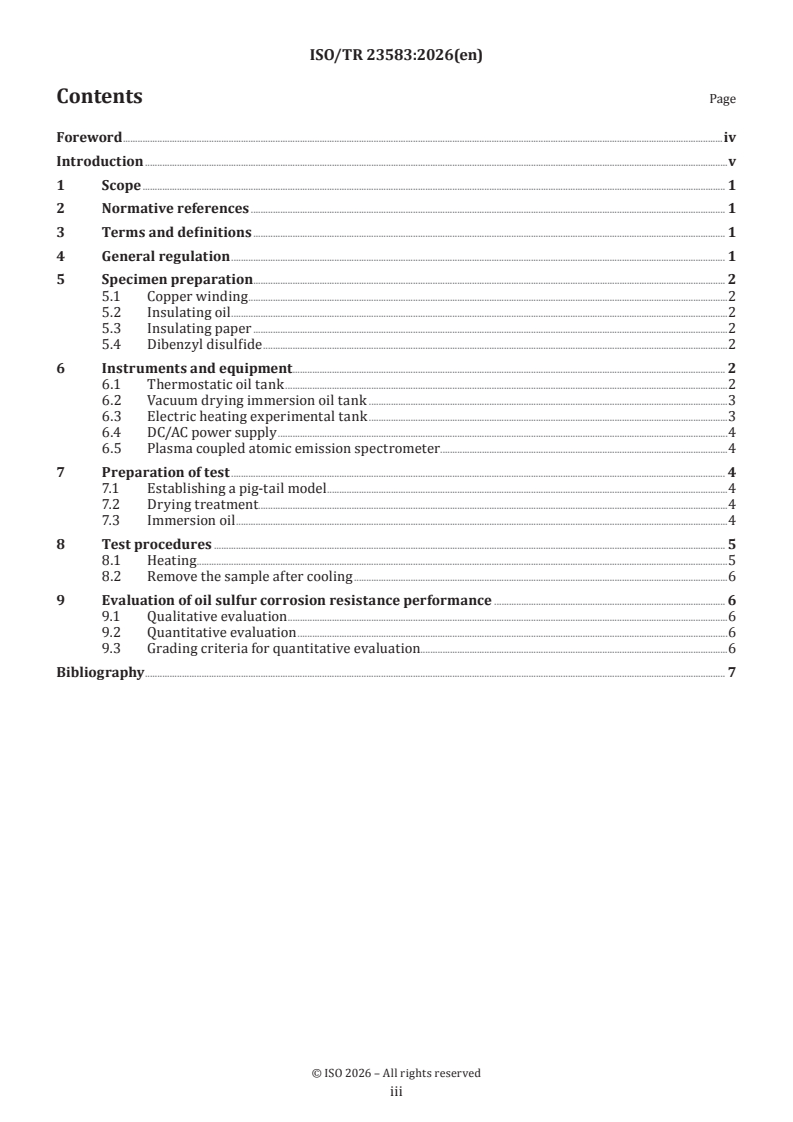
Contents Page
Foreword .iv
Introduction .v
1 Scope . 1
2 Normative references . 1
3 Terms and definitions . 1
4 General regulation . 1
5 Specimen preparation . . 2
5.1 Copper winding .2
5.2 Insulating oil .2
5.3 Insulating paper .2
5.4 Dibenzyl disulfide .2
6 Instruments and equipment . 2
6.1 Thermostatic oil tank .2
6.2 Vacuum drying immersion oil tank .3
6.3 Electric heating experimental tank .3
6.4 DC/AC power supply .4
6.5 Plasma coupled atomic emission spectrometer.4
7 Preparation of test . 4
7.1 Establishing a pig-tail model .4
7.2 Drying treatment.4
7.3 Immersion oil .4
8 Test procedures . 5
8.1 Heating.5
8.2 Remove the sample after cooling .6
9 Evaluation of oil sulfur corrosion resistance performance . 6
9.1 Qualitative evaluation .6
9.2 Quantitative evaluation .6
9.3 Grading criteria for quantitative evaluation.6
Bibliography . 7
iii
Foreword
ISO (the International Organization for Standardization) is a worldwide federation of national standards
bodies (ISO member bodies). The work of preparing International Standards is normally carried out through
ISO technical committees. Each member body interested in a subject for which a technical committee
has been established has the right to be represented on that committee. International organizations,
governmental and non-governmental, in liaison with ISO, also take part in the work. ISO collaborates closely
with the International Electrotechnical Commission (IEC) on all matters of electrotechnical standardization.
The procedures used to develop this document and those intended for its further maintenance are described
in the ISO/IEC Directives, Part 1. In particular, the different approval criteria needed for the different types
of ISO document should be noted. This document was drafted in accordance with the editorial rules of the
ISO/IEC Directives, Part 2 (see www.iso.org/directives).
ISO draws attention to the possibility that the implementation of this document may involve the use of (a)
patent(s). ISO takes no position concerning the evidence, validity or applicability of any claimed patent
rights in respect thereof. As of the date of publication of this document, ISO had not received notice of (a)
patent(s) which may be required to implement this document. However, implementers are cautioned that
this may not represent the latest information, which may be obtained from the patent database available at
www.iso.org/patents. ISO shall not be held responsible for identifying any or all such patent rights.
Any trade name used in this document is information given for the convenience of users and does not
constitute an endorsement.
For an explanation of the voluntary nature of standards, the meaning of ISO specific terms and expressions
related to conformity assessment, as well as information about ISO's adherence to the World Trade
Organization (WTO) principles in the Technical Barriers to Trade (TBT), see www.iso.org/iso/foreword.html.
This document was prepared by Technical Committee ISO/TC 156, Corrosion of metals and alloys.
Any feedback or questions on this document should be directed to the user’s national standards body. A
complete listing of these bodies can be found at www.iso.org/members.html.
iv
Introduction
Many factors affect the sulfur corrosion of copper windings in power equipment in the power industry.
These include:
— temperature;
— corrosive sulfide concentration in oil;
— acid products derived from oil-paper insulation aging;
— moisture;
— the type of electric field (AC or DC electric field);
— electric field strength;
— the contact state between the copper winding and the insulating paper;
— the quality of the copper winding.
These have a significant influence on the occurrence of sulfur corrosion and the generation of corrosion
products. The current assessment methods of sulfur corrosion of copper windings do not sufficiently
consider these factors. Existing standards (e.g. ASTM D 1275A, ASTM D 1275B, IEC 62535, GB/T 25961) test
specifications or methods for testing whether the quality of insulating oil meets the requirements.
As for the corrosion of copper, the existing standards are test methods for the corrosion of copper metal in
the atmospheric environment, petroleum products, etc. Standards such as GB/T 38265.15, ASTM D 130 and
ISO 6251 specify special testing or assessment methods for lubricants, oil and copper parts in atmospheric
environments (e.g. pipelines, tower parts and other structures), which does not fully apply to power
equipment.
Therefore, with reference to the existing standards for corrosive sulfur de
...