


ISO/PAS 19486
(Main)Intelligent transport systems — Acceleration control for pedal error (ACPE) — Performance requirements and test procedures
Intelligent transport systems — Acceleration control for pedal error (ACPE) — Performance requirements and test procedures
Systèmes de transport intelligents — Contrôle de l'accélération en cas d'erreur de pédale (ACPE) — Exigences de performance et procédures d'essai
General Information
Buy Standard

Standards Content (Sample)
FINAL DRAFT
Publicly
Available
Specification
ISO/DPAS 19486
ISO/TC 204
Intelligent transport systems —
Secretariat: ANSI
Acceleration control for pedal
Voting begins on:
error (ACPE) — Performance
2024-12-30
requirements and test procedures
Voting terminates on:
2025-02-24
Systèmes de transport intelligents — Contrôle de l'accélération
en cas d'erreur de pédale (ACPE) — Exigences de performance et
procédures d'essai
RECIPIENTS OF THIS DRAFT ARE INVITED TO SUBMIT,
WITH THEIR COMMENTS, NOTIFICATION OF ANY
RELEVANT PATENT RIGHTS OF WHICH THEY ARE AWARE
AND TO PROVIDE SUPPOR TING DOCUMENTATION.
IN ADDITION TO THEIR EVALUATION AS
BEING ACCEPTABLE FOR INDUSTRIAL, TECHNO
LOGICAL, COMMERCIAL AND USER PURPOSES, DRAFT
INTERNATIONAL STANDARDS MAY ON OCCASION HAVE
TO BE CONSIDERED IN THE LIGHT OF THEIR POTENTIAL
TO BECOME STAN DARDS TO WHICH REFERENCE MAY BE
MADE IN NATIONAL REGULATIONS.
Reference number
ISO/DPAS 19486:2024(en) © ISO 2024
FINAL DRAFT
ISO/DPAS 19486:2024(en)
Publicly
Available
Specification
ISO/DPAS 19486
ISO/TC 204
Intelligent transport systems –
Secretariat: ANSI
Acceleration control for pedal error
Voting begins on:
(ACPE) – Performance requirements
and test procedures
Voting terminates on:
Systèmes de transport intelligents — Contrôle de l'accélération
en cas d'erreur de pédale (ACPE) — Exigences de performance et
procédures d'essai
RECIPIENTS OF THIS DRAFT ARE INVITED TO SUBMIT,
WITH THEIR COMMENTS, NOTIFICATION OF ANY
RELEVANT PATENT RIGHTS OF WHICH THEY ARE AWARE
AND TO PROVIDE SUPPOR TING DOCUMENTATION.
© ISO 2024
IN ADDITION TO THEIR EVALUATION AS
All rights reserved. Unless otherwise specified, or required in the context of its implementation, no part of this publication may
BEING ACCEPTABLE FOR INDUSTRIAL, TECHNO
LOGICAL, COMMERCIAL AND USER PURPOSES, DRAFT
be reproduced or utilized otherwise in any form or by any means, electronic or mechanical, including photocopying, or posting on
INTERNATIONAL STANDARDS MAY ON OCCASION HAVE
the internet or an intranet, without prior written permission. Permission can be requested from either ISO at the address below
TO BE CONSIDERED IN THE LIGHT OF THEIR POTENTIAL
or ISO’s member body in the country of the requester.
TO BECOME STAN DARDS TO WHICH REFERENCE MAY BE
MADE IN NATIONAL REGULATIONS.
ISO copyright office
CP 401 • Ch. de Blandonnet 8
CH-1214 Vernier, Geneva
Phone: +41 22 749 01 11
Email: copyright@iso.org
Website: www.iso.org
Published in Switzerland Reference number
ISO/DPAS 19486:2024(en) © ISO 2024
ii
ISO/DPAS 19486:2024(en)
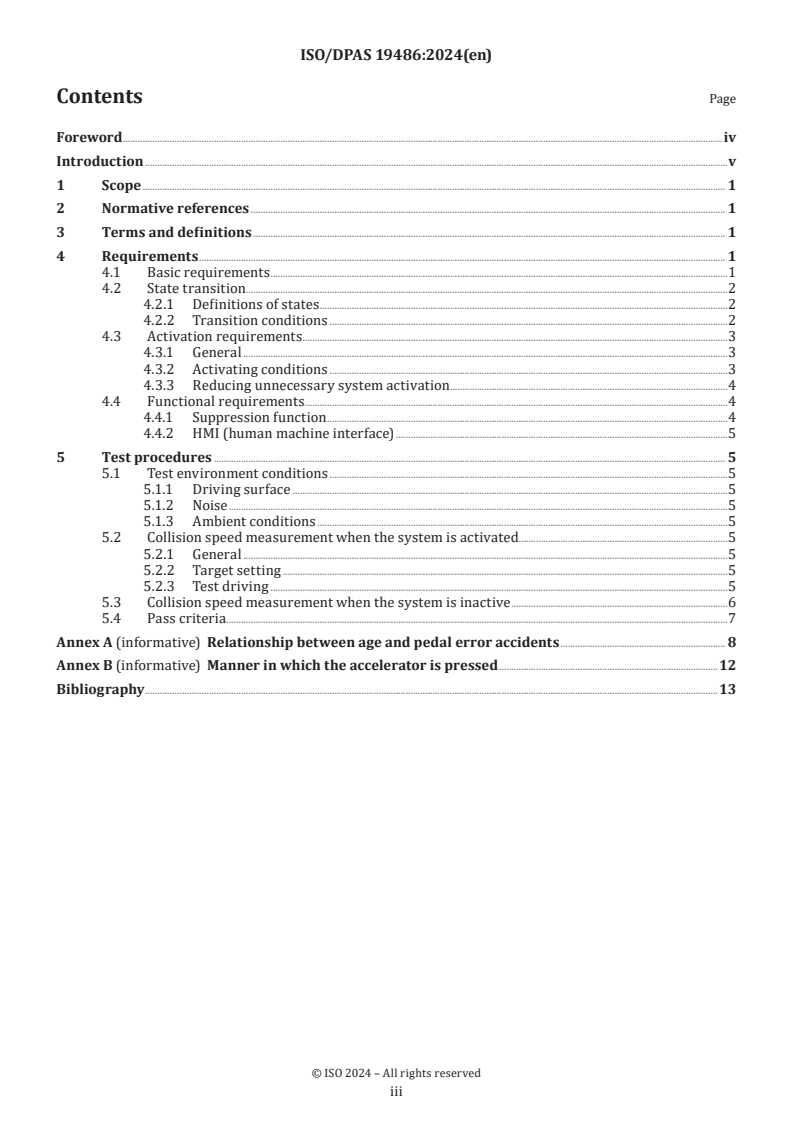
Contents Page
Foreword .iv
Introduction .v
1 Scope . 1
2 Normative references . 1
3 Terms and definitions . 1
4 Requirements . 1
4.1 Basic requirements .1
4.2 State transition .2
4.2.1 Definitions of states .2
4.2.2 Transition conditions .2
4.3 Activation requirements .3
4.3.1 General .3
4.3.2 Activating conditions .3
4.3.3 Reducing unnecessary system activation.4
4.4 Functional requirements . .4
4.4.1 Suppression function .4
4.4.2 HMI (human machine interface) .5
5 Test procedures . 5
5.1 Test environment conditions .5
5.1.1 Driving surface .5
5.1.2 Noise .5
5.1.3 Ambient conditions .5
5.2 Collision speed measurement when the system is activated.5
5.2.1 General .5
5.2.2 Target setting .5
5.2.3 Test driving .5
5.3 Collision speed measurement when the system is inactive .6
5.4 Pass criteria.7
Annex A (informative) Relationship between age and pedal error accidents . 8
Annex B (informative) Manner in which the accelerator is pressed .12
Bibliography .13
iii
ISO/DPAS 19486:2024(en)
Foreword
ISO (the International Organization for Standardization) is a worldwide federation of national standards
bodies (ISO member bodies). The work of preparing International Standards is normally carried out through
ISO technical committees. Each member body interested in a subject for which a technical committee
has been established has the right to be represented on that committee. International organizations,
governmental and non-governmental, in liaison with ISO, also take part in the work. ISO collaborates closely
with the International Electrotechnical Commission (IEC) on all matters of electrotechnical standardization.
The procedures used to develop this document and those intended for its further maintenance are described
in the ISO/IEC Directives, Part 1. In particular, the different approval criteria needed for the different types
of ISO document should be noted. This document was drafted in accordance with the editorial rules of the
ISO/IEC Directives, Part 2 (see www.iso.org/directives).
ISO draws attention to the possibility that the implementation of this document may involve the use of (a)
patent(s). ISO takes no position concerning the evidence, validity or applicability of any claimed patent
rights in respect thereof. As of the date of publication of this document, ISO had not received notice of (a)
patent(s) which may be required to implement this document. However, implementers are cautioned that
this may not represent the latest information, which may be obtained from the patent database available at
www.iso.org/patents. ISO shall not be held responsible for identifying any or all such patent rights.
Any trade name used in this document is information given for the convenience of users and does not
constitute an endorsement.
For an explanation of the voluntary nature of standards, the meaning of ISO specific terms and expressions
related to conformity assessment, as well as information about ISO's adherence to the World Trade
Organization (WTO) principles in the Technical Barriers to Trade (TBT), see www.iso.org/iso/foreword.html.
This document was prepared by Technical Committee ISO/TC 204, Intelligent transport systems.
Any feedback or questions on this document should be directed to the user’s national standards body. A
complete listing of these bodies can be found at www.iso.org/members.html.
iv
ISO/DPAS 19486:2024(en)
Introduction
In recent years, accidents caused by operating errors have become an increasing a problem. “Pedal errors”
are one of the causes that often lead to major accidents. A typical "pedal error" case is when a driver
accidentally presses the accelerator pedal as hard and deeply as a brake pedal when braking hard, even
though the driver's true intention was to press the brake to slow down or stop.
If the driver was not being aware of this mistake, the vehicle will accelerate unintentionally, potentially
resulting in an accident.
In various countries, for example Japan, there is concern that societal changes such as an aging population
could potentially lead to an increase in such accidents. Dealing with this circumstance has become an urgent
issue for automobile manufacturers, and they are expected to take action as soon as possible.
NOTE 1 The relationship between age and frequency of pedal error accidents is explored in Annex A.
This document specifies the functional requirements for an acceleration control for pedal error (ACPE)
system, which helps to prevent collisions caused by pedal errors and reduces damage.
Such a system notifies the driver at an early stage of the manoeuvre, and suppresses vehicle acceleration.
This is very effective because it encourages the driver to operate correctly and also mitigates the damage in
the event of an accident by delaying the time to collision, and reducing the impact load at a collision.
However, with current technology, it is impossible to determine the driver's true intentions. This is because
it is not possible to directly determine whether the driver is pressing the accelerator correctly or incorrectly.
Therefore, this document describes a system that suppresses acceleration when an obstacle is detected
in the immediate direction of the vehicle's travel and the driver presses the accelerator pedal faster and
deeper than usual. Such a situation suggests that the driver is likely to have pressed the accelerator pedal by
mistake.
An automatic emergency braking system (AEB) that aims to avoid and mitigate collisions is already available
in the market, with the relevant system requirements specified in ISO 22839. However, because driver
operation is given the top priority in such a system, acceleration suppression cannot be activated when
the driver presses the accelerator pedal, even if pressed in error. In addition, the sensors used for AEB are
specialized for detecting objects at a relatively greater distance it is difficult to detect nearby building walls
and windows, which are the main targets of ACPE. Therefore, AEB is unlikely to function in the crash cases
targeted by ACPE systems.
This document does not preclude acceleration suppression for distant obstacles. It is desirable to
simultaneously reduce unnecessary system activations that impede the driver's true intention to accelerate,
and be able to activate the system even for obstacles at a greater distance, depending on the circumstances
in every country.
NOTE 2 The inclusion of vulnerable road users (VRUs) as target obstacles and the extension of target distance are
potential points for development in future revisions of this document.
v
----------------------
...
© ISO #### – All rights reserved
ISO AWI PAS/DPAS 19486
ISO /TC 204/WG14
Secretariat: XXXX ANSI
Date: 2024-12-13
Intelligent transport systems – Acceleration control for pedal
error (ACPE) – Performance requirements, and test procedures
DPAS stage r2.03
Warning for WDs and CDs
This document is not an ISO International Standard. It is distributed for review and comment. It is subject to
change without notice and may not be referred to as an International Standard.
Recipients of this draft are invited to submit, with their comments, notification of any relevant patent rights of
which they are aware and to provide supporting documentation.
ISO #####-#:####(X)
Systèmes de transport intelligents — Contrôle de l'accélération en cas d'erreur de pédale (ACPE) — Exigences
de performance et procédures d'essai
2 © ISO #### – All rights reserved
ISO PAS/DPAS 19486:(en)
All rights reserved. Unless otherwise specified, or required in the context of its implementation, no part of this publication
may be reproduced or utilized otherwise in any form or by any means, electronic or mechanical, including photocopying,
or posting on the internet or an intranet, without prior written permission. Permission can be requested from either ISO
at the address below or ISO’s member body in the country of the requester.
ISO copyright office
CP 401 • Ch. de Blandonnet 8
CH-1214 Vernier, Geneva
Phone: + 41 22 749 01 11
EmailE-mail: copyright@iso.org
Website: www.iso.orgwww.iso.org
Published in Switzerland
© ISO #### 2024 – All rights reserved
iii
ISO PAS/DPAS 19486:(en)
Contents
Foreword . vi
Introduction . vii
1 Scope . 1
2 Normative references . 1
3 Terms and definitions . 1
4 Requirements . 2
4.1 Basic requirements . 2
4.2 State transition . 2
4.3 Activation requirements . 4
4.4 Functional requirements . 7
5 Test procedures . 7
5.1 Test environment conditions . 7
5.2 Collision speed measurement when the system is activated . 7
5.3 Collision speed measurement when the system is inactive . 9
5.4 Pass criteria . 10
Annex A (informative) Relationship between age and pedal error accidents . 11
Annex B (informative) Manner in which the accelerator is pressed . 18
Bibliography . 21
Foreword . iv
Introduction . v
1 Scope . 1
2 Normative references . 1
3 Terms and definitions . 1
4 Requirements . 2
4.1 Basic requirements . 2
4.2 State transition . 2
4.2.1 Definitions of states . 2
4.2.2 Transition conditions . 3
4.3 Activation requirements . 4
4.3.1 General. 4
4.3.2 Activating conditions . 4
4.3.3 Reducing the unnecessary system activation . 5
4.4 Functional requirements . 5
4.4.1 Suppression function . 5
4.4.2 HMI (Human Machine Interface) . 5
5 Test procedures . 5
5.1 Test environment conditions . 5
5.1.1 Driving surface . 5
5.1.2 Noise . 5
5.1.3 Ambient conditions . 6
5.2 Collision speed measurement when the system is activated . 6
5.2.1 General. 6
5.2.2 Target setting . 6
iv © ISO #### 2024 – All rights reserved
iv
ISO PAS/DPAS 19486:(en)
5.2.3 Test driving . 6
5.3 Collision speed measurement when the system is inactive . 7
5.4 Pass criteria . 7
Annex A (informative) Purpose of the standard . 8
A.1 Aging population rates around the world . 8
A.2 Crash caused by pedal error in Japan . 8
Annex B (informative) Manner in which the accelerator is pressed (see 4.3.2 and 5.2.3) . 12
Annex C (informative) Actual performance evaluation results by JNCAP . 13
Bibliography . 14
© ISO #### 2024 – All rights reserved
v
ISO PAS/DPAS 19486:(en)
Foreword
ISO (the International Organization for Standardization) is a worldwide federation of national standards
bodies (ISO member bodies). The work of preparing International Standards is normally carried out through
ISO technical committees. Each member body interested in a subject for which a technical committee has been
established has the right to be represented on that committee. International organizations, governmental and
non-governmental, in liaison with ISO, also take part in the work. ISO collaborates closely with the
International Electrotechnical Commission (IEC) on all matters of electrotechnical standardization.
The procedures used to develop this document and those intended for its further maintenance are described
in the ISO/IEC Directives, Part 1. In particular, the different approval criteria needed for the different types of
ISO documentsdocument should be noted. This document was drafted in accordance with the editorial rules
of the ISO/IEC Directives, Part 2 (see www.iso.org/directives).
Attention is drawnISO draws attention to the possibility that some of the elementsimplementation of this
document may beinvolve the subjectuse of (a) patent(s). ISO takes no position concerning the evidence,
validity or applicability of any claimed patent rights. in respect thereof. As of the date of publication of this
document, ISO had not received notice of (a) patent(s) which may be required to implement this document.
However, implementers are cautioned that this may not represent the latest information, which may be
obtained from the patent database available at www.iso.org/patents. ISO shall not be held responsible for
identifying any or all such patent rights. Details of any patent rights identified during the development of the
document will be in the Introduction and/or on the ISO list of patent declarations received (see
www.iso.org/patents).
Any trade name used in this document is information given for the convenience of users and does not
constitute an endorsement.
For an explanation of the voluntary nature of standards, the meaning of ISO specific terms and expressions
related to conformity assessment, as well as information about ISO's adherence to the World Trade
Organization (WTO) principles in the Technical Barriers to Trade (TBT), see www.iso.org/iso/foreword.html.
This document was prepared by Technical Committee ISO/TC 204, Intelligent transport systems.
Any feedback or questions on this document should be directed to the user’s national standards body. A
complete listing of these bodies can be found at www.iso.org/members.html.
vi © ISO #### 2024 – All rights reserved
vi
ISO PAS/DPAS 19486:(en)
Introduction
Recently, the number of elderly drivers has increased, andIn recent years, accidents caused by operating
errors are becominghave become an increasing a problem. “Pedal errors” are one of the causes that often lead
to major accidents. A typical "pedal error" case is when a driver accidentally presses the accelerator pedal as
hard and deeply as a brake pedal when braking hard, even though the driver's true intention was to press the
brake to slow down or stop.
If the driver was not being aware of this mistake, the vehicle will accelerate unintentionally, potentially
resulting in crashing into a store window when starting from a parking lot, or with the vehicle ahead when
starting from a traffic light, which are very common. an accident.
In developedvarious countries including, for example Japan, itthere is concernedconcern that societal changes
such as the number of elderly drivers is expectedan aging population could potentially lead to be growing,
such accident casesan increase in such accidents. Dealing with this circumstance has become an urgent issue
for automobile manufacturers, and they are expected to take action as soon as possible.
NOTE 1 The relationship between age and frequency of pedal error accidents is explored in Annex A.
This document specifies the functional requirements for an acceleration control for pedal error (ACPE),)
system, which helps to prevent collisions caused by pedal errors and reduces damage.
Accidents caused by pedal errors occur when the driver continues to press the accelerator pedal while starting
the vehicle or at low speeds, misunderstanding that he/she is pressing the brake in mind and not being aware
that the wrong pedal is being pressed.
Such a system that notifies the driver at an early stage of the manoeuvre, and suppresses vehicle acceleration.
This is very effective because it delays the time to collisi
...
Questions, Comments and Discussion
Ask us and Technical Secretary will try to provide an answer. You can facilitate discussion about the standard in here.