

ISO/IEC Guide 79:2026
(Main)Gender responsive standards — Guidance for standards developers
- Abstract
This document provides guidance for standards developers on how to consider gender in the drafting, revision and updating of ISO and IEC standards and similar deliverables. It provides an assessment form and other tools and information, which can be used to ensure standards are gender responsive.
- Status
- Published
- Publication Date
- 04-Oct-2026
- Technical Committee
- ISO/TMBG - Technical Management Board - groups
- Drafting Committee
- ISO/TMBG - Technical Management Board - groups
- Current Stage
- 6060 - International Standard published
- Start Date
- 05-Oct-2026
- Completion Date
- 05-Oct-2026
ISO/IEC Guide 79:2026 is an ISO/IEC guide published by ISO and IEC for standards developers. It explains how to consider gender in the drafting, revision and updating of ISO and IEC standards and similar deliverables, and it provides an assessment form and declaration form to support that work.
What does ISO/IEC Guide 79:2026 specify?
ISO/IEC Guide 79:2026 gives guidance on making standards gender responsive. It focuses on how standards developers should look for sex- and gender-related differences, judge their relevance, and reflect them in the content and use of standards.
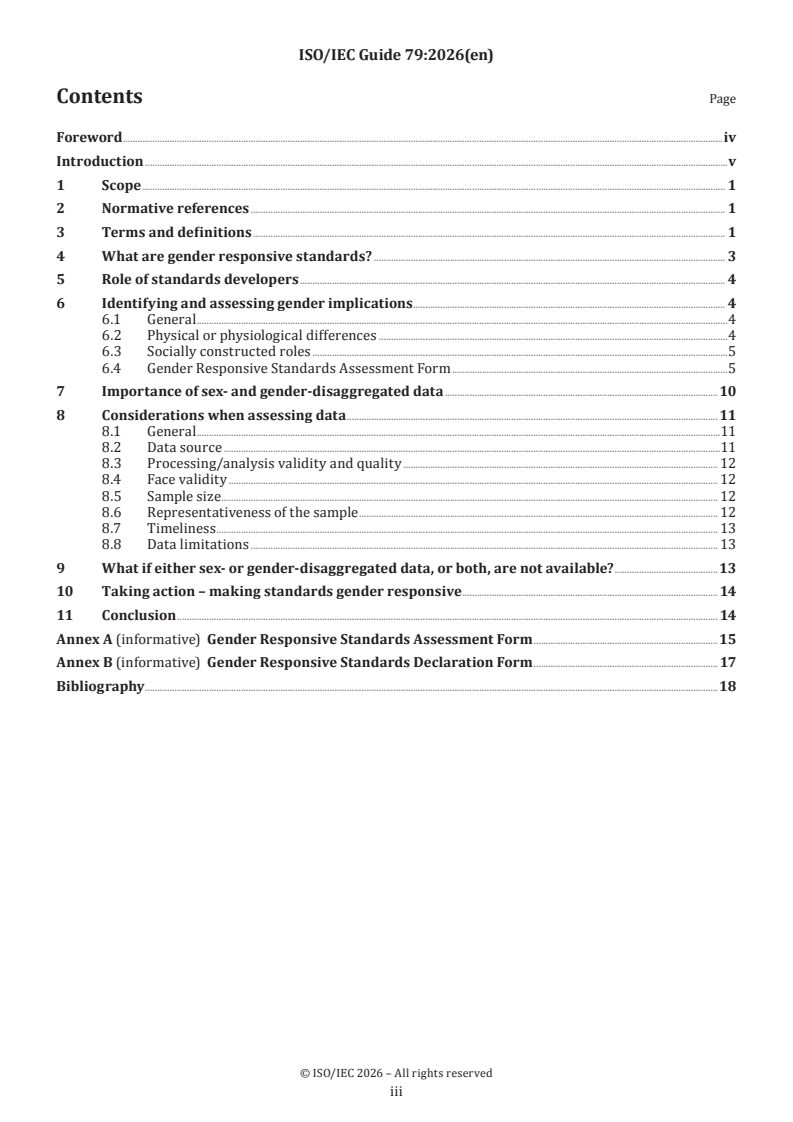
The guide applies to ISO and IEC standards and similar deliverables. Section 2 states that there are no normative references. The document is organized into clauses on scope, terms and definitions, the meaning of gender responsive standards, the role of standards developers, how to identify and assess gender implications, data quality, what to do when data are not available, and how to take action.
| Annex | What it covers |
|---|---|
| Annex A | Gender Responsive Standards Assessment Form |
| Annex B | Gender Responsive Standards Declaration Form |
What are the key requirements of ISO/IEC Guide 79:2026?
ISO/IEC Guide 79:2026 asks standards developers to start early, examine both physical and social gender differences, and use data carefully. It also expects the committee to document its decision and revisit it as new evidence appears.
Start with the assumption that gender may matter
Clause 5 says gender implications should be considered throughout the standards development process, starting at the earliest stage. Clause 6.1 adds that developers should begin with the assumption that sex and gender differences may affect the standard.
In practice, that means the committee should not wait until the final draft to think about gender. It should check the issue while setting scope, drafting requirements, revising text, and reviewing an existing standard.
Look at both physical and social differences
Clause 6.2 highlights physical or physiological factors such as strength, anthropometrics, hormones, skin thickness, body fat percentage, voice and facial recognition, centre of gravity, pregnancy, breastfeeding, menstruation, menopause, reactions to chemicals or pollutants, ageing and metabolic rates. Clause 6.3 adds socially constructed roles and expectations, such as authority in the home, workplace roles, cultural practices, and care responsibilities.
In practice, this means a standard may need to treat users differently, or define tests and assumptions more carefully, when body characteristics or social roles change the way a product, process, system or service works for women and men.
Use sex- and gender-disaggregated data where relevant
Clause 7 says committees should decide whether sex differences, gender differences, or both, are relevant to their work, and then seek sex- or gender-disaggregated data, or both, as appropriate. The guide explains that data are critical in standards development, but that undivided data can hide important differences.
In practice, this affects what evidence the committee looks for and how it interprets it. If the data are not broken down in the right way, the resulting requirements can miss risks, performance gaps or user needs.
Check data quality before relying on it
Clause 8 asks standards developers to examine data source, processing and analysis, face validity, sample size, representativeness, timeliness and data limitations. It also says data sources should be cited for transparency.
In practice, the committee should ask who collected the data, how it was collected, whether the sample reflects the affected population, whether the data are current, and whether the limitations are serious enough to affect the standard’s credibility or applicability.
Act when data are limited or absent
Clause 9 says that if sex- or gender-disaggregated data are not available, developers can collect them if possible, use existing data with their limitations clearly acknowledged, and specify assumptions. It also recommends seeking input from women’s organizations, relevant academics, research bodies, consumer groups or gender experts.
In practice, this gives committees a documented way to proceed without pretending that limited data are complete. It also helps them avoid gender blindness when evidence is weak.
Record the outcome with the annex forms
Clause 6.4 links the assessment process to Annex A and Annex B. The guide describes three possible outcomes: the standard needs changes to address sex or gender differences; no relevant differences are identified for now but will be revisited; or there are insufficient data to incorporate gender considerations at this time.
In practice, the forms create a record of what was checked, what evidence was used, and why the committee chose a particular path.
What terms does ISO/IEC Guide 79:2026 define?
ISO/IEC Guide 79:2026 defines a small set of terms that frame the whole document.
- Gender - a social construct that changes over time and helps define roles and expectations in a society.
- Gender responsive standard (GRS) - an international standard that reflects differences and addresses the needs of women and men, and females and males.
- Standards developer - an individual or group involved in any activity in the development of standards or similar deliverables.
- Gender implication - the effect that a standard’s content and use can have on women and men, including social structures, personal experience, health and policy design.
- Sex-disaggregated data - data separated by sex so differences between females and males can be measured.
- Gender-disaggregated data - data separated by gender identity so differences between gender identities can be measured.
- Bias - a preconceived or unreasoned tendency that can hinder impartial judgment.
Who uses ISO/IEC Guide 79:2026?
ISO/IEC Guide 79:2026 is for standards developers in ISO and IEC technical committees, subcommittees, working groups and related drafting teams. It is used by people who shape scope, write requirements, review evidence, revise published standards and complete Annex A and Annex B.
It is relevant across many fields where standards affect people directly or indirectly, including household appliances, electroacoustics, electromagnetic exposure assessment, clothing sizing, protective clothing, health informatics, ageing services, voice commands and artificial intelligence.
Which standards are used with ISO/IEC Guide 79:2026?
ISO/IEC Guide 79:2026 states that it has no normative references, but it cites related standards and companion documents in its definitions, examples and bibliography.
| Standard | What it contributes |
|---|---|
| ISO 53800:2024 | Source for the definition of gender equality |
| ISO/IEC Guide 2:2004 | Source for the definition of standardization |
| ISO 15535:2023 | Source for the definition of anthropometry |
| ISO 26000:2010 | Source for the definition of social responsibility |
| ISO 30415:2021 | Source for the definition of diversity |
| ISO 10303-2:2024 | Source for the definition of data |
The bibliography also cites example standards such as ISO 19867-1, ISO 19869, IEC 60335-2-15, IEC 60318-7, IEC/IEEE 62704-1 to IEC/IEEE 62704-4, ISO 8559-2, ISO 13688, ISO 13506-1, ISO/TR 9143, ISO 25551, ISO/IEC 30122-2, ISO/IEC/TR 24027 and ISO/IEC/TS 12791, which illustrate how gender considerations appear in different technical areas.
What does the ISO/IEC Guide 79:2026 document contain?
ISO/IEC Guide 79:2026 contains a step-by-step guide for identifying gender implications, checking data quality, and deciding what action to take. It includes Figure 1 on the process for assessing gender responsiveness and Table 1 with case studies from several technical committees and standards.
Annex A provides a working assessment form for committee use, and Annex B provides a declaration form to record the committee’s outcome. The document also includes background explanations, definitions, practical examples and a bibliography that points to related standards, datasets and research.
Frequently Asked Questions
ISO/IEC Guide 79:2026 is a guide published by the International Organization for Standardization (ISO). Its full title is "Gender responsive standards — Guidance for standards developers". This standard covers: This document provides guidance for standards developers on how to consider gender in the drafting, revision and updating of ISO and IEC standards and similar deliverables. It provides an assessment form and other tools and information, which can be used to ensure standards are gender responsive.
This document provides guidance for standards developers on how to consider gender in the drafting, revision and updating of ISO and IEC standards and similar deliverables. It provides an assessment form and other tools and information, which can be used to ensure standards are gender responsive.
ISO/IEC Guide 79:2026 is classified under the following ICS (International Classification for Standards) categories: 01.120 - Standardization. General rules. The ICS classification helps identify the subject area and facilitates finding related standards.
ISO/IEC Guide 79:2026 is available in PDF format for immediate download after purchase. The document can be added to your cart and obtained through the secure checkout process. Digital delivery ensures instant access to the complete standard document.
Standards Content (Sample)
Guide 79
First edition
Gender responsive standards —
2026-10
Guidance for standards developers
Reference number
© ISO/IEC 2026
All rights reserved.
This ISO publication is protected by copyright and is owned by ISO and/or its licensors.
The content of this ISO publication is provided under licence, not sold. Use is subject to the applicable licence terms issued by ISO,
an ISO member body, or an authorized third-party distributor.
Except as required for implementation or expressly permitted by a separate licence, no part of this ISO publication may be
reproduced, distributed, modified, used, or made available in any form or by any means – electronic or mechanical, including
photocopying, scanning, recording, or posting on internal or external digital platforms.
Any use beyond the scope of the granted rights is prohibited and may result in legal action.
ISO copyright office
CP 401 • CH-1214 Vernier, Geneva
Phone: +41 22 749 01 11
Email: copyright@iso.org
Website: www.iso.org
Published in Switzerland
© ISO/IEC 2026 – All rights reserved
ii
Contents Page
Foreword .iv
Introduction .v
1 Scope . 1
2 Normative references . 1
3 Terms and definitions . 1
4 What are gender responsive standards? . 3
5 Role of standards developers . 4
6 Identifying and assessing gender implications . 4
6.1 General .4
6.2 Physical or physiological differences .4
6.3 Socially constructed roles .5
6.4 Gender Responsive Standards Assessment Form .5
7 Importance of sex- and gender-disaggregated data . 10
8 Considerations when assessing data .11
8.1 General .11
8.2 Data source .11
8.3 Processing/analysis validity and quality . 12
8.4 Face validity . 12
8.5 Sample size . 12
8.6 Representativeness of the sample . 12
8.7 Timeliness . 13
8.8 Data limitations . 13
9 What if either sex- or gender-disaggregated data, or both, are not available? .13
10 Taking action – making standards gender responsive . 14
11 Conclusion . 14
Annex A (informative) Gender Responsive Standards Assessment Form .15
Annex B (informative) Gender Responsive Standards Declaration Form . 17
Bibliography .18
© ISO/IEC 2026 – All rights reserved
iii
Foreword
ISO (the International Organization for Standardization) and IEC (the International Electrotechnical
Commission) form the specialized system for worldwide standardization. National bodies that are
members of ISO or IEC participate in the development of International Standards through technical
committees established by the respective organization to deal with particular fields of technical activity.
ISO and IEC technical committees collaborate in fields of mutual interest. Other international organizations,
governmental and non-governmental, in liaison with ISO and IEC, also take part in the work.
The procedures used to develop this document and those intended for its further maintenance are described
in the ISO/IEC Directives, Part 1. In particular, the different approval criteria needed for the different types
of document should be noted. This document was drafted in accordance with the editorial rules of the ISO/
IEC Directives, Part 2 (see www.iso.org/directives or www.iec.ch/members_experts/refdocs).
ISO and IEC draw attention to the possibility that the implementation of this document may involve the
use of (a) patent(s). ISO and IEC take no position concerning the evidence, validity or applicability of any
claimed patent rights in respect thereof. As of the date of publication of this document, ISO and IEC had not
received notice of (a) patent(s) which may be required to implement this document. However, implementers
are cautioned that this may not represent the latest information, which may be obtained from the patent
database available at www.iso.org/patents and https://patents.iec.ch. ISO and IEC shall not be held
responsible for identifying any or all such patent rights.
Any trade name used in this document is information given for the convenience of users and does not
constitute an endorsement.
For an explanation of the voluntary nature of standards, the meaning of ISO specific terms and expressions
related to conformity assessment, as well as information about ISO's adherence to the World Trade
Organization (WTO) principles in the Technical Barriers to Trade (TBT) see www.iso.org/iso/foreword.html.
In the IEC, see www.iec.ch/understanding-standards.
This document was prepared by the ISO/IEC Joint Strategic Advisory Group on Gender Responsive Standards.
Any feedback or questions on this document should be directed to the user’s national standards
body. A complete listing of these bodies can be found at www.iso.org/members.html and
www.iec.ch/national-committees.
© ISO/IEC 2026 – All rights reserved
iv
Introduction
On 19 May 2019, ISO and IEC signed the United Nations Economic Commission for Europe (UNECE)
[1]
Declaration on Gender Responsive Standards and Standards Development, pledging to make standards
and the standards development process gender responsive. The UNECE Declaration recognizes that
currently women are not as well-served by standards as men. The Declaration encourages standards
development organizations of all types to create gender responsive standards (GRS) and gender responsive
standards development environments. The Declaration and its implementation aim to provide a practical
framework for standards bodies and standards developers seeking to make the standards they develop, and
the standards development process they follow, gender responsive.
In response to the UNECE Declaration, and as part of ISO and IEC’s respective gender and diversity action
plans, the Joint Strategic Advisory Group (JSAG) was established to develop guidance to help standards
developers ensure that the standards they are developing are gender responsive.
Enabling gender equality in standards and standards development is a complex challenge that requires taking
action on different elements of the system and process. The complexity of this challenge is compounded by
the breadth and depth of subjects covered through standardization. The focus of this document is specifically
on enabling the development of gender responsive standards. This document is intentionally broad so that
it is applicable regardless of the subject matter. It is meant to generate meaningful discussions within the
committee to support standard developers as they work to ensure their standards are gender responsive.
All standards developers should apply this document, make use of the accompanying assessment form
(Annex A) and complete the declaration form (Annex B).
© ISO/IEC 2026 – All rights reserved
v
Guide ISO/IEC Guide 79:2026(en)
Gender responsive standards — Guidance for standards
developers
1 Scope
This document provides guidance for standards developers on how to consider gender in the drafting,
revision and updating of ISO and IEC standards and similar deliverables. It provides an assessment form and
other tools and information, which can be used to ensure standards are gender responsive.
2 Normative references
There are no normative references in this document.
3 Terms and definitions
For the purposes of this document, the following terms and definitions apply.
ISO and IEC maintain terminology databases for use in standardization at the following addresses:
— ISO Online browsing platform: available at https:// www .iso .org/ obp
— IEC Electropedia: available at https:// www .electropedia .org/
3.1
gender
continually evolving social construct codifying expected behaviours and social and cultural norms, used to
define and describe roles and individuals in a society, often reduced to concepts of femininity and masculinity
(i.e. what it means to be a woman and/or a man) despite the diversity (3.17) (spectrum) of genders
Note 1 to entry: Gender varies from one society to another, and is based on cultural, economic and historical contexts.
3.2
gender responsive standard
GRS
International Standard that reflects an understanding of differences and equally addresses the needs of
women and men, and females and males
3.3
standards developer
individual or group taking part in any activity throughout the development of standards or similar
deliverables
3.4
gender equality
equal rights, responsibilities and opportunities for women and men and girls and boys
Note 1 to entry: Gender equality does not mean that women and men, girls and boys, will become the same but that
women’s and men’s rights, responsibilities and opportunities will not depend on whether they were born male or
female.
Note 2 to entry: Gender equality implies that the interests, needs and priorities of both women and girls, men and
boys, are taken into consideration, recognizing them in all their diversity (3.17).
[2]
[SOURCE: ISO 53800:2024, 3.4]
© ISO/IEC 2026 – All rights reserved
3.5
standardization
activity of establishing, with regard to actual or potential problems, provisions for common and repeated
use, aimed at the achievement of the optimum degree of order in a given context
Note 1 to entry: In particular, the activity consists of the processes of formulating, issuing and implementing standards.
Note 2 to entry: Important benefits of standardization are improvement of the suitability of products, processes and
services for their intended purposes, prevention of barriers to trade and facilitation of technological cooperation.
[3]
[SOURCE: ISO/IEC Guide 2:2004, 1.1]
3.6
gender implication
effect that the content and use of a standard will have on women and men, including social structures,
individual experiences, physical and mental health, and policy design
3.7
sex
typically assigned at birth and/or one's physical attributes which includes a combination of hormones,
chromosomes, physiology and anatomy
3.8
physiological
relating to the way in which the bodies of living things work
3.9
socially constructed
concept or idea that is formed through social and/or cultural processes and accepted by a society, and is not
based on any natural or innate source
3.10
anthropometry
study and measurement of the physical dimensions and mass of the human body and its constituent
(external) parts
[4]
[SOURCE: ISO 15535:2023, 3.6]
3.11
social responsibility
responsibility of an organization for the impacts of its decisions and activities on society and the
environment, through transparent and ethical behaviour that:
— contributes to sustainable development, inclusiveness, health and the welfare of society;
— takes into account the expectations of stakeholders;
— is in compliance with applicable law and consistent with international norms of behaviour;
— is integrated throughout the organization and practised in its relationships
Note 1 to entry: Activities include products, services and processes.
Note 2 to entry: Relationships refer to an organization's activities within its sphere of influence.
Note 3 to entry: Includes activities on members and workforce of organizations.
Note 4 to entry: Social responsibility includes gender equality.
[5]
[SOURCE: ISO 26000:2010, 2.18, modified — Notes 3 and 4 to entry have been added.]
© ISO/IEC 2026 – All rights reserved
3.12
bias
unconscious, conscious or systematic tendency, inclination or opinion that is preconceived or unreasoned
and that hinders impartial judgement
Note 1 to entry: Bias can be both explicit and implicit.
Note 2 to entry: Gender bias is one of its specific forms.
3.13
sex-disaggregated data
data (3.15) that is collected, categorized and presented separately based on sex (3.7), allowing for the
measurement of differences between females and males
Note 1 to entry: It is the responsibility of the committee to determine whether it is more relevant to distinguish in
terms of sex- or gender-disaggregated data (3.14), or both, on a case-by-case basis.
3.14
gender-disaggregated data
data (3.15) that are collected, categorized and presented separately based on gender identity, allowing for
the measurement of differences between different gender identities
Note 1 to entry: It is the responsibility of the committee to determine whether it is more relevant to distinguish in
terms of gender- or sex-disaggregated data (3.13), or both, on a case-by-case basis.
3.15
data
representation of information in a manner suitable for communication, interpretation, or processing by
human beings or computers
[7]
[SOURCE: ISO 10303-2:2024, 3.1.207, modified — “formal” has been removed from definition.]
3.16
data source
where the data (3.15) comes from and who collected it
3.17
diversity
characteristics of differences and similarities between people
Note 1 to entry: Diversity includes factors that influence the identities and perspectives that people bring when
interacting.
Note 2 to entry: Diversity can support the development of environments and practices that foster learning from others
to gain diverse perspectives on inclusiveness.
Note 3 to entry: Diversity dimensions include the demographic and other personal characteristics, for example age,
disability, sex, sexual orientation, gender, gender identity, race, colour, nationality, ethnic or national origin, religion
or belief, as well as characteristics related to the socio-economic context. These are often identified and agreed-upon
dimensions, which can be associated with legal requirements in different jurisdictions.
[6]
[SOURCE: ISO 30415:2021, 3.7, modified — “at work” has been removed from Note 1 to entry; "workplace"
has been removed from Note 2 to entry; “of the workforce” has been removed from Note 3 to entry.]
4 What are gender responsive standards?
Gender responsive standards, and similar deliverables, are developed with consideration for gender
implications in the content, requirements and application of standards. When developing standards, or
other similar deliverables, developers should identify relevant differences based on both sex and gender
and determine how to address the implications of those differences in the standard. There are physical/
physiological differences as well as social and cultural constructs defining roles and expectations for
women and men that standards developers should consider. Taking such factors into account is expected to
© ISO/IEC 2026 – All rights reserved
ensure that gender implications for the specified product, process, system or service are equally met by the
standard.
5 Role of standards developers
All standard developers have an important role in shaping the direction, scope and content of standards
and guiding the development process. Therefore, standards developers have a role to play in ensuring
that standards are gender responsive. Standards developers should ensure that gender implications are
considered throughout the standards development process. These discussions should begin at the earliest
stage of the standards development process and continue through all other stages of development to ensure
the final standard can effectively address gender considerations.
6 Identifying and assessing gender implications
6.1 General
Standard developers should start with the assumption that sex and gender differences will have implications
for their standards’ content. Starting with this assumption can enable a more robust examination to
determine how sex and gender differences impact (or are relevant to) the standards under development and
what actions should be taken to ensure the standards equally meet the needs of women and men.
EXAMPLE When in a car accident, females are 73 % more likely to be seriously injured or die than males. This is
because crash test dummies are based on a male’s anthropometry. While the overall safety of cars has improved, the
improvement has been greater for males than females, because cars are not required to be tested with an equivalent
female crash test dummy. Failure to account for females in the design results in worse outcomes for females in the
[8]
final product.
Standards developers should determine whether a standard functions, performs, and/or impacts women
and men differently to be able to ensure the standard is gender responsive.
6.2 Physical or physiological differences
Some of the most common physical or physiological sex differences that merit consideration by standards
developers include, but are not limited to:
— physical strength (e.g. grip strength)
— anthropometrics
— hormones
— skin thickness
— body fat percentage
— voice/ facial recognition
— centre of gravity
— pregnancy/breastfeeding
— menstruation/menopause
— reactions to chemicals/pollutants
— gender differences in ageing
— metabolic rates
© ISO/IEC 2026 – All rights reserved
EXAMPLE When exposed to the same dose of radiation, females are at a greater risk of developing and subsequently
dying from cancer than males. Because of physiological differences, females are at a greater risk of developing cancer
than males even if acceptable exposure levels are lowered. Consequently, when developing a standard, it is worth
considering that equal outcomes are not always possible, however an examination of gender differences can allow for
[9]
a consideration of what is acceptable for each gender.
6.3 Socially constructed roles
Beyond the physical/physiological characteristics, standards developers should also consider other
differences between women and men due to socially constructed roles or expectations, such as:
— power/authority dynamics in the home and public domains (e.g. who is most likely to be or considered to
be the decision-maker; who is most likely to have or considered to have control);
— work environments (i.e. who is most likely to occupy more junior roles; are there roles that are typically
seen as women’s or men’s roles; gender inequalities in leadership, promotion, pay or recruitment; will the
structure, or terms or conditions of work equally enable access to work for both women and men);
— behavioural or cultural differences (i.e. dress codes, access to banking or financial services, education,
freedom of movement);
— social responsibilities (i.e. elder care, childcare).
Socially constructed roles and expectations vary within and between countries, regions, socio-economic
groups, religious groups, etc. Standards developers should strive to identify and understand the implications
[10]
of these types of gender differences and how a culture influences gender norms. This can help standards
developers understand the implications of such gender differences and norms for the standards they are
developing, thus ensuring that their standards are gender responsive.
EXAMPLE To understand how gender and sex can impact a standard, we can consider the example of cookstoves.
[11]
In 2018, ISO released guidance on cookstoves (ISO 19867-1). ISO collaborated with the Global Alliance for Clean
[12]
Cookstoves to improve safety and efficiency. Cookstoves fuelled by solid fuels (i.e. coal, dung) and kerosene are
a major contributor to indoor pollution. Indoor pollution is estimated to be responsible for 3,8 million premature
[13] [13]
deaths annually. Women and children are disproportionately impacted by household pollution. Due to gendered
cultural norms, women often spend more time on food preparation, increasing their exposure to harmful pollution.
Moreover, research has shown that due to physiological differences, pollution poses a greater health threat to
[14]
women than men. This gender difference is taken into account in the standards for field testing the impact and
performance of cookstoves, where the standard user is directed to document the division of cooking tasks between
[15]
women and men as part of the impact assessment (see ISO 19869:2019, 11.4.1). In the case of cookstoves, sex and
[16]
gender differences put women at greater risk. Gender differences are further accounted for in the guidelines for
social impact assessment of clean cookstoves and clean cooking solutions, where extensive guidance is provided for
the integration of gender analysis into cookstove and household energy projects.
6.4 Gender Responsive Standards Assessment Form
To support standards developers in identifying and assessing gender implications, a Gender Responsive
Standards Assessment Form has been developed (see Annex A). The results of the assessment form which
are documented in Annex B will be one of the following.
— The committee has identified that there are either sex or gender differences, or both, (which can range
from limited to significant) that the standard must address, and the committee has made the necessary
modifications to the standard.
— The committee has determined that there are no relevant sex or gender differences at this time. However,
the committee will revisit as new data become available.
— The committee has determined that there are insufficient data at this time to incorporate gender
considerations. However, this should be revisited as new data become available. No gender considerations
are needed in the standard.
The process of completing the assessment form and the results will enable standards developers to better
understand what action should be taken to ensure their deliverable is gender responsive. The form should be
© ISO/IEC 2026 – All rights reserved
completed at the earliest stage of the standards development process and should be revisited at key stages
of the process to ensure that initial findings are still valid.
The assessment form can be applied to new standards as well as to already published standards (i.e. during a
periodic review). The fact that standards have already been published does not mean that gender differences
were effectively or equitably addressed. Additionally, , if the standard has not equitably addressed the
implications of either sex or gender differences, or both, there is sufficient justification for the standard to
be revised.
Figure 1 outlines the process for assessing gender-responsiveness, which is further detailed in the GRS
Assessment Form.
Figure 1 — Process for assessing gender responsiveness in standards
Table 1 presents case studies on standards and similar deliverables where gender considerations have been
addressed. The information provided is relevant as of the date of publication of this document.
© ISO/IEC 2026 – All rights reserved
Table 1 — GRS Case Studies
Technical Committee Standard Gender consideration Overview of gender considerations
addressed
IEC TC/61, Safety of IEC 60335-2- Physical strength Consideration of:
[17]
household and similar 15:2024,
Anthropometrics
electrical appliances Household and similar
— the safe use of electrical
Voice recognition
electrical appliances
appliances for heating liquids for
- Safety - Part 2-15:
household and similar purposes;
Particular require-
— vulnerable persons, including
ments for appliances
the elderly population and
for heating liquids
youth. The latest edition also
considers gender differences;
— social roles, as women are
usually primary users of
household appliances, and
make important decision of
purchasing these products;
— the use of test probes for
assessment of products include
anthropometric considerations
and gender differences.
[18]
IEC TC/29, Electroacous- IEC 60318-7:2022 Anthropometrics Consideration of:
tics (Revision of IEC
60318-7:2017),
— a manikin with dimensions
Electroacoustics - Sim-
corresponding to a median
ulators of human head
human adult, while recognizing
and ear - Part 7: Head
that a gender-neutral model
and torso simulator for
does not necessarily capture
the measurement of
acoustic variations between
sound sources close to
male and female users caused
the ear
by differences in their anatomy.
Anatomical differences also
occur across ethnicity;
— limitations in evaluating sound
sources close to the ear, as
anatomical differences, such as
manikin size, and in particular
pinna and ear canal size and
angle, are known to affect
acoustic measurements and
thereby the performance of
these devices across genders;
— gender responsiveness during
the development process, while
recognizing that sufficient data
are not available at the time of
the revision;
— future work to define gender-
dependent anthropomorphic ear
simulator sizes in addition to the
average human size in future
revisions of this standard.
© ISO/IEC 2026 – All rights reserved
TTabablele 1 1 ((ccoonnttiinnueuedd))
Technical Committee Standard Gender consideration Overview of gender considerations
addressed
IEC TC/106, Methods IEC/IEEE 62704-1: Anthropometrics Consideration of:
[19]
for the assessment of 2017,
electric, magnetic and Determining the peak
— numerical models and
electromagnetic fields spatial-average spe-
calculations for human exposure
associated with human cific absorption rate
to electric, magnetic, and
exposure (SAR) in the human
electromagnetic fields;
body from wireless
— the use of models to support
communications
testing of products where there
devices, 30 MHz to
is a lack of volunteers;
6 GHz - Part 1: General
requirements for using
— the development of numerical
the finite difference
models for the full population,
time-domain (FDTD)
including differences in gender,
method for SAR calcu-
size, age, etc;
lations
IEC/IEEE 62704-2:
— how electromagnetic fields
[20]
2017,
travel through different bodies.
Specific requirements
for finite difference
time domain (FDTD)
modelling of exposure
from vehicle mounted
antennas
IEC/IEEE 62704-3:
[21]
2017,
Specific requirements
for using the finite
difference time domain
(FDTD) method for SAR
calculations of mobile
phones
IEC/IEEE 62704-4:
[22]
2020,
General requirements
for using the finite el-
ement method for SAR
calculations
[23]
ISO/TC/133, Clothing ISO 8559-2:2025, Anthropometrics Consideration of:
sizing systems - size Size designation of
designation, size meas- clothes — Part 2:
— different sizing systems in
urement methods and Primary and secondary
different companies resulting
digital fittings dimension indicators
in different size designations
fitting people with identical
or very similar body
measurements;
— a reference document for an
international size designation
system for different types of
garments;
— the establishment of a table
listing the primary and
secondary body dimensions for
most of the garments intended
for sectors divided into men's,
women's, boys' and girls' sectors.
© ISO/IEC 2026 – All rights reserved
TTabablele 1 1 ((
...