

ISO 24294:2021
(Main)Timber — Round and sawn timber — Vocabulary
General Information
- Abstract
This document defines terms related to round and sawn timber. It applies to identification of a tree and its components, stages of processing in round and sawn forms, and timber grading, dimensions, anatomical structure, features, moisture content and conditions relating to stain, fungal and insect attack. It does not apply to terms related to strength properties of wood, engineered timber products or timber structures.
- Status
- Published
- Publication Date
- 08-Sep-2021
- Technical Committee
- ISO/TC 218 - Timber
- Drafting Committee
- ISO/TC 218/WG 1 - Terminology
- Current Stage
- 9020 - International Standard under periodical review
- Start Date
- 15-Jul-2026
- Completion Date
- 15-Jul-2026
Buy Documents


ISO 24294:2021 - Timber -- Round and sawn timber -- Vocabulary
ISO 24294:2021 - Timber — Round and sawn timber — Vocabulary/9/2021


ISO 24294:2021 - Bois -- Bois ronds et bois sciés -- Vocabulaire
ISO 24294:2021 - Bois — Bois ronds et bois sciés — Vocabulaire/8/2021

ISO 24294:2021 - Timber — Round and sawn timber — Vocabulary Released:15. 07. 2022
Overview
ISO 24294:2021 - "Timber - Round and sawn timber - Vocabulary" is an international vocabulary standard that defines terms and definitions used across the timber supply chain. The second edition (2021) updates and clarifies terminology for identification of trees and tree components, stages of processing, grading, dimensions, anatomical structure, timber features, moisture conditions, and conditions related to stain, fungal and insect attack. It expressly excludes terms related to strength properties of wood, engineered timber products and timber structures.
Key topics
This vocabulary standard organizes and standardizes terminology so stakeholders speak the same language. Major topic areas include:
- Terms and definitions for basic concepts such as wood, timber, species, hardwood and softwood.
- Round timber vocabulary (logs, long poles, butt/middle/top logs, debarking, felling, bundles/piles).
- Sawn timber vocabulary (sawn timber types, rough sawn, regularized, prepared timber).
- Moisture content and drying terminology relevant to handling and end-use condition.
- Dimensions for round and sawn timber (diameters, lengths, permitted deviations and sizing concepts).
- Anatomical structure and common features (sapwood, heartwood, knots, grain).
- Features, defects and grading - terms that affect sorting, grading and end-use suitability.
- Biological deterioration terms covering stain, fungal attack and insect/wood-borer degradation.
The 2021 edition consolidates and re-orders term categories and provides updated, clarified definitions to improve international harmonization.
Practical applications and users
ISO 24294:2021 is a reference vocabulary rather than a prescriptive performance standard. Typical uses include:
- Supporting clear, consistent procurement contracts, product labels and commercial descriptions.
- Guiding grading, inspection and quality control at forest, log yard and sawmill operations.
- Informing specifications for processing, storage, drying and packaging of round and sawn timber.
- Training and documentation for mill operators, inspectors, traders, builders and importers.
- Enabling consistent terminology in research, regulation and standards development.
- Facilitating international trade by reducing ambiguity between trading partners and across languages.
Primary users: timber manufacturers, sawmills, wholesalers, timber merchants, construction professionals (non-structural terminology), government regulators, standards bodies, and academic researchers.
Related standards
ISO 24294 is intended to be used alongside other ISO standards and national grading systems. It replaces ISO 24294:2013 and ISO 1032:1974 and complements standards addressing timber testing, grading rules and product specifications (see ISO Online Browsing Platform for related documents).
Keywords: ISO 24294, timber vocabulary, round timber, sawn timber, timber grading, timber dimensions, moisture content, timber defects, wood terminology, timber processing.
Relations
- Effective Date
- 23-Apr-2020
- Effective Date
- 23-Apr-2020
Buy Documents
ISO 24294:2021 - Timber -- Round and sawn timber -- Vocabulary
ISO 24294:2021 - Timber — Round and sawn timber — Vocabulary/9/2021
ISO 24294:2021 - Bois -- Bois ronds et bois sciés -- Vocabulaire
ISO 24294:2021 - Bois — Bois ronds et bois sciés — Vocabulaire/8/2021
ISO 24294:2021 - Timber — Round and sawn timber — Vocabulary Released:15. 07. 2022
Get Certified
Connect with accredited certification bodies for this standard

Gozdarski inštitut Slovenije
Slovenian Forestry Institute. Forest management certification support, timber testing.
Sponsored listings
Frequently Asked Questions
ISO 24294:2021 is a standard published by the International Organization for Standardization (ISO). Its full title is "Timber — Round and sawn timber — Vocabulary". This standard covers: This document defines terms related to round and sawn timber. It applies to identification of a tree and its components, stages of processing in round and sawn forms, and timber grading, dimensions, anatomical structure, features, moisture content and conditions relating to stain, fungal and insect attack. It does not apply to terms related to strength properties of wood, engineered timber products or timber structures.
This document defines terms related to round and sawn timber. It applies to identification of a tree and its components, stages of processing in round and sawn forms, and timber grading, dimensions, anatomical structure, features, moisture content and conditions relating to stain, fungal and insect attack. It does not apply to terms related to strength properties of wood, engineered timber products or timber structures.
ISO 24294:2021 is classified under the following ICS (International Classification for Standards) categories: 01.040.79 - Wood technology (Vocabularies); 79.040 - Wood, sawlogs and sawn timber. The ICS classification helps identify the subject area and facilitates finding related standards.
ISO 24294:2021 has the following relationships with other standards: It is inter standard links to ISO 1032:1974, ISO 24294:2013. Understanding these relationships helps ensure you are using the most current and applicable version of the standard.
ISO 24294:2021 is available in PDF format for immediate download after purchase. The document can be added to your cart and obtained through the secure checkout process. Digital delivery ensures instant access to the complete standard document.
Standards Content (Sample)
INTERNATIONAL ISO
STANDARD 24294
Second edition
2021-09
Timber — Round and sawn timber —
Vocabulary
Bois — Bois ronds et bois sciés — Vocabulaire
Reference number
©
ISO 2021
© ISO 2021
All rights reserved. Unless otherwise specified, or required in the context of its implementation, no part of this publication may
be reproduced or utilized otherwise in any form or by any means, electronic or mechanical, including photocopying, or posting
on the internet or an intranet, without prior written permission. Permission can be requested from either ISO at the address
below or ISO’s member body in the country of the requester.
ISO copyright office
CP 401 • Ch. de Blandonnet 8
CH-1214 Vernier, Geneva
Phone: +41 22 749 01 11
Email: copyright@iso.org
Website: www.iso.org
Published in Switzerland
ii © ISO 2021 – All rights reserved
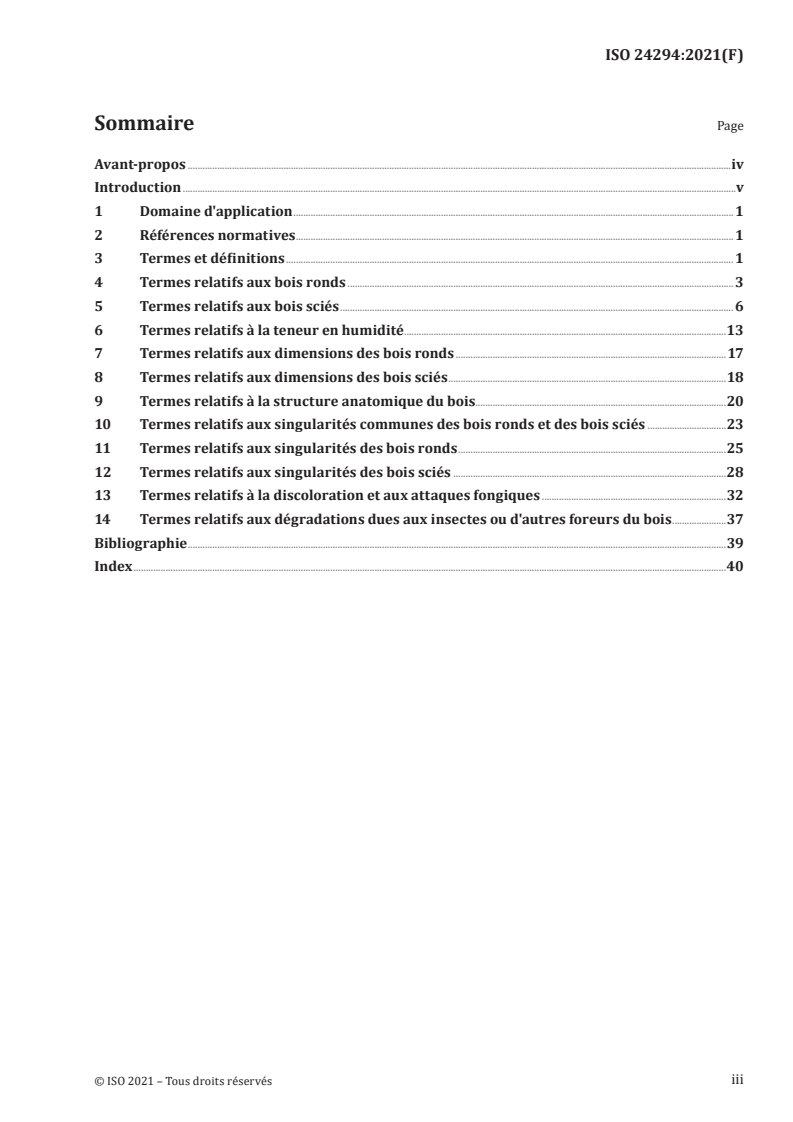
Contents Page
Foreword .iv
Introduction .v
1 Scope . 1
2 Normative references . 1
3 Terms and definitions . 1
4 Terms related to round timber . 3
5 Terms related to sawn timber . 6
6 Terms related to moisture content .13
7 Terms related to dimensions of round timber .16
8 Terms related to dimensions of sawn timber .18
9 Terms related to the anatomical structure of timber .20
10 Terms related to common features of round and sawn timber .22
11 Terms related to features of round timber .24
12 Terms related to features of sawn timber .27
13 Terms related to stain and fungal attack .31
14 Terms related to degradation by insects or other wood borers .35
Bibliography .38
Index .39
Foreword
ISO (the International Organization for Standardization) is a worldwide federation of national standards
bodies (ISO member bodies). The work of preparing International Standards is normally carried out
through ISO technical committees. Each member body interested in a subject for which a technical
committee has been established has the right to be represented on that committee. International
organizations, governmental and non-governmental, in liaison with ISO, also take part in the work.
ISO collaborates closely with the International Electrotechnical Commission (IEC) on all matters of
electrotechnical standardization.
The procedures used to develop this document and those intended for its further maintenance are
described in the ISO/IEC Directives, Part 1. In particular, the different approval criteria needed for the
different types of ISO documents should be noted. This document was drafted in accordance with the
editorial rules of the ISO/IEC Directives, Part 2 (see www .iso .org/ directives).
Attention is drawn to the possibility that some of the elements of this document may be the subject of
patent rights. ISO shall not be held responsible for identifying any or all such patent rights. Details of
any patent rights identified during the development of the document will be in the Introduction and/or
on the ISO list of patent declarations received (see www .iso .org/ patents).
Any trade name used in this document is information given for the convenience of users and does not
constitute an endorsement.
For an explanation of the voluntary nature of standards, the meaning of ISO specific terms and
expressions related to conformity assessment, as well as information about ISO's adherence to the
World Trade Organization (WTO) principles in the Technical Barriers to Trade (TBT), see www .iso .org/
iso/ foreword .html.
This document was prepared by Technical Committee ISO/TC 218, Timber.
This second edition of ISO 24294 cancels and replaces ISO 24294:2013 and ISO 1032:1974, which have
been technically revised. The main changes compared to the previous editions are as follows:
— updated, corrected and clarified definitions;
— re-ordered term categories and terms within categories to match the subject matter.
Any feedback or questions on this document should be directed to the user’s national standards body. A
complete listing of these bodies can be found at www .iso .org/ members .html.
iv © ISO 2021 – All rights reserved
Introduction
Wood is a naturally occurring resource and is the only major construction material that is renewable.
Because it is renewable, the use of wood and the many different timber products made from wood,
contributes to overall sustainable development. Many of these timber products are intended specifically
for use both as structural and non-structural elements in the construction of timber-framed or
platform-frame buildings. Properties of wood are affected by species, natural growth characteristics
and moisture content and with its unique cell structure; wood has different strength properties in
different grain directions.
This document defines terms related to the physical and mechanical characteristics of the many
different hardwood and softwood round, sawn and processed timbers in a manner that is consistent
and recognized globally. This document has been prepared by the various groups involved in the timber
industry, such as manufacturers, builders, wholesalers and importers, as well as research organizations,
academia, national regulatory bodies, standards developers and professional design organizations.
Understanding the nature of the various physical characteristics and features of round and sawn timber
enables effective communication related to sawn and processed timber, in a manner that is consistently
understood by and equitable to all active and potential traders/users. Its use alongside other standards
also aids harmonization and provide a basis for specialist terminology.
INTERNATIONAL STANDARD ISO 24294:2021(E)
Timber — Round and sawn timber — Vocabulary
1 Scope
This document defines terms related to round and sawn timber. It applies to identification of a tree
and its components, stages of processing in round and sawn forms, and timber grading, dimensions,
anatomical structure, features, moisture content and conditions relating to stain, fungal and insect
attack. It does not apply to terms related to strength properties of wood, engineered timber products or
timber structures.
2 Normative references
There are no normative references in this document.
3 Terms and definitions
ISO and IEC maintain terminological databases for use in standardization at the following addresses:
— ISO Online browsing platform: available at https:// www .iso .org/ obp
— IEC Electropedia: available at https:// www .electropedia .org/
3.1
wood
lignocellulosic substance between the pith (9.14) and bark (9.5) of a tree or a shrub
Note 1 to entry: Lignified materials from bamboo, cork, rattan, palm trees and other monocotyledons are not
wood.
Note 2 to entry: Internationally, the terms “wood” and timber (3.2) are often used interchangeably to represent
the basic material of wood products.
3.2
timber
wood (3.1) in the form of standing or felled trees, or a solid wood product of these after processing (3.10)
Note 1 to entry: In the case of processed solid wood products, refers to round timber (4.1) and sawn timber (5.1).
Does not apply to other wood products, such as wood-based panels, veneer, wood pulp, chips (3.11) or sawdust
(3.12).
Note 2 to entry: Internationally, the terms “timber” and “wood” are often used interchangeably to represent the
basic material of wood products.
Note 3 to entry: In Canada and the U.S., there is a homograph for the term “timber”. See 5.6.
3.3
species
botanical category classifying a group of distinct trees with a significant level of genetic similarity
EXAMPLE Douglas-fir (Pseudotsuga menziesii) and Norway spruce (Picea abies).
Note 1 to entry: Usually referred to by a common name and identified by a botanical name that is based on a
Linnaean binomial of its genus and species.
3.3.1
species group
species combination, en CA, U.S.
population of two or more tree species (3.3) or multiple populations of the same tree species combined
into a single marketing group on the basis of similar properties using criteria appropriate for the
intended end use
EXAMPLE Spruce-pine-fir (S-P-F).
Note 1 to entry: Evaluated to develop combined species properties so that the wood products from species within
the group can be used interchangeably.
Note 2 to entry: Trees of the same species group may originate from one or more growth or production regions.
3.4
hardwood
wood (3.1) of trees of the botanical class Angiospermae, subclass Dicotyledonae
Note 1 to entry: The term has no reference to the actual hardness of the wood.
Note 2 to entry: Generally deciduous trees with broad leaves and enclosed seeds.
3.5
softwood
wood (3.1) of trees of the botanical class Gymnospermae, subclass Coniferophytae
Note 1 to entry: The term has no reference to the actual hardness of the wood.
Note 2 to entry: Generally evergreen trees with needle or scale-like leaves and unenclosed seeds, also known as
conifers.
3.6
feature
physical, morphological or growth characteristic of timber (3.2) that could affect its use
3.7
defect
feature (3.6) that results in lower quality of timber (3.2) which causes restrictions in use
3.8
grading
separation or sorting of timber (3.2) by end-use, tree species (3.3), appearance, mechanical or working
properties, sizes or some combination thereof
3.9
batch
lot
specified quantity of a product
3.10
processing
function or a combination of functions other than felling (4.26) that change the form of the material
without changing its solid wood (3.1) structure
Note 1 to entry: May include debarking (4.14), sawing, re-sawing, planing (surfacing), cross-cutting and trimming
at the sawmill, but does not include gluing.
Note 2 to entry: May be supplemented by drying (6.10) at various stages of production.
2 © ISO 2021 – All rights reserved
3.11
chips
small flakes of wood (3.1) produced during a fragmentation process
Note 1 to entry: Generally utilized for pulp, wood-based products or fuel.
3.12
sawdust
fine particles of wood (3.1) produced during the process of sawing
3.13
cross-section
virtual section at a right angle to the longitudinal axis
3.14
length
shortest distance between the ends of a piece of timber (3.2)
4 Terms related to round timber
4.1
round timber
felled tree after delimbing and removal of top, that may or may not have been cross-cut
4.1.1
long pole
round timber (4.1) that has not been cross-cut
4.1.2
log
cross-cut portion of round timber (4.1)
4.1.3
butt log
log (4.1.2) produced from the larger end of a long pole (4.1.1)
4.1.4
middle log
log (4.1.2) produced from the portion of a long pole (4.1.1) between the butt log (4.1.3) and the top end
log (4.1.5)
Note 1 to entry: More than one middle log may be obtained from one long pole.
4.1.5
top end log
log (4.1.2) produced from the smaller end of a long pole (4.1.1)
4.1.6
cylindrical log
perfect round log
log (4.1.2) that has a cross-section (3.13) on both ends that represents a true circle
Note 1 to entry: The roundness of a log is determined by measuring the largest diameter (7.1) and the diameter at
right angles to it, at the least round end and calculating the ratio of the lesser and greater diameters, expressed as
a percentage. The roundness of 100 % is rarely achieved naturally.
4.2
crown
upper portion of a tree with branches
4.3
spring of the crown
zone of the stem (4.4) from where the lowest branches of the crown (4.2) grow out
4.4
stem
portion of a tree above ground, excluding branches
Note 1 to entry: Sometimes refers to trees in general, i.e. stems per unit area.
4.5
trunk
portion of a stem (4.4) used for valuing a standing tree
Note 1 to entry: Usually specified by stating the minimum top diameter (7.1.3).
4.6
butt swelling
flared base part of the stem (4.4)
4.7
buttress
projecting rib at the lower end of the stem (4.4)
4.8
stump
portion of the tree that remains above and below ground level after felling (4.26)
Note 1 to entry: Does not apply to uprooted trees (4.26.1).
4.9
branch whorl
zone of the stem (4.4) where several branches or knots (10.1) occur at approximately the same cross-
section (3.13)
4.10
de-sapped round timber
round timber (4.1) that has had all sapwood (9.1) thoroughly removed
Note 1 to entry: The sapwood is removed generally to prevent biodeterioration (13.1).
4.11
pruned timber
timber (3.2) from a tree that had its lower branches removed by pruning (4.11.1)
4.11.1
pruning
removal of live or dead branches or of multiple leaders of shoots from standing trees
[SOURCE: ISO 6814:2009, 2.19]
4.12
stop
portion of a stem (4.4) where there is a marked reduction in diameter (7.1)
Note 1 to entry: Can occur at a thick branch or at a branch whorl (4.9) in some tree species (3.3).
4.13
cross-cut point
location on round timber (4.1) where it will be cross-cut
4 © ISO 2021 – All rights reserved
4.13.1
theoretical cross-cut point
point at which a trunk (4.5) or round timber (4.1) is visually assessed for cross-cutting for grading (3.8)
purposes
4.14
debarking
removing bark (9.5) from trees or round timber (4.1)
4.14.1
rough debarking
partial removing of bark (9.5)
4.14.2
bundle debarking
simultaneous debarking (4.14) of a group of round timbers (4.1)
4.14.3
piece-by-piece debarking
debarking (4.14) of individual round timbers (4.1)
4.14.4
patch debarking
rough debarking (4.14.1) resulting in spots or patches of remaining bark (9.5) on the surface of round
timber (4.1)
4.14.5
clean debarking
complete removal of bark (9.5) and any remnants of branches and branch wood
4.15
ring barking
girdling, en CA, U.S.
removing a narrow strip of bark (9.5) around the stem (4.4) of a living tree to weaken it or cause death
Note 1 to entry: Not to be confused with debarking (4.14) for the purpose of processing (3.10) round timber (4.1).
4.16
sawlog
log (4.1.2) for processing (3.10) into sawn timber (5.1)
4.17
veneer log
log (4.1.2) for conversion into veneer
4.18
pulpwood
log (4.1.2) or logs used for mechanical or chemical conversion into pulp for paper or wood panel
products
4.19
pit prop
round timber (4.1) intended for supporting mine works
4.20
special assortment log
log (4.1.2) specified by length (3.14) or diameter (7.1), or both, for a specific end-use
4.21
regularized round timber
round timber (4.1) processed to obtain a cylindrical or conical shape
4.22
pole
long round timber (4.1) for use in a free-standing application
4.23
stake
round timber (4.1) of small diameter (7.1) usually pointed at one end
Note 1 to entry: May also be split or sawn.
4.24
bundle
group of evenly placed logs (4.1.2), bundled by strapping or other packaging means
4.25
pile
stack, en CA, U.S.
deck, en CA, U.S.
group of logs (4.1.2) stacked in a row or several parallel rows
Note 1 to entry: Can be located at a forest landing, road-side landing or mill yard.
4.26
felling
separating the stem (4.4) of a tree from its root system
Note 1 to entry: Done by cutting a standing tree near ground level to leave a stump (4.8) or by cutting off a root
ball of an uprooted tree (4.26.1).
4.26.1
uprooted tree
tree that is blown over as a result of wind or mechanically pushed over with the root ball still attached
5 Terms related to sawn timber
5.1
sawn timber
lumber, en CA, U.S.
sawn lumber, en CA, U.S.
solid wood (3.1) product obtained by the longitudinal sawing of logs (4.1.2), having at least two parallel
planes
Note 1 to entry: Often supplemented by additional processing (3.10) and/or drying (6.10).
Note 2 to entry: Does not include any products obtained by end, face (5.17) or edge (5.18) gluing of sawn timber
components.
5.1.1
rough sawn timber
sawn timber (5.1) without any additional processing (3.10)
5.1.2
regularized green timber
regularized green lumber, en CA, U.S.
sawn timber (5.1), in a green state, processed to specified permitted deviations (8.8)
5.1.3
prepared timber
blank
sawn timber (5.1) that, at the end-use moisture content (6.7), has been processed to permitted deviations
(8.8) under special agreement between buyer and seller
6 © ISO 2021 – All rights reserved
5.2
regularized dried timber
regularized dried lumber, en CA, U.S.
regularized dry timber
sawn timber (5.1) that, after drying (6.10) to the end-use moisture content (6.7), has been processed to
specified permitted deviations (8.8)
5.3
planed timber
planed lumber, en CA, U.S.
dressed lumber, en CA, U.S.
surfaced lumber, en CA, U.S.
sawn timber (5.1) that, at the end-use moisture content (6.7), has been processed for its full length (3.14)
and width (8.2) on at least one face (5.17) to obtain a smooth surface
Note 1 to entry: The end-use moisture content forming part of a specification for planed lumber is typically
specified as either an average moisture content (6.1) with a limit on the variation, or as a moisture content limit,
which a large portion of the production shall not exceed.
5.4
profiled timber
profiled lumber, en CA, U.S.
sawn timber (5.1) that, at the end-use moisture content (6.7), has been processed to obtain a specified,
non-rectangular cross-section (3.13)
5.5
boule
set of pieces of unedged timber (5.14), resulting from cutting a log (4.1.2) longitudinally by successive
parallel cuts, and reassembled into the original log form without the slabs (5.15)
5.6
baulk
timber, en CA, U.S.
large scantling, en MY
large sawn timber (5.1) of square or rectangular cross-section (3.13)
Note 1 to entry: In Canada and the U.S., the minimum dimensions of the cross-section of a timber are
114 mm × 114 mm (nominal 5 in × 5 in).
Note 2 to entry: In Malaysia, the minimum dimensions of the cross-section of a large scantling are nominal
10 in × 6 in.
Note 3 to entry: In Belarus, Russia and Ukraine, the minimum dimensions of the cross-section of a baulk are
100 mm × 100 mm.
Note 4 to entry: In the EU, the minimum thickness (8.1) of a baulk is 80 mm and the sum of the thickness and
width (8.2) shall be greater than or equal to 200 mm.
Note 5 to entry: In Canada and the U.S., there is a homograph for the term “timber”. See 3.2.
5.7
board
piece of sawn timber (5.1) of smaller dimensions
Note 1 to entry: In Malaysia, at least 141 mm (nominal 6 in) in width (8.2).
Note 2 to entry: In Belarus, Russia and Ukraine, less than 100 mm thick with the width at least twice the thickness
(8.1).
Note 3 to entry: In Great Britain/UK, at least 100 mm (nominal 4 in) in width.
Note 4 to entry: In Japan, less than 75 mm thick with the width at least four times the thickness.
Note 5 to entry: In Canada and the U.S., less than 38 mm (nominal 2 in.) thick and 38 mm (nominal 2 in.) or more
in width.
5.8
lath
slat, en CA, U.S.
strip, en MY
thin, narrow strip of sawn timber (5.1)
Note 1 to entry: Typically, 9 mm (3/8 in) to 12,5 mm (1/2 in) in thickness (8.1) and 38 mm (1-1/2 in) in width (8.2).
Note 2 to entry: In Malaysia, the width can be up to 141 mm (nominal 6 in).
Note 3 to entry: Typically used as backing for wall plaster and sometimes for fences.
5.9
scantling
piece of sawn timber (5.1) of rectangular cross-section (3.13) whose thickness (8.1) usually equals or
exceeds half its width (8.2)
EXAMPLE 1 Small scantlings have sizes such as 3 in × 2 in, 4 in × 2 in, 4 in × 3 in, 6 in × 4 in, etc.
EXAMPLE 2 Large scantlings have sizes such as 10 in × 6 in, 12 in × 8 in, 12 in × 12 in, etc.
Note 1 to entry: In Malaysia, the minimum dimensions of the cross-section of a large scantling (5.6) are nominal
10 in × 6 in.
Note 2 to entry: In Belarus, Russia and Ukraine, the thickness of a small scantling is less than 100 mm.
5.10
cant
flitch, en CA, U.S.
log (4.1.2) sawn on at least one side
Note 1 to entry: Usually intended for further processing (3.10).
Note 2 to entry: In some countries, may be specified as having at least two flat sides.
5.11
square-edged timber
square-cornered timber, en CA, U.S.
sawn timber (5.1) of rectangular cross-section (3.13)
Note 1 to entry: Wane (5.13), in specified amounts, is permitted in some cases.
Note 2 to entry: In Canada and the U.S., the term “square-edged” refers to sawn timber free of wane and without
eased edges/eased arrises (5.19.3).
Note 3 to entry: In Canada and the U.S., the term “square cornered” refers to sawn timber with an allowance for
wane in some cases but without eased edges/eased arrises.
5.12
taper-edged timber
sawn timber (5.1) processed so that the edges (5.18) are not parallel
5.13
wane
absence of wood (3.1) in the cross-section (3.13) of sawn timber (5.1) due to the original rounded surface
of a log (4.1.2), with or without bark (9.5), on any face (5.17) or edge (5.18) and extending along the
longitudinal axis of the piece
8 © ISO 2021 – All rights reserved
5.14
unedged timber
sawn timber (5.1) with parallel faces (5.17) and with one or both edges (5.18) left unsawn
5.15
slab
thin longitudinal exterior slice of a log (4.1.2) obtained by the first sawcut
Note 1 to entry: May be further processed.
5.16
squared end
end of sawn timber (5.1) that has a plane surface at a right angle to the longitudinal axis of the piece
5.17
face
either of the two wider longitudinal opposite surfaces of sawn timber (5.1) or any of the longitudinal
surfaces if the piece has a square cross-section (3.13)
5.17.1
outside face
face (5.17) furthest away from the pith (9.14)
5.17.2
inside face
face (5.17) nearer to the pith (9.14)
5.17.3
better face
face (5.17) that, using a specific rule for grading (3.8), is judged to be of a higher grade than the other
face
5.17.4
worse face
face (5.17) that, using a specific rule for grading (3.8), is judged to be of a lower grade than the other
face
5.18
edge
either one of the narrow longitudinal surfaces of square-edged timber (5.11)
Note 1 to entry: In Canada and the U.S., also applies to the part of the face (5.17) nearest to the arris (5.19) defined
for the purpose of grading (3.8).
Note 2 to entry: In Canada and the U.S., there is a homograph for the term “edge”. See 5.19.
5.19
arris
edge, en CA, U.S.
line of intersection of two faces (5.17) or a face and an edge (5.18)
Note 1 to entry: In Canada and the U.S., there is a homograph for the term “edge”. See 5.18.
5.19.1
waney arris
waney edge, en CA, U.S.
arris (5.19) that contains wane (5.13) in one or more places
5.19.2
sharp arris
sharp edge, en CA, U.S.
arris (5.19) free of wane (5.13)
5.19.3
eased arris
eased edge, en CA, U.S.
arris (5.19) that has a slightly rounded surface
5.20
plain sawn timber
sawn timber (5.1) that has a face (5.17) normal or approximately normal to the rays (9.20)
Note 1 to entry: Limits on the angle between rays depend on the species (3.3) and on other factors; e.g. for oak, the
angle between the rays and the face are between 60° and 90°. Other limits can be specified in rules for grading
(3.8).
5.21
plain sawn timber
sawn timber (5.1) that has a face (5.17) tangential or approximately tangential to the
growth rings (9.8)
Note 1 to entry: Limits for species (3.3) where the rays are not visible are 0° and 30° for the angle between the
growth rings and the face. Other limits can be specified in rules for grading (3.8).
5.22
quarter sawn timber
sawn timber (5.1) that has a face (5.17) tangential or approximately tangential to the rays
(9.20)
Note 1 to entry: Limits on the angle between rays depend on the species (3.3) and on other factors; e.g. for oak,
the angle between the rays and the face are between 0° and 30°. Other limits can be specified in rules for grading
(3.8).
5.23
quarter sawn timber
sawn timber (5.1) that has a face (5.17) normal or approximately normal to the growth
rings (9.8)
Note 1 to entry: Limits for species (3.3) where the rays are not visible are 90° and 60° for the angle between the
growth rings and the face. Other limits can be specified in rules for grading (3.8).
Note 2 to entry: In Canada and the U.S., the term “quarter sawn” refers to timber (3.2) sawn so that the growth
rings form angles of 45° to 90° with the face of the piece.
5.24
fully quarter sawn timber
sawn timber (5.1) where the angle between the rays (9.20) and a face (5.17) is 10° or less
5.25
fully quarter sawn timber
sawn timber (5.1) where the angle between the growth rings (9.8) and a face (5.17) is
80° or more
5.26
grain
fibres (9.18) in wood (3.1) and their direction, size, arrangement, appearance or quality
Note 1 to entry: In English, there is a homograph for the term “grain”. See 9.19.
5.26.1
diagonal grain
deviation of grain (5.26) from a line parallel to the edges (5.18), through the thickness (8.1) of the piece.
Note 1 to entry: See also slope of grain (12.7).
10 © ISO 2021 – All rights reserved
5.26.2
flat grain
FG, en CA, U.S.
slash grain
SG, en CA, U.S.
timber (3.2) sawn approximately parallel to the growth rings (9.8) so that all or some of the growth
rings form an angle of less than 45° with either face (5.17) of the piece
Note 1 to entry: A piece of sawn timber (5.1) containing both vertical grain (5.26.4) and flat grain is classified as
flat grain.
5.26.3
mixed grain
MG, en CA, U.S.
sawn timber (5.1) with any mixture of vertical grain (5.26.4) and flat grain (5.26.2)
5.26.4
vertical grain
VG, en CA, U.S.
edge grain
EG, en CA, U.S.
rift grain
timber (3.2) sawn at approximate right angles to the growth rings (9.8) so that they form an angle of 45°
or more with either face (5.17) of the piece
5.27
exposed pith
pith (9.14) that is visible on a part or the full length (3.14) of a face (5.17) or an edge (5.18)
5.28
boxed heart
pith (9.14) that is present and not visible on any face (5.17) or edge (5.18)
5.29
free of heart centre
FOHC, en CA, U.S.
side cut
piece of sawn timber (5.1) that does not contain the pith (9.14)
5.30
heart plank
piece of sawn timber (5.1) that contains the pith (9.14)
5.31
side board
first piece of sawn timber (5.1) cut from the outer portion of a log (4.1.2)
5.32
sawing defect
surface irregularity on a piece of sawn timber (5.1) caused by sawing
5.32.1
tooth marks
scoring on the surface of sawn timber (5.1) caused by a saw tooth
5.32.2
chipped grain
breaking away of the fibres (9.18) below the surface of sawn timber (5.1) caused by the action of a tool
Note 1 to entry: Frequently occurs on the edge (5.18) and by the breaking away of dried knots (10.1).
5.32.3
snaking
waviness on the surface of sawn timber (5.1) caused by irregular sawing
5.32.4
torn grain
condition of the surface of sawn timber (5.1) on which the fibres (9.18) have been dragged up or pulled
out
5.33
warp
distortion of a piece of sawn timber (5.1) caused by processing (3.10), drying (6.10), or storage, or some
combination thereof
5.33.1
bow
warp (5.33) consisting of lengthwise curvature of a piece of sawn timber (5.1) normal to the face (5.17)
5.33.1.1
simple bow
warp (5.33) consisting of a single bow (5.33.1)
5.33.1.2
complex bow
warp (5.33) consisting of two or more bows (5.33.1) in alternate directions
5.33.2
spring
crook, en CA, U.S.
side bend, en CA U.S.
warp (5.33) consisting of lengthwise curvature of a piece of sawn timber (5.1) normal to the edge (5.18)
5.33.2.1
simple spring
simple crook, en CA, U.S.
warp (5.33) consisting of a single spring (5.33.2)
5.33.2.2
compound spring
warp (5.33) consisting of two or more springs (5.33.2) in alternate directions
5.33.3
cup
warp (5.33) consisting of curvature of a piece of sawn timber (5.1) across the width of the piece
5.33.4
twist
warp (5.33) consisting of lengthwise spiral distortion of a piece of sawn timber (5.1)
5.34
raised grain
condition of the surface of sawn timber (5.1) where a distortion of the grain (5.26) (9.19) causes ends of
fibres (9.18) to loosen
5.35
top rupture
deviation in the grain (5.26) (9.19) caused by damage to the top of a live tree
12 © ISO 2021 – All rights reserved
6 Terms related to moisture content
6.1
moisture content
MC
amount of water contained in wood (3.1), expressed as a percentage of the mass of the wood in the oven-
dry state (6.16.1)
Note 1 to entry: Determined as mass of evaporable water divided by mass of wood in oven-dry state.
Note 2 to entry: When moisture content is specified for production, it is expressed as either an average moisture
content with a limit on the variation, or as a moisture content limit, which a large portion of the production
should not exceed.
6.2
free water
free moisture
water that is contained in the cell cavities and intercellular spaces of wood (3.1)
6.3
bound water
bound moisture
water in the cell walls of wood (3.1)
6.4
fibre saturation point
FSP
moisture content (6.1) of wood (3.1) saturated with bound water (6.3) but with no free water (6.2)
Note 1 to entry: Considered to be approximately 30 % in wood of temperate species (3.3).
Note 2 to entry: The exact value is difficult to determine because there is generally some free water when the cell
walls are fully saturated.
6.4.1
wood hygroscopicity limit
moisture content (6.1) of wood (3.1) at a stated ambient temperature, when the cell walls have absorbed
the maximum of bound water (6.3) from the surrounding air and no free water (6.2) exists in the cell
cavities
Note 1 to entry: At room temperature it is the same as the fibre saturation point (6.4).
6.5
final moisture content
moisture content (6.1) at the end of drying (6.10) process
6.6
equilibrium moisture content
stabilised moisture content (6.1) of wood (3.1) in a given environment
6.7
end-use moisture content
moisture content (6.1) appropriate to the environment of final use
6.8
surface moisture content
moisture content (6.1) on the surface of a piece of timber (3.2)
6.9
core moisture content
moisture content (6.1) at the centre of the cross-section (3.13) of a piece of timber (3.2)
6.10
drying
seasoning
reduction of the moisture content (6.1) of timber (3.2)
6.11
green timber
timber (3.2) that has not been subject to drying (6.10) below the fibre saturation point (6.4)
Note 1 to entry: Generally refers to freshly cut timber that might have had some exposure to air drying.
Note 2 to entry: In Canada and the U.S., sawn timber (5.1) where a large portion of the pieces are expected to have
moisture content (6.1) above 19 % at the time of grading (3.8) is considered green.
6.12
shipping dry timber
shipping dry lumber, en CA, U.S.
sawn timber (5.1) that has a moisture content (6.1) sufficiently low to limit stain (13.9), mould (13.17)
and fungal attack (13.2) of timber while in transport
6.13
dry graded timber
dry lumber, en CA, U.S.
sawn timber (5.1) that has a specified moisture content (6.1) at the time of grading (3.8)
Note 1 to entry: In Europe, refers to sawn timber that has a mean moisture content of 20 % or less, without any
measurement exceeding 24 % at the time of grading.
Note 2 to entry: In Canada and the U.S., the term “dry lumber” is used to refer to sawn timber that has a moisture
content of 19 % or less at the time of grading.
Note 3 to entry: In Japan, there are several classes of moisture content depending on use of timber (3.2). The
number after “D” is the mean moisture content of sawn timber at the time of grading:
— D15, D20 and D25 for structural use softwood (3.5) timber;
— D13 and D15 for non-structural use softwood timber; and
— D10 and D13 for structural or non-structural use hardwood (3.4) timber.
6.14
air-dried timber
air-dried lumber, en CA, U.S.
air-dry timber
sawn timber (5.1) that has been subject to drying (6.10) by exposure to air without any artificial heating
and has a moisture content (6.1) in approximate equilibrium with the surrounding natural atmospheric
conditions
Note 1 to entry: In Japan, mean moisture content of 30 % or less at the time of grading (3.8) is targeted.
6.15
kiln-dried timber
kiln-dried lumber or KD lumber, en CA, U.S.
kiln-dry timber
sawn timber (5.1) that has been subject to drying (6.10) in a closed chamber in which the required
moisture content (6.1) is obtained by artificial heat and humidity control
Note 1 to entry: The moisture content is targeted to the same limitations as dry graded timber (6.13).
14 © ISO 2021 – All rights reserved
6.16
oven-dry timber
oven-dry wood, en CA, U.S.
timber (3.2) that contains neither free water (6.2) nor bound water (6.3)
Note 1 to entry: Obtained by drying (6.10) in a ventilated oven at 103 °C ± 2 °C until constant mass is achieved.
6.16.1
oven-dry state
state of a piece of wood (3.1) that contains neither free water (6.2) nor bound water (6.3)
6.17
shrinkage
decrease in dimensions of a piece of timber (3.2) due to reduction of the moisture content (6.1) below the
fibre saturation point (6.4)
6.17.1
total shrinkage
shrinkage (6.17) in a stated anatomical direction (radial or tangential or longitudinal) between the fibre
saturation point (6.4) state and the oven-dry state (6.16.1), expressed as a percentage of the dimension at
the fibre saturation point state
6.17.2
shrinkage value
shrinkage coefficient
shrinkage (6.17) in a stated anatomical direction for a one percentage point reduction in moisture
content (6.1)
Note 1 to entry: Derived by dividing total shrinkage (6.17.1) by the fibre saturation point (6.4).
6.17.3
radial shrinkage
shrinkage (6.17) in a direction normal to the growth rings (9.8) or in a direction parallel to the rays
(9.20)
6.17.4
tangential shrinkage
shrinkage (6.17) in a direction tangential to the growth rings (9.8) or in a direction normal to the rays
(9.20)
6.17.5
longitudinal shrinkage
shrinkage (6.17) in a direction parallel to grain (9.19)
6.18
swelling
increase in dimensions of a piece of timber (3.2) due to increase in bound water (6.3)
6.18.1
total swelling
swelling (6.18) in a stated anatomical direction between the oven-dry state (6.16.1) and the fibre
saturation point (6.4) state expressed as a percentage of the dimension at the oven-dry state
6.18.2
swelling value
swelling coefficient
swelling (6.18) in a stated anatomical direction for a one percentage point increase in moisture content
(6.1)
Note 1 to entry: Derived by dividing total swelling (6.18.1) by the fibre saturation point (6.4).
6.18.3
radial swelling
swelling (6.18) in a direction normal to the growth rings (9.8) or in a direction parallel to the rays (9.20)
6.18.4
tangential swelling
swelling (6.18) in a direction tangential to the growth rings (9.8) or in a direction normal to the rays
(9.20)
6.18.5
longitudinal swelling
swelling (6.18) in a direction parallel to grain (9.19)
6.19
moisture pocket
small portion or section of timber (3.2) that retains excessive moisture content (6.1) after drying (6.10)
6.20
case-hardened timber
timber (3.2) where the outer layers have undergone some drying (6.10) and become set without
corresponding shrinkage (6.17), causing stress between the inner and outer layers
6.21
honeycombing
separation of the fibres (9.18) in the interior of a piece of timber (3.2) induced by drying (6.10) stresses
Note 1 to entry: The separation usually occurs along and in the plane of the rays (9.20).
Note 2 to entry: See also fissure (10.11) and honeycomb (13.34).
6.22
collapse
flattening or buckling of cell walls during excessive drying (6.10)
Note 1 to entry: The collapse manifests itself as a wavy surface.
7 Terms related to dimensions of round timber
7.1
diameter
distance between two parallel lines tangential to the stem (4.4) or to round timber (4.1)
7.1.1
butt diameter
large diameter
diameter (7.1) at the larger end
7.1.2
mid diameter
mid girth, en MY
diameter (7.1) at mid-length (3.14)
7.1.3
top diameter
diameter (7.1) at the smaller end
7.2
full dimension
dimension with any fraction of the unit of measurement ignored
16 © ISO 2021 – All rights reserved
7.3
nominal length
specified length (3.14) of round timber (4.1), disregarding any cross-cut allowance (7.4)
7.4
cross-cut allowance
additional clearance to compensate the loss of length (3.14) due to a cross-cut
7.5
solid volume
measure of the quantity of wood (3.1) in round timber (4.1) based on its dimensions
Note 1 to entry: Usually expressed in cubic metres.
Note 2 to entry: Can be based on dimensions determined over bark (7.7) or under bark (7.8).
Note 3 to entry: See also bark allowance (7.9).
7.6
piled volume
stacked volume
volume occupied by a pile (4.25) of round timber (4.1) determined by external dimensions, including air
spaces
7.7
over bark
outside bark
including the bark (9.5) in a measurement
7.8
under bark
inside bark
excluding the bark (9.5) from a measurement
7.9
bark allowance
factor to convert the volume of round timber (4.1), measured over bark (7.7), to the corresponding
volume measured under bark (7.8)
7.10
weight measure
measure of the quantity of round timber (4.1) based on its mass
7.11 Terms related to measurement of solid volume
7.11.1
piece-by-piece measurement of volume
determination of solid volume (7.5) based on measurement of the diameter (7.1), with or without bark
(9.5), and the length (3.14) of each individual piece of round timber (4.1)
7.11.2
geometric measurement of piled volume
measurement of the aggregate volume of a pile (4.25) of round timber (4.1) with a fixed form with
conversion of piled volume (7.6) into solid volume (7.5)
7.11.3
mass measurement of volume
weighing of round timber (4.1) with subsequent conversion of the mass into solid volume (7.5)
7.11.4
hydrostatic measurement of volume
determination of the solid volume (7.5) of round timber (4.1) by change in water displacement upon
complete immersion in water
7.11.5
photographic determination of volume
determination of solid volume (7.5) of round timber (4.1) by measurement of the size and density of the
pile (4.25) using its photo image and taking into account the lengths (3.14)
7.11.6
electro-optical determination of volume
determination of solid volume (7.5) of round timber (4.1) by electro-optical (scanning) devices
8 Terms related to dimensions of sawn timber
8.1
thickness
distance between the faces (5.17) of a piece of sawn timber (5.1) at the specified place of measurement
8.2
width
distance between the edges (5.18) of a piece of sawn timber (5.1) at the specified place of measurement
8.2.1
narrowest width
width (8.2) of unedged timber (5.14) measured at the narrowest point of the narrower face (5.17)
8.3
setting size
size to which a machine is set to give sawn timber (5.1) a required dimension
Note 1 to entry: The setting size usually includes an oversize allowance for sawing inaccuracies and shrinkage
(6.17).
8.4
nominal dimension
basic size
size by which sawn timber (5.1) is designated or marketed, approximately equal to its actual size (8.6)
Note 1 to entry: No inference should be drawn that nominal designations are actual sizes.
8.5
dimension stock
batch (3.9) of sawn timber (5.1) sawn to target sizes (8.7) for a specified purpose
8.6
actual size
size of a piece of sawn timber (5.1) at the time of measurement
8.7
target size
standard size, en CA, U.S.
size of a piece of sawn timber (5.1) at a specified moisture content (6.1) that is desired after processing
(3.10)
Note 1 to entry: Аny permitted deviation (8.8) is expressed relative to the target size.
18 © ISO 2021 – All rights reserved
8.8
permitted deviation
combination of the permitted algebraic differences between the limits of the actual size (8.6) and the
corresponding target size (8.7)
Note 1 to entry: Generally expressed as a combination of the upper and lower permitted deviations (8.9) (8.10).
If the upper permitted deviation has a different magnitude than the lower permitted deviation, the target size
and the permitted deviation are typically indicated as follows:
+3
(50 ) mm.
−2
If the upper and lower permitted deviations have the same magnitude, the target size and the permitted deviation
are typically indicated as follows:
(75 ± 2) mm.
8.9
upper permitted deviation
algebraic difference between the upper limit of size and the corresponding target size (8.7)
8.10
lower permitted deviation
algebraic difference between the lower limit of size and the corresponding target size (8.7)
8.11
tolerance
algebraic difference between the upper permitted deviation (8.9) and the lower permitted deviation
(8.10)
Note 1 to entry: Tolerance is an absolute value without si
...
INTERNATIONAL ISO
STANDARD 24294
Second edition
2021-09
Timber — Round and sawn timber —
Vocabulary
Bois — Bois ronds et bois sciés — Vocabulaire
Reference number
©
ISO 2021
© ISO 2021
All rights reserved. Unless otherwise specified, or required in the context of its implementation, no part of this publication may
be reproduced or utilized otherwise in any form or by any means, electronic or mechanical, including photocopying, or posting
on the internet or an intranet, without prior written permission. Permission can be requested from either ISO at the address
below or ISO’s member body in the country of the requester.
ISO copyright office
CP 401 • Ch. de Blandonnet 8
CH-1214 Vernier, Geneva
Phone: +41 22 749 01 11
Email: copyright@iso.org
Website: www.iso.org
Published in Switzerland
ii © ISO 2021 – All rights reserved
Contents Page
Foreword .iv
Introduction .v
1 Scope . 1
2 Normative references . 1
3 Terms and definitions . 1
4 Terms related to round timber . 3
5 Terms related to sawn timber . 6
6 Terms related to moisture content .13
7 Terms related to dimensions of round timber .16
8 Terms related to dimensions of sawn timber .18
9 Terms related to the anatomical structure of timber .20
10 Terms related to common features of round and sawn timber .22
11 Terms related to features of round timber .24
12 Terms related to features of sawn timber .27
13 Terms related to stain and fungal attack .31
14 Terms related to degradation by insects or other wood borers .35
Bibliography .38
Index .39
Foreword
ISO (the International Organization for Standardization) is a worldwide federation of national standards
bodies (ISO member bodies). The work of preparing International Standards is normally carried out
through ISO technical committees. Each member body interested in a subject for which a technical
committee has been established has the right to be represented on that committee. International
organizations, governmental and non-governmental, in liaison with ISO, also take part in the work.
ISO collaborates closely with the International Electrotechnical Commission (IEC) on all matters of
electrotechnical standardization.
The procedures used to develop this document and those intended for its further maintenance are
described in the ISO/IEC Directives, Part 1. In particular, the different approval criteria needed for the
different types of ISO documents should be noted. This document was drafted in accordance with the
editorial rules of the ISO/IEC Directives, Part 2 (see www .iso .org/ directives).
Attention is drawn to the possibility that some of the elements of this document may be the subject of
patent rights. ISO shall not be held responsible for identifying any or all such patent rights. Details of
any patent rights identified during the development of the document will be in the Introduction and/or
on the ISO list of patent declarations received (see www .iso .org/ patents).
Any trade name used in this document is information given for the convenience of users and does not
constitute an endorsement.
For an explanation of the voluntary nature of standards, the meaning of ISO specific terms and
expressions related to conformity assessment, as well as information about ISO's adherence to the
World Trade Organization (WTO) principles in the Technical Barriers to Trade (TBT), see www .iso .org/
iso/ foreword .html.
This document was prepared by Technical Committee ISO/TC 218, Timber.
This second edition of ISO 24294 cancels and replaces ISO 24294:2013 and ISO 1032:1974, which have
been technically revised. The main changes compared to the previous editions are as follows:
— updated, corrected and clarified definitions;
— re-ordered term categories and terms within categories to match the subject matter.
Any feedback or questions on this document should be directed to the user’s national standards body. A
complete listing of these bodies can be found at www .iso .org/ members .html.
iv © ISO 2021 – All rights reserved
Introduction
Wood is a naturally occurring resource and is the only major construction material that is renewable.
Because it is renewable, the use of wood and the many different timber products made from wood,
contributes to overall sustainable development. Many of these timber products are intended specifically
for use both as structural and non-structural elements in the construction of timber-framed or
platform-frame buildings. Properties of wood are affected by species, natural growth characteristics
and moisture content and with its unique cell structure; wood has different strength properties in
different grain directions.
This document defines terms related to the physical and mechanical characteristics of the many
different hardwood and softwood round, sawn and processed timbers in a manner that is consistent
and recognized globally. This document has been prepared by the various groups involved in the timber
industry, such as manufacturers, builders, wholesalers and importers, as well as research organizations,
academia, national regulatory bodies, standards developers and professional design organizations.
Understanding the nature of the various physical characteristics and features of round and sawn timber
enables effective communication related to sawn and processed timber, in a manner that is consistently
understood by and equitable to all active and potential traders/users. Its use alongside other standards
also aids harmonization and provide a basis for specialist terminology.
INTERNATIONAL STANDARD ISO 24294:2021(E)
Timber — Round and sawn timber — Vocabulary
1 Scope
This document defines terms related to round and sawn timber. It applies to identification of a tree
and its components, stages of processing in round and sawn forms, and timber grading, dimensions,
anatomical structure, features, moisture content and conditions relating to stain, fungal and insect
attack. It does not apply to terms related to strength properties of wood, engineered timber products or
timber structures.
2 Normative references
There are no normative references in this document.
3 Terms and definitions
ISO and IEC maintain terminological databases for use in standardization at the following addresses:
— ISO Online browsing platform: available at https:// www .iso .org/ obp
— IEC Electropedia: available at https:// www .electropedia .org/
3.1
wood
lignocellulosic substance between the pith (9.14) and bark (9.5) of a tree or a shrub
Note 1 to entry: Lignified materials from bamboo, cork, rattan, palm trees and other monocotyledons are not
wood.
Note 2 to entry: Internationally, the terms “wood” and timber (3.2) are often used interchangeably to represent
the basic material of wood products.
3.2
timber
wood (3.1) in the form of standing or felled trees, or a solid wood product of these after processing (3.10)
Note 1 to entry: In the case of processed solid wood products, refers to round timber (4.1) and sawn timber (5.1).
Does not apply to other wood products, such as wood-based panels, veneer, wood pulp, chips (3.11) or sawdust
(3.12).
Note 2 to entry: Internationally, the terms “timber” and “wood” are often used interchangeably to represent the
basic material of wood products.
Note 3 to entry: In Canada and the U.S., there is a homograph for the term “timber”. See 5.6.
3.3
species
botanical category classifying a group of distinct trees with a significant level of genetic similarity
EXAMPLE Douglas-fir (Pseudotsuga menziesii) and Norway spruce (Picea abies).
Note 1 to entry: Usually referred to by a common name and identified by a botanical name that is based on a
Linnaean binomial of its genus and species.
3.3.1
species group
species combination, en CA, U.S.
population of two or more tree species (3.3) or multiple populations of the same tree species combined
into a single marketing group on the basis of similar properties using criteria appropriate for the
intended end use
EXAMPLE Spruce-pine-fir (S-P-F).
Note 1 to entry: Evaluated to develop combined species properties so that the wood products from species within
the group can be used interchangeably.
Note 2 to entry: Trees of the same species group may originate from one or more growth or production regions.
3.4
hardwood
wood (3.1) of trees of the botanical class Angiospermae, subclass Dicotyledonae
Note 1 to entry: The term has no reference to the actual hardness of the wood.
Note 2 to entry: Generally deciduous trees with broad leaves and enclosed seeds.
3.5
softwood
wood (3.1) of trees of the botanical class Gymnospermae, subclass Coniferophytae
Note 1 to entry: The term has no reference to the actual hardness of the wood.
Note 2 to entry: Generally evergreen trees with needle or scale-like leaves and unenclosed seeds, also known as
conifers.
3.6
feature
physical, morphological or growth characteristic of timber (3.2) that could affect its use
3.7
defect
feature (3.6) that results in lower quality of timber (3.2) which causes restrictions in use
3.8
grading
separation or sorting of timber (3.2) by end-use, tree species (3.3), appearance, mechanical or working
properties, sizes or some combination thereof
3.9
batch
lot
specified quantity of a product
3.10
processing
function or a combination of functions other than felling (4.26) that change the form of the material
without changing its solid wood (3.1) structure
Note 1 to entry: May include debarking (4.14), sawing, re-sawing, planing (surfacing), cross-cutting and trimming
at the sawmill, but does not include gluing.
Note 2 to entry: May be supplemented by drying (6.10) at various stages of production.
2 © ISO 2021 – All rights reserved
3.11
chips
small flakes of wood (3.1) produced during a fragmentation process
Note 1 to entry: Generally utilized for pulp, wood-based products or fuel.
3.12
sawdust
fine particles of wood (3.1) produced during the process of sawing
3.13
cross-section
virtual section at a right angle to the longitudinal axis
3.14
length
shortest distance between the ends of a piece of timber (3.2)
4 Terms related to round timber
4.1
round timber
felled tree after delimbing and removal of top, that may or may not have been cross-cut
4.1.1
long pole
round timber (4.1) that has not been cross-cut
4.1.2
log
cross-cut portion of round timber (4.1)
4.1.3
butt log
log (4.1.2) produced from the larger end of a long pole (4.1.1)
4.1.4
middle log
log (4.1.2) produced from the portion of a long pole (4.1.1) between the butt log (4.1.3) and the top end
log (4.1.5)
Note 1 to entry: More than one middle log may be obtained from one long pole.
4.1.5
top end log
log (4.1.2) produced from the smaller end of a long pole (4.1.1)
4.1.6
cylindrical log
perfect round log
log (4.1.2) that has a cross-section (3.13) on both ends that represents a true circle
Note 1 to entry: The roundness of a log is determined by measuring the largest diameter (7.1) and the diameter at
right angles to it, at the least round end and calculating the ratio of the lesser and greater diameters, expressed as
a percentage. The roundness of 100 % is rarely achieved naturally.
4.2
crown
upper portion of a tree with branches
4.3
spring of the crown
zone of the stem (4.4) from where the lowest branches of the crown (4.2) grow out
4.4
stem
portion of a tree above ground, excluding branches
Note 1 to entry: Sometimes refers to trees in general, i.e. stems per unit area.
4.5
trunk
portion of a stem (4.4) used for valuing a standing tree
Note 1 to entry: Usually specified by stating the minimum top diameter (7.1.3).
4.6
butt swelling
flared base part of the stem (4.4)
4.7
buttress
projecting rib at the lower end of the stem (4.4)
4.8
stump
portion of the tree that remains above and below ground level after felling (4.26)
Note 1 to entry: Does not apply to uprooted trees (4.26.1).
4.9
branch whorl
zone of the stem (4.4) where several branches or knots (10.1) occur at approximately the same cross-
section (3.13)
4.10
de-sapped round timber
round timber (4.1) that has had all sapwood (9.1) thoroughly removed
Note 1 to entry: The sapwood is removed generally to prevent biodeterioration (13.1).
4.11
pruned timber
timber (3.2) from a tree that had its lower branches removed by pruning (4.11.1)
4.11.1
pruning
removal of live or dead branches or of multiple leaders of shoots from standing trees
[SOURCE: ISO 6814:2009, 2.19]
4.12
stop
portion of a stem (4.4) where there is a marked reduction in diameter (7.1)
Note 1 to entry: Can occur at a thick branch or at a branch whorl (4.9) in some tree species (3.3).
4.13
cross-cut point
location on round timber (4.1) where it will be cross-cut
4 © ISO 2021 – All rights reserved
4.13.1
theoretical cross-cut point
point at which a trunk (4.5) or round timber (4.1) is visually assessed for cross-cutting for grading (3.8)
purposes
4.14
debarking
removing bark (9.5) from trees or round timber (4.1)
4.14.1
rough debarking
partial removing of bark (9.5)
4.14.2
bundle debarking
simultaneous debarking (4.14) of a group of round timbers (4.1)
4.14.3
piece-by-piece debarking
debarking (4.14) of individual round timbers (4.1)
4.14.4
patch debarking
rough debarking (4.14.1) resulting in spots or patches of remaining bark (9.5) on the surface of round
timber (4.1)
4.14.5
clean debarking
complete removal of bark (9.5) and any remnants of branches and branch wood
4.15
ring barking
girdling, en CA, U.S.
removing a narrow strip of bark (9.5) around the stem (4.4) of a living tree to weaken it or cause death
Note 1 to entry: Not to be confused with debarking (4.14) for the purpose of processing (3.10) round timber (4.1).
4.16
sawlog
log (4.1.2) for processing (3.10) into sawn timber (5.1)
4.17
veneer log
log (4.1.2) for conversion into veneer
4.18
pulpwood
log (4.1.2) or logs used for mechanical or chemical conversion into pulp for paper or wood panel
products
4.19
pit prop
round timber (4.1) intended for supporting mine works
4.20
special assortment log
log (4.1.2) specified by length (3.14) or diameter (7.1), or both, for a specific end-use
4.21
regularized round timber
round timber (4.1) processed to obtain a cylindrical or conical shape
4.22
pole
long round timber (4.1) for use in a free-standing application
4.23
stake
round timber (4.1) of small diameter (7.1) usually pointed at one end
Note 1 to entry: May also be split or sawn.
4.24
bundle
group of evenly placed logs (4.1.2), bundled by strapping or other packaging means
4.25
pile
stack, en CA, U.S.
deck, en CA, U.S.
group of logs (4.1.2) stacked in a row or several parallel rows
Note 1 to entry: Can be located at a forest landing, road-side landing or mill yard.
4.26
felling
separating the stem (4.4) of a tree from its root system
Note 1 to entry: Done by cutting a standing tree near ground level to leave a stump (4.8) or by cutting off a root
ball of an uprooted tree (4.26.1).
4.26.1
uprooted tree
tree that is blown over as a result of wind or mechanically pushed over with the root ball still attached
5 Terms related to sawn timber
5.1
sawn timber
lumber, en CA, U.S.
sawn lumber, en CA, U.S.
solid wood (3.1) product obtained by the longitudinal sawing of logs (4.1.2), having at least two parallel
planes
Note 1 to entry: Often supplemented by additional processing (3.10) and/or drying (6.10).
Note 2 to entry: Does not include any products obtained by end, face (5.17) or edge (5.18) gluing of sawn timber
components.
5.1.1
rough sawn timber
sawn timber (5.1) without any additional processing (3.10)
5.1.2
regularized green timber
regularized green lumber, en CA, U.S.
sawn timber (5.1), in a green state, processed to specified permitted deviations (8.8)
5.1.3
prepared timber
blank
sawn timber (5.1) that, at the end-use moisture content (6.7), has been processed to permitted deviations
(8.8) under special agreement between buyer and seller
6 © ISO 2021 – All rights reserved
5.2
regularized dried timber
regularized dried lumber, en CA, U.S.
regularized dry timber
sawn timber (5.1) that, after drying (6.10) to the end-use moisture content (6.7), has been processed to
specified permitted deviations (8.8)
5.3
planed timber
planed lumber, en CA, U.S.
dressed lumber, en CA, U.S.
surfaced lumber, en CA, U.S.
sawn timber (5.1) that, at the end-use moisture content (6.7), has been processed for its full length (3.14)
and width (8.2) on at least one face (5.17) to obtain a smooth surface
Note 1 to entry: The end-use moisture content forming part of a specification for planed lumber is typically
specified as either an average moisture content (6.1) with a limit on the variation, or as a moisture content limit,
which a large portion of the production shall not exceed.
5.4
profiled timber
profiled lumber, en CA, U.S.
sawn timber (5.1) that, at the end-use moisture content (6.7), has been processed to obtain a specified,
non-rectangular cross-section (3.13)
5.5
boule
set of pieces of unedged timber (5.14), resulting from cutting a log (4.1.2) longitudinally by successive
parallel cuts, and reassembled into the original log form without the slabs (5.15)
5.6
baulk
timber, en CA, U.S.
large scantling, en MY
large sawn timber (5.1) of square or rectangular cross-section (3.13)
Note 1 to entry: In Canada and the U.S., the minimum dimensions of the cross-section of a timber are
114 mm × 114 mm (nominal 5 in × 5 in).
Note 2 to entry: In Malaysia, the minimum dimensions of the cross-section of a large scantling are nominal
10 in × 6 in.
Note 3 to entry: In Belarus, Russia and Ukraine, the minimum dimensions of the cross-section of a baulk are
100 mm × 100 mm.
Note 4 to entry: In the EU, the minimum thickness (8.1) of a baulk is 80 mm and the sum of the thickness and
width (8.2) shall be greater than or equal to 200 mm.
Note 5 to entry: In Canada and the U.S., there is a homograph for the term “timber”. See 3.2.
5.7
board
piece of sawn timber (5.1) of smaller dimensions
Note 1 to entry: In Malaysia, at least 141 mm (nominal 6 in) in width (8.2).
Note 2 to entry: In Belarus, Russia and Ukraine, less than 100 mm thick with the width at least twice the thickness
(8.1).
Note 3 to entry: In Great Britain/UK, at least 100 mm (nominal 4 in) in width.
Note 4 to entry: In Japan, less than 75 mm thick with the width at least four times the thickness.
Note 5 to entry: In Canada and the U.S., less than 38 mm (nominal 2 in.) thick and 38 mm (nominal 2 in.) or more
in width.
5.8
lath
slat, en CA, U.S.
strip, en MY
thin, narrow strip of sawn timber (5.1)
Note 1 to entry: Typically, 9 mm (3/8 in) to 12,5 mm (1/2 in) in thickness (8.1) and 38 mm (1-1/2 in) in width (8.2).
Note 2 to entry: In Malaysia, the width can be up to 141 mm (nominal 6 in).
Note 3 to entry: Typically used as backing for wall plaster and sometimes for fences.
5.9
scantling
piece of sawn timber (5.1) of rectangular cross-section (3.13) whose thickness (8.1) usually equals or
exceeds half its width (8.2)
EXAMPLE 1 Small scantlings have sizes such as 3 in × 2 in, 4 in × 2 in, 4 in × 3 in, 6 in × 4 in, etc.
EXAMPLE 2 Large scantlings have sizes such as 10 in × 6 in, 12 in × 8 in, 12 in × 12 in, etc.
Note 1 to entry: In Malaysia, the minimum dimensions of the cross-section of a large scantling (5.6) are nominal
10 in × 6 in.
Note 2 to entry: In Belarus, Russia and Ukraine, the thickness of a small scantling is less than 100 mm.
5.10
cant
flitch, en CA, U.S.
log (4.1.2) sawn on at least one side
Note 1 to entry: Usually intended for further processing (3.10).
Note 2 to entry: In some countries, may be specified as having at least two flat sides.
5.11
square-edged timber
square-cornered timber, en CA, U.S.
sawn timber (5.1) of rectangular cross-section (3.13)
Note 1 to entry: Wane (5.13), in specified amounts, is permitted in some cases.
Note 2 to entry: In Canada and the U.S., the term “square-edged” refers to sawn timber free of wane and without
eased edges/eased arrises (5.19.3).
Note 3 to entry: In Canada and the U.S., the term “square cornered” refers to sawn timber with an allowance for
wane in some cases but without eased edges/eased arrises.
5.12
taper-edged timber
sawn timber (5.1) processed so that the edges (5.18) are not parallel
5.13
wane
absence of wood (3.1) in the cross-section (3.13) of sawn timber (5.1) due to the original rounded surface
of a log (4.1.2), with or without bark (9.5), on any face (5.17) or edge (5.18) and extending along the
longitudinal axis of the piece
8 © ISO 2021 – All rights reserved
5.14
unedged timber
sawn timber (5.1) with parallel faces (5.17) and with one or both edges (5.18) left unsawn
5.15
slab
thin longitudinal exterior slice of a log (4.1.2) obtained by the first sawcut
Note 1 to entry: May be further processed.
5.16
squared end
end of sawn timber (5.1) that has a plane surface at a right angle to the longitudinal axis of the piece
5.17
face
either of the two wider longitudinal opposite surfaces of sawn timber (5.1) or any of the longitudinal
surfaces if the piece has a square cross-section (3.13)
5.17.1
outside face
face (5.17) furthest away from the pith (9.14)
5.17.2
inside face
face (5.17) nearer to the pith (9.14)
5.17.3
better face
face (5.17) that, using a specific rule for grading (3.8), is judged to be of a higher grade than the other
face
5.17.4
worse face
face (5.17) that, using a specific rule for grading (3.8), is judged to be of a lower grade than the other
face
5.18
edge
either one of the narrow longitudinal surfaces of square-edged timber (5.11)
Note 1 to entry: In Canada and the U.S., also applies to the part of the face (5.17) nearest to the arris (5.19) defined
for the purpose of grading (3.8).
Note 2 to entry: In Canada and the U.S., there is a homograph for the term “edge”. See 5.19.
5.19
arris
edge, en CA, U.S.
line of intersection of two faces (5.17) or a face and an edge (5.18)
Note 1 to entry: In Canada and the U.S., there is a homograph for the term “edge”. See 5.18.
5.19.1
waney arris
waney edge, en CA, U.S.
arris (5.19) that contains wane (5.13) in one or more places
5.19.2
sharp arris
sharp edge, en CA, U.S.
arris (5.19) free of wane (5.13)
5.19.3
eased arris
eased edge, en CA, U.S.
arris (5.19) that has a slightly rounded surface
5.20
plain sawn timber
sawn timber (5.1) that has a face (5.17) normal or approximately normal to the rays (9.20)
Note 1 to entry: Limits on the angle between rays depend on the species (3.3) and on other factors; e.g. for oak, the
angle between the rays and the face are between 60° and 90°. Other limits can be specified in rules for grading
(3.8).
5.21
plain sawn timber
sawn timber (5.1) that has a face (5.17) tangential or approximately tangential to the
growth rings (9.8)
Note 1 to entry: Limits for species (3.3) where the rays are not visible are 0° and 30° for the angle between the
growth rings and the face. Other limits can be specified in rules for grading (3.8).
5.22
quarter sawn timber
sawn timber (5.1) that has a face (5.17) tangential or approximately tangential to the rays
(9.20)
Note 1 to entry: Limits on the angle between rays depend on the species (3.3) and on other factors; e.g. for oak,
the angle between the rays and the face are between 0° and 30°. Other limits can be specified in rules for grading
(3.8).
5.23
quarter sawn timber
sawn timber (5.1) that has a face (5.17) normal or approximately normal to the growth
rings (9.8)
Note 1 to entry: Limits for species (3.3) where the rays are not visible are 90° and 60° for the angle between the
growth rings and the face. Other limits can be specified in rules for grading (3.8).
Note 2 to entry: In Canada and the U.S., the term “quarter sawn” refers to timber (3.2) sawn so that the growth
rings form angles of 45° to 90° with the face of the piece.
5.24
fully quarter sawn timber
sawn timber (5.1) where the angle between the rays (9.20) and a face (5.17) is 10° or less
5.25
fully quarter sawn timber
sawn timber (5.1) where the angle between the growth rings (9.8) and a face (5.17) is
80° or more
5.26
grain
fibres (9.18) in wood (3.1) and their direction, size, arrangement, appearance or quality
Note 1 to entry: In English, there is a homograph for the term “grain”. See 9.19.
5.26.1
diagonal grain
deviation of grain (5.26) from a line parallel to the edges (5.18), through the thickness (8.1) of the piece.
Note 1 to entry: See also slope of grain (12.7).
10 © ISO 2021 – All rights reserved
5.26.2
flat grain
FG, en CA, U.S.
slash grain
SG, en CA, U.S.
timber (3.2) sawn approximately parallel to the growth rings (9.8) so that all or some of the growth
rings form an angle of less than 45° with either face (5.17) of the piece
Note 1 to entry: A piece of sawn timber (5.1) containing both vertical grain (5.26.4) and flat grain is classified as
flat grain.
5.26.3
mixed grain
MG, en CA, U.S.
sawn timber (5.1) with any mixture of vertical grain (5.26.4) and flat grain (5.26.2)
5.26.4
vertical grain
VG, en CA, U.S.
edge grain
EG, en CA, U.S.
rift grain
timber (3.2) sawn at approximate right angles to the growth rings (9.8) so that they form an angle of 45°
or more with either face (5.17) of the piece
5.27
exposed pith
pith (9.14) that is visible on a part or the full length (3.14) of a face (5.17) or an edge (5.18)
5.28
boxed heart
pith (9.14) that is present and not visible on any face (5.17) or edge (5.18)
5.29
free of heart centre
FOHC, en CA, U.S.
side cut
piece of sawn timber (5.1) that does not contain the pith (9.14)
5.30
heart plank
piece of sawn timber (5.1) that contains the pith (9.14)
5.31
side board
first piece of sawn timber (5.1) cut from the outer portion of a log (4.1.2)
5.32
sawing defect
surface irregularity on a piece of sawn timber (5.1) caused by sawing
5.32.1
tooth marks
scoring on the surface of sawn timber (5.1) caused by a saw tooth
5.32.2
chipped grain
breaking away of the fibres (9.18) below the surface of sawn timber (5.1) caused by the action of a tool
Note 1 to entry: Frequently occurs on the edge (5.18) and by the breaking away of dried knots (10.1).
5.32.3
snaking
waviness on the surface of sawn timber (5.1) caused by irregular sawing
5.32.4
torn grain
condition of the surface of sawn timber (5.1) on which the fibres (9.18) have been dragged up or pulled
out
5.33
warp
distortion of a piece of sawn timber (5.1) caused by processing (3.10), drying (6.10), or storage, or some
combination thereof
5.33.1
bow
warp (5.33) consisting of lengthwise curvature of a piece of sawn timber (5.1) normal to the face (5.17)
5.33.1.1
simple bow
warp (5.33) consisting of a single bow (5.33.1)
5.33.1.2
complex bow
warp (5.33) consisting of two or more bows (5.33.1) in alternate directions
5.33.2
spring
crook, en CA, U.S.
side bend, en CA U.S.
warp (5.33) consisting of lengthwise curvature of a piece of sawn timber (5.1) normal to the edge (5.18)
5.33.2.1
simple spring
simple crook, en CA, U.S.
warp (5.33) consisting of a single spring (5.33.2)
5.33.2.2
compound spring
warp (5.33) consisting of two or more springs (5.33.2) in alternate directions
5.33.3
cup
warp (5.33) consisting of curvature of a piece of sawn timber (5.1) across the width of the piece
5.33.4
twist
warp (5.33) consisting of lengthwise spiral distortion of a piece of sawn timber (5.1)
5.34
raised grain
condition of the surface of sawn timber (5.1) where a distortion of the grain (5.26) (9.19) causes ends of
fibres (9.18) to loosen
5.35
top rupture
deviation in the grain (5.26) (9.19) caused by damage to the top of a live tree
12 © ISO 2021 – All rights reserved
6 Terms related to moisture content
6.1
moisture content
MC
amount of water contained in wood (3.1), expressed as a percentage of the mass of the wood in the oven-
dry state (6.16.1)
Note 1 to entry: Determined as mass of evaporable water divided by mass of wood in oven-dry state.
Note 2 to entry: When moisture content is specified for production, it is expressed as either an average moisture
content with a limit on the variation, or as a moisture content limit, which a large portion of the production
should not exceed.
6.2
free water
free moisture
water that is contained in the cell cavities and intercellular spaces of wood (3.1)
6.3
bound water
bound moisture
water in the cell walls of wood (3.1)
6.4
fibre saturation point
FSP
moisture content (6.1) of wood (3.1) saturated with bound water (6.3) but with no free water (6.2)
Note 1 to entry: Considered to be approximately 30 % in wood of temperate species (3.3).
Note 2 to entry: The exact value is difficult to determine because there is generally some free water when the cell
walls are fully saturated.
6.4.1
wood hygroscopicity limit
moisture content (6.1) of wood (3.1) at a stated ambient temperature, when the cell walls have absorbed
the maximum of bound water (6.3) from the surrounding air and no free water (6.2) exists in the cell
cavities
Note 1 to entry: At room temperature it is the same as the fibre saturation point (6.4).
6.5
final moisture content
moisture content (6.1) at the end of drying (6.10) process
6.6
equilibrium moisture content
stabilised moisture content (6.1) of wood (3.1) in a given environment
6.7
end-use moisture content
moisture content (6.1) appropriate to the environment of final use
6.8
surface moisture content
moisture content (6.1) on the surface of a piece of timber (3.2)
6.9
core moisture content
moisture content (6.1) at the centre of the cross-section (3.13) of a piece of timber (3.2)
6.10
drying
seasoning
reduction of the moisture content (6.1) of timber (3.2)
6.11
green timber
timber (3.2) that has not been subject to drying (6.10) below the fibre saturation point (6.4)
Note 1 to entry: Generally refers to freshly cut timber that might have had some exposure to air drying.
Note 2 to entry: In Canada and the U.S., sawn timber (5.1) where a large portion of the pieces are expected to have
moisture content (6.1) above 19 % at the time of grading (3.8) is considered green.
6.12
shipping dry timber
shipping dry lumber, en CA, U.S.
sawn timber (5.1) that has a moisture content (6.1) sufficiently low to limit stain (13.9), mould (13.17)
and fungal attack (13.2) of timber while in transport
6.13
dry graded timber
dry lumber, en CA, U.S.
sawn timber (5.1) that has a specified moisture content (6.1) at the time of grading (3.8)
Note 1 to entry: In Europe, refers to sawn timber that has a mean moisture content of 20 % or less, without any
measurement exceeding 24 % at the time of grading.
Note 2 to entry: In Canada and the U.S., the term “dry lumber” is used to refer to sawn timber that has a moisture
content of 19 % or less at the time of grading.
Note 3 to entry: In Japan, there are several classes of moisture content depending on use of timber (3.2). The
number after “D” is the mean moisture content of sawn timber at the time of grading:
— D15, D20 and D25 for structural use softwood (3.5) timber;
— D13 and D15 for non-structural use softwood timber; and
— D10 and D13 for structural or non-structural use hardwood (3.4) timber.
6.14
air-dried timber
air-dried lumber, en CA, U.S.
air-dry timber
sawn timber (5.1) that has been subject to drying (6.10) by exposure to air without any artificial heating
and has a moisture content (6.1) in approximate equilibrium with the surrounding natural atmospheric
conditions
Note 1 to entry: In Japan, mean moisture content of 30 % or less at the time of grading (3.8) is targeted.
6.15
kiln-dried timber
kiln-dried lumber or KD lumber, en CA, U.S.
kiln-dry timber
sawn timber (5.1) that has been subject to drying (6.10) in a closed chamber in which the required
moisture content (6.1) is obtained by artificial heat and humidity control
Note 1 to entry: The moisture content is targeted to the same limitations as dry graded timber (6.13).
14 © ISO 2021 – All rights reserved
6.16
oven-dry timber
oven-dry wood, en CA, U.S.
timber (3.2) that contains neither free water (6.2) nor bound water (6.3)
Note 1 to entry: Obtained by drying (6.10) in a ventilated oven at 103 °C ± 2 °C until constant mass is achieved.
6.16.1
oven-dry state
state of a piece of wood (3.1) that contains neither free water (6.2) nor bound water (6.3)
6.17
shrinkage
decrease in dimensions of a piece of timber (3.2) due to reduction of the moisture content (6.1) below the
fibre saturation point (6.4)
6.17.1
total shrinkage
shrinkage (6.17) in a stated anatomical direction (radial or tangential or longitudinal) between the fibre
saturation point (6.4) state and the oven-dry state (6.16.1), expressed as a percentage of the dimension at
the fibre saturation point state
6.17.2
shrinkage value
shrinkage coefficient
shrinkage (6.17) in a stated anatomical direction for a one percentage point reduction in moisture
content (6.1)
Note 1 to entry: Derived by dividing total shrinkage (6.17.1) by the fibre saturation point (6.4).
6.17.3
radial shrinkage
shrinkage (6.17) in a direction normal to the growth rings (9.8) or in a direction parallel to the rays
(9.20)
6.17.4
tangential shrinkage
shrinkage (6.17) in a direction tangential to the growth rings (9.8) or in a direction normal to the rays
(9.20)
6.17.5
longitudinal shrinkage
shrinkage (6.17) in a direction parallel to grain (9.19)
6.18
swelling
increase in dimensions of a piece of timber (3.2) due to increase in bound water (6.3)
6.18.1
total swelling
swelling (6.18) in a stated anatomical direction between the oven-dry state (6.16.1) and the fibre
saturation point (6.4) state expressed as a percentage of the dimension at the oven-dry state
6.18.2
swelling value
swelling coefficient
swelling (6.18) in a stated anatomical direction for a one percentage point increase in moisture content
(6.1)
Note 1 to entry: Derived by dividing total swelling (6.18.1) by the fibre saturation point (6.4).
6.18.3
radial swelling
swelling (6.18) in a direction normal to the growth rings (9.8) or in a direction parallel to the rays (9.20)
6.18.4
tangential swelling
swelling (6.18) in a direction tangential to the growth rings (9.8) or in a direction normal to the rays
(9.20)
6.18.5
longitudinal swelling
swelling (6.18) in a direction parallel to grain (9.19)
6.19
moisture pocket
small portion or section of timber (3.2) that retains excessive moisture content (6.1) after drying (6.10)
6.20
case-hardened timber
timber (3.2) where the outer layers have undergone some drying (6.10) and become set without
corresponding shrinkage (6.17), causing stress between the inner and outer layers
6.21
honeycombing
separation of the fibres (9.18) in the interior of a piece of timber (3.2) induced by drying (6.10) stresses
Note 1 to entry: The separation usually occurs along and in the plane of the rays (9.20).
Note 2 to entry: See also fissure (10.11) and honeycomb (13.34).
6.22
collapse
flattening or buckling of cell walls during excessive drying (6.10)
Note 1 to entry: The collapse manifests itself as a wavy surface.
7 Terms related to dimensions of round timber
7.1
diameter
distance between two parallel lines tangential to the stem (4.4) or to round timber (4.1)
7.1.1
butt diameter
large diameter
diameter (7.1) at the larger end
7.1.2
mid diameter
mid girth, en MY
diameter (7.1) at mid-length (3.14)
7.1.3
top diameter
diameter (7.1) at the smaller end
7.2
full dimension
dimension with any fraction of the unit of measurement ignored
16 © ISO 2021 – All rights reserved
7.3
nominal length
specified length (3.14) of round timber (4.1), disregarding any cross-cut allowance (7.4)
7.4
cross-cut allowance
additional clearance to compensate the loss of length (3.14) due to a cross-cut
7.5
solid volume
measure of the quantity of wood (3.1) in round timber (4.1) based on its dimensions
Note 1 to entry: Usually expressed in cubic metres.
Note 2 to entry: Can be based on dimensions determined over bark (7.7) or under bark (7.8).
Note 3 to entry: See also bark allowance (7.9).
7.6
piled volume
stacked volume
volume occupied by a pile (4.25) of round timber (4.1) determined by external dimensions, including air
spaces
7.7
over bark
outside bark
including the bark (9.5) in a measurement
7.8
under bark
inside bark
excluding the bark (9.5) from a measurement
7.9
bark allowance
factor to convert the volume of round timber (4.1), measured over bark (7.7), to the corresponding
volume measured under bark (7.8)
7.10
weight measure
measure of the quantity of round timber (4.1) based on its mass
7.11 Terms related to measurement of solid volume
7.11.1
piece-by-piece measurement of volume
determination of solid volume (7.5) based on measurement of the diameter (7.1), with or without bark
(9.5), and the length (3.14) of each individual piece of round timber (4.1)
7.11.2
geometric measurement of piled volume
measurement of the aggregate volume of a pile (4.25) of round timber (4.1) with a fixed form with
conversion of piled volume (7.6) into solid volume (7.5)
7.11.3
mass measurement of volume
weighing of round timber (4.1) with subsequent conversion of the mass into solid volume (7.5)
7.11.4
hydrostatic measurement of volume
determination of the solid volume (7.5) of round timber (4.1) by change in water displacement upon
complete immersion in water
7.11.5
photographic determination of volume
determination of solid volume (7.5) of round timber (4.1) by measurement of the size and density of the
pile (4.25) using its photo image and taking into account the lengths (3.14)
7.11.6
electro-optical determination of volume
determination of solid volume (7.5) of round timber (4.1) by electro-optical (scanning) devices
8 Terms related to dimensions of sawn timber
8.1
thickness
distance between the faces (5.17) of a piece of sawn timber (5.1) at the specified place of measurement
8.2
width
distance between the edges (5.18) of a piece of sawn timber (5.1) at the specified place of measurement
8.2.1
narrowest width
width (8.2) of unedged timber (5.14) measured at the narrowest point of the narrower face (5.17)
8.3
setting size
size to which a machine is set to give sawn timber (5.1) a required dimension
Note 1 to entry: The setting size usually includes an oversize allowance for sawing inaccuracies and shrinkage
(6.17).
8.4
nominal dimension
basic size
size by which sawn timber (5.1) is designated or marketed, approximately equal to its actual size (8.6)
Note 1 to entry: No inference should be drawn that nominal designations are actual sizes.
8.5
dimension stock
batch (3.9) of sawn timber (5.1) sawn to target sizes (8.7) for a specified purpose
8.6
actual size
size of a piece of sawn timber (5.1) at the time of measurement
8.7
target size
standard size, en CA, U.S.
size of a piece of sawn timber (5.1) at a specified moisture content (6.1) that is desired after processing
(3.10)
Note 1 to entry: Аny permitted deviation (8.8) is expressed relative to the target size.
18 © ISO 2021 – All rights reserved
8.8
permitted deviation
combination of the permitted algebraic differences between the limits of the actual size (8.6) and the
corresponding target size (8.7)
Note 1 to entry: Generally expressed as a combination of the upper and lower permitted deviations (8.9) (8.10).
If the upper permitted deviation has a different magnitude than the lower permitted deviation, the target size
and the permitted deviation are typically indicated as follows:
+3
(50 ) mm.
−2
If the upper and lower permitted deviations have the same magnitude, the target size and the permitted deviation
are typically indicated as follows:
(75 ± 2) mm.
8.9
upper permitted deviation
algebraic difference between the upper limit of size and the corresponding target size (8.7)
8.10
lower permitted deviation
algebraic difference between the lower limit of size and the corresponding target size (8.7)
8.11
tolerance
algebraic difference between the upper permitted deviation (8.9) and the lower permitted deviation
(8.10)
Note 1 to entry: Tolerance is an absolute value without si
...
NORME ISO
INTERNATIONALE 24294
Deuxième édition
2021-09
Bois — Bois ronds et bois sciés —
Vocabulaire
Timber — Round and sawn timber — Vocabulary
Numéro de référence
DOCUMENT PROTÉGÉ PAR COPYRIGHT
© ISO 2021
Tous droits réservés. Sauf prescription différente ou nécessité dans le contexte de sa mise en œuvre, aucune partie de cette
publication ne peut être reproduite ni utilisée sous quelque forme que ce soit et par aucun procédé, électronique ou mécanique,
y compris la photocopie, ou la diffusion sur l’internet ou sur un intranet, sans autorisation écrite préalable. Une autorisation peut
être demandée à l’ISO à l’adresse ci-après ou au comité membre de l’ISO dans le pays du demandeur.
ISO copyright office
Case postale 401 • Ch. de Blandonnet 8
CH-1214 Vernier, Genève
Tél.: +41 22 749 01 11
E-mail: copyright@iso.org
Web: www.iso.org
Publié en Suisse
ii
Sommaire Page
Avant-propos .iv
Introduction .v
1 Domaine d'application .1
2 Références normatives .1
3 Termes et définitions . 1
4 Termes relatifs aux bois ronds .3
5 Termes relatifs aux bois sciés . 6
6 Termes relatifs à la teneur en humidité .13
7 Termes relatifs aux dimensions des bois ronds .17
8 Termes relatifs aux dimensions des bois sciés .18
9 Termes relatifs à la structure anatomique du bois.20
10 Termes relatifs aux singularités communes des bois ronds et des bois sciés .23
11 Termes relatifs aux singularités des bois ronds .25
12 Termes relatifs aux singularités des bois sciés .28
13 Termes relatifs à la discoloration et aux attaques fongiques .32
14 Termes relatifs aux dégradations dues aux insectes ou d'autres foreurs du bois .37
Bibliographie .39
Index .40
iii
Avant-propos
L'ISO (Organisation internationale de normalisation) est une fédération mondiale d'organismes
nationaux de normalisation (comités membres de l'ISO). L'élaboration des Normes internationales est
en général confiée aux comités techniques de l'ISO. Chaque comité membre intéressé par une étude
a le droit de faire partie du comité technique créé à cet effet. Les organisations internationales,
gouvernementales et non gouvernementales, en liaison avec l'ISO participent également aux travaux.
L'ISO collabore étroitement avec la Commission électrotechnique internationale (IEC) en ce qui
concerne la normalisation électrotechnique.
Les procédures utilisées pour élaborer le présent document et celles destinées à sa mise à jour sont
décrites dans les Directives ISO/IEC, Partie 1. Il convient, en particulier, de prendre note des différents
critères d'approbation requis pour les différents types de documents ISO. Le présent document a
été rédigé conformément aux règles de rédaction données dans les Directives ISO/IEC, Partie 2 (voir
www.iso.org/directives).
L'attention est attirée sur le fait que certains des éléments du présent document peuvent faire l'objet de
droits de propriété intellectuelle ou de droits analogues. L'ISO ne saurait être tenue pour responsable
de ne pas avoir identifié de tels droits de propriété et averti de leur existence. Les détails concernant
les références aux droits de propriété intellectuelle ou autres droits analogues identifiés lors de
l'élaboration du document sont indiqués dans l'Introduction et/ou dans la liste des déclarations de
brevets reçues par l'ISO (voir www.iso.org/brevets).
Les appellations commerciales éventuellement mentionnées dans le présent document sont données
pour information, par souci de commodité, à l’intention des utilisateurs et ne sauraient constituer un
engagement.
Pour une explication de la nature volontaire des normes, la signification des termes et expressions
spécifiques de l'ISO liés à l'évaluation de la conformité, ou pour toute information au sujet de l'adhésion
de l'ISO aux principes de l’Organisation mondiale du commerce (OMC) concernant les obstacles
techniques au commerce (OTC), voir www.iso.org/avant-propos.
Le présent document a été élaboré par le comité technique ISO/TC 218, Bois.
Cette deuxième édition de l'ISO 24294 annule et remplace l'ISO 24294:2013 et l'ISO 1032:1974, qui ont
fait l'objet d'une révision technique.
Les principales modifications sont les suivantes:
— mise à jour, correction et clarification des définitions;
— réorganisation des catégories de termes et des termes au sein des catégories afin de correspondre
au sujet.
Il convient que l’utilisateur adresse tout retour d’information ou toute question concernant le présent
document à l’organisme national de normalisation de son pays. Une liste exhaustive desdits organismes
se trouve à l’adresse www.iso.org/fr/members.html.
iv
Introduction
Le bois est une ressource naturelle et est le seul matériau principal de la construction qui soit
renouvelable. Parce qu'il est renouvelable, l'utilisation du bois et de plusieurs produits à base de bois
contribue au développement durable. Beaucoup de ces produits sont destinés à des usages spécifiques
comme éléments structuraux ou non dans la construction de bâtiments à poutres et poteaux ou de
l'ossature à plate-forme. Les propriétés du bois dépendent des essences, de la croissance naturelle et de
la teneur en humidité; le bois possède des caractéristiques de résistance différentes en fonction du sens
du fil.
Le présent document définit des termes relatifs aux caractéristiques physiques et mécaniques des
différents bois feuillus et résineux, les bois ronds, sciés et transformés de manière à ce qu'il y ait
cohérence et reconnaissance globale. Le présent document a été préparé par les différents groupes
impliqués dans l'industrie du bois, comme les fabricants, les constructeurs, les négociants et les
importateurs, aussi bien que les organismes de recherche, les universités, les organisations nationales
en charge des règlementations, les rédacteurs de normes et les organisations professionnelles de
conception.
La compréhension de la nature des différentes caractéristiques physiques et des singularités des bois
ronds et des bois sciés facilite une communication réelle relative au bois scié et au bois transformé
de manière à avoir une compréhension systématique et équitable par les utilisateurs et négociants en
activité ou potentiels. Son utilisation conjointement avec d'autres normes permet une harmonisation et
fournit une base pour les spécialistes de la terminologie.
v
NORME INTERNATIONALE ISO 24294:2021(F)
Bois — Bois ronds et bois sciés — Vocabulaire
1 Domaine d'application
Le présent document définit la terminologie relative aux bois ronds aux et bois sciés. Il s'applique à
l'identification d'un arbre et de ses constituants, aux étapes d'usinage sous forme ronde et sciée,
ainsi qu'au classement du bois, ses dimensions, sa structure anatomique, ses singularités, sa teneur
en humidité et les conditions relatives à la discoloration ainsi qu'aux attaques de champignons et
d'insectes. Il ne s'applique pas aux termes relatifs aux caractéristiques de résistance du bois, des
produits transformés à base de bois ou des structures en bois.
2 Références normatives
Le présent document ne contient aucune référence normative.
3 Termes et définitions
L'ISO et l'IEC tiennent à jour des bases de données terminologiques destinées à être utilisées en
normalisation, consultables aux adresses suivantes:
— ISO Online browsing platform: disponible à l'adresse https:// www .iso .org/ obp
— IEC Electropedia: disponible à l'adresse https:// www .electropedia .org/
3.1
bois
matière ligneuse et cellulosique située entre la moelle (9.14) et l'écorce (9.5) d'un arbre ou d'un arbuste
Note 1 à l'article: Les matériaux ligneux à base de bambou, de liège, de rotin, de palmier et autres monocotylédones
ne sont pas du bois.
Note 2 à l'article: Internationalement, les termes «bois» (wood) et « bois » (timber, 3.2) sont souvent
interchangeables pour représenter le matériau de base utilisé pour former les produits en bois.
3.2
bois
bois (3.1) sous forme d'arbres sur pied ou abattus, ou un produit en bois massif obtenu après usinage
(3.10)
Note 1 à l'article: Dans le cas de produits en bois massif transformés, se référer au bois rond (4.1) et au bois scié
(5.1). Ne s'applique pas aux autres produits en bois, tels que les panneaux à base de bois, le placage, la pâte à
papier, les plaquettes (3.11) ou la sciure (3.12).
Note 2 à l'article: Internationalement, les termes «bois» (wood) et «bois» (timber) sont souvent interchangeables
pour représenter le matériau de base utilisé pour former les produits en bois.
Note 3 à l'article: Au Canada et aux États-Unis, il existe un homonyme pour le terme «bois». Voir 5.6.
3.3
essence
catégorie botanique classant un groupe d'arbres distincts présentant un niveau significatif de similarité
génétique
EXEMPLE Douglas (sapin de Douglas – fr CA) (Pseudotsuga menziesii) et épicéa (Picea abies).
Note 1 à l'article: Généralement référencée par un nom commun et identifiée par un nom botanique basé sur un
binôme linnéen de son genre et espèce.
3.3.1
groupe d'essences
combinaison d'essences, fr CA
population d'au moins deux essences (3.3) d'arbres ou de plusieurs populations d'une même essence
d'arbre combinées en un groupe de commercialisation unique sur la base de propriétés similaires en
utilisant des critères appropriés pour l'utilisation finale prévue
EXEMPLE Épicéa-pin-sapin (S-P-F)
Note 1 à l'article: Évalué de manière à développer les propriétés des essences combinées afin que les produits en
bois provenant d'essences comprises dans le groupe puissent être utilisés de manière interchangeable.
Note 2 à l'article: Les arbres d'un même groupe d'essences peuvent provenir d'une ou plusieurs régions de
croissance ou de production.
3.4
bois feuillu
bois (3.1) provenant des arbres de la classe botanique des angiospermes, sous-classe des dicotylédones
Note 1 à l'article: Le terme anglais «hardwood» ne fait pas référence à la dureté réelle du bois.
Note 2 à l'article: Il s'agit généralement de feuillus à feuilles larges dont les graines sont enfermées.
3.5
bois résineux
bois (3.1) provenant des arbres de la classe botanique des gymnospermes, sous-classe des coniférophytes
Note 1 à l'article: Le terme anglais «hardwood» ne fait pas référence à la dureté réelle du bois.
Note 2 à l'article: Il s'agit généralement d'arbres à feuillage persistant avec des feuilles en forme d'aiguilles ou
d'écailles et des graines non enfermées, également connus sous le nom de conifères.
3.6
singularité
particularité physique, morphologique ou anatomique du bois (3.2), susceptible d'affecter son utilisation
3.7
défaut
singularité (3.6) qui diminue la qualité et réduit l'utilisation du bois (3.2)
3.8
classement
séparation ou tri du bois (3.2) selon l'utilisation finale, l'essence (3.3) de l'arbre, l'apparence, les
propriétés mécaniques ou de travail, les dimensions ou une combinaison de celles-ci
3.9
lot
quantité spécifiée d'un produit
3.10
usinage
fonction ou combinaison de fonctions autres que l'abattage (4.26) qui modifient la forme du matériau
sans altérer l'intégrité de sa structure en bois (3.1)
Note 1 à l'article: Peut inclure l'écorçage (4.14), le sciage, le resciage, le rabotage (surfaçage), le tronçonnage et le
parage en scierie, mais n'inclut pas le collage.
Note 2 à l'article: Peut être complété par le séchage (6.10) à différentes étapes de la production.
3.11
plaquettes
particules de bois (3.1) produites lors du processus de fragmentation
Note 1 à l'article: Généralement utilisées pour la pâte à papier, la fabrication de certains produits à base de bois
ou comme combustible.
3.12
sciure
fines particules de bois (3.1) produites lors du processus de sciage
3.13
section transversale
section virtuelle à angle droit par rapport à l'axe longitudinal
3.14
longueur
plus petite distance entre les bouts d'une pièce de bois (3.2)
4 Termes relatifs aux bois ronds
4.1
bois rond
arbre abattu après ébranchage et écimage, ayant été tronçonné ou non
4.1.1
grume
bois rond (4.1) non tronçonné
4.1.2
bille
partie tronçonnée d'un bois rond (4.1)
4.1.3
bille de pied
bille (4.1.2) découpée à partir de la plus grosse section d'une grume (4.1.1)
4.1.4
surbille
bille (4.1.2) produite à partir d'une grume (4.1.1) entre la bille de pied (4.1.3) et la dernière surbille (4.1.5)
Note 1 à l'article: Il est possible d'obtenir plusieurs surbilles à partir d'une grume.
4.1.5
dernière surbille
bille (4.1.2) découpée à partir de la plus petite section d'une grume (4.1.1)
4.1.6
bille cylindrique
bois rond parfait
bille (4.1.2) qui a une section transversale (3.13) sur les deux extrémités représentant un vrai cercle
Note 1 à l'article: La rondeur d'une bille est déterminée par la mesure du diamètre (7.1) le plus grand et le diamètre
qui lui est perpendiculaire sur l'extrémité la moins ronde et en calculant le rapport du plus petit et du plus grand
diamètre, exprimé sous forme de pourcentage. Il est rare qu'une rondeur de 100 % soit naturellement atteinte.
4.2
houppier
partie supérieure de l'arbre comprenant les branches
4.3
base du houppier
partie de la tige (4.4) où les branches les plus basses du houppier (4.2) prennent naissance
4.4
tige
partie de l'arbre au-dessus du sol, les branches exclues
Note 1 à l'article: Le terme «tige» est parfois utilisé de manière générale en référence aux arbres, c.-à-d., tiges par
unité de surface.
4.5
tronc
partie de la tige (4.4) permettant de valoriser un arbre sur pied
Note 1 à l'article: Déterminée en général par un diamètre fin bout (7.1.3) minimal.
4.6
empattement
partie évasée située à la base de la tige (4.4)
4.7
contrefort
nervure saillante située à la base de la tige (4.4)
4.8
souche
partie de l'arbre qui reste au-dessus et sous le niveau du sol après l'abattage (4.26)
Note 1 à l'article: Ne s'applique pas aux arbres arrachés (4.26.1).
4.9
couronne
zone de la tige (4.4) sur laquelle plusieurs branches ou nœuds (10.1) apparaissent sensiblement à la
même section transversale (3.13)
4.10
bois rond sans aubier
bois rond (4.1) dont l'aubier (9.1) a été entièrement enlevé par un façonnage approprié
Note 1 à l'article: Généralement, l'aubier est enlevé pour éviter les altérations biologiques (13.1).
4.11
bois élagué
bois (3.2) provenant d'un arbre ayant subi un élagage (4.11.1) des branches inférieures
4.11.1
élagage
enlèvement des branches vivantes ou mortes ou de pousses terminales multiples sur des arbres en place
[SOURCE: ISO 6814:2009, 2.19]
4.12
redent
partie d'une tige (4.4) présentant une réduction marquée de diamètre (7.1)
Note 1 à l'article: Peut apparaître près d'une grosse branche ou d'une couronne (4.9) pour certaines essences (3.3)
d'arbres.
4.13
découpe
point d'un bois rond (4.1) où celui-ci sera tronçonné
4.13.1
découpe virtuelle
point auquel un tronc (4.5) ou un bois rond (4.1) est visiblement supposé devoir être découpé, en vue du
classement (3.8)
4.14
écorçage
enlèvement de l'écorce (9.5) des arbres ou des bois ronds (4.1)
4.14.1
écorçage partiel
enlèvement d'une partie de l'écorce (9.5)
4.14.2
écorçage d'un paquet
écorçage (4.14) simultané d'un ensemble de bois ronds (4.1)
4.14.3
écorçage pièce à pièce
écorçage (4.14) de bois ronds (4.1) individuels
4.14.4
écorçage par morceau
écorçage partiel (4.14.1) entraînant des taches ou des morceaux d'écorce (9.5) résiduelle à la surface du
bois rond (4.1)
4.14.5
écorçage complet
enlèvement total de l'écorce (9.5), des branches et des rameaux restants
4.15
annélation
annelage, fr CA
enlèvement d'un ruban étroit d'écorce (9.5) autour de la tige (4.4) d'un arbre vivant afin de l'affaiblir ou
de provoquer sa mort
Note 1 à l'article: Ne pas confondre avec l'écorçage (4.14) en vue de l'usinage (3.10) du bois rond (4.1).
4.16
bille de sciage
bille (4.1.2) destinée à l'usinage (3.10) en vue de sa conversion en bois scié (5.1)
4.17
bille de placage
bille (4.1.2) destinée à la transformation en placage
4.18
bois de trituration
bille(s) (4.1.2) utilisée(s) en vue de la conversion mécanique ou chimique en pâte à papier ou en panneaux
à base de bois
4.19
bois de mine
bois rond (4.1), destiné au soutènement des galeries de mine
4.20
bois rond spécifique
bille (4.1.2) caractérisée par sa longueur (3.14) et/ou son diamètre (7.1) pour un usage spécifique
4.21
bois rond égalisé
bois rond (4.1) ayant subi un usinage afin de lui donner une forme cylindrique ou conique
4.22
poteau
bois rond (4.1) de grande longueur, utilisé individuellement en position verticale
4.23
piquet
bois rond (4.1) de petit diamètre (7.1) ayant reçu un usinage en pointe à une extrémité
Note 1 à l'article: Peut également être fendu ou scié.
4.24
paquet
ensemble de billes (4.1.2) rangées et liées par cerclage ou par d'autres moyens d'emballage
4.25
pile
ensemble de billes (4.1.2) empilées en rang ou en plusieurs rangs parallèles
Note 1 à l'article: Peut se trouver sur une aire de dépôt forestière, une aire de dépôt en bord de route ou dans la
cour d'une scierie.
4.26
abattage
séparation de la tige (4.4) d'un arbre de son système racinaire
Note 1 à l'article: Cette opération est réalisée en coupant un arbre sur pied près du niveau du sol en laissant une
souche (4.8) ou en coupant la galette racinaire d'un arbre arraché (4.26.1).
4.26.1
arbre arraché
arbre renversé par le vent ou renversé mécaniquement, la galette racinaire étant encore attachée
5 Termes relatifs aux bois sciés
5.1
bois scié
bois d'œuvre, fr CA
produit en bois (3.1) massif obtenu par sciage longitudinal des billes (4.1.2) et ayant au moins deux plans
parallèles
Note 1 à l'article: Souvent complété par un usinage (3.10) et/ou un séchage (6.10) supplémentaires.
Note 2 à l'article: Ne comprend pas les produits obtenus par collage des bouts, des faces (5.17) ou des rives (5.18)
des constituants de bois scié.
5.1.1
bois brut de sciage
bois scié (5.1) qui n'a subi aucun usinage (3.10) supplémentaire
5.1.2
bois égalisé
bois d'œuvre égalisé, fr CA
bois scié (5.1) à l'état vert, usiné en vue de respecter des écarts admissibles (8.8) spécifiés
5.1.3
prédébit
bois ébauché
bois scié (5.1) qui, à la teneur en humidité d'utilisation (6.7), a été usiné en vue de respecter des écarts
admissibles (8.8) spécifiés par accord entre l'acheteur et le vendeur
5.2
bois calibré
bois d'œuvre calibré, fr CA
bois scié (5.1) ayant reçu, après séchage (6.10) à la teneur en humidité d'utilisation (6.7), un usinage en
vue de respecter des écarts admissibles (8.8) spécifiés par accord
5.3
bois raboté
bois d'œuvre raboté, fr CA
bois scié (5.1) qui, à la teneur en humidité d'utilisation (6.7), a été usiné sur toute sa longueur (3.14) et sa
largeur (8.2) sur au moins une face (5.17) pour obtenir une surface parfaitement lisse
Note 1 à l'article: La teneur en humidité d'utilisation faisant partie d'une spécification pour le bois raboté est
généralement spécifiée en tant que teneur en humidité (6.1) moyenne avec une limite de variation, ou en tant que
limite de teneur en humidité qu'une grande partie de la production ne doit pas dépasser.
5.4
bois profilé
bois d'œuvre profilé, fr CA
bois scié (5.1) qui, à la teneur en humidité d'utilisation (6.7), a été usiné dans le but d'obtenir une section
transversale (3.13) particulière, non rectangulaire
5.5
plot
ensemble de plateaux (5.14) obtenus en sciant longitudinalement une bille (4.1.2) par traits successifs
parallèles, et replacés, après sciage, l'un sur l'autre, de façon а reconstituer la bille sans les dosses (5.15)
5.6
pièce équarrie
bois scié (5.1) de grosse section transversale (3.13), de forme carrée ou rectangulaire
Note 1 à l'article: Au Canada et en Amérique du Nord, les dimensions minimales de la section transversale d'une
pièce équarrie sont 114 mm × 114 mm (dimensions nominales 5 po × 5 po).
Note 2 à l'article: En Malaisie, les dimensions minimales des sections transversales d'une grande pièce équarrie
sont 10 po x 6 po (dimensions nominales).
Note 3 à l'article: En Belarus, Russie et Ukraine, les dimensions minimales de la section transversale d'une pièce
équarrie sont 100 mm × 100 mm.
Note 4 à l'article: En Europe, l'épaisseur (8.1) minimale d'une pièce équarrie est de 80 mm et la somme de
l'épaisseur et de la largeur (8.2) doit être supérieure ou égale à 200 mm.
Note 5 à l'article: En français, il existe un homonyme pour le terme «pièce équarrie». Voir 3.2.
5.7
planche
pièce de bois scié (5.1) de plus petite dimension
Note 1 à l'article: En Malaisie, la largeur (8.2) minimale d'une planche est de 141 mm (dimension nominale 6 po).
Note 2 à l'article: En Belarus, Russie et Ukraine, une planche a une épaisseur de moins de 100 mm et une largeur
d'au moins deux fois l'épaisseur (8.1).
Note 3 à l'article: En Grande-Bretagne/Royaume-Uni, la largeur minimale d'une planche est de 100 mm
(dimension nominale 4 po).
Note 4 à l'article: Au Japon, l'épaisseur d'une planche doit être inférieure à 75 mm et la largeur doit être d'au
moins quatre fois l'épaisseur.
Note 5 à l'article: Au Canada et en Amérique du Nord, une planche a une épaisseur inférieure à 38 mm (dimension
nominale 2 po) et une largeur supérieure ou égale à 38 mm (dimension nominale 2 po).
5.8
latte
lame, fr CA
bande mince et étroite de bois scié (5.1)
Note 1 à l'article: La dimension typique est de 9 mm (3/8 po) à 12,5 mm (1/2 po) en épaisseur (8.1) et de 38 mm
(1-1/2 po) en largeur (8.2).
Note 2 à l'article: En Malaisie, la largeur peut aller jusqu'à 141 mm (dimension nominale 6 po).
Note 3 à l'article: Typiquement, elle est utilisée en soutien de murs en plâtre et parfois pour des clôtures.
5.9
pièce équarrie
pièce de bois scié (5.1) de section transversale (3.13) rectangulaire dont l'épaisseur (8.1) est habituellement
égale ou supérieure à la moitié de sa largeur (8.2)
EXEMPLE 1 Les petites pièces équarries sont de dimensions telles que 3 po × 2 po, 4 po × 2 po, 4 po × 3 po,
6 po × 4 po, etc.
EXEMPLE 2 Les grandes pièces équarries sont de dimensions telles que 10 po × 6 po, 12 po × 8 po, 12 po × 12
po, etc.
Note 1 à l'article: En Malaisie, les dimensions minimales des sections transversales d'une grande pièce équarrie
(5.6) sont 10 po x 6 po (dimensions nominales).
Note 2 à l'article: En Belarus, Russie et Ukraine, l'épaisseur d'une petite pièce équarrie est en dessous de 100 mm.
5.10
noyau
équarri, fr CA
bille (4.1.2) sciée sur au moins un côté
Note 1 à l'article: Généralement destiné à un usinage (3.10) ultérieur.
Note 2 à l'article: Dans certains pays, il peut être spécifié que le noyau possède au moins deux côtés plats.
5.11
avivé
avivé d'équerre, fr CA
bois scié (5.1) de section transversale (3.13) rectangulaire
Note 1 à l'article: Des flaches (5.13) sont permises dans certains cas dans la limite de tolérance.
Note 2 à l'article: Au Canada et en Amérique du Nord, le terme «avivé» est utilisé en référence au bois scié sans
aucune flache et sans bords adoucis/arêtes adoucies (5.19.3).
Note 3 à l'article: Au Canada et en Amérique du Nord, le terme «avivé d'équerre» est utilisé en référence au bois
scié avec une tolérance pour les flaches (5.13) mais sans bords adoucis/arêtes adoucies (5.19.3).
5.12
avivés coniques
bois scié (5.1) usiné de telle façon que les rives (5.18) ne sont pas parallèles
5.13
flache
absence de bois (3.1) dans la section transversale (3.13) du bois scié (5.1) due à la surface arrondie
originale d'une bille (4.1.2), avec ou sans écorce (9.5), sur toute face (5.17) ou rive (5.18) et s'étendant le
long de l'axe longitudinal de la pièce
5.14
plateau
bois scié (5.1) possédant deux faces (5.17) parallèles et une ou deux rives (5.18) laissées brutes
5.15
dosse
fine partie extérieure longitudinale d'une bille (4.1.2), obtenue par le premier sciage
Note 1 à l'article: Peut être usinée ultérieurement.
5.16
bout affranchi d'équerre
extrémité du bois scié (5.1), plane et perpendiculaire à l'axe longitudinal de la pièce
5.17
face
n'importe lequel des deux côtés longitudinaux opposés les plus larges du bois scié (5.1) ou toute surface
longitudinale si la pièce est de section transversale (3.13) carrée
5.17.1
face extérieure
face (5.17) qui est la plus loin de la moelle (9.14)
5.17.2
face intérieure
face (5.17) qui est la plus proche de la moelle (9.14)
5.17.3
parement
face (5.17) qui, selon des règles de classement (3.8) spécifiques, est jugée d'une classe supérieure à celle
des autres faces
5.17.4
contreparement
face (5.17) qui, selon des règles de classement (3.8) spécifiques, est jugée d'une classe inférieure à celle
des autres faces
5.18
rive
chant
côté de la pièce, fr CA
n'importe laquelle des surfaces longitudinales étroites du bois avivé (5.11)
Note 1 à l'article: Au Canada et en Amérique du Nord, s'applique également à la partie de la face (5.17) la plus
proche de l'arête (5.19) définie en vue du classement (3.8).
Note 2 à l'article: Cette note s'applique à la langue anglaise uniquement. Voir 5.19.
5.19
arête
intersection de deux faces (5.17) ou d'une face et d'une rive (5.18)
Note 1 à l'article: Cette note s'applique à la langue anglaise uniquement. Voir 5.18.
5.19.1
arête flacheuse
arête (5.19) présentant une ou plusieurs flaches (5.13)
5.19.2
arête vive
arête (5.19) nette de flache (5.13)
5.19.3
arête adoucie
bord adouci
coin arrondi, fr CA
arête (5.19) qui a été arrondie légèrement
5.20
bois scié sur dosse
bois scié (5.1) qui a une face (5.17) perpendiculaire ou approximativement
perpendiculaire aux rayons (9.20)
Note 1 à l'article: Les limites dépendent de l'essence (3.3) et d'autres facteurs; par exemple, pour le chêne, l'angle
entre les rayons et la face se situe entre 60° et 90°. D'autres limites peuvent être précisées dans les règles de
classement (3.8).
5.21
bois scié sur dosse
bois scié (5.1) qui a une face (5.17) tangentielle ou approximativement tangentielle
aux couches d'accroissement (9.8)
Note 1 à l'article: Pour les essences (3.3) où les rayons ne sont pas visibles, les valeurs correspondantes de l'angle
entre les couches d'accroissement et la face sont 0° et 30°. D'autres limites peuvent être précisées dans les règles
de classement (3.8).
5.22
bois scié sur quartier
bois scié (5.1) qui a une face (5.17) tangentielle ou approximativement tangentielle
aux rayons (9.20)
Note 1 à l'article: Les limites dépendent de l'essence (3.3) et d'autres facteurs; par exemple, pour le chêne, l'angle
entre les rayons et la face se situe entre 0° et 30°. D'autres limites peuvent être précisées dans les règles de
classement (3.8).
5.23
bois scié sur quartier
bois scié (5.1) qui a une face (5.17) perpendiculaire ou approximativement
perpendiculaire aux couches d'accroissement (9.8)
Note 1 à l'article: Pour les essences (3.3) où les rayons ne sont pas visibles, les valeurs correspondantes de l'angle
entre les couches d'accroissement et la face sont 90° et 60°. D'autres limites peuvent être précisées dans les règles
de classement (3.8).
Note 2 à l'article: Au Canada et en Amérique du Nord, le terme «bois scié sur quartier» se réfère au bois (3.2) scié
de telle façon que les couches d'accroissement forment des angles de 45° à 90° par rapport à la face de la pièce.
5.24
bois scié sur plein quartier
bois scié (5.1) dans lequel l'angle entre les rayons (9.20) et une face (5.17) est de 10°
ou moins
5.25
bois scié sur plein quartier
bois scié (5.1) où l'angle entre les couches d'accroissement (9.8) et une face (5.17)
est de 80° ou plus
5.26
fil
fibres (9.18) dans le bois (3.1) et leur direction, dimension, aspect ou qualité
Note 1 à l'article: En français, il y a un homonyme pour le terme «fil». Voir 9.19.
5.26.1
fil travers
fil oblique, fr CA
déviation du fil (5.26) par rapport à une ligne parallèle aux rives (5.18) dans l'épaisseur (8.1) de la pièce
Note 1 à l'article: Voir aussi la pente de fil (12.7).
5.26.2
fil plot
débité sur dosse, fr CA
débité en plot, fr CA
bois (3.2) scié approximativement parallèle aux couches d'accroissement (9.8) de telle façon que tout ou
partie des couches d'accroissement forme un angle de moins de 45° avec n'importe quelle face (5.17) de
la pièce
Note 1 à l'article: Une pièce de bois sciée (5.1) contenant à la fois un fil vertical (5.26.4) et un fil plot est classé
comme fil plot.
5.26.3
fil mélangé
débit mélangé, fr CA
MG, fr CA
bois scié (5.1) ayant un mélange de fil vertical (5.26.4) et de fil plot (5.26.2)
5.26.4
fil vertical
VG, fr CA
fil de rive
EG, fr CA
bois (3.2) formant approximativement un angle droit avec les couches d'accroissement (9.8) de telle sorte
qu'elles forment un angle de 45° ou plus avec n'importe quelle face (5.17) de la pièce
5.27
cœur découvert
moelle (9.14) apparaissant sur une partie ou toute la longueur (3.14) d'une face (5.17) ou d'une rive (5.18)
5.28
cœur enfermé
cœur renfermé, fr CA
cœur enveloppé, fr CA
moelle (9.14) présente mais n'apparaissant ni sur les faces (5.17) ni sur les rives (5.18)
5.29
libre de centre de cœur, fr CA
FOHC, fr CA
côté coupé
pièce de bois scié (5.1) qui ne contient pas la moelle (9.14)
5.30
planche de cœur
pièce de bois scié (5.1) qui contient la moelle (9.14)
5.31
planche de bord
planche de rive
première pièce de bois scié (5.1), à partir de l'extérieur de la bille (4.1.2)
5.32
défaut de sciage
irrégularité à la surface d'une pièce de bois scié (5.1) due au sciage
5.32.1
traits de scie
traces marquées laissées à la surface du bois scié (5.1) dues à une dent de scie
5.32.2
éclat
grain haché, fr CA
arrachement des fibres (9.18) depuis le dessous de la surface du bois scié (5.1), provoqué par l'action
d'un outil
Note 1 à l'article: Se produit fréquemment sur la rive (5.18) et par la cassure des nœuds (10.1) secs.
5.32.3
ondulation
surface sinueuse à la surface du bois scié (5.1) résultant d'un sciage défectueux
5.32.4
bois pelucheux
présence, sur la surface d'un bois scié (5.1), de fibres (9.18) séparées partiellement, et relevées
5.33
déformation
courbure, fr CA
modification de la forme géométrique d'une pièce de bois scié (5.1) provoquée par l'usinage (3.10), le
séchage (6.10), le stockage, ou une combinaison de ceux-ci
5.33.1
flèche de face
voilement longitudinal de la face, fr CA
arqué, fr CA
déformation (5.33) d'une pièce de bois scié (5.1) dans le sens de la longueur perpendiculairement à la
face (5.17)
5.33.1.1
flèche de face simple
déformation (5.33) caractérisée par une seule flèche de face (5.33.1)
5.33.1.2
flèche de face complexe
déformation (5.33) caractérisée par deux ou plusieurs flèches de face (5.33.1), dans des sens différents
5.33.2
flèche de rive
voilement longitudinal de rive, fr CA
cambré, fr CA
déformation (5.33) d'une pièce de bois scié (5.1) dans le sens de la longueur perpendiculairement à la
rive (5.18)
5.33.2.1
flèche de rive simple
voilement longitudinal de rive simple, fr CA
déformation (5.33) caractérisée par une seule flèche de rive (5.33.2)
5.33.2.2
flèche de rive complexe
déformation (5.33) caractérisée par deux ou plusieurs flèches de rive (5.33.2), dans des sens différents
5.33.3
tuilage
voilement transversal, fr CA
tirant à cœur, fr CA
déformation (5.33) caractérisée par une pièce de bois scié (5.1) dans le sens de la largeur de la pièce
5.33.4
gauchissement
torsion, fr CA
déformation (5.33) d'allure hélicoïdale d'une pièce de bois scié (5.1) dans le sens de la longueur
5.34
fil tranché
grain soulevé, fr CA
état de la surface d'une pièce de bois scié (5.1) sur laquelle une distorsion du fil (5.26) (9.19) provoque
un relâchement des extrémités des fibres (9.18)
5.35
cassure de cime
déviation du fil (5.26) (9.19) causée par un dommage à la cime d'un arbre sur pied
6 Termes relatifs à la teneur en humidité
6.1
teneur en humidité
MC
quantité d'eau contenue dans le bois (3.1), exprimée en pourcentage de la masse du bois à l'état anhydre
(6.16.1)
Note 1 à l'article: Déterminée comme la masse d'eau évaporable divisée par la masse de bois à l'état anhydre.
Note 2 à l'article: Lorsque la teneur en humidité fait partie d'une spécification de production, elle est généralement
exprimée en tant que teneur en humidité moyenne avec une limite de variation, ou en tant que limite de teneur en
humidité. Il convient dans ce cas qu'une grande partie de la production ne dépasse pas cette valeur.
6.2
eau libre
humidité libre
eau contenue dans les cavités cellulaires et les espaces intercellulaires du bois (3.1)
6.3
eau liée
humidité liée
eau fixée dans les parois cellulaires du bois (3.1)
6.4
point de saturation des fibres
FSP
teneur en humidité (6.1) du bois (3.1) saturé d'eau liée (6.3) mais sans eau libre (6.2)
Note 1 à l'article: Considérée comme étant d'environ 30 % dans le bois des essences (3.3) tempérées.
Note 2 à l'article: La valeur exacte est difficile à déterminer dans la mesure où il reste généralement un peu d'eau
libre lorsque les membranes cellulaires sont complètement saturées.
6.4.1
limite hygroscopique du bois
teneur en humidité (6.1) du bois (3.1) à une température ambiante donnée, lorsque les membranes
cellulaires ont absorbé la quantité maximale d'eau liée (6.3) de l'air environnant et qu'il n'y a pas d'eau
libre (6.2) dans les cavités cellulaires
Note 1 à l'article: À température ambiante, elle est identique au point de saturation des fibres (6.4).
6.5
teneur en humidité finale
teneur en humidité (6.1) à la fin du processus de séchage (6.10)
6.6
teneur en humidité d'équilibre
teneur en humidité (6.1) stabilisée du bois (3.1) dans un environnement donné
6.7
teneur en humidité d'utilisation
teneur en humidité (6.1) appropriée aux conditions environnantes lors de l'utilisation finale
6.8
teneur en humidité superficielle
teneur en humidité (6.1) à la surface d'une pièce de bois (3.2)
6.9
teneur en humidité à cœur
teneur en humidité (6.1) d'une pièce de bois (3.2) au milieu de sa section transversale (3.13)
6.10
séchage
diminution de la teneur en humidité (6.1) du bois (3.2)
6.11
bois vert
bois (3.2) qui n'a pas été soumis à un séchage (6.10) au-delà du point de saturation des fibres (6.4)
Note 1 à l'article: Fait généralement référence au bois fraîchement coupé, susceptible d'avoir été exposé au
séchage à l'air.
Note 2 à l'article: Au Canada et en Amérique du Nord, le bois scié (5.1) dont une grande partie des pièces sont
censées avoir une teneur en humidité (6.1) supérieure à 19 % au moment du classement (3.8) est considéré comme
vert.
6.12
bois sec à l'expédition
bois d'œuvre sec à l'expédition, fr CA
bois scié (5.1) ayant une teneur en humidité (6.1) suffisamment basse pour limiter les discolorations
(13.9), les moisissures (13.17) et toute attaque fongique (13.2) pendant le transport
6.13
bois classé sec
bois scié (5.1) qui a une teneur en humidité (6.1) spécifiée au moment du classement (3.8)
Note 1 à l'article: En Europe, fait référence au bois scié qui a une teneur en humidité moyenne de 20 % ou moins
sans aucune mesure excédant 24 % au moment du classement.
Note 2 à l'article: Au Canada et en Amérique du Nord, le terme «bois sec» est utilisé en référence au bois scié dont
la teneur en humidité est inférieure ou égale à 19 % au moment du classement.
Note 3 à l'article: Au Japon, il existe plusieurs classes de teneur en humidité qui dépendent de l'utilisation du bois
(3.2). Le nombre après «D» indique la teneur en humidité du bois scié au moment du classement:
— D15, D20 et D25 pour le bois résineux (3.5) destiné à un usage structurel;
— D13 et D15 pour le bois résineux destiné à un usage non structurel; et
— D10 et D13 pour le bois feuillu (3.4) destiné à un usage structurel ou non structurel.
6.14
bois sec à l'air
bois scié (5.1) ayant été soumis à un séchage (6.10) par exposition à l'air sans chaleur artificielle et ayant
une teneur en humidité (6.1) sensiblement en équilibre avec les conditions atmosphériques naturelles
environnantes
Note 1 à l'article: Au Japon, une teneur en humidité moyenne inférieure ou égale à 30 % au moment du classement
(3.8) est visée.
6.15
bois étuvé
bois scié (5.1) ayant été soumis à un séchage (6.10) dans une étuve où la teneur en humidité (6.1) requise
est obtenue par un chauffage artificiel et un contrôle de l'humidité de l'air
Note 1 à l'article: La teneur en humidité visée est soumise aux mêmes limites que le bois classé sec (6.13).
6.16
bois séché au four
bois anhydre
bois (3.2) qui ne contient ni eau libre (6.2) ni eau liée (6.3)
Note 1 à l'article: Il est obtenu par séchage (6.10) dans une étuve ventilée à 103 °C ± 2 °C jusqu'à l'obtention d'une
masse constante.
6.16.1
état anhydre
état d'une pièce de bois (3.1) qui ne contient ni eau libre (6.2) ni eau liée (6.3)
6.17
retrait
diminution des dimensions d'une pièce de bois (3.2) due à la diminution de la teneur en humidité (6.1)
au-delà du point de saturation des fibres (6.4)
6.17.1
retrait total
retrait (6.17) dans une direction anatomique donnée (radiale, tangentielle ou longitudinale), entre
le point de saturation des fibres (6.4) et l'état anhydre (6.16.1), par rapport à la dimension au point de
saturation des fibres et exprimé en pourcentage
6.17.2
taux de retrait
coefficient de retrait
retrait (6.17) dans une direction anatomique donnée, pour une diminution d'un pour cent de teneur en
humidité (6.1)
Note 1 à l'article: Il est obtenu en divisant le retrait total (6.17.1) par le point de saturation des fibres (6.4).
6.17.3
retrait radial
retrait (6.17) dans une direction perpendiculaire aux couches d'accroissement (9.8) ou parallèle aux
rayons (9.20)
6.17.4
retrait tangentiel
retrait (6.17) dans une direction tangentielle aux couches d'accroissement (9.8) ou perpendiculaire aux
rayons (9.20)
6.17.5
retrait longitudinal
retrait (6.17) dans une direction parallèle au fil (9.19)
6.18
gonflement
augmentation des dimensions d'une pièce de bois (3.2) due à l'augmentation de l'eau liée (6.3)
6.18.1
gonflement total
gonflement (6.18) dans une direction anatomique donnée, entre l'état anhydre (6.16.1) et le point de
saturation des fibres (6.4), par rapport à la dimension à l'état anhydre et exprimé en pourcentage
6.18.2
taux de gonflement
coefficient de gonflement
gonflement (6.18) dans une direction anatomique donnée, pour une augmentation d'un pour cent de
teneur en humidité (6.1)
Note 1 à l'article: Il est obtenu en divisant le gonflement total (6.18.1) par le point de saturation des fibres (6.4).
6.18.3
gonflement radial
gonflement (6.18) dans une direction perpendiculaire aux couches d'accroissement (9.8) ou parallèle aux
rayons (9.20)
6.18.4
gonflement tangentiel
gonflement (6.18) dans une direction tangentielle aux couches d'accroissement (9.8) ou perpendiculaire
aux rayons (9.20)
6.18.5
gonflement longitudinal
gonflement (6.18) dans une direction parallèle au fil (9.19)
6.19
poche d'eau
partie ou section d'une pièce de bois (3.2) qui retient une teneur en humidité (6.1) excessive après
séchage (6.10)
6.20
bois cémenté
bois (3.2) dont les couches extérieures ont subi un séchage (6.10) et ont perdu leur élasticité sans retrait
(6.17) correspondant, causant des contraintes entre les couches intérieures et les couches extérieures
6.21
fente interne
séparation des fibres (9.18) à l'intérieur d'une pièce de bois (3.2), induite par des contraintes de séchage
(6.10)
Note 1 à l'article: La séparation se produit généralement dans le plan des rayons (9.20).
Note 2 à l'article: Voir aussi fente (10.11) et rayon de miel (13.34).
6.22
collapse
effondrement ou déformation des membranes cellulaires durant un séchage (6.10) excessif
Note 1 à l'article: Le collapse se manifeste par une ondulation des surfaces de sciages.
7 Termes relatifs aux dimensions des bois ronds
7.1
diamètre
distance entre deux parallèles tangentes à la tige (4.4) ou au bois rond (4.1)
7.1.1
diamètre gros bout
diamètre (7.1) à la plus grosse extrémité
7.1.2
diamètre médian
diamètre (7.1) au milieu de la longueur (3.14)
7.1.3
diamètre fin bout
diamètre (7.1) à la plus petite extrémité
7.2
dimension couverte
dimension exprimée en négligeant la fraction de l'unité de mesure
7.3
longueur nominale
longueur (3.14)spécifiée d'un bois rond (4.1), sans tenir compte des surlongueurs (7.4)
7.4
surlongueur
espace additionnel pour compenser la perte de longueur (3.14) due au tronçonnage
7.5
volume réel
mesure de la quantité de bois (3.1)
...
NORME ISO
INTERNATIONALE 24294
Deuxième édition
2021-09
Bois — Bois ronds et bois sciés —
Vocabulaire
Timber — Round and sawn timber — Vocabulary
Numéro de référence
DOCUMENT PROTÉGÉ PAR COPYRIGHT
© ISO 2021
Tous droits réservés. Sauf prescription différente ou nécessité dans le contexte de sa mise en œuvre, aucune partie de cette
publication ne peut être reproduite ni utilisée sous quelque forme que ce soit et par aucun procédé, électronique ou mécanique,
y compris la photocopie, ou la diffusion sur l’internet ou sur un intranet, sans autorisation écrite préalable. Une autorisation peut
être demandée à l’ISO à l’adresse ci-après ou au comité membre de l’ISO dans le pays du demandeur.
ISO copyright office
Case postale 401 • Ch. de Blandonnet 8
CH-1214 Vernier, Genève
Tél.: +41 22 749 01 11
E-mail: copyright@iso.org
Web: www.iso.org
Publié en Suisse
ii
Sommaire Page
Avant-propos .iv
Introduction .v
1 Domaine d'application .1
2 Références normatives .1
3 Termes et définitions . 1
4 Termes relatifs aux bois ronds .3
5 Termes relatifs aux bois sciés . 6
6 Termes relatifs à la teneur en humidité .13
7 Termes relatifs aux dimensions des bois ronds .17
8 Termes relatifs aux dimensions des bois sciés .18
9 Termes relatifs à la structure anatomique du bois.20
10 Termes relatifs aux singularités communes des bois ronds et des bois sciés .23
11 Termes relatifs aux singularités des bois ronds .25
12 Termes relatifs aux singularités des bois sciés .28
13 Termes relatifs à la discoloration et aux attaques fongiques .32
14 Termes relatifs aux dégradations dues aux insectes ou d'autres foreurs du bois .37
Bibliographie .39
Index .40
iii
Avant-propos
L'ISO (Organisation internationale de normalisation) est une fédération mondiale d'organismes
nationaux de normalisation (comités membres de l'ISO). L'élaboration des Normes internationales est
en général confiée aux comités techniques de l'ISO. Chaque comité membre intéressé par une étude
a le droit de faire partie du comité technique créé à cet effet. Les organisations internationales,
gouvernementales et non gouvernementales, en liaison avec l'ISO participent également aux travaux.
L'ISO collabore étroitement avec la Commission électrotechnique internationale (IEC) en ce qui
concerne la normalisation électrotechnique.
Les procédures utilisées pour élaborer le présent document et celles destinées à sa mise à jour sont
décrites dans les Directives ISO/IEC, Partie 1. Il convient, en particulier, de prendre note des différents
critères d'approbation requis pour les différents types de documents ISO. Le présent document a
été rédigé conformément aux règles de rédaction données dans les Directives ISO/IEC, Partie 2 (voir
www.iso.org/directives).
L'attention est attirée sur le fait que certains des éléments du présent document peuvent faire l'objet de
droits de propriété intellectuelle ou de droits analogues. L'ISO ne saurait être tenue pour responsable
de ne pas avoir identifié de tels droits de propriété et averti de leur existence. Les détails concernant
les références aux droits de propriété intellectuelle ou autres droits analogues identifiés lors de
l'élaboration du document sont indiqués dans l'Introduction et/ou dans la liste des déclarations de
brevets reçues par l'ISO (voir www.iso.org/brevets).
Les appellations commerciales éventuellement mentionnées dans le présent document sont données
pour information, par souci de commodité, à l’intention des utilisateurs et ne sauraient constituer un
engagement.
Pour une explication de la nature volontaire des normes, la signification des termes et expressions
spécifiques de l'ISO liés à l'évaluation de la conformité, ou pour toute information au sujet de l'adhésion
de l'ISO aux principes de l’Organisation mondiale du commerce (OMC) concernant les obstacles
techniques au commerce (OTC), voir www.iso.org/avant-propos.
Le présent document a été élaboré par le comité technique ISO/TC 218, Bois.
Cette deuxième édition de l'ISO 24294 annule et remplace l'ISO 24294:2013 et l'ISO 1032:1974, qui ont
fait l'objet d'une révision technique.
Les principales modifications sont les suivantes:
— mise à jour, correction et clarification des définitions;
— réorganisation des catégories de termes et des termes au sein des catégories afin de correspondre
au sujet.
Il convient que l’utilisateur adresse tout retour d’information ou toute question concernant le présent
document à l’organisme national de normalisation de son pays. Une liste exhaustive desdits organismes
se trouve à l’adresse www.iso.org/fr/members.html.
iv
Introduction
Le bois est une ressource naturelle et est le seul matériau principal de la construction qui soit
renouvelable. Parce qu'il est renouvelable, l'utilisation du bois et de plusieurs produits à base de bois
contribue au développement durable. Beaucoup de ces produits sont destinés à des usages spécifiques
comme éléments structuraux ou non dans la construction de bâtiments à poutres et poteaux ou de
l'ossature à plate-forme. Les propriétés du bois dépendent des essences, de la croissance naturelle et de
la teneur en humidité; le bois possède des caractéristiques de résistance différentes en fonction du sens
du fil.
Le présent document définit des termes relatifs aux caractéristiques physiques et mécaniques des
différents bois feuillus et résineux, les bois ronds, sciés et transformés de manière à ce qu'il y ait
cohérence et reconnaissance globale. Le présent document a été préparé par les différents groupes
impliqués dans l'industrie du bois, comme les fabricants, les constructeurs, les négociants et les
importateurs, aussi bien que les organismes de recherche, les universités, les organisations nationales
en charge des règlementations, les rédacteurs de normes et les organisations professionnelles de
conception.
La compréhension de la nature des différentes caractéristiques physiques et des singularités des bois
ronds et des bois sciés facilite une communication réelle relative au bois scié et au bois transformé
de manière à avoir une compréhension systématique et équitable par les utilisateurs et négociants en
activité ou potentiels. Son utilisation conjointement avec d'autres normes permet une harmonisation et
fournit une base pour les spécialistes de la terminologie.
v
NORME INTERNATIONALE ISO 24294:2021(F)
Bois — Bois ronds et bois sciés — Vocabulaire
1 Domaine d'application
Le présent document définit la terminologie relative aux bois ronds aux et bois sciés. Il s'applique à
l'identification d'un arbre et de ses constituants, aux étapes d'usinage sous forme ronde et sciée,
ainsi qu'au classement du bois, ses dimensions, sa structure anatomique, ses singularités, sa teneur
en humidité et les conditions relatives à la discoloration ainsi qu'aux attaques de champignons et
d'insectes. Il ne s'applique pas aux termes relatifs aux caractéristiques de résistance du bois, des
produits transformés à base de bois ou des structures en bois.
2 Références normatives
Le présent document ne contient aucune référence normative.
3 Termes et définitions
L'ISO et l'IEC tiennent à jour des bases de données terminologiques destinées à être utilisées en
normalisation, consultables aux adresses suivantes:
— ISO Online browsing platform: disponible à l'adresse https:// www .iso .org/ obp
— IEC Electropedia: disponible à l'adresse https:// www .electropedia .org/
3.1
bois
matière ligneuse et cellulosique située entre la moelle (9.14) et l'écorce (9.5) d'un arbre ou d'un arbuste
Note 1 à l'article: Les matériaux ligneux à base de bambou, de liège, de rotin, de palmier et autres monocotylédones
ne sont pas du bois.
Note 2 à l'article: Internationalement, les termes «bois» (wood) et « bois » (timber, 3.2) sont souvent
interchangeables pour représenter le matériau de base utilisé pour former les produits en bois.
3.2
bois
bois (3.1) sous forme d'arbres sur pied ou abattus, ou un produit en bois massif obtenu après usinage
(3.10)
Note 1 à l'article: Dans le cas de produits en bois massif transformés, se référer au bois rond (4.1) et au bois scié
(5.1). Ne s'applique pas aux autres produits en bois, tels que les panneaux à base de bois, le placage, la pâte à
papier, les plaquettes (3.11) ou la sciure (3.12).
Note 2 à l'article: Internationalement, les termes «bois» (wood) et «bois» (timber) sont souvent interchangeables
pour représenter le matériau de base utilisé pour former les produits en bois.
Note 3 à l'article: Au Canada et aux États-Unis, il existe un homonyme pour le terme «bois». Voir 5.6.
3.3
essence
catégorie botanique classant un groupe d'arbres distincts présentant un niveau significatif de similarité
génétique
EXEMPLE Douglas (sapin de Douglas – fr CA) (Pseudotsuga menziesii) et épicéa (Picea abies).
Note 1 à l'article: Généralement référencée par un nom commun et identifiée par un nom botanique basé sur un
binôme linnéen de son genre et espèce.
3.3.1
groupe d'essences
combinaison d'essences, fr CA
population d'au moins deux essences (3.3) d'arbres ou de plusieurs populations d'une même essence
d'arbre combinées en un groupe de commercialisation unique sur la base de propriétés similaires en
utilisant des critères appropriés pour l'utilisation finale prévue
EXEMPLE Épicéa-pin-sapin (S-P-F)
Note 1 à l'article: Évalué de manière à développer les propriétés des essences combinées afin que les produits en
bois provenant d'essences comprises dans le groupe puissent être utilisés de manière interchangeable.
Note 2 à l'article: Les arbres d'un même groupe d'essences peuvent provenir d'une ou plusieurs régions de
croissance ou de production.
3.4
bois feuillu
bois (3.1) provenant des arbres de la classe botanique des angiospermes, sous-classe des dicotylédones
Note 1 à l'article: Le terme anglais «hardwood» ne fait pas référence à la dureté réelle du bois.
Note 2 à l'article: Il s'agit généralement de feuillus à feuilles larges dont les graines sont enfermées.
3.5
bois résineux
bois (3.1) provenant des arbres de la classe botanique des gymnospermes, sous-classe des coniférophytes
Note 1 à l'article: Le terme anglais «hardwood» ne fait pas référence à la dureté réelle du bois.
Note 2 à l'article: Il s'agit généralement d'arbres à feuillage persistant avec des feuilles en forme d'aiguilles ou
d'écailles et des graines non enfermées, également connus sous le nom de conifères.
3.6
singularité
particularité physique, morphologique ou anatomique du bois (3.2), susceptible d'affecter son utilisation
3.7
défaut
singularité (3.6) qui diminue la qualité et réduit l'utilisation du bois (3.2)
3.8
classement
séparation ou tri du bois (3.2) selon l'utilisation finale, l'essence (3.3) de l'arbre, l'apparence, les
propriétés mécaniques ou de travail, les dimensions ou une combinaison de celles-ci
3.9
lot
quantité spécifiée d'un produit
3.10
usinage
fonction ou combinaison de fonctions autres que l'abattage (4.26) qui modifient la forme du matériau
sans altérer l'intégrité de sa structure en bois (3.1)
Note 1 à l'article: Peut inclure l'écorçage (4.14), le sciage, le resciage, le rabotage (surfaçage), le tronçonnage et le
parage en scierie, mais n'inclut pas le collage.
Note 2 à l'article: Peut être complété par le séchage (6.10) à différentes étapes de la production.
3.11
plaquettes
particules de bois (3.1) produites lors du processus de fragmentation
Note 1 à l'article: Généralement utilisées pour la pâte à papier, la fabrication de certains produits à base de bois
ou comme combustible.
3.12
sciure
fines particules de bois (3.1) produites lors du processus de sciage
3.13
section transversale
section virtuelle à angle droit par rapport à l'axe longitudinal
3.14
longueur
plus petite distance entre les bouts d'une pièce de bois (3.2)
4 Termes relatifs aux bois ronds
4.1
bois rond
arbre abattu après ébranchage et écimage, ayant été tronçonné ou non
4.1.1
grume
bois rond (4.1) non tronçonné
4.1.2
bille
partie tronçonnée d'un bois rond (4.1)
4.1.3
bille de pied
bille (4.1.2) découpée à partir de la plus grosse section d'une grume (4.1.1)
4.1.4
surbille
bille (4.1.2) produite à partir d'une grume (4.1.1) entre la bille de pied (4.1.3) et la dernière surbille (4.1.5)
Note 1 à l'article: Il est possible d'obtenir plusieurs surbilles à partir d'une grume.
4.1.5
dernière surbille
bille (4.1.2) découpée à partir de la plus petite section d'une grume (4.1.1)
4.1.6
bille cylindrique
bois rond parfait
bille (4.1.2) qui a une section transversale (3.13) sur les deux extrémités représentant un vrai cercle
Note 1 à l'article: La rondeur d'une bille est déterminée par la mesure du diamètre (7.1) le plus grand et le diamètre
qui lui est perpendiculaire sur l'extrémité la moins ronde et en calculant le rapport du plus petit et du plus grand
diamètre, exprimé sous forme de pourcentage. Il est rare qu'une rondeur de 100 % soit naturellement atteinte.
4.2
houppier
partie supérieure de l'arbre comprenant les branches
4.3
base du houppier
partie de la tige (4.4) où les branches les plus basses du houppier (4.2) prennent naissance
4.4
tige
partie de l'arbre au-dessus du sol, les branches exclues
Note 1 à l'article: Le terme «tige» est parfois utilisé de manière générale en référence aux arbres, c.-à-d., tiges par
unité de surface.
4.5
tronc
partie de la tige (4.4) permettant de valoriser un arbre sur pied
Note 1 à l'article: Déterminée en général par un diamètre fin bout (7.1.3) minimal.
4.6
empattement
partie évasée située à la base de la tige (4.4)
4.7
contrefort
nervure saillante située à la base de la tige (4.4)
4.8
souche
partie de l'arbre qui reste au-dessus et sous le niveau du sol après l'abattage (4.26)
Note 1 à l'article: Ne s'applique pas aux arbres arrachés (4.26.1).
4.9
couronne
zone de la tige (4.4) sur laquelle plusieurs branches ou nœuds (10.1) apparaissent sensiblement à la
même section transversale (3.13)
4.10
bois rond sans aubier
bois rond (4.1) dont l'aubier (9.1) a été entièrement enlevé par un façonnage approprié
Note 1 à l'article: Généralement, l'aubier est enlevé pour éviter les altérations biologiques (13.1).
4.11
bois élagué
bois (3.2) provenant d'un arbre ayant subi un élagage (4.11.1) des branches inférieures
4.11.1
élagage
enlèvement des branches vivantes ou mortes ou de pousses terminales multiples sur des arbres en place
[SOURCE: ISO 6814:2009, 2.19]
4.12
redent
partie d'une tige (4.4) présentant une réduction marquée de diamètre (7.1)
Note 1 à l'article: Peut apparaître près d'une grosse branche ou d'une couronne (4.9) pour certaines essences (3.3)
d'arbres.
4.13
découpe
point d'un bois rond (4.1) où celui-ci sera tronçonné
4.13.1
découpe virtuelle
point auquel un tronc (4.5) ou un bois rond (4.1) est visiblement supposé devoir être découpé, en vue du
classement (3.8)
4.14
écorçage
enlèvement de l'écorce (9.5) des arbres ou des bois ronds (4.1)
4.14.1
écorçage partiel
enlèvement d'une partie de l'écorce (9.5)
4.14.2
écorçage d'un paquet
écorçage (4.14) simultané d'un ensemble de bois ronds (4.1)
4.14.3
écorçage pièce à pièce
écorçage (4.14) de bois ronds (4.1) individuels
4.14.4
écorçage par morceau
écorçage partiel (4.14.1) entraînant des taches ou des morceaux d'écorce (9.5) résiduelle à la surface du
bois rond (4.1)
4.14.5
écorçage complet
enlèvement total de l'écorce (9.5), des branches et des rameaux restants
4.15
annélation
annelage, fr CA
enlèvement d'un ruban étroit d'écorce (9.5) autour de la tige (4.4) d'un arbre vivant afin de l'affaiblir ou
de provoquer sa mort
Note 1 à l'article: Ne pas confondre avec l'écorçage (4.14) en vue de l'usinage (3.10) du bois rond (4.1).
4.16
bille de sciage
bille (4.1.2) destinée à l'usinage (3.10) en vue de sa conversion en bois scié (5.1)
4.17
bille de placage
bille (4.1.2) destinée à la transformation en placage
4.18
bois de trituration
bille(s) (4.1.2) utilisée(s) en vue de la conversion mécanique ou chimique en pâte à papier ou en panneaux
à base de bois
4.19
bois de mine
bois rond (4.1), destiné au soutènement des galeries de mine
4.20
bois rond spécifique
bille (4.1.2) caractérisée par sa longueur (3.14) et/ou son diamètre (7.1) pour un usage spécifique
4.21
bois rond égalisé
bois rond (4.1) ayant subi un usinage afin de lui donner une forme cylindrique ou conique
4.22
poteau
bois rond (4.1) de grande longueur, utilisé individuellement en position verticale
4.23
piquet
bois rond (4.1) de petit diamètre (7.1) ayant reçu un usinage en pointe à une extrémité
Note 1 à l'article: Peut également être fendu ou scié.
4.24
paquet
ensemble de billes (4.1.2) rangées et liées par cerclage ou par d'autres moyens d'emballage
4.25
pile
ensemble de billes (4.1.2) empilées en rang ou en plusieurs rangs parallèles
Note 1 à l'article: Peut se trouver sur une aire de dépôt forestière, une aire de dépôt en bord de route ou dans la
cour d'une scierie.
4.26
abattage
séparation de la tige (4.4) d'un arbre de son système racinaire
Note 1 à l'article: Cette opération est réalisée en coupant un arbre sur pied près du niveau du sol en laissant une
souche (4.8) ou en coupant la galette racinaire d'un arbre arraché (4.26.1).
4.26.1
arbre arraché
arbre renversé par le vent ou renversé mécaniquement, la galette racinaire étant encore attachée
5 Termes relatifs aux bois sciés
5.1
bois scié
bois d'œuvre, fr CA
produit en bois (3.1) massif obtenu par sciage longitudinal des billes (4.1.2) et ayant au moins deux plans
parallèles
Note 1 à l'article: Souvent complété par un usinage (3.10) et/ou un séchage (6.10) supplémentaires.
Note 2 à l'article: Ne comprend pas les produits obtenus par collage des bouts, des faces (5.17) ou des rives (5.18)
des constituants de bois scié.
5.1.1
bois brut de sciage
bois scié (5.1) qui n'a subi aucun usinage (3.10) supplémentaire
5.1.2
bois égalisé
bois d'œuvre égalisé, fr CA
bois scié (5.1) à l'état vert, usiné en vue de respecter des écarts admissibles (8.8) spécifiés
5.1.3
prédébit
bois ébauché
bois scié (5.1) qui, à la teneur en humidité d'utilisation (6.7), a été usiné en vue de respecter des écarts
admissibles (8.8) spécifiés par accord entre l'acheteur et le vendeur
5.2
bois calibré
bois d'œuvre calibré, fr CA
bois scié (5.1) ayant reçu, après séchage (6.10) à la teneur en humidité d'utilisation (6.7), un usinage en
vue de respecter des écarts admissibles (8.8) spécifiés par accord
5.3
bois raboté
bois d'œuvre raboté, fr CA
bois scié (5.1) qui, à la teneur en humidité d'utilisation (6.7), a été usiné sur toute sa longueur (3.14) et sa
largeur (8.2) sur au moins une face (5.17) pour obtenir une surface parfaitement lisse
Note 1 à l'article: La teneur en humidité d'utilisation faisant partie d'une spécification pour le bois raboté est
généralement spécifiée en tant que teneur en humidité (6.1) moyenne avec une limite de variation, ou en tant que
limite de teneur en humidité qu'une grande partie de la production ne doit pas dépasser.
5.4
bois profilé
bois d'œuvre profilé, fr CA
bois scié (5.1) qui, à la teneur en humidité d'utilisation (6.7), a été usiné dans le but d'obtenir une section
transversale (3.13) particulière, non rectangulaire
5.5
plot
ensemble de plateaux (5.14) obtenus en sciant longitudinalement une bille (4.1.2) par traits successifs
parallèles, et replacés, après sciage, l'un sur l'autre, de façon а reconstituer la bille sans les dosses (5.15)
5.6
pièce équarrie
bois scié (5.1) de grosse section transversale (3.13), de forme carrée ou rectangulaire
Note 1 à l'article: Au Canada et en Amérique du Nord, les dimensions minimales de la section transversale d'une
pièce équarrie sont 114 mm × 114 mm (dimensions nominales 5 po × 5 po).
Note 2 à l'article: En Malaisie, les dimensions minimales des sections transversales d'une grande pièce équarrie
sont 10 po x 6 po (dimensions nominales).
Note 3 à l'article: En Belarus, Russie et Ukraine, les dimensions minimales de la section transversale d'une pièce
équarrie sont 100 mm × 100 mm.
Note 4 à l'article: En Europe, l'épaisseur (8.1) minimale d'une pièce équarrie est de 80 mm et la somme de
l'épaisseur et de la largeur (8.2) doit être supérieure ou égale à 200 mm.
Note 5 à l'article: En français, il existe un homonyme pour le terme «pièce équarrie». Voir 3.2.
5.7
planche
pièce de bois scié (5.1) de plus petite dimension
Note 1 à l'article: En Malaisie, la largeur (8.2) minimale d'une planche est de 141 mm (dimension nominale 6 po).
Note 2 à l'article: En Belarus, Russie et Ukraine, une planche a une épaisseur de moins de 100 mm et une largeur
d'au moins deux fois l'épaisseur (8.1).
Note 3 à l'article: En Grande-Bretagne/Royaume-Uni, la largeur minimale d'une planche est de 100 mm
(dimension nominale 4 po).
Note 4 à l'article: Au Japon, l'épaisseur d'une planche doit être inférieure à 75 mm et la largeur doit être d'au
moins quatre fois l'épaisseur.
Note 5 à l'article: Au Canada et en Amérique du Nord, une planche a une épaisseur inférieure à 38 mm (dimension
nominale 2 po) et une largeur supérieure ou égale à 38 mm (dimension nominale 2 po).
5.8
latte
lame, fr CA
bande mince et étroite de bois scié (5.1)
Note 1 à l'article: La dimension typique est de 9 mm (3/8 po) à 12,5 mm (1/2 po) en épaisseur (8.1) et de 38 mm
(1-1/2 po) en largeur (8.2).
Note 2 à l'article: En Malaisie, la largeur peut aller jusqu'à 141 mm (dimension nominale 6 po).
Note 3 à l'article: Typiquement, elle est utilisée en soutien de murs en plâtre et parfois pour des clôtures.
5.9
pièce équarrie
pièce de bois scié (5.1) de section transversale (3.13) rectangulaire dont l'épaisseur (8.1) est habituellement
égale ou supérieure à la moitié de sa largeur (8.2)
EXEMPLE 1 Les petites pièces équarries sont de dimensions telles que 3 po × 2 po, 4 po × 2 po, 4 po × 3 po,
6 po × 4 po, etc.
EXEMPLE 2 Les grandes pièces équarries sont de dimensions telles que 10 po × 6 po, 12 po × 8 po, 12 po × 12
po, etc.
Note 1 à l'article: En Malaisie, les dimensions minimales des sections transversales d'une grande pièce équarrie
(5.6) sont 10 po x 6 po (dimensions nominales).
Note 2 à l'article: En Belarus, Russie et Ukraine, l'épaisseur d'une petite pièce équarrie est en dessous de 100 mm.
5.10
noyau
équarri, fr CA
bille (4.1.2) sciée sur au moins un côté
Note 1 à l'article: Généralement destiné à un usinage (3.10) ultérieur.
Note 2 à l'article: Dans certains pays, il peut être spécifié que le noyau possède au moins deux côtés plats.
5.11
avivé
avivé d'équerre, fr CA
bois scié (5.1) de section transversale (3.13) rectangulaire
Note 1 à l'article: Des flaches (5.13) sont permises dans certains cas dans la limite de tolérance.
Note 2 à l'article: Au Canada et en Amérique du Nord, le terme «avivé» est utilisé en référence au bois scié sans
aucune flache et sans bords adoucis/arêtes adoucies (5.19.3).
Note 3 à l'article: Au Canada et en Amérique du Nord, le terme «avivé d'équerre» est utilisé en référence au bois
scié avec une tolérance pour les flaches (5.13) mais sans bords adoucis/arêtes adoucies (5.19.3).
5.12
avivés coniques
bois scié (5.1) usiné de telle façon que les rives (5.18) ne sont pas parallèles
5.13
flache
absence de bois (3.1) dans la section transversale (3.13) du bois scié (5.1) due à la surface arrondie
originale d'une bille (4.1.2), avec ou sans écorce (9.5), sur toute face (5.17) ou rive (5.18) et s'étendant le
long de l'axe longitudinal de la pièce
5.14
plateau
bois scié (5.1) possédant deux faces (5.17) parallèles et une ou deux rives (5.18) laissées brutes
5.15
dosse
fine partie extérieure longitudinale d'une bille (4.1.2), obtenue par le premier sciage
Note 1 à l'article: Peut être usinée ultérieurement.
5.16
bout affranchi d'équerre
extrémité du bois scié (5.1), plane et perpendiculaire à l'axe longitudinal de la pièce
5.17
face
n'importe lequel des deux côtés longitudinaux opposés les plus larges du bois scié (5.1) ou toute surface
longitudinale si la pièce est de section transversale (3.13) carrée
5.17.1
face extérieure
face (5.17) qui est la plus loin de la moelle (9.14)
5.17.2
face intérieure
face (5.17) qui est la plus proche de la moelle (9.14)
5.17.3
parement
face (5.17) qui, selon des règles de classement (3.8) spécifiques, est jugée d'une classe supérieure à celle
des autres faces
5.17.4
contreparement
face (5.17) qui, selon des règles de classement (3.8) spécifiques, est jugée d'une classe inférieure à celle
des autres faces
5.18
rive
chant
côté de la pièce, fr CA
n'importe laquelle des surfaces longitudinales étroites du bois avivé (5.11)
Note 1 à l'article: Au Canada et en Amérique du Nord, s'applique également à la partie de la face (5.17) la plus
proche de l'arête (5.19) définie en vue du classement (3.8).
Note 2 à l'article: Cette note s'applique à la langue anglaise uniquement. Voir 5.19.
5.19
arête
intersection de deux faces (5.17) ou d'une face et d'une rive (5.18)
Note 1 à l'article: Cette note s'applique à la langue anglaise uniquement. Voir 5.18.
5.19.1
arête flacheuse
arête (5.19) présentant une ou plusieurs flaches (5.13)
5.19.2
arête vive
arête (5.19) nette de flache (5.13)
5.19.3
arête adoucie
bord adouci
coin arrondi, fr CA
arête (5.19) qui a été arrondie légèrement
5.20
bois scié sur dosse
bois scié (5.1) qui a une face (5.17) perpendiculaire ou approximativement
perpendiculaire aux rayons (9.20)
Note 1 à l'article: Les limites dépendent de l'essence (3.3) et d'autres facteurs; par exemple, pour le chêne, l'angle
entre les rayons et la face se situe entre 60° et 90°. D'autres limites peuvent être précisées dans les règles de
classement (3.8).
5.21
bois scié sur dosse
bois scié (5.1) qui a une face (5.17) tangentielle ou approximativement tangentielle
aux couches d'accroissement (9.8)
Note 1 à l'article: Pour les essences (3.3) où les rayons ne sont pas visibles, les valeurs correspondantes de l'angle
entre les couches d'accroissement et la face sont 0° et 30°. D'autres limites peuvent être précisées dans les règles
de classement (3.8).
5.22
bois scié sur quartier
bois scié (5.1) qui a une face (5.17) tangentielle ou approximativement tangentielle
aux rayons (9.20)
Note 1 à l'article: Les limites dépendent de l'essence (3.3) et d'autres facteurs; par exemple, pour le chêne, l'angle
entre les rayons et la face se situe entre 0° et 30°. D'autres limites peuvent être précisées dans les règles de
classement (3.8).
5.23
bois scié sur quartier
bois scié (5.1) qui a une face (5.17) perpendiculaire ou approximativement
perpendiculaire aux couches d'accroissement (9.8)
Note 1 à l'article: Pour les essences (3.3) où les rayons ne sont pas visibles, les valeurs correspondantes de l'angle
entre les couches d'accroissement et la face sont 90° et 60°. D'autres limites peuvent être précisées dans les règles
de classement (3.8).
Note 2 à l'article: Au Canada et en Amérique du Nord, le terme «bois scié sur quartier» se réfère au bois (3.2) scié
de telle façon que les couches d'accroissement forment des angles de 45° à 90° par rapport à la face de la pièce.
5.24
bois scié sur plein quartier
bois scié (5.1) dans lequel l'angle entre les rayons (9.20) et une face (5.17) est de 10°
ou moins
5.25
bois scié sur plein quartier
bois scié (5.1) où l'angle entre les couches d'accroissement (9.8) et une face (5.17)
est de 80° ou plus
5.26
fil
fibres (9.18) dans le bois (3.1) et leur direction, dimension, aspect ou qualité
Note 1 à l'article: En français, il y a un homonyme pour le terme «fil». Voir 9.19.
5.26.1
fil travers
fil oblique, fr CA
déviation du fil (5.26) par rapport à une ligne parallèle aux rives (5.18) dans l'épaisseur (8.1) de la pièce
Note 1 à l'article: Voir aussi la pente de fil (12.7).
5.26.2
fil plot
débité sur dosse, fr CA
débité en plot, fr CA
bois (3.2) scié approximativement parallèle aux couches d'accroissement (9.8) de telle façon que tout ou
partie des couches d'accroissement forme un angle de moins de 45° avec n'importe quelle face (5.17) de
la pièce
Note 1 à l'article: Une pièce de bois sciée (5.1) contenant à la fois un fil vertical (5.26.4) et un fil plot est classé
comme fil plot.
5.26.3
fil mélangé
débit mélangé, fr CA
MG, fr CA
bois scié (5.1) ayant un mélange de fil vertical (5.26.4) et de fil plot (5.26.2)
5.26.4
fil vertical
VG, fr CA
fil de rive
EG, fr CA
bois (3.2) formant approximativement un angle droit avec les couches d'accroissement (9.8) de telle sorte
qu'elles forment un angle de 45° ou plus avec n'importe quelle face (5.17) de la pièce
5.27
cœur découvert
moelle (9.14) apparaissant sur une partie ou toute la longueur (3.14) d'une face (5.17) ou d'une rive (5.18)
5.28
cœur enfermé
cœur renfermé, fr CA
cœur enveloppé, fr CA
moelle (9.14) présente mais n'apparaissant ni sur les faces (5.17) ni sur les rives (5.18)
5.29
libre de centre de cœur, fr CA
FOHC, fr CA
côté coupé
pièce de bois scié (5.1) qui ne contient pas la moelle (9.14)
5.30
planche de cœur
pièce de bois scié (5.1) qui contient la moelle (9.14)
5.31
planche de bord
planche de rive
première pièce de bois scié (5.1), à partir de l'extérieur de la bille (4.1.2)
5.32
défaut de sciage
irrégularité à la surface d'une pièce de bois scié (5.1) due au sciage
5.32.1
traits de scie
traces marquées laissées à la surface du bois scié (5.1) dues à une dent de scie
5.32.2
éclat
grain haché, fr CA
arrachement des fibres (9.18) depuis le dessous de la surface du bois scié (5.1), provoqué par l'action
d'un outil
Note 1 à l'article: Se produit fréquemment sur la rive (5.18) et par la cassure des nœuds (10.1) secs.
5.32.3
ondulation
surface sinueuse à la surface du bois scié (5.1) résultant d'un sciage défectueux
5.32.4
bois pelucheux
présence, sur la surface d'un bois scié (5.1), de fibres (9.18) séparées partiellement, et relevées
5.33
déformation
courbure, fr CA
modification de la forme géométrique d'une pièce de bois scié (5.1) provoquée par l'usinage (3.10), le
séchage (6.10), le stockage, ou une combinaison de ceux-ci
5.33.1
flèche de face
voilement longitudinal de la face, fr CA
arqué, fr CA
déformation (5.33) d'une pièce de bois scié (5.1) dans le sens de la longueur perpendiculairement à la
face (5.17)
5.33.1.1
flèche de face simple
déformation (5.33) caractérisée par une seule flèche de face (5.33.1)
5.33.1.2
flèche de face complexe
déformation (5.33) caractérisée par deux ou plusieurs flèches de face (5.33.1), dans des sens différents
5.33.2
flèche de rive
voilement longitudinal de rive, fr CA
cambré, fr CA
déformation (5.33) d'une pièce de bois scié (5.1) dans le sens de la longueur perpendiculairement à la
rive (5.18)
5.33.2.1
flèche de rive simple
voilement longitudinal de rive simple, fr CA
déformation (5.33) caractérisée par une seule flèche de rive (5.33.2)
5.33.2.2
flèche de rive complexe
déformation (5.33) caractérisée par deux ou plusieurs flèches de rive (5.33.2), dans des sens différents
5.33.3
tuilage
voilement transversal, fr CA
tirant à cœur, fr CA
déformation (5.33) caractérisée par une pièce de bois scié (5.1) dans le sens de la largeur de la pièce
5.33.4
gauchissement
torsion, fr CA
déformation (5.33) d'allure hélicoïdale d'une pièce de bois scié (5.1) dans le sens de la longueur
5.34
fil tranché
grain soulevé, fr CA
état de la surface d'une pièce de bois scié (5.1) sur laquelle une distorsion du fil (5.26) (9.19) provoque
un relâchement des extrémités des fibres (9.18)
5.35
cassure de cime
déviation du fil (5.26) (9.19) causée par un dommage à la cime d'un arbre sur pied
6 Termes relatifs à la teneur en humidité
6.1
teneur en humidité
MC
quantité d'eau contenue dans le bois (3.1), exprimée en pourcentage de la masse du bois à l'état anhydre
(6.16.1)
Note 1 à l'article: Déterminée comme la masse d'eau évaporable divisée par la masse de bois à l'état anhydre.
Note 2 à l'article: Lorsque la teneur en humidité fait partie d'une spécification de production, elle est généralement
exprimée en tant que teneur en humidité moyenne avec une limite de variation, ou en tant que limite de teneur en
humidité. Il convient dans ce cas qu'une grande partie de la production ne dépasse pas cette valeur.
6.2
eau libre
humidité libre
eau contenue dans les cavités cellulaires et les espaces intercellulaires du bois (3.1)
6.3
eau liée
humidité liée
eau fixée dans les parois cellulaires du bois (3.1)
6.4
point de saturation des fibres
FSP
teneur en humidité (6.1) du bois (3.1) saturé d'eau liée (6.3) mais sans eau libre (6.2)
Note 1 à l'article: Considérée comme étant d'environ 30 % dans le bois des essences (3.3) tempérées.
Note 2 à l'article: La valeur exacte est difficile à déterminer dans la mesure où il reste généralement un peu d'eau
libre lorsque les membranes cellulaires sont complètement saturées.
6.4.1
limite hygroscopique du bois
teneur en humidité (6.1) du bois (3.1) à une température ambiante donnée, lorsque les membranes
cellulaires ont absorbé la quantité maximale d'eau liée (6.3) de l'air environnant et qu'il n'y a pas d'eau
libre (6.2) dans les cavités cellulaires
Note 1 à l'article: À température ambiante, elle est identique au point de saturation des fibres (6.4).
6.5
teneur en humidité finale
teneur en humidité (6.1) à la fin du processus de séchage (6.10)
6.6
teneur en humidité d'équilibre
teneur en humidité (6.1) stabilisée du bois (3.1) dans un environnement donné
6.7
teneur en humidité d'utilisation
teneur en humidité (6.1) appropriée aux conditions environnantes lors de l'utilisation finale
6.8
teneur en humidité superficielle
teneur en humidité (6.1) à la surface d'une pièce de bois (3.2)
6.9
teneur en humidité à cœur
teneur en humidité (6.1) d'une pièce de bois (3.2) au milieu de sa section transversale (3.13)
6.10
séchage
diminution de la teneur en humidité (6.1) du bois (3.2)
6.11
bois vert
bois (3.2) qui n'a pas été soumis à un séchage (6.10) au-delà du point de saturation des fibres (6.4)
Note 1 à l'article: Fait généralement référence au bois fraîchement coupé, susceptible d'avoir été exposé au
séchage à l'air.
Note 2 à l'article: Au Canada et en Amérique du Nord, le bois scié (5.1) dont une grande partie des pièces sont
censées avoir une teneur en humidité (6.1) supérieure à 19 % au moment du classement (3.8) est considéré comme
vert.
6.12
bois sec à l'expédition
bois d'œuvre sec à l'expédition, fr CA
bois scié (5.1) ayant une teneur en humidité (6.1) suffisamment basse pour limiter les discolorations
(13.9), les moisissures (13.17) et toute attaque fongique (13.2) pendant le transport
6.13
bois classé sec
bois scié (5.1) qui a une teneur en humidité (6.1) spécifiée au moment du classement (3.8)
Note 1 à l'article: En Europe, fait référence au bois scié qui a une teneur en humidité moyenne de 20 % ou moins
sans aucune mesure excédant 24 % au moment du classement.
Note 2 à l'article: Au Canada et en Amérique du Nord, le terme «bois sec» est utilisé en référence au bois scié dont
la teneur en humidité est inférieure ou égale à 19 % au moment du classement.
Note 3 à l'article: Au Japon, il existe plusieurs classes de teneur en humidité qui dépendent de l'utilisation du bois
(3.2). Le nombre après «D» indique la teneur en humidité du bois scié au moment du classement:
— D15, D20 et D25 pour le bois résineux (3.5) destiné à un usage structurel;
— D13 et D15 pour le bois résineux destiné à un usage non structurel; et
— D10 et D13 pour le bois feuillu (3.4) destiné à un usage structurel ou non structurel.
6.14
bois sec à l'air
bois scié (5.1) ayant été soumis à un séchage (6.10) par exposition à l'air sans chaleur artificielle et ayant
une teneur en humidité (6.1) sensiblement en équilibre avec les conditions atmosphériques naturelles
environnantes
Note 1 à l'article: Au Japon, une teneur en humidité moyenne inférieure ou égale à 30 % au moment du classement
(3.8) est visée.
6.15
bois étuvé
bois scié (5.1) ayant été soumis à un séchage (6.10) dans une étuve où la teneur en humidité (6.1) requise
est obtenue par un chauffage artificiel et un contrôle de l'humidité de l'air
Note 1 à l'article: La teneur en humidité visée est soumise aux mêmes limites que le bois classé sec (6.13).
6.16
bois séché au four
bois anhydre
bois (3.2) qui ne contient ni eau libre (6.2) ni eau liée (6.3)
Note 1 à l'article: Il est obtenu par séchage (6.10) dans une étuve ventilée à 103 °C ± 2 °C jusqu'à l'obtention d'une
masse constante.
6.16.1
état anhydre
état d'une pièce de bois (3.1) qui ne contient ni eau libre (6.2) ni eau liée (6.3)
6.17
retrait
diminution des dimensions d'une pièce de bois (3.2) due à la diminution de la teneur en humidité (6.1)
au-delà du point de saturation des fibres (6.4)
6.17.1
retrait total
retrait (6.17) dans une direction anatomique donnée (radiale, tangentielle ou longitudinale), entre
le point de saturation des fibres (6.4) et l'état anhydre (6.16.1), par rapport à la dimension au point de
saturation des fibres et exprimé en pourcentage
6.17.2
taux de retrait
coefficient de retrait
retrait (6.17) dans une direction anatomique donnée, pour une diminution d'un pour cent de teneur en
humidité (6.1)
Note 1 à l'article: Il est obtenu en divisant le retrait total (6.17.1) par le point de saturation des fibres (6.4).
6.17.3
retrait radial
retrait (6.17) dans une direction perpendiculaire aux couches d'accroissement (9.8) ou parallèle aux
rayons (9.20)
6.17.4
retrait tangentiel
retrait (6.17) dans une direction tangentielle aux couches d'accroissement (9.8) ou perpendiculaire aux
rayons (9.20)
6.17.5
retrait longitudinal
retrait (6.17) dans une direction parallèle au fil (9.19)
6.18
gonflement
augmentation des dimensions d'une pièce de bois (3.2) due à l'augmentation de l'eau liée (6.3)
6.18.1
gonflement total
gonflement (6.18) dans une direction anatomique donnée, entre l'état anhydre (6.16.1) et le point de
saturation des fibres (6.4), par rapport à la dimension à l'état anhydre et exprimé en pourcentage
6.18.2
taux de gonflement
coefficient de gonflement
gonflement (6.18) dans une direction anatomique donnée, pour une augmentation d'un pour cent de
teneur en humidité (6.1)
Note 1 à l'article: Il est obtenu en divisant le gonflement total (6.18.1) par le point de saturation des fibres (6.4).
6.18.3
gonflement radial
gonflement (6.18) dans une direction perpendiculaire aux couches d'accroissement (9.8) ou parallèle aux
rayons (9.20)
6.18.4
gonflement tangentiel
gonflement (6.18) dans une direction tangentielle aux couches d'accroissement (9.8) ou perpendiculaire
aux rayons (9.20)
6.18.5
gonflement longitudinal
gonflement (6.18) dans une direction parallèle au fil (9.19)
6.19
poche d'eau
partie ou section d'une pièce de bois (3.2) qui retient une teneur en humidité (6.1) excessive après
séchage (6.10)
6.20
bois cémenté
bois (3.2) dont les couches extérieures ont subi un séchage (6.10) et ont perdu leur élasticité sans retrait
(6.17) correspondant, causant des contraintes entre les couches intérieures et les couches extérieures
6.21
fente interne
séparation des fibres (9.18) à l'intérieur d'une pièce de bois (3.2), induite par des contraintes de séchage
(6.10)
Note 1 à l'article: La séparation se produit généralement dans le plan des rayons (9.20).
Note 2 à l'article: Voir aussi fente (10.11) et rayon de miel (13.34).
6.22
collapse
effondrement ou déformation des membranes cellulaires durant un séchage (6.10) excessif
Note 1 à l'article: Le collapse se manifeste par une ondulation des surfaces de sciages.
7 Termes relatifs aux dimensions des bois ronds
7.1
diamètre
distance entre deux parallèles tangentes à la tige (4.4) ou au bois rond (4.1)
7.1.1
diamètre gros bout
diamètre (7.1) à la plus grosse extrémité
7.1.2
diamètre médian
diamètre (7.1) au milieu de la longueur (3.14)
7.1.3
diamètre fin bout
diamètre (7.1) à la plus petite extrémité
7.2
dimension couverte
dimension exprimée en négligeant la fraction de l'unité de mesure
7.3
longueur nominale
longueur (3.14)spécifiée d'un bois rond (4.1), sans tenir compte des surlongueurs (7.4)
7.4
surlongueur
espace additionnel pour compenser la perte de longueur (3.14) due au tronçonnage
7.5
volume réel
mesure de la quantité de bois (3.1)
...
МЕЖДУНАРОДНЫЙ
ISO
СТАНДАРТ
Второе издание
2021-09
Лесоматериалы круглые и пиленые.
Словарь
Timber — Round and sawn timber — Vocabulary
Ответственность за подготовку русской версии несет GOST R
(Российская Федерация) в соответствии со статьей 18.1 Устава ISO
Ссылочный номер
©
ISO 2021
ДОКУМЕНТ ЗАЩИЩЕН АВТОРСКИМ ПРАВОМ
© ISO 2021
Все права сохраняются. Если не указано иное, никакую часть настоящей публикации нельзя копировать или использовать в
какой-либо форме или каким-либо электронным или механическим способом, включая фотокопии и микрофильмы, без
предварительного письменного согласия. Согласие можно запросить в ISO по указанному ниже адресу или у комитета-члена ISO
в стране, обращающейся с запросом.
ISO copyright office
CP 401 • Ch. de Blandonnet 8
CH-1214 Vernier,Geneva
Phone: +41 22 749 01 11
Email: copyright@iso.org
Website: www.iso.org
Опубликовано в Швейцарии
ii © ISO 2021 — Все права сохраняются
Содержание Страница
Предисловие . iv
Введение . v
1 Область применения. 1
2 Нормативные ссылки . 1
3 Термины и определения . 1
4 Термины характеризующие круглые лесоматериалы . 3
5 Термины характеризующие пиломатериалы . 8
6 Термины характеризующие влажность . 16
7 Термины характеризующие размеры круглых лесоматериалов . 20
8 Термины характеризующие размеры пиломатериалов . 22
9 Термины характеризующие анатомическое строение лесоматериалов . 24
10 Термины характеризующие общие характеристики круглых лесоматериалов и
пиломатериалов . 27
11 Термины характеризующие свойства круглых лесоматериалов . 30
12 Термины характеризующие свойства пиломатериалов . 34
13 Термины характеризующие окраски и грибные поражения . 39
14 Термины характеризующие повреждения насекомыми или другими древоточцами . 44
Библиография . 47
Указатель . 48
Предисловие
ИСО (Международная организация по стандартизации) представляет собой всемирное объединение
национальных организаций по стандартизации (комитеты-члены ИСО). Разработка Международных
стандартов обычно осуществляется техническими комитетами ИСО. Каждый комитет-член может
принимать участие в работе любого технического комитета по интересующему его вопросу.
Правительственные и неправительственные международные организации, сотрудничающие с ИСО,
также принимают участие в этой работе. ИСО тесно сотрудничает с Международной
электротехнической комиссией (МЭК) по всем вопросам стандартизации в электротехнике.
Процедуры, использованные для разработки настоящего документа, и процедуры, предназначенные
для его дальнейшего поддержания, описаны в Директивах ИСО/МЭК, часть 1. В частности, следует
отметить различные критерии утверждения, необходимые для различных типов документов ИСО.
Данный документ был составлен в соответствии с редакционными правилами Директив ИСО/МЭК,
часть 2 (см. www.iso.org/directives).
Следует обратить внимание на возможность того, что некоторые элементы данного документа могут
быть объектом патентного права. ISO не несёт ответственности за выявление каких-либо или всех
таких патентных прав. Подробная информация о любых патентных правах, выявленных в ходе
разработки документа приведена во Введении и/или в списке полученных патентных деклараций ISO
(см. www.iso.org/patents).
Любые торговые названия, используемые в данном документе, являются информацией, приведённой
для удобства пользователей и не являются их одобрением.
Описание добровольного характера стандартов, значение специфических терминов и выражений ISO,
связанных с оценкой соответствия, а также информацию о приверженности ISO принципам Всемирной
Торговой Организации (ВТО) о Технических Барьерах в Торговле Technical Barriers to Trade - TBT)
можно найти на сайте www.iso.org/iso/foreword.html.
Данный документ был подготовлен Техническим комитетом ISO/TC 218, Лесоматериалы.
Данное второе издание ISO 24294 отменяет и заменяет ISO 24294:2013 и ISO 1032:1974, которые были
пересмотрены с технической точки зрения. Основные изменения по сравнению с предыдущими
изданиями следующие:
— обновлены, исправлены и уточнены определения;
— изменён порядок категорий терминов и терминов внутри категорий для соответствия тематике.
Отзывы или вопросы по данному документу следует направлять в национальный орган по
стандартизации страны пользователя. Полный список этих органов можно найти на сайте
www.iso.org/members.html.
iv © ISO 2021 — Все права сохраняются
Введение
Древесина - это природный ресурс и основной строительный материал, который является
возобновляемым, поэтому использование древесины и различных изделий из неё способствует
общему устойчивому развитию. Многие изделия из древесины предназначены для использования в
качестве конструктивных и неконструктивных элементов при строительстве деревянных каркасных или
платформенно-каркасных зданий. Свойства древесины зависят от породы, условий произрастания и
содержания влаги, а также от её уникальной клеточной структуры; древесина обладает различными
прочностными характеристиками в зависимости от направления волокон.
Настоящий документ определяет термины, связанные с физико-механическими свойствами круглых,
пилёных и обработанных лесоматериалов из лиственных и хвойных пород, в последовательной и
признанной во всём мире форме. Данный документ подготовлен различными группами авторов,
задействованных в лесной промышленности, включая производителей, строителей, оптовиков и
импортёров, а также исследовательскими и научными организациями, национальными регулирующими
органами, разработчиками стандартов и профессиональными проектными организациями.
Понимание природы различных физических характеристик и особенностей круглых и пилёных
лесоматериалов позволяет осуществлять эффективный обмен информацией, связанной с пилёными и
обработанными лесоматериалами, таким образом, чтобы она была понятна и приемлема для всех
действующих и потенциальных участников торговли/пользователей. Его использование наряду с
другими стандартами способствует гармонизации и обеспечивает основу для профессиональной
терминологии.
МЕЖДУНАРОДНЫЙ СТАНДАРТ ISO 24294:2021(R)
Лесоматериалы круглы и пиленые. Словарь
1 Область применения
Документ определяет термины, относящиеся к круглым и пилёным лесоматериалам. Он относится к
идентификации деревьев и их компонентов, этапам переработки круглых и пилёных лесоматериалов,
сортировке древесины, размерам, анатомическому строению, свойствам, содержанию влаги и
условиям, связанным с окрасками, грибком и поражением насекомыми. Стандарт не распространяется
на термины, связанные с прочностными характеристиками древесины, композитными изделиями из
древесины и деревянными конструкциями.
2 Нормативные ссылки
Документ не содержит нормативных ссылок.
3 Термины и определения
ИСО и МЭК поддерживают терминологические базы данных для использования в стандартизации по
следующим адресам:
— ISO онлайн платформа: доступна по адресу https://www.iso.org/obp
— МЭК Электропедия: доступна по адресу https://www.electropedia.org/
3.1
древесина
wood
лигноцеллюлозное вещество между сердцевиной (9.14) и корой (9.5) дерева или кустарника
Примечание 1 к статье: Лигнифицированные материалы из бамбука, пробки, ротанга, пальмового дерева и других
однодольных древесиной не являются.
Примечание 2 к статье: В международной практике термины ''древесина'' и лесоматериалы (3.2) часто
используются как взаимозаменяемые для обозначения основного материала, используемого для производства
продукции из древесины.
3.2
леосматериалы
timber
древесина (3.1) в виде стоящих на корню или поваленных деревьев или продукция из цельной
древесины, полученная после переработки (3.10)
Примечание 1 к статье: Для продукции из переработанной цельной древесины, относится к круглым
лесоматериалам (4.1) и пиломатериалам (5.1). Не относится к другой продукции из древесины, такой как
древесные плиты, шпон, древесная масса, щепа (3.11) или опилки (3.12).
Примечание 2 к статье: В международной практике термины «древесина» и «лесоматериалы» часто используются
как взаимозаменяемые для обозначения основного материала, используемого для производства продукции из
древесины.
Примечание 3 к статье: В Канаде и США существует омоним для термина «лесоматериалы». См. 5.6.
3.3
порода
вид
species
ботаническая категория, классифицирующая группу различных деревьев со значительным уровнем
генетического сходства
ПРИМЕР Псевдотсуга Мензиса (Pseudotsuga menziesii) и Ель обыкновенная (Picea abies).
Примечание 1 к статье: Обычно обозначается общим названием и определяется ботаническим названием,
основанным на биноме Линнея для рода и вида.
3.3.1
группа пород
species group
species combination, en CA, U.S.
совокупность двух или более древесных пород (3.3) или несколько совокупностей одного и того же
вида, объединённых в одну товарную группу на основании схожих свойств, с использованием
критериев для предполагаемого конечного использования
ПРИМЕР Ель-сосна-пихта (S-P-F).
Примечание 1 к статье: Проводится оценка общих свойств пород для обеспечения их взаимозаменяемости в
составе продукции из древесины.
Примечание 2 к статье: Деревья одной и той же группы пород могут происходить из одного или нескольких
регионов произрастания или заготовки.
3.4
древесина лиственных пород
hardwood
древесина (3.1) деревьев ботанического класса Покрытосеменные, подкласса Двудольные
Примечание 1 к статье: Термин не имеет отношения к фактической твёрдости древесины.
Примечание 2 к статье: Обычно, листопадные деревья с широкими листьями и закрытыми семенами.
3.5
древесина хвойных пород
softwood
древесина (3.1) деревьев ботанического класса Голосеменные, подкласса Хвойные
Примечание 1 к статье: Этот термин не имеет отношения к фактической твёрдости древесины.
Примечание 2 к статье: Обычно вечнозелёные деревья с игольчатыми или чешуевидными листьями и
незамкнутыми семенами, также известные как хвойные.
3.6
особенность
feature
физические, морфологические характеристики или характер роста лесоматериалов (3.2), которые
могут повлиять на их дальнейшее использование
3.7
дефект
defect
особенность (3.6), приводящая к снижению качества лесоматериалов (3.2), которая является
причиной ограничения в применении
2 © ISO 2021 — Все права сохраняются
3.8
сортировка
grading
разделение или группирование лесоматериалов (3.2) по назначению, породам (3.3), внешнему виду,
механическим или рабочим характеристикам, размерам или их комбинациям
3.9
партия
batch
lot
определённое количество продукции
3.10
переработка
обработка
processing
операция или сочетание операций, за исключением валки (4.26), при которых изменяется форма
материала без изменения структуры цельной древесины (3.1)
Примечание 1 к статье: Может включать окорку (4.14), черновую и чистовую распиловку, строгание
(фрезерование), поперечную распиловку и торцовку на лесопильном заводе, исключая склеивание.
Примечание 2 к статье: Может сопровождаться сушкой (6.10) на различных этапах производства.
3.11
щепа
chips
частицы древесины (3.1) малых размеров, получаемые в процессе измельчения
Примечание 1 к статье: Обычно используется для производства целлюлозы, в качестве технологического сырья
для продукции из древесины или топлива.
3.12
опилки
sawdust
мелкие частицы древесины (3.1), получающиеся в процессе пиления
3.13
поперечное сечение
cross-section
виртуальное сечение под прямым углом к продольной оси
3.14
длина
length
наименьшее расстояние между торцами лесоматериала (3.2)
4 Термины характеризующие круглые лесоматериалы
4.1
Круглые лесоматериалы
round timber
деревья после валки и обрезки ветвей и вершины, до или после поперечного деления
4.1.1
долготьё
хлыст
long pole
круглые лесоматериалы (4.1), которые не подвергались поперечной распиловке
4.1.2
бревно
log
части круглых лесоматериалов (4.1), полученные при поперечной распиловке
4.1.3
комлевое бревно
butt log
бревно (4.1.2), полученное из нижней части хлыста (4.1.1)
4.1.4
Срединное бревно
middle log
бревно (4.1.2), полученное из части хлыста (4.1.1) расположенной между комлевым бревном (4.1.3) и
вершинным бревном (4.1.5)
Примечание 1 к статье: Из одного хлыста может быть получено более одного срединного бревна.
4.1.5
вершинное бревно
top end log
бревно (4.1.2), полученное из верхней части хлыста (4.1.1)
4.1.6
круглое бревно
cylindrical log
perfect round log
бревно (4.1.2), имеющее на обоих торцах поперечное сечение (3.13) в виде правильного круга
Примечание 1 к статье: Округлость бревна определяется путём измерения наибольшего диаметра (7.1) и
диаметра под прямым углом к нему на наименее круглом торце и вычисления отношения меньшего и большего
диаметров, выраженного в процентах. Округлость в 100 % редко достигается естественным путём.
4.2
крона
crown
верхняя часть дерева с ветвями
4.3
начало кроны
spring of the crown
часть ствола (4.4), где начинают расти нижние ветви кроны (4.2)
4.4
ствол
stem
надземная часть дерева без ветвей
Примечание 1 к статье: Иногда относится к деревьям в целом, например, количество стволов на единицу
площади.
4.5
деловая часть ствола
trunk
часть ствола (4.4) используемая для оценки деревьев на корню
Примечание 1 к статье: Обычно определяется путём указания минимального верхнего диаметра (7.1.3).
4 © ISO 2021 — Все права сохраняются
4.6
закомелистость
butt swelling
утолщение нижней части ствола (4.4)
4.7
ребристая закомелистость
buttress
ребристое утолщение нижней части ствола (4.4)
4.8
пень
stump
часть дерева, которая остаётся в земле и над её поверхностью после валки (4.26)
Примечание 1 к статье: Не применяется к деревьям, вырванным с корнем (4.26.1).
4.9
мутовка
branch whorl
часть ствола (4.4) где несколько ветвей или сучков (10.1) расположены приблизительно в одной
плоскости поперечного сечения (3.13)
4.10
беззаболонные круглые лесоматериалы
de-sapped round timber
круглые лесоматериалы (4.1) с полностью удалений заболонью (9.1)
Примечание 1 к статье: Заболонь обычно удаляется для предотвращения биоповреждений (13.1).
4.11
бессучковые лесоматериалы
pruned timber
лесоматериалы (3.2) из дерева, у которого нижние ветви были удалены при обрезке (4.11.1)
4.11.1
обрезка
pruning
удаление здоровых или сухих ветвей (сучьев) или многочисленных побегов у деревьев на корню
[ИСТОЧНИК: ISO 6814:2009, 2.19]
4.12
граница
stop
участок ствола (4.4) на котором имеется заметное уменьшение диаметра (7.1)
Примечание 1 к статье: Может возникать у толстой ветви или мутовки (4.9) у некоторых пород (3.3) деревьев.
4.13
метка поперечного раскроя
cross-cut point
место на боковой поверхности круглых лесоматериалов (4.1) где будет производиться его поперечное
деление
4.13.1
условная метка поперечного раскроя
theoretical cross-cut point
точка на боковой поверхности деловой части ствола (4.5) или круглых лесоматериалов (4.1) где
визуально намечается место поперечного деления для последующей сортировки (3.8)
4.14
окорка
debarking
удаление коры (9.5) с деревьев или круглых лесоматериалов (4.1)
4.14.1
грубая окорка
rough debarking
частичное удаление коры (9.5)
4.14.2
пачковая окорка
bundle debarking
одновременная окорка (4.14) партии круглых лесоматериалов (4.1)
4.14.3
поштучная окорка
piece-by-piece debarking
окорка (4.14) отдельных круглых лесоматериалов (4.1)
4.14.4
окорка пятнистая
patch debarking
грубая окорка (4.14.1), в результате которой образуются пятна или участки оставшейся коры (9.5) на
поверхности круглых лесоматериалов (4.1)
4.14.5
чистая окорка
clean debarking
полное удаление коры (9.5) и любых остатков древесины ветвей и сучьев
4.15
кольцевая обрезка коры
ring barking
girdling, en CA, U.S.
удаление узкой полоски коры (9.5) вокруг ствола (4.4) живого дерева, чтобы ослаблять его или
привести к гибели
Примечание 1 к статье: Не путать с окоркой (4.14) с целью переработки (3.10) круглых лесоматериалов (4.1).
4.16
пиловочник
sawlog
бревно (4.1.2) для переработки (3.10) в пиломатериалы (5.1)
4.17
фанерный кряж
veneer log
бревно (4.1.2) для выработки лущёного шпона
4.18
балансы
pulpwood
бревно (4.1.2) или брёвна, используемые для производства целлюлозы или древесных плит путём
механического или химического преобразования
4.19
рудничная стойка
pit prop
круглые лесоматериалы (4.1) используемые для крепления горных выработок
6 © ISO 2021 — Все права сохраняются
4.20
бревно специального назначения
special assortment log
бревно (4.1.2) определённой длины (3.14) и/или диаметра (7.1), для конкретного целевого
использования
4.21
оцилиндрованное бревно
regularized round timber
круглые лесоматериалы (4.1), переработанные для придания им цилиндрической или конической
формы
4.22
столб
pole
длинные круглые лесоматериалы (4.1), предназначенные для использования в качестве вертикальной
опоры
4.23
кол
stake
круглые лесоматериалы (4.1) небольшого диаметра (7.1) обычно заострённые с одного конца
Примечание 1 к статье: Может также быть расколотым или распиленным.
4.24
пакет
bundle
совокупность равномерно уложенных брёвен (4.1.2), скреплённых обвязкой или другими упаковочными
средствами
4.25
штабель
pile
stack, en CA, U.S.
deck, en CA, U.S.
совокупность брёвен (4.1.2) уложенных в ряд или несколько параллельных рядов
Примечание 1 к статье: Может быть расположен на лесном (верхнем) складе, нижнем (у дороги общего
пользования) или складе предприятия.
4.26
валка
felling
отделение ствола (4.4) от корневой системы дерева
Примечание 1 к статье: Выполняется путём спиливания стоящего дерева на уровне земли с оставлением пня (4.8)
или путём обрезания корневого щита у вырванного с корнем дерева (4.26.1).
4.26.1
вырванное с корнем дерево
uprooted tree
дерево, поваленное ветром или перевёрнутое механически с сохранившимся корневым щитом
5 Термины характеризующие пиломатериалы
5.1
пиломатериалы
sawn timber
lumber, en CA, U.S.
sawn lumber, en CA, U.S.
продукция из цельной древесины (3.1) полученная при продольной распиловке брёвен (4.1.2) и
имеющая, по крайней мере, две параллельные плоскости
Примечание 1 к статье: Часто сопровождается дополнительной переработкой (3.10) и/или сушкой (6.10).
Примечание 2 к статье: Не включает продукцию, полученную путём сращивания пиломатериалов по длине,
склеивания по пласти (5.17) или по кромке (5.18).
5.1.1
черновые пиломатериалы
rough sawn timber
пиломатериалы (5.1), не подвергавшиеся дополнительной обработке (3.10)
5.1.2
калиброванные сырые пиломатериалы
regularized green timber
regularized green lumber, en CA, U.S.
сырые пиломатериалы (5.1), произведённые с определёнными допускаемыми отклонениями (8.8)
5.1.3
готовые пиломатериалы
prepared timber
blank
пиломатериалы (5.1) эксплуатационной влажности (6.7), произведённые с допускаемыми
отклонениями (8.8) по специальному соглашению между покупателем и продавцом
5.2
калиброванные сухие пиломатериалы
regularized dried timber
regularized dried lumber, en CA, U.S.
regularized dry timber
пиломатериалы (5.1), которые после сушки (6.10) до эксплуатационной влажности (6.7),
переработаны с учётом определённых допускаемых отклонений (8.8)
5.3
строганые пиломатериалы
planed timber
planed lumber, en CA, U.S.
dressed lumber, en CA, U.S.
surfaced lumber, en CA, U.S.
пиломатериалы (5.1) эксплуатационной влажности (6.7), которые были переработаны по всей длине
(3.14) и ширине (8.2) не менее чем на одной пласти (5.17) для получения гладкой поверхности
Примечание 1 к статье: эксплуатационная влажность, являющаяся частью спецификации на строганые
пиломатериалы, обычно указывается либо как средняя влажность (6.1) с ограничением по вариации, либо как
предельное значение влажности, которое не должно превышаться для большей части продукции.
5.4
профильные пиломатериалы
profiled timber
profiled lumber, en CA, U.S.
пиломатериалы (5.1) эксплуатационной влажности (6.7), переработанные с целью придания им
определённого, не прямоугольного поперечного сечения (3.13)
8 © ISO 2021 — Все права сохраняются
5.5
связка
boule
пакет из необрезных пиломатериалов (5.14), полученных при продольной распиловке бревна (4.1.2)
последовательными параллельными пропилами и собранный в исходную форму бревна без горбыля
(5.15)
5.6
брус
балка
baulk
timber, en CA, U.S.
large scantling, en MY
крупноразмерные пиломатериалы (5.1) с квадратным или прямоугольным поперечным сечением
(3.13)
Примечание 1 к статье: В Канаде и США минимальные размеры поперечного сечения бруса составляют 114 мм ×
114 мм (номинально 5 дюймов × 5 дюймов).
Примечание 2 к статье: В Малайзии минимальные размеры поперечного сечения бруса составляют 10 дюймов ×
6 дюймов (номинальный размер).
Примечание 3 к статье: В Беларуси, России и Украине минимальные размеры поперечного сечения бруса
составляют 100 мм × 100 мм.
Примечание 4 к статье: В ЕС минимальная толщина (8.1) бруса составляет 80 мм, а сумма толщины и ширины
(8.2) должна быть больше или равна 200 мм.
Примечание 5 к статье: В Канаде и США существует омоним для термина ''лесоматериалы''. См. 3.2.
5.7
доска
board
пиломатериалы (5.1) малых размеров (в поперечном сечении)
Примечание 1 к статье: В Малайзии - не менее 141 мм (номинальный размер 6 дюймов) в ширину (8.2)
Примечание 2 к статье: В Беларуси, России и на Украине – толщиной (8.1) до 100 мм, шириной - не менее
двойной толщины.
Примечание 3 к статье: В Великобритании/США - шириной не менее 100 мм (номинально 4 дюйма).
Примечание 4 к статье: В Японии - толщиной до 75 мм, шириной - не менее чем в четыре раза больше толщины.
Примечание 5 к статье: В Канаде и США - толщиной менее 38 мм (номинально 2 дюйма) и шириной не менее 38
мм (номинально 2 дюйма).
5.8
планка
рейка
lath
slat, en CA, U.S.
strip, en MY
пиломатериалы (5.1) в виде тонких, узких полос
Примечание 1 к статье: Обычно от 9 мм (3/8 дюйма) до 12,5 мм (1/2 дюйма) толщиной (8.1) и 38 мм (1-1/2 дюйма)
шириной (8.2).
Примечание 2 к статье: В Малайзии ширина может достигать 141 мм (номинальный размер 6 дюймов).
Примечание 3 к статье: Обычно используется в качестве основы для штукатурки стен и иногда для ограждений.
5.9
скантлинг
брусок
scantling
пиломатериалы (5.1) прямоугольного поперечного сечения (3.13) у которых толщина (8.1) обычно
равна или превышает половину его ширины (8.2)
ПРИМЕР 1 Небольшие скантлинги имеют размеры 3'' × 2'', 4'' × 2'', 4'' × 3'', 6'' × 4'' и т.д.
ПРИМЕР 2 Большие скантлинги имеют размеры 10'' × 6'', 12'' × 8'', 12'' × 12'', и т.д.
Примечание 1 к статье: В Малайзии минимальные размеры поперечного сечения бруса (5.6) составляют 10 × 6
дюймов (номинальный размер).
Примечание 2 к статье: В Беларуси, России и на Украине толщина бруска - менее 100 мм.
5.10
окантованное бревно
cant
flitch, en CA, U.S.
бревно (4.1.2) распиленное (продольно) как минимум с одной стороны
Примечание 1 к статье: Обычно предназначенное для последующей переработки (3.10)
Примечание 2 к статье: В некоторых странах плоскими могут быть только две стороны.
5.11
обрезные пиломатериалы
square-edged timber
square-cornered timber, en CA, U.S.
пиломатериалы (5.1) прямоугольного поперечного сечения (3.13)
Примечание 1 к статье: Обзол (5.13) определённого размера допускается в некоторых случаях.
Примечание 2 к статье: В Канаде и США термин ''с прямоугольными кромками'' относится к пиломатериалам, не
имеющим обзола и без закруглённых кромок (5.19.3).
Примечание 3 к статье: В Канаде и США термин '' прямоугольный'' относится к пиломатериалам с допуском по
обзолу в некоторых случаях, но без закруглённых кромок.
5.12
пиломатериалы, обрезанные по сбегу
taper-edged timber
пиломатериалы (5.1), обработанные таким образом, что их кромки (5.18) не параллельны
5.13
обзол
wane
отсутствие древесины (3.1) на поверхности поперечного сечения (3.13) пиломатериалов (5.1) из-за
естественной округлости боковой поверхности бревна(4.1.2), с корой (9.5) или без неё, на любой
пласти (5.17) или кромке (5.18) идущей вдоль продольной оси пиломатериала
5.14
необрезные пиломатериалы
unedged timber
пиломатериалы (5.1) с параллельными пластями (5.17) и с одной или двумя непропиленными
кромками (5.18)
10 © ISO 2021 — Все права сохраняются
5.15
горбыль
slab
тонкий продольный наружный срез бревна (4.1.2), полученный при первом распиле.
Примечание 1 к статье: Может быть дополнительно обработан.
5.16
прямоугольный торец
squared end
торец пиломатериала (5.1), имеющий плоскую поверхность, расположенную под прямым углом к
продольной оси
5.17
пласть
face
любая из двух противоположных более широких продольных поверхностей пиломатериалов (5.1) или
любая продольная поверхность при квадратном поперечном сечении (3.13)
5.17.1
наружная пласть
outside face
пласть (5.17), расположенная дальше от сердцевины (9.14)
5.17.2
внутренняя пласть
inside face
пласть (5.17), расположенная ближе к сердцевине (9.14)
5.17.3
лучшая пласть
better face
пласть (5.17) которая, при использовании определённых правил сортировки (3.8), оценивается как
имеющая более высокий сорт, чем другая пласть
5.17.4
худшая пласть
worse face
пласть (5.17) которая, при использовании определённых правил сортировки (3.8), оценивается как
имеющая более низкий сорт, чем другая пласть
5.18
кромка
edge
любая из узких продольных поверхностей обрезных пиломатериалов (5.11)
Примечание 1 к статье: В Канаде и США также применяется к части пласти (5.17), ближайшей к ребру (5.19), в
целях сортировки (3.8).
Примечание 2 к статье: В Канаде и США для термина существует омоним см. 5.19.
5.19
ребро
arris
edge, en CA, U.S.
линия пересечения двух пластей (5.17) или пласти и кромки (5.18)
Примечание 1 к статье: В Канаде и США для термина существует омоним см. 5.18.
5.19.1
ребро с обзолом
waney arris
waney edge, en CA, U.S.
ребро (5.19), которое содержит обзол (5.13) в одном или нескольких местах
5.19.2
острое ребро
sharp arris
sharp edge, en CA, U.S.
ребро (5.19) без обзола (5.13)
5.19.3
закруглённое ребро
eased arris
eased edge, en CA, U.S.
ребро (5.19), имеющее слегка закруглённую поверхность
5.20
пиломатериалы тангентальной распиловки
plain sawn timber
<с видимыми сердцевинными лучами> пиломатериалы (5.1), у которых пласть (5.17)
перпендикулярна или почти перпендикулярна сердцевинным лучам (9.20)
Примечание 1 к статье: Предельные значения угла между лучами зависят от породы (3.3) и от других факторов;
например, для дуба угол между лучами и пластью составляет от 60° до 90°. Другие ограничения могут быть
указаны в правилах сортировки (3.8).
5.21
пиломатериалы тангентальной распиловки
plain sawn timber
<с не видимыми сердцевинными лучами> пиломатериалы (5.1), у которых пласть (5.17) параллельна
или почти параллельна кольцам роста (9.8)
Примечание 1 к статье: Предельные значения угла между кольцами роста и пластью для пород (3.3), у которых
сердцевинные лучи не видны, составляют от 0° до 30°. Другие ограничения могут быть указаны в правилах
сортировки (3.8).
5.22
пиломатериалы радиальной распиловки
quarter sawn timber
<с видимыми сердцевинными лучами> пиломатериалы (5.1), у которых пласть (5.17) параллельна
или почти параллельна сердцевинным лучам (9.20)
Примечание 1 к статье: Предельные значения угла между лучами зависят от породы (3.3) и от других факторов;
например, для дуба угол между лучами и пластью составляет от 0° до 30°. Другие ограничения могут быть
указаны в правилах сортировки (3.8).
5.23
пиломатериалы радиальной распиловки
quarter sawn timber
<с не видимыми сердцевинными лучами> пиломатериалы (5.1), у которых пласть (5.17)
перпендикулярна или почти перпендикулярна кольцам роста (9.8)
Примечание 1 к статье: Предельные значения угла между кольцами роста и пластью для пород (3.3), у которых
сердцевинные лучи не видны, составляют от 60° до 90°. Другие ограничения могут быть указаны в правилах
сортировки (3.8).
Примечание 2 к статье: В Канаде и США термин ''радиальная распиловка'' относится к лесоматериалам (3.2),
распиленным так, что кольца роста образуют с пластью углы от 45° до 90°.
12 © ISO 2021 — Все права сохраняются
5.24
пиломатериалы полностью радиальной распиловки
fully quarter sawn timber
<с видимыми сердцевинными лучами> пиломатериалы (5.1), у которых угол между сердцевинными
лучами (9.20) и пластью (5.17) составляет не более 10°
5.25
пиломатериалы полностью радиальной распиловки
fully quarter sawn timber
<с не видимыми сердцевинными лучами> пиломатериалы (5.1), у которых угол между кольцам роста
(9.8) и пластью (5.17) составляет не менее 80°
5.26
волокна
направление волокон
grain
волокна (9.18) древесины (3.1) их направление, размер, расположение, внешний вид или качество
Примечание 1 к статье: В английском языке для термина существует омоним. См. 9.19.
5.26.1
наклон волокон диагональный
косослой
diagonal grain
отклонение волокон (5.26) от линии, параллельной кромке (5.18) по толщине (8.1)
Примечание 1 к статье: См. также наклон волокон (12.7).
5.26.2
тангентальный распил
flat grain
FG, en CA, U.S.
slash grain
SG, en CA, U.S.
лесоматериалы (3.2) распиленные приблизительно параллельно кольцам роста (9.8) так, что все или
некоторые кольца роста образуют угол менее 45° к любой из пластей (5.17)
Примечание 1 к статье: пиломатериалы (5.1) содержащие как радиальный (5.26.4), так и тангентальный распил
классифицируется как тангентальный распил.
5.26.3
смешанный распил
mixed grain
MG, en CA, U.S.
смесь пиломатериалов (5.1), содержащая радиальный распил (5.26.4) и тангентальный распил
(5.26.2)
5.26.4
радиальный распил
vertical grain
VG, en CA, U.S.
edge grain
EG, en CA, U.S.
rift grain
лесоматериалы (3.2), распиленные приблизительно под прямым углом к кольцам роста (9.8) так, что
они образуют угол не менее 45° к любой из пластей (5.17)
5.27
exposed pith
открытая сердцевина
сердцевина (9.14), видимая частично или по всей длине (3.14) на пласти (5.17) или на кромке (5.18)
5.28
скрытая сердцевина
boxed heart
сердцевина (9.14), которая имеется, но невидна на пласти (5.17) или на кромке (5.18)
5.29
бессердцевинные
free of heart centre
FOHC, en CA, U.S.
side cut
пиломатериалы (5.1), в которых отсутствует сердцевина (9.14)
5.30
сердцевинная доска
heart plank
пиломатериалы (5.1) содержащие сердцевину (9.14)
5.31
боковая доска
side board
пиломатериал (5.1) полученный из внешней стороны бревна (4.1.2)
5.32
дефект распиловки
sawing defect
неровность поверхности пиломатериала (5.1), возникшая при пилении
5.32.1
риски
tooth marks
следы на поверхности пиломатериала (5.1), оставленные зубьями пилы
5.32.2
задранное волокно
chipped grain
вырыв волокон (9.18) ниже поверхности пиломатериала (5.1), вызванный действием инструмента
Примечание 1 к статье: Часто встречается на кромке (5.18) и из-за обламывания сухих сучков (10.1).
5.32.3
волнистость
snaking
волнообразная неровность на поверхности пиломатериала (5.1), вызванная неравномерной
распиловкой
5.32.4
вырванные волокна
torn grain
состояние поверхности пиломатериала (5.1), при котором волокна (9.18) задраны или вырваны
5.33
покоробленность
warp
искривление пиломатериала (5.1), возникающее в процессе переработки (3.10), сушки (6.10),
хранения, или их сочетания
14 © ISO 2021 — Все права сохраняются
5.33.1
продольная покоробленность по пласти
bow
покоробленность (5.33) в виде искривления по длине пиломатериала (5.1), в плоскости,
перпендикулярной пласти (5.17)
5.33.1.1
простая покоробленность по пласти
simple bow
покоробленность (5.33) с одной продольной покоробленностью по пласти (5.33.1)
5.33.1.2
сложная покоробленность по пласти
complex bow
покоробленность (5.33) с двумя или более продольными покоробленностями по пласти (5.33.1) в
разных направлениях
5.33.2
продольная покоробленность по кромке
spring
crook, en CA, U.S.
side bend, en CA U.S.
покоробленность (5.33) в виде искривления по длине пиломатериала (5.1), в плоскости,
перпендикулярной кромке (5.18)
5.33.2.1
простая покоробленность по кромке
simple spring
simple crook, en CA, U.S.
покоробленность (5.33) с одной продольной покоробленностью по кромке (5.33.2)
5.33.2.2
сложная покоробленность по кромке
compound spring
покоробленность (5.33) с двумя или более покоробленностями по кромке (5.33.2) в разных
направлениях
5.33.3
поперечная покоробленность
cup
покоробленность (5.33) пиломатериалов (5.1) по ширине
5.33.4
крыловатость
twist
покоробленность (5.33) в виде продольного спирального искривления пиломатериала (5.1)
5.34
ворсистость
raised grain
состояние поверхности пиломатериала (5.1), при котором искривление волокон (5.26) (9.19) приводит
к отслаиванию концов волокон (9.18)
5.35
вершинный излом
top rupture
искривление волокон (5.26) (9.19), вызванное повреждением верхушки живого дерева
6 Термины характеризующие влажность
6.1
влажность
moisture content
MC
масса воды в древесине (3.1), выраженная в процентах от массы древесины в абсолютно сухом
состоянии (6.16.1)
Примечание 1 к статье: Определяется как масса испарившейся воды, делённая на массу древесины в абсолютно
сухом состоянии.
Примечание 2 к статье: Когда влажность указывается для продукции, она выражается либо как среднее
содержание влаги с предельным отклонением, либо как предельное значение содержания влаги, которое не
должно быть превышено в большей части продукции.
6.2
свободная вода
свободная влага
free water
free moisture
вода, которая содержится в полостях клеток и межклеточных пространствах древесины (3.1)
6.3
связанная вода
связанная влага
bound water
bound moisture
вода, которая содержится в стенках клеток древесины (3.1)
6.4
точка насыщения волокон
fibre saturation point
FSP
влажность (6.1) древесины (3.1) насыщенной связанной водой (6.3), но без свободной воды (6.2)
Примечание 1 к статье: Считается равной примерно 30% для древесины пород (3.3) умеренного климата.
Примечание 2 к статье: Точное значение сложно определить, поскольку при полном насыщении клеточных стенок
обычно имеется некоторое количество свободной воды.
6.4.1
предел гигроскопичности древесины
wood hygroscopicity limit
влажность (6.1) древесины (3.1) при определённой температуре окружающей среды, когда клеточные
стенки поглотили максимум связанной воды (6.3) из окружающего воздуха, а полости клеток не
содержат свободной воды (6.2)
Примечание 1 к статье: При комнатной температуре это то же самое, что и точка насыщения волокон (6.4).
6.5
конечная влажность
final moisture content
влажность (6.1) в конце процесса сушки (6.10)
6.6
равновесная влажность
equilibrium moisture content
устойчивая влажность (6.1) древесины (3.1) в определённых атмосферных условиях
16 © ISO 2021 — Все права сохраняются
6.7
эксплуатационная влажность
end-use moisture content
влажность (6.1) соответствующая атмосферным условиям конечного использования e
6.8
поверхностная влажность
surface moisture content
влажность (6.1) на поверхности лесоматериала (3.2)
6.9
внутренняя влажность
core moisture content
влажность (6.1) в центре поперечного сечения (3.13) лесоматериала (3.2)
6.10
сушка
drying
seasoning
снижение влажности (6.1) лесоматериалов (3.2)
6.11
сырые лесоматериалы
green timber
лесоматериалы (3.2) которые не подвергалась сушке (6.10) ниже точки насыщения волокон (6.4)
Примечание 1 к статье: Обычно относится к свежесрубленным лесоматериалам, которые могли подвергаться
частичной сушке на воздухе.
Примечание 2 к статье: В Канаде и США пиломатериалы (5.1), у большей части которых влажность (6.1) во
время сортировки (3.8) превышает 19%, считаются сырыми.
6.12
пиломатериалы транспортной влажности
shipping dry timber
shipping dry lumber, en CA, U.S.
пиломатериалы (5.1), с влажностью (6.1) достаточно низкой, для того, чтобы сдерживать появление
окраски (13.9), плесени (13.17) и поражения грибами (13.2) при транспортировании
6.13
сухие пиломатериалы
dry graded timber
dry lumber, en CA, U.S.
пиломатериалы (5.1), которые имеют определённую влажность (6.1) во время сортировки (3.8)
Примечание 1 к статье: В Европе относится к пиломатериалам, у которых во время сортировки средняя влажность
не превышает 20%, а отдельные значения не превышают 24%.
Примечание 2 к статье: В Канаде и США термин ''сухие пиломатериалы'' относится к пиломатериалам, у которых
во время сортировки влажность не превышает 19%.
Примечание 3 к статье: В Японии существует несколько классов влажности в зависимости от назначения
лесоматериалов (3.2). Число после буквы ''D'' означает среднюю влажность пиломатериалов во время
сортировки:
— D15, D20 и D25 для лесоматериалов хвойных (3.5) пород конструкционного назначения;
— D13 и D15 для не конструкционных лесоматериалов хвойных пород; и
— D10 и D13 для конструкционных или не конструкционных лесоматериалов лиственных (3.4) пород.
6.14
пиломатериалы атмосферной сушки
air-dried timber
air-dried lumber, en CA, U.S.
air-dry timber
пиломатериалы (5.1), которые были подвергнуты сушке (6.10) на открытом воздухе без
искусственного нагрева и имеют влажность (6.1) в приблизительном равновесии с естественными
атмосферными условиями
Примечание 1 к статье: В Японии заданная средняя влажность во время сортировки (3.8) не превышает 30%.
6.15
пиломатериалы камерной сушки
kiln-dried timber
kiln-dried lumber or KD lumber, en CA, U.S.
kiln-dry timber
пиломатериалы (5.1), которые были подвергнуты сушке (6.10) в закрытой камере, в которой
требуемая влажность (6.1) достигается искусственным контролем температуры и влажности
Примечание 1 к статье: На влажность накладываются такие же ограничения, что и для сухих пиломатериалов
(6.13).
6.16
абсолютно сухие лесоматериалы
oven-dry timber
oven-dry wood, en CA, U.S.
лесоматериалы (3.2) которые не содержат ни свободной (6.2) ни связанной воды (6.3)
Примечание 1 к статье: Получают путём сушки (6.10) в вентилируемой сушильной камере при температуре 103°C
± 2°C до достижения постоянной массы.
6.16.1
абсолютно сухое состояние
oven-dry state
состояние древесины (3.1), при котором она не содержат ни свободной (6.2) ни связанной воды (6.3)
6.17
усушка
shrinkage
уменьшение размеров лесоматериалов (3.2) в результате снижения влажности (6.1) ниже точки
насыщения волокон (6.4)
6.17.1
полная усушка
total shrinkage
усушка (6.17) в определённом анатомическом направлении (радиальном, тангенциальном или
продольном) при переходе от точки насыщения волокон (6.4) до абсолютно сухого состояния
(6.16.1), выраженная в процентах от размера в точке насыщения волокон
6.17.2
коэффициент усушки
shrinkage value
shrinkage coefficient
усушка (6.17) в определённом анатомическом направлении при уменьшении влажности (6.1) на один
процент
Примечание 1 к статье: Результат деления значения полной усушки (6.17.1) на значение точки насыщения
волокон (6.4).
18 © ISO 2021 — Все права сохраняются
6.17.3
радиальная усушка
radial shrinkage
усушка (6.17) в направлении, перпендикулярном кольцам роста (9.8) либо параллельном
сердцевинным лучам (9.20)
6.17.4
тангенциальная усушка
tangential shrinkage
усушка (6.17) в направлении, параллельном кольцам роста (9.8) либо перпендикулярном
сердцевинным лучам (9.20)
6.17.5
усушка вдоль волокон
longitudinal shrinkage
усушка (6.17) в направлении параллельном направлению волокон (9.19)
6.18
разбухание
swelling
увеличение размеров лесоматериалов (3.2) при увеличении содержания связанной воды (6.3)
6.18.1
полное разбухание
total swelling
разбухание (6.18) в определённом анатомическом направлении при переходе от абсолютно сухого
состояния (6.16.1) до точки насыщения волокон (6.4), выраженное в процентах от размера при
абсолютно сухом состоянии
6.18.2
коэффициент разбухания
swelling value
swelling coefficient
разбухание (6.18) в определённом анатомическом направлении при увеличении влажности (6.1) на
один процент
Примечание 1 к статье: Результат деления значения полного разбухания (6.18.1) на значение точки насыщения
волокон (6.4).
6.18.3
радиальное разбухание
radial swelling
разбухание (6.18) в направлении, перпендикулярном кольцам роста (9.8) либо параллельном
сердцевинным лучам (9.20)
6.18.4
тангенциальное разбухание
tangential swelling
разбухание (6.18) в направлении, параллельном кольцам роста (9.8) либо перпендикулярном
сердцевинным лучам (9.20)
6.18.5
разбухание вдоль волокон
longitudinal swelling
разбухание (6.18) в направлении параллельном направлению волокон (9.19)
6.19
водослой
moisture pocket
небольшой участок или часть лесоматериала (3.2), сохранившая избыточную влажность (6.1) после
сушки (6.10)
6.20
лесоматериалы с остаточным напряжением
case-hardened timber
лесоматериалы (3.2), у внешних слоёв которых в процессе сушки (6.10) не произошла
соответствующая усушка (6.17), вызвав напряжение между внутренними и внешними слоями
6.21
внутренняя трещиноватость
honeycombing
разрыв волокон (9.18) внутри лесоматериалов (3.2) вызванный напряжениями при сушке (6.10)
Примечание 1 к статье: Разрыв обычно происходит вдоль и в плоскости сердцевидных лучей (9. 20).
Примечание 2 к статье: См. также трещина (10.11) и сотовость (13.34).
6.22
ко
...