

ISO 12156-2:2017
(Main)Diesel fuel — Assessment of lubricity using the high-frequency reciprocating rig (HFRR) — Part 2: Limit
General Information
- Abstract
ISO 12156-2:2017 specifies the performance requirement (limit) necessary to ensure reliable operation of diesel fuel injection equipment with respect to lubrication by fuel of such equipment. ISO 12156-2:2017 applies to fuels used in diesel engines.
- Status
- Published
- Publication Date
- 12-Jul-2017
- Technical Committee
- ISO/TC 22/SC 34 - Propulsion, powertrain and powertrain fluids
- Drafting Committee
- ISO/TC 22/SC 34/WG 2 - Injection equipment
- Current Stage
- 9093 - International Standard confirmed
- Start Date
- 21-Dec-2022
- Completion Date
- 29-Aug-2026
Buy Documents
ISO 12156-2:2017 - Diesel fuel -- Assessment of lubricity using the high-frequency reciprocating rig (HFRR)
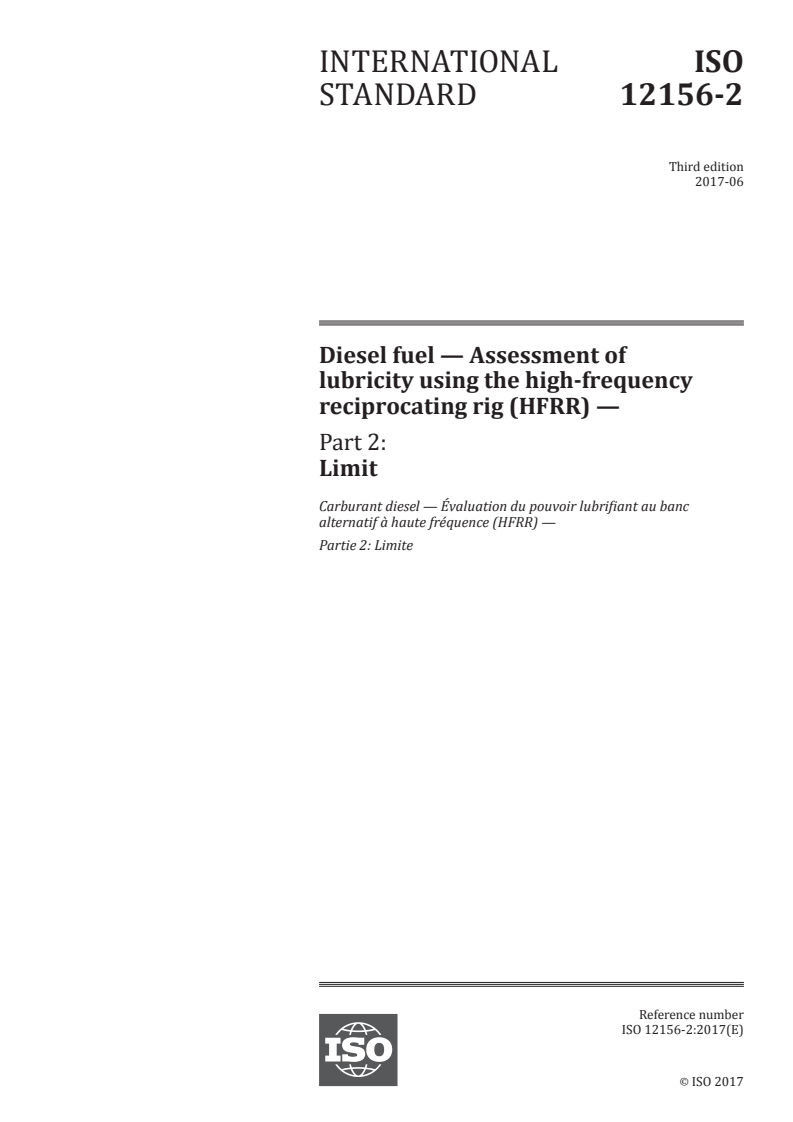
ISO 12156-2:2017 - Diesel fuel — Assessment of lubricity using the high-frequency reciprocating rig (HFRR) — Part 2: Limit/13/2017
Overview
ISO 12156-2:2017 specifies the performance requirement (limit) for diesel fuel lubricity when assessed with the high-frequency reciprocating rig (HFRR). Part 2 of the ISO 12156 series defines the pass/fail criterion needed to ensure reliable operation of diesel fuel injection equipment with respect to fuel lubrication. This third edition (2017) updates the previous edition to align with changes in ISO 12156-1, adds a second test method, and improves precision.
Key topics and requirements
- Scope: Applies to fuels used in diesel engines where lubricity affects injector and pump reliability.
- Test method linkage: Uses the HFRR test methods defined in ISO 12156-1. Two HFRR methods are referenced:
- Method A - Digital Camera
- Method B - Visual Observation
- Referee method: In case of dispute, Method A (Digital Camera) is the referee method.
- Performance limit: The mandatory lubricity limit is a wear scar diameter (WSD ≤ 460 μm). Fuels producing a WSD greater than 460 μm do not meet the ISO 12156-2 limit.
- Designation: When specifying a fuel lubricity requirement, the standard is designated as “Lubricity ISO 12156-2”.
Practical applications
- Ensuring fuel injection equipment reliability - The WSD limit helps prevent excessive wear in high-pressure pumps and injectors caused by poor fuel lubricity.
- Fuel quality specification - Fuel producers and distributors can include ISO 12156-2 compliance in product specifications to demonstrate suitability for modern diesel engines.
- Supplier and OEM contracts - Engine manufacturers (OEMs) and fleet operators can define lubricity requirements to reduce maintenance and warranty risk.
- Laboratory testing and conformity assessment - Accredited test labs use the HFRR procedures in ISO 12156-1 and the limit in ISO 12156-2 to report compliance.
- Regulatory and procurement standards - Authorities and large buyers can reference the standard when setting minimum fuel quality criteria.
Who uses this standard
- Fuel producers and blenders
- Automotive and diesel engine manufacturers (OEMs)
- Independent fuel testing laboratories and quality assurance teams
- Fleet operators, fuel suppliers, and regulatory bodies
Related standards
- ISO 12156-1 - Diesel fuel - Assessment of lubricity using the HFRR - Part 1: Test method (defines HFRR test procedures used to determine WSD)
- Other fuel and lubricant standards (refer to ISO/TC 22 and ISO/TC 28 publications for related specifications)
Keywords: ISO 12156-2:2017, diesel fuel lubricity, HFRR, wear scar diameter, WSD 460 μm, fuel injection equipment, lubricity testing, ISO 12156-1.
Relations
- Effective Date
- 28-Nov-2015
Buy Documents
ISO 12156-2:2017 - Diesel fuel -- Assessment of lubricity using the high-frequency reciprocating rig (HFRR)
ISO 12156-2:2017 - Diesel fuel — Assessment of lubricity using the high-frequency reciprocating rig (HFRR) — Part 2: Limit/13/2017
Get Certified
Connect with accredited certification bodies for this standard

Element Materials Technology
Materials testing and product certification.

ABS Group Brazil
ABS Group certification services in Brazil.

ABS Quality Evaluations Inc.
American Bureau of Shipping quality certification.
Sponsored listings
Frequently Asked Questions
ISO 12156-2:2017 is a standard published by the International Organization for Standardization (ISO). Its full title is "Diesel fuel — Assessment of lubricity using the high-frequency reciprocating rig (HFRR) — Part 2: Limit". This standard covers: ISO 12156-2:2017 specifies the performance requirement (limit) necessary to ensure reliable operation of diesel fuel injection equipment with respect to lubrication by fuel of such equipment. ISO 12156-2:2017 applies to fuels used in diesel engines.
ISO 12156-2:2017 specifies the performance requirement (limit) necessary to ensure reliable operation of diesel fuel injection equipment with respect to lubrication by fuel of such equipment. ISO 12156-2:2017 applies to fuels used in diesel engines.
ISO 12156-2:2017 is classified under the following ICS (International Classification for Standards) categories: 75.160.20 - Liquid fuels. The ICS classification helps identify the subject area and facilitates finding related standards.
ISO 12156-2:2017 has the following relationships with other standards: It is inter standard links to ISO 12156-2:2007. Understanding these relationships helps ensure you are using the most current and applicable version of the standard.
ISO 12156-2:2017 is available in PDF format for immediate download after purchase. The document can be added to your cart and obtained through the secure checkout process. Digital delivery ensures instant access to the complete standard document.
Standards Content (Sample)
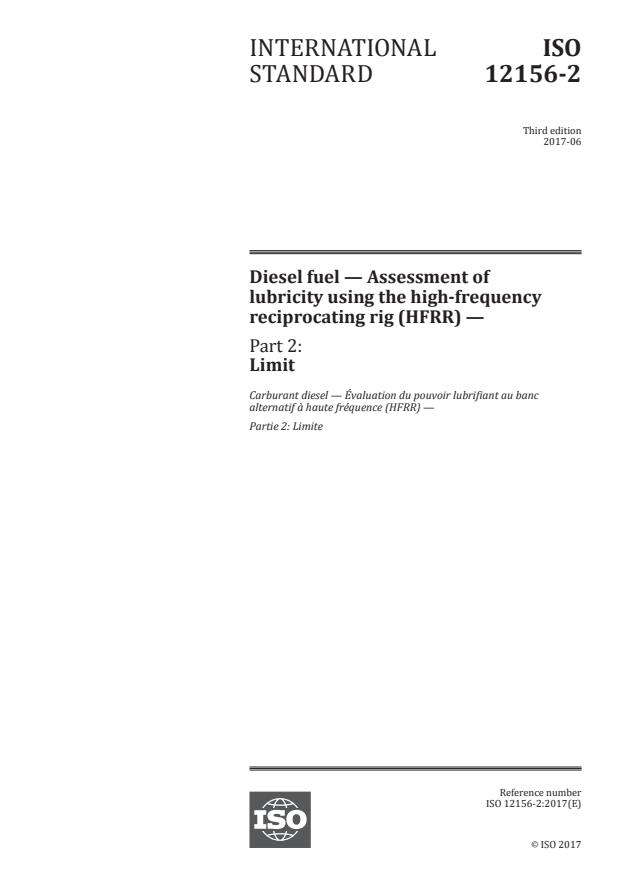
INTERNATIONAL ISO
STANDARD 12156-2
Third edition
2017-06
Diesel fuel — Assessment of
lubricity using the high-frequency
reciprocating rig (HFRR) —
Part 2:
Limit
Carburant diesel — Évaluation du pouvoir lubrifiant au banc
alternatif à haute fréquence (HFRR) —
Partie 2: Limite
Reference number
©
ISO 2017
© ISO 2017, Published in Switzerland
All rights reserved. Unless otherwise specified, no part of this publication may be reproduced or utilized otherwise in any form
or by any means, electronic or mechanical, including photocopying, or posting on the internet or an intranet, without prior
written permission. Permission can be requested from either ISO at the address below or ISO’s member body in the country of
the requester.
ISO copyright office
Ch. de Blandonnet 8 • CP 401
CH-1214 Vernier, Geneva, Switzerland
Tel. +41 22 749 01 11
Fax +41 22 749 09 47
copyright@iso.org
www.iso.org
ii © ISO 2017 – All rights reserved
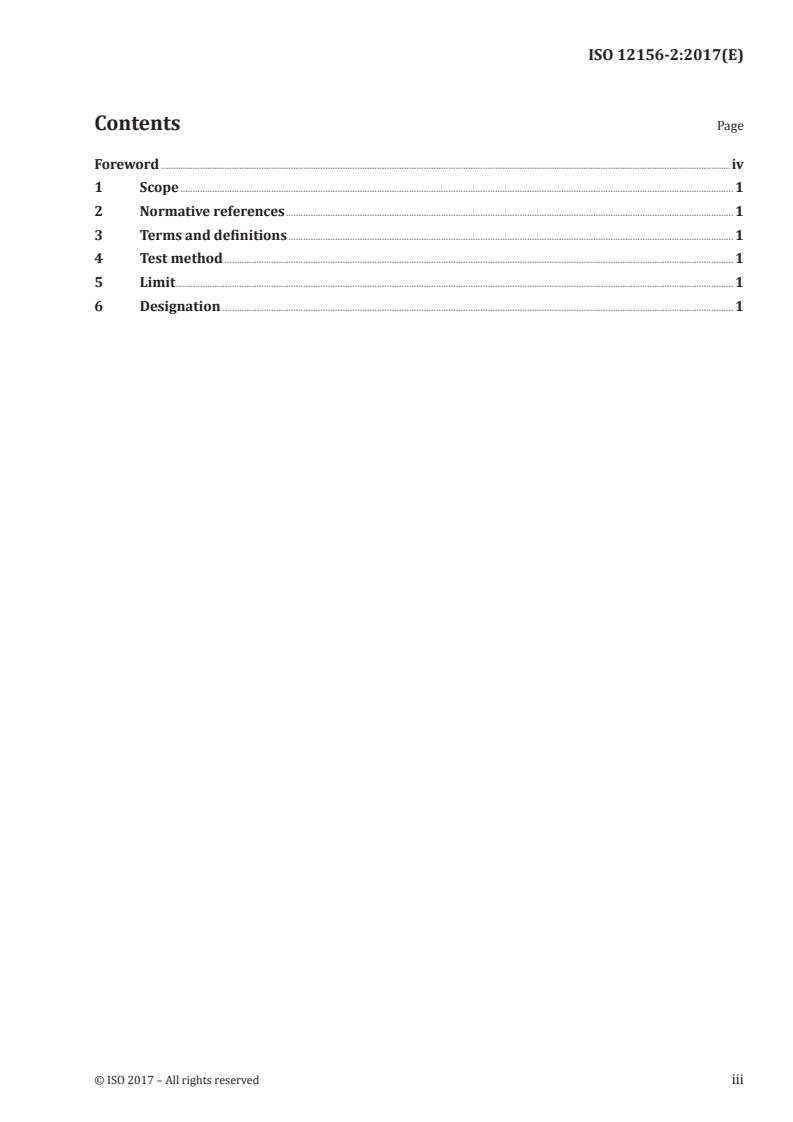
Contents Page
Foreword .iv
1 Scope . 1
2 Normative references . 1
3 Terms and definitions . 1
4 Test method . 1
5 Limit . 1
6 Designation . 1
Foreword
ISO (the International Organization for Standardization) is a worldwide federation of national standards
bodies (ISO member bodies). The work of preparing International Standards is normally carried out
through ISO technical committees. Each member body interested in a subject for which a technical
committee has been established has the right to be represented on that committee. International
organizations, governmental and non-governmental, in liaison with ISO, also take part in the work.
ISO collaborates closely with the International Electrotechnical Commission (IEC) on all matters of
electrotechnical standardization.
The procedures used to develop this document and those intended for its further maintenance are
described in the ISO/IEC Directives, Part 1. In particular the different approval criteria needed for the
different types of ISO documents should be noted. This document was drafted in accordance with the
editor
...
INTERNATIONAL ISO
STANDARD 12156-2
Third edition
2017-06
Diesel fuel — Assessment of
lubricity using the high-frequency
reciprocating rig (HFRR) —
Part 2:
Limit
Carburant diesel — Évaluation du pouvoir lubrifiant au banc
alternatif à haute fréquence (HFRR) —
Partie 2: Limite
Reference number
©
ISO 2017
© ISO 2017, Published in Switzerland
All rights reserved. Unless otherwise specified, no part of this publication may be reproduced or utilized otherwise in any form
or by any means, electronic or mechanical, including photocopying, or posting on the internet or an intranet, without prior
written permission. Permission can be requested from either ISO at the address below or ISO’s member body in the country of
the requester.
ISO copyright office
Ch. de Blandonnet 8 • CP 401
CH-1214 Vernier, Geneva, Switzerland
Tel. +41 22 749 01 11
Fax +41 22 749 09 47
copyright@iso.org
www.iso.org
ii © ISO 2017 – All rights reserved
Contents Page
Foreword .iv
1 Scope . 1
2 Normative references . 1
3 Terms and definitions . 1
4 Test method . 1
5 Limit . 1
6 Designation . 1
Foreword
ISO (the International Organization for Standardization) is a worldwide federation of national standards
bodies (ISO member bodies). The work of preparing International Standards is normally carried out
through ISO technical committees. Each member body interested in a subject for which a technical
committee has been established has the right to be represented on that committee. International
organizations, governmental and non-governmental, in liaison with ISO, also take part in the work.
ISO collaborates closely with the International Electrotechnical Commission (IEC) on all matters of
electrotechnical standardization.
The procedures used to develop this document and those intended for its further maintenance are
described in the ISO/IEC Directives, Part 1. In particular the different approval criteria needed for the
different types of ISO documents should be noted. This document was drafted in accordance with the
editor
...