


ISO/TS 13830:2013
(Main)Nanotechnologies — Guidance on voluntary labelling for consumer products containing manufactured nano-objects
Nanotechnologies — Guidance on voluntary labelling for consumer products containing manufactured nano-objects
ISO/TS 13830:2013 provides guidance on the content of voluntary labels for consumer products containing manufactured nano-objects.
Nanotechnologies — Lignes directrices pour l'étiquetage volontaire des produits de consommation contenant des nano-objets manufacturés
L'ISO/TS 13830:2013 fournit des lignes directrices sur le contenu des étiquettes volontaires pour les produits de consommation contenant des nano-objets manufacturés (PCMNO).
General Information
- Status
- Published
- Publication Date
- 05-Dec-2013
- Technical Committee
- ISO/TC 229 - Nanotechnologies
- Drafting Committee
- ISO/TC 229 - Nanotechnologies
- Current Stage
- 9093 - International Standard confirmed
- Start Date
- 04-Oct-2023
- Completion Date
- 14-Feb-2026
Relations
- Effective Date
- 12-Feb-2026
Overview
ISO/TS 13830:2013 - Nanotechnologies - Guidance on voluntary labelling for consumer products containing manufactured nano-objects - provides a harmonized, voluntary framework for labelling consumer products containing manufactured nano-objects (PCMNOs). The Technical Specification clarifies scope (excludes naturally occurring or incidental nano-objects), emphasizes transparency and non-misleading communication, and sets out principles for what manufacturers and suppliers may disclose on product labels and packaging.
Key Topics
- Scope and definitions: clear terms such as manufactured nano-object (MNO), nanoscale (approximately 1 nm to 100 nm) and PCMNO are defined with reference to ISO vocabulary.
- Identification and description: guidance on how to declare nano-content, e.g. using “nano” or “nanoscale” before/after ingredient names or the phrase “contains manufactured nano-objects”. Where available, labels may include concise descriptions of intended effects (benefits and risk aspects).
- Instructions for use: recommended inclusion of handling, maintenance, storage, cleaning or disposal advice if nano-content changes normal practice.
- Emergency and first-aid: advise on whether nano-content alters emergency response or first-aid procedures compared with non-nano equivalents.
- Supply-chain information: obligations to obtain and retain substantiating information from suppliers, literature or validated data to support label claims.
- Format and placement: labelling must be visible, legible, durable and provided in the official language(s) of the market; labels may be on product or packaging as appropriate.
- Voluntary nature and legal context: the specification is guidance only and does not supersede mandatory regulatory labelling requirements.
Applications
ISO/TS 13830:2013 is practical for:
- Manufacturers and brand owners deciding whether and how to disclose manufactured nano-objects on consumer product labels.
- Downstream suppliers, distributors and retailers who need to verify and communicate nano-content to consumers.
- Product safety and compliance teams integrating voluntary labelling with existing legal and safety requirements.
- Consumer organisations and NGOs seeking a consistent approach to transparency on nanotechnology in consumer goods.
Typical use cases include product declarations for consumer goods where nanotechnology is intentionally added, supporting informed purchasing and safe use.
Related standards
Relevant documents to consult alongside ISO/TS 13830:2013:
- ISO/TS 80004-1 - Nanotechnologies - Vocabulary (core terms)
- ISO 10377 - Consumer product safety - Guidelines for suppliers
- ISO 20282-1 - Ease of operation of everyday products
- ISO/TS 27687 and ISO/TS 80004-4 - Terminology and nanostructured materials
ISO/TS 13830:2013 helps organizations implement consistent, transparent voluntary labelling practices for nano-enabled consumer products while aligning with broader nanotechnology vocabularies and safety guidance.
Buy Documents
ISO/TS 13830:2013 - Nanotechnologies -- Guidance on voluntary labelling for consumer products containing manufactured nano-objects
ISO/TS 13830:2013 - Nanotechnologies -- Lignes directrices pour l'étiquetage volontaire des produits de consommation contenant des nano-objets manufacturés
Frequently Asked Questions
ISO/TS 13830:2013 is a technical specification published by the International Organization for Standardization (ISO). Its full title is "Nanotechnologies — Guidance on voluntary labelling for consumer products containing manufactured nano-objects". This standard covers: ISO/TS 13830:2013 provides guidance on the content of voluntary labels for consumer products containing manufactured nano-objects.
ISO/TS 13830:2013 provides guidance on the content of voluntary labels for consumer products containing manufactured nano-objects.
ISO/TS 13830:2013 is classified under the following ICS (International Classification for Standards) categories: 07.030 - Physics. Chemistry; 07.120 - Nanotechnologies. The ICS classification helps identify the subject area and facilitates finding related standards.
ISO/TS 13830:2013 has the following relationships with other standards: It is inter standard links to CEN ISO/TS 13830:2013. Understanding these relationships helps ensure you are using the most current and applicable version of the standard.
ISO/TS 13830:2013 is available in PDF format for immediate download after purchase. The document can be added to your cart and obtained through the secure checkout process. Digital delivery ensures instant access to the complete standard document.
Standards Content (Sample)
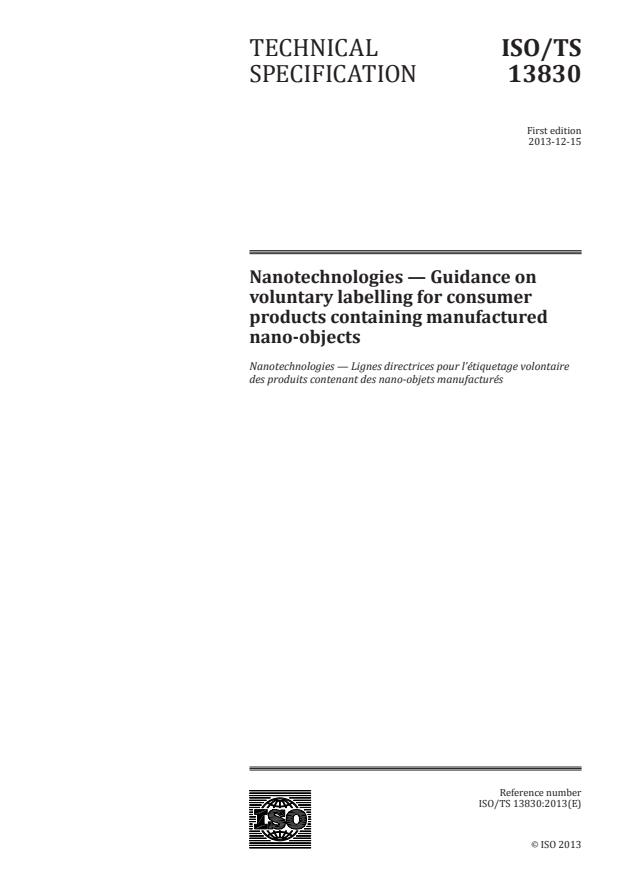
TECHNICAL ISO/TS
SPECIFICATION 13830
First edition
2013-12-15
Nanotechnologies — Guidance on
voluntary labelling for consumer
products containing manufactured
nano-objects
Nanotechnologies — Lignes directrices pour l’étiquetage volontaire
des produits contenant des nano-objets manufacturés
Reference number
©
ISO 2013
© ISO 2013
All rights reserved. Unless otherwise specified, no part of this publication may be reproduced or utilized otherwise in any form
or by any means, electronic or mechanical, including photocopying, or posting on the internet or an intranet, without prior
written permission. Permission can be requested from either ISO at the address below or ISO’s member body in the country of
the requester.
ISO copyright office
Case postale 56 • CH-1211 Geneva 20
Tel. + 41 22 749 01 11
Fax + 41 22 749 09 47
E-mail copyright@iso.org
Web www.iso.org
Published in Switzerland
ii © ISO 2013 – All rights reserved
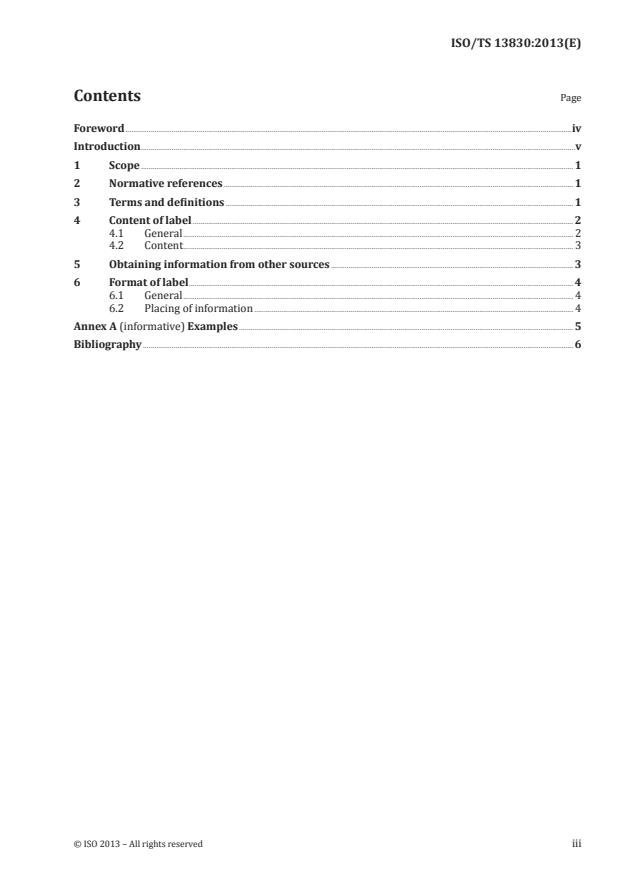
Contents Page
Foreword .iv
Introduction .v
1 Scope . 1
2 Normative references . 1
3 Terms and definitions . 1
4 Content of label . 2
4.1 General . 2
4.2 Content . 3
5 Obtaining information from other sources . 3
6 Format of label . 4
6.1 General . 4
6.2 Placing of information . 4
Annex A (informative) Examples . 5
Bibliography . 6
Foreword
ISO (the International Organization for Standardization) is a worldwide federation of national standards
bodies (ISO member bodies). The work of preparing International Standards is normally carried out
through ISO technical committees. Each member body interested in a subject for which a technical
committee has been established has the right to be represented on that committee. International
organizations, governmental and non-governmental, in liaison with ISO, also take part in the work.
ISO collaborates closely with the International Electrotechnical Commission (IEC) on all matters of
electrotechnical standardization.
The procedures used to develop this document and those intended for its further maintenance are
described in the ISO/IEC Directives, Part 1. In particular the different approval criteria needed for the
different types of ISO documents should be noted. This document was drafted in accordance with the
editorial rules of the ISO/IEC Directives, Part 2 (see www.iso.org/directives).
Attention is drawn to the possibility that some of the elements of this document may be the subject of
patent rights. ISO shall not be held responsible for identifying any or all such patent rights. Details of
any patent rights identified during the development of the document will be in the Introduction and/or
on the ISO list of patent declarations received (see www.iso.org/patents).
Any trade name used in this document is information given for the convenience of users and does not
constitute an endorsement.
For an explanation on the meaning of ISO specific terms and expressions related to conformity
assessment, as well as information about ISO’s adherence to the WTO principles in the Technical Barriers
to Trade (TBT) see the following URL: Foreword - Supplementary information
The committee responsible for this document is ISO/TC 229, Nanotechnologies.
For the purposes of research, users are encouraged to share their views on this document and their
priorities for changes to future editions.
Click on the link below to take part in the online survey:
https://www.surveymonkey.com/s/ISO_TS_13830
iv © ISO 2013 – All rights reserved
Introduction
It is generally agreed that nanotechnology brings benefits and better performance to enabled consumer
products along with possible concerns for adverse effects, which both raise issues about the public
awareness on the benefits and concerns.
As nanotechnology is implemented more broadly, the number of products using nanotechnology, in
particular the consumer products containing manufactured nano-objects, will increase. Any approach
to affixing a label to consumer products containing manufactured nano-objects (PCMNOs) should
ensure accurate communication about the product and its properties and avoid misleading labelling.
It is important that sufficient openness and transparency accompany the responsible introduction
of new technologies to the marketplace. Labelling can help consumers to make informed choices for
purchase and use. The labelling specified by this Technical Specification does not attempt to prejudge
either the positive or negative effects of consumer products containing manufactured nano-objects.
The purpose of the guidance in this Technical Specification is to provide a framework to facilitate a
harmonized approach for the voluntary provision of labelling for PCMNOs that may or may not exhibit
or impart nanoscale phenomena. This Technical Specification is designed as voluntary guidance on
conveying specific product information that a manufacturer may choose to disclose on product labels
and is not intended to provide mandatory labelling requirements, which are established by relevant
regulatory authorities.
This Technical Specification is designed for use by businesses and other organizations involved in the
manufacture and distribution of consumer PCMNOs. In order to conform to this Technical Specification,
all the normative clauses of this Technical Specification apply. A decision about whether to use this
Technical Specification is subject to voluntary consideration. Other parties such as authorities,
healthcare professionals, consumers, consumer organizations, environmental NGOs and trade unions
may also find it useful.
This Technical Specification provides guidance that does not supersede or substitute for any applicable
legal requirements. Product manufacturers and distributors are advised to identify and understand
applicable legal requirements and guidance issued by regulatory authorities. Products intended for sale
in a specific country or region should conform to, and the use of this document should not conflict with,
legal requirements for product labels and labelling established for that country or region.
TECHNICAL SPECIFICATION ISO/TS 13830:2013(E)
Nanotechnologies — Guidance on voluntary labelling for
consumer products containing manufactured nano-objects
1 Scope
This Technical Specification provides guidance on the content of voluntary labels for consumer products
containing manufactured nano-objects (PCMNO).
This Technical Specification is not applicable to consumer products that contain naturally occurring
nano-objects that were not subjected to manufacturing processes. Consumer products containing nano-
objects that are incidentally present (i.e. unintentional by-products of a process) are also outside the
scope of this Technical Specification.
2 Normative references
The following documents, in whole or
...
SPÉCIFICATION ISO/TS
TECHNIQUE 13830
Première édition
2013-12-15
Nanotechnologies — Lignes directrices
pour l’étiquetage volontaire des
produits de consommation contenant
des nano-objets manufacturés
Nanotechnologies — Guidance on voluntary labelling for consumer
products containing manufactured nano-objects
Numéro de référence
©
ISO 2013
DOCUMENT PROTÉGÉ PAR COPYRIGHT
© ISO 2013
Droits de reproduction réservés. Sauf indication contraire, aucune partie de cette publication ne peut être reproduite ni utilisée
sous quelque forme que ce soit et par aucun procédé, électronique ou mécanique, y compris la photocopie, l’affichage sur
l’internet ou sur un Intranet, sans autorisation écrite préalable. Les demandes d’autorisation peuvent être adressées à l’ISO à
l’adresse ci-après ou au comité membre de l’ISO dans le pays du demandeur.
ISO copyright office
Case postale 56 • CH-1211 Geneva 20
Tel. + 41 22 749 01 11
Fax + 41 22 749 09 47
E-mail copyright@iso.org
Web www.iso.org
Version française parue en 2014
Publié en Suisse
ii © ISO 2013 – Tous droits réservés
Sommaire Page
Avant-propos .iv
Introduction .v
1 Domaine d’application . 1
2 Références normatives . 1
3 Termes et définitions . 1
4 Contenu de l’étiquette . 2
4.1 Généralités . 2
4.2 Contenu . 3
5 Obtention des informations auprès d’autres sources . 3
6 Format de l’étiquette . 4
6.1 Généralités . 4
6.2 Mise en place des informations . 4
Annexe A (informative) Exemples . 5
Bibliographie . 6
Avant-propos
L’ISO (Organisation internationale de normalisation) est une fédération mondiale d’organismes
nationaux de normalisation (comités membres de l’ISO). L’élaboration des Normes internationales est
en général confiée aux comités techniques de l’ISO. Chaque comité membre intéressé par une étude
a le droit de faire partie du comité technique créé à cet effet. Les organisations internationales,
gouvernementales et non gouvernementales, en liaison avec l’ISO participent également aux travaux.
L’ISO collabore étroitement avec la Commission électrotechnique internationale (CEI) en ce qui concerne
la normalisation électrotechnique.
Les procédures utilisées pour élaborer le présent document et celles destinées à sa mise à jour sont
décrites dans les Directives ISO/CEI, Partie 1. Il convient, en particulier, de prendre note des différents
critères d’approbation requis pour les différents types de documents ISO. Le présent document a été
rédigé conformément aux règles de rédaction données dans les Directives ISO/CEI, Partie 2 (voir www.
iso.org/directives).
L’attention est appelée sur le fait que certains des éléments du présent document peuvent faire l’objet de
droits de propriété intellectuelle ou de droits analogues. L’ISO ne saurait être tenue pour responsable
de ne pas avoir identifié de tels droits de propriété et averti de leur existence. Les détails concernant les
références aux droits de propriété intellectuelle ou autres droits analogues identifiés lors de l’élaboration
du document sont indiqués dans l’Introduction et/ou sur la liste ISO des déclarations de brevets reçues
(voir www.iso.org/patents).
Les éventuelles appellations commerciales utilisées dans le présent document sont données pour
information à l’intention des utilisateurs et ne constituent pas une approbation ou une recommandation.
Pour une explication de la signification des termes et expressions spécifiques de l’ISO liés à l’évaluation de
la conformité, aussi bien que pour des informations au sujet de l’adhésion de l’ISO aux principes de l’OMC
concernant les obstacles techniques au commerce (OTC), voir le lien suivant Foreword - Supplementary
information.
Le comité chargé de l’élaboration du présent document est l’ISO/TC 229, Nanotechnologies.
À des fins de recherches, les utilisateurs sont encouragés à donner leur avis concernant le présent
document et à indiquer les changements à effectuer dans les futures éditions par ordre de priorité.
Cliquer sur le lien ci-dessous pour participer à l’enquête en ligne
https://www.surveymonkey.com/s/ISO_TS_13830
iv © ISO 2013 – Tous droits réservés
Introduction
Il est généralement admis que les nanotechnologies sont bénéfiques aux produits de consommation
technologiques et qu’elles en améliorent les performances, tout en ayant d’éventuels effets préjudiciables,
ce qui soulève des questions quant à la sensibilisation du public à ces avantages et à ces inconvénients.
Comme l’utilisation des nanotechnologies se généralise, le nombre de produits utilisant les
nanotechnologies, en particulier les produits de consommation contenant des nano-objets
manufacturés, va augmenter. Il convient que toute méthode d’apposition d’une étiquette sur les produits
de consommation contenant des nano-objets manufacturés (PCMNO) garantisse une communication
exacte sur le produit et ses propriétés, et évite les étiquetages trompeurs.
Il est important de faire preuve de suffisamment d’ouverture d’esprit et de transparence dans le cadre
de l’introduction responsable de nouvelles technologies sur le marché. L’étiquetage peut aider les
consommateurs à faire des choix avisés au moment de l’achat et de l’utilisation. L’étiquetage spécifié par
la présente Spécification technique ne tente pas de préjuger des effets positifs ou négatifs des produits
de consommation contenant des nano-objets manufacturés. Les lignes directrices de la présente
Spécification technique ont pour objet de fournir un cadre pour faciliter une approche harmonisée
pour l’application volontaire de l’étiquetage des PCMNO pouvant ou non présenter ou provoquer des
phénomènes à l’échelle nanométrique. La présente Spécification technique est destinée à fournir des
lignes directrices volontaires sur la communication d’informations spécifiques sur le produit qu’un
fabricant peut choisir de mentionner sur les étiquettes d’un produit. Elle n’est pas destinée à fournir
des exigences d’étiquetage obligatoires, ces dernières étant établies par les autorités réglementaires
compétentes.
La présente Spécification technique est destinée à être utilisée par les entreprises et autres organismes
impliqués dans la fabrication et la distribution des produits de consommation contenant des nano-objets
manufacturés. Pour se conformer à la présente Spécification technique, tous les articles normatifs qui la
composent s’appliquent. La décision d’utiliser la présente Spécification technique est un acte volontaire.
Celle-ci peut également se révéler utile à d’autres parties, telles que les autorités, les professionnels
de santé, les consommateurs, les organisations de consommateurs, les ONG environnementales et les
organisations syndicales.
La présente Spécification technique fournit des lignes directrices qui ne remplacent ni n’abrogent les
exigences légales applicables. Il est conseillé aux fabricants et aux distributeurs de produits d’identifier
et de comprendre les exigences légales applicables ainsi que les lignes directrices émises par les autorités
réglementaires. Il convient que les produits destinés à la vente dans un pays ou une région spécifique
soient conformes aux exigences légales relatives aux étiquettes des produits et à l’étiquetage établies
dans le pays ou la région concerné(e), et que l’utilisation du présent document n’entre pas en conflit avec
lesdites exigences.
SPÉCIFICATION TECHNIQUE ISO/TS 13830:2013(F)
Nanotechnologies — Lignes directrices pour l’étiquetage
volontaire des produits de consommation contenant des
nano-objets manufacturés
1 Domaine d’application
La présente Spécification technique fournit des lignes directrices sur le contenu des étiquettes
volontaires pour les produits de consommation contenant des nano-objets manufacturés (PCMNO).
La présente Spécification technique n’est pas applicable aux produits de consommation qui contiennent
des nano-objets d’origine naturelle qui n’ont pas fait l’objet de processus de fabrication. Les produits de
consommation contenant des nano-objets présents de façon fortuite (c’est-à-dire des sous-produits non
intentionnels d’un processus) sont également hors du domaine d’application de la présente Spécification
technique.
2 Références normatives
Les documents suivants, en totalité ou en partie, sont référencés de façon normative dans le présent
document et sont indispensables pour son application. Pour les références datées, seule l’édition citée
s’applique. Pour les références non datées, la dernière édition du document de référence s’applique (y
compris les éventuels amendements).
ISO/TS 80004-1, Nanotechnologies — Vocabu
...
ТЕХНИЧЕСКИЕ ISO/TS
УСЛОВИЯ 13830
Первое издание
2013-12-15
Нанотехнологии. Руководство по
добровольному этикетированию
потребительской продукции, содержащей
промышленные нано-объекты
Nanotechnologies – Guidance on voluntary labeling for consumer products
containing manufactured nano-objects
Ответственность за подготовку русской версии несѐт GOST R
(Российская Федерация) в соответствии со статьѐй 18.1 Устава ISO
Ссылочный номер
©
ISO 2013
ДОКУМЕНТ ЗАЩИЩЕН АВТОРСКИМ ПРАВОМ
© ISO 2013
Все права сохраняются. Если не задано иначе, никакую часть настоящей публикации нельзя копировать или использовать в какой-
либо форме или каким-либо электронным или механическим способом, включая фотокопии и микрофильмы, без предварительного
письменного согласия офиса ISO по адресу, указанному ниже, или членов ISO в стране регистрации пребывания.
ISO copyright office
Case postale 56 CH-1211 Geneva 20
Tel. + 41 22 749 01 11
Fax + 41 22 749 09 47
E-mail copyright@iso.org
Web www.iso.org
Опубликовано в Швейцарии
ii © ISO 2013 – Все права сохраняются
Содержание Страница
Предисловие .iv
Введение .v
1 Область применения .1
2 Нормативные ссылки .1
3 Термины и определения .1
4 Содержание этикетки .3
4.1 Общие положения .3
4.2 Содержание .3
5 Получение информации из других источников .4
6 Формат этикетки .4
6.1 Общие положения .4
6.2 Размещение информации .4
Приложение A (информативное) Примеры .5
Библиография .6
ISO/TS 13830:2014(R)
Предисловие
Международная организация по стандартизации (ISO) является всемирной федерацией национальных
организаций по стандартизации (комитетов-членов ISO). Разработка международных стандартов обычно
осуществляется техническими комитетами ISO. Каждый комитет-член, заинтересованный в деятельности,
для которой был создан технический комитет, имеет право быть представленным в этом комитете.
Международные правительственные и неправительственные организации, имеющие связи с ISO, также
принимают участие в работах. Что касается стандартизации в области электротехники, то ISO работает в
тесном сотрудничестве с Международной электротехнической комиссией (IEC).
Методики, использованные для разработки настоящего стандарта и других документов, предназначенных
для его дальнейшей поддержки, изложены в Директивах ISP/IEC, Часть 1. В частности, следует брать на
заметку разные критерии одобрения, необходимые для разных типов документов ISO. Проект настоящего
документа был разработан в соответствии с редакционными правилами Директив ISO/IEC, Часть 2
(смотрите www.iso.org/directives).
Следует иметь в виду, что некоторые элементы настоящего документа Технической спецификации могут
быть объектом патентных прав. Международная организация по стандартизации не может нести
ответственность за идентификацию какого-либо одного или всех патентных прав. Подробности любых
патентных прав, выявленных при разработке этого документа, будут изложены во Введении и/или в
перечне патентных деклараций, полученных в ISO (смотрите www.iso.org/patents).
Любое торговое имя, использованное в этом документе, является информацией, которая дается для
удобства пользователей и не представляет его поддержку со стороны ISO.
Для объяснения смысла специфических терминов и выражений ISO, имеющих отношение к оценке
соответствия, а также информацию о приверженности ISO принципам ВТО в Технических барьерах
торговле смотрите следующий унифицированный указатель информационного ресурса (URL): предисловие
– дополнительная информация.
Комитет ISO/TC 229, Нанотехнологии, отвечает за разработку настоящего документа.
В целях проведения научных исследований, пользователей документа просят выражать свои взгляды по
его содержанию и свои приоритеты для изменений в будущих изданиях.
Чтобы принять участие в обозрении в режиме online, выполните щелчок мышью на
http://www.surveymonkey.cjm/s/ISO TS 13830.
iv © ISO 2013 – Все права сохраняются
Введение
Существует общее согласие в том, что нанотехнология приносят пользу и улучшают рабочую
характеристику пригодной потребительской продукции с возможным беспокойством в отношении вредных
воздействий. В результате этой обеспокоенности возникают вопросы, в какой степени общество знает об
упомянутой пользе и вредном воздействии.
Так как нанотехнология реализуется все более широко, то количество определенной потребительской
продукции, использующей нанотехнологию и содержащей промышленные нано-объекты, будет
увеличиваться. Любой подход к прикреплению этикеток на потребительской продукции, содержащей
промышленные нано-объекты (PCMNO – products, containing manufactured nano-object), следует обеспечить
правильным сообщением о продукте и его свойствах, избегая нанесения этикеток, вводящих в
заблуждение.
Важно, чтобы достаточная открытость и прозрачность сопровождали ответственное представление новых
технологий на рынках сбыта. Этикетирование может помочь потребителям делать информированный
выбор для покупки и применения. Нанесение этикеток, которое задается настоящими техническими
условиями, не является попыткой предрешить положительные или отрицательные воздействия
потребительской продукции с промышленными нано-объектами. Целью руководства в этих Технических
условиях является предоставление структуры, чтобы облегчить гармонизированный подход для
добровольного обеспечения этикетками PCMNO, которые могут или не могут показывать или сообщать о
наномасштабных явлениях. Настоящие Технические условия предназначается в качестве добровольного
руководства по передаче специфической информации о продукции, которую производитель может
выбирать и раскрывать на своих этикетках. Руководство не предъявляет обязательные требования
этикетирования, которые установлены соответствующими регулирующими органами властями.
Настоящие Технические условия предназначается для коммерческих и других организаций, вовлеченных в
изготовление и распределение потребительских PCMNOs. Чтобы соответствовать настоящим Техническим
условиям, применяются все нормативные разделы документа. Решение об использовании настоящих
Технических условий подлежит добровольному рассмотрению. Другие стороны, например, органы
исполнительной власти, врачи, потребительские организации, неправительственные организации по
защите окружающей среды и профсоюзы, могут быть также полезными.
Эти Технические условия дают руководство, которое не замещает и не заменяет любые приемлемые
технические требования. Производителям и распределителям продукции рекомендуется
идентифицировать и понимать приемлемые законные требования и руководящие указания регулирующих
органов власти. Следует обеспечить соответствие продукции, предназначенной для продажи в
определенной стране или регионе. При использовании настоящего документа не следует конфликтовать с
законными требованиями, которые предъявляются к этикеткам на товарах и процессу их нанесения, если
эти требования установлены для конкретной страны или региона.
ТЕХНИЧЕСКИЕ УСЛОВИЯ ISO/TS 13830:2013(R)
Нанотехнологии. Руководство по добровольному этикетированию
потребительской продукции, содержащей промышленные нано-
объекты
1 Область применения
Настоящие Технические условия предоставляют руководство по содержанию добровольных этикеток на
потребительской продукции, содержащей промышленные нано-объекты (PCMNO).
Настоящие Технические условия не применяются к потребительской продукции, содержащей естественно
встречающиеся нано-объекты, не зависящие от производственных процессов. Потребительская продукция,
содержащая нано-объекты, которые случайно присутствуют (т.е. являются непреднамеренными побочными
продуктами производства) также выходят за область применения настоящих Технических условий.
2 Нормативные ссылки
Следующие нормативные документы, целиком или частично, упоминаются в этой спецификации и
являются обязательными для ее применения. Что касается устаревших ссылок, то к ним применяется
только цитируемое издание. Для всегда актуальных ссылок применяется самое последнее издание
справочного документа (включая поправки).
ISO/TS 80004-1:2000, Нанотехнологии. Словарь. Часть 1. Основные термины
3 Термины и определения
В настоящем документе применяются термины и определения, данные в ISO/TS 80004-1, а также
следующие.
3.1
потребительский продукт
consumer product
продукт, который предназначается для потребления и используется индивидуально скорее для личного,
чем профессионального применения, за исключением его упаковки
[ИСТОЧНИК: ISO 20282-1:2006, 3.2 – измененный]
3.2
этикетка
label
письменный, напечатанн
...
Questions, Comments and Discussion
Ask us and Technical Secretary will try to provide an answer. You can facilitate discussion about the standard in here.
Loading comments...