

ISO/FDIS 8553
(Main)Milk — Enumeration of microorganisms — Plate-loop technique at 30 °C
- Abstract
ISO 8553|IDF 131 specifies a method for the enumeration of microorganisms in raw milk by using the plate loop technique at 30 °C.
- Status
- Not Published
- Technical Committee
- ISO/TC 34/SC 5 - Milk and milk products
- Drafting Committee
- ISO/TC 34/SC 5 - Milk and milk products
- Current Stage
- 5020 - FDIS ballot initiated: 2 months. Proof sent to secretariat
- Start Date
- 26-Aug-2026
- Completion Date
- 26-Aug-2026
Buy Documents
ISO/FDIS 8553 - Milk — Enumeration of microorganisms — Plate-loop technique at 30 °C
REDLINE ISO/FDIS 8553 - Milk — Enumeration of microorganisms — Plate-loop technique at 30 °C
ISO/FDIS 8553 - Lait — Dénombrement des micro-organismes — Méthode de l'anse calibrée en boîtes de Petri à 30 °C
ISO/FDIS 8553 is a draft International Standard published jointly by ISO and IDF for the enumeration of microorganisms in raw milk by the plate-loop technique at 30 °C. It tells laboratories how to prepare the sample, inoculate it with a calibrated loop, incubate the plates, count colonies, and report the result as a plate loop count.
What does ISO/FDIS 8553 specify?
ISO/FDIS 8553 specifies a microbiological method for raw milk only, and it is used for samples within the method’s stated count range. Sampling itself is outside the method, so the standard points users to the product-specific sampling standard or to an agreement between the parties concerned.
The document is organized into 12 clauses plus two annexes and a bibliography.
| Annex | What it covers |
|---|---|
| Annex A | Informative flow diagram of the main steps |
| Annex B | Normative culture media and reagents, including MPCA preparation and performance testing |
The structure matters in practice because the core procedure is split between sample preparation, loop inoculation, incubation, counting, result expression, and quality assurance.
What are the key requirements of ISO/FDIS 8553?
ISO/FDIS 8553 sets out a direct plate-loop procedure that uses a calibrated inoculating loop, molten milk plate count agar (MPCA), aerobic incubation at 30 °C, and colony counting on countable plates. In practice, the method is designed for routine dairy microbiology where a fast estimate of microbial load in raw milk is needed.
Sample handling and preparation
Clause 7 says sampling follows the relevant product standard, and Clause 8 says the laboratory sample is prepared according to the milk sample preparation rules. This matters because representative sampling is critical for a result that reflects the milk lot being checked.
Loop inoculation and controls
Clause 9 requires aseptic handling and careful preparation of the loop inoculation equipment. The method also uses control plates such as a sterile instrument control, a rinsing control, and an agar control, so the user can check that the equipment and medium are clean and suitable before relying on the counts.
Incubation and counting
Clause 9.4 incubates the poured plates at 30 °C for 72 h, and Clause 9.5 counts colonies on plates with fewer than 300 colonies. Spreading colonies are treated as single colonies, and overgrown plates are discarded when counting is no longer reliable.
Calculation and reporting
Clause 10 expresses the result as microorganisms in cfu per ml, reported as the plate loop count (PLC). The standard also directs users to ISO 7218 for low counts, high counts, and other special cases, which matters when a result falls outside the straightforward countable range.
Quality assurance and media
Clauses 5 and 12 require good laboratory practice, suitable equipment, positive and negative controls, and performance testing of MPCA. Annex B gives the medium and reagent requirements, so laboratories can prepare or verify the same medium consistently.
What terms does ISO/FDIS 8553 define?
ISO/FDIS 8553 uses a few key terms that anchor the method and the report.
- microorganisms - bacteria, yeasts, and moulds that can form colonies in or on MPCA under the specified test conditions.
- plate-loop technique - the method that transfers a measured milk portion with a calibrated loop instead of using serial decimal dilutions.
- milk plate count agar (MPCA) - the poured-plate medium used for colony growth; the standard also notes the names plate count skim milk agar and plate count milk agar (PCMA).
- colony-forming units (cfu) - the unit used to express the counted microbial load.
- plate loop count (PLC) - the final result reported as cfu per ml from the plate-loop method.
- aerobic plate count (APC) - the broader counting concept explained in the introduction as a generic indicator of aerobic mesophilic microorganisms.
Who uses ISO/FDIS 8553?
ISO/FDIS 8553 is used by dairy microbiology laboratories, quality control teams, and food control bodies that test raw milk. It is relevant when a processor, laboratory, or authority needs a standardized way to compare microbial counts between samples, batches, or suppliers.
It is also useful for staff who validate or check the method itself, because the standard includes equipment setup, control plates, medium performance testing, and reporting rules.
What changed in ISO/FDIS 8553 from the previous edition?
ISO/FDIS 8553 is the second edition and it replaces ISO 8553 | IDF 131:2004. The foreword says the revision is technical and that the changes are minor.
The stated changes are:
- updated normative references
- procedure aligned with ISO 4833-1
- result expression aligned with ISO 7218
- Annex A flow diagram added
- MPCA performance testing introduced
- bibliography updated
Which standards are used with ISO/FDIS 8553?
ISO/FDIS 8553 uses several companion standards to support sampling, preparation, counting, and media quality.
- ISO 6887-1 - general rules for initial suspension and decimal dilutions.
- ISO 6887-5 - milk-specific preparation of test samples and decimal dilutions.
- ISO 7218 - general microbiological laboratory requirements, calculation rules, and guidance for counting and reporting.
- ISO 11133 - preparation, storage, and performance testing of culture media and reagents.
- ISO 707 | IDF 50 - recommended sampling guidance for milk and milk products.
- ISO 4833 series - used as the comparison method when checking loop calibration.
What does the ISO/FDIS 8553 document contain?
ISO/FDIS 8553 contains the full workflow from sample preparation to test report. It includes the principle of the method, equipment and consumables, incubation conditions, colony-counting guidance, and the way to calculate and report the result.
Annex A gives a simple flow diagram of the main steps, which helps labs train staff and check the sequence of work. Annex B gives the MPCA composition, preparation steps, disinfecting solution, and performance testing requirements, including the control organisms used to verify the medium.
The document also includes a quality assurance clause and a test report clause, so users know what to record when they run the method and how to document deviations or special cases.
Relations
- Effective Date
- 09-Dec-2023
Buy Documents
ISO/FDIS 8553 - Milk — Enumeration of microorganisms — Plate-loop technique at 30 °C
REDLINE ISO/FDIS 8553 - Milk — Enumeration of microorganisms — Plate-loop technique at 30 °C
ISO/FDIS 8553 - Lait — Dénombrement des micro-organismes — Méthode de l'anse calibrée en boîtes de Petri à 30 °C
Frequently Asked Questions
ISO/FDIS 8553 is a draft published by the International Organization for Standardization (ISO). Its full title is "Milk — Enumeration of microorganisms — Plate-loop technique at 30 °C". This standard covers: ISO 8553|IDF 131 specifies a method for the enumeration of microorganisms in raw milk by using the plate loop technique at 30 °C.
ISO 8553|IDF 131 specifies a method for the enumeration of microorganisms in raw milk by using the plate loop technique at 30 °C.
ISO/FDIS 8553 is classified under the following ICS (International Classification for Standards) categories: 07.100.30 - Food microbiology. The ICS classification helps identify the subject area and facilitates finding related standards.
ISO/FDIS 8553 has the following relationships with other standards: It is inter standard links to ISO 8553:2004. Understanding these relationships helps ensure you are using the most current and applicable version of the standard.
ISO/FDIS 8553 is available in PDF format for immediate download after purchase. The document can be added to your cart and obtained through the secure checkout process. Digital delivery ensures instant access to the complete standard document.
Standards Content (Sample)
FINAL DRAFT
International
Standard
IDF 131
ISO/TC 34/SC 5
Milk — Enumeration of
Secretariat: NEN
microorganisms — Plate-loop
Voting begins on:
technique at 30 °C
2026-08-26
Lait — Dénombrement des micro-organismes — Méthode de
Voting terminates on:
l'anse calibrée en boîtes de Petri à 30 °C
2026-10-21
RECIPIENTS OF THIS DRAFT ARE INVITED TO SUBMIT,
WITH THEIR COMMENTS, NOTIFICATION OF ANY
RELEVANT PATENT RIGHTS OF WHICH THEY ARE AWARE
AND TO PROVIDE SUPPOR TING DOCUMENTATION.
IN ADDITION TO THEIR EVALUATION AS
BEING ACCEPTABLE FOR INDUSTRIAL, TECHNO
LOGICAL, COMMERCIAL AND USER PURPOSES, DRAFT
INTERNATIONAL STANDARDS MAY ON OCCASION HAVE
TO BE CONSIDERED IN THE LIGHT OF THEIR POTENTIAL
TO BECOME STAN DARDS TO WHICH REFERENCE MAY BE
MADE IN NATIONAL REGULATIONS.
Reference numbers
IDF 131:2026(en) © ISO and IDF 2026
FINAL DRAFT
IDF 131:2026(en) International
Standard
IDF 131
ISO/TC 34/SC 5
Milk — Enumeration of
Secretariat: NEN
microorganisms — Plate-loop
Voting begins on:
technique at 30 °C
Lait — Dénombrement des micro-organismes — Méthode de
Voting terminates on:
l'anse calibrée en boîtes de Petri à 30 °C
RECIPIENTS OF THIS DRAFT ARE INVITED TO SUBMIT,
WITH THEIR COMMENTS, NOTIFICATION OF ANY
RELEVANT PATENT RIGHTS OF WHICH THEY ARE AWARE
© ISO and IDF 2026
AND TO PROVIDE SUPPOR TING DOCUMENTATION.
All rights reserved. Unless otherwise specified, or required in the context of its implementation, no part of this publication may
IN ADDITION TO THEIR EVALUATION AS
be reproduced or utilized otherwise in any form or by any means, electronic or mechanical, including photocopying, or posting on
BEING ACCEPTABLE FOR INDUSTRIAL, TECHNO
LOGICAL, COMMERCIAL AND USER PURPOSES, DRAFT
the internet or an intranet, without prior written permission. Permission can be requested from either ISO at the address below
INTERNATIONAL STANDARDS MAY ON OCCASION HAVE
or ISO’s member body in the country of the requester.
TO BE CONSIDERED IN THE LIGHT OF THEIR POTENTIAL
ISO copyright office International Dairy Federation TO BECOME STAN DARDS TO WHICH REFERENCE MAY BE
MADE IN NATIONAL REGULATIONS.
CP 401 • Ch. de Blandonnet 8 Silver Building • Bd Auguste Reyers 70/B
CH-1214 Vernier, Geneva B-1030 Brussels
Phone: +41 22 749 01 11 Phone: +32 2 325 67 40
Fax: +32 2 325 67 41
Email: copyright@iso.org Email: info@fil-idf.org
Website: www.iso.org Website: www.fil-idf.org
Reference numbers
Published in Switzerland ISO/FDIS 8553:2026(en)
IDF 131:2026(en) © ISO and IDF 2026
ii
IDF 131:2026(en)
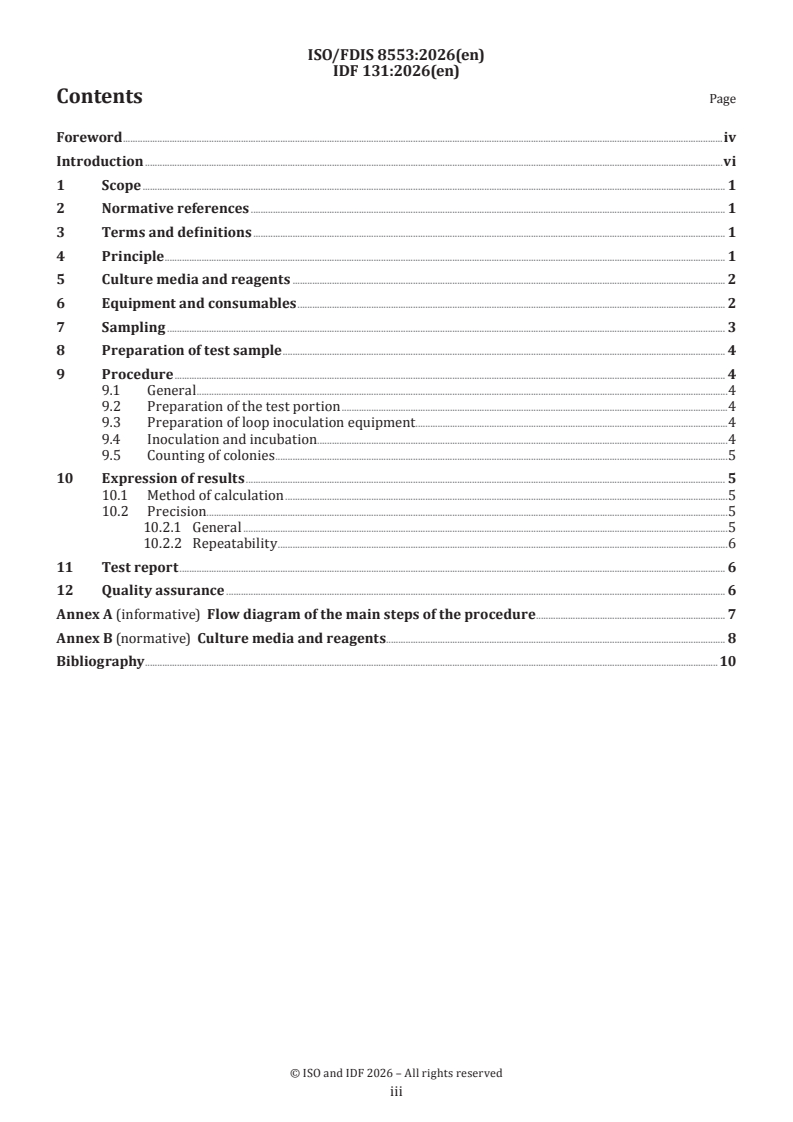
Contents Page
Foreword .iv
Introduction .vi
1 Scope . 1
2 Normative references . 1
3 Terms and definitions . 1
4 Principle . 1
5 Culture media and reagents . 2
6 Equipment and consumables . 2
7 Sampling . 3
8 Preparation of test sample . 4
9 Procedure . 4
9.1 General .4
9.2 Preparation of the test portion .4
9.3 Preparation of loop inoculation equipment .4
9.4 Inoculation and incubation.4
9.5 Counting of colonies .5
10 Expression of results . 5
10.1 Method of calculation .5
10.2 Precision . . .5
10.2.1 General .5
10.2.2 Repeatability .6
11 Test report . 6
12 Quality assurance . 6
Annex A (informative) Flow diagram of the main steps of the procedure . 7
Annex B (normative) Culture media and reagents . 8
Bibliography .10
iii
IDF 131:2026(en)
Foreword
ISO (the International Organization for Standardization) is a worldwide federation of national standards
bodies (ISO member bodies). The work of preparing International Standards is normally carried out through
ISO technical committees. Each member body interested in a subject for which a technical committee
has been established has the right to be represented on that committee. International organizations,
governmental and non-governmental, in liaison with ISO, also take part in the work. ISO collaborates closely
with the International Electrotechnical Commission (IEC) on all matters of electrotechnical standardization.
The procedures used to develop this document and those intended for its further maintenance are described
in the ISO/IEC Directives, Part 1. In particular, the different approval criteria needed for the different types
of ISO document should be noted. This document was drafted in accordance with the editorial rules of the
ISO/IEC Directives, Part 2 (see www.iso.org/directives).
ISO draws attention to the possibility that the implementation of this document may involve the use of (a)
patent(s). ISO takes no position concerning the evidence, validity or applicability of any claimed patent
rights in respect thereof. As of the date of publication of this document, ISO had not received notice of (a)
patent(s) which may be required to implement this document. However, implementers are cautioned that
this may not represent the latest information, which may be obtained from the patent database available at
www.iso.org/patents. ISO shall not be held responsible for identifying any or all such patent rights.
Any trade name used in this document is information given for the convenience of users and does not
constitute an endorsement.
For an explanation of the voluntary nature of standards, the meaning of ISO specific terms and expressions
related to conformity assessment, as well as information about ISO’s adherence to the World Trade
Organization (WTO) principles in the Technical Barriers to Trade (TBT), see www.iso.org/iso/foreword.html.
This document was prepared by Technical Committee ISO/TC 34, Food products, Subcommittee SC 5, Milk
and milk products, and the International Dairy Federation (IDF). It is being published jointly by ISO and IDF.
This second edition cancels and replaces the first edition (ISO 8553 | IDF 131:2004), which has been
technically revised.
The main changes are as follows:
— the normative references have been updated,
— the description of the procedure has been adapted to that specified by ISO 4833-1,
— the expression of results has been changed to be in accordance with ISO 7218,
— a flow diagram of the main steps of the procedure has been included in Annex A,
— the performance testing of the culture medium, milk plate count agar (MPCA), has been introduced,
— the Bibliography has been updated.
Any feedback or questions on this document should be directed to the user’s national standards body. A
complete listing of these bodies can be found at www.iso.org/members.html.
iv
IDF 131:2026(en)
IDF (the International Dairy Federation) is a non-profit private sector organization representing the
interests of various stakeholders in dairying at the global level. IDF members are organized in National
Committees, which are national associations composed of representatives of dairy-related national interest
groups including dairy farmers, dairy processing industry, dairy suppliers, academics and governments/
food control authorities.
ISO and IDF collaborate closely on all matters of standardization relating to methods of analysis and
sampling for milk and milk products. Since 2001, ISO and IDF jointly publish their International Standards
using the logos and reference numbers of both organizations.
IDF draws attention to the possibility that the implementation of this document may involve the use of (a)
patent(s). IDF takes no position concerning the evidence, validity or applicability of any claimed patent
rights in respect thereof. As of the date of publication of this document, IDF had not received notice of (a)
patent(s) which may be required to implement this document. However, implementers are cautioned that
this may not represent the latest information, which may be obtained from the patent database available at
www.iso.org/patents. IDF shall not be held responsible for identifying any or all such patent rights.
Any trade name used in this document is information given for the convenience of users and does not
constitute an endorsement.
This document was prepared by the IDF Standing Committee on Methods for Dairy Microbiology and ISO
Technical Committee ISO/TC 34, Food products, Subcommittee SC 5, Milk and milk products. It is being
published jointly by ISO and IDF.
The work was carried out by the IDF/ISO Action Team (H24) of the Standing Committee on Methods for Dairy
Microbiology under the aegis of its project leader Barbara Gerten (DE).
v
IDF 131:2026(en)
Introduction
The aerobic plate count (APC) is intended to indicate the level of microorganism in a product.
It is not a measure of the entire population of microorganisms, as is falsely suggested by other frequently
used terms such as “total plate count” and “total viable count”. APC is a generic test for microorganisms that
grow aerobically at mesophilic temperatures (approximately 20 °C to 45 °C). The APC does not differentiate
between different types of microorganisms and includes bacteria as well as yeasts and moulds.
Reference [5] gives an overview of the methods for the direct and indirect assessment of the bacterial content
of milk. Results of evaluations of the plate loop technique for determining viable bacterial counts in milk are
given in References [6] and [7]. For a comparison of plate loop and agar plate methods for bacteriological
examination of manufacturing grade raw milk, see Reference [8].
The main technical changes listed in the Foreword, introduced in this document compared to ISO 8553 | IDF
131:2004, are considered as minor (see ISO 17468).
These technical changes have a minor impact on the performance characteristics of the method.
vi
FINAL DRAFT International Standard
IDF 131:2026(en)
Milk — Enumeration of microorganisms — Plate-loop
technique at 30 °C
1 Scope
This document specifies the enumeration of microorganisms by the plate-loop technique at 30 °C.
This document is applicable to raw milk and is only applicable to samples that contain microorganisms up to
a level of 3 × 10 cfu/ml.
2 Normative references
The following documents are referred to in the text in such a way that some or all of their content constitutes
requirements of this document. For dated references, only the edition cited applies. For undated references,
the latest edition of the referenced document (including any amendments) applies.
ISO 6887-1, Microbiology of the food chain — Preparation of test samples, initial suspension and decimal
dilutions for microbiological examination — Part 1: General rules for the preparation of the initial suspension
and decimal dilutions
ISO 6887-5, Microbiology of the food chain — Preparation of test samples, initial suspension and decimal
dilutions for microbiological examination — Part 5: Specific rules for the preparation of milk and milk products
ISO 7218, Microbiology of the food chain — General requirements and guidance for microbiological examinations
ISO 11133, Microbiology of the food chain, animal feed and water — Preparation, production, storage and
performance testing of culture media and reagents
3 Terms and definitions
For the purposes of this document, the following terms and definitions apply.
ISO and IEC maintain terminology databases for use in standardization at the following addresses:
— ISO Online browsing platform: available at https:// www .iso .org/ obp
— IEC Electropedia: available at https:// www .electropedia .org/
3.1
microorganisms
bacteria, yeasts and moulds, usually capable of forming colonies in/on milk plate count agar (MPCA) when a
specified test is conducted
Note 1 to entry: Specified tests are given in Clause 9.
4 Principle
A specified quantity of the liquid test sample is picked up by a calibrated inoculating loop. It uses
volumetrically calibrated loops for transferring samples instead of decimal dilutions. The calibrated loop is
attached to a continuous volume pipette for dispensing and rinsing the sample into an empty Petri dish. It is
mixed well with a specified molten culture medium to form a poured plate.
IDF 131:2026(en)
When the number of colony-forming units (cfu) is expected to be at or near the limit of determination, the
use of duplicate plates is preferable. If duplicate plates are used, the minimum for the sum of colonies on
both plates should be 10 colonies. In this case, the level of contamination is expected to be higher than 5 cfu/
ml for the liquid samples.
Other plates are prepared under the same conditions.
The plates are incubated under aerobic conditions at 30 °C for 72 h.
The number of microorganisms (plate loop count; PLC) per millilitre of test sample is calculated from the
number of colonies obtained on the plates containing fewer than 300 colonies.
A flow diagram of the main steps of the procedure is given in Annex A.
5 Culture media and reagents
Follow good laboratory practices in accordance with ISO 7218. The composition of the culture media and
reagents and their preparation are specified in Annex B. For performance testing of the culture media,
follow the procedures in accordance with Annex B and ISO 11133.
6 Equipment and consumables
Disposable equipment is an acceptable alternative to reusable items if these have the suitable specifications.
The usual microbiological laboratory equipment (see ISO 7218) and, in particular, the following shall be
used.
6.1 Loop inoculation equipment.
6.1.1 Components
The total equipment assembly can be purchased as a unit but can also be made up from the components
listed in 6.1.1.1 to 6.1.1.3. Automatic equipment may also be used.
6.1.1.1 Platinum inoculating loop, calibrated to hold 0,001 ml, soldered to a Luer-lock hypodermic
needle. Make a 30° bend about 3 mm to 4 mm from the loop, with the loop opening towards the hub.
Alternatively, use a loop, calibrated to hold 0,001 ml, made of platinum, platinum-rhodium or platinum-
iridium wire of diameter 0,4 mm to 0,5 mm, attached to a wire of length 60 mm to 70 mm. Make a 30° bend
abou
...
(Draft) ISO/FDIS 8553
IDF 131
ISO/TC 34/SC 5/N 2089b
Secretariat: NEN
Date: 2026-06-1108-12
Milk — Enumeration of microorganisms — Plate-loop technique
at 30 °C
Lait — Dénombrement des micro-organismes — Méthode de l'anse calibrée en boîtes de Petri à 30
degrés °C
(Draft) FDIS stage
Warning
This document is not an ISO International Standard. It is distributed for review and comment. It is subject to
change without notice and may not be referred to as an International Standard.
Recipients of this draft are invited to submit, with their comments, notification of any relevant patent rights of
which they are aware and to provide supporting documentation.
IDF 131:2026(en)
All rights reserved. Unless otherwise specified, or required in the context of its implementation, no part of this publication
may be reproduced or utilized otherwise in any form or by any means, electronic or mechanical, including photocopying,
or posting on the internet or an intranet, without prior written permission. Permission can be requested from either ISO
at the address below or ISO’s member body in the country of the requester.
ISO copyright office
CP 401 • Ch. de Blandonnet 8
CH-1214 Vernier, Geneva
Phone: + 41 22 749 01 11
E-mail: copyright@iso.org
Website: www.iso.org
International Dairy Federation
Silver Building • Bd Auguste Reyers 70/B
Geneva B-1030 Brussels
Phone: +32 2 325 67 40
Email: info@fil-idf.org
Website: www.fil-idf.org
Published in Switzerland
ii
IDF 131:2026(en)
Contents
Foreword . iv
Introduction . vi
1 Scope . 1
2 Normative references . 1
3 Terms and definitions . 1
4 Principle . 1
5 Culture media and reagents . 2
6 Equipment and consumables . 2
7 Sampling . 3
8 Preparation of test sample . 4
9 Procedure . 4
9.1 General. 4
9.2 Preparation of the test portion . 4
9.3 Preparation of loop inoculation equipment . 4
9.4 Inoculation and incubation . 4
9.5 Counting of colonies . 5
10 Expression of results . 5
10.1 Method of calculation . 5
10.2 Precision . 5
11 Test report . 6
12 Quality assurance . 6
Annex A (informative) Flow diagram of the main steps of the procedure . 7
Annex B (normative) Culture media and reagents . 9
Bibliography . 11
iii
IDF 131:2026(en)
Foreword
ISO (the International Organization for Standardization) is a worldwide federation of national standards
bodies (ISO member bodies). The work of preparing International Standards is normally carried out through
ISO technical committees. Each member body interested in a subject for which a technical committee has been
established has the right to be represented on that committee. International organizations, governmental and
non-governmental, in liaison with ISO, also take part in the work. ISO collaborates closely with the
International Electrotechnical Commission (IEC) on all matters of electrotechnical standardization.
The procedures used to develop this document and those intended for its further maintenance are described
in the ISO/IEC Directives, Part 1. In particular, the different approval criteria needed for the different types of
ISO document should be noted. This document was drafted in accordance with the editorial rules of the
ISO/IEC Directives, Part 2 (see www.iso.org/directives).
ISO draws attention to the possibility that the implementation of this document may involve the use of (a)
patent(s). ISO takes no position concerning the evidence, validity or applicability of any claimed patent rights
in respect thereof. As of the date of publication of this document, ISO had not received notice of (a) patent(s)
which may be required to implement this document. However, implementers are cautioned that this may not
represent the latest information, which may be obtained from the patent database available at
www.iso.org/patents. ISO shall not be held responsible for identifying any or all such patent rights.
Any trade name used in this document is information given for the convenience of users and does not
constitute an endorsement.
For an explanation of the voluntary nature of standards, the meaning of ISO specific terms and expressions
related to conformity assessment, as well as information about ISO’s adherence to the World Trade
Organization (WTO) principles in the Technical Barriers to Trade (TBT), see www.iso.org/iso/foreword.html.
This document was prepared by Technical Committee ISO/TC 34, Food products, Subcommittee SC 5, Milk and
milk products, and the International Dairy Federation (IDF). It is being published jointly by ISO and IDF.
This second edition cancels and replaces the first edition (ISO 8553 | IDF 131:2004), which has been
technically revised.
The main changes are as follows:
— the normative references have been updated,
— the description of the procedure has been adapted to that specified by ISO 4833-1,
— the expression of results has been changed to be in accordance with ISO 7218,
— a flow diagram of the main steps of the procedure has been included in Annex A,
— the performance testing of the culture medium, milk plate count agar (MPCA), has been introduced,
— the Bibliography has been updated.
Any feedback or questions on this document should be directed to the user’s national standards body. A
complete listing of these bodies can be found at www.iso.org/members.html.
iv
IDF 131:2026(en)
IDF (the International Dairy Federation) is a non-profit private sector organization representing the interests
of various stakeholders in dairying at the global level. IDF members are organized in National Committees,
which are national associations composed of representatives of dairy-related national interest groups
including dairy farmers, dairy processing industry, dairy suppliers, academics and governments/food control
authorities.
ISO and IDF collaborate closely on all matters of standardization relating to methods of analysis and sampling
for milk and milk products. Since 2001, ISO and IDF jointly publish their International Standards using the
logos and reference numbers of both organizations.
IDF draws attention to the possibility that the implementation of this document may involve the use of (a)
patent(s). IDF takes no position concerning the evidence, validity or applicability of any claimed patent rights
in respect thereof. As of the date of publication of this document, IDF had not received notice of (a) patent(s)
which may be required to implement this document. However, implementers are cautioned that this may not
represent the latest information, which may be obtained from the patent database available at
www.iso.org/patents. IDF shall not be held responsible for identifying any or all such patent rights.
Any trade name used in this document is information given for the convenience of users and does not
constitute an endorsement.
This document was prepared by the IDF Standing Committee on Methods for Dairy Microbiology and ISO
Technical Committee ISO/TC 34, Food products, Subcommittee SC 5, Milk and milk products. It is being
published jointly by ISO and IDF.
The work was carried out by the IDF/ISO Action Team (H24) of the Standing Committee on Methods for Dairy
Microbiology under the aegis of its project leader Barbara Gerten (DE).
v
IDF 131:2026(en)
Introduction
The aerobic plate count (APC) is intended to indicate the level of microorganism in a product.
It is not a measure of the entire population of microorganisms, as is falsely suggested by other frequently used
terms such as “total plate count” and “total viable count”. APC is a generic test for microorganisms that grow
aerobically at mesophilic temperatures (approximately 20 °C to 45 °C). The APC does not differentiate
between different types of microorganisms and includes bacteria as well as yeasts and moulds.
[5]
Reference gives an overview of the methods for the direct and indirect assessment of the bacterial content
of milk. Results of evaluations of the plate loop technique for determining viable bacterial counts in milk are
[6] [7]
given in References and . For a comparison of plate loop and agar plate methods for bacteriological
[8]
examination of manufacturing grade raw milk, see Reference .
The main technical changes listed in the Foreword, introduced in this document compared to ISO 8553 | IDF
131:2004, are considered as minor (see ISO 17468).
These technical changes have a minor impact on the performance characteristics of the method.
vi
IDF 131:2026(en)
Milk — Enumeration of microorganisms — Plate-loop technique at
30 °C
1 Scope
This document specifies the enumeration of microorganisms by the plate-loop technique at 30 °C.
This document is applicable to raw milk and is only applicable to samples that contain microorganisms up to
a level of 3× × 10 cfu/ml.
2 Normative references
The following documents are referred to in the text in such a way that some or all of their content constitutes
requirements of this document. For dated references, only the edition cited applies. For undated references,
the latest edition of the referenced document (including any amendments) applies.
ISO 6887-1, Microbiology of the food chain — Preparation of test samples, initial suspension and decimal
dilutions for microbiological examination — Part 1: General rules for the preparation of the initial suspension
and decimal dilutions
ISO 6887-5, Microbiology of the food chain — Preparation of test samples, initial suspension and decimal
dilutions for microbiological examination — Part 5: Specific rules for the preparation of milk and milk products
ISO 7218, Microbiology of the food chain — General requirements and guidance for microbiological
examinations
ISO 11133, Microbiology of the food chain, animal feed and water — Preparation, production, storage and
performance testing of culture media and reagents
3 Terms and definitions
For the purposes of this document, the following terms and definitions apply.
ISO and IEC maintain terminology databases for use in standardization at the following addresses:
— ISO Online browsing platform: available at https://www.iso.org/obp
— IEC Electropedia: available at https://www.electropedia.org/
3.1
microorganisms
bacteria, yeasts and moulds, usually capable of forming colonies in/on milk plate count agar (MPCA) when a
specified test is conducted
Note 1 to entry: Specified tests are given in Clause 9.
4 Principle
A specified quantity of the liquid test sample is picked up by a calibrated inoculating loop. It uses
volumetrically calibrated loops for transferring samples instead of decimal dilutions. The calibrated loop is
attached to a continuous volume pipette for dispensing and rinsing the sample into an empty Petri dish. It is
mixed well with a specified molten culture medium to form a poured plate.
IDF 131:2026(en)
When the number of colony-forming units (cfu) is expected to be at or near the limit of determination, the use
of duplicate plates is preferable. If duplicate plates are used, the minimum for the sum of colonies on both
plates should be 10 colonies. In this case, the level of contamination is expected to be higher than 5 cfu/ml for
the liquid samples.
Other plates are prepared under the same conditions.
The plates are incubated under aerobic conditions at 30 °C for 72 h.
The number of microorganisms (plate loop count; PLC) per millilitre of test sample is calculated from the
number of colonies obtained on the plates containing fewer than 300 colonies.
A flow diagram of the main steps of the procedure is given in Annex A.
5 Culture media and reagents
Follow good laboratory practices in accordance with ISO 7218. The composition of the culture media and
reagents and their preparation are specified in Annex B. For performance testing of the culture media, follow
the procedures in accordance with Annex B and ISO 11133.
6 Equipment and consumables
Disposable equipment is an acceptable alternative to reusable items if these have the suitable specifications.
The usual microbiological laboratory equipment (see ISO 7218) and, in particular, the following shall be used.
6.1 Loop inoculation equipment.
6.1.1 Components
The total equipment assembly can be purchased as a unit but can also be made up from the components listed
in 6.1.1.1 to 6.1.1.3. Automatic equipment may also be used.
6.1.1.1 Platinum inoculating loop, calibrated to hold 0,001 ml, soldered to a Luer-lock hypodermic needle.
Make a 30° bend about 3 mm to 4 mm from the loop, with the loop opening towards the hub.
Alternatively, use a loop, calibrated to hold 0,001 ml, made of platinum, platinum-rhodium or platinum-
iridium wire of diameter 0,4 mm to 0,5 mm, attached to a wire of length 60 mm to 70 mm. Make a 30° bend
about 3 mm to 4 mm from the loop. Kink the opposite end of the wire in several places. Insert the kinked end
of the wire in a Luer-lock hypodermic needle, 13-gauge, tip sawn or clipped off 24 mm to 26 mm from the
point where the barrel enters the hub, to a point where the bend is about 12 mm to 14 mm from the end of the
barrel. The wire is fixed in the Luer-locked hypodermic needle by its kinks.
[8] [9]
NOTE Illustrations showing the 0,001 ml inoculation loop and wire shank are provided in References and .
[9] [10]
References and include also photographic illustrations of the transfer and measurement instrument assembled and
ready for use as well as its usage during inoculation.
Regularly check the calibration of the loop and thus the accuracy of the procedure by analysing 25 samples in
duplicate by both the colony-count technique at 30 °C (see the ISO 4833 series) and the plate-loop technique
at 30 °C.
The samples should give plate counts of between 10 and 300 in accordance with the colony-count technique
(see the ISO 4833 series). Either the pour-plate technique or the surface-plate technique can be used, taking
into account the appropriate dilutions. The averages of the counts, obtained by the two methods, should not
differ by more than ±10 %.
IDF 131:2026(en)
6.1.1.2 Continuous pipette (self-refilling syringe), of capacity 2 ml, with Luer-lock fitting, adjustable to
deliver 1,0 ml.
6.1.1.3 Silicone rubber tubing, of internal diameter 3,0 mm, of sufficient length to facilitate the inoculation
process, attached to the syringe and extending into a capped diluent container.
NOTE A piece of silicone
...
PROJET FINAL
Norme
internationale
FIL 131
ISO/TC 34/SC 5
Lait — Dénombrement des micro-
Secrétariat: NEN
organismes — Méthode de l'anse
Début de vote:
calibrée en boîtes de Petri à 30 °C
2026-08-26
Milk — Enumeration of microorganisms — Plate-loop technique
Vote clos le:
at 30 °C
2026-10-21
LES DESTINATAIRES DU PRÉSENT PROJET SONT
INVITÉS À PRÉSENTER, AVEC LEURS OBSERVATIONS,
NOTIFICATION DES DROITS DE PROPRIÉTÉ DONT ILS
AURAIENT ÉVENTUELLEMENT CONNAISSANCE ET À
FOURNIR UNE DOCUMENTATION EXPLICATIVE.
OUTRE LE FAIT D’ÊTRE EXAMINÉS POUR
ÉTABLIR S’ILS SONT ACCEPTABLES À DES FINS
INDUSTRIELLES, TECHNOLOGIQUES ET COM-MERCIALES,
AINSI QUE DU POINT DE VUE DES UTILISATEURS, LES
PROJETS DE NORMES
INTERNATIONALES DOIVENT PARFOIS ÊTRE CONSIDÉRÉS
DU POINT DE VUE DE LEUR POSSI BILITÉ DE DEVENIR DES
NORMES POUVANT
SERVIR DE RÉFÉRENCE DANS LA RÉGLEMENTATION
NATIONALE.
Numéros de référence
FIL 131:2026(fr) © ISO et FIL 2026
PROJET FINAL
FIL 131:2026(fr) Norme
internationale
FIL 131
ISO/TC 34/SC 5
Lait — Dénombrement des micro-
Secrétariat: NEN
organismes — Méthode de l'anse
Début de vote:
calibrée en boîtes de Petri à 30 °C
2026-08-26
Milk — Enumeration of microorganisms — Plate-loop technique
Vote clos le:
at 30 °C
2026-10-21
LES DESTINATAIRES DU PRÉSENT PROJET SONT
INVITÉS À PRÉSENTER, AVEC LEURS OBSERVATIONS,
NOTIFICATION DES DROITS DE PROPRIÉTÉ DONT ILS
AURAIENT ÉVENTUELLEMENT CONNAISSANCE ET À
DOCUMENT PROTÉGÉ PAR COPYRIGHT
FOURNIR UNE DOCUMENTATION EXPLICATIVE.
OUTRE LE FAIT D’ÊTRE EXAMINÉS POUR
© ISO et FIL 2026
ÉTABLIR S’ILS SONT ACCEPTABLES À DES FINS
INDUSTRIELLES, TECHNOLOGIQUES ET COM-MERCIALES,
Tous droits réservés. Sauf prescription différente ou nécessité dans le contexte de sa mise en œuvre, aucune partie de cette
AINSI QUE DU POINT DE VUE DES UTILISATEURS, LES
publication ne peut être reproduite ni utilisée sous quelque forme que ce soit et par aucun procédé, électronique ou mécanique,
PROJETS DE NORMES
INTERNATIONALES DOIVENT PARFOIS ÊTRE CONSIDÉRÉS
y compris la photocopie, ou la diffusion sur l’internet ou sur un intranet, sans autorisation écrite préalable. Une autorisation peut
DU POINT DE VUE DE LEUR POSSI BILITÉ DE DEVENIR DES
être demandée à l’ISO à l’adresse ci-après ou au comité membre de l’ISO dans le pays du demandeur.
NORMES POUVANT
ISO copyright office International Dairy Federation SERVIR DE RÉFÉRENCE DANS LA RÉGLEMENTATION
NATIONALE.
Case postale 401 • Ch. de Blandonnet 8 Silver Building • Bd Auguste Reyers 70/B
CH-1214 Vernier, Genève B-1030 Brussels
Tél.: +41 22 749 01 11 Tél.: + 32 2 325 67 40
Fax: + 32 2 325 67 41
E-mail: copyright@iso.org E-mail: info@fil-idf.org
Web: www.iso.org Web: www.fil-idf.org
Numéros de référence
Publié en Suisse ISO/FDIS 8553:2026(fr)
FIL 131:2026(fr) © ISO et FIL 2026
© ISO et FIL 2026 – Tous droits réservés
ii
FIL 131:2026(fr)
Sommaire Page
Avant-propos .iv
Introduction .vi
1 Domaine d’application . 1
2 Références normatives . 1
3 Termes et définitions . 1
4 Principe. 2
5 Milieux de culture et réactifs . 2
6 Équipement et consommables . 2
6.1 Matériel d’ensemencement .2
6.1.1 Composants .2
6.1.2 Assemblage et stérilisation du matériel d’ensemencement .3
7 Échantillonnage . 4
8 Préparation de l’échantillon pour essai . 4
9 Mode opératoire . 4
9.1 Généralités .4
9.2 Préparation de la prise d’essai.4
9.3 Préparation du matériel d’ensemencement à l’anse calibrée .4
9.4 Ensemencement et incubation . .4
9.5 Comptage des colonies.5
10 Expression des résultats . 6
10.1 Méthode de calcul .6
10.2 Fidélité .6
10.2.1 Généralités .6
10.2.2 Répétabilité .6
11 Rapport d’essai . 6
12 Assurance qualité . 7
Annexe A (informative) Logigramme des principales étapes du mode opératoire . 8
Annexe B (normative) Milieux de culture et réactifs . 9
Bibliographie .12
© ISO et FIL 2026 – Tous droits réservés
iii
FIL 131:2026(fr)
Avant-propos
L’ISO (Organisation internationale de normalisation) est une fédération mondiale d’organismes nationaux
de normalisation (comités membres de l’ISO). L’élaboration des Normes internationales est en général
confiée aux comités techniques de l’ISO. Chaque comité membre intéressé par une étude a le droit de faire
partie du comité technique créé à cet effet. Les organisations internationales, gouvernementales et non
gouvernementales, en liaison avec l’ISO participent également aux travaux. L’ISO collabore étroitement avec
la Commission électrotechnique internationale (IEC) en ce qui concerne la normalisation électrotechnique.
Les procédures utilisées pour élaborer le présent document et celles destinées à sa mise à jour sont
décrites dans les Directives ISO/IEC, Partie 1. Il convient, en particulier, de prendre note des différents
critères d’approbation requis pour les différents types de documents ISO. Le présent document
a été rédigé conformément aux règles de rédaction données dans les Directives ISO/IEC, Partie 2
(voir http://www.iso.org/directives).
L’ISO attire l’attention sur le fait que la mise en application du présent document peut entraîner l’utilisation
d’un ou de plusieurs brevets. L’ISO ne prend pas position quant à la preuve, à la validité et à l’applicabilité de
tout droit de brevet revendiqué à cet égard. À la date de publication du présent document, l’ISO n’avait pas
reçu notification qu’un ou plusieurs brevets pouvaient être nécessaires à sa mise en application. Toutefois,
il y a lieu d’avertir les responsables de la mise en application du présent document que des informations
plus récentes sont susceptibles de figurer dans la base de données de brevets, disponible à l’adresse
www.iso.org/brevets. L’ISO ne saurait être tenue pour responsable de ne pas avoir identifié tout ou partie de
tels droits de brevet.
Les appellations commerciales éventuellement mentionnées dans le présent document sont données pour
information, par souci de commodité, à l’intention des utilisateurs et ne sauraient constituer un engagement.
Pour une explication de la nature volontaire des normes, la signification des termes et expressions
spécifiques de l’ISO liés à l’évaluation de la conformité, ou pour toute information au sujet de l’adhésion de
l’ISO aux principes de l’Organisation mondiale du commerce (OMC) concernant les obstacles techniques au
commerce (OTC), voir www.iso.org/avant-propos.
Le présent document a été élaboré par le comité technique ISO/TC 34, Produits alimentaires, sous-comité
SC 5, Lait et produits laitiers, et la Fédération Internationale du Lait (FIL). Il est publié conjointement par l’ISO
et la FIL.
Cette deuxième édition annule et remplace la première édition (ISO 8553 | IDF 131:2004), qui a fait l’objet
d’une révision technique.
Les principales modifications sont les suivantes:
— les références normatives ont été mises à jour;
— la description du mode opératoire a été adaptée à celle spécifiée par l’ISO 4833-1;
— l’expression des résultats a été modifiée pour être conforme à l’ISO 7218;
— un logigramme des principales étapes du mode opératoire est présenté à l’Annexe A;
— les essais de performance du milieu de culture, la gélose au lait pour dénombrement sur boîte (MPCA),
ont été introduits;
— la bibliographie a été mise à jour.
Il convient que l’utilisateur adresse tout retour d’information ou toute question concernant le présent
document à l’organisme national de normalisation de son pays. Une liste exhaustive desdits organismes se
trouve à l’adresse www.iso.org/fr/members.html.
La FIL (Fédération Internationale du Lait) est une organisation privée à but non lucratif qui représente les
intérêts des divers acteurs de la filière laitière au niveau international. Les membres de la FIL sont organisés
en comités nationaux, qui sont des associations nationales composées de représentants de groupes d’intérêt
© ISO et FIL 2026 – Tous droits réservés
iv
FIL 131:2026(fr)
nationaux dans le secteur des produits laitiers, incluant des producteurs laitiers, des acteurs de l’industrie
de transformation des produits laitiers, des fournisseurs de produits laitiers, des universitaires et des
représentants des gouvernements/autorités chargées du contrôle des aliments.
L’ISO et la FIL collaborent étroitement sur toutes les activités de normalisation concernant les méthodes
d’analyse et d’échantillonnage du lait et des produits laitiers. Depuis 2001, l’ISO et la FIL publient
conjointement leurs Normes internationales en utilisant les logos et les numéros de référence des deux
organisations.
La FIL attire l’attention sur le fait que la mise en application du présent document peut entraîner l’utilisation
d’un ou de plusieurs brevets. La FIL ne prend pas position quant à la preuve, à la validité et à l’applicabilité
de tout droit de propriété revendiqué à cet égard. À la date de publication du présent document, la FIL
n’avait pas reçu notification qu’un ou plusieurs brevets pouvaient être nécessaires à sa mise en application.
Toutefois, il y a lieu d’avertir les responsables de la mise en application du présent document que des
informations plus récentes sont susceptibles de figurer dans la base de données de brevets, disponible à
l’adresse www.iso.org/brevets. La FIL ne saurait être tenue pour responsable de ne pas avoir identifié de
tels droits de propriété et averti de leur existence.
Les appellations commerciales éventuellement mentionnées dans le présent document sont données pour
information, par souci de commodité, à l’intention des utilisateurs et ne sauraient constituer un engagement.
Le présent document a été élaboré par le Comité permanent en charge des méthodes de microbiologie laitière
de la FIL et le comité technique ISO/TC 34, Produits alimentaires, sous-comité SC 5, Lait et produits laitiers, de
l’ISO. Il est publié conjointement par l’ISO et la FIL.
Les travaux ont été confiés à l’Équipe d’action FIL/ISO (H24) du Comité permanent en charge des méthodes de
microbiologie laitière, sous la conduite de son chef de projet, Barbara Gerten (DE).
© ISO et FIL 2026 – Tous droits réservés
v
FIL 131:2026(fr)
Introduction
Le dénombrement de la flore aérobie sur gélose (APC) est destiné à indiquer le niveau de micro-organismes
dans un produit.
Il ne s’agit pas d’une mesure de l’ensemble de la population de micro-organismes, comme le suggèrent à
tort d’autres termes fréquemment utilisés tels que “dénombrement total sur gélose” et “dénombrement
total viable”. L’APC est un essai générique pour les micro-organismes qui se développent en aérobie à des
températures mésophiles (environ 20 °C à 45 °C). L’APC ne fait pas de distinction entre les différents types
de micro-organismes. et inclut les bactéries ainsi que les levures et les moisissures.
La Référence [5] donne un aperçu des méthodes d’évaluation directe et indirecte de la teneur en bactéries
du lait. Les résultats des évaluations de la méthode de l’anse calibrée en boîtes de Petri pour déterminer
le dénombrement des bactéries viables dans le lait sont donnés dans les Références [6] et [7]. Pour une
comparaison de la méthode de l’anse calibrée en boîtes de Petri et de la méthode sur boîtes de gélose pour
l’examen bactériologique du lait cru de qualité industrielle, voir la Référence [8].
Les principales modifications techniques énumérées dans l’Avant-propos et introduites dans le présent
document par rapport à l’ISO 8553 | IDF 131:2004 sont considérées comme des modifications mineures
(voir l’ISO 17468).
Ces modifications techniques ont un impact mineur sur les caractéristiques de performance de la méthode.
© ISO et FIL 2026 – Tous droits réservés
vi
PROJET FINAL Norme internationale
FIL 131:2026(fr)
Lait — Dénombrement des micro-organismes — Méthode de
l'anse calibrée en boîtes de Petri à 30 °C
1 Domaine d’application
Le présent document spécifie le dénombrement des micro-organismes par la méthode de l’anse calibrée en
boîtes de Petri à 30 °C.
Le présent document s’applique au lait cru et ne s’applique qu’aux échantillons contenant des micro-
organismes jusqu’à un niveau de 3 × 10 ufc/ml.
2 Références normatives
Les documents suivants sont cités dans le texte de sorte qu’ils constituent, pour tout ou partie de leur
contenu, des exigences du présent document. Pour les références datées, seule l’édition citée s’applique. Pour
les références non datées, la dernière édition du document de référence s’applique (y compris les éventuels
amendements).
ISO 6887-1, Microbiologie de la chaîne alimentaire — Préparation des échantillons, de la suspension mère et des
dilutions décimales en vue de l'examen microbiologique — Partie 1: Règles générales pour la préparation de la
suspension mère et des dilutions décimales
ISO 6887-5, Microbiologie de la chaîne alimentaire — Préparation des échantillons, de la suspension mère et des
dilutions décimales en vue de l'examen microbiologique — Partie 5: Règles spécifiques pour la préparation du
lait et des produits laitiers
ISO 7218, Microbiologie de la chaîne alimentaire — Exigences générales et recommandations pour les examens
microbiologiques
ISO 11133, Microbiologie de la chaîne alimentaire, des aliments pour animaux et de l’eau — Préparation,
production, stockage et essais de performance des milieux de culture et des réactifs
3 Termes et définitions
Pour les besoins du présent document, les termes et définitions suivants s’appliquent.
L’ISO et l’IEC tiennent à jour des bases de données terminologiques destinées à être utilisées en normalisation,
consultables aux adresses suivantes:
— ISO Online browsing platform: disponible à l’adresse https:// www .iso .org/ obp
— IEC Electropedia: disponible à l’adresse https:// www .electropedia .org/
3.1
micro-organismes
bactéries, levures et moisissures, généralement capables de former des colonies dans/sur la gélose au lait
pour dénombrement sur boîte (MPCA) lorsqu’un essai spécifié est effectué
Note 1 à l'article: Les essais spécifiés sont présentés à l’Article 9.
© ISO et FIL 2026 – Tous droits réservés
FIL 131:2026(fr)
4 Principe
Une quantité spécifiée de l’échantillon liquide pour essai est prélevée par une anse d’ensemencement calibrée.
Des anses calibrées volumétriquement sont utilisées pour transférer les échantillons au lieu de dilutions
décimales. L’anse calibrée est fixée à une pipette à volume continu pour déposer et rincer l’échantillon dans
une boîte de Petri vide. Celui-ci est bien mélangé à un milieu de culture fondu spécifié, constituant ainsi une
boîte de gélose ensemencée en profondeur.
Lorsqu’il est attendu que le nombre d’unités formant colonie (ufc) soit au niveau ou proche de la limite de
détermination, il est préférable de réaliser des boîtes en double exemplaire. En cas de réalisation de boîtes
en double exemplaire, il convient que la somme des colonies dans les deux boîtes soit au minimum égale à 10.
Dans ce cas, il est attendu que le niveau de contamination soit supérieur à 5 ufc/ml pour les échantillons
liquides.
Les autres boîtes sont préparées dans les mêmes conditions.
Les boîtes sont incubées en conditions aérobies à 30 °C pendant 72 h.
Le nombre de micro-organismes (dénombrement par la méthode de l’anse calibrée en boîtes de Petri, PLC)
par millilitre d’échantillon pour essai est calculé à partir du nombre de colonies obtenues sur les boîtes
contenant moins de 300 colonies.
Un logigramme des principales étapes du mode opératoire est présenté à l’Annexe A.
5 Milieux de culture et réactifs
Suivre les bonnes pratiques de laboratoire conformément à l’ISO 7218. La composition des milieux de culture
et des réactifs et leur préparation sont spécifiées à l’Annexe B. Pour les essais de performance des milieux de
culture, suivre les modes opératoires conformément à l’Annexe B et à l’ISO 11133.
6 Équipement et consommables
Le matériel à usage unique est acceptable au même titre que les éléments réutilisables, à condition que ses
spécifications soient convenables. Le matériel courant de laboratoire de microbiologie (voir l’ISO 7218) et,
en particulier, ce qui suit doit être utilisé.
6.1 Matériel d’ensemencement
6.1.1 Composants
Cet assemblage d’équipements peut être acheté tel quel, mais il est également possible de le constituer à
partir des composants listés de 6.1.1.1 à 6.1.1.3. Un équipement automatique peut être également utilisé.
6.1.1.1 Anse calibrée en fil de platine, étalonnée pour prélever 0,001 ml, soudée à une aiguille de
seringue Luer-lock. Couder le fil à 30° à environ 3 mm ou 4 mm de l’anse, l’anse s’ouvrant en direction du
raccord.
À défaut, utiliser une anse, étalonnée à 0,001 ml, en fil de platine, de platine rhodié ou de platine iridié, d’un
diamètre compris entre 0,4 mm et 0,5 mm, fixée à un fil d’une longueur de 60 mm à 70 mm. Couder le fil à 30°
à environ 3 mm ou 4 mm de l’anse. Vriller l’extrémité opposée du fil à plusieurs endroits. Insérer l’ex
...