

ISO 15609-5:2011
(Main)Specification and qualification of welding procedures for metallic materials — Welding procedure specification — Part 5: Resistance welding
General Information
- Abstract
ISO 15609-5:2011 specifies requirements for the content of welding procedure specifications for resistance spot, seam, butt and projection welding processes. It is necessary to establish the acceptability of applying the principles of ISO 15609-5:2011 to other resistance and related welding processes before any qualification is undertaken. Variables listed in ISO 15609-5:2011 are those influencing either weld dimensions (quality), weld nugget dimension, weld pattern positioning, mechanical properties or geometry of the welded joint.
- Status
- Published
- Publication Date
- 20-Sep-2011
- Technical Committee
- ISO/TC 44/SC 6 - Resistance welding and allied mechanical joining
- Drafting Committee
- ISO/TC 44/SC 6/WG 3 - Quality management and testing
- Current Stage
- 9093 - International Standard confirmed
- Start Date
- 10-Dec-2021
- Completion Date
- 29-Aug-2026
Buy Documents
ISO 15609-5:2011 - Specification and qualification of welding procedures for metallic materials — Welding procedure specification — Part 5: Resistance welding Released:11/25/2011
ISO 15609-5:2011 - Descriptif et qualification d'un mode opératoire de soudage pour les matériaux métalliques — Descriptif d'un mode opératoire de soudage — Partie 5: Soudage par résistance Released:11/25/2011
Overview
ISO 15609-5:2011 - Specification and qualification of welding procedures for metallic materials - Part 5: Resistance welding - defines the required content of a welding procedure specification (WPS) for resistance welding processes. It covers spot, seam (roll spot), projection, butt (flash/upset) and related resistance welding methods and identifies the variables that influence weld dimensions, weld nugget size, weld positioning, mechanical properties and joint geometry. The standard also points to the need to confirm applicability before using its principles for other resistance or related processes.
Key technical topics and requirements
ISO 15609-5:2011 specifies the minimum information a resistance welding WPS must include:
- Product and WPS identification and reference to the welding procedure qualification record (WPQR).
- Parent material details: designation, composition, coatings and thickness/dimensions.
- Welding process designation (per ISO 4063): e.g., spot, seam, projection, flash/upset.
- Machine specification: type and identification of welding equipment.
- Joint design: overlap, pitch, edge distance, pattern, sequence - sketches are recommended.
- Surface and edge preparation: degreasing, brushing, edge finishing.
- Welding technique: manual/mechanized/robotic, clamping, sequence, operator protection.
- Electrodes and auxiliaries: geometry, materials and applicable tolerances (referencing ISO 5184, ISO 5821, ISO 5827, ISO 8430).
- Machine parameters and control settings: power source type, transformer taps, welding current, squeeze/heat/hold/off times, number of impulses, electrode force, seam speed, cooling requirements and monitoring/recorder settings (Annex D gives parameter examples).
- Tolerance ranges and quality acceptance criteria (examples in Annexes A–C).
Practical applications and users
ISO 15609-5:2011 is used to:
- Prepare and document WPSs for production and qualification of resistance welds.
- Ensure repeatable, auditable welding practice across suppliers and manufacturing sites.
- Support welding engineers, quality managers, procedure writers, auditors and inspection bodies in automotive, rail, appliance, electronics, shipbuilding and heavy industry where resistance welding is common.
- Provide the basis for operator training, machine setup, maintenance schedules and troubleshooting (electrode maintenance, cooling systems, secondary cables).
Who will use it: welding engineers, QA/QC teams, production supervisors, welding procedure qualified professionals and conformity assessors.
Related standards
- ISO 15607 (general WPS rules)
- ISO 15614-12 / ISO 15614-13 (Welding procedure tests for spot/seam/projection and butt/flash)
- ISO 4063 (welding process nomenclature)
- ISO 669, ISO 17677-1, ISO 5183, ISO 5184, ISO 5821, ISO 5827, ISO 8205, ISO 8430, ISO 14327
Keywords: ISO 15609-5:2011, resistance welding WPS, welding procedure specification, spot welding, seam welding, projection welding, flash welding, welding qualification, WPQR, weld nugget, machine parameters.
Relations
- Effective Date
- 09-Feb-2026
- Effective Date
- 09-Feb-2026
- Effective Date
- 09-Feb-2026
- Effective Date
- 09-Feb-2026
- Effective Date
- 09-Feb-2026
- Effective Date
- 09-Feb-2026
- Effective Date
- 09-Feb-2026
- Effective Date
- 09-Feb-2026
- Effective Date
- 09-Feb-2026
- Effective Date
- 09-Feb-2026
- Effective Date
- 09-Feb-2026
- Effective Date
- 09-Feb-2026
- Effective Date
- 09-Feb-2026
- Effective Date
- 09-Feb-2026
- Effective Date
- 09-Feb-2026
Buy Documents
ISO 15609-5:2011 - Specification and qualification of welding procedures for metallic materials — Welding procedure specification — Part 5: Resistance welding Released:11/25/2011
ISO 15609-5:2011 - Descriptif et qualification d'un mode opératoire de soudage pour les matériaux métalliques — Descriptif d'un mode opératoire de soudage — Partie 5: Soudage par résistance Released:11/25/2011
Get Certified
Connect with accredited certification bodies for this standard

DVS-ZERT GmbH
German welding certification society.
CARES (UK Certification Authority for Reinforcing Steels)
UK certification for reinforcing steels and construction.
EWF/IIW (European/International Welding Federation)
International welding personnel certification.
Sponsored listings
Frequently Asked Questions
ISO 15609-5:2011 is a standard published by the International Organization for Standardization (ISO). Its full title is "Specification and qualification of welding procedures for metallic materials — Welding procedure specification — Part 5: Resistance welding". This standard covers: ISO 15609-5:2011 specifies requirements for the content of welding procedure specifications for resistance spot, seam, butt and projection welding processes. It is necessary to establish the acceptability of applying the principles of ISO 15609-5:2011 to other resistance and related welding processes before any qualification is undertaken. Variables listed in ISO 15609-5:2011 are those influencing either weld dimensions (quality), weld nugget dimension, weld pattern positioning, mechanical properties or geometry of the welded joint.
ISO 15609-5:2011 specifies requirements for the content of welding procedure specifications for resistance spot, seam, butt and projection welding processes. It is necessary to establish the acceptability of applying the principles of ISO 15609-5:2011 to other resistance and related welding processes before any qualification is undertaken. Variables listed in ISO 15609-5:2011 are those influencing either weld dimensions (quality), weld nugget dimension, weld pattern positioning, mechanical properties or geometry of the welded joint.
ISO 15609-5:2011 is classified under the following ICS (International Classification for Standards) categories: 25.160.10 - Welding processes. The ICS classification helps identify the subject area and facilitates finding related standards.
ISO 15609-5:2011 has the following relationships with other standards: It is inter standard links to EN ISO 11970:2025, EN ISO 15614-13:2023, EN ISO 15614-13:2012, EN ISO 15614-12:2021, EN ISO 18592:2019, EN ISO 15611:2024, CEN ISO/TS 15011-6:2012, EN ISO 15614-12:2014, EN ISO 15613:2025, EN ISO 15607:2019, EN ISO 14732:2025, EN ISO 18278-1:2015, EN ISO 16924:2018, EN ISO 15614-13:2021, EN ISO 14373:2015. Understanding these relationships helps ensure you are using the most current and applicable version of the standard.
ISO 15609-5:2011 is available in PDF format for immediate download after purchase. The document can be added to your cart and obtained through the secure checkout process. Digital delivery ensures instant access to the complete standard document.
Standards Content (Sample)
INTERNATIONAL ISO
STANDARD 15609-5
Second edition
2011-10-01
Corrected version
2011-12-01
Specification and qualification of welding
procedures for metallic materials —
Welding procedure specification —
Part 5:
Resistance welding
Descriptif et qualification d'un mode opératoire de soudage pour les
matériaux métalliques — Descriptif d'un mode opératoire de
soudage —
Partie 5: Soudage par résistance
Reference number
©
ISO 2011
© ISO 2011
All rights reserved. Unless otherwise specified, no part of this publication may be reproduced or utilized in any form or by any means,
electronic or mechanical, including photocopying and microfilm, without permission in writing from either ISO at the address below or
ISO's member body in the country of the requester.
ISO copyright office
Case postale 56 CH-1211 Geneva 20
Tel. + 41 22 749 01 11
Fax + 41 22 749 09 47
E-mail copyright@iso.org
Web www.iso.org
Published in Switzerland
ii © ISO 2011 – All rights reserved
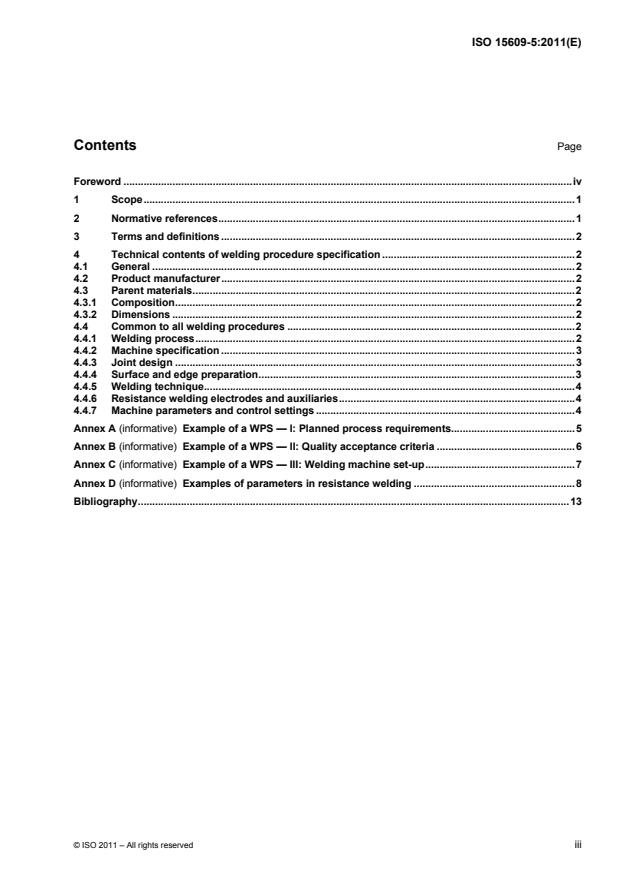
Contents Page
Foreword . iv
1 Scope . 1
2 Normative references . 1
3 Terms and definitions . 2
4 Technical contents of welding procedure specification . 2
4.1 General . 2
4.2 Product manufacturer . 2
4.3 Parent materials . 2
4.3.1 Composition . 2
4.3.2 Dimensions . 2
4.4 Common to all welding procedures . 2
4.4.1 Welding process . 2
4.4.2 Machine specification . 3
4.4.3 Joint design . 3
4.4.4 Surface and edge preparation . 3
4.4.5 Welding technique . 4
4.4.6 Resistance welding electrodes and auxiliaries . 4
4.4.7 Machine parameters and control settings . 4
Annex A (informative) Example of a WPS — I: Planned process requirements. 5
Annex B (informative) Example of a WPS — II: Quality acceptance criteria . 6
Annex C (informative) Example of a WPS — III: Welding machine set-up . 7
Annex D (informative) Examples of parameters in resistance welding . 8
Bibliography . 13
Foreword
ISO (the International Organization for Standardization) is a worldwide federation of national standards bodies
(ISO member bodies). The work of preparing International Standards is normally carried out through ISO
technical committees. Each member body interested in a subject for which a technical committee has been
established has the right to be represented on that committee. International organizations, governmental and
non-governmental, in liaison with ISO, also take part in the work. ISO collaborates closely with the
International Electrotechnical Commission (IEC) on all matters of electrotechnical standardization.
International Standards are drafted in accordance with the rules given in the ISO/IEC Directives, Part 2.
The main task of technical committees is to prepare International Standards. Draft International Standards
adopted by the technical committees are circulated to the member bodies for voting. Publication as an
International Standard requires approval by at least 75 % of the member bodies casting a vote.
Attention is drawn to the possibility that some of the elements of this document may be the subject of patent
rights. ISO shall not be held responsible for identifying any or all such patent rights.
ISO 15609-5 was prepared by Technical Committee ISO/TC 44, Welding and allied processes, Subcommittee
SC 6, Resistance welding and allied mechanical joining.
This second edition cancels and replaces the first edition (ISO 15609-5:2004), which has been technically
revised.
ISO 15609 consists of the following parts, under the general title Specification and qualification of welding
procedures for metallic materials — Welding procedure specification:
Part 1: Arc welding
Part 2: Gas welding
Part 3: Electron beam welding
Part 4: Laser beam welding
Part 5: Resistance welding
Part 6: Laser-arc hybrid welding
This corrected version of ISO 15609-5:2011 incorporates the following corrections:
correction of the French title on the cover page of the English version;
removal of "16" at the end of key item 17 in Figure D.1;
replacement of the graphic in Figure D.5 raising the lower arrow near "10";
removal of the second key item 13 in Figure D.5.
Requests for official interpretations of any aspect of this part of ISO 15609 should be directed to the
Secretariat of ISO/TC 44/SC 6 via your national standards body. A complete listing of these bodies can be
found at www.iso.org.
iv © ISO 2011 – All rights reserved
INTERNATIONAL STANDARD ISO 15609-5:2011(E)
Specification and qualification of welding procedures for
metallic materials — Welding procedure specification —
Part 5:
Resistance welding
1 Scope
This part of ISO 15609 specifies requirements for the content of welding procedure specifications for
resistance spot, seam, butt and projection welding processes. It is necessary to establish the acceptability of
applying the principles of this part of ISO 15609 to other resistance and related welding processes before any
qualification is undertaken.
NOTE Details of ISO 15609 (all parts — for titles, see Foreword) are given in ISO 15607:2003, Annex A.
Variables listed in this part of ISO 15609 are those influencing either weld dimensions (quality), weld nugget
dimension, weld pattern positioning, mechanical properties or geometry of the welded joint.
2 Normative references
The following referenced documents are indispensable for the application of this document. For dated
references, only the edition cited applies. For undated references, the latest edition of the referenced
document (including any amendments) applies.
ISO 669, Resistance welding — Resistance welding equipment — Mechanical and electrical requirements
ISO 4063, Welding and allied processes — Nomenclature of processes and reference numbers
ISO 5183 (all parts), Resistance welding equipment — Electrode adaptors, male taper 1:10
ISO 5184, Straight resistance spot welding electrodes
ISO 5821, Resistance welding — Spot welding electrode caps
ISO 5827, Spot welding — Electrode back-ups and clamps
ISO 8205-1, Water-cooled secondary connection cables for resistance welding — Part 1: Dimensions and
requirements for double-conductor connection cables
ISO 8205-2, Water-cooled secondary connection cables for resistance welding — Part 2: Dimensions and
requirements for single-conductor connection cables
ISO 8430 (all parts), Resistance spot welding — Electrode holders
ISO 15607:2003, Specification and qualification of welding procedures for metallic materials — General rules
ISO 15614-12, Specification and qualification of welding procedures for metallic materials — Welding
procedure test — Part 12: Spot, seam and projection welding
ISO 15614-13, Specification and qualification of welding procedures for metallic materials — Welding
procedure test — Part 13: Resistance butt and flash welding
ISO 17677-1, Resistance welding — Vocabulary — Part 1: Spot, projection and seam welding
3 Terms and definitions
For the purposes of this International Standard, the terms and definitions given in ISO 15607, ISO 17677-1
and ISO 669 apply.
4 Technical contents of welding procedure specification
4.1 General
The welding procedure specification (WPS) shall provide all information required to make a weld. The
minimum information required in a WPS for resistance welding processes is listed in 4.2 to 4.4.
For some applications, it is necessary to supplement the list. All relevant information shall be specified in the
WPS.
Tolerance ranges shall be specified.
Examples of the WPS format are shown in Annexes A, B and C; these forms should be modified according to
actual practice.
4.2 Product manufacturer
Identification of the product manufacturer.
Identification of the WPS.
Reference to the welding procedure qualification record (WPQR — see ISO 15614-12 and ISO 15614-
13).
4.3 Parent materials
4.3.1 Composition
Designation and type(s) of the material(s) and referenced standard(s).
In case of coating(s), type, thickness, single or double sided.
4.3.2 Dimensions
Thickness of material(s).
Dimensions of cross-section of pipe or section (butt welding).
4.4 Common to all welding procedures
4.4.1 Welding process
Welding process(es) specified shall be desig
...
NORME ISO
INTERNATIONALE 15609-5
Deuxième édition
2011-10-01
Version corrigée
2011-12-01
Descriptif et qualification d'un mode
opératoire de soudage pour les matériaux
métalliques — Descriptif d'un mode
opératoire de soudage —
Partie 5:
Soudage par résistance
Specification and qualification of welding procedures for metallic
materials — Welding procedure specification —
Part 5: Resistance welding
Numéro de référence
©
ISO 2011
DOCUMENT PROTÉGÉ PAR COPYRIGHT
© ISO 2011
Droits de reproduction réservés. Sauf prescription différente, aucune partie de cette publication ne peut être reproduite ni utilisée sous
quelque forme que ce soit et par aucun procédé, électronique ou mécanique, y compris la photocopie et les microfilms, sans l'accord écrit
de l'ISO à l'adresse ci-après ou du comité membre de l'ISO dans le pays du demandeur.
ISO copyright office
Case postale 56 CH-1211 Geneva 20
Tel. + 41 22 749 01 11
Fax + 41 22 749 09 47
E-mail copyright@iso.org
Web www.iso.org
Publié en Suisse
ii © ISO 2011 – Tous droits réservés
Sommaire Page
Avant-propos . iv
1 Domaine d'application . 1
2 Références normatives . 1
3 Termes et définitions . 2
4 Contenu technique d'un descriptif de mode opératoire de soudage . 2
4.1 Généralités . 2
4.2 Fabricant du produit . 2
4.3 Matériaux de base . 2
4.3.1 Composition . 2
4.3.2 Dimensions du matériau de base . 3
4.4 Commun à tous les modes opératoires de soudage . 3
4.4.1 Procédé de soudage . 3
4.4.2 Spécification de la machine de soudage . 3
4.4.3 Conception de l'assemblage . 4
4.4.4 Préparation des surfaces et des bords . 4
4.4.5 Technique de soudage . 4
4.4.6 Électrodes de soudage par résistance et accessoires . 4
4.4.7 Paramètres concernant la machine, réglage des commandes . 4
Annexe A (informative) Exemple de DMOS — I: Exigences prévues pour les procédés . 6
Annexe B (informative) Exemple de DMOS — II: Critères d'acceptation de la qualité . 7
Annexe C (informative) Exemple de DMOS — III: Réglage de la machine de soudage . 8
Annexe D (informative) Exemples de paramètres de soudage par résistance . 9
Bibliographie . 14
Avant-propos
L'ISO (Organisation internationale de normalisation) est une fédération mondiale d'organismes nationaux de
normalisation (comités membres de l'ISO). L'élaboration des Normes internationales est en général confiée
aux comités techniques de l'ISO. Chaque comité membre intéressé par une étude a le droit de faire partie du
comité technique créé à cet effet. Les organisations internationales, gouvernementales et non
gouvernementales, en liaison avec l'ISO participent également aux travaux. L'ISO collabore étroitement avec
la Commission électrotechnique internationale (CEI) en ce qui concerne la normalisation électrotechnique.
Les Normes internationales sont rédigées conformément aux règles données dans les Directives ISO/CEI,
Partie 2.
La tâche principale des comités techniques est d'élaborer les Normes internationales. Les projets de Normes
internationales adoptés par les comités techniques sont soumis aux comités membres pour vote. Leur
publication comme Normes internationales requiert l'approbation de 75 % au moins des comités membres
votants.
L'attention est appelée sur le fait que certains des éléments du présent document peuvent faire l'objet de
droits de propriété intellectuelle ou de droits analogues. L'ISO ne saurait être tenue pour responsable de ne
pas avoir identifié de tels droits de propriété et averti de leur existence.
L'ISO 15609-5 a été élaborée par le comité technique ISO/TC 44, Soudage et techniques connexes,
sous-comité SC 6, Soudage par résistance et assemblage mécanique allié.
Cette deuxième édition annule et remplace la première édition (ISO 15609-5:2004), qui a fait l'objet d'une
révision technique.
L'ISO 15609 comprend les parties suivantes, présentées sous le titre général Descriptif et qualification d'un
mode opératoire de soudage pour les matériaux métalliques — Descriptif d'un mode opératoire de soudage:
Partie 1: Soudage à l'arc
Partie 2: Soudage aux gaz
Partie 3: Soudage par faisceau d'électrons
Partie 4: Soudage par faisceau laser
Partie 5: Soudage par résistance
Partie 6:Soudage hybride laser-arc
La présente version corrigée de l'ISO 15609-5:2011 comprend les corrections suivantes:
suppression de «16» à la fin du repère d'élément 17 dans la légende de la Figure D.1;
remplacement du graphique de la Figure D.5 par un graphique où la flèche inférieure située à proximité
du repère d'élément 10 a été repositionnée.
Il convient d'adresser les demandes d'interprétation officielles de l'un quelconque des aspects de la présente
partie de l'ISO 15609 au secrétariat de l'ISO/TC 44/SC 6 via votre organisme national de normalisation. La
liste exhaustive de ces organismes peut être trouvée à l'adresse www.iso.org.
iv © ISO 2011 – Tous droits réservés
NORME INTERNATIONALE ISO 15609-5:2011(F)
Descriptif et qualification d'un mode opératoire de soudage
pour les matériaux métalliques — Descriptif d'un mode
opératoire de soudage —
Partie 5:
Soudage par résistance
1 Domaine d'application
La présente partie de l'ISO 15609 spécifie les exigences relatives au contenu des descriptifs de modes
opératoires de soudage pour les procédés de soudage par résistance par points, à la molette, en bout et par
bossages. La vérification de la possibilité d'appliquer les principes de la présente partie de l'ISO 15609 à
d'autres procédés de soudage par résistance ou assimilés se fait avant d'entreprendre toute qualification.
NOTE Des détails sur l'ISO 15609 (toutes les parties — pour les titres, voir l'Avant-propos) sont donnés dans
l'ISO 15607:2003, Annexe A.
Les variables énumérées dans la présente partie de l'ISO 15609 sont celles qui ont une influence soit sur les
dimensions de la soudure (qualité), les dimensions du noyau de la soudure, la configuration des soudures, les
caractéristiques mécaniques ou la géométrie de l'assemblage soudé.
2 Références normatives
Les documents de référence suivants sont indispensables pour l'application du présent document. Pour les
références datées, seule l'édition citée s'applique. Pour les références non datées, la dernière édition du
document de référence (y compris les éventuels amendements) s'applique.
ISO 669, Soudage par résistance — Matériel de soudage par résistance — Exigences mécaniques et
électriques
ISO 4063, Soudage et techniques connexes — Nomenclature et numérotation des procédés
ISO 5183 (toutes les parties), Équipement de soudage par résistance — Allonges d'électrode à embout
amovible, cône mâle 1:10
ISO 5184, Pointes d'électrodes droites pour soudage par points par résistance
ISO 5821, Soudage par résistance — Embouts amovibles de pointes d'électrodes pour soudage par points
par résistance
ISO 5827, Machines à souder par points — Équipements inférieurs et brides de serrage
ISO 8205-1, Câbles secondaires refroidis par eau, pour le soudage par résistance — Partie 1: Dimensions et
exigences pour câbles à deux conducteurs
ISO 8205-2, Câbles secondaires refroidis par eau pour le soudage par résistance — Partie 2: Dimensions et
exigences pour câbles à un conducteur
ISO 8430 (toutes les parties), Soudage par points par résistance — Porte-électrodes
ISO 15607:2003, Descriptif et qualification d'un mode opératoire de soudage pour les matériaux
métalliques — Règles générales
ISO 15614-12, Descriptif et qualification d'un mode opératoire de soudage pour les matériaux métalliques —
Épreuve de qualification d'un mode opératoire de soudage — Partie 12: Soudage par points, à la molette et
par bossages
ISO 15614-13, Descriptif et qualification d'un mode opératoire de soudage pour les matériaux métalliques —
Épreuve de qualification d'un mode opératoire de soudage — Partie 13: Soudage en bout par résistance pure
et soudage par étincelage
ISO 17677-1, Soudage par résistance — Vocabulaire — Partie 1: Soudage par points, par bossages et à la
molette
3 Termes et définitions
Pour les besoins du présent document, les termes et définitions donnés dans l'ISO 15607, ISO 17677-1 et
l'ISO 669 s'appliquent.
4 Contenu technique d'un descriptif de mode opératoire de soudage
4.1 Généralités
Le descriptif de mode opératoire de soudage (DMOS) doit fournir toutes les informations exigées pour la
réalisation de la soudure. Les informations minimales exigées dans un DMOS pour les procédés de soudage
par résistance sont énumérées en 4.2 à 4.4.
Pour certaines applications, il est nécessaire de compléter la liste. Toutes les informations appropriées
doivent être spécifiées dans le DMOS.
Les plages de tolérances doivent être spécifiées.
Des exemples de modèles de DMOS sont présentés en Annexes A, B et C; il convient de modifier ces
modèles suivant la pratique courante.
4.2 Fabricant du produit
Identification du fabricant du produit.
Identification du DMOS.
Référence au procès-verbal de qualification de mode opératoire de soudage (PV-QMOS — voir
l'ISO 15614-12 et l'ISO 15614-13).
4.3 Matériaux de base
4.3.1 Composition
désignation et type(s) du ou des matériaux et norme(s) référencée(s);
dans le cas de revêtement(s), type, épaisseur, simple ou double paroi.
2 © ISO 2011 – Tous droits réservés
4.3.2 Dimensions du matériau de base
épaisseur du ou des matériaux;
dimensions de la section du tube ou du profilé (soudage en bout).
4.4 Commun à tous les modes opératoires de soudage
4.4.1 Procédé de soudage
La désignation du ou des procédés de soudage spécifié(s) doit être celle indiquée dans l'ISO 4063:
a) Soudage par résistance par points (21):
manuel,
soudage par points multiples:
direct
indirect
push-pull
en série,
mécanisé,
automatisé,
robotisé,
soudage-collage;
b) Soudage à la molette (22) (soudage par points à la molette):
soudage manuel/mécanisé/automatique/robotisé;
c) Soudage par bossages (23):
uniques/multiples,
emboutis/massifs;
d) Soudage par étincelage (24):
clignotant/upsetting,
avec/sans préchauffage;
e) Soudage en bout (soudage en bout par résistance pure) (25).
4.4.2 Spécification de la machine de soudage
Type de machine utilisée et identification appropriée.
...