


ISO/PRF 22785-3
(Main)Paints and varnishes — Coatings on plastics and composites — Part 3: Constant climate and alternating climate testing
Paints and varnishes — Coatings on plastics and composites — Part 3: Constant climate and alternating climate testing
This document gives an overview on the constant climate and alternating climate tests of coatings on plastics, plastics composites and similar substrates, hereinafter shortly referred to as plastics. Characteristics of plastics and differences to metallic substrates are explained, as well as their effect on the behaviour of the coating during the climate tests.
Titre manque — Partie 3: Titre manque
General Information
- Status
- Not Published
- Technical Committee
- ISO/TC 35/SC 9 - General test methods for paints and varnishes
- Drafting Committee
- ISO/TC 35/SC 9/WG 31 - Properties after application
- Current Stage
- 5020 - FDIS ballot initiated: 2 months. Proof sent to secretariat
- Start Date
- 10-Apr-2026
- Completion Date
- 11-Apr-2026
Overview
ISO/PRF 22785-3: Paints and varnishes - Coatings on plastics and composites - Part 3: Constant climate and alternating climate tests is a draft international standard developed by ISO Technical Committee 35/SC 9. This document provides guidelines for evaluating the performance and durability of coatings applied to plastics and composite substrates through both constant and alternating climate tests.
The standard addresses key differences between plastics and metallic substrates, such as thermal conductivity, water absorption, and elasticity, and explains how these factors influence coating behavior under environmental stresses. ISO/PRF 22785-3 is valuable for industries where paints and varnishes are used to protect or enhance plastics, including automotive, electronics, packaging, and construction.
Key Topics
Characteristics of Plastics Substrates: The standard highlights critical properties of plastics affecting coating performance, including:
- Lower thermal conductivity compared to metals
- Variation in specific heat capacity and glass transition temperature
- Greater susceptibility to deformation and phase transitions
- Water absorption and release, additive migration, and underlying barrier effects
Constant Climate Tests: Evaluation under steady environmental conditions such as:
- Wet climate (high humidity, non-condensing)
- Dry climate (controlled heating or cold storage)
- Condensation atmosphere (constant humidity)
Alternating Climate Tests: Exposure to cyclic temperature and humidity changes, including:
- Condensation alternating climate tests
- Cold/warm and warm/humid/cold cycles to simulate real-world service conditions
Immersion in Water: Assessing the effects of partial or complete immersion in water at specified conditions.
Evaluation Methods: Detailed procedures for:
- Visual assessment (surface condition, gloss, color)
- Adhesive strength (cross-cut, impact, scratch, peel tests)
- Use of referenced ISO and EN methods for consistency and reliability
Applications
ISO/PRF 22785-3 is practically valuable for:
- Automotive Industry: Ensuring coatings on plastic exterior/interior parts meet durability requirements under climatic stress.
- Consumer Electronics: Validating protective finishes on plastic housings and components.
- Construction: Testing weather-resistant coatings on plastic building elements.
- Packaging: Evaluating coatings on plastic packaging materials for strength and longevity.
- Quality Control & R&D: Standardizing climate testing procedures to support product development, certification, and regulatory compliance.
By following ISO/PRF 22785-3, organizations can better select, apply, and evaluate paint and varnish systems tailored to plastics, thereby improving product performance and lifespan.
Related Standards
Several standards are referenced in ISO/PRF 22785-3, supporting a harmonized approach to testing and evaluation:
- ISO 6270-2 / ISO 6270-3: Resistance to humidity, condensation tests
- ISO 2813: Gloss determination at various geometries
- ISO 2409: Cross-cut test for adhesion assessment
- ISO 4628 Series: Degradation evaluation (blistering, cracking, flaking, etc.)
- ISO 20567 Series: Stone-chip resistance tests
- ISO 18314-1: Color measurement
- EN 1464: Adhesive peel resistance
- DIN 55980, DIN 6167: Yellowness and hue determination
Adhering to these referenced standards ensures consistency, comparability, and technical accuracy in coating evaluation for plastics and composites.
Conclusion
By establishing common methodologies for constant and alternating climate testing of coatings on plastics, ISO/PRF 22785-3 supports manufacturers, laboratories, and regulatory bodies in achieving reliable and reproducible results. Its relevance spans multiple sectors, fostering enhanced durability, compliance, and overall product quality in coatings applied to plastic substrates.
Buy Documents
ISO/PRF 22785-3 - Paints and varnishes — Coatings on plastics and composites — Part 3: Constant climate and alternating climate tests/15/2025
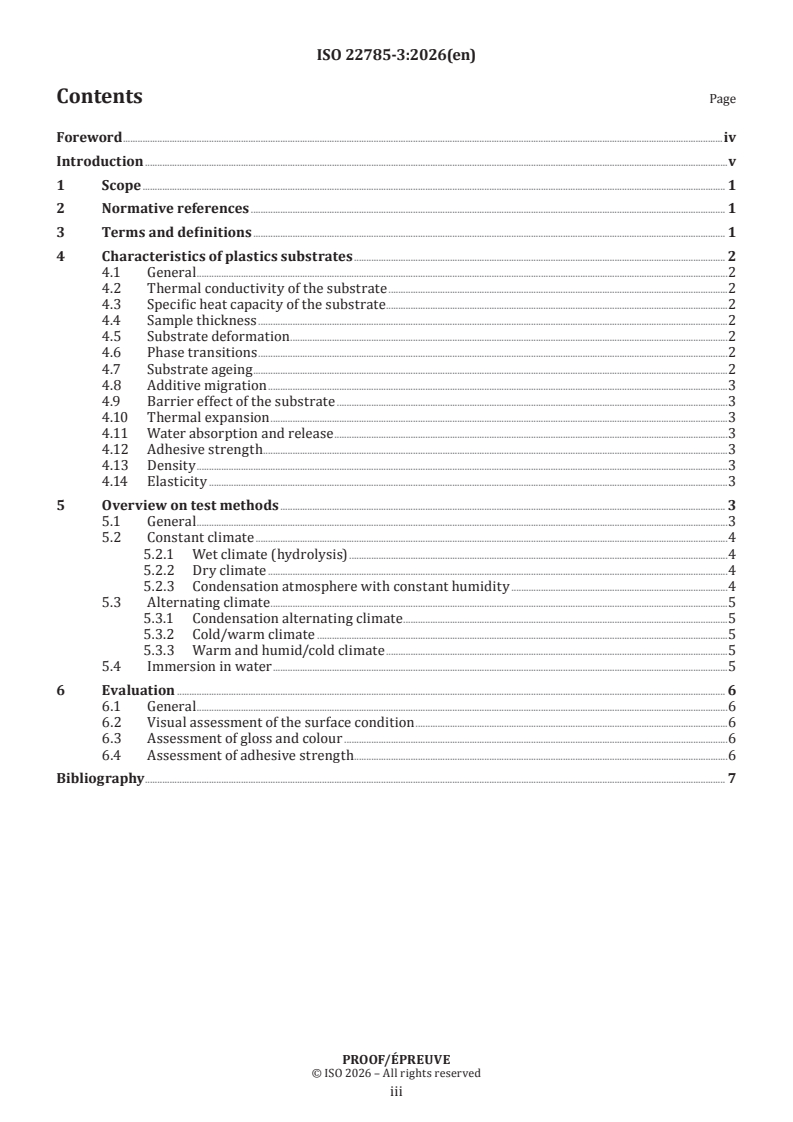
ISO/PRF 22785-3 - Paints and varnishes — Coatings on plastics and composites — Part 3: Constant climate and alternating climate testing
REDLINE ISO/PRF 22785-3 - Paints and varnishes — Coatings on plastics and composites — Part 3: Constant climate and alternating climate testing
Get Certified
Connect with accredited certification bodies for this standard

Smithers Quality Assessments
US management systems and product certification.

DIN CERTCO
DIN Group product certification.
Sponsored listings
Frequently Asked Questions
ISO/PRF 22785-3 is a draft published by the International Organization for Standardization (ISO). Its full title is "Paints and varnishes — Coatings on plastics and composites — Part 3: Constant climate and alternating climate testing". This standard covers: This document gives an overview on the constant climate and alternating climate tests of coatings on plastics, plastics composites and similar substrates, hereinafter shortly referred to as plastics. Characteristics of plastics and differences to metallic substrates are explained, as well as their effect on the behaviour of the coating during the climate tests.
This document gives an overview on the constant climate and alternating climate tests of coatings on plastics, plastics composites and similar substrates, hereinafter shortly referred to as plastics. Characteristics of plastics and differences to metallic substrates are explained, as well as their effect on the behaviour of the coating during the climate tests.
ISO/PRF 22785-3 is classified under the following ICS (International Classification for Standards) categories: 83.080.01 - Plastics in general; 83.120 - Reinforced plastics; 87.040 - Paints and varnishes. The ICS classification helps identify the subject area and facilitates finding related standards.
ISO/PRF 22785-3 is available in PDF format for immediate download after purchase. The document can be added to your cart and obtained through the secure checkout process. Digital delivery ensures instant access to the complete standard document.
Standards Content (Sample)
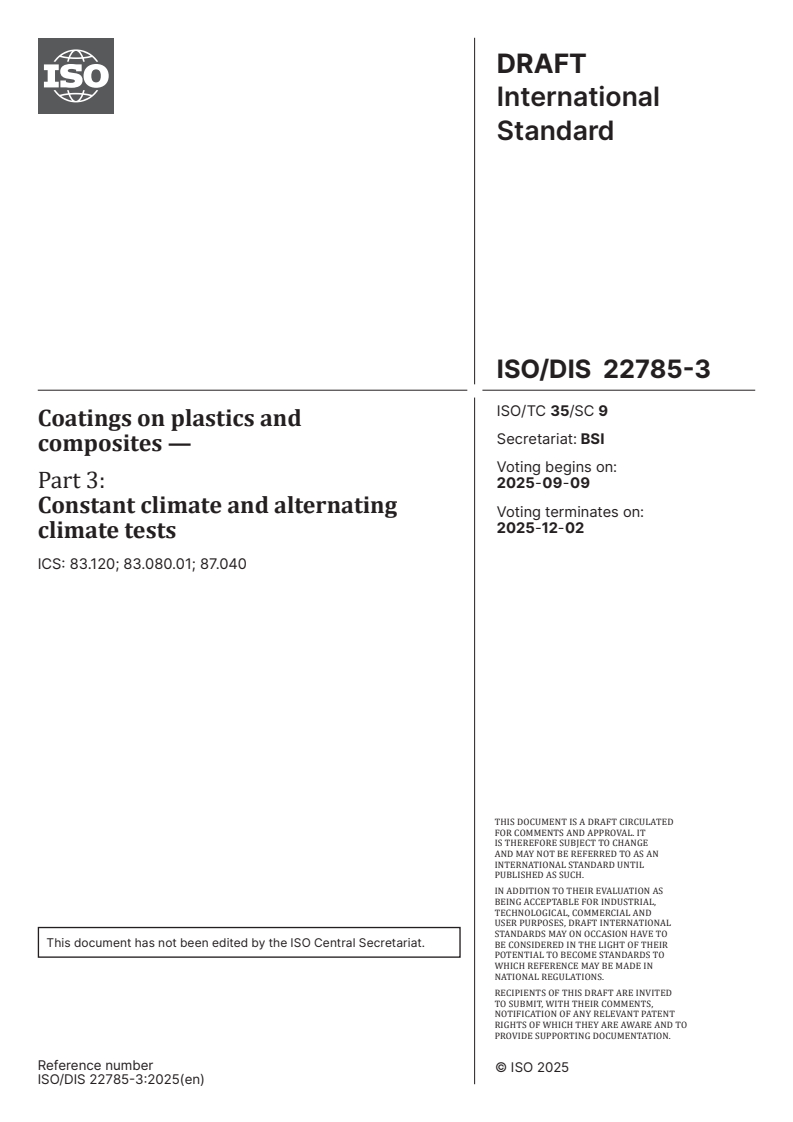
DRAFT
International
Standard
ISO/DIS 22785-3
ISO/TC 35/SC 9
Coatings on plastics and
Secretariat: BSI
composites —
Voting begins on:
Part 3: 2025-09-09
Constant climate and alternating
Voting terminates on:
2025-12-02
climate tests
ICS: 83.120; 83.080.01; 87.040
THIS DOCUMENT IS A DRAFT CIRCULATED
FOR COMMENTS AND APPROVAL. IT
IS THEREFORE SUBJECT TO CHANGE
AND MAY NOT BE REFERRED TO AS AN
INTERNATIONAL STANDARD UNTIL
PUBLISHED AS SUCH.
IN ADDITION TO THEIR EVALUATION AS
BEING ACCEPTABLE FOR INDUSTRIAL,
TECHNOLOGICAL, COMMERCIAL AND
USER PURPOSES, DRAFT INTERNATIONAL
STANDARDS MAY ON OCCASION HAVE TO
This document has not been edited by the ISO Central Secretariat.
BE CONSIDERED IN THE LIGHT OF THEIR
POTENTIAL TO BECOME STANDARDS TO
WHICH REFERENCE MAY BE MADE IN
NATIONAL REGULATIONS.
RECIPIENTS OF THIS DRAFT ARE INVITED
TO SUBMIT, WITH THEIR COMMENTS,
NOTIFICATION OF ANY RELEVANT PATENT
RIGHTS OF WHICH THEY ARE AWARE AND TO
PROVIDE SUPPORTING DOCUMENTATION.
Reference number
ISO/DIS 22785-3:2025(en)
DRAFT
ISO/DIS 22785-3:2025(en)
International
Standard
ISO/DIS 22785-3
ISO/TC 35/SC 9
Coatings on plastics and
Secretariat: BSI
composites —
Voting begins on:
Part 3:
Constant climate and alternating
Voting terminates on:
climate tests
ICS: 83.120; 83.080.01; 87.040
THIS DOCUMENT IS A DRAFT CIRCULATED
FOR COMMENTS AND APPROVAL. IT
IS THEREFORE SUBJECT TO CHANGE
AND MAY NOT BE REFERRED TO AS AN
INTERNATIONAL STANDARD UNTIL
PUBLISHED AS SUCH.
IN ADDITION TO THEIR EVALUATION AS
BEING ACCEPTABLE FOR INDUSTRIAL,
© ISO 2025
TECHNOLOGICAL, COMMERCIAL AND
USER PURPOSES, DRAFT INTERNATIONAL
All rights reserved. Unless otherwise specified, or required in the context of its implementation, no part of this publication may
STANDARDS MAY ON OCCASION HAVE TO
be reproduced or utilized otherwise in any form or by any means, electronic or mechanical, including photocopying, or posting on
This document has not been edited by the ISO Central Secretariat. BE CONSIDERED IN THE LIGHT OF THEIR
the internet or an intranet, without prior written permission. Permission can be requested from either ISO at the address below
POTENTIAL TO BECOME STANDARDS TO
WHICH REFERENCE MAY BE MADE IN
or ISO’s member body in the country of the requester.
NATIONAL REGULATIONS.
ISO copyright office
RECIPIENTS OF THIS DRAFT ARE INVITED
CP 401 • Ch. de Blandonnet 8
TO SUBMIT, WITH THEIR COMMENTS,
CH-1214 Vernier, Geneva
NOTIFICATION OF ANY RELEVANT PATENT
Phone: +41 22 749 01 11
RIGHTS OF WHICH THEY ARE AWARE AND TO
PROVIDE SUPPORTING DOCUMENTATION.
Email: copyright@iso.org
Website: www.iso.org
Published in Switzerland Reference number
ISO/DIS 22785-3:2025(en)
ii
ISO/DIS 22785-3:2025(en)
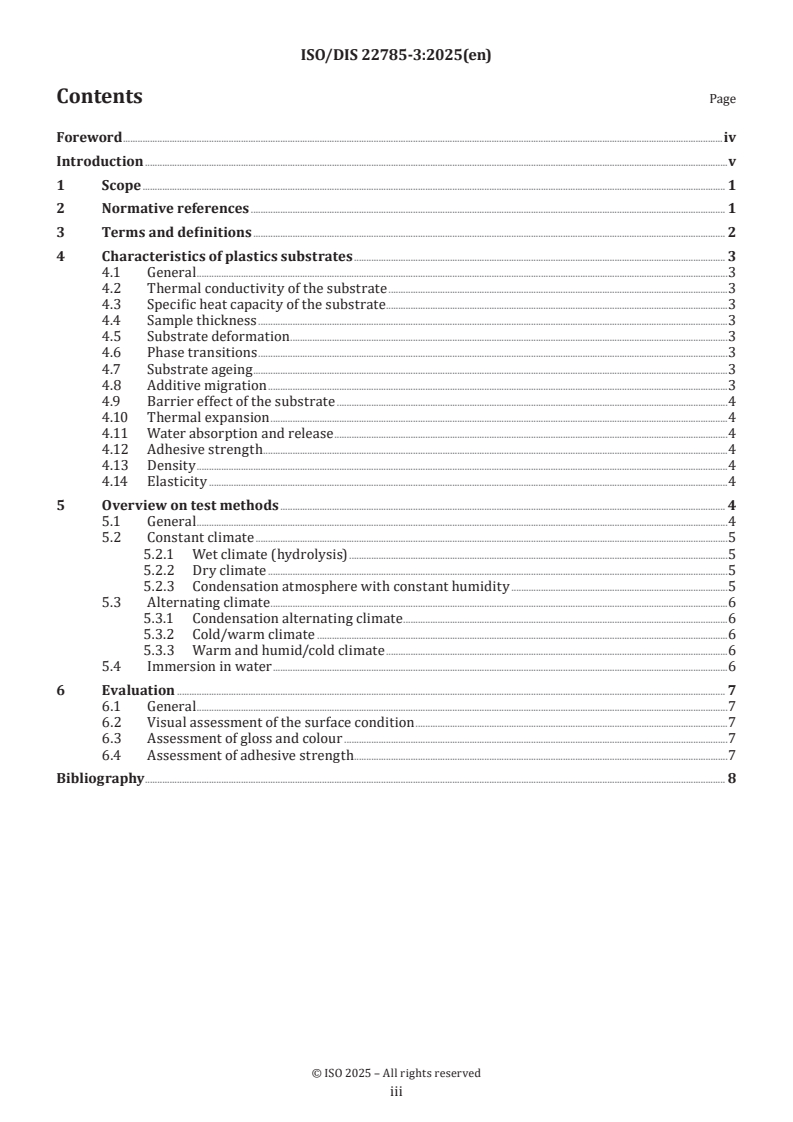
Contents Page
Foreword .iv
Introduction .v
1 Scope . 1
2 Normative references . 1
3 Terms and definitions . 2
4 Characteristics of plastics substrates . 3
4.1 General .3
4.2 Thermal conductivity of the substrate .3
4.3 Specific heat capacity of the substrate .3
4.4 Sample thickness .3
4.5 Substrate deformation .3
4.6 Phase transitions .3
4.7 Substrate ageing .3
4.8 Additive migration .3
4.9 Barrier effect of the substrate .4
4.10 Thermal expansion .4
4.11 Water absorption and release .4
4.12 Adhesive strength . .4
4.13 Density .4
4.14 Elasticity .4
5 Overview on test methods . 4
5.1 General .4
5.2 Constant climate .5
5.2.1 Wet climate (hydrolysis) .5
5.2.2 Dry climate .5
5.2.3 Condensation atmosphere with constant humidity .5
5.3 Alternating climate .6
5.3.1 Condensation alternating climate .6
5.3.2 Cold/warm climate .6
5.3.3 Warm and humid/cold climate .6
5.4 Immersion in water .6
6 Evaluation . 7
6.1 General .7
6.2 Visual assessment of the surface condition .7
6.3 Assessment of gloss and colour .7
6.4 Assessment of adhesive strength.7
Bibliography . 8
iii
ISO/DIS 22785-3:2025(en)
Foreword
ISO (the International Organization for Standardization) is a worldwide federation of national standards
bodies (ISO member bodies). The work of preparing International Standards is normally carried out through
ISO technical committees. Each member body interested in a subject for which a technical committee
has been established has the right to be represented on that committee. International organizations,
governmental and non-governmental, in liaison with ISO, also take part in the work. ISO collaborates closely
with the International Electrotechnical Commission (IEC) on all matters of electrotechnical standardization.
The procedures used to develop this document and those intended for its further maintenance are described
in the ISO/IEC Directives, Part 1. In particular, the different approval criteria needed for the different types
of ISO documents should be noted. This document was drafted in accordance with the editorial rules of the
ISO/IEC Directives, Part 2 (see www.iso.org/directives).
Attention is drawn to the possibility that some of the elements of this document may be the subject of patent
rights. ISO shall not be held responsible for identifying any or all such patent rights. Details of any patent
rights identified during the development of the document will be in the Introduction and/or on the ISO list of
patent declarations received (see www.iso.org/patents).
Any trade name used in this document is information given for the convenience of users and does not
constitute an endorsement.
For an explanation of the voluntary nature of standards, the meaning of ISO specific terms and expressions
related to conformity assessment, as well as information about ISO's adherence to the World Trade
Organization (WTO) principles in the Technical Barriers to Trade (TBT), see www.iso.org/iso/foreword.html.
This document was prepared by Technical Committee ISO/TC 35, Paints and varnishes, Subcommittee SC 9,
General test methods for paints and varnishes.
A list of all parts in the ISO 22785 series can be found on the ISO website.
Any feedback or questions on this document should be directed to the user’s national standards body. A
complete listing of these bodies can be found at www.iso.org/members.html.
iv
ISO/DIS 22785-3:2025(en)
Introduction
An overview of the common climate test methods is given (in particular for automotive exteriors and
interiors). Many of the existing test methods have been developed for coatings on metals. In this document
it is explained which test methods can lead to a deviating behaviour of the coating on plastics substrates
and which measures can be taken, where appropriate. It can happen that the substrate has an effect on the
behaviour of the coating during the test. At times it can be useful to select test conditions which are based
on standards from the plastics sector and not on standards from the coating sector, in order to take into
account the thermal conductivity of a plastics substrate which is normally lower.
The methods listed refer to simple, flat test specimens, but also components. For three-dimensional samples,
different results can be obtained during the exposure; therefore the installation position or test position are
specified in advance or taken from a sampling plan.
v
DRAFT International Standard ISO/DIS 22785-3:2025(en)
Coatings on plastics and composites —
Part 3:
Constant climate and alternating climate tests
1 Scope
This document provides guidnce on the constant climate and alternating climate tests of coatings on plastics,
plastics composites and similar substrates, hereinafter shortly referred to as plastics.
Characteristics of plastics and differences to metallic substrates are explained, as well as their effect on the
behaviour of the coating during the climate tests.
2 Normative references
The following documents are referred to in the text in such a way that some or all of their content constitutes
requirements of this document. For dated references, only the edition cited applies. For undated references,
the latest edition of the referenced document (including any amendments) applies.
ISO 105-A02, Textiles — Tests for colour fastness — Part A02: Grey scale for assessing change in colour
ISO 105-A03, Textiles — Tests for colour fastness — Part A03: Grey scale for assessing staining
ISO 2409, Paints and varnishes — Cross-cut test
ISO 2813, Paints and varnishes — Determination of gloss value at 20°, 60° and 85°
ISO 4618, Paints and varnishes — Vocabulary
ISO 4628-1, Paints and varnishes — Evaluation of degradation of coatings — Designation of quantity
...
International
Standard
ISO 22785-3
First edition
Paints and varnishes — Coatings on
plastics and composites —
Part 3:
Constant climate and alternating
climate testing
PROOF/ÉPREUVE
Reference number
ISO 22785-3:2026(en) © ISO 2026
ISO 22785-3:2026(en)
© ISO 2026
All rights reserved. Unless otherwise specified, or required in the context of its implementation, no part of this publication may
be reproduced or utilized otherwise in any form or by any means, electronic or mechanical, including photocopying, or posting on
the internet or an intranet, without prior written permission. Permission can be requested from either ISO at the address below
or ISO’s member body in the country of the requester.
ISO copyright office
CP 401 • Ch. de Blandonnet 8
CH-1214 Vernier, Geneva
Phone: +41 22 749 01 11
Email: copyright@iso.org
Website: www.iso.org
Published in Switzerland
PROOF/ÉPREUVE
ii
ISO 22785-3:2026(en)
Contents Page
Foreword .iv
Introduction .v
1 Scope . 1
2 Normative references . 1
3 Terms and definitions . 1
4 Characteristics of plastics substrates . 2
4.1 General .2
4.2 Thermal conductivity of the substrate .2
4.3 Specific heat capacity of the substrate .2
4.4 Sample thickness .2
4.5 Substrate deformation .2
4.6 Phase transitions .2
4.7 Substrate ageing .2
4.8 Additive migration .3
4.9 Barrier effect of the substrate .3
4.10 Thermal expansion .3
4.11 Water absorption and release .3
4.12 Adhesive strength . .3
4.13 Density .3
4.14 Elasticity .3
5 Overview on test methods . 3
5.1 General .3
5.2 Constant climate .4
5.2.1 Wet climate (hydrolysis) .4
5.2.2 Dry climate .4
5.2.3 Condensation atmosphere with constant humidity .4
5.3 Alternating climate .5
5.3.1 Condensation alternating climate .5
5.3.2 Cold/warm climate .5
5.3.3 Warm and humid/cold climate .5
5.4 Immersion in water .5
6 Evaluation . 6
6.1 General .6
6.2 Visual assessment of the surface condition .6
6.3 Assessment of gloss and colour .6
6.4 Assessment of adhesive strength.6
Bibliography . 7
PROOF/ÉPREUVE
iii
ISO 22785-3:2026(en)
Foreword
ISO (the International Organization for Standardization) is a worldwide federation of national standards
bodies (ISO member bodies). The work of preparing International Standards is normally carried out through
ISO technical committees. Each member body interested in a subject for which a technical committee
has been established has the right to be represented on that committee. International organizations,
governmental and non-governmental, in liaison with ISO, also take part in the work. ISO collaborates closely
with the International Electrotechnical Commission (IEC) on all matters of electrotechnical standardization.
The procedures used to develop this document and those intended for its further maintenance are described
in the ISO/IEC Directives, Part 1. In particular, the different approval criteria needed for the different types
of ISO document should be noted. This document was drafted in accordance with the editorial rules of the
ISO/IEC Directives, Part 2 (see www.iso.org/directives).
ISO draws attention to the possibility that the implementation of this document may involve the use of (a)
patent(s). ISO takes no position concerning the evidence, validity or applicability of any claimed patent
rights in respect thereof. As of the date of publication of this document, ISO had not received notice of (a)
patent(s) which may be required to implement this document. However, implementers are cautioned that
this may not represent the latest information, which may be obtained from the patent database available at
www.iso.org/patents. ISO shall not be held responsible for identifying any or all such patent rights.
Any trade name used in this document is information given for the convenience of users and does not
constitute an endorsement.
For an explanation of the voluntary nature of standards, the meaning of ISO specific terms and expressions
related to conformity assessment, as well as information about ISO's adherence to the World Trade
Organization (WTO) principles in the Technical Barriers to Trade (TBT), see www.iso.org/iso/foreword.html.
This document was prepared by Technical Committee ISO/TC 35, Paints and varnishes, Subcommittee SC 9,
General test methods for paints and varnishes.
A list of all parts in the ISO 22785 series can be found on the ISO website.
Any feedback or questions on this document should be directed to the user’s national standards body. A
complete listing of these bodies can be found at www.iso.org/members.html.
PROOF/ÉPREUVE
iv
ISO 22785-3:2026(en)
Introduction
The ISO 22785 series explains the characteristics of plastics and the differences between plastics substrates
and metallic substrates.
This document gives an overview of the common climate test methods used in particular for coatings of
automotive exteriors and interiors. Many of the existing test methods have been developed for coatings on
metals. This document specifies the test methods that can lead to a deviating behaviour of the coating on
plastics substrates and the measures that can be taken, where appropriate. It is possible that the substrate
has an effect on the behaviour of the coating during the test. At times, it can be useful to select test conditions
which are based on standards from the plastics sector and not on standards from the coating sector, in order
to take into account the thermal conductivity of a plastics substrate which is normally lower.
The methods listed in this document refer to simple, flat test specimens, but also components. For three-
dimensional samples, different results can be obtained during the exposure; therefore, the installation
position or test position are specified in advance or taken from a sampling plan.
PROOF/ÉPREUVE
v
International Standard ISO 22785-3:2026(en)
Paints and varnishes — Coatings on plastics and
composites —
Part 3:
Constant climate and alternating climate testing
1 Scope
This document specifies the constant climate and alternating climate testing of coatings on plastics, plastics
composites and similar substrates, hereinafter collectively referred to as plastics.
This document shows the potential effect of plastics on the behaviour of the coating during climate testing.
2 Normative references
The following documents are referred to in the text in such a way that some or all of their content constitutes
requirements of this document. For dated references, only the edition cited applies. For undated references,
the latest edition of the referenced document (including any amendments) applies.
ISO 4618, Paints and varnishes — Vocabulary
ISO 22785-1, Coatings on plastics and composites — Part 3: General introduction
3 Terms and definitions
For the purposes of this document, the terms and definitions given in ISO 4618, ISO 22785-1 and the
following apply.
ISO and IEC maintain terminology databases for use in standardization at the following addresses:
— ISO Online browsing platform: available at https:// www .iso .org/ obp
— IEC Electropedia: available at https:// www .electropedia .org/
3.1
constant climate
environment with constant climatic conditions
3.2
wet climate
environment with a relative humidity of usually > 90 %, non-condensing
3.3
dry climate
environment with a relative humidity of usually < 20 %
3.4
condensation atmosphere with constant humidity
environment with condensing humidity
PROOF/ÉPREUVE
ISO 22785-3:2026(en)
3.5
alternating climate
cyclic succession of phases with different climatic conditions
3.6
condensation alternating climate
alternating climate (3.5) with at least one phase with condensing air humidity
3.7
immersion in water
partial or complete immersion of the sample in water
4 Characteristics of plastics substrates
4.1 General
Plastics-specific characteristics for pure plastics can be taken from Reference [33]. For recyclates or plastics
mixtures, the characteristics can deviate from the information in Reference [33].
4.2 Thermal conductivity of the substrate
The thermal conducti
...
Formatted
...
Style Definition
...
Style Definition
...
Style Definition
...
Style Definition
...
ISO/DISPRF 22785-3:2025(en)
Style Definition
...
ISO /TC 35/SC 9
Style Definition
...
Style Definition
...
Secretariat: BSI
Style Definition
...
Date: 2026-01-1404-08
Style Definition
...
Style Definition
...
Style Definition
...
Style Definition
...
Style Definition
...
Style Definition
...
Paints and varnishes — Coatings on plastics and composites —
Style Definition
...
Style Definition
...
Style Definition
...
Style Definition
...
Style Definition
...
Part 3: Style Definition
...
Constant climate and alternating climate teststesting Style Definition
...
Style Definition
...
Style Definition
...
Style Definition
...
Style Definition
...
Style Definition
...
Style Definition
...
Style Definition
...
Style Definition
...
PROOF
Style Definition
...
Style Definition
...
Style Definition
...
Style Definition
...
Style Definition
...
Style Definition
...
Style Definition
...
Style Definition
...
Style Definition
...
Style Definition
...
Style Definition
...
Style Definition
...
Style Definition
...
Style Definition
...
Style Definition
...
Style Definition
...
Style Definition
...
Style Definition
...
Style Definition
...
Style Definition
...
Style Definition
...
Style Definition
...
Style Definition
...
Style Definition
...
Style Definition
...
Style Definition
...
Style Definition
...
St l D fi iti
Formatted: Font: Bold
Formatted: HeaderCentered
Formatted: Default Paragraph Font
Formatted: Adjust space between Latin and Asian text,
All rights reserved. Unless otherwise specified, or required in the context of its implementation, no part of this publication
Adjust space between Asian text and numbers
may be reproduced or utilized otherwise in any form or by any means, electronic or mechanical, including photocopying,
or posting on the internet or an intranet, without prior written permission. Permission can be requested from either
Formatted: Right: 1.5 cm, Bottom: 1 cm, Gutter: 0 cm,
ISO at the address below or ISO’s member body in the country of the requester.
Header distance from edge: 1.27 cm, Footer distance
from edge: 0.5 cm
ISO copyright office
CP 401 • Ch. de Blandonnet 8
CH-1214 Vernier, Geneva
Phone: + 41 22 749 01 11
EmailE-mail: copyright@iso.org
Formatted: German (Germany)
Website: www.iso.orgwww.iso.org
Formatted: German (Germany)
Published in Switzerland
Formatted: Font: 10 pt
Formatted: Font: 10 pt
Formatted: Font: 11 pt
Formatted: FooterPageRomanNumber, Space After: 0
pt, Line spacing: single
ii © ISO 2025 2026 – All rights reserved
ii
ISO/DISPRF 22785-3:20252026(en) Formatted: Font: 11 pt, Bold, Font color: Auto
Formatted: Font: 11 pt, Bold, Font color: Auto
Formatted: Font: 11 pt, Bold, Font color: Auto
Contents
Formatted: Font: Bold
Formatted: HeaderCentered, Left
Foreword . v
Formatted: Adjust space between Latin and Asian text,
Introduction . vi
Adjust space between Asian text and numbers
1 Scope . 1
2 Normative references . 1
3 Terms and definitions . 1
4 Characteristics of plastics substrates . 2
4.1 General. 2
4.2 Thermal conductivity of the substrate . 2
4.3 Specific heat capacity of the substrate . 2
4.4 Sample thickness . 2
4.5 Substrate deformation . 2
4.6 Phase transitions . 2
4.7 Substrate ageing . 3
4.8 Additive migration . 3
4.9 Barrier effect of the substrate . 3
4.10 Thermal expansion . 3
4.11 Water absorption and release . 3
4.12 Adhesive strength . 3
4.13 Density . 3
4.14 Elasticity . 3
5 Overview on test methods . 4
5.1 General. 4
5.2 Constant climate . 4
5.3 Alternating climate. 5
5.4 Immersion in water. 5
6 Evaluation . 6
6.1 General. 6
6.2 Visual assessment of the surface condition . 6
6.3 Assessment of gloss and colour . 6
6.4 Assessment of adhesive strength . 6
Bibliography . 8
Foreword . iv
Introduction . v
1 Scope . 1
2 Normative references . 1
3 Terms and definitions . 2
4 Characteristics of plastics substrates . 3
Formatted: Font: 10 pt
4.1 General. 3
Formatted: Font: 10 pt
4.2 Thermal conductivity of the substrate . 3
Formatted: FooterCentered, Left, Space Before: 0 pt,
4.3 Specific heat capacity of the substrate . 3
Tab stops: Not at 17.2 cm
4.4 Sample thickness . 3
4.5 Substrate deformation . 3
Formatted: Font: 11 pt
4.6 Phase transitions . 3
Formatted: FooterPageRomanNumber, Left, Space
4.7 Substrate ageing . 3
After: 0 pt, Tab stops: Not at 17.2 cm
iii
Formatted: Font: Bold
Formatted: HeaderCentered
4.8 Additive migration . 3
4.9 Barrier effect of the substrate . 3
4.10 Thermal expansion . 3
4.11 Water absorption and release . 3
4.12 Adhesive strength . 4
4.13 Density . 4
4.14 Elasticity . 4
5 Overview on test methods . 4
5.1 General. 4
5.2 Constant climate . 4
5.2.1 Wet climate (hydrolysis) . 4
5.2.2 Dry climate . 4
5.2.3 Condensation atmosphere with constant humidity . 5
5.3 Alternating climate. 5
5.3.1 Condensation alternating climate . 5
5.3.2 Cold/warm climate . 5
5.3.3 Warm and humid/cold climate . 5
5.4 Immersion in water. 6
6 Evaluation . 6
6.1 General. 6
6.2 Visual assessment of the surface condition . 6
6.3 Assessment of gloss and colour . 6
6.4 Assessment of adhesive strength . 6
Bibliography . 8
Formatted: Font: 10 pt
Formatted: Font: 10 pt
Formatted: Font: 11 pt
Formatted: FooterPageRomanNumber, Space After: 0
pt, Line spacing: single
iv © ISO 2025 2026 – All rights reserved
iv
ISO/DISPRF 22785-3:20252026(en) Formatted: Font: 11 pt, Bold, Font color: Auto
Formatted: Font: 11 pt, Bold, Font color: Auto
Formatted: Font: 11 pt, Bold, Font color: Auto
Foreword
Formatted: Font: Bold
ISO (the International Organization for Standardization) is a worldwide federation of national standards Formatted: HeaderCentered, Left
bodies (ISO member bodies). The work of preparing International Standards is normally carried out through
Formatted: Adjust space between Latin and Asian text,
ISO technical committees. Each member body interested in a subject for which a technical committee has been
Adjust space between Asian text and numbers
established has the right to be represented on that committee. International organizations, governmental and
non-governmental, in liaison with ISO, also take part in the work. ISO collaborates closely with the
International Electrotechnical Commission (IEC) on all matters of electrotechnical standardization.
The procedures used to develop this document and those intended for its further maintenance are described
in the ISO/IEC Directives, Part 1. In particular, the different approval criteria needed for the different types of
ISO document should be noted. This document was drafted in accordance with the editorial rules of the
ISO/IEC Directives, Part 2 (see www.iso.org/directives).
Formatted: English (United Kingdom)
ISO draws attention to the possibility that the implementation of this document may involve the use of (a)
patent(s). ISO takes no position concerning the evidence, validity or applicability of any claimed patent rights
in respect thereof. As of the date of publication of this document, ISO had not received notice of (a) patent(s)
which may be required to implement this document. However, implementers are cautioned that this may not
represent the latest information, which may be obtained from the patent database available at
www.iso.org/patents.www.iso.org/patents. ISO shall not be held responsible for identifying any or all such
patent rights.
Any trade name used in this document is information given for the convenience of users and does not
constitute an endorsement.
For an explanation of the voluntary nature of standards, the meaning of ISO specific terms and expressions
related to conformity assessment, as well as information about ISO's adherence to the World Trade
Organization (WTO) principles in the Technical Barriers to Trade (TBT), see
www.iso.org/iso/foreword.htmlwww.iso.org/iso/foreword.html.
Formatted: English (United Kingdom)
This document was prepared by Technical Committee ISO/TC 35, Paints and varnishes, Subcommittee SC 9,
Formatted: Adjust space between Latin and Asian text,
General test methods for paints and varnishes.
Adjust space between Asian text and numbers
A list of all parts in the ISO 22785 series can be found on the ISO website.
Formatted: Default Paragraph Font
Formatted: Default Paragraph Font
Any feedback or questions on this document should be directed to the user’s national standards body. A
Formatted: Default Paragraph Font
complete listing of these bodies can be found at www.iso.org/members.htmlwww.iso.org/members.html.
Formatted: English (United Kingdom)
Formatted: English (United Kingdom)
Formatted: Adjust space between Latin and Asian text,
Adjust space between Asian text and numbers
Formatted: Font: 10 pt
Formatted: Font: 10 pt
Formatted: FooterCentered, Left, Space Before: 0 pt,
Tab stops: Not at 17.2 cm
Formatted: Font: 11 pt
Formatted: FooterPageRomanNumber, Left, Space
After: 0 pt, Tab stops: Not at 17.2 cm
v
Formatted: Font: Bold
Formatted: HeaderCentered
Introduction
The ISO 22785 series explains the characteristics of plastics and the differences between plastics substrates
and metallic substrates.
This document gives an overview of the common climate test methods used in particular for coatings of
Formatted: Adjust space between Latin and Asian text,
automotive exteriors and interiors. Many of the existing test methods have been developed for coatings on
Adjust space between Asian text and numbers
metals. This document explains which specifies the test methods that can lead to a deviating behaviour of the
coating on plastics substrates and whichthe measures that can be taken, where appropriate. It is possible that
the substrate has an effect on the behaviour of the coating during the test. At times, it can be useful to select
test conditions which are based on standards from the plastics sector and not on standards from the coating
sector, in order to take into account the thermal conductivity of a plastics substrate which is normally lower.
The methods listed in this document refer to simple, flat test specimens, but also components. For three-
dimensional samples, different results can be obtained during the exposure; therefore, the installation
position or test position are specified in advance or taken from a sampling plan.
Formatted: Font: 10 pt
Formatted: Font: 10 pt
Formatted: Font: 11 pt
Formatted: FooterPageRomanNumber, Space After: 0
pt, Line spacing: single
vi © ISO 2025 2026 – All rights reserved
vi
DRAFT International Standard ISO/DIS 22785-3:2025(en)
Formatted: Font: Not Bold
Formatted: Header, Space After: 0 pt, Line spacing:
single
Paints and varnishes — Coatings on plastics and composites — Part 3:
Constant climate and alternating climate tests
Formatted: Right: 1.5 cm, Bottom: 1 cm, Gutter: 0 cm,
Part 3:
Header distance from edge: 1.27 cm, Footer distance
Constant climate and alternating climate testing
from edge: 0.5 cm
1 Scope
Formatted: Adjust space between Latin and Asian text,
Adjust space between Asian text and numbers
This document specifies the constant climate and alternating climate teststesting of coatings on plastics,
plastics composites and similar substrates, hereinafter shortlycollectively referred to as plastics.
Characteristics This document shows the potential effect of plastics and differences to metallic substrates are
explained, as well as their effect on the behaviour of the coating during the climate teststesting.
Formatted: Default Paragraph Font
2 Normative references
Formatted: Default Paragraph Font
Formatted: Default Paragraph Font
The following documents are referred to in the text in such a way that some or all of their content constitutes
requirements of this document. For dated references, only the edition cited applies. For undated references,
Formatted: Adjust space between Latin and Asian text,
the latest edition of the referenced document (including any amendments) applies.
Adjust space between Asian text and numbers, Tab
stops: Not at 0.7 cm + 1.4 cm + 2.1 cm + 2.8 cm +
ISO 4618, Paints and varnishes — Vocabulary
3.5 cm + 4.2 cm + 4.9 cm + 5.6 cm + 6.3 cm + 7 cm
Formatted: Default Paragraph Font
ISO 22785--1, Coatings on plastics and composites — Part 3: General introduction
Formatted: Default Paragraph Font
3 Terms and definitions
Formatted: Default Paragraph Font
Formatted: Default Paragraph Font
For the purposes of this document, the terms and definitions given in ISO 4618, ISO 22785-1 and the following
Formatted: Adjust space between Latin and Asian text,
apply.
Adjust space between Asian text and numbers
ISO and IEC maintain terminology databases for use in standardization at the following addresses:
Formatted: Default Paragraph Font
Formatted: Default Paragraph Font
— — ISO Online browsing platform: available at https://www.iso.org/obphttps://www.iso.org/obp
Formatted: Default Paragraph Font
— — IEC Electropedia: available at https://www.electropedia.org/https://www.electropedia.org/
Formatted: Default Paragraph Font
Formatted: Default Paragraph Font
3.1 3.1
constant climate
Formatted: English (United Kingdom)
environment with constant climatic conditions
Formatted: Font: Cambria, 11 pt, English (United
Kingdom)
3.2 3.2
Formatted: English (United Kingdom)
wet climate
environment with a relative humidity of usually > 90 %, non-condensing
Formatted: English (United Kingdom)
Formatted: Font: Cambria, English (United Kingdom)
3.3 3.3
dry climate Formatted: TermNum2, Adjust space between Latin
environment with a relative humidity of usually < 20 % and Asian text, Adjust space between Asian text and
numbers
Formatted: Footer, Left, Space After: 0 pt, Tab stops:
Not at 17.2 cm
Formatted: Font: Bold
Formatted: HeaderCentered
3.4 3.4
condensation atmosphere with constant humidity
environment with condensing humidity
3.5 3.5
alternating climate
cyclic succession of phases with different climatic conditions
3.6 3.6
condensation alternating climate
alternating climate (3.5) with at least one phase with condensing air humidity
Formatted: Font: Italic
3.7 3.7
immersion in water
partial or complete immersion of the sample in water
Formatted: Adjust space between Latin and Asian text,
Adjust space between Asian text and numbers, Tab
4 Characteristics of plastics substrates
stops: Not at 0.71 cm
4.1 General
Formatted: Adjust space between Latin and Asian text,
Adjust space between Asian text and numbers
Plastics-specific characteristics for pure plastics can be taken from Reference [6].[33]. For recyclates or
Formatted: Adjust space between Latin and Asian text,
plastics mixtures, the characteristics can deviate from the information in Reference [6].[33].
Adjust space between Asian text and numbers, Tab
stops: Not at 0.71 cm
4.2 Thermal conductivity of the substrate
Formatted: Adjust space between Latin and Asian text,
Adjust
...
Questions, Comments and Discussion
Ask us and Technical Secretary will try to provide an answer. You can facilitate discussion about the standard in here.
Loading comments...