


ISO/FDIS 22785-5
(Main)Paints and varnishes — Coatings on plastics and composites — Part 5: Chemical resistance testing
Paints and varnishes — Coatings on plastics and composites — Part 5: Chemical resistance testing
This document gives an overview on chemical tests on the coatings of plastics, plastics composites and similar substrates. Chemical resistance is normally a surface test, nevertheless the substrate has an influence and is also considered.
Peintures et vernis — Revêtements sur plastiques et composites — Partie 5: Essais de résistance aux produits chimiques
General Information
- Status
- Not Published
- Technical Committee
- ISO/TC 35/SC 9 - General test methods for paints and varnishes
- Drafting Committee
- ISO/TC 35/SC 9/WG 31 - Properties after application
- Current Stage
- 5020 - FDIS ballot initiated: 2 months. Proof sent to secretariat
- Start Date
- 24-Apr-2026
- Completion Date
- 24-Apr-2026
Buy Documents
ISO/FDIS 22785-5 - Paints and varnishes — Coatings on plastics and composites — Part 5: Chemical resistance/16/2025
ISO/FDIS 22785-5 - Paints and varnishes — Coatings on plastics and composites — Part 5: Chemical resistance testing
REDLINE ISO/FDIS 22785-5 - Paints and varnishes — Coatings on plastics and composites — Part 5: Chemical resistance testing
Overview
ISO/FDIS 22785-5: Paints and Varnishes - Coatings on Plastics and Composites - Part 5: Chemical Resistance provides guidance for evaluating the chemical resistance of coatings applied to plastics, plastic composites, and similar substrates. Developed by ISO Technical Committee 35/SC 9, this international standard establishes a framework for conducting and documenting chemical resistance tests, considering both the coated surface and the influence of the underlying substrate.
Chemical resistance testing is typically a surface-level assessment. However, the characteristics of the substrate-especially with plastics and composites-can significantly influence test outcomes. This standard addresses these complexities, ensuring reliable and reproducible testing processes suitable for industries where coated plastics are exposed to diverse chemical environments.
Key Topics
Sample Preparation and Conditioning
- Requirements for specimen geometry and protection during testing
- Importance of sample conditioning to enhance reproducibility, with specific considerations for plastics due to their sensitivity to humidity and slower equilibrium adjustment compared to metals
Test Methods
- Immersion Methods: Following ISO 2812-1 and ISO 2812-2, panels are immersed in test liquids or water
- Absorbent Medium Method: Application of chemicals using absorbent materials as specified in ISO 2812-3
- Spotting Methods: Droplets of test substances are applied, observing effects such as staining or swelling (ISO 2812-4)
- Temperature-gradient Oven Method: Utilizes a gradient oven to evaluate chemical effects at varied temperatures (ISO 2812-5)
- Chemical Load on Electrical/Electronic Equipment: Relevant for components subjected to chemicals in operational environments (ISO 16750-5)
Chemical Categories for Testing
- Automotive fluids (fuels, oils, brake fluid, radiator anti-freeze)
- Laboratory chemicals (acids, bases, alcohols)
- Biological substances (rosin, simulated bird droppings, artificial sweat)
- Substances of daily use (ketchup, coffee, hand cream, sunscreen)
Evaluation Criteria
- Visual assessment of the coating’s surface post-exposure
- Measurement of gloss, color, haze, and other properties to determine the extent of chemical damage or degradation as per related ISO methods
- Consideration of substrate influence, temperature sensitivity, and potential volumetric changes due to chemical absorption
Applications
ISO/FDIS 22785-5 is applicable across various sectors that use coatings on plastics and composite substrates, including:
- Automotive Industry: Evaluates the chemical resistance of coatings on dashboards, interior panels, and exterior trim exposed to fuels, lubricants, cleaning agents, and biological contaminants
- Consumer Goods: Ensures durability of coatings on electronics, appliances, and furniture where exposure to household chemicals, cosmetics, or food substances is likely
- Electrical and Electronic Equipment: Assesses how coatings on plastic components withstand contact with operating fluids, cleaning products, and biological matter in real-world conditions
- General Manufacturing: Applicable to any industry seeking to verify the chemical durability and longevity of coated plastic parts under various environmental influences
By adhering to ISO/FDIS 22785-5, organizations can better ensure product quality, reliability, and compliance with international best practices, while documenting product performance for regulatory and customer assurance.
Related Standards
The following standards are closely linked to ISO/FDIS 22785-5 and are often referenced for detailed procedures or supplementary tests:
- ISO 2812 (Parts 1-5): Methods for determining chemical resistance by immersion, absorbent media, spotting, and temperature-gradient oven
- ISO 3270: Standard climate conditions for sample conditioning and testing
- ISO 16750-5: Chemical load testing for electrical and electronic automotive equipment
- ISO 1514: Standard for test panels used in coatings evaluation
- ISO 4618, ISO 2409, ISO 1518, ISO 2813, ISO 18314-1: Surface evaluation including scratch resistance, gloss, color, and wettability
- EN 590, EN 228, EN 14214, DIN 51604, DIN 53160: Specific requirements for automotive fuels, fluids, and test chemicals
By integrating ISO/FDIS 22785-5 with these related standards, organizations achieve comprehensive testing protocols for coating chemical resistance, supporting safe and effective use of coated plastics and composites in demanding environments.
Buy Documents
ISO/FDIS 22785-5 - Paints and varnishes — Coatings on plastics and composites — Part 5: Chemical resistance/16/2025
ISO/FDIS 22785-5 - Paints and varnishes — Coatings on plastics and composites — Part 5: Chemical resistance testing
REDLINE ISO/FDIS 22785-5 - Paints and varnishes — Coatings on plastics and composites — Part 5: Chemical resistance testing
Get Certified
Connect with accredited certification bodies for this standard

DIN CERTCO
DIN Group product certification.

Smithers Quality Assessments
US management systems and product certification.
Sponsored listings
Frequently Asked Questions
ISO/FDIS 22785-5 is a draft published by the International Organization for Standardization (ISO). Its full title is "Paints and varnishes — Coatings on plastics and composites — Part 5: Chemical resistance testing". This standard covers: This document gives an overview on chemical tests on the coatings of plastics, plastics composites and similar substrates. Chemical resistance is normally a surface test, nevertheless the substrate has an influence and is also considered.
This document gives an overview on chemical tests on the coatings of plastics, plastics composites and similar substrates. Chemical resistance is normally a surface test, nevertheless the substrate has an influence and is also considered.
ISO/FDIS 22785-5 is classified under the following ICS (International Classification for Standards) categories: 83.080.01 - Plastics in general; 83.120 - Reinforced plastics; 87.040 - Paints and varnishes. The ICS classification helps identify the subject area and facilitates finding related standards.
ISO/FDIS 22785-5 is available in PDF format for immediate download after purchase. The document can be added to your cart and obtained through the secure checkout process. Digital delivery ensures instant access to the complete standard document.
Standards Content (Sample)
DRAFT
International
Standard
ISO/DIS 22785-5
ISO/TC 35/SC 9
Coatings on plastics and
Secretariat: BSI
composites —
Voting begins on:
Part 5: 2025-09-10
Chemical resistance
Voting terminates on:
2025-12-03
ICS: 87.040; 83.120; 83.080.01
THIS DOCUMENT IS A DRAFT CIRCULATED
FOR COMMENTS AND APPROVAL. IT
IS THEREFORE SUBJECT TO CHANGE
AND MAY NOT BE REFERRED TO AS AN
INTERNATIONAL STANDARD UNTIL
PUBLISHED AS SUCH.
IN ADDITION TO THEIR EVALUATION AS
BEING ACCEPTABLE FOR INDUSTRIAL,
TECHNOLOGICAL, COMMERCIAL AND
USER PURPOSES, DRAFT INTERNATIONAL
STANDARDS MAY ON OCCASION HAVE TO
This document has not been edited by the ISO Central Secretariat.
BE CONSIDERED IN THE LIGHT OF THEIR
POTENTIAL TO BECOME STANDARDS TO
WHICH REFERENCE MAY BE MADE IN
NATIONAL REGULATIONS.
RECIPIENTS OF THIS DRAFT ARE INVITED
TO SUBMIT, WITH THEIR COMMENTS,
NOTIFICATION OF ANY RELEVANT PATENT
RIGHTS OF WHICH THEY ARE AWARE AND TO
PROVIDE SUPPORTING DOCUMENTATION.
Reference number
ISO/DIS 22785-5:2025(en)
DRAFT
ISO/DIS 22785-5:2025(en)
International
Standard
ISO/DIS 22785-5
ISO/TC 35/SC 9
Coatings on plastics and
Secretariat: BSI
composites —
Voting begins on:
Part 5:
Chemical resistance
Voting terminates on:
ICS: 87.040; 83.120; 83.080.01
THIS DOCUMENT IS A DRAFT CIRCULATED
FOR COMMENTS AND APPROVAL. IT
IS THEREFORE SUBJECT TO CHANGE
AND MAY NOT BE REFERRED TO AS AN
INTERNATIONAL STANDARD UNTIL
PUBLISHED AS SUCH.
IN ADDITION TO THEIR EVALUATION AS
BEING ACCEPTABLE FOR INDUSTRIAL,
© ISO 2025
TECHNOLOGICAL, COMMERCIAL AND
USER PURPOSES, DRAFT INTERNATIONAL
All rights reserved. Unless otherwise specified, or required in the context of its implementation, no part of this publication may
STANDARDS MAY ON OCCASION HAVE TO
be reproduced or utilized otherwise in any form or by any means, electronic or mechanical, including photocopying, or posting on
This document has not been edited by the ISO Central Secretariat. BE CONSIDERED IN THE LIGHT OF THEIR
the internet or an intranet, without prior written permission. Permission can be requested from either ISO at the address below
POTENTIAL TO BECOME STANDARDS TO
WHICH REFERENCE MAY BE MADE IN
or ISO’s member body in the country of the requester.
NATIONAL REGULATIONS.
ISO copyright office
RECIPIENTS OF THIS DRAFT ARE INVITED
CP 401 • Ch. de Blandonnet 8
TO SUBMIT, WITH THEIR COMMENTS,
CH-1214 Vernier, Geneva
NOTIFICATION OF ANY RELEVANT PATENT
Phone: +41 22 749 01 11
RIGHTS OF WHICH THEY ARE AWARE AND TO
PROVIDE SUPPORTING DOCUMENTATION.
Email: copyright@iso.org
Website: www.iso.org
Published in Switzerland Reference number
ISO/DIS 22785-5:2025(en)
ii
ISO/DIS 22785-5:2025(en)
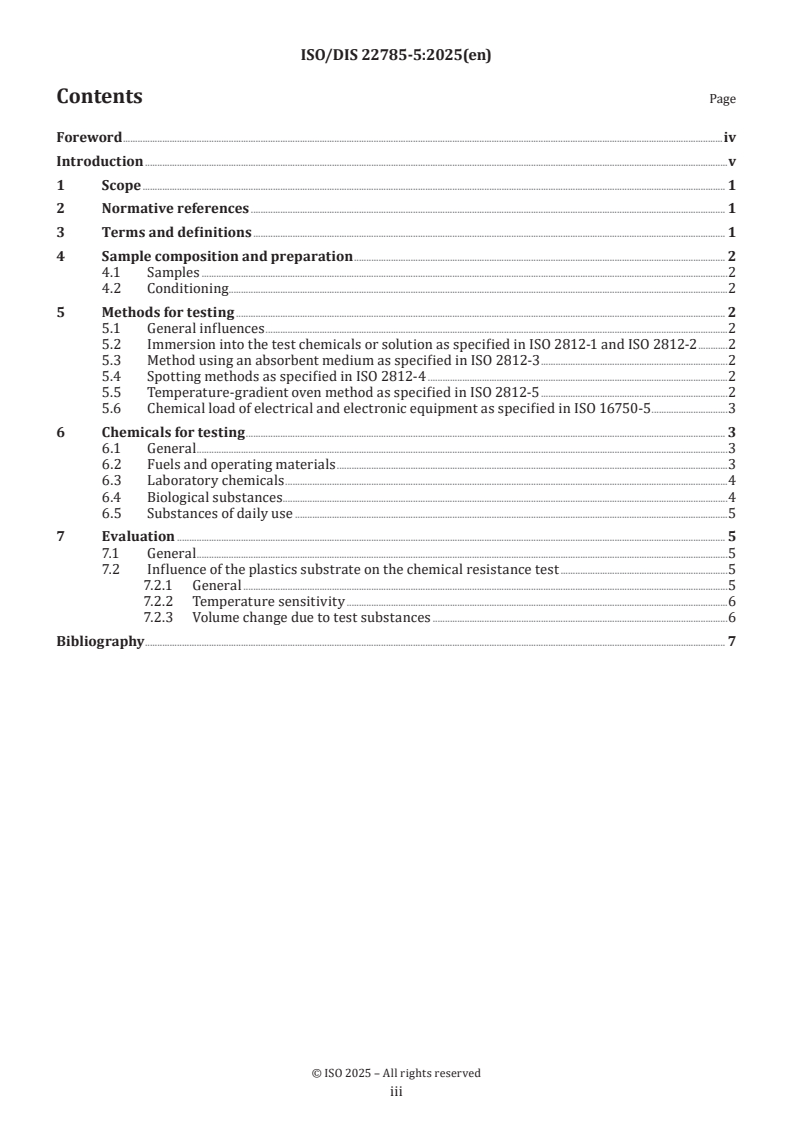
Contents Page
Foreword .iv
Introduction .v
1 Scope . 1
2 Normative references . 1
3 Terms and definitions . 1
4 Sample composition and preparation . 2
4.1 Samples .2
4.2 Conditioning.2
5 Methods for testing . 2
5.1 General influences .2
5.2 Immersion into the test chemicals or solution as specified in ISO 2812-1 and ISO 2812-2 .2
5.3 Method using an absorbent medium as specified in ISO 2812-3 .2
5.4 Spotting methods as specified in ISO 2812-4 .2
5.5 Temperature-gradient oven method as specified in ISO 2812-5 .2
5.6 Chemical load of electrical and electronic equipment as specified in ISO 16750-5 .3
6 Chemicals for testing . 3
6.1 General .3
6.2 Fuels and operating materials .3
6.3 Laboratory chemicals .4
6.4 Biological substances . .4
6.5 Substances of daily use .5
7 Evaluation . 5
7.1 General .5
7.2 Influence of the plastics substrate on the chemical resistance test .5
7.2.1 General .5
7.2.2 Temperature sensitivity .6
7.2.3 Volume change due to test substances .6
Bibliography . 7
iii
ISO/DIS 22785-5:2025(en)
Foreword
ISO (the International Organization for Standardization) is a worldwide federation of national standards
bodies (ISO member bodies). The work of preparing International Standards is normally carried out through
ISO technical committees. Each member body interested in a subject for which a technical committee
has been established has the right to be represented on that committee. International organizations,
governmental and non-governmental, in liaison with ISO, also take part in the work. ISO collaborates closely
with the International Electrotechnical Commission (IEC) on all matters of electrotechnical standardization.
The procedures used to develop this document and those intended for its further maintenance are described
in the ISO/IEC Directives, Part 1. In particular, the different approval criteria needed for the different types
of ISO documents should be noted. This document was drafted in accordance with the editorial rules of the
ISO/IEC Directives, Part 2 (see www.iso.org/directives).
Attention is drawn to the possibility that some of the elements of this document may be the subject of patent
rights. ISO shall not be held responsible for identifying any or all such patent rights. Details of any patent
rights identified during the development of the document will be in the Introduction and/or on the ISO list of
patent declarations received (see www.iso.org/patents).
Any trade name used in this document is information given for the convenience of users and does not
constitute an endorsement.
For an explanation of the voluntary nature of standards, the meaning of ISO specific terms and expressions
related to conformity assessment, as well as information about ISO's adherence to the World Trade
Organization (WTO) principles in the Technical Barriers to Trade (TBT), see www.iso.org/iso/foreword.html.
This document was prepared by Technical Committee ISO/TC 35, Paints and varnishes, Subcommittee SC 9,
General test methods for paints and varnishes.
A list of all parts in the ISO 22785 series can be found on the ISO website.
Any feedback or questions on this document should be directed to the user’s national standards body. A
complete listing of these bodies can be found at www.iso.org/members.html.
iv
ISO/DIS 22785-5:2025(en)
Introduction
Chemical resistance is normally a surface test, nevertheless the substrate has an influence and is also
considered.
v
DRAFT International Standard ISO/DIS 22785-5:2025(en)
Coatings on plastics and composites —
Part 5:
Chemical resistance
1 Scope
This document provides guidance on chemical tests on the coatings of plastics, plastics composites and
similar substrates.
Chemical resistance is normally a surface test, nevertheless the substrate has an influence and is also
considered.
2 Normative references
The following documents are referred to in the text in such a way that some or all of their content constitutes
requirements of this document. For dated references, only the edition cited applies. For undated references,
the latest edition of the referenced document (including any amendments) applies.
ISO 1514, Paints and varnishes — Standard panels for testing
ISO 2812-1, Paints and varnishes — Determination of resistan
...
FINAL DRAFT
International
Standard
ISO/TC 35/SC 9
Paints and varnishes — Coatings on
Secretariat: BSI
plastics and composites —
Voting begins on:
2026-04-24
Part 5:
Chemical resistance testing
Voting terminates on:
2026-06-19
RECIPIENTS OF THIS DRAFT ARE INVITED TO SUBMIT,
WITH THEIR COMMENTS, NOTIFICATION OF ANY
RELEVANT PATENT RIGHTS OF WHICH THEY ARE AWARE
AND TO PROVIDE SUPPOR TING DOCUMENTATION.
IN ADDITION TO THEIR EVALUATION AS
BEING ACCEPTABLE FOR INDUSTRIAL, TECHNO-
LOGICAL, COMMERCIAL AND USER PURPOSES, DRAFT
INTERNATIONAL STANDARDS MAY ON OCCASION HAVE
TO BE CONSIDERED IN THE LIGHT OF THEIR POTENTIAL
TO BECOME STAN DARDS TO WHICH REFERENCE MAY BE
MADE IN NATIONAL REGULATIONS.
Reference number
FINAL DRAFT
International
Standard
ISO/TC 35/SC 9
Paints and varnishes — Coatings on
Secretariat: BSI
plastics and composites —
Voting begins on:
Part 5:
Chemical resistance testing
Voting terminates on:
RECIPIENTS OF THIS DRAFT ARE INVITED TO SUBMIT,
WITH THEIR COMMENTS, NOTIFICATION OF ANY
RELEVANT PATENT RIGHTS OF WHICH THEY ARE AWARE
AND TO PROVIDE SUPPOR TING DOCUMENTATION.
© ISO 2026
IN ADDITION TO THEIR EVALUATION AS
All rights reserved. Unless otherwise specified, or required in the context of its implementation, no part of this publication may
BEING ACCEPTABLE FOR INDUSTRIAL, TECHNO-
LOGICAL, COMMERCIAL AND USER PURPOSES, DRAFT
be reproduced or utilized otherwise in any form or by any means, electronic or mechanical, including photocopying, or posting on
INTERNATIONAL STANDARDS MAY ON OCCASION HAVE
the internet or an intranet, without prior written permission. Permission can be requested from either ISO at the address below
TO BE CONSIDERED IN THE LIGHT OF THEIR POTENTIAL
or ISO’s member body in the country of the requester.
TO BECOME STAN DARDS TO WHICH REFERENCE MAY BE
MADE IN NATIONAL REGULATIONS.
ISO copyright office
CP 401 • Ch. de Blandonnet 8
CH-1214 Vernier, Geneva
Phone: +41 22 749 01 11
Email: copyright@iso.org
Website: www.iso.org
Published in Switzerland Reference number
ii
Contents Page
Foreword .iv
Introduction .v
1 Scope . 1
2 Normative references . 1
3 Terms and definitions . 1
4 Sample composition and preparation . 1
4.1 Samples .1
4.2 Conditioning.2
5 Methods for testing . 2
5.1 General influences .2
5.2 Immersion into the test chemicals or solution.2
5.3 Method using an absorbent medium .2
5.4 Spotting methods .2
5.5 Temperature-gradient oven method .2
5.6 Chemical load of electrical and electronic equipment .3
6 Chemicals for testing . 3
6.1 General .3
6.2 Fuels and operating materials .3
6.3 Laboratory chemicals .4
6.4 Biological substances . .4
6.5 Substances of daily use .4
7 Evaluation . 5
7.1 General .5
7.2 Influence of the plastics substrate on the chemical resistance test .5
7.2.1 General .5
7.2.2 Temperature sensitivity .5
7.2.3 Volume change due to test substances .5
Bibliography . 7
iii
Foreword
ISO (the International Organization for Standardization) is a worldwide federation of national standards
bodies (ISO member bodies). The work of preparing International Standards is normally carried out through
ISO technical committees. Each member body interested in a subject for which a technical committee
has been established has the right to be represented on that committee. International organizations,
governmental and non-governmental, in liaison with ISO, also take part in the work. ISO collaborates closely
with the International Electrotechnical Commission (IEC) on all matters of electrotechnical standardization.
The procedures used to develop this document and those intended for its further maintenance are described
in the ISO/IEC Directives, Part 1. In particular, the different approval criteria needed for the different types
of ISO document should be noted. This document was drafted in accordance with the editorial rules of the
ISO/IEC Directives, Part 2 (see www.iso.org/directives).
ISO draws attention to the possibility that the implementation of this document may involve the use of (a)
patent(s). ISO takes no position concerning the evidence, validity or applicability of any claimed patent
rights in respect thereof. As of the date of publication of this document, ISO had not received notice of (a)
patent(s) which may be required to implement this document. However, implementers are cautioned that
this may not represent the latest information, which may be obtained from the patent database available at
www.iso.org/patents. ISO shall not be held responsible for identifying any or all such patent rights.
Any trade name used in this document is information given for the convenience of users and does not
constitute an endorsement.
For an explanation of the voluntary nature of standards, the meaning of ISO specific terms and expressions
related to conformity assessment, as well as information about ISO's adherence to the World Trade
Organization (WTO) principles in the Technical Barriers to Trade (TBT), see www.iso.org/iso/foreword.html.
This document was prepared by Technical Committee ISO/TC 35, Paints and varnishes, Subcommittee SC 9,
General test methods for paints and varnishes.
A list of all parts in the ISO 22785 series can be found on the ISO website.
Any feedback or questions on this document should be directed to the user’s national standards body. A
complete listing of these bodies can be found at www.iso.org/members.html.
iv
Introduction
The ISO 22785 series explains the characteristics of plastics and the differences between plastics substrates
and metallic substrates.
Even though chemical resistance testing is usually a surface test, the substrate has an influence on the
chemical resistance of the coating and is also considered during the test.
v
FINAL DRAFT International Standard ISO/FDIS 22785-5:2026(en)
Paints and varnishes — Coatings on plastics and
composites —
Part 5:
Chemical resistance testing
1 Scope
This document specifies chemical resistance testing of coatings on plastics, plastics composites and similar
substrates, hereinafter collectively referred to as plastics.
This document shows the potential effect of plastics on the behaviour of the coating during chemical
resistance testing.
2 Normative references
The following documents are referred to in the text in such a way that some or all of their content constitutes
requirements of this document. For dated references, only the edition cited applies. For undated references,
the latest edition of the referenced document (including any amendments) applies.
ISO 4618, Paints and varnishes — Vocabulary
ISO 22785-1, Coatings on plastics and composites — Part 1: General introduction
3 Terms and definitions
For the purposes of this document, the terms and definitions given in ISO 4618 and ISO 22785-1 apply.
ISO and IEC maintain terminology databases for use in standardization at the following addresses:
— ISO Online browsing platform: available at https:// www .iso .org/ obp
— IEC Electropedia: available at https:// www .electropedia .org/
4 Sample com
...
Style Definition
...
Style Definition
...
Style Definition
...
Style Definition
...
Style Definition
...
ISO/DIS FDIS 22785-5:2025(en)
Style Definition
...
ISO /TC 35/SC 9/WG 31
Style Definition
...
Style Definition
...
Secretariat: BSI
Style Definition
...
Date: 2026-01-1604-08
Style Definition
...
Style Definition
...
Style Definition
...
Style Definition
...
Style Definition
...
Style Definition
...
Paints and varnishes — Coatings on plastics and composites —
Style Definition
...
Style Definition
...
Style Definition
...
Style Definition
...
Style Definition
...
Part 5: Style Definition
...
Chemical resistance testing Style Definition
...
Style Definition
...
Style Definition
...
Style Definition
...
Style Definition
...
Style Definition
...
Style Definition
...
Style Definition
...
Style Definition
...
FDIS stage
Style Definition
...
Style Definition
...
Style Definition
...
Style Definition
...
Style Definition
...
Style Definition
...
Style Definition
...
Style Definition
...
Style Definition
...
Style Definition
...
Style Definition
...
Style Definition
...
Style Definition
...
Style Definition
...
Style Definition
...
Style Definition
...
Style Definition
...
Style Definition
...
Style Definition
...
Style Definition
...
Style Definition
...
Style Definition
...
Style Definition
...
Style Definition
...
Style Definition
...
Style Definition
...
Style Definition
...
St l D fi iti
ISO /FDIS 22785-5:2025(E2026(en) Formatted: Font: 11 pt, Bold
Formatted: Font: 11 pt, Bold
Formatted: Font: 11 pt, Bold
Formatted: HeaderCentered, Space After: 0 pt, Line
spacing: single
All rights reserved. Unless otherwise specified, or required in the context of its implementation, no Part part of this
publication may be reproduced or utilized otherwise in any form or by any means, electronic or mechanical, including Formatted: Default Paragraph Font
photocopying, or posting on the internet or an intranet, without prior written permission. Permission can be requested
Formatted: Indent: Left: 0 cm, Right: 0 cm, Space
from either ISO at the address below or ISO’s member body in the country of the requester.
Before: 0 pt, No page break before, Adjust space
between Latin and Asian text, Adjust space between
ISO copyright office
Asian text and numbers
CP 401 • Ch. de Blandonnet 8
Formatted: Right: 1.5 cm, Bottom: 1 cm, Gutter: 0 cm,
CH-1214 Vernier, Geneva
Header distance from edge: 1.27 cm, Footer distance
Phone: + 41 22 749 01 11
from edge: 0.5 cm
EmailE-mail: copyright@iso.org
Website: www.iso.orgwww.iso.org
Formatted: German (Germany)
Formatted: German (Germany)
Published in Switzerland
Formatted: Font: 10 pt
Formatted: Font: 10 pt
Formatted: Font: 11 pt
Formatted: FooterPageRomanNumber, Space After: 0
pt, Line spacing: single
ii © ISO 2025 2026 – All rights reserved
ii
ISO/DIS FDIS 22785-5:20252026(en)
Formatted: Font: Bold, English (United Kingdom)
Formatted: Font: Bold, English (United Kingdom)
Formatted: Font: Bold, English (United Kingdom)
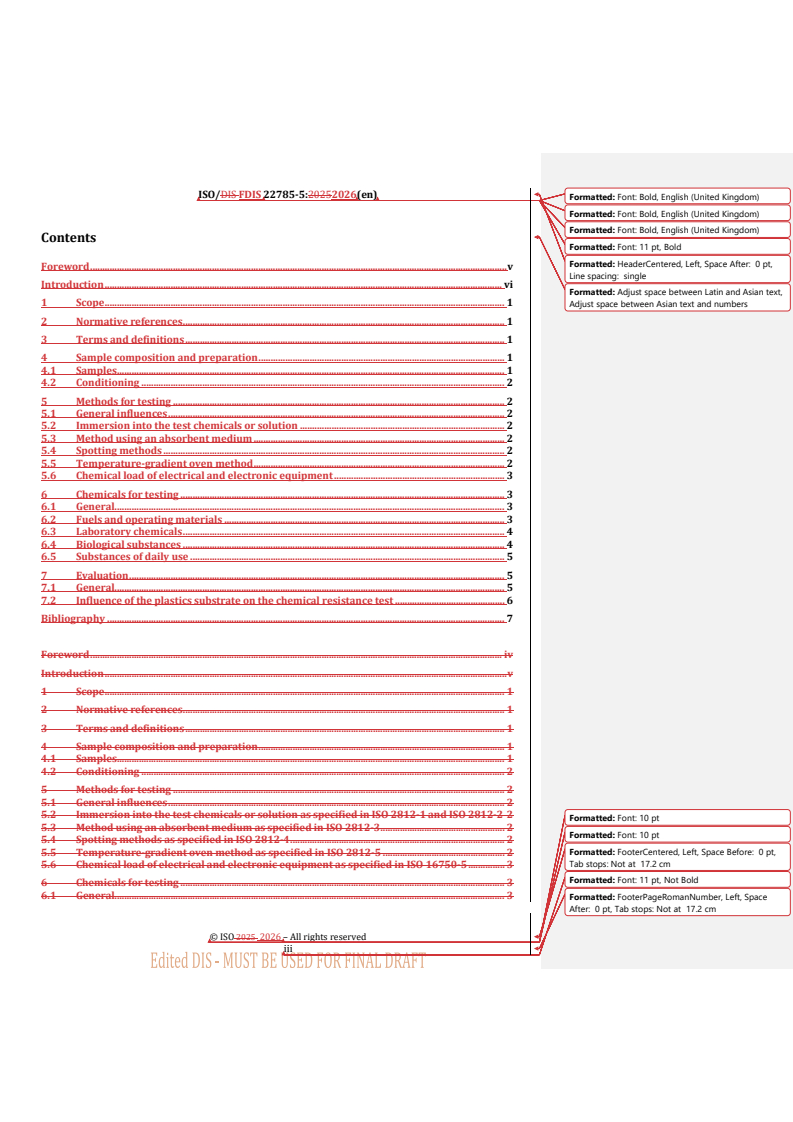
Contents
Formatted: Font: 11 pt, Bold
Formatted: HeaderCentered, Left, Space After: 0 pt,
Foreword . v
Line spacing: single
Introduction . vi
Formatted: Adjust space between Latin and Asian text,
1 Scope . 1
Adjust space between Asian text and numbers
2 Normative references . 1
3 Terms and definitions . 1
4 Sample composition and preparation . 1
4.1 Samples . 1
4.2 Conditioning . 2
5 Methods for testing . 2
5.1 General influences . 2
5.2 Immersion into the test chemicals or solution . 2
5.3 Method using an absorbent medium . 2
5.4 Spotting methods . 2
5.5 Temperature-gradient oven method . 2
5.6 Chemical load of electrical and electronic equipment . 3
6 Chemicals for testing . 3
6.1 General. 3
6.2 Fuels and operating materials . 3
6.3 Laboratory chemicals . 4
6.4 Biological substances . 4
6.5 Substances of daily use . 5
7 Evaluation . 5
7.1 General. 5
7.2 Influence of the plastics substrate on the chemical resistance test . 6
Bibliography . 7
Foreword . iv
Introduction . v
1 Scope . 1
2 Normative references . 1
3 Terms and definitions . 1
4 Sample composition and preparation . 1
4.1 Samples . 1
4.2 Conditioning . 2
5 Methods for testing . 2
5.1 General influences . 2
5.2 Immersion into the test chemicals or solution as specified in ISO 2812-1 and ISO 2812-2 2
Formatted: Font: 10 pt
5.3 Method using an absorbent medium as specified in ISO 2812-3 . 2
Formatted: Font: 10 pt
5.4 Spotting methods as specified in ISO 2812-4 . 2
Formatted: FooterCentered, Left, Space Before: 0 pt,
5.5 Temperature-gradient oven method as specified in ISO 2812-5 . 2
Tab stops: Not at 17.2 cm
5.6 Chemical load of electrical and electronic equipment as specified in ISO 16750-5 . 3
Formatted: Font: 11 pt, Not Bold
6 Chemicals for testing . 3
6.1 General. 3
Formatted: FooterPageRomanNumber, Left, Space
After: 0 pt, Tab stops: Not at 17.2 cm
iii
ISO /FDIS 22785-5:2025(E2026(en) Formatted: Font: 11 pt, Bold
Formatted: Font: 11 pt, Bold
Formatted: Font: 11 pt, Bold
6.2 Fuels and operating materials . 3
Formatted: HeaderCentered, Space After: 0 pt, Line
6.3 Laboratory chemicals . 3
spacing: single
6.4 Biological substances . 4
6.5 Substances of daily use . 4
7 Evaluation . 4
7.1 General. 4
7.2 Influence of the plastics substrate on the chemical resistance test . 5
7.2.1 General. 5
7.2.2 Temperature sensitivity . 5
7.2.3 Volume change due to test substances . 5
Bibliography . 6
Formatted: Font: 10 pt
Formatted: Font: 10 pt
Formatted: Font: 11 pt
Formatted: FooterPageRomanNumber, Space After: 0
pt, Line spacing: single
iv © ISO 2025 2026 – All rights reserved
iv
ISO/DIS FDIS 22785-5:20252026(en)
Formatted: Font: Bold, English (United Kingdom)
Formatted: Font: Bold, English (United Kingdom)
Formatted: Font: Bold, English (United Kingdom)
Foreword
Formatted: Font: 11 pt, Bold
ISO (the International Organization for Standardization) is a worldwide federation of national standards
Formatted: HeaderCentered, Left, Space After: 0 pt,
bodies (ISO member bodies). The work of preparing International Standards is normally carried out through Line spacing: single
ISO technical committees. Each member body interested in a subject for which a technical committee has been
Formatted: Adjust space between Latin and Asian text,
established has the right to be represented on that committee. International organizations, governmental and
Adjust space between Asian text and numbers
non-governmental, in liaison with ISO, also take part in the work. ISO collaborates closely with the
International Electrotechnical Commission (IEC) on all matters of electrotechnical standardization.
The procedures used to develop this document and those intended for its further maintenance are described
in the ISO/IEC Directives, Part 1. In particular, the different approval criteria needed for the different types of
ISO document should be noted. This document was drafted in accordance with the editorial rules of the
ISO/IEC Directives, Part 2 (see www.iso.org/directives).
Formatted: English (United Kingdom)
ISO draws attention to the possibility that the implementation of this document may involve the use of (a)
patent(s). ISO takes no position concerning the evidence, validity or applicability of any claimed patent rights
in respect thereof. As of the date of publication of this document, ISO had not received notice of (a) patent(s)
which may be required to implement this document. However, implementers are cautioned that this may not
represent the latest information, which may be obtained from the patent database available at
www.iso.org/patents.www.iso.org/patents. ISO shall not be held responsible for identifying any or all such
patent rights.
Any trade name used in this document is information given for the convenience of users and does not
constitute an endorsement.
For an explanation of the voluntary nature of standards, the meaning of ISO specific terms and expressions
related to conformity assessment, as well as information about ISO's adherence to the World Trade
Organization (WTO) principles in the Technical Barriers to Trade (TBT), see
www.iso.org/iso/foreword.htmlwww.iso.org/iso/foreword.html.
Formatted: English (United Kingdom)
This document was prepared by Technical Committee ISO/TC 35, Paints and varnishes, Subcommittee SC 9,
Formatted: Adjust space between Latin and Asian text,
General test methods for paints and varnishes. Adjust space between Asian text and numbers
A list of all parts in the ISO 22785 series can be found on the ISO website.
Formatted: Default Paragraph Font
Formatted: Default Paragraph Font
Any feedback or questions on this document should be directed to the user’s national standards body. A
Formatted: Default Paragraph Font
complete listing of these bodies can be found at www.iso.org/members.htmlwww.iso.org/members.html.
Formatted: English (United Kingdom)
Formatted: English (United Kingdom)
Formatted: Adjust space between Latin and Asian text,
Adjust space between Asian text and numbers
Formatted: Font: 10 pt
Formatted: Font: 10 pt
Formatted: FooterCentered, Left, Space Before: 0 pt,
Tab stops: Not at 17.2 cm
Formatted: Font: 11 pt, Not Bold
Formatted: FooterPageRomanNumber, Left, Space
After: 0 pt, Tab stops: Not at 17.2 cm
v
ISO /FDIS 22785-5:2025(E2026(en) Formatted: Font: 11 pt, Bold
Formatted: Font: 11 pt, Bold
Formatted: Font: 11 pt, Bold
Introduction
Formatted: HeaderCentered, Space After: 0 pt, Line
spacing: single
The ISO 22785 series explains the characteristics of plastics and the differences between plastics substrates
and metallic substrates.
Even though chemical resistance testing is usually a surface test, the substrate has an influence on the chemical
Formatted: Adjust space between Latin and Asian text,
resistance of the coating and is also considered during the test.
Adjust space between Asian text and numbers
Formatted: Font: 10 pt
Formatted: Font: 10 pt
Formatted: Font: 11 pt
Formatted: FooterPageRomanNumber, Space After: 0
pt, Line spacing: single
vi © ISO 2025 2026 – All rights reserved
vi
DRAFT International Standard ISO/DIS 22785-5:2025(en)
Formatted: Main Title 2, Space After: 0 pt, Adjust
Paints and varnishes — Coatings on plastics and composites —
space between Latin and Asian text, Adjust space
between Asian text and numbers
Part 5:
Formatted: Right: 1.5 cm, Bottom: 1 cm, Gutter: 0 cm,
Chemical resistance testing Section start: New page, Header distance from edge:
1.27 cm, Footer distance from edge: 0.5 cm
1 Scope Formatted: Adjust space between Latin and Asian text,
Adjust space between Asian text and numbers
This document specifies chemical tests on the resistance testing of coatings ofon plastics, plastics composites
Formatted: Adjust space between Latin and Asian text,
and similar substrates, hereinafter collectively referred to as plastics.
Adjust space between Asian text and numbers
Formatted: Default Paragraph Font
This document shows the potential effect of plastics on the behaviour of the coating during chemical resistance
testing.
Formatted: Default Paragraph Font
Formatted: Default Paragraph Font
2 Normative references
Formatted: Adjust space between Latin and Asian text,
Adjust space between Asian text and numbers, Tab
The following documents are referred to in the text in such a way that some or all of their content constitutes
stops: Not at 0.7 cm + 1.4 cm + 2.1 cm + 2.8 cm +
requirements of this document. For dated references, only the edition cited applies. For undated references,
3.5 cm + 4.2 cm + 4.9 cm + 5.6 cm + 6.3 cm + 7 cm
the latest edition of the referenced document (including any amendments) applies.
Formatted: Default Paragraph Font
ISO 4618, Paints and varnishes — Vocabulary
Formatted: Default Paragraph Font
Formatted: Default Paragraph Font
ISO 22785--1, Coatings on plastics and composites — Part 1: General introduction
Formatted: Default Paragraph Font
3 Terms and definitions
Formatted: Adjust space between Latin and Asian text,
Adjust space between Asian text and numbers
For the purposes of this document, the terms and definitions given in ISO 4618 and ISO 22785-1 apply.
Formatted: Default Paragraph Font
ISO and IEC maintain terminology databases for use in standardization at the following addresses:
Formatted: Default Paragraph Font
Formatted: Default Paragraph Font
— — ISO Online browsing platform: available at https://www.iso.org/obphttps://www.iso.org/obp
Formatted: Default Paragraph Font
— — IEC Electropedia: available at https://www.electropedia.org/https://www.electropedia.org/
Formatted: Default Paragraph Font
Formatted: English (United Kingdom)
4 Sample composition and preparation
Formatted: Font: 11 pt, English (United Kingdom)
4.1 Samples
Formatted: English (United Kingdom)
Formatted: English (United Kingdom)
Coatings on specimen plates specified in ISO 1514 as well as coatings on components are tested. Depending
on the selected test method, there are different requirements for the sample geometry. In particular, for Formatted: Adjust space between Latin and Asian text,
continuous drip methods and exposure through filter papers, flat specimens are a prerequisite. Adjust space between Asian text and numbers
Formatted: Adjust space between Latin and Asian text,
Defects and damage of all kinds in the substrate affect the appearance and characteristics.
Adjust space between Asian text and numbers, Tab
stops: Not at 0.71 cm
The coating system and the substrate are selected together with the pre-treatment and coating methods so
Formatted: Default Paragraph Font
that a homogeneous coating is achieved. The coating thickness is documented according to the optical or
coating requirement. Formatted: Default Paragraph Font
Formatted: Adjust space between Latin and Asian text,
For immersion methods, edges and back-sides of the samples are sufficiently protected.
Adjust space between Asian text and numbers
Formatted
...
ISO /FDIS 22785-5:2025(E2026(en) Formatted: Font: 11 pt, Bold
Formatted: Font: 11 pt, Bold
Formatted: Font: 11 pt, Bold
Depending on the colour or transparency of the samples, visual evaluation can be difficult. For release tests, a
Formatted: HeaderCentered, Space After: 0 pt, Line
high contrast of the colouring layer is selected.
spacing: single
4.2 Conditioning
Formatted: Adjust space between Latin and Asian text,
Adjust space between Asian text and numbers, Tab
Conditioning serves to increase the repeatability and reproducibility of test results.
stops: Not at 0.71 cm
Formatted: Adjust space between Latin and Asian text,
Since the characteristics of plastics substrates stro
...