

ISO 22567
(Main)General requirements for establishing muscular strength databases
General Information
- Abstract
This document specifies general requirements for establishing muscular strength databases and their associated reports, which contain measurements taken in accordance with ISO 25033-1.1)
- Status
- Not Published
- Technical Committee
- ISO/TC 159/SC 3 - Anthropometry and biomechanics
- Drafting Committee
- ISO/TC 159/SC 3 - Anthropometry and biomechanics
- Current Stage
- 6000 - International Standard under publication
- Start Date
- 19-Aug-2026
- Completion Date
- 03-Oct-2026
Buy Documents
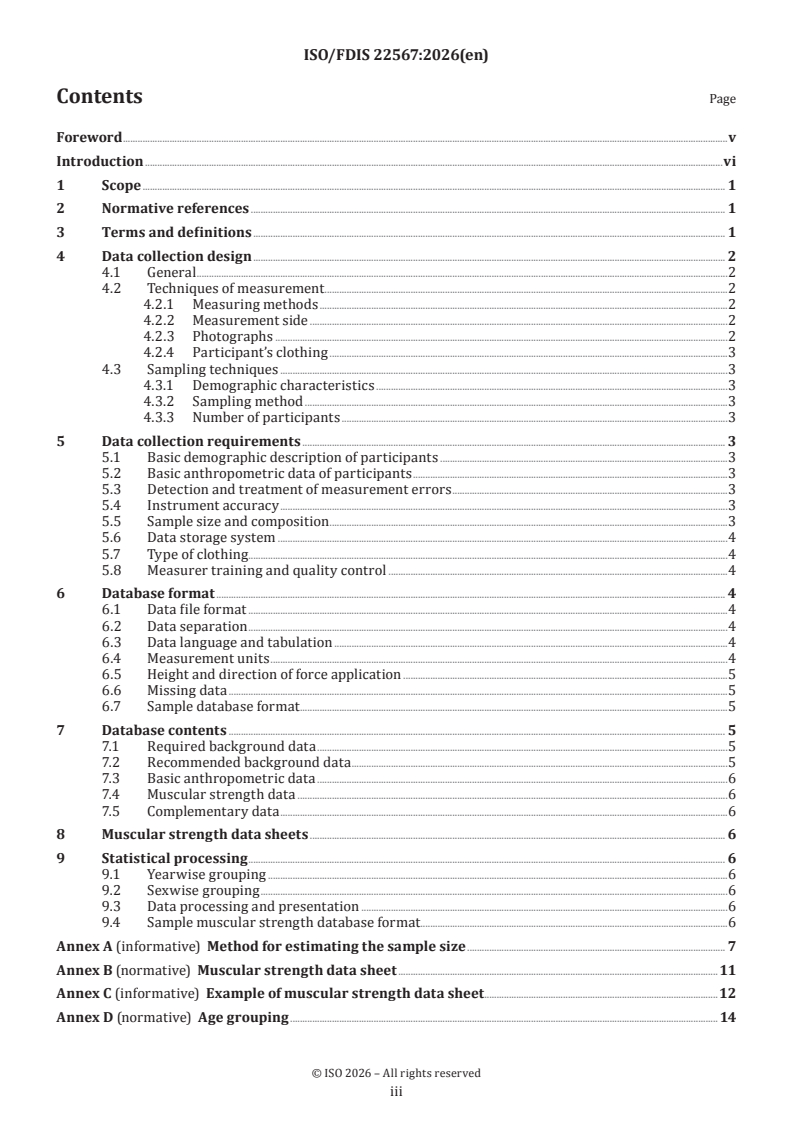
ISO/FDIS 22567 - General requirements for establishing muscular strength databases

REDLINE ISO/FDIS 22567 - General requirements for establishing muscular strength databases
Overview
ISO 22567: General requirements for establishing muscular strength databases is an international standard developed by ISO Technical Committee 159, Subcommittee 3 (Anthropometry and biomechanics) to support researchers and national standard bodies in creating reliable, internationally compatible muscular strength databases. These databases are intended to provide robust, comparable data sets on human muscular strength for use in various applications such as technological design, ergonomics, and health-related studies.
This standard outlines the essential requirements for designing data collection methods, sampling, database structures, and statistical processing necessary to establish high-quality, standardized muscular strength databases. By following ISO 22567, organizations can ensure their data is consistent, accurate, and suitable for global comparison and analysis.
Key Topics
ISO 22567 covers several core aspects required for developing muscular strength databases:
Data Collection Design
- Selection of measurement techniques in line with ISO 25033-1
- Documentation of measurement side (left/right) and procedures
- Clear indication of participants’ clothing and its coding
Sampling Techniques
- Preference for random or stratified random sampling
- Recording demographic characteristics and making clear distinctions between population subgroups
- Determination of adequate sample size using statistically supported formulas
Data Collection Requirements
- Recording basic demographic (age, sex, occupation, etc.) and anthropometric data (height, body mass, shoulder height)
- Ensuring accuracy of instruments and proper measurer training
- Data storage in secure digital formats with appropriate privacy safeguards
Database Format and Contents
- Usage of standardized file formats (e.g., ASCII per ISO/IEC 8859-1)
- Tab-separated data entries in English with clear naming conventions
- Standardized units (mm, kg, N, Nm)
- Coding for missing data and type of clothing
- Required and recommended background fields, with flexibility to include supplementary parameters
Statistical Processing and Presentation
- Year-wise and sex-wise grouping for data analysis
- Rigorous error checking and documentation of data anomalies
- Guidance for data tabulation and reporting
Applications
The principles and requirements set by ISO 22567 are applicable across a wide range of fields that rely on robust muscular strength data, such as:
- Ergonomics and Occupational Health
- Supporting the development of workplace and product designs that accommodate varying human strength levels
- Assisting in setting safe force limits and standards for manual tasks
- Biomechanical and Anthropometric Research
- Enabling comparative studies across populations and countries by harmonizing data collection and reporting standards
- Providing reference data for clinical, sports, or rehabilitation contexts
- National Standardization
- Facilitating the creation of national muscular strength databases aligned with international requirements
- Contributing to safety and accessibility requirements in policy and regulatory frameworks
Related Standards
For comprehensive, internationally compatible muscular strength data collection and database design, it is important to consider the following related standards:
- ISO 25033-1: Basic muscular strength measurements for technological design - definitions, instrumentation, measurement protocols
- ISO 7250-1: Basic human body measurements for technological design - body measurement definitions and landmarks
- ISO/IEC 8859-1: Information technology - 8-bit single-byte coded graphic character sets (Latin alphabet No. 1)
- ISO 3166-1: Codes for the representation of names of countries (used for data location coding)
- ISO 8601-1: Date and time format (for recording date of measurement and birthdate)
By adhering to ISO 22567 and its supporting standards, organizations and researchers can ensure data integrity, interoperability, and global relevance in the field of muscular strength measurement and analysis.
Buy Documents
ISO/FDIS 22567 - General requirements for establishing muscular strength databases
REDLINE ISO/FDIS 22567 - General requirements for establishing muscular strength databases
Get Certified
Connect with accredited certification bodies for this standard

BSI Group
BSI (British Standards Institution) is the business standards company that helps organizations make excellence a habit.

Bureau Veritas
Bureau Veritas is a world leader in laboratory testing, inspection and certification services.

DNV
DNV is an independent assurance and risk management provider.
Sponsored listings
Frequently Asked Questions
ISO 22567 is a draft published by the International Organization for Standardization (ISO). Its full title is "General requirements for establishing muscular strength databases". This standard covers: This document specifies general requirements for establishing muscular strength databases and their associated reports, which contain measurements taken in accordance with ISO 25033-1.1)
This document specifies general requirements for establishing muscular strength databases and their associated reports, which contain measurements taken in accordance with ISO 25033-1.1)
ISO 22567 is classified under the following ICS (International Classification for Standards) categories: 03.120.30 - Application of statistical methods; 13.180 - Ergonomics. The ICS classification helps identify the subject area and facilitates finding related standards.
ISO 22567 is available in PDF format for immediate download after purchase. The document can be added to your cart and obtained through the secure checkout process. Digital delivery ensures instant access to the complete standard document.
Standards Content (Sample)
FINAL DRAFT
International
Standard
ISO/FDIS 22567
ISO/TC 159/SC 3
General requirements for
Secretariat: JISC
establishing muscular strength
Voting begins on:
databases
2026-06-23
Voting terminates on:
2026-08-18
RECIPIENTS OF THIS DRAFT ARE INVITED TO SUBMIT,
WITH THEIR COMMENTS, NOTIFICATION OF ANY
RELEVANT PATENT RIGHTS OF WHICH THEY ARE AWARE
AND TO PROVIDE SUPPOR TING DOCUMENTATION.
IN ADDITION TO THEIR EVALUATION AS
BEING ACCEPTABLE FOR INDUSTRIAL, TECHNO
LOGICAL, COMMERCIAL AND USER PURPOSES, DRAFT
INTERNATIONAL STANDARDS MAY ON OCCASION HAVE
TO BE CONSIDERED IN THE LIGHT OF THEIR POTENTIAL
TO BECOME STAN DARDS TO WHICH REFERENCE MAY BE
MADE IN NATIONAL REGULATIONS.
Reference number
ISO/FDIS 22567:2026(en) © ISO 2026
FINAL DRAFT
ISO/FDIS 22567:2026(en)
International
Standard
ISO/FDIS 22567
ISO/TC 159/SC 3
General requirements for
Secretariat: JISC
establishing muscular strength
Voting begins on:
databases
Voting terminates on:
RECIPIENTS OF THIS DRAFT ARE INVITED TO SUBMIT,
WITH THEIR COMMENTS, NOTIFICATION OF ANY
RELEVANT PATENT RIGHTS OF WHICH THEY ARE AWARE
AND TO PROVIDE SUPPOR TING DOCUMENTATION.
© ISO 2026
IN ADDITION TO THEIR EVALUATION AS
All rights reserved. Unless otherwise specified, or required in the context of its implementation, no part of this publication may
BEING ACCEPTABLE FOR INDUSTRIAL, TECHNO
LOGICAL, COMMERCIAL AND USER PURPOSES, DRAFT
be reproduced or utilized otherwise in any form or by any means, electronic or mechanical, including photocopying, or posting on
INTERNATIONAL STANDARDS MAY ON OCCASION HAVE
the internet or an intranet, without prior written permission. Permission can be requested from either ISO at the address below
TO BE CONSIDERED IN THE LIGHT OF THEIR POTENTIAL
or ISO’s member body in the country of the requester.
TO BECOME STAN DARDS TO WHICH REFERENCE MAY BE
MADE IN NATIONAL REGULATIONS.
ISO copyright office
CP 401 • Ch. de Blandonnet 8
CH-1214 Vernier, Geneva
Phone: +41 22 749 01 11
Email: copyright@iso.org
Website: www.iso.org
Published in Switzerland Reference number
ISO/FDIS 22567:2026(en) © ISO 2026
ii
ISO/FDIS 22567:2026(en)
Contents Page
Foreword .v
Introduction .vi
1 Scope . 1
2 Normative references . 1
3 Terms and definitions . 1
4 Data collection design . 2
4.1 General .2
4.2 Techniques of measurement .2
4.2.1 Measuring methods .2
4.2.2 Measurement side .2
4.2.3 Photographs .2
4.2.4 Participant’s clothing .3
4.3 Sampling techniques .3
4.3.1 Demographic characteristics .3
4.3.2 Sampling method .3
4.3.3 Number of participants .3
5 Data collection requirements . 3
5.1 Basic demographic description of participants .3
5.2 Basic anthropometric data of participants .3
5.3 Detection and treatment of measurement errors .3
5.4 Instrument accuracy .3
5.5 Sample size and composition .3
5.6 Data storage system .4
5.7 Type of clothing.4
5.8 Measurer training and quality control .4
6 Database format . 4
6.1 Data file format .4
6.2 Data separation .4
6.3 Data language and tabulation .4
6.4 Measurement units .4
6.5 Height and direction of force application .5
6.6 Missing data .5
6.7 Sample database format .5
7 Database contents . 5
7.1 Required background data .5
7.2 Recommended background data .5
7.3 Basic anthropometric data .6
7.4 Muscular strength data .6
7.5 Complementary data .6
8 Muscular strength data sheets . 6
9 Statistical processing . 6
9.1 Yearwise grouping .6
9.2 Sexwise grouping .6
9.3 Data processing and presentation .6
9.4 Sample muscular strength database format .6
Annex A (informative) Method for estimating the sample size . 7
Annex B (normative) Muscular strength data sheet .11
Annex C (informative) Example of muscular strength data sheet .12
Annex D (normative) Age grouping . 14
iii
ISO/FDIS 22567:2026(en)
Annex E (normative) Procedure for preparing data and statistics .15
Annex F (informative) Muscular strength sample database format . 17
Bibliography .18
iv
ISO/FDIS 22567:2026(en)
Foreword
ISO (the International Organization for Standardization) is a worldwide federation of national standards
bodies (ISO member bodies). The work of preparing International Standards is normally carried out through
ISO technical committees. Each member body interested in a subject for which a technical committee
has been established has the right to be represented on that committee. International organizations,
governmental and non-governmental, in liaison with ISO, also take part in the work. ISO collaborates closely
with the International Electrotechnical Commission (IEC) on all matters of electrotechnical standardization.
The procedures used to develop this document and those intended for its further maintenance are described
in the ISO/IEC Directives, Part 1. In particular, the different approval criteria needed for the different types
of ISO document should be noted. This document was drafted in accordance with the editorial rules of the
ISO/IEC Directives, Part 2 (see www.iso.org/directives).
ISO draws attention to the possibility that the implementation of this document may involve the use of (a)
patent(s). ISO takes no position concerning the evidence, validity or applicability of any claimed patent
rights in respect thereof. As of the date of publication of this document, ISO had not received notice of (a)
patent(s) which may be required to implement this document. However, implementers are cautioned that
this may not represent the latest information, which may be obtained from the patent database available at
www.iso.org/patents. ISO shall not be held responsible for identifying any or all such patent rights.
Any trade name used in this document is information given for the convenience of users and does not
constitute an endorsement.
For an explanation of the voluntary nature of standards, the meaning of ISO specific terms and expressions
related to conformity assessment, as well as information about ISO's adherence to the World Trade
Organization (WTO) principles in the Technical Barriers to Trade (TBT), see www.iso.org/iso/foreword.html.
This document was prepared by Technical Committee ISO/TC 159, Ergonomics, Subcommittee SC 3,
Anthropometry and biomechanics.
Any feedback or questions on this document should be directed to the user’s national standards body. A
complete listing of these bodies can be found at www.iso.org/members.html.
v
ISO/FDIS 22567:2026(en)
Introduction
Human muscular strength, also referred to as muscular strength, is the force which the muscles can develop
during their contraction. Muscular strength refers to the amount of force a human can produce via muscle
or muscle group activation with a single maximal effort, depending on posture and direction of force
transferred to the environment. Muscular strength measurement is of two types namely, static (isometric)
and dynamic (e.g. isotonic). Isometric strength refers to the muscular force generated during an isometric
contraction, where the muscles produce tension without changing their length and, without movement of
the joint. Static muscular force is usually larger than dynamic force. The dynamic force, depending on the
velocity of the shortening muscles, amounts to about 50 % to 90 % of the maximal static force. Generally, it
is a common practice to measure the static strength to compare different populations or to set the limits for
force application. Muscular strength depends not only on the muscle mass, but also on health and training,
technique and experience, and motivation. The personal and task factors that influence muscular strength
are age, gender, posture, body mass, reach distance, arm and wrist orientations, speed of exertion, and
duration and frequency of efforts. This strength is maximum at a young age, and it goes on decreasing with
age.
Muscular strength databases of different populations help in formulating design criteria and safe limits.
However, direct inference of muscular strength to safe levels should be restricted since knowledge on their
association is often limited. One of the major difficulties in generating international databases on muscular
strength parameters of various populations is that the available studies cannot be comparable with each
other. Because, either the definitions of parameters differ, or the methods used for measurement can also
be different. Muscular strength is a vector quantity, and therefore, in its measurement, magnitude as well as
direction of application of force are important parameters.
This document will help different researchers and national standard bodies in generating internationally
compatible muscular strength databases. It provides necessary information, such as characteristics of the
user population, sampling methods, measurement items and statistics, to make international comparison
possible among various population segments.
vi
FINAL DRAFT International Standard ISO/FDIS 22567:2026(en)
General requirements for establishing muscular strength
databases
1 Scope
This document specifies general requirements for establishing muscular strength databases and their
1)
associated reports, which contain measurements taken in accordance with ISO 25033-1.
2 Normative references
The following documents are referred to in the text in such a way that some or all of their content constitutes
requirements of this document. For dated references, only the edition cited applies. For undated references,
the latest edition of the referenced document (including any amendments) applies.
ISO 7250-1, Basic human body measurements for technological design — Part 1: Body measurement definitions
and landmarks
ISO/IEC 8859-1, Information technology — 8-bit single-byte coded graphic character sets — Part 1: Latin
alphabet No. 1
ISO 25033-1, Basic muscular strength measurements for technological design — Part 1 Muscular strength
measurements definitions, instrumentation, and protocol
3 Terms and definitions
For the purposes of this document, the following terms and definitions apply.
ISO and IEC maintain terminology databases for use in standardization at the following addresses:
— ISO Online browsing platform: available at https:// www .iso .org/ obp
— IEC Electropedia: available at https:// www .electropedia .org/
3.1
population segment
group of people having one or more common background characteristics that influence their anthropometric
distributions
3.2
user population
population segment (3.1) or segments for whom a technological design is intended
3.3
random sample
sample established by following a set of procedures to ensure that each and every individual in the
population has an equal chance of being selected
3.4
stratified sample
sample established by a procedure in which the population is divided into sub-populations (strata), each one
of which contributes with a specified number of randomly selected individuals
1) ISO 25033-1 is in accordance with ISO 7250-1 and includes strength parameter definitions, measurement setups,
protocol for data collection and other details.
ISO/FDIS 22567:2026(en)
3.5
demographic data
background information (such as sex, dwelling or working place, occupation, education) used to describe
members of the user population (3.2) and/or population segments (3.1)
3.6
muscular strength
maximal force or torque which an individual can voluntarily exert on an external test object under given
conditions
Note 1 to entry: For the purpose of this document, muscular strength refers to static (isometric) muscular strength.
3.7
muscular strength data
muscular strength measurement values of parameters (such as pull force, push force. hand grip force etc.)
exerted by a person
3.8
muscular strength database
collection of individual muscular strength parameter data and background information (demographic data)
recorded on a group of people (the sample)
3.9
muscular strength report
technical report describing the origin, contents, methods, and statistical characteristics of the muscular
strength database (3.8)
3.10
relative accuracy
ratio of accuracy of measurement to the population mean of the parameter in question
4 Data collection design
4.1 General
The following methods shall be used in assembling internationally compatible muscular strength databases.
4.2 Techniques of measurement
4.2.1 Measuring methods
The measuring methods given in ISO 25033-1 shall be used. Any deviation from this shall be indicated in the
muscular strength report. Items other than those specified by ISO 25033-1 shall be measured according to
the purpose of the investigation. In such cases, definitions, methods, instruments and measurement units
shall be clearly indicated in the report.
4.2.2 Measurement side
When a measurement is taken on both the left and right sides of the human body, the report shall clearly
indicate on which side the measurement has been taken.
4.2.3 Photographs
Photographs or detailed sketches of the measurements taken should be provided and the measurement
procedures should be documented. Photographs should be such that it shall not be possible to identify the
individuals in the photographs.
ISO/FDIS 22567:2026(en)
4.2.4 Participant’s clothing
The participant shall be wearing normal clothing and shoes. If the measurement is taken without shoes,
the same shall be mentioned. The type of clothing, if relevant, shall be coded on the muscular strength data
sheet.
4.3 Sampling techniques
4.3.1 Demographic characteristics
The demographic characteristics of the population shall be indicated as clearly as possible in the report. In
the event that the population is divided into several subgroups, e.g. survey location and dwelling location for
either sampling or statistical reporting, this shall be stated in the report.
4.3.2 Sampling method
It is desirable that random or stratified sampling methods be used. However, if this is impossible, the report
shall indicate the sampling method used.
4.3.3 Number of participants
It is desirable that the number of participants needed for a database be established using a statistical
formula based on the accuracy of results desired by the investigator (see Annex A).
5 Data collection requirements
5.1 Basic demographic description of participants
Biographic data shall be collected (e.g., by using a questionnaire) to provide information about sex, date of
birth, date of survey, and survey location. Other demographic information may be included depending upon
the purpose of the study.
5.2 Basic anthropometric data of participants
For all the participants whose muscular strength data is to be collected, three anthropometric parameters,
namely, stature (body height), body mass (weight), and shoulder (acromion) height, shall be measured. For
this purpose, instructions given in ISO 7250-1 shall be followed.
5.3 Detection and treatment of measurement errors
The editing of obvious anomalies during data collection s
...
ISO/FDIS 22567:2025(en)
ISO /TC 159/SC 3/WG 4
Date: 2025-12-08
Secretariat: JISC
Date: 2026-06-08
General requirements for establishing muscular strength databases
FDIS stage
All rights reserved. Unless otherwise specified, or required in the context of its implementation, no part of this publication
may be reproduced or utilized otherwise in any form or by any means, electronic or mechanical, including photocopying,
or posting on the internet or an intranet, without prior written permission. Permission can be requested from either ISO
at the address below or ISO’s member body in the country of the requester.
ISO copyright office
CP 401 • Ch. de Blandonnet 8
CH-1214 Vernier, Geneva
Phone: + 41 22 749 01 11
EmailE-mail: copyright@iso.org
Website: www.iso.org
Published in Switzerland
ISO NP/FDIS 22567 CD (2024:2026(en)
Contents
Foreword . iv
Introduction . v
1 Scope . 5
2 Normative references . 5
3 Terms and definitions . 6
4 Data collection design . 7
4.1 General . 7
4.2 Techniques of measurement . 7
4.3 Sampling techniques . 7
5 Data collection requirements . 8
5.1 Basic demographic description of participants . 8
5.2 Basic anthropometric data of participants . 8
5.3 Detection and treatment of measurement errors . 8
5.4 Instrument accuracy . 8
5.5 Sample size and composition . 8
5.6 Data storage system . 8
5.7 Type of clothing . 9
5.8 Measurer training and quality control . 9
6 Database format . 9
6.1 Data file format . 9
6.2 Data separation . 9
6.3 Data language and tabulation . 9
6.4 Measurement units . 9
6.5 Height and direction of force application . 9
6.6 Missing data . 9
6.7 Sample database format . 9
7 Database contents . 9
7.1 Required background data . 9
7.2 Recommended background data . 10
7.3 Basic anthropometric data . 10
7.4 Muscular strength data . 10
7.5 Complementary data . 10
8 Muscular strength data sheets . 10
9 Statistical processing . 11
9.1 Yearwise grouping . 11
9.2 Sexwise grouping . 11
9.3 Data processing and presentation . 11
9.4 Sample muscular strength database format . 11
Annex A (informative) Method for estimating the sample size . 12
Annex B (normative) Muscular strength data sheet . 16
Annex C (informative) Example of muscular strength data sheet . 17
Annex D (normative) Age grouping . 19
Annex E (normative) Procedure for preparing data and statistics . 20
Annex F (informative) Muscular strength sample database format . 22
© ISO #### 2026 – All rights reserved
ii
ISO/FDIS 22567:2025 2026(en)
Bibliography . 23
iii
ISO NP/FDIS 22567 CD (2024:2026(en)
Foreword
ISO (the International Organization for Standardization) is a worldwide federation of national standards
bodies (ISO member bodies). The work of preparing International Standards is normally carried out through
ISO technical committees. Each member body interested in a subject for which a technical committee has been
established has the right to be represented on that committee. International organizations, governmental and
non-governmental, in liaison with ISO, also take part in the work. ISO collaborates closely with the
International Electrotechnical Commission (IEC) on all matters of electrotechnical standardization.
The procedures used to develop this document and those intended for its further maintenance are described
in the ISO/IEC Directives, Part 1. In particular, the different approval criteria needed for the different types of
ISO document should be noted. This document was drafted in accordance with the editorial rules of the
ISO/IEC Directives, Part 2 (see www.iso.org/directives).
ISO draws attention to the possibility that the implementation of this document may involve the use of (a)
patent(s). ISO takes no position concerning the evidence, validity or applicability of any claimed patent rights
in respect thereof. As of the date of publication of this document, ISO had not received notice of (a) patent(s)
which may be required to implement this document. However, implementers are cautioned that this may not
represent the latest information, which may be obtained from the patent database available at
www.iso.org/patents. ISO shall not be held responsible for identifying any or all such patent rights.
Any trade name used in this document is information given for the convenience of users and does not
constitute an endorsement.
For an explanation of the voluntary nature of standards, the meaning of ISO specific terms and expressions
related to conformity assessment, as well as information about ISO's adherence to the World Trade
Organization (WTO) principles in the Technical Barriers to Trade (TBT), see www.iso.org/iso/foreword.html.
This document was prepared by Technical Committee ISO/TC159TC 159, Ergonomics, Subcommittee SC 3,
Anthropometry and biomechanics.
Any feedback or questions on this document should be directed to the user’s national standards body. A
complete listing of these bodies can be found at www.iso.org/members.html.
© ISO #### 2026 – All rights reserved
iv
ISO/FDIS 22567:2025 2026(en)
Introduction
Human muscular strength, also referred to as muscular strength, is the force which the muscles can develop
during their contraction. Muscular strength refers to the amount of force a human can produce via muscle or
muscle group activation with a single maximal effort, depending on posture and direction of force transferred
to the environment. Muscular strength measurement is of two types namely, static (isometric) and dynamic
(e.g. isotonic). Isometric strength refers to the muscular force generated during an isometric contraction,
where the muscles produce tension without changing their length and, without movement of the joint. Static
muscular force is usually larger than dynamic force. The dynamic force, depending on the velocity of the
shortening muscles, amounts to about 50 % to 90 % of the maximal static force. Generally, it is a common
practice to measure the static strength to compare different populations or to set the limits for force
application. Muscular strength depends not only on the muscle mass, but also on health and training,
technique and experience, and motivation. The personal and task factors that influence muscular strength are
age, gender, posture, body mass, reach distance, arm and wrist orientations, speed of exertion, and duration
and frequency of efforts. This strength is maximum at a young age, and it goes on decreasing with age.
Muscular strength databases of different populations help in formulating design criteria and safe limits.
However, direct inference of muscular strength to safe levels should be restricted since knowledge on their
association is often limited. One of the major difficulties in generating international databases on muscular
strength parameters of various populations is that the available studies cannot be comparable with each
other. Because, either the definitions of parameters differ, or the methods used for measurement can also be
different. Muscular strength is a vector quantity, and therefore, in its measurement, magnitude as well as
direction of application of force are important parameters.
This document will help different researchers and national standard bodies in generating internationally
compatible muscular strength databases. It provides necessary information, such as characteristics of the user
population, sampling methods, measurement items and statistics, to make international comparison possible
among various population segments.
General requirements for establishing muscular strength databases
1 Scope
This document specifies general requirements for establishing muscular strength databases and their
1 1)
associated reports, which contain measurements taken in accordance with ISO 25033-1 .
2 Normative references
The following documents are referred to in the text in such a way that some or all of their content constitutes
requirements of this document. For dated references, only the edition cited applies. For undated references,
the latest edition of the referenced document (including any amendments) applies.
ISO 7250--1, Basic human body measurements for technological design — Part 1: Body measurement definitions
and landmarks
ISO/IEC 8859--1, Information technology — 8-bit single-byte coded graphic character sets — Part 1: Latin
alphabet No. 1
ISO 25033-1 document has been prepared on the lines of ISO 7250-1 and includes strength parameter definitions,
measurement setups, protocol for data collection and other details.
1)
ISO 25033-1 is in accordance with ISO 7250-1 and includes strength parameter definitions, measurement setups,
protocol for data collection and other details.
v
ISO NP/FDIS 22567 CD (2024:2026(en)
ISO 25033--1, Basic muscular strength measurements for technological design — Part 1 Muscular strength
measurements definitions, instrumentation, and protocol
3 Terms and definitions
For the purposes of this document, the following terms and definitions apply.
ISO and IEC maintain terminology databases for use in standardization at the following addresses:
— — ISO Online browsing platform: available at https://www.iso.org/obp
— — IEC Electropedia: available at https://www.electropedia.org/
3.1 3.1
population segment
group of people having one or more common background characteristics that influence their anthropometric
distributions
3.2 3.2
user population
population segment (3.1(3.1)) or segments for whom a technological design is intended
3.3 3.3
random sample
sample established by following a set of procedures to ensure that each and every individual in the population
has an equal chance of being selected
3.4 3.4
stratified sample
sample established by a procedure in which the population is divided into sub-populations (strata), each one
of which contributes with a specified number of randomly selected individuals
3.5 3.5
demographic data
background information (such as sex, dwelling or working place, occupation, education) used to describe
members of the user population (3.2(3.2)) and/or population segments (3.1(3.1))
3.6 3.6
muscular strength
the maximal force or torque which an individual can voluntarily exert on an external test object under given
conditions. For the purpose of this document, muscular strength refers to static (isometric) muscular strength
3.7Note 1 to entry: For the purpose of this document, muscular strength refers to static (isometric) muscular strength.
3.7
muscular strength data
muscular strength measurement values of parameters (such as pull force, push force. hand grip force etc.)
exerted by a person
3.8 3.8
muscular strength database
collection of individual muscular strength parameter data and background information (demographic data)
recorded on a group of people (the sample)
© ISO #### 2026 – All rights reserved
ISO/FDIS 22567:2025 2026(en)
3.9 3.9
muscular strength report
technical report describing the origin, contents, methods, and statistical characteristics of the muscular
strength database (3.8)
3.10 3.10
relative accuracy
ratio of accuracy of measurement to the population mean of the parameter in question
4 Data collection design
4.1 General
The following methods shall be used in assembling internationally compatible muscular strength databases.
4.2 Techniques of measurement
4.2.1 Measuring methods
The measuring methods given in ISO 25033-1 shall be used. Any deviation from this shall be indicated in the
muscular strength report. Items other than those specified by ISO 25033-1 shall be measured according to
the purpose of the investigation. In such cases, definitions, methods, instruments and measurement units shall
be clearly indicated in the report.
4.2.2 Measurement side
When a measurement is taken on both the left and right sides of the human body, the report shall clearly
indicate on which side the measurement has been taken.
4.2.3 Photographs
Photographs or detailed sketches of the measurements taken should be provided and the measurement
procedures should be documented. Photographs should be such that it shall not be possible to identify the
individuals in the photographs.
4.2.4 Participant’s clothing
The participant shall be wearing normal clothing and shoes. If the measurement is taken without shoes, the
same shall be mentioned. The type of clothing, if relevant, shall be coded on the muscular strength data sheet.
4.3 Sampling techniques
4.3.1 Demographic characteristics
The demographic characteristics of the population shall be indicated as clearly as possible in the report. In the
event that the population is divided into several subgroups, e.g. survey location and dwelling location for
either sampling or statistical reporting, this shall be stated in the report.
4.3.2 Sampling method
It is desirable that random or stratified random sampling methods be used. However, if this is impossible, the
report shall indicate the sampling method used.
ISO NP/FDIS 22567 CD (2024:2026(en)
4.3.3 Number of participants
It is desirable that the number of participants needed for a database be established using a statistical formula
based on the accuracy of results desired by the investigator (see Annex AAnnex A).).
5 Data collection requirements
5.1 Basic demographic description of participants
Biographic data shall be collected (e.g., by using a questionnaire) to provide information about sex, date of
birth, date of survey, and survey location. Other demographic information may be included depending upon
the purpose of the study.
5.2 Basic anthropometric data of participants
For all the participants whose muscular strength data is to be collected, three anthropometric parameters,
namely, stature (body height), body mass (weight), and shoulder (acromion) height, shall be measured. For
this purpose, instructions given in ISO 7250-1 shall be followed.
5.3 Detection and treatment of measurement errors
The editing of obvious anomalies during data collection should be carried out using, for example, computer
software specifically written for the purpose of detecting figures that lie outside any reasonable range of data
given for that parameter (see Annex EAnnex E).).
5.4 Instrument accuracy
Muscular strength measuring instruments shall measure to the nearest Newton. Instruments for measuring
body mass shall weigh to the nearest 500 g.
5.5 Sample size and composition
The sample size shall be sufficient to estimate the value of the given measurement in a specified group. A
method for calculating sample size is presented in Annex AAnnex A.
Where appropriate for a particular study, the following may also be taken into account for sample size
determination:
— — geographical location;
— — socio-economic status;
— — educational level;
— — occupation;
— — other demographic variables that influence anthropometric and strength distributions.
While planning the data collection, the age and sex of the participants shall always be taken into account.
5.6 Data storage system
All biographical and participant data shall be recorded on digital media compatible with widespread digital
systems, whenever possible. Appropriate safeguards for data security shall be considered.
© ISO #### 2026 – All rights reserved
ISO/FDIS 22567:2025 2026(en)
5.7 Type of clothing
The type of clothing shall be coded and identified for analysis purposes. [e.g. normal clothing=: 1, special
clothing (such as winter clothing like sweatshirts, jackets) =): 2, other clothing (such as using PPEs) =): 3].
5.8 Measurer training and quality control
Frequent and regular measurer training and quality control shall be carried out by persons experienced in
anthropometry and muscular strength measurement, in order to ensure the desired accuracy. To find out
inter- and intra-measurer mean absolute difference, three readings for each anthropometric parameter and
muscular strength variable given in ISO 25033-1 shall be taken recorded.
6 Database format
6.1 Data file format
The ASCII code, according to ISO/IEC 8859-1, shall be used. For analytical purposes, it may also be convenient
to utilize other data storage formats in addition to ASCII.
6.2 Data separation
Each data item shall be separated by a tab.
6.3 Data language and tabulation
The data shall be entered in English. The name of each data item shall be shown in the first row of the database
using the designated English words. Item code numbers and acronyms should not be used in row 1 instead of
English names, as they can cause confusion. The second and subsequent rows of the database shall contain
actual data from participants with each data item in the same order as its name is listed in row 1.
6.4 Measurement units
All the body measurements shall be recorded in millimetres (mm) or kilograms (kg)
...