


ISO/TS 20658:2017
(Main)Medical laboratories — Requirements for collection, transport, receipt, and handling of samples
Medical laboratories — Requirements for collection, transport, receipt, and handling of samples
ISO/TS 20658:2017 specifies requirements and good practice recommendations for the collection, transport, receipt and handling of samples intended for medical laboratory examinations. ISO/TS 20658:2017 is applicable to medical laboratories and other medical services involved in laboratory pre-examination processes that include the examination request, patient preparation and identification, sample collection, transport, receipt and storage. It may also be applicable to some biobanks. ISO/TS 20658:2017 does not apply to blood and blood products intended for transfusion.
Laboratoires de biologie médicale — Exigences pour le prélèvement, le transport, la réception et la manipulation des échantillons
Medicinski laboratoriji - Zahteve za odvzem, transport, prejem in ravnanje z vzorci
Ta dokument določa zahteve in priporočila glede dobrih praks za zbiranje, transport, prejemanje vzorcev, predvidenih za medicinske laboratorijske preiskave, in ravnanje z njimi.
Ta dokument se uporablja za medicinske laboratorije in druge zdravstvene storitve, vključene v laboratorijske predpreiskovalne procese, ki vključujejo zahteve za preiskavo, pripravo in identifikacijo bolnika, jemanje vzorcev, transport, prejem in shranjevanje vzorcev. Lahko se uporablja tudi za nekatere biobanke.
Ta dokument se ne nanaša na kri in krvne proizvode, predvidene za transfuzijo.
General Information
- Status
- Withdrawn
- Publication Date
- 01-Nov-2017
- Current Stage
- 9599 - Withdrawal of International Standard
- Start Date
- 19-May-2023
- Completion Date
- 12-Feb-2026
Relations
- Effective Date
- 23-Apr-2020



Get Certified
Connect with accredited certification bodies for this standard

BSI Group
BSI (British Standards Institution) is the business standards company that helps organizations make excellence a habit.

TÜV Rheinland
TÜV Rheinland is a leading international provider of technical services.

TÜV SÜD
TÜV SÜD is a trusted partner of choice for safety, security and sustainability solutions.
Sponsored listings
Frequently Asked Questions
ISO/TS 20658:2017 is a technical specification published by the International Organization for Standardization (ISO). Its full title is "Medical laboratories — Requirements for collection, transport, receipt, and handling of samples". This standard covers: ISO/TS 20658:2017 specifies requirements and good practice recommendations for the collection, transport, receipt and handling of samples intended for medical laboratory examinations. ISO/TS 20658:2017 is applicable to medical laboratories and other medical services involved in laboratory pre-examination processes that include the examination request, patient preparation and identification, sample collection, transport, receipt and storage. It may also be applicable to some biobanks. ISO/TS 20658:2017 does not apply to blood and blood products intended for transfusion.
ISO/TS 20658:2017 specifies requirements and good practice recommendations for the collection, transport, receipt and handling of samples intended for medical laboratory examinations. ISO/TS 20658:2017 is applicable to medical laboratories and other medical services involved in laboratory pre-examination processes that include the examination request, patient preparation and identification, sample collection, transport, receipt and storage. It may also be applicable to some biobanks. ISO/TS 20658:2017 does not apply to blood and blood products intended for transfusion.
ISO/TS 20658:2017 is classified under the following ICS (International Classification for Standards) categories: 11.100.01 - Laboratory medicine in general. The ICS classification helps identify the subject area and facilitates finding related standards.
ISO/TS 20658:2017 has the following relationships with other standards: It is inter standard links to ISO 20658:2023. Understanding these relationships helps ensure you are using the most current and applicable version of the standard.
ISO/TS 20658:2017 is available in PDF format for immediate download after purchase. The document can be added to your cart and obtained through the secure checkout process. Digital delivery ensures instant access to the complete standard document.
Standards Content (Sample)
SLOVENSKI STANDARD
01-maj-2018
Medicinski laboratoriji - Zahteve za odvzem, transport, prejem in ravnanje z vzorci
Medical laboratories - Requirements for collection, transport, receipt, and handling of
samples
Laboratoires de biologie médicale - Exigences pour le prélèvement, le transport, la
réception et la manipulation des échantillons
Ta slovenski standard je istoveten z: ISO/TS 20658:2017
ICS:
11.100.01 Laboratorijska medicina na Laboratory medicine in
splošno general
2003-01.Slovenski inštitut za standardizacijo. Razmnoževanje celote ali delov tega standarda ni dovoljeno.
TECHNICAL ISO/TS
SPECIFICATION 20658
First edition
2017-10
Medical laboratories — Requirements
for collection, transport, receipt, and
handling of samples
Laboratoires de biologie médicale — Exigences pour le prélèvement,
le transport, la réception et la manipulation des échantillons
Reference number
©
ISO 2017
© ISO 2017, Published in Switzerland
All rights reserved. Unless otherwise specified, no part of this publication may be reproduced or utilized otherwise in any form
or by any means, electronic or mechanical, including photocopying, or posting on the internet or an intranet, without prior
written permission. Permission can be requested from either ISO at the address below or ISO’s member body in the country of
the requester.
ISO copyright office
Ch. de Blandonnet 8 • CP 401
CH-1214 Vernier, Geneva, Switzerland
Tel. +41 22 749 01 11
Fax +41 22 749 09 47
copyright@iso.org
www.iso.org
ii © ISO 2017 – All rights reserved
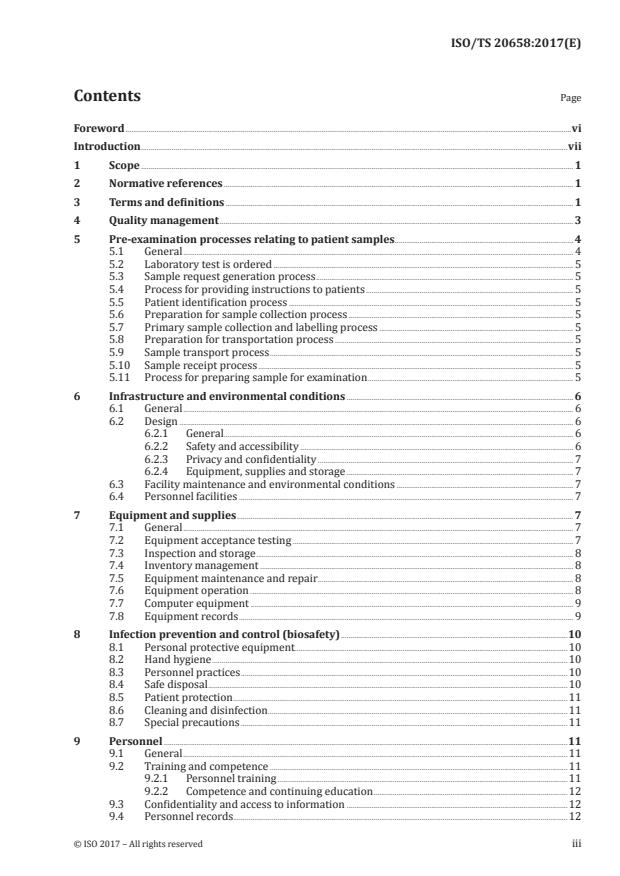
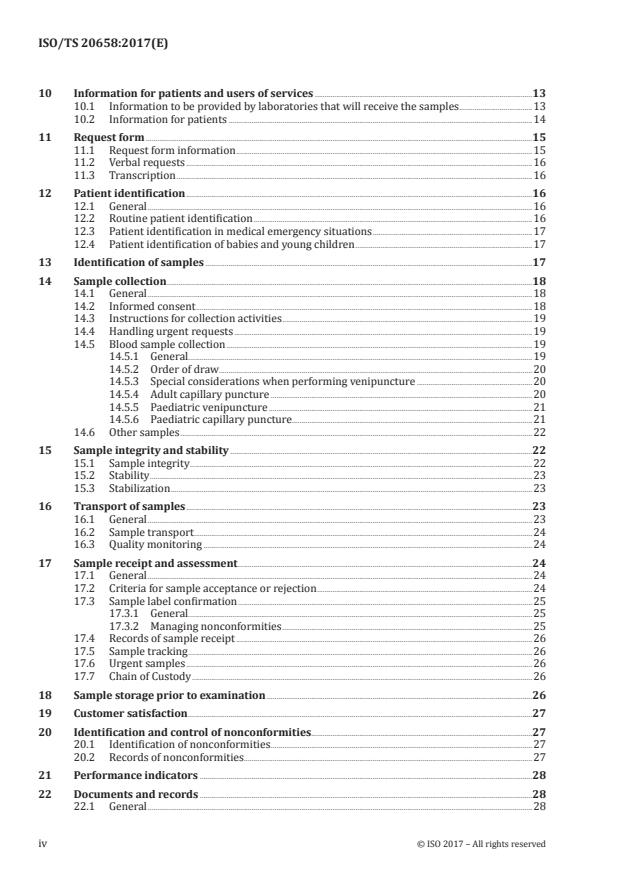
Contents Page
Foreword .vi
Introduction .vii
1 Scope . 1
2 Normative references . 1
3 Terms and definitions . 1
4 Quality management . 3
5 Pre-examination processes relating to patient samples. 4
5.1 General . 4
5.2 Laboratory test is ordered . 5
5.3 Sample request generation process . 5
5.4 Process for providing instructions to patients . 5
5.5 Patient identification process . 5
5.6 Preparation for sample collection process . 5
5.7 Primary sample collection and labelling process . 5
5.8 Preparation for transportation process . 5
5.9 Sample transport process . 5
5.10 Sample receipt process . 5
5.11 Process for preparing sample for examination . 5
6 Infrastructure and environmental conditions . 6
6.1 General . 6
6.2 Design . 6
6.2.1 General. 6
6.2.2 Safety and accessibility . 6
6.2.3 Privacy and confidentiality . 7
6.2.4 Equipment, supplies and storage . 7
6.3 Facility maintenance and environmental conditions . 7
6.4 Personnel facilities . 7
7 Equipment and supplies . 7
7.1 General . 7
7.2 Equipment acceptance testing . 7
7.3 Inspection and storage . 8
7.4 Inventory management . 8
7.5 Equipment maintenance and repair . 8
7.6 Equipment operation . 8
7.7 Computer equipment . 9
7.8 Equipment records . 9
8 Infection prevention and control (biosafety) .10
8.1 Personal protective equipment.10
8.2 Hand hygiene .10
8.3 Personnel practices .10
8.4 Safe disposal .10
8.5 Patient protection .11
8.6 Cleaning and disinfection . .11
8.7 Special precautions .11
9 Personnel .11
9.1 General .11
9.2 Training and competence .11
9.2.1 Personnel training .11
9.2.2 Competence and continuing education .12
9.3 Confidentiality and access to information .12
9.4 Personnel records.12
10 Information for patients and users of services .13
10.1 Information to be provided by laboratories that will receive the samples .13
10.2 Information for patients .14
11 Request form .15
11.1 Request form information .15
11.2 Verbal requests .16
11.3 Transcription .16
12 Patient identification .16
12.1 General .16
12.2 Routine patient identification .16
12.3 Patient identification in medical emergency situations .17
12.4 Patient identification of babies and young children .17
13 Identification of samples .17
14 Sample collection .18
14.1 General .18
14.2 Informed consent .18
14.3 Instructions for collection activities .19
14.4 Handling urgent requests .19
14.5 Blood sample collection .19
14.5.1 General.19
14.5.2 Order of draw.20
14.5.3 Special considerations when performing venipuncture .20
14.5.4 Adult capillary puncture .20
14.5.5 Paediatric venipuncture .21
14.5.6 Paediatric capillary puncture .21
14.6 Other samples .22
15 Sample integrity and stability .22
15.1 Sample integrity .22
15.2 Stability .23
15.3 Stabilization .23
16 Transport of samples .23
16.1 General .23
16.2 Sample transport .24
16.3 Quality monitoring .24
17 Sample receipt and assessment .24
17.1 General .24
17.2 Criteria for sample acceptance or rejection .24
17.3 Sample label confirmation .25
17.3.1 General.25
17.3.2 Managing nonconformities .25
17.4 Records of sample receipt .26
17.5 Sample tracking .26
17.6 Urgent samples .26
17.7 Chain of Custody .26
18 Sample storage prior to examination .26
19 Customer satisfaction .27
20 Identification and control of nonconformities.27
20.1 Identification of nonconformities .27
20.2 Records of nonconformities.27
21 Performance indicators .28
22 Documents and records .28
22.1 General .28
iv © ISO 2017 – All rights reserved
22.2 Documents .29
22.3 Records .29
Annex A (informative) Your five moments for hand hygiene .30
Annex B (informative) Disinfectants .31
Bibliography .33
Foreword
ISO (the International Organization for Standardization) is a worldwide federation of national standards
bodies (ISO member bodies). The work of preparing International Standards is normally carried out
through ISO technical committees. Each member body interested in a subject for which a technical
committee has been established has the right to be represented on that committee. International
organizations, governmental and non-governmental, in liaison with ISO, also take part in the work.
ISO collaborates closely with the International Electrotechnical Commission (IEC) on all matters of
electrotechnical standardization.
The procedures used to develop this document and those intended for its further maintenance are
described in the ISO/IEC Directives, Part 1. In particular, the different approval criteria needed for the
different types of ISO documents should be noted. This document was drafted in accordance with the
editorial rules of the ISO/IEC Directives, Part 2 (see www.iso.org/directives).
Attention is drawn to the possibility that some of the elements of this document may be the subject of
patent rights. ISO shall not be held responsible for identifying any or all such patent rights. Details of
any patent rights identified during the development of the document will be in the Introduction and/or
on the ISO list of patent declarations received (see www.iso.org/patents).
Any trade name used in this document is information given for the convenience of users and does not
constitute an endorsement.
For an explanation on the voluntary nature of standards, the meaning of ISO specific terms and
expressions related to conformity assessment, as well as information about ISO's adherence to the
World Trade Organization (WTO) principles in the Technical Barriers to Trade (TBT), see the following
URL: www.iso.org/iso/foreword.html.
This document was prepared by Technical Committee ISO/TC 212, Clinical Laboratory testing and in
vitro diagnostic test systems.
vi © ISO 2017 – All rights reserved
Introduction
Medical laboratory services are essential to patient care and public health and therefore, have to
be available to meet the needs of all patients and the clinical personnel responsible for the care of
those patients. Such services are required to be performed according to documented policies and
procedures for examination requests, patient preparation, patient identification, collection of samples,
transportation of samples, sample storage, processing, examination of samples and reporting results,
in addition to the considerations of safety and ethics in medical laboratory work.
This document provides guidance from a number of sources that are incorporated into a set of good
laboratory practices encompassing the pre-examination processes, in a way that meets published
requirements for sample collection and handling. This document is intended to be used by individuals
and organizations engaged in the collection of samples for submission to medical laboratories for
examination, for the purpose of ensuring the quality of laboratory services and to achieve better health
outcomes for the public.
It is acknowledged that a country could have its own specific guidance or requirements applicable to
professional personnel, their activities and their responsibilities in this domain.
Each laboratory or sample collection organization should determine its level of adherence to the good
laboratory practices described in this document. Management should take the first step by setting
appropriate priorities based on patient and customer needs, the resources available, as well as local,
regional and national mandates.
This document was developed based on the Canadian Standard CSA Z316.7−12.
TECHNICAL SPECIFICATION ISO/TS 20658:2017(E)
Medical laboratories — Requirements for collection,
transport, receipt, and handling of samples
1 Scope
This document specifies requirements and good practice recommendations for the collection, transport,
receipt and handling of samples intended for medical laboratory examinations.
This document is applicable to medical laboratories and other medical services involved in laboratory
pre-examination processes that include the examination request, patient preparation and identification,
sample collection, transport, receipt and storage. It may also be applicable to some biobanks.
This document does not apply to blood and blood products intended for transfusion.
2 Normative references
There are no normative references in this document.
3 Terms and definitions
3.1
arterial puncture
procedure (3.13) that involves the collection of blood from arteries by puncturing the skin
3.2
biobank
entity that performs biobanking (3.3)
Note 1 to entry: A biobank encompasses staff, facilities and procedures (e.g. management systems) and includes
service providers, as well as repositories of biological materials.
3.3
biobanking
process (3.14) of receiving, collecting, storing and distributing biological materials from human, animal,
plant and microorganisms, as well as related information and data, for the purpose of research and
development
Note 1 to entry: Some or all of the following activities may also be included: processing, testing and analysing.
Note 2 to entry: For the purpose of this document, this definition only includes human materials procured solely
for diagnostic and treatment purposes, e.g. surgical pathology archives.
3.4
capillary puncture
procedure (3.13) that involves the collection of blood from capillaries by puncturing the skin
3.5
cleaning
process (3.14) to remove any type of contamination, visible or not
[SOURCE: ISO 15190:2003, 3.5]
3.6
decontamination
procedure (3.13) that eliminates or reduces microbial or toxic agents to a safe level with respect to the
transmission of infection or other adverse effects
[SOURCE: ISO 15190:2003, 3.7]
3.7
disinfection
process (3.14) of reducing the number of microorganisms, but not usually bacterial spores, without
necessarily killing or removing all organisms
[SOURCE: ISO 15190:2003, 3.9]
3.8
examination processes
analytical phase
set of operations having the object of determining the value or characteristics of a property
Note 1 to entry: Laboratory examinations are also often called assays or tests.
[SOURCE: ISO 15189:2012, 3.7, modified — Notes to entry 2 and 3 have been omitted.]
3.9
hand hygiene
general term referring to any action of hand cleansing
[SOURCE: WHO Guidelines on Hand Hygiene in Health Care, 2009]
3.10
medical laboratory
clinical laboratory
laboratory for the biological, microbiological, immunological, chemical, immunohaematological,
haematological, biophysical, cytological, pathological, genetic or other examination of materials
derived from the human body for the purpose of providing information for the diagnosis, management,
prevention and treatment of disease in, or assessment of the health of, human beings, and which may
provide a consultant advisory service covering all aspects of laboratory investigation including the
interpretation of results and advice on further appropriate investigation
Note 1 to entry: These examinations also include procedures for determining, measuring or otherwise describing
the presence or absence of various substances or microorganisms.
[SOURCE: ISO 15189:2012, 3.11]
3.11
post-examination processes
post-analytical phase
processes (3.14) following the examination, including review of results, retention and storage of clinical
material, sample and waste disposal, as well as formatting, releasing, reporting and retention of
examination results
[SOURCE: ISO 15189:2012, 3.14]
3.12
pre-examination processes
pre-analytical phase
processes (3.14) that start, in chronological order, from the clinician’s request and include the
examination request, preparation and identification of the patient, collection of the primary sample(s)
and transportation to and within the laboratory and end when the analytical examination begins
[SOURCE: ISO 15189:2012, 3.15]
2 © ISO 2017 – All rights reserved
3.13
procedure
specified way to carry out an activity or a process (3.14)
[SOURCE: ISO 9000:2015, 3.4.5]
3.14
process
set of interrelated or interacting activities that use inputs to deliver an intended result
Note 1 to entry: Inputs to a process are generally outputs of other processes and outputs of a process are generally
the inputs to other processes.
[SOURCE: ISO 9000:2015, 3.4.1]
3.15
personal protective equipment
materials used to form a barrier to prevent contamination of a person by chemical or biological
substances
Note 1 to entry: This includes, but is not limited to, lab coats, gowns, gloves, face shields and goggles.
3.16
sample
primary sample
discrete portion of a body fluid, breath, hair or tissue taken for examination, study or analysis of one or
more quantities or properties assumed to apply for the whole
Note 1 to entry: Global Harmonization Task Force (GHTF) uses the term specimen in its harmonized guidance
documents to mean a sample of biological origin intended for examination by a medical laboratory.
Note 2 to entry: In some ISO and CEN documents, a specimen is defined as “a biological sample derived from the
human body.”
Note 3 to entry: In some countries, the term “specimen” is used instead of primary sample (or a subsample
of it), which is the sample prepared for sending to, or as received by, the laboratory and which is intended for
examination.
Note 4 to entry: The term “sample” is used in this document to include both the primary sample (specimen) and
sample (aliquot).
[SOURCE: ISO 15189:2012, 3.16, modified — Note 4 to entry has been added.]
3.17
sample collection
process of obtaining a primary sample (3.16)
3.18
venipuncture
procedure (3.13) that involves the collection of venous blood by penetrating a vein with a needle or
other collection apparatus
4 Quality management
An organization engaged in collecting, handling and submitting samples for examinations by medical
laboratories, should establish, document, implement and maintain a system, to enhance customer
satisfaction through assurance of conformity to customer needs, fulfil applicable statutory and
regulatory requirements and include processes to improve the system. Having a quality management
system in place will facilitate the implementation of these requirements.
5 Pre-examination processes relating to patient samples
5.1 General
This document presents requirements and good practice recommendations in the order of the process
flow for sample collection, handling, transport and receiving. Only a brief description of each activity
follows Figure 1, details are provided in the subsequent sections.
Figure 1 — Pre-examination processes relating to patient samples
4 © ISO 2017 – All rights reserved
5.2 Laboratory test is ordered
The organization shall provide information on how to order tests to all users of the services. There
shall be instructions provided for the completion of a test request form (see 10.1 and Clause 11).
5.3 Sample request generation process
The organization shall have procedures for the handling of requests for sample collection. This will
include both written and verbal requests, in routine and emergency situations, in both paper and
electronic formats. (See 11.2)
5.4 Process for providing instructions to patients
The organization shall have procedures describing information that is given to and obtained from
patients. The type of test requested will determine the need for fulfilment of specific requirements
before sample collection (see 10.2).
5.5 Patient identification process
The organization shall have policies and procedures for patient identification for both routine sample
collection and sample collection in medical emergency situations (see 12.2 and 12.3).
5.6 Preparation for sample collection process
The organization shall have policies and procedures for infection prevention and control (see Clause 8),
informed consent (see 14.2), patient preparation and for recording any deviations.
5.7 Primary sample collection and labelling process
The organization shall have procedures for the proper collection, labelling and handling of samples
(see Clause 13, 14.3, 14.5, 14.6).
5.8 Preparation for transportation process
The organization shall have procedures for samples that require special handling to maintain the
integrity of the sample prior to and during transportation to the laboratory (see Clause 15).
5.9 Sample transport process
The organization shall have procedures for packaging and transporting of samples (see Clause 16).
Transportation of samples is subject to statutory and regulatory requirements.
5.10 Sample receipt process
The organization shall have procedures for the receipt, assessment, processing and storage of samples.
Sample reception procedures shall cover all sample types received by the facility (see Clause 17).
5.11 Process for preparing sample for examination
The organization shall have procedures for preparing samples for examination. This process may occur
at the collection facility or following transportation to the testing laboratory (see Clause 18).
6 Infrastructure and environmental conditions
6.1 General
Sufficient space shall be allocated for pre-examination activities to ensure the quality of work, safety
of personnel and patient care services are not compromised. The materials and equipment need to
be adequate for supporting the activities of the facility and be maintained in functional and reliable
condition.
6.2 Design
6.2.1 General
The design of the sample collection facilities shall support efficient operations and minimize the risk
of injury and occupational illness. Patients, personnel and visitors shall be protected from recognized
hazards.
When designing locations for sample collection, consideration shall be given to accessibility, comfort,
safety, privacy and confidentiality for patients and personnel.
Statutory and regulatory requirements may apply.
6.2.2 Safety and accessibility
The following shall be considered in the design process:
a) accessibility for mobility devices;
b) ease of evacuation in case of emergency;
c) non-skid floor surface;
d) access to a sink for hand washing, or the provision of alcohol-based or other hand sanitizer;
e) specific safety aspects for children in collection rooms (e.g. child proof locks on cupboards, safe
height for needles/sharps containers and any features in a waiting room) as well as for paediatric
sample collection;
f) availability and proximity of toilets;
g) ergonomically designed furniture for ease of collection for both personnel and patients, including
a bed, a chair able to be easily reclined, with two side armrests, or a stretcher for the patient to lie
down in the case of a medical emergency;
h) space between seats in the patient waiting area to minimize risk of droplet infection from
symptomatic patients of respiratory tract infection to other patients;
i) some facilities may need to have equipment for resuscitation; statutory and regulatory
requirements may apply;
j) access to first aid;
k) posted instructions for how to obtain rapid medical attention when required;
l) access to a biohazardous spill kit for safe disposal of broken or leaking samples;
m) separation of areas in which there are incompatible activities.
6 © ISO 2017 – All rights reserved
6.2.3 Privacy and confidentiality
To protect patient privacy and confidentiality, sample collection shall be performed in an area that
a) provides sufficient privacy to ensure patient confidentiality is maintained,
b) provides personal privacy for the patient during sample collection (e.g. during a blood draw or
collection of a urine sample and when removal of clothing is necessary),
c) has a secure place for storage of a patient’s personal property if needed, and
d) protects confidentiality of information on documents and in electronic systems.
6.2.4 Equipment, supplies and storage
When relevant, the facility design shall be able to accommodate
a) space for storage of all the required materials and supplies used in sample collection, and
b) space for materials and equipment needed for the collection and stabilization of samples, transport
and storage.
6.3 Facility maintenance and environmental conditions
Work areas shall be clean and well maintained. The facility shall design and verify a cleaning and
disinfection process, with emphasis on infection control.
The spaces dedicated to pre-examination processes need to be designated smoke-free.
Measures need to be taken to ensure good housekeeping in the facility. This includes special procedures
for decontamination, as well as training for personnel involved in housekeeping tasks.
6.4 Personnel facilities
There shall be adequate access to washrooms, to a supply of drinking water and facilities for storage of
personal protective equipment and clothing.
Safety of personnel working alone should be considered.
7 Equipment and supplies
7.1 General
Procedures shall be developed and implemented for the selection and use of purchased external
services, equipment and consumable supplies. Purchased items need to consistently meet the
organization’s quality requirements.
Equipment, including hardware, software, consumables and reagents shall be safeguarded from
adjustments or tampering that might invalidate pre-examination activities or subsequent examination
results.
NOTE Refrigerators, centrifuges and transport boxes are some of the most widely used equipment in sample
collection facilities.
7.2 Equipment acceptance testing
Equipment shall be verified upon receipt and before use to ensure that it is capable of achieving the
necessary performance and that it complies with requirements specified at the time of procurement.
Each item of equipment shall be uniquely labelled, marked or otherwise identified.
7.3 Inspection and storage
Consumable materials shall be inspected on receipt and accepted or rejected in accordance with the
organization’s specified requirements; then stored according to manufacturer’s specifications. Records of
the acceptance or rejection of consumable materials shall be kept for a defined period, in accordance with
the facility’s document and record control system. Statutory and regulatory requirements may apply.
Equipment and supplies shall be available in sufficient quantities and suitable for their intended use
in sample collection, stabilization, transport and storage processes. When selecting equipment, use of
energy and future disposal (i.e. protection of the environment) should be taken into account.
Equipment and supplies shall be clean and well maintained. Supplies shall be kept under controlled
conditions during transport and storage.
Selection of sample collection devices shall take into account local and regional safety regulations.
Procedures shall be developed and implemented for the safe handling, maintenance, transport, storage
and use of equipment, to prevent its contamination or deterioration.
7.4 Inventory management
An inventory control system for supplies shall be established to ensure that
a) supplies shall not be used after their expiry date,
b) sufficient supplies are available to meet the needs of the operation, and
c) safety data sheets are available.
7.5 Equipment maintenance and repair
Current instructions on the use, safety and maintenance of equipment, including any documentation
provided by the manufacturer of the equipment shall be available. Procedures for proper calibration
of equipment used in pre-examination activities shall be provided. Documented and recorded
processes and procedures for preventive maintenance that, at a minimum, follows the manufacturer’s
recommendations are also required.
Equipment used in sample collection, processing and transport should be designed and constructed
of materials facilitating thorough internal and external cleaning and disinfection. Beds, chairs and
countertops shall be made of materials that can be easily cleaned and disinfected when soiled.
When equipment is found to be defective, it shall be taken out of service, clearly labelled and
appropriately stored until it has been repaired. The effect of the defect should be evaluated and
any follow up action taken when indicated. Records shall be available that confirm the equipment’s
acceptability for return to service after damage, malfunction and repair. .
Reasonable measures shall be taken to decontaminate equipment before service, repair or
decommissioning. Repair shall take place in safe working conditi
...
TECHNICAL ISO/TS
SPECIFICATION 20658
First edition
2017-10
Medical laboratories — Requirements
for collection, transport, receipt, and
handling of samples
Laboratoires de biologie médicale — Exigences pour le prélèvement,
le transport, la réception et la manipulation des échantillons
Reference number
©
ISO 2017
© ISO 2017, Published in Switzerland
All rights reserved. Unless otherwise specified, no part of this publication may be reproduced or utilized otherwise in any form
or by any means, electronic or mechanical, including photocopying, or posting on the internet or an intranet, without prior
written permission. Permission can be requested from either ISO at the address below or ISO’s member body in the country of
the requester.
ISO copyright office
Ch. de Blandonnet 8 • CP 401
CH-1214 Vernier, Geneva, Switzerland
Tel. +41 22 749 01 11
Fax +41 22 749 09 47
copyright@iso.org
www.iso.org
ii © ISO 2017 – All rights reserved
Contents Page
Foreword .vi
Introduction .vii
1 Scope . 1
2 Normative references . 1
3 Terms and definitions . 1
4 Quality management . 3
5 Pre-examination processes relating to patient samples. 4
5.1 General . 4
5.2 Laboratory test is ordered . 5
5.3 Sample request generation process . 5
5.4 Process for providing instructions to patients . 5
5.5 Patient identification process . 5
5.6 Preparation for sample collection process . 5
5.7 Primary sample collection and labelling process . 5
5.8 Preparation for transportation process . 5
5.9 Sample transport process . 5
5.10 Sample receipt process . 5
5.11 Process for preparing sample for examination . 5
6 Infrastructure and environmental conditions . 6
6.1 General . 6
6.2 Design . 6
6.2.1 General. 6
6.2.2 Safety and accessibility . 6
6.2.3 Privacy and confidentiality . 7
6.2.4 Equipment, supplies and storage . 7
6.3 Facility maintenance and environmental conditions . 7
6.4 Personnel facilities . 7
7 Equipment and supplies . 7
7.1 General . 7
7.2 Equipment acceptance testing . 7
7.3 Inspection and storage . 8
7.4 Inventory management . 8
7.5 Equipment maintenance and repair . 8
7.6 Equipment operation . 8
7.7 Computer equipment . 9
7.8 Equipment records . 9
8 Infection prevention and control (biosafety) .10
8.1 Personal protective equipment.10
8.2 Hand hygiene .10
8.3 Personnel practices .10
8.4 Safe disposal .10
8.5 Patient protection .11
8.6 Cleaning and disinfection . .11
8.7 Special precautions .11
9 Personnel .11
9.1 General .11
9.2 Training and competence .11
9.2.1 Personnel training .11
9.2.2 Competence and continuing education .12
9.3 Confidentiality and access to information .12
9.4 Personnel records.12
10 Information for patients and users of services .13
10.1 Information to be provided by laboratories that will receive the samples .13
10.2 Information for patients .14
11 Request form .15
11.1 Request form information .15
11.2 Verbal requests .16
11.3 Transcription .16
12 Patient identification .16
12.1 General .16
12.2 Routine patient identification .16
12.3 Patient identification in medical emergency situations .17
12.4 Patient identification of babies and young children .17
13 Identification of samples .17
14 Sample collection .18
14.1 General .18
14.2 Informed consent .18
14.3 Instructions for collection activities .19
14.4 Handling urgent requests .19
14.5 Blood sample collection .19
14.5.1 General.19
14.5.2 Order of draw.20
14.5.3 Special considerations when performing venipuncture .20
14.5.4 Adult capillary puncture .20
14.5.5 Paediatric venipuncture .21
14.5.6 Paediatric capillary puncture .21
14.6 Other samples .22
15 Sample integrity and stability .22
15.1 Sample integrity .22
15.2 Stability .23
15.3 Stabilization .23
16 Transport of samples .23
16.1 General .23
16.2 Sample transport .24
16.3 Quality monitoring .24
17 Sample receipt and assessment .24
17.1 General .24
17.2 Criteria for sample acceptance or rejection .24
17.3 Sample label confirmation .25
17.3.1 General.25
17.3.2 Managing nonconformities .25
17.4 Records of sample receipt .26
17.5 Sample tracking .26
17.6 Urgent samples .26
17.7 Chain of Custody .26
18 Sample storage prior to examination .26
19 Customer satisfaction .27
20 Identification and control of nonconformities.27
20.1 Identification of nonconformities .27
20.2 Records of nonconformities.27
21 Performance indicators .28
22 Documents and records .28
22.1 General .28
iv © ISO 2017 – All rights reserved
22.2 Documents .29
22.3 Records .29
Annex A (informative) Your five moments for hand hygiene .30
Annex B (informative) Disinfectants .31
Bibliography .33
Foreword
ISO (the International Organization for Standardization) is a worldwide federation of national standards
bodies (ISO member bodies). The work of preparing International Standards is normally carried out
through ISO technical committees. Each member body interested in a subject for which a technical
committee has been established has the right to be represented on that committee. International
organizations, governmental and non-governmental, in liaison with ISO, also take part in the work.
ISO collaborates closely with the International Electrotechnical Commission (IEC) on all matters of
electrotechnical standardization.
The procedures used to develop this document and those intended for its further maintenance are
described in the ISO/IEC Directives, Part 1. In particular, the different approval criteria needed for the
different types of ISO documents should be noted. This document was drafted in accordance with the
editorial rules of the ISO/IEC Directives, Part 2 (see www.iso.org/directives).
Attention is drawn to the possibility that some of the elements of this document may be the subject of
patent rights. ISO shall not be held responsible for identifying any or all such patent rights. Details of
any patent rights identified during the development of the document will be in the Introduction and/or
on the ISO list of patent declarations received (see www.iso.org/patents).
Any trade name used in this document is information given for the convenience of users and does not
constitute an endorsement.
For an explanation on the voluntary nature of standards, the meaning of ISO specific terms and
expressions related to conformity assessment, as well as information about ISO's adherence to the
World Trade Organization (WTO) principles in the Technical Barriers to Trade (TBT), see the following
URL: www.iso.org/iso/foreword.html.
This document was prepared by Technical Committee ISO/TC 212, Clinical Laboratory testing and in
vitro diagnostic test systems.
vi © ISO 2017 – All rights reserved
Introduction
Medical laboratory services are essential to patient care and public health and therefore, have to
be available to meet the needs of all patients and the clinical personnel responsible for the care of
those patients. Such services are required to be performed according to documented policies and
procedures for examination requests, patient preparation, patient identification, collection of samples,
transportation of samples, sample storage, processing, examination of samples and reporting results,
in addition to the considerations of safety and ethics in medical laboratory work.
This document provides guidance from a number of sources that are incorporated into a set of good
laboratory practices encompassing the pre-examination processes, in a way that meets published
requirements for sample collection and handling. This document is intended to be used by individuals
and organizations engaged in the collection of samples for submission to medical laboratories for
examination, for the purpose of ensuring the quality of laboratory services and to achieve better health
outcomes for the public.
It is acknowledged that a country could have its own specific guidance or requirements applicable to
professional personnel, their activities and their responsibilities in this domain.
Each laboratory or sample collection organization should determine its level of adherence to the good
laboratory practices described in this document. Management should take the first step by setting
appropriate priorities based on patient and customer needs, the resources available, as well as local,
regional and national mandates.
This document was developed based on the Canadian Standard CSA Z316.7−12.
TECHNICAL SPECIFICATION ISO/TS 20658:2017(E)
Medical laboratories — Requirements for collection,
transport, receipt, and handling of samples
1 Scope
This document specifies requirements and good practice recommendations for the collection, transport,
receipt and handling of samples intended for medical laboratory examinations.
This document is applicable to medical laboratories and other medical services involved in laboratory
pre-examination processes that include the examination request, patient preparation and identification,
sample collection, transport, receipt and storage. It may also be applicable to some biobanks.
This document does not apply to blood and blood products intended for transfusion.
2 Normative references
There are no normative references in this document.
3 Terms and definitions
3.1
arterial puncture
procedure (3.13) that involves the collection of blood from arteries by puncturing the skin
3.2
biobank
entity that performs biobanking (3.3)
Note 1 to entry: A biobank encompasses staff, facilities and procedures (e.g. management systems) and includes
service providers, as well as repositories of biological materials.
3.3
biobanking
process (3.14) of receiving, collecting, storing and distributing biological materials from human, animal,
plant and microorganisms, as well as related information and data, for the purpose of research and
development
Note 1 to entry: Some or all of the following activities may also be included: processing, testing and analysing.
Note 2 to entry: For the purpose of this document, this definition only includes human materials procured solely
for diagnostic and treatment purposes, e.g. surgical pathology archives.
3.4
capillary puncture
procedure (3.13) that involves the collection of blood from capillaries by puncturing the skin
3.5
cleaning
process (3.14) to remove any type of contamination, visible or not
[SOURCE: ISO 15190:2003, 3.5]
3.6
decontamination
procedure (3.13) that eliminates or reduces microbial or toxic agents to a safe level with respect to the
transmission of infection or other adverse effects
[SOURCE: ISO 15190:2003, 3.7]
3.7
disinfection
process (3.14) of reducing the number of microorganisms, but not usually bacterial spores, without
necessarily killing or removing all organisms
[SOURCE: ISO 15190:2003, 3.9]
3.8
examination processes
analytical phase
set of operations having the object of determining the value or characteristics of a property
Note 1 to entry: Laboratory examinations are also often called assays or tests.
[SOURCE: ISO 15189:2012, 3.7, modified — Notes to entry 2 and 3 have been omitted.]
3.9
hand hygiene
general term referring to any action of hand cleansing
[SOURCE: WHO Guidelines on Hand Hygiene in Health Care, 2009]
3.10
medical laboratory
clinical laboratory
laboratory for the biological, microbiological, immunological, chemical, immunohaematological,
haematological, biophysical, cytological, pathological, genetic or other examination of materials
derived from the human body for the purpose of providing information for the diagnosis, management,
prevention and treatment of disease in, or assessment of the health of, human beings, and which may
provide a consultant advisory service covering all aspects of laboratory investigation including the
interpretation of results and advice on further appropriate investigation
Note 1 to entry: These examinations also include procedures for determining, measuring or otherwise describing
the presence or absence of various substances or microorganisms.
[SOURCE: ISO 15189:2012, 3.11]
3.11
post-examination processes
post-analytical phase
processes (3.14) following the examination, including review of results, retention and storage of clinical
material, sample and waste disposal, as well as formatting, releasing, reporting and retention of
examination results
[SOURCE: ISO 15189:2012, 3.14]
3.12
pre-examination processes
pre-analytical phase
processes (3.14) that start, in chronological order, from the clinician’s request and include the
examination request, preparation and identification of the patient, collection of the primary sample(s)
and transportation to and within the laboratory and end when the analytical examination begins
[SOURCE: ISO 15189:2012, 3.15]
2 © ISO 2017 – All rights reserved
3.13
procedure
specified way to carry out an activity or a process (3.14)
[SOURCE: ISO 9000:2015, 3.4.5]
3.14
process
set of interrelated or interacting activities that use inputs to deliver an intended result
Note 1 to entry: Inputs to a process are generally outputs of other processes and outputs of a process are generally
the inputs to other processes.
[SOURCE: ISO 9000:2015, 3.4.1]
3.15
personal protective equipment
materials used to form a barrier to prevent contamination of a person by chemical or biological
substances
Note 1 to entry: This includes, but is not limited to, lab coats, gowns, gloves, face shields and goggles.
3.16
sample
primary sample
discrete portion of a body fluid, breath, hair or tissue taken for examination, study or analysis of one or
more quantities or properties assumed to apply for the whole
Note 1 to entry: Global Harmonization Task Force (GHTF) uses the term specimen in its harmonized guidance
documents to mean a sample of biological origin intended for examination by a medical laboratory.
Note 2 to entry: In some ISO and CEN documents, a specimen is defined as “a biological sample derived from the
human body.”
Note 3 to entry: In some countries, the term “specimen” is used instead of primary sample (or a subsample
of it), which is the sample prepared for sending to, or as received by, the laboratory and which is intended for
examination.
Note 4 to entry: The term “sample” is used in this document to include both the primary sample (specimen) and
sample (aliquot).
[SOURCE: ISO 15189:2012, 3.16, modified — Note 4 to entry has been added.]
3.17
sample collection
process of obtaining a primary sample (3.16)
3.18
venipuncture
procedure (3.13) that involves the collection of venous blood by penetrating a vein with a needle or
other collection apparatus
4 Quality management
An organization engaged in collecting, handling and submitting samples for examinations by medical
laboratories, should establish, document, implement and maintain a system, to enhance customer
satisfaction through assurance of conformity to customer needs, fulfil applicable statutory and
regulatory requirements and include processes to improve the system. Having a quality management
system in place will facilitate the implementation of these requirements.
5 Pre-examination processes relating to patient samples
5.1 General
This document presents requirements and good practice recommendations in the order of the process
flow for sample collection, handling, transport and receiving. Only a brief description of each activity
follows Figure 1, details are provided in the subsequent sections.
Figure 1 — Pre-examination processes relating to patient samples
4 © ISO 2017 – All rights reserved
5.2 Laboratory test is ordered
The organization shall provide information on how to order tests to all users of the services. There
shall be instructions provided for the completion of a test request form (see 10.1 and Clause 11).
5.3 Sample request generation process
The organization shall have procedures for the handling of requests for sample collection. This will
include both written and verbal requests, in routine and emergency situations, in both paper and
electronic formats. (See 11.2)
5.4 Process for providing instructions to patients
The organization shall have procedures describing information that is given to and obtained from
patients. The type of test requested will determine the need for fulfilment of specific requirements
before sample collection (see 10.2).
5.5 Patient identification process
The organization shall have policies and procedures for patient identification for both routine sample
collection and sample collection in medical emergency situations (see 12.2 and 12.3).
5.6 Preparation for sample collection process
The organization shall have policies and procedures for infection prevention and control (see Clause 8),
informed consent (see 14.2), patient preparation and for recording any deviations.
5.7 Primary sample collection and labelling process
The organization shall have procedures for the proper collection, labelling and handling of samples
(see Clause 13, 14.3, 14.5, 14.6).
5.8 Preparation for transportation process
The organization shall have procedures for samples that require special handling to maintain the
integrity of the sample prior to and during transportation to the laboratory (see Clause 15).
5.9 Sample transport process
The organization shall have procedures for packaging and transporting of samples (see Clause 16).
Transportation of samples is subject to statutory and regulatory requirements.
5.10 Sample receipt process
The organization shall have procedures for the receipt, assessment, processing and storage of samples.
Sample reception procedures shall cover all sample types received by the facility (see Clause 17).
5.11 Process for preparing sample for examination
The organization shall have procedures for preparing samples for examination. This process may occur
at the collection facility or following transportation to the testing laboratory (see Clause 18).
6 Infrastructure and environmental conditions
6.1 General
Sufficient space shall be allocated for pre-examination activities to ensure the quality of work, safety
of personnel and patient care services are not compromised. The materials and equipment need to
be adequate for supporting the activities of the facility and be maintained in functional and reliable
condition.
6.2 Design
6.2.1 General
The design of the sample collection facilities shall support efficient operations and minimize the risk
of injury and occupational illness. Patients, personnel and visitors shall be protected from recognized
hazards.
When designing locations for sample collection, consideration shall be given to accessibility, comfort,
safety, privacy and confidentiality for patients and personnel.
Statutory and regulatory requirements may apply.
6.2.2 Safety and accessibility
The following shall be considered in the design process:
a) accessibility for mobility devices;
b) ease of evacuation in case of emergency;
c) non-skid floor surface;
d) access to a sink for hand washing, or the provision of alcohol-based or other hand sanitizer;
e) specific safety aspects for children in collection rooms (e.g. child proof locks on cupboards, safe
height for needles/sharps containers and any features in a waiting room) as well as for paediatric
sample collection;
f) availability and proximity of toilets;
g) ergonomically designed furniture for ease of collection for both personnel and patients, including
a bed, a chair able to be easily reclined, with two side armrests, or a stretcher for the patient to lie
down in the case of a medical emergency;
h) space between seats in the patient waiting area to minimize risk of droplet infection from
symptomatic patients of respiratory tract infection to other patients;
i) some facilities may need to have equipment for resuscitation; statutory and regulatory
requirements may apply;
j) access to first aid;
k) posted instructions for how to obtain rapid medical attention when required;
l) access to a biohazardous spill kit for safe disposal of broken or leaking samples;
m) separation of areas in which there are incompatible activities.
6 © ISO 2017 – All rights reserved
6.2.3 Privacy and confidentiality
To protect patient privacy and confidentiality, sample collection shall be performed in an area that
a) provides sufficient privacy to ensure patient confidentiality is maintained,
b) provides personal privacy for the patient during sample collection (e.g. during a blood draw or
collection of a urine sample and when removal of clothing is necessary),
c) has a secure place for storage of a patient’s personal property if needed, and
d) protects confidentiality of information on documents and in electronic systems.
6.2.4 Equipment, supplies and storage
When relevant, the facility design shall be able to accommodate
a) space for storage of all the required materials and supplies used in sample collection, and
b) space for materials and equipment needed for the collection and stabilization of samples, transport
and storage.
6.3 Facility maintenance and environmental conditions
Work areas shall be clean and well maintained. The facility shall design and verify a cleaning and
disinfection process, with emphasis on infection control.
The spaces dedicated to pre-examination processes need to be designated smoke-free.
Measures need to be taken to ensure good housekeeping in the facility. This includes special procedures
for decontamination, as well as training for personnel involved in housekeeping tasks.
6.4 Personnel facilities
There shall be adequate access to washrooms, to a supply of drinking water and facilities for storage of
personal protective equipment and clothing.
Safety of personnel working alone should be considered.
7 Equipment and supplies
7.1 General
Procedures shall be developed and implemented for the selection and use of purchased external
services, equipment and consumable supplies. Purchased items need to consistently meet the
organization’s quality requirements.
Equipment, including hardware, software, consumables and reagents shall be safeguarded from
adjustments or tampering that might invalidate pre-examination activities or subsequent examination
results.
NOTE Refrigerators, centrifuges and transport boxes are some of the most widely used equipment in sample
collection facilities.
7.2 Equipment acceptance testing
Equipment shall be verified upon receipt and before use to ensure that it is capable of achieving the
necessary performance and that it complies with requirements specified at the time of procurement.
Each item of equipment shall be uniquely labelled, marked or otherwise identified.
7.3 Inspection and storage
Consumable materials shall be inspected on receipt and accepted or rejected in accordance with the
organization’s specified requirements; then stored according to manufacturer’s specifications. Records of
the acceptance or rejection of consumable materials shall be kept for a defined period, in accordance with
the facility’s document and record control system. Statutory and regulatory requirements may apply.
Equipment and supplies shall be available in sufficient quantities and suitable for their intended use
in sample collection, stabilization, transport and storage processes. When selecting equipment, use of
energy and future disposal (i.e. protection of the environment) should be taken into account.
Equipment and supplies shall be clean and well maintained. Supplies shall be kept under controlled
conditions during transport and storage.
Selection of sample collection devices shall take into account local and regional safety regulations.
Procedures shall be developed and implemented for the safe handling, maintenance, transport, storage
and use of equipment, to prevent its contamination or deterioration.
7.4 Inventory management
An inventory control system for supplies shall be established to ensure that
a) supplies shall not be used after their expiry date,
b) sufficient supplies are available to meet the needs of the operation, and
c) safety data sheets are available.
7.5 Equipment maintenance and repair
Current instructions on the use, safety and maintenance of equipment, including any documentation
provided by the manufacturer of the equipment shall be available. Procedures for proper calibration
of equipment used in pre-examination activities shall be provided. Documented and recorded
processes and procedures for preventive maintenance that, at a minimum, follows the manufacturer’s
recommendations are also required.
Equipment used in sample collection, processing and transport should be designed and constructed
of materials facilitating thorough internal and external cleaning and disinfection. Beds, chairs and
countertops shall be made of materials that can be easily cleaned and disinfected when soiled.
When equipment is found to be defective, it shall be taken out of service, clearly labelled and
appropriately stored until it has been repaired. The effect of the defect should be evaluated and
any follow up action taken when indicated. Records shall be available that confirm the equipment’s
acceptability for return to service after damage, malfunction and repair. .
Reasonable measures shall be taken to decontaminate equipment before service, repair or
decommissioning. Repair shall take place in safe working conditions and appropriate personal
protective equipment shall be provided. Decontamination and disposal of used equipment shall be
performed in accordance with any statutory and regulatory requirements.
7.6 Equipment operation
Only trained and competent personnel shall operate equipment. Instructions on the use and
maintenance of equipment, (including any relevant manuals and directions for use provided by the
manufacturer), shall be available to facility personnel. This includes instructions for decontaminating
centrifuges after tube breakages.
Refrigerator and freezer temperatures shall be monitored and recorded to eliminate risk for unreliable
results. Temperature ranges established shall meet the requirements of items stored within.
8 © ISO 2017 – All rights reserved
Centrifuges shall have the timing mechanism, rotation speed and internal temperature checked
periodically; as appropriate for refrigerated centrifuges.
Equipment shall be cleaned and maintained in a safe working condition. This includes examination of
electrical safety and emergency stop devices, safety features on sample collection devices and the safe
handling and disposal of biological materials by authorized persons. The
...
Questions, Comments and Discussion
Ask us and Technical Secretary will try to provide an answer. You can facilitate discussion about the standard in here.
Loading comments...