

ISO 22742:2026
(Main)Packaging — Linear bar code and two-dimensional symbols for product packaging
General Information
- Abstract
This document: specifies the minimum requirements for the design of labels containing a linear bar code and two dimensional (2D) symbols on product packages to convey data between trading partners; provides guidance for the formatting on the label of data presented in a linear bar code, 2D symbols or human-readable form; provides specific recommendations regarding the choice of linear bar code and 2D symbologies, and specifies quality requirements and classes of bar code density; provides specific recommendations regarding both linear and 2D symbologies, which allow a broad choice for general use of scanning hardware (e.g. area imagers, linear imagers, single line laser scanners, and raster laser scanners); makes recommendations as to label placement, size and the inclusion of free text and any appropriate graphics. This document supports item identification and supply chain processes, at the product package level, such as inventory control, picking, and point of use. NOTE 1 ISO 15394[2] supports the distribution and transportation business processes, so aiding the tracing and tracking of unique shipments. NOTE 2 ISO 28219 addresses the direct part marking. The purpose of this document is to establish the machine readable (e.g. bar code) and human-readable data content of labels applied to product packages. Intended applications include, but are not limited to, inventory, warehouse management, maintenance and point of purchase. While guidance is provided, specific label dimensions or marking areas and the location of the information are not defined in this document. Before implementing this specification, suppliers and manufacturers are advised to review and mutually agree on these details with their trading partners. This document does not supersede or replace any applicable safety or regulatory marking or labelling requirements. It is intended to satisfy the product package requirements of numerous applications and industry groups. As such, it is applicable to a wide range of industries, each of which has specific implementation guidelines. This document is also applicable to any other labelling requirements.
- Status
- Published
- Publication Date
- 12-May-2026
- Technical Committee
- ISO/TC 122 - Packaging
- Drafting Committee
- ISO/TC 122/WG 12 - Supply chain applications of logistics technology
- Current Stage
- 6060 - International Standard published
- Start Date
- 13-May-2026
- Due Date
- 13-Sep-2026
- Completion Date
- 13-May-2026


Overview
ISO 22742:2026 - Packaging - Linear bar code and two-dimensional symbols for product packaging provides international guidelines for the design and use of product package labels containing linear bar codes and two-dimensional (2D) symbols. Published by the International Organization for Standardization (ISO), this standard establishes minimum requirements for encoding critical product information using machine-readable (e.g., bar code and 2D symbol) and human-readable formats. The document is designed to support item identification, inventory control, picking, and other supply chain processes at the product package level across diverse industries.
ISO 22742:2026 facilitates seamless data exchange between trading partners by standardizing label content, formatting, symbology selection, and placement. While it offers recommendations for label design, placement, and data representation, it does not prescribe specific label dimensions or the precise location of markings, leaving these details to be mutually agreed upon by suppliers and partners.
Key Topics
- Label Design and Content: Specifies minimum requirements for encoding data in linear bar codes, 2D symbols, and human-readable forms, ensuring consistency and clarity.
- Symbology and Data Carriers: Provides recommendations on the selection and use of linear (e.g., Code 128, EAN/UPC) and two-dimensional (e.g., Data Matrix, QR Codes, PDF417) bar code symbologies, considering compatibility with various scanning hardware.
- Data Formatting: Offers guidance on structuring both coded and human-readable information, including mandatory and optional data elements such as item identification, quantity, traceability, and supplier information.
- Quality and Density Classes: Specifies quality requirements and bar code density classes to optimize readability and data accuracy.
- Label Placement and Size: Recommends best practices for label positioning, sizing, inclusion of free text, and supportive graphics.
- Interoperability: Supports integration with other standards and business processes in inventory management, warehouse operations, and supply chain logistics.
Applications
ISO 22742:2026 is applicable to a broad spectrum of industries utilizing product packaging labels for operational efficiency and supply chain automation. Typical applications include:
- Inventory management: Facilitating accurate tracking of goods, improving stock control, and reducing manual entry errors through bar code scanning.
- Warehouse operations: Enhancing picking, packing, and shipping processes by consolidating key product data into standardized labels.
- Point of purchase: Simplifying product identification and pricing at retail checkout via universally recognized bar codes and 2D symbols.
- Maintenance and logistics: Streamlining traceability, recall management, and compliance by encoding essential information such as serial numbers, lot numbers, and country of origin.
- Supply chain integration: Enabling smooth data exchange between suppliers, manufacturers, and distributors, especially in multi-industry contexts.
The standard is designed to be flexible and is intended for use wherever standardized product labelling supports business, operational, or regulatory needs. It does not override safety or mandatory regulatory requirements but ensures labels support diverse industry practices and traceability demands.
Related Standards
ISO 22742:2026 references and complements several other standards, including:
- ISO 15394: Distribution and transportation processes, for shipment tracking and tracing.
- ISO 28219: Direct part marking requirements.
- ISO/IEC 15415 & 15416: Bar code symbol print quality for 2D and linear codes.
- ISO/IEC 15418 & ANSI MH10.8.2: Data identifiers and GS1 application identifiers.
- ISO/IEC 16022, 18004, 15438: Specifications for Data Matrix, QR Code, and PDF417 symbologies.
- GS1 General Specifications: Global data alignment in retail and supply chain environments.
By aligning with these standards, ISO 22742:2026 provides a comprehensive framework for packaging bar code and 2D symbols, optimizing efficiency in product identification, traceability, and supply chain management.
Relations
- Revises
ISO 22742:2010 - Packaging — Linear bar code and two-dimensional symbols for product packaging - Effective Date
- 16-Sep-2023
Get Certified
Connect with accredited certification bodies for this standard

BRCGS (Brand Reputation Compliance Global Standards)
Global food safety and quality standards owner.
Sponsored listings
Frequently Asked Questions
ISO 22742:2026 is a standard published by the International Organization for Standardization (ISO). Its full title is "Packaging — Linear bar code and two-dimensional symbols for product packaging". This standard covers: This document: specifies the minimum requirements for the design of labels containing a linear bar code and two dimensional (2D) symbols on product packages to convey data between trading partners; provides guidance for the formatting on the label of data presented in a linear bar code, 2D symbols or human-readable form; provides specific recommendations regarding the choice of linear bar code and 2D symbologies, and specifies quality requirements and classes of bar code density; provides specific recommendations regarding both linear and 2D symbologies, which allow a broad choice for general use of scanning hardware (e.g. area imagers, linear imagers, single line laser scanners, and raster laser scanners); makes recommendations as to label placement, size and the inclusion of free text and any appropriate graphics. This document supports item identification and supply chain processes, at the product package level, such as inventory control, picking, and point of use. NOTE 1 ISO 15394[2] supports the distribution and transportation business processes, so aiding the tracing and tracking of unique shipments. NOTE 2 ISO 28219 addresses the direct part marking. The purpose of this document is to establish the machine readable (e.g. bar code) and human-readable data content of labels applied to product packages. Intended applications include, but are not limited to, inventory, warehouse management, maintenance and point of purchase. While guidance is provided, specific label dimensions or marking areas and the location of the information are not defined in this document. Before implementing this specification, suppliers and manufacturers are advised to review and mutually agree on these details with their trading partners. This document does not supersede or replace any applicable safety or regulatory marking or labelling requirements. It is intended to satisfy the product package requirements of numerous applications and industry groups. As such, it is applicable to a wide range of industries, each of which has specific implementation guidelines. This document is also applicable to any other labelling requirements.
This document: specifies the minimum requirements for the design of labels containing a linear bar code and two dimensional (2D) symbols on product packages to convey data between trading partners; provides guidance for the formatting on the label of data presented in a linear bar code, 2D symbols or human-readable form; provides specific recommendations regarding the choice of linear bar code and 2D symbologies, and specifies quality requirements and classes of bar code density; provides specific recommendations regarding both linear and 2D symbologies, which allow a broad choice for general use of scanning hardware (e.g. area imagers, linear imagers, single line laser scanners, and raster laser scanners); makes recommendations as to label placement, size and the inclusion of free text and any appropriate graphics. This document supports item identification and supply chain processes, at the product package level, such as inventory control, picking, and point of use. NOTE 1 ISO 15394[2] supports the distribution and transportation business processes, so aiding the tracing and tracking of unique shipments. NOTE 2 ISO 28219 addresses the direct part marking. The purpose of this document is to establish the machine readable (e.g. bar code) and human-readable data content of labels applied to product packages. Intended applications include, but are not limited to, inventory, warehouse management, maintenance and point of purchase. While guidance is provided, specific label dimensions or marking areas and the location of the information are not defined in this document. Before implementing this specification, suppliers and manufacturers are advised to review and mutually agree on these details with their trading partners. This document does not supersede or replace any applicable safety or regulatory marking or labelling requirements. It is intended to satisfy the product package requirements of numerous applications and industry groups. As such, it is applicable to a wide range of industries, each of which has specific implementation guidelines. This document is also applicable to any other labelling requirements.
ISO 22742:2026 is classified under the following ICS (International Classification for Standards) categories: 01.080.99 - Other graphical symbols; 55.020 - Packaging and distribution of goods in general. The ICS classification helps identify the subject area and facilitates finding related standards.
ISO 22742:2026 has the following relationships with other standards: It is inter standard links to ISO 22742:2010. Understanding these relationships helps ensure you are using the most current and applicable version of the standard.
ISO 22742:2026 is available in PDF format for immediate download after purchase. The document can be added to your cart and obtained through the secure checkout process. Digital delivery ensures instant access to the complete standard document.
Standards Content (Sample)
International
Standard
ISO 22742
Third edition
Packaging — Linear bar code and
2026-05
two-dimensional symbols for
product packaging
Emballages — Code-barres linéaire et symboles bidimensionnels
pour emballage de produits
Reference number
© ISO 2026
All rights reserved. Unless otherwise specified, or required in the context of its implementation, no part of this publication may
be reproduced or utilized otherwise in any form or by any means, electronic or mechanical, including photocopying, or posting on
the internet or an intranet, without prior written permission. Permission can be requested from either ISO at the address below
or ISO’s member body in the country of the requester.
ISO copyright office
CP 401 • Ch. de Blandonnet 8
CH-1214 Vernier, Geneva
Phone: +41 22 749 01 11
Email: copyright@iso.org
Website: www.iso.org
Published in Switzerland
ii
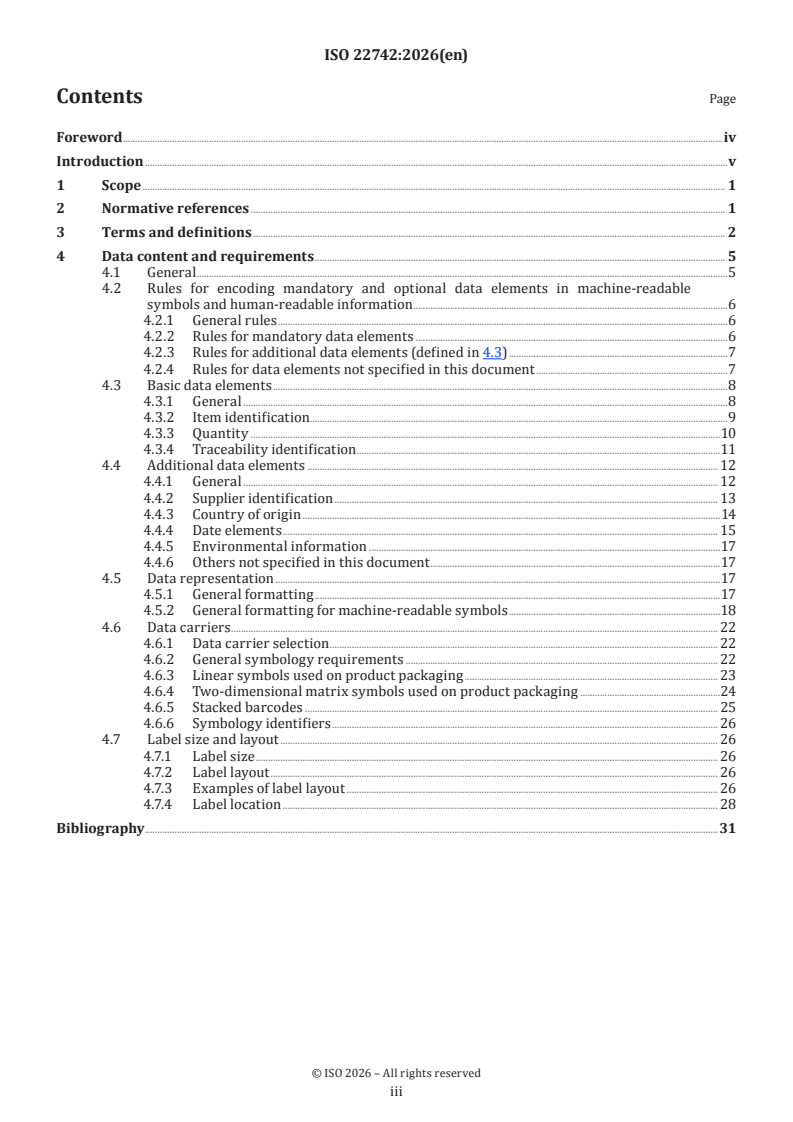
Contents Page
Foreword .iv
Introduction .v
1 Scope . 1
2 Normative references . 1
3 Terms and definitions . 2
4 Data content and requirements . 5
4.1 General .5
4.2 Rules for encoding mandatory and optional data elements in machine-readable
symbols and human-readable information .6
4.2.1 General rules .6
4.2.2 Rules for mandatory data elements .6
4.2.3 Rules for additional data elements (defined in 4.3) .7
4.2.4 Rules for data elements not specified in this document .7
4.3 Basic data elements .8
4.3.1 General .8
4.3.2 Item identification . . .9
4.3.3 Quantity .10
4.3.4 Traceability identification .11
4.4 Additional data elements . 12
4.4.1 General . 12
4.4.2 Supplier identification . 13
4.4.3 Country of origin .14
4.4.4 Date elements . 15
4.4.5 Environmental information .17
4.4.6 Others not specified in this document .17
4.5 Data representation .17
4.5.1 General formatting .17
4.5.2 General formatting for machine-readable symbols .18
4.6 Data carriers . 22
4.6.1 Data carrier selection . . 22
4.6.2 General symbology requirements . 22
4.6.3 Linear symbols used on product packaging . 23
4.6.4 Two-dimensional matrix symbols used on product packaging .24
4.6.5 Stacked barcodes . 25
4.6.6 Symbology identifiers . 26
4.7 Label size and layout . 26
4.7.1 Label size . 26
4.7.2 Label layout . 26
4.7.3 Examples of label layout . 26
4.7.4 Label location . 28
Bibliography .31
iii
Foreword
ISO (the International Organization for Standardization) is a worldwide federation of national standards
bodies (ISO member bodies). The work of preparing International Standards is normally carried out through
ISO technical committees. Each member body interested in a subject for which a technical committee
has been established has the right to be represented on that committee. International organizations,
governmental and non-governmental, in liaison with ISO, also take part in the work. ISO collaborates closely
with the International Electrotechnical Commission (IEC) on all matters of electrotechnical standardization.
The procedures used to develop this document and those intended for its further maintenance are described
in the ISO/IEC Directives, Part 1. In particular, the different approval criteria needed for the different types
of ISO document should be noted. This document was drafted in accordance with the editorial rules of the
ISO/IEC Directives, Part 2 (see www.iso.org/directives).
ISO draws attention to the possibility that the implementation of this document may involve the use of (a)
patent(s). ISO takes no position concerning the evidence, validity or applicability of any claimed patent
rights in respect thereof. As of the date of publication of this document, ISO had not received notice of (a)
patent(s) which may be required to implement this document. However, implementers are cautioned that
this may not represent the latest information, which may be obtained from the patent database available at
www.iso.org/patents. ISO shall not be held responsible for identifying any or all such patent rights.
Any trade name used in this document is information given for the convenience of users and does not
constitute an endorsement.
For an explanation of the voluntary nature of standards, the meaning of ISO specific terms and expressions
related to conformity assessment, as well as information about ISO's adherence to the World Trade
Organization (WTO) principles in the Technical Barriers to Trade (TBT), see www.iso.org/iso/foreword.html.
This document was prepared by Technical Committee ISO/TC 122, Packaging.
This third edition cancels and replaces the second edition (ISO 22742:2010), which has been technically
revised.
The main changes are as follows:
— added URL formats;
— preference on formats with concatenated fields;
— preference on 2D matrix symbologies.
Any feedback or questions on this document should be directed to the user’s national standards body. A
complete listing of these bodies can be found at www.iso.org/members.html.
iv
Introduction
Bar code marked product package labels are in widespread use in global industries. A number of different
standards exist, each designed to meet the requirements of that specific industry sector. For effective and
economic use within and between industry sectors, one common multi industry standard is a necessity.
A bar code marked product package label is designed to facilitate the automation of inventory, distribution,
repair and point of purchase operations. The bar code information on the product package label can be used
as a key to access the appropriate database, which contains detailed information about the product including
information transmitted via electronic data interchange (EDI). In addition, a product package label can
contain other information as agreed between the trading partners.
Two dimensional symbols can be included to assist moving greater amounts of product data from sender to
recipient.
Labelers can include a code containing a URL on product package for marketing and information purposes
by the labeler to enable direct access via smart phone.
[2]
Whereas ISO 15394 is intended to support the transportation function within the supply chain (e.g.
[9]
from the shipping dock, through the transportation processes, and to the receiving dock) and ISO 28219
handles marking of the product itself, this document is intended to support the logistic functions preceding
and following transportation. At the origin point, this document is designed for use from manufacture to
storage, to picking and packing, to delivery to the shipping dock, and all associated inventory processes.
At the destination point, it is designed for use from the receiving dock to order checking, to storage, to
consumption, and to all associated inventory processes and reverse logistic processes.
v
International Standard ISO 22742:2026(en)
Packaging — Linear bar code and two-dimensional symbols
for product packaging
1 Scope
This document:
a) specifies the minimum requirements for the design of labels containing a linear bar code and two
dimensional (2D) symbols on product packages to convey data between trading partners;
b) provides guidance for the formatting on the label of data presented in a linear bar code, 2D symbols or
human-readable form;
c) provides specific recommendations regarding the choice of linear bar code and 2D symbologies, and
specifies quality requirements and classes of bar code density;
d) provides specific recommendations regarding both linear and 2D symbologies, which allow a broad
choice for general use of scanning hardware (e.g. area imagers, linear imagers, single line laser scanners,
and raster laser scanners);
e) makes recommendations as to label placement, size and the inclusion of free text and any appropriate
graphics.
This document supports item identification and supply chain processes, at the product package level, such
as inventory control, picking, and point of use.
[2]
NOTE 1 ISO 15394 supports the distribution and transportation business processes, so aiding the tracing and
tracking of unique shipments.
NOTE 2 ISO 28219 addresses the direct part marking.
The purpose of this document is to establish the machine readable (e.g. bar code) and human-readable data
content of labels applied to product packages.
Intended applications include, but are not limited to, inventory, warehouse management, maintenance and
point of purchase.
While guidance is provided, specific label dimensions or marking areas and the location of the information
are not defined in this document. Before implementing this specification, suppliers and manufacturers are
advised to review and mutually agree on these details with their trading partners.
This document does not supersede or replace any applicable safety or regulatory marking or labelling
requirements. It is intended to satisfy the product package requirements of numerous applications
and industry groups. As such, it is applicable to a wide range of industries, each of which has specific
implementation guidelines. This document is also applicable to any other labelling requirements.
2 Normative references
The following documents are referred to in the text in such a way that some or all of their content constitutes
requirements of this document. For dated references, only the edition cited applies. For undated references,
the latest edition of the referenced document (including any amendments) applies.
ISO 3166-1, Codes for the representation of names of countries and their subdivisions — Part 1: Country code
ISO/IEC 15415, Automatic identification and data capture techniques — Bar code symbol print quality test
specification — Two-dimensional symbols
ISO/IEC 15416, Automatic identification and data capture techniques — Bar code print quality test specification
— Linear symbols
ISO/IEC 15459-3, Information technology — Automatic identification and data capture techniques — Unique
identification — Part 3: Common rules
ISO/IEC 15418, Information technology — Automatic identification and data capture techniques — GS1
Application Identifiers and ASC MH10 Data Identifiers and maintenance
ISO/IEC 15434, Information technology — Automatic identification and data capture techniques — Syntax for
high-capacity ADC media
ISO/IEC 15438, Information technology — Automatic identification and data capture techniques — PDF417 bar
code symbology specification
ISO/IEC 16022, Information technology — Automatic identification and data capture techniques — Data Matrix
bar code symbology specification
ISO/IEC 18004, Information technology — Automatic identification and data capture techniques — QR code
bar code symbology specification
ISO/IEC 18975, Information technology — Automatic identification and data capture techniques — Encoding
and resolving identifiers over HTTP
ISO/IEC 19762, Information technology — Automatic identification and data capture (AIDC) techniques —
Vocabulary
IEC 61406-1, Identification Link - Part 1: General requirements
IEC 61406-2, Identification link Part 2: Types/models, lots/batches, items and characteristics
ANSI MH10.8.2, Data Application Identifier Standard
DIN 16598, Syntax keyboard and Web compatible encoding of data elements in machine readable symbols
applied with ASC Data Identifiers
GS1, GS1 General Specifications
3 Terms and definitions
For the purposes of this document, the terms and definitions given in ISO/IEC 19762 and the following apply.
ISO and IEC maintain terminology databases for use in standardization at the following addresses:
— ISO Online browsing platform: available at https:// www .iso .org/ obp
— IEC Electropedia: available at https:// www .electropedia .org/
3.1
Code 128
[1]
continuous, variable length, bar code symbology capable of encoding all 128 (code 0-127) ISO/IEC 646
[14]
IRV characters, the 128 upper characters of ISO/IEC 8859-1 (codes 128-255), and four non-data function
characters
[3]
Note 1 to entry: See ISO/IEC 15417 for the Code 128 symbology specification.
3.2
component
part, assembly or raw material that is a constituent of a higher-level assembly
3.3
country of origin
manufacturing country wherein the product obtained its present identity as a part, subassembly or finished
product
3.4
data element title
part of the data area title for linear code that gives a brief description of the data element
EXAMPLE Part number and customer number.
Note 1 to entry: The data element can contain abbreviations.
3.5
Data Matrix
error correcting two-dimensional matrix symbology defined by ISO/IEC 16022
3.6
dot
localized region with a reflectance that differs from that of the surrounding surface
3.7
GS1 system
specifications, standards and guidelines administered by GS1
3.8
EAN/UPC
family of bar code symbols including EAN-8, EAN-13, UPC-A, and UPC-E bar code symbols as defined by
ISO/IEC 15420
3.9
error correction
mathematical procedure that allows the detection and rectification of errors to take place
3.10
format
high capacity ADC medium comprising one or more segments (3.15)
Note 1 to entry: A format contains one format type.
3.11
format trailer
character used to identify the end of a format envelope
Note 1 to entry: This term is defined by ISO/IEC 15434.
3.12
PDF417
error correcting two-dimensional multi row symbology defined by ISO/IEC 15438
3.13
product package
first tie, wrap or container of a single item or quantity thereof that constitutes a complete identifiable pack
Note 1 to entry: A product package can be an item packaged singularly, multiple quantities of the same item packaged
together, or a group of parts packaged together. For the purposes of this document, the term “product package”
includes component packages and packaging intended for storage and transport.
3.14
QR Code
error correcting matrix symbology consisting of an array of nominally square modules arranged in an
overall square pattern, including a unique finder pattern located at three corners of the symbol and intended
to assist in easy location of its position, size and inclination
Note 1 to entry: See ISO/IEC 18004 for the QR Code symbology specification.
3.15
segment
logical group of data elements, specifically a logical portion of an electronic data interchange (EDI) or high
capacity ADC message
Note 1 to entry: This term is defined by ISO/IEC 15434.
3.16
semantics
means by which the purpose of a field of data is identified
Note 1 to entry: Semantic examples used in automatic data capture include ISO/IEC 15418, ANSI MH10.8.2 Data
Identifiers, GS1 Applications Identifiers, EDI (X12/EDIFACT/CII) Data Element Qualifiers.
3.17
serial number
code assigned by the supplier (3.19) to an entity for its lifetime
EXAMPLE Computer serial number, traceability number and contract tool identification.
3.18
structure
order of data elements in a message
3.19
supplier
party that produces, provides or furnishes an item or service
3.20
syntax
way in which data are put together to form messages
Note 1 to entry: Syntax also includes rules governing the use of appropriate identifiers, delimiters, separator
character(s), and other non-data characters within the message. Syntax is the equivalent to grammar in spoken
language. The syntactic example used in automatic data capture includes ISO/IEC 15434.
3.21
traceability identification
code assigned to identify or trace a unique group of entities (e.g. lot, batch, item, revision or serial number)
3.22
traceability number
code assigned by the supplier (3.19) to identify and trace a unique group of entities (e.g. lot, batch)
3.23
Global Location Number
GLN
GS1 identification key to identify locations or parties
4 Data content and requirements
4.1 General
Before implementing this specification, suppliers and manufacturers should review and mutually agree on
specific labelling details with their trading partners. The labelling requirements of this document and other
standards can be combined into one label or appear as separate labels. The common rules as defined by
ISO/IEC 15459-3 shall be applied.
The label format accommodates both mandatory and optional data elements.
The number included in the character count is exclusive of overhead characters such as start and stop
characters and any other characters required by a standard symbology specification to properly encode
data.
All data elements encoded in a machine-readable medium shall be preceded by a qualifier. Qualifiers may
be Data Identifier defined in ISO/IEC 15418 and ANSI MH10.8.2 Data Identifiers or Application Identifiers as
defined in ISO/IEC 15418 and the GS1 General Specifications standard.
The choice of appropriate qualifiers (e.g. GS1 applications identifiers, data identifiers etc.) for any user will
normally be defined in the applicable industry convention being followed.
Any industries developing product or shipment identification conventions should consider business
practices, information requirements and systems capabilities of the trading partners based on the common
rules as defined by ISO/IEC 15459-3. Frequently used are Data Identifiers or GS1 Applications Identifiers. In
this case users may also recognise the following guidelines.
a) GS1 applications identifiers
1) The definitions of the GS1 applications identifiers are supported by application guidelines. The GS1
AIs, and associated guidelines, have been designed for international and multi sectorial trading
purposes.
2) The GS1 item identification system and related encodation specification are complemented by the
GS1 maintained Application Identifiers, hereafter referred to as “GS1 Applications Identifiers” (GS1
AIs). This specification comprises two principal elements that are the key to any encoding system:
the data content and the data carrier.
3) The use of GS1 AIs is subject to the rules established by GS1.
4) GS1 AIs identify generic and simple data fields for use in cross sectorial and international supply
chain applications. The GS1 General Specifications standard provide rules for the definition, format
and structure of the data fields.
5) Each GS1 AI consists of two up to four digits. A list of existing and future AIs and their data fields
are contained within the GS1 AI lengths table in the GS1 General Specifications standard.
b) Data Identifiers
1) The descriptions in the Data Identifier list are general in nature and are used in industrial and
international applications. Specific application guidelines provide the detailed definition used
amongst trading partners.
2) The full list of registered Data Identifiers and the full specification for their use are found in
ANSI MH10.8.2.
3) DIs may be used with any alphanumeric data carrier and are designed to ensure cross industry
commonality of Data Identifiers used in automatic identification technologies.
4) DIs have a format of one alphabetic character alone, or one alphabetic character prefixed by one,
two or three numeric characters.
[8]
When using specific qualifiers, the Issuing Agency Code (IAC) established in ISO/IEC 15459-2 and the
Company Identification Number (CIN) assigned by the issuing agency is used as prefix within data fields.
Examples for this usage are the DIs 25P, 25S, 37S and 25T, and the AIs 00 and 01. In the GS1 General
Specifications standard, this coding structure is the GS1 company prefix (GCP).
The format of values is described by a sequence of character set and character count range. The character
set is described as follows:
— a: alphabet;
— n:digit;
— an: alphanumeric.
The character count may be defined by:
— number: field of given fix length;
— number.number: character count is between the given count. If one number is omitted, the minimum/
maximum applies, e.g. ".5" describes 0 to 5 characters, "3." describes minimum three characters.
Multiple encoded fields are represented by a plus sign (+). The plus sign is not encoded in the data.
EXAMPLE "an3+n.3" describes three alphanumeric characters directly followed by up to three digits. A data
string in compliance conformity with this example is "A3B45". "A3B" is the three-character alphanumeric string. "45"
are two digits, which is in conformance to the specification of up to three digits.
NOTE Some data fields contain the “+” character as separator within a data field, e.g. 37S. These appearances of
the “+” character are not meant in this context.
Other data structures with a scope on a limited application field are not covered by this document. One
[12]
example is the Health industry business code (HIBC) for medical devices .
4.2 Rules for encoding mandatory and optional data elements in machine-readable
symbols and human-readable information
4.2.1 General rules
The choice to encode in linear bar code, 2D symbol, or both shall be agreed between trading partners.
The appropriate qualifier (e.g. Data Identifier or Application Identifier) shall precede all machine-readable
data elements. The Data or Application Identifiers should be selected from the options given in 4.1 and shall
be in accordance with ISO/IEC 15418.
4.2.2 Rules for mandatory data elements
4.2.2.1 Encoding mandatory elements in machine readable symbols
Mandatory data elements shall be encoded in a machine-readable symbol, as follows.
a) If only a linear bar code is used, the mandatory data shall be in the linear bar code.
b) If both a linear bar code and 2D symbol are used on the label, the mandatory data shall be in the linear
bar code and the 2D symbol.
c) If a 2D symbol is used, all coded data shall be in the 2D symbol.
4.2.2.2 Human-readable information for encoded data elements
Human-readable information for mandatory data elements shall be on the label in all cases, as follows.
a) For linear symbols, the human readable shall be human-readable interpretation (HRI).
b) For 2D symbols, the human readable shall be any combination of HRI and human translation.
When mandatory data are only in the 2D symbol, the mandatory human readable shall be adjacent to the 2D
symbol.
NOTE The human-readable information can be presented in another syntax than data in codes. For example,
parentheses are used to highlight qualifiers. These parentheses are not allowed to be used in code contents.
4.2.3 Rules for additional data elements (defined in 4.3)
4.2.3.1 Encoding in machine-readable symbols
Additional data elements should be encoded in a machine-readable symbol, as follows.
a) If only linear bar codes are used, the data should be in the linear bar code.
b) If both linear bar codes and the 2D symbol are used
1) data should be in the linear bar code and should be included in 2D;
2) if the data are included in the linear bar code, the data shall also be included in the 2D symbol;
3) if the same additional data occur in multiple data carriers on a single item, the data values shall be
the same.
c) If only a 2D symbol is used, the data should be in the 2D symbol.
4.2.3.2 Human-readable information for encoded data elements
Human-readable information for optional data elements encoded in a linear symbol shall be on the label in
all cases. In this case, human-readable interpretation shall be present and human translation may be added.
For data elements encoded in 2D symbols, the human-readable information should be on the label and it
shall be any combination of HRI and human translation.
4.2.3.3 Human-readable information for data elements not encoded
Human-readable information for additional data elements that are not encoded in machine-readable symbols
may be shown in human-readable information only.
4.2.4 Rules for data elements not specified in this document
4.2.4.1 Encoding additional data elements in machine-readable symbols
a) If only linear bar codes are used, the data may be in the linear bar code.
b) If both linear bar codes and 2D symbols are used:
1) data may be in linear bar code and should be included in 2D;
2) if the same additional data occur in multiple data carriers on a single item, the data values shall be
the same.
c) If only a 2D symbol is used, the data should be in the 2D symbol.
4.2.4.2 Human-readable information for encoded data elements
For data elements encoded in a linear symbol, the human-readable information shall be on the label in
all cases, see Table 1. In this case, human-readable interpretation shall be present and human-readable
translation may be added.
For data elements encoded in 2D symbols, the human-readable information shall be on the label. This
information may be in the form of a HRI or human translation. Relevant legal demands or industry
specifications can apply.
4.2.4.3 Human-readable information for data elements not encoded
Other data elements may be shown in free text only.
EXAMPLE Product description and parametric values.
Table 1 — Machine-readable symbols and human-readable information
Requirement for encoding Requirement for
Machine-readable
Data element status human-readable
symbols on label
Linear bar code 2D
information
Bar code required not applicable required
Mandatory Bar code + 2D required required required
2D not applicable required required
Bar code optional encoding required if encoded
required if encoded
b
Bar code + 2D optional encoding optional encoding
Optional
in bar code
a
specified
2D not applicable optional encoding optional if encoded
None not applicable not applicable inclusion possible
Bar code encoding possible not applicable required if encoded
required if encoded
Bar code + 2D encoding possible encoding possible
Optional
in bar code
a
not specified
2D not applicable optional encoding possible if encoded
None not applicable not applicable inclusion possible
a
In this document, “specified optional data elements” are supplier item identification, country of origin, and date. All others
belong to the category “optional data elements not specified”.
b
If the data element is encoded in linear bar code, it shall also be included in the 2D symbol. If the same additional data occur
in multiple data carriers on a single item, the data values shall be the same.
4.3 Basic data elements
4.3.1 General
Whether a data element is mandatory or optional is dependent on industry, market, or individual trading
partner requirements, see Table 2. These data elements may be human readable, machine readable, or both.
If machine readable, the data elements shall be in accordance with ISO/IEC 15418.
Certain data elements are mandatory to a broad range of product package applications. These are:
— item identification code,
— quantity without or quantity with unit of measure,
— traceability identification,
— serial number or traceability number.
Table 2 — Data element usage
Data element Requirement
Item identification code Mandatory.
Mandatory, if the package contains more than one of an item and the quantity
may not be found in the master data of the product.
Quantity
Note that some manufacturers may change the product code to represent a change
in quantity.
Optional, but may be mandatory due to applicable legal demands or industry
Traceability identification
specifications.
4.3.2 Item identification
Either the supplier or the customer may assign item identification. Either the customer item identification, or
the supplier item identification, or both may be shown on the label as agreed between the trading partners.
If both are shown on the label, at least one of the two item identifiers shall be encoded in a machine-readable
symbol.
The supplier's part number shall be used for item identification in the absence of a different agreement
between trading partners.
The maximum length of this data element is 25 alphanumeric characters, not including the appropriate
identifier (AI or DI).
The item identification data field shall be in one of the formats shown in Tables 3 and 4. These identifiers
represent the most frequently used formats for product package. The complete list of possible item
identification codes shall be found in ANSI MH 10.8.2 or the GS1 General Specifications standard.
Table 3 — Data Identifiers used in item identification
Data characteristics type and
Data Identifier Data field Description
length
P Product number an1 + an.25 Customer assigned part number.
1P Product number an2 + an.25 Supplier assigned part number.
Combined manufacturer identifica-
tion code/item code under the 12/13
3P Product number an2 + n12.13 + n2.5
digit GS1 GTIN formats, plus supple-
mental codes, if any.
8P Product number an2 + n14 GS1 GTIN
Component of an item (one product
19P Product number an3 + an.32
contained in multiple packages).
Internationally unique item code.
25P Product number an3 + an.32
Combined IAC/CIN and item code
assigned by the supplier.
The value is the concatenation of the
Versioned product following fields: IAC/CIN, literal plus
51P an3+an.50
number ("+"), Product code, literal plus ("+"),
product version
The value is the concatenation of the
following fields: conformity assess-
53P EU Marine Equipment an3+a1+n4+an5.20
ment module, notified body, certifi-
cate
Pharmacy product number main-
tained by IFA. The value is comprised
IFA Pharmacy Product of the following fields: two characters
9N an2+an2+an15.26+n2
Number product registration code (PRAC),
product reference (PR), two PPN
check digits
Table 4 — Application Identifiers used in item identification
Application Data characteristics
Data field Description
Identifier type and length
Global Trade Item Number: shorthand term for
n8
Not applicable when
the GS1 Global Trade Item Number.
Global Trade Item n12
used in UPC-A, EAN-
Number (GTIN) n13
A GTIN may use the GTIN 8, GTIN-12, GTIN 13 or
13, EAN-8 or ITF-14
n14
GTIN 14 standard numbering structure.
01 GTIN n2 + n14 GTIN identification of trade items.
03 GTIN n2 + n14 GTIN identification of made to order trade item.
Product version number defined by the man-
22 Product version n2 + an.20
ufacturer.
241 Part number n3 + an.30 Customer assigned part number.
Roll products – width, length, core diameter,
8001 Roll products n4 + n14
direction and splices.
Identification of the
GS1 identification of a fixed measure trade item
8006 components of a n4 + n14 + n2 + n2
(GTIN) packed in separate parcels (n of x).
trade item
4.3.3 Quantity
Unless otherwise specified, the implied quantity of the product identified on the outside of the product
package is one.
Two primary methods exist of identifying the quantity inside a product package.
a) The first situation is where the product package identifies the product code and the quantity contained
therein on the product package label. This may be analogous to a raw material being received where ten
of an item are received in the same box and the product package identifies ten products having the same
product code. In this situation, the quantity would be ten.
b) The second situation is where a quantity of product and its packaging are identified by a product code
different from the product code assigned to the product inside. This may be analogous to a consumable
unit (e.g. batteries) where the combination of the items, quantity and packaging constitutes a unique
product code. In this situation, the quantity would be one.
If used, the quantity shall be the quantity in the package or container to which the label is affixed. The
default unit of measure for Data Identifier “Q” is EACH or PIECES. The default unit of measure for Application
Identifier “30” is EACH or PIECES (count of items).
When Data Identifiers are used and when a different unit of measure is required, as agreed between trading
partners, the Data Identifier “7Q” shall be used with the quantity followed by two alphanumeric characters
representing the ANS X12.3 unit of measurement code. In the special case where multiple containers
comprise a single product (the contents of each container shall be combined with the content of the other
containers to constitute a single product), the Data Identifier “6Q” or Application Identifier “8006” shall be
used to link the various containers.
When Application Identifiers are used and when a different unit of measure is required, as agreed between
trading partners, one of the Application Identifiers in the “3nn” series, as specified in the GS1 General
Specifications standard, shall be used with a decimal point indicator and the quantity.
When the GS1 system is used, the identification always relates to the complete package (packaging +
contents). Fixed measure trade items are those that are always produced in the same version and composition
(type, size, mass, quantity of contents, design, etc.). Like a “fixed” measure trade item, a “variable” measure
trade item is an entity with predefined characteristics (e.g. the nature of the product or its contents). Unlike
a “fixed” measure trade item, a “variable” measure trade item has at least one characteristic that varies
whilst other characteristics of the trade item remain the same. The variable characteristic may be mass,
dimension, number of items contained or volume information. The complete identification of a variable
measure trade item consists of both an identification number and information about the variable data.
The quantity data field should be in one of the formats shown in Tables 5 and 6. These identifiers represent
the most frequently used formats for product package applications.
Table 5 — Data Identifiers used to identify quantity
Application Data characteristics
a
Data field Description
Identifier type and length
The number of products (pcs) in the shipment
container.
Q Quantity in package an1 + n.14
EXAMPLE 1 Q2000.
The actual mass of package (kilograms implied by
convention). (This includes an encoded decimal
2Q Actual mass an2 + n.14
point, if necessary.)
EXAMPLE 2 2Q200.1.
Where multiple containers comprise a single
product (the contents of each container shall
be combined with the content of the other con-
One package over tainers to constitute a single product) to link the
6Q an2 + n.1/n.2
multiple containers various containers. The format # of # (“this is
the nth piece of x pieces to define the product”).
Presented in the format “n/x”, where the “/”
(slash) is used as a delimiter between two values.
Print only the significant digits for the human-readable quantity. Do not print leading zero.
a
Examples show encoded characters. Spaces are shown for clarity but are not encoded.
Table 6 — Application Identifiers used to identify quantity
Application Data characteristics
a
Data field Description
Identifier type and length
Count of items contained in a variable measure
trade item.
30 Quantity in package n2 + n.8
EXAMPLE 1 302 000.
Defined quantity and unit measure of the pack-
Quantity with spe-
age (mass, sqm, volume, length, etc.) in a metric
cific unit of measure
b
and non-metric system. Possible combinations
3nn n4 + n6
(with decimal point
of AIs: about 50.
indication)
EXAMPLE 2 310 100 002 5 equals 2,5 kg net mass.
For AI 30, print only the significant digits for the human-readable quantity. Do not print leading zeros.
a
Examples show encoded characters. Spaces are shown for clarity but are not encoded.
b
Plus one digit for decimal point indication.
4.3.4 Traceability identification
The supplier assigns the traceability identification if applicable. Traceability identification is mandatory
if required by legal demands or industry specifications. This category of identification includes product
information, such as serial numbers, lot or batch numbers.
When Data Identifiers are used, traceability identification should be either a serial number, a lot/batch
number or a manufacturing date.
When Application Identifiers are used, traceability identification should be either a serial number (using the
Application Identifier “21”) or a lot/batch number (using the Application Identifier “10”).
In certain circumstances, both the serial number and the lot/batch number may be shown on the label. In
this case, the one sufficient for tracing the device shall be at least included in the machine-readable symbol.
The maximum length of this data element is 32 alphanumeric characters, if not specified by Table 7 or 8.
Applicable industry specifications may specify other maximum length values and may extend the length
until 50 alphanumeric characters.
The product traceability data field should be in one of the formats shown in Tables 7 and 8. These identifiers
represent the most frequently used formats for product package applications.
Table 7 — Data Identifiers used for traceability information
Data characteristics type and
Data Identifier Data field Description
length
Serial number or code assigned by
...