

ISO 24862
(Main)Plastics — Polyols for use in the production of polyurethanes — Determination of degree of unsaturation for polyols by Raman spectrometric method
- Abstract
This international standard specifies a method for quantifying the total unsaturation of polyetherpolyols for use in the production of polyurethanes by Raman spectrometric method. It is not applicable to unsaturated compounds that are conjugated with a carbonyl group, a carboxyl group, or a nitrile group.
- Status
- Not Published
- Technical Committee
- ISO/TC 61/SC 12 - Thermosetting materials
- Drafting Committee
- ISO/TC 61/SC 12/WG 6 - Polyurethane raw materials
- Current Stage
- 6000 - International Standard under publication
- Start Date
- 22-Sep-2026
- Completion Date
- 10-Oct-2026
Buy Documents
ISO/PRF 24862 - Plastics — Polyols for use in the production of polyurethanes — Determination of degree of unsaturation for polyols by Raman spectrometric method
REDLINE ISO/PRF 24862 - Plastics — Polyols for use in the production of polyurethanes — Determination of degree of unsaturation for polyols by Raman spectrometric method
ISO 24862 is an ISO International Standard for plastics that covers a Raman spectrometric method for measuring the total unsaturation of polyether polyols used in polyurethane production. It gives a practical way to quantify allyl and cis-propenyl unsaturation without using the mercuric acetate titration route.
What does ISO 24862 specify?
ISO 24862 specifies a test method for the total unsaturation of polyether polyols used in the production of polyurethanes. The method is based on Raman spectrometry and is not suitable for unsaturated compounds conjugated with a carbonyl group, a carboxyl group, or a nitrile group.
The document is organized into 9 clauses:
- Scope
- Normative references
- Terms and definitions
- Principle
- Reagents and materials
- Apparatus
- Procedure
- Calculation of degree of unsaturation
- Test report
It also includes 3 informative annexes with worked examples.
| Annex | What it covers |
|---|---|
| Annex A | Example of relative scattering intensity measurement |
| Annex B | Example of unsaturation measurement |
| Annex C | Example of Raman spectrums |
What are the key requirements of ISO 24862?
ISO 24862 sets out a complete measurement workflow: choose suitable reagents and equipment, record Raman peaks for the sample and internal standard, calculate relative scattering intensity from model compounds, and report the total degree of unsaturation in meq/g.
The scope limits what the method can be used for
ISO 24862 applies to total unsaturation in polyether polyols used for polyurethane production. It excludes unsaturated compounds with conjugation to carbonyl, carboxyl, or nitrile groups, so the method should be reserved for samples that match the chemistry described in the standard.
The principle is peak comparison, not direct chemical titration
ISO 24862 uses the Raman bands of the allyl and cis-propenyl C=C stretch regions, with intensities measured relative to an internal standard peak. The document identifies m-dichlorobenzene as the internal standard because its aromatic ring peak appears at 1 580 cm^-1, away from the analytical bands. In practice, this means the operator compares the sample signal against a stable reference signal rather than trying to measure absolute intensity alone.
Model compounds establish the response factors
ISO 24862 requires model compounds for allyl and cis-propenyl terminal groups. Their measured signals are used to determine the relative scattering intensity for each group per unit degree of unsaturation. That matters because the final calculation depends on the instrument response for each unsaturated group, not just on peak height.
The apparatus needs Raman capability suitable for quantitative work
ISO 24862 recommends a Raman spectrometer with a 532 nm laser excitation source. For quantitative analysis, the detector’s relative intensity across the measurement range shall be calibrated; if that is not feasible, the standard recommends using a CCD or CMOS detector with the same 532 nm source to keep results consistent and comparable. The spectrometer should cover at least 1 500 cm^-1 to 1 750 cm^-1, with 100 cm^-1 to 3 500 cm^-1 recommended, and the spectral resolution shall be at least 6 cm^-1.
Sample handling and weighing need to be controlled
ISO 24862 calls for a measuring cell such as a capillary with at least a 1 mm inner diameter, and an equivalent cell may be used if it gives the same results. An analytical balance with readability of 0.000 1 g and weighing accuracy of 0.001 g is specified. In practice, this means the operator must be able to prepare small, reproducible mixtures of sample and internal standard.
The procedure depends on correct peak measurement
ISO 24862 measures the scattering intensity of the allyl and cis-propenyl C=C bands against the internal standard band. The measurement window is 1 500 cm^-1 to 1 750 cm^-1, and Annexes A and B show example measurement conditions and peak-separation ranges. The procedure notes that peak heights can be taken from the baseline or after baseline correction, so the important point is to use a consistent way of extracting the peak intensity.
The calculation separates the two types of unsaturation
ISO 24862 calculates separate degrees of unsaturation for the allyl group and the cis-propenyl group, then adds them to obtain the total degree of unsaturation. The result is reported in meq/g. Annex B also shows that the relative scattering intensity should be measured on the same device used for the test, and measured periodically because detector performance can drift.
The test report needs enough detail for traceability
ISO 24862 requires the report to identify the standard used, describe the sample, identify the internal standard and model compounds, record the instrument and settings, list the masses and calculated values, and state the date and the measurer. For users, that supports traceability, repeatability, and comparison between laboratories.
What terms does ISO 24862 define?
ISO 24862 uses the terms and definitions of ISO 472, and several document-specific terms are central to the method.
- Degree of unsaturation - the amount of unsaturated terminal group content, expressed in meq/g in this standard.
- Total degree of unsaturation - the sum of the allyl and cis-propenyl contributions measured for the sample.
- Internal standard - the reference material, m-dichlorobenzene, used to normalize Raman peak intensity.
- Model compounds - reference compounds used to establish the relative Raman response of allyl and cis-propenyl groups.
- Allyl group - one of the unsaturated terminal groups measured by the method, identified by its Raman band near 1 649 cm^-1.
- cis-Propenyl group - the other measured unsaturated terminal group, identified by its Raman band near 1 670 cm^-1.
- Raman shift - the peak position in cm^-1 used to locate the analytical bands.
Who uses ISO 24862?
ISO 24862 is used by laboratories that test polyether polyols, by polyurethane manufacturers, and by quality control teams that need to verify raw materials. It is also relevant to suppliers and buyers of polyols who need an agreed test method for specifications, incoming inspection, or supplier qualification.
In practice, it supports:
- routine QC of polyether polyols
- comparison of batches from different suppliers
- method-based verification in analytical laboratories
- process monitoring in polyurethane feedstock production
- documentation of unsaturation data in test reports
What changed in ISO 24862 from the previous edition?
ISO 24862 is intended to replace the mercuric acetate titration method used in ISO 17710. The introduction says the new approach was chosen to avoid the mercury waste handling associated with the earlier method and to provide a Raman spectrometric alternative.
Which standards are used with ISO 24862?
ISO 24862 cites ISO 472, Plastics - Vocabulary, for the terms and definitions used in the document. It also refers to ISO 17710, Plastics - Polyols for use in the production of polyurethanes - Determination of degree of unsaturation by microtitration, as the earlier method discussed in the introduction and compared in Annex B.
What does the ISO 24862 document contain?
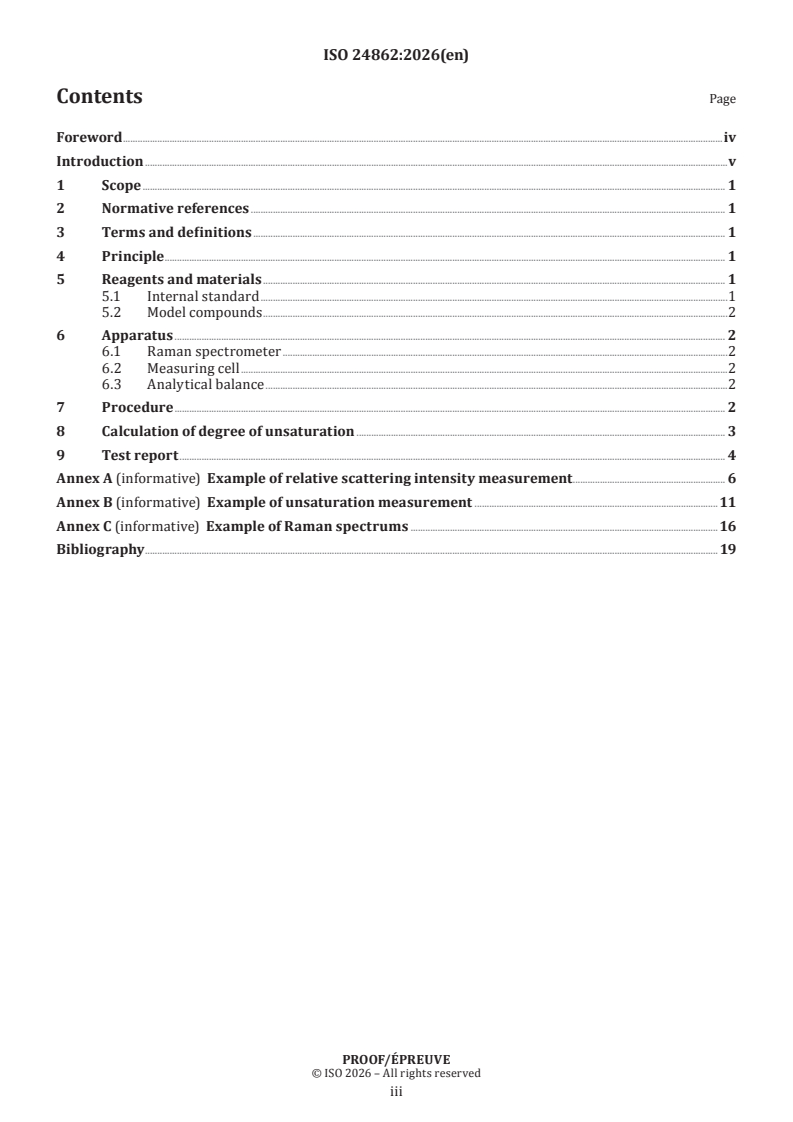
ISO 24862 contains the test principle, the reagent list, the apparatus requirements, the procedure, the calculation formulas, and the reporting items needed to run the method. It also includes informative annexes with examples of relative scattering intensity measurement, example unsaturation measurements, and example Raman spectrums.
The annexes provide practical support for method setup and interpretation. Annex A shows how peak intensities are separated and used to derive relative scattering intensity, Annex B shows example polyol measurements and compares the Raman method with microtitration, and Annex C shows representative spectra for polyol samples and model compounds.
Buy Documents
ISO/PRF 24862 - Plastics — Polyols for use in the production of polyurethanes — Determination of degree of unsaturation for polyols by Raman spectrometric method
REDLINE ISO/PRF 24862 - Plastics — Polyols for use in the production of polyurethanes — Determination of degree of unsaturation for polyols by Raman spectrometric method
Get Certified
Connect with accredited certification bodies for this standard

DIN CERTCO
DIN Group product certification.

Smithers Quality Assessments
US management systems and product certification.
Sponsored listings
Frequently Asked Questions
ISO 24862 is a draft published by the International Organization for Standardization (ISO). Its full title is "Plastics — Polyols for use in the production of polyurethanes — Determination of degree of unsaturation for polyols by Raman spectrometric method". This standard covers: This international standard specifies a method for quantifying the total unsaturation of polyetherpolyols for use in the production of polyurethanes by Raman spectrometric method. It is not applicable to unsaturated compounds that are conjugated with a carbonyl group, a carboxyl group, or a nitrile group.
This international standard specifies a method for quantifying the total unsaturation of polyetherpolyols for use in the production of polyurethanes by Raman spectrometric method. It is not applicable to unsaturated compounds that are conjugated with a carbonyl group, a carboxyl group, or a nitrile group.
ISO 24862 is classified under the following ICS (International Classification for Standards) categories: 83.100 - Cellular materials. The ICS classification helps identify the subject area and facilitates finding related standards.
ISO 24862 is available in PDF format for immediate download after purchase. The document can be added to your cart and obtained through the secure checkout process. Digital delivery ensures instant access to the complete standard document.
Standards Content (Sample)
International
Standard
First edition
Plastics — Polyols for use in the
production of polyurethanes
— Determination of degree of
unsaturation for polyols by Raman
spectrometric method
Plastiques — Polyols destinés à la production de polyuréthanes
— Détermination du degré d'insaturation des polyols par
spectrométrie Raman
PROOF/ÉPREUVE
Reference number
© ISO 2026
All rights reserved. Unless otherwise specified, or required in the context of its implementation, no part of this publication may
be reproduced or utilized otherwise in any form or by any means, electronic or mechanical, including photocopying, or posting on
the internet or an intranet, without prior written permission. Permission can be requested from either ISO at the address below
or ISO’s member body in the country of the requester.
ISO copyright office
CP 401 • Ch. de Blandonnet 8
CH-1214 Vernier, Geneva
Phone: +41 22 749 01 11
Email: copyright@iso.org
Website: www.iso.org
Published in Switzerland
PROOF/ÉPREUVE
ii
Contents Page
Foreword .iv
Introduction .v
1 Scope . 1
2 Normative references . 1
3 Terms and definitions . 1
4 Principle . 1
5 Reagents and materials . 1
5.1 Internal standard .1
5.2 Model compounds .2
6 Apparatus . 2
6.1 Raman spectrometer .2
6.2 Measuring cell .2
6.3 Analytical balance .2
7 Procedure . 2
8 Calculation of degree of unsaturation . 3
9 Test report . 4
Annex A (informative) Example of relative scattering intensity measurement . 6
Annex B (informative) Example of unsaturation measurement .11
Annex C (informative) Example of Raman spectrums .16
Bibliography . 19
PROOF/ÉPREUVE
iii
Foreword
ISO (the International Organization for Standardization) is a worldwide federation of national standards
bodies (ISO member bodies). The work of preparing International Standards is normally carried out through
ISO technical committees. Each member body interested in a subject for which a technical committee
has been established has the right to be represented on that committee. International organizations,
governmental and non-governmental, in liaison with ISO, also take part in the work. ISO collaborates closely
with the International Electrotechnical Commission (IEC) on all matters of electrotechnical standardization.
The procedures used to develop this document and those intended for its further maintenance are described
in the ISO/IEC Directives, Part 1. In particular, the different approval criteria needed for the different types
of ISO document should be noted. This document was drafted in accordance with the editorial rules of the
ISO/IEC Directives, Part 2 (see www.iso.org/directives).
ISO draws attention to the possibility that the implementation of this document may involve the use of (a)
patent(s). ISO takes no position concerning the evidence, validity or applicability of any claimed patent
rights in respect thereof. As of the date of publication of this document, ISO had not received notice of (a)
patent(s) which may be required to implement this document. However, implementers are cautioned that
this may not represent the latest information, which may be obtained from the patent database available at
www.iso.org/patents. ISO shall not be held responsible for identifying any or all such patent rights.
Any trade name used in this document is information given for the convenience of users and does not
constitute an endorsement.
For an explanation of the voluntary nature of standards, the meaning of ISO specific terms and expressions
related to conformity assessment, as well as information about ISO's adherence to the World Trade
Organization (WTO) principles in the Technical Barriers to Trade (TBT), see www.iso.org/iso/foreword.html.
This document was prepared by Technical Committee ISO/TC 61, Plastics, Subcommittee SC 12, Thermosetting
materials.
Any feedback or questions on this document should be directed to the user’s national standards body. A
complete listing of these bodies can be found at www.iso.org/members.html.
PROOF/ÉPREUVE
iv
Introduction
Conventionally, a titration method using mercuric acetate (see ISO 17710) has been used as a method for
measuring degree of unsaturation of polyether polyols for polyurethanes. However, in recent years, the
treatment of mercury waste liquid associated with analysis has become a global problem.
This document is intended to replace the mercuric acetate titration method with a more facile and
environmentally friendly Raman spectrometric method.
PROOF/ÉPREUVE
v
International Standard ISO 24862:2026(en)
Plastics — Polyols for use in the production of polyurethanes
— Determination of degree of unsaturation for polyols by
Raman spectrometric method
1 Scope
This document specifies a method to measure the total unsaturation of polyether polyols used in the
production of polyurethanes by a Raman spectrometric method. It is not applicable to unsaturated
compounds that are conjugated with a carbonyl group, a carboxyl group, or a nitrile group.
2 Normative references
The following documents are referred to in the text in such a way that some or all of their content constitutes
requirements of this document. For dated references, only the edition cited applies. For undated references,
the latest edition of the referenced document (including any amendments) applies.
ISO 472, Plastics — Vocabulary
3 Terms and definitions
For the purposes of this document, the terms and definitions given in ISO 472 apply.
ISO and IEC maintain terminology databases for use in standardization at the following addresses:
— ISO Online browsing platform: available at https:// www .iso .org/ obp
— IEC Electropedia: available at https:// www .electropedia .org/
4 Principle
-1
The Raman shifts of the C=C bond stretching of allyl and cis-propenyl groups appear at 1 649 cm and
-1
1 670 cm , respectively.
The intensities of both peaks can be measured relative to the intensity of an internal standard peak.
-1
Compounds without peaks in the 1 600 to 1 700 cm region and with appropriate peaks in the immediate
vicinity can be used as an internal standard. Because m-dichlorobenzene has aromatic ring C=C peak
-1
appearing at 1 580 cm , it can be used as an internal standard.
The relative intensity of each unsaturated terminal group, allyl and cis-propenyl, are determined using
model compounds.
On the basis of the above relative intensities, degree of unsaturation of the allyl and the cis-propenyl groups
in polyether polyols are individually determined.
The total degree of unsaturation can be calculated by addition of both values.
5 Reagents and materials
5.1 Internal standard
m-Dichlorobenzene
PROOF/ÉPREUVE
5.2 Model compounds
Allyl alcohol base ethers
cis-Propenyl alcohol base ethers
6 Apparatus
Normal laboratory equipment and the following apparatus are recommended.
6.1 Raman spectrometer
A Raman spectrometer with a 532 nm laser excitation source should be used.
For quantitative analysis, calibration of the detector's relative intensity across the measurement range shall
be performed.
If such calibration is not feasible, the use of a CCD or CMOS detector in combination with a 532 nm laser
excitation source should be adopted to ensure consistency and comparability of results.
-1 -1
The Raman spectrometer should at least have a spectral range of 1 500 cm to 1 750 cm , however a wider
-1 -1 -1
spectral range of 100 cm to 3 500 cm is recommended. Spectral resolution of at least 6 cm is required.
6.2 Measuring cell
Capillary with at least a 1 mm inner diameter.
NOTE Equivalent measuring cells matching a particular Raman spectrometer can be used if they can be shown to
lead to the same results.
6.3 Analytical balance
Readability 0,000 1 g and weighing accuracy 0,001 g.
7 Procedure
The scattering intensity of the C=C stretch band of the allyl and cis-propenyl group are determined by
comparing the peak height with the internal reference band. The compounds without bands in the (1 600 to
-1
1 700) cm region and with appropriate bands in the immediate vicinity can be used as internal reference
-1
materials. Because m-dichlorobenzene (b.p. 173 °C) has aromatic ring C=C peak appearing at 1 580 cm , it
can be used as an internal standard. For example, in a sample with a total unsaturation of 0,05 meq/g, about
30 mg of m-dichlorobenzene is added to 0,5 g of sample, stirred thoroughly, and encapsulated in a capillary
with an inner diameter of 1 mm for measurement.
-1
The measurement area is (1 500 to 1 750) cm including the three C=C stretch bands described above.
An example of a measured chart is shown in Figure 1.
Measurement conditions and spectra for other measurement examples are shown in Annexes A, B and C.
PROOF/ÉPREUVE
Key
-1
X Raman shift, cm
Y intensity (arbitrary unit)
1 cis-propenyl
2 allyl
3 phenylene
[ ]
Figure 1 — Example of Raman spectrum of C = C stretching peaks 1
8 Calculation of degree of unsaturation
From the measurement data of the model compound, the relative scattering intensity f and f of per unit
a p
degree of unsaturation for the internal reference band of the allyl or cis-propenyl groups can be determined
according to the following definitions.
Calculate the relative scattering intensity of the allyl group of per unit degree of unsaturation f as shown in
a
Formula (1):
f =I /I (a) × w (a)/w × 1/x (1)
a a i i a a
where
f is the relative scattering intensity of the allyl group of per unit degree of unsaturation;
a
x is the unsaturated degree of the allyl group terminal model compound, in meq/g;
a
-1
I is the intensity of Raman scattering peak (1 649 cm ) of the allyl group terminal model
a
compound;
-1
I (a) is the intensity of Raman scattering peak (1 580 cm ) of the internal standard;
i
w is the mass of the allyl group terminal model compound, in g;
a
w (a) is the mass of the internal standard, in g.
i
However, it should be noted that f does not contain the molecular weight of m-Dichlorobenzene, so it is not a
a
scattering intensity ratio per functional group.
PROOF/ÉPREUVE
Similarly, calculate the relative scattering intensity of the cis-propenyl group of per unit degree of
unsaturation f as shown in Formula (2):
p
f =I /I (p) × w (p)/w × 1/x (2)
p p i i p p
where
f is the relative scattering intensity of the cis-propenyl group of per unit degree of unsaturation;
p
x is the unsaturated degree of the cis-propenyl group terminal model compound, in meq/g;
p
-1
I is the intensity of Raman scattering peak (1 670 cm ) of the cis-propenyl group terminal model
p
compound;
-1
I (p) is the intensity of Raman scattering peak (1 580 cm ) of the internal standard;
i
w is the mass of the cis-propenyl group terminal model compound, in g;
p
w (p) is the mass of the internal standard, in g.
i
Next, calculate the degree of unsaturation of the allyl group X ,the degree of unsaturation of the cis-propenyl
a
group X meq/g of the sample as shown in Formulae (3) and (4):
p
X = { I (s)/I (s)} × {w (s)/w } × 1/f (3)
a a i i s a
X = {I (s)/I (s)} × {w (s)/w } × 1/f (4)
p p i i s p
where
X is the degree of unsaturation of the allyl group in the sample, in meq/g;
a
X is the degree of unsaturation of the cis-propenyl group in the sample, in meq/g;
p
-1
I (s) is the intensity of Raman scattering peak (1 649 cm ) of the allyl group in the sample;
a
-1
I (s) is the intensity of Raman scattering peak (1 670 cm ) of the cis-propenyl group in the sample;
p
-1
I (s) is the intensity of Raman scattering peak (1 580 cm ) of the internal standard;
i
w is the mass of the sample, in g;
s
w (s) is the mass of the internal standard, in g.
i
f is the relative scattering intensity of the allyl group of per unit degree of unsaturation;
a
f is the relative scattering intensity of the cis-propenyl group of per unit degree of unsaturation.
p
Therefore, calculate the total degree of unsaturation of the sample as shown in Formula (5):
X = X + X (5)
a p
where X is the total degree of unsaturation of the sample, in meq/g.
9 Test report
The test report shall include the following particulars;
a) a reference to this document, i.e. ISO 24862:2026;
b) details of the sample (a type of polyol and all details necessary for complete ide
...
ISO/DISPRF 24862:2026(en)
ISO/TC 61/SC 12/WG 6
Secretariat: JISC
Date: 2026-06-0508-24
Plastics — Polyols for use in the production of polyurethanes —
Determination of degree of unsaturation for polyols by Raman
spectrometric method
Plastiques — Polyols destinés à la production de polyuréthanes — Détermination du degré d'insaturation des
polyols par spectrométrie Raman
PROOF
ISO/PRF 24862:2026(en)
All rights reserved. Unless otherwise specified, or required in the context of its implementation, no part of this publication
may be reproduced or utilized otherwise in any form or by any means, electronic or mechanical, including photocopying,
or posting on the internet or an intranet, without prior written permission. Permission can be requested from either ISO
at the address below or ISO’s member body in the country of the requester.
ISO copyright office
CP 401 • Ch. de Blandonnet 8
CH-1214 Vernier, Geneva
Phone: + 41 22 749 01 11
EmailE-mail: copyright@iso.org
Website: www.iso.org
Published in Switzerland
ii
ISO/PRF 24862:2026(en)
Contents
Foreword . iv
Introduction . v
1 Scope . 1
2 Normative references . 1
3 Terms and definitions . 1
4 Principle . 1
5 Reagents and materials . 1
5.1 Internal standard . 1
5.2 Model compounds . 2
6 Apparatus . 2
6.1 Raman spectrometer . 2
6.2 Measuring cell . 2
6.3 Analytical balance . 2
7 Procedure . 2
8 Calculation of degree of unsaturation . 4
9 Test report . 5
Annex A (informative) Example of relative scattering intensity measurement . 6
Annex B (informative) Example of unsaturation measurement . 13
Annex C (informative) Example of Raman spectrums . 19
Bibliography . 24
iii
ISO/PRF 24862:2026(en)
Foreword
ISO (the International Organization for Standardization) is a worldwide federation of national standards
bodies (ISO member bodies). The work of preparing International Standards is normally carried out through
ISO technical committees. Each member body interested in a subject for which a technical committee has been
established has the right to be represented on that committee. International organizations, governmental and
non-governmental, in liaison with ISO, also take part in the work. ISO collaborates closely with the
International Electrotechnical Commission (IEC) on all matters of electrotechnical standardization.
The procedures used to develop this document and those intended for its further maintenance are described
in the ISO/IEC Directives, Part 1. In particular, the different approval criteria needed for the different types of
ISO document should be noted. This document was drafted in accordance with the editorial rules of the
ISO/IEC Directives, Part 2 (see www.iso.org/directives).
ISO draws attention to the possibility that the implementation of this document may involve the use of (a)
patent(s). ISO takes no position concerning the evidence, validity or applicability of any claimed patent rights
in respect thereof. As of the date of publication of this document, ISO had not received notice of (a) patent(s)
which may be required to implement this document. However, implementers are cautioned that this may not
represent the latest information, which may be obtained from the patent database available at
www.iso.org/patents. ISO shall not be held responsible for identifying any or all such patent rights.
Any trade name used in this document is information given for the convenience of users and does not
constitute an endorsement.
For an explanation of the voluntary nature of standards, the meaning of ISO specific terms and expressions
related to conformity assessment, as well as information about ISO's adherence to the World Trade
Organization (WTO) principles in the Technical Barriers to Trade (TBT), see www.iso.org/iso/foreword.html.
This document was prepared by Technical Committee ISO/TC 61, Plastics, Subcommittee SC 12, Thermosetting
materials.
Any feedback or questions on this document should be directed to the user’s national standards body. A
complete listing of these bodies can be found at www.iso.org/members.html.
iv
ISO/PRF 24862:2026(en)
Introduction
Conventionally, a titration method using mercuric acetate (see ISO 17710) has been used as a method for
measuring degree of unsaturation of polyether polyols for polyurethanes. However, in recent years, the
treatment of mercury waste liquid associated with analysis has become a global problem.
This document is intended to replace the mercuric acetate titration method with a more facile and
environmentally friendly Raman spectrometric method.
.
v
ISO/PRF 24862:2026(en)
Plastics — Polyols for use in the production of polyurethanes —
Determination of degree of unsaturation for polyols by Raman
spectrometric method
1 Scope
This document specifies a method to measure the total unsaturation of polyether polyols used in the
production of polyurethanes by a Raman spectrometric method. It is not applicable to unsaturated compounds
that are conjugated with a carbonyl group, a carboxyl group, or a nitrile group.
2 Normative references
The following documents are referred to in the text in such a way that some or all of their content constitutes
requirements of this document. For dated references, only the edition cited applies. For undated references,
the latest edition of the referenced document (including any amendments) applies.
ISO 472, Plastics — Vocabulary
3 Terms and definitions
For the purposes of this document, the terms and definitions given in ISO 472 apply.
ISO and IEC maintain terminology databases for use in standardization at the following addresses:
— — ISO Online browsing platform: available at https://www.iso.org/obp
— — IEC Electropedia: available at https://www.electropedia.org/
4 Principle
-1
The Raman shifts of the C=C bond stretching of allyl and cis-propenyl groups appear at 1 649 cm and
-1
1 670 cm , respectively.
The intensities of both peaks can be measured relative to the intensity of an internal standard peak.
-1
Compounds without peaks in the 1 600 to 1 700 cm region and with appropriate peaks in the immediate
vicinity can be used as an internal standard. Because m-dichlorobenzene has aromatic ring C=C peak
-1
appearing at 1 580 cm , it can be used as an internal standard.
The relative intensity of each unsaturated terminal group, allyl and cis-propenyl, are determined using model
compounds.
On the basis of the above relative intensities, degree of unsaturation of the allyl and the cis-propenyl groups
in polyether polyols are individually determined.
The total degree of unsaturation can be calculated by addition of both values.
5 Reagents and materials
5.1 Internal standard
m-Dichlorobenzene
ISO/PRF 24862:2026(en)
5.2 Model compounds
Allyl alcohol base ethers
cis-Propenyl alcohol base ethers
6 Apparatus
Normal laboratory equipment and the following apparatus are recommended.
6.1 Raman spectrometer
A Raman spectrometer with a 532 nm laser excitation source should be used.
For quantitative analysis, calibration of the detector's relative intensity across the measurement range shall
be performed.
If such calibration is not feasible, the use of a CCD or CMOS detector in combination with a 532 nm laser
excitation source should be adopted to ensure consistency and comparability of results.
-1 -1
The Raman spectrometer should at least have a spectral range of 1 500 cm to 1 750 cm ,, however a wider
-1 -1 -1
spectral range of 100 cm to 3 500 cm is recommended. Spectral resolution of at least 6 cm is required.
6.2 Measuring cell
Capillary with at least a 1 mm inner diameter.
NOTE: The above cell is not limited - you are available to use one which is Equivalent measuring cells matching
a match for your particular Raman spectrometer. can be used if they can be shown to lead to the same results.
6.3 Analytical balance
Readability 0,000 1 g and weighing accuracy 0,001 g.
7 Procedure
The scattering intensity of the C=C stretch band of the allyl and cis-propenyl group are determined by
comparing the peak height with the internal reference band. The compounds without bands in the (1 600 to
-1
1 700) cm region and with appropriate bands in the immediate vicinity can be used as internal reference
-1
materials. Because m-dichlorobenzene (b.p. 173 °C) has aromatic ring C=C peak appearing at 1 580 cm , it
can be used as an internal standard. For example, in a sample with a total unsaturation of 0,05 meq/g, about
30 mg of m-dichlorobenzene is added to 0,5 g of sample, stirred thoroughly, and encapsulated in a capillary
with an inner diameter of 1 mm for measurement.
-1
The measurement area is (1 500 to 1 750) cm including the three C=C stretch bands described above.
An example of a measured chart is shown in Figure 1Figure 1.
Measurement conditions and spectra for other measurement examples are shown in Annexes AAnnexes A, B,
B and CC.
ISO/PRF 24862:2026(en)
Key
-1
X Raman shift, cm
Y intensity (arbitrary unit)
-1
X Raman shift, cm
1 cis-propenyl
2 allyl
3 phenylene
ISO/PRF 24862:2026(en)
[1]
Figure 1 — Example of Raman spectrum of C = C stretching peaks[
Reference : A.] Masui, S. Yonemori, M. Noshiro : BUNSEKI KAGAKU, 32, 387, 1983
8 Calculation of degree of unsaturation
From the measurement data of the model compound, the relative scattering intensity f and f of per unit
a p
degree of unsaturation for the internal reference band of the allyl or cis-propenyl groups can be determined
according to the following definitions.
Calculate the relative scattering intensity of the allyl group of per unit degree of unsaturation f as shown in
a
Formula (1)Formula (1)::
f =I /I (a) × w (a)/w × 1/x (1)
a a i i a a
where
f is the relative scattering intensity of the allyl group of per unit degree of unsaturation;
a
xa is the unsaturated degree of the allyl group terminal model compound, in meq/g;
-1
Ia is the intensity of Raman scattering peak (1 649 cm ) of the allyl group terminal model compound;
-1
I (a) is the intensity of Raman scattering peak (1 580 cm ) of the internal standard;
i
wa is the mass of the allyl group terminal model compound, in g;
wi (a) is the mass of the internal standard, in g.
However, it should be noted that f does not contain the molecular weight of m-Dichlorobenzene, so it is not a
a
scattering intensity ratio per functional group.
Similarly, calculate the relative scattering intensity of the cis-propenyl group of per unit degree of unsaturation
f as shown in Formula (2)Formula (2)::
p
f =I /I (p) × w (p)/w × 1/x (2)
p p i i p p
where
f is the relative scattering intensity of the cis-propenyl group of per unit degree of unsaturation;
p
x is the unsaturated degree of the cis-propenyl group terminal model compound, in meq/g;
p
-1
I is the intensity of Raman scattering peak (1 670 cm ) of the cis-propenyl group terminal model compound;
p
-1
I (p) is the intensity of Raman scattering peak (1 580 cm ) of the internal standard;
i
w is the mass of the cis-propenyl group terminal model compound, in g;
p
w (p) is the mass of the internal standard, in g.
i
Next, calculate the degree of unsaturation of the allyl group X ,the degree of unsaturation of the cis-propenyl
a
group X meq/g of the sample as shown in Formulae (3)Formula (3) and (4)(4)::
p
X ={= { I (s)/I (s)} × {w (s)/w } × 1/f (3)
a a i i s a
X ={= {I (s)/I (s)} × {w (s)/w } × 1/f (4)
p p i i s p
where
Xa is the degree of unsaturation of the allyl group in the sample, in meq/g;
Xp is the degree of unsaturation of the cis-propenyl group in the sample, in meq/g;
-1
Ia(s) is the intensity of Raman scattering peak (1 649 cm ) of the allyl group in the sample;
-1
Ip(s) is the intensity of Raman scattering peak (1 670 cm ) of the cis-propenyl group in the sample;
-1
Ii(s) is the intensity of Raman scattering peak (1 580 cm ) of the internal standard;
ws is the mass of the sample, in g;
wi (s) is the mass of the internal standard, in g.
ISO/PRF 24862:2026(en)
f is the relative scattering intensity of the allyl group of per unit degree of unsaturation;
a
f is the relative scattering intensity of the cis-propenyl group of per unit degree of unsaturation.
p
Therefore, calculate the total degree of unsaturation of the sample as shown in Formula (5)Formula (5)::
X = X + X (5)
a p
where X is the total degree of unsaturation of the sample, in meq/g.
9 Test report
The test report shall include the following particulars;
a) a) a reference to this document, i.e. ISO 24862:202y2026;
b) b) details of the sample (a type of polyol and all details necessary for complete identification of
the sample);
c) c) details of internal standard and model compounds (name of supplier, lot No., and so on) ;
d) d) the test conditions (name of instrument, set parameter, and remarks if any);
e) e) the test results (mass of sample, internal standard and model compounds, f , f , X , X , X and
a p a p
remarks if any);
f) f) the date of analysis;
g) g) the name of measurer(s).
ISO/PRF 24862:2026(en)
Annex A
(informative)
Example of relative scattering intensity measurement
A.1 Internal standards and model compounds
Table A.1 — Characterization of internal standards and model compounds
Theoretical
B.P. Density degree of
CAS. No.
Name M.W.
a
unsaturation
RN®
(°C) (25 °C)
(meq / /g)
ab
m-Dichlorobenzene 541-73-1 147 173 1,28 -
bc
Allyl ethyl ether 557-31-3 86 64 0,76 11,6
cd
Ethyl 1-propenyl ether 928-55-2 86 67-76 0,76 11,6
NOTE 1 — Boiling Point (B.P.) of allyl ethyl ether and ethyl 1-propenyl ether are quite lower than m-
Dichlorobenzene. Care should be taken to avoid vaporization and weight loss during handling.
NOTE 2 — Theoretical degree of unsaturation
Theoretical degree of unsaturation indicates the number of double bonds per molecule calculated from
the molecular formula and expressed as milliequivalents per gram (meq/g).
For example, allyl ethyl ether and et
...