

oSIST prEN IEC 63315:2024
(Main)Audio/Video, information and communication technology equipment – Safety – DC power transfer between ICT equipment ports using ICT wiring and cables at ≤ 60 V DC
General Information
- Abstract
- Status
- Not Published
- Public Enquiry End Date
- 30-Oct-2024
- Technical Committee
- MOV - Measuring equipment for electromagnetic quantities
- Current Stage
- 4020 - Public enquire (PE) (Adopted Project)
- Start Date
- 27-Aug-2024
- Due Date
- 14-Jan-2025
- Completion Date
- 05-Dec-2024

Overview
oSIST prEN IEC 63315:2024 is an International Electrotechnical Commission (IEC) standard that specifies safety requirements for DC power transfer between audio/video (AV), information, and communication technology (ICT) equipment using ICT wiring and cables operating at voltages of 60 V DC or less. Developed by IEC Technical Committee 108, this standard is essential for manufacturers, installers, and regulators of ICT and AV equipment who need to ensure safe and reliable power delivery between interconnected devices through common interfaces such as USB, PoE, or HDMI.
The standard sets out safeguards, testing methods, and compliance requirements specifically tailored to risks associated with DC power transfer at low voltages, including prevention of fire and electric shock. It supplements requirements found in IEC 62368-1 and focuses on ensuring compatibility and safety in a broad range of AV and ICT environments.
Key Topics
oSIST prEN IEC 63315:2024 addresses several crucial aspects related to DC power transfer safety in ICT and AV systems:
Scope of Application
Applies to any equipment designed to supply and/or receive DC power through standard ICT interfaces and cables (e.g., USB, HDMI, PoE) at voltages ≤ 60 V DC.Safety Safeguards
Prescribes technical measures and protocols to reduce risks of fire and electrically-caused injury, including requirements for static and non-static power sources, specific interface protections, and compliance with power delivery specifications.Definitions and Interfaces
Clarifies critical terms such as power sourcing equipment (PSE), powered device (PD), local and remote ICT interfaces, qualified load, and various power source types.Protocol Safeguards
Emphasizes the importance of data packet negotiation for power delivery and includes measures such as cyclic redundancy checks (CRC), sequence numbers, and connection authentication to assure data integrity and safe operation.Cable Requirements
Establishes rules for cable length, markings, and material compliance, particularly for detachable ICT interface cables.Testing and Compliance
Specifies compliance checks, including inspections, measurements under various fault conditions, and adherence to related IEC standards for safety assessment.
Applications
This standard offers practical value in several scenarios relevant to the modern deployment of AV and ICT systems:
Device Interoperability and Charging
Ensures safe charging and power supply operations between various devices, such as smartphones, tablets, laptops, and networked AV equipment, especially when different brands and types are connected.Networked Installations (e.g., PoE)
Guides the implementation of Power over Ethernet (PoE) and similar technologies, securing installations in offices, industrial plants, and smart buildings where AV and ICT devices are distributed over considerable distances.Consumer and Professional Installations
Provides safety assurance for installers and integrators configuring complex AV/ICT setups in commercial, educational, or entertainment venues.Building Infrastructure
Covers requirements for cables that are installed as part of building wiring, ensuring compliance with safety rules and minimizing risk during installation and operation.
Related Standards
oSIST prEN IEC 63315:2024 works in concert with several other IEC and international standards to ensure comprehensive coverage of safety and interoperability for ICT and AV environments. Key related standards include:
- IEC 62368-1: Audio/video, information, and communication technology equipment - Part 1: Safety requirements
- IEC 62780 series: Universal serial bus interfaces for data and power
- IEC 63002: Interoperability specifications for external power supplies
- IEC 61784-3: Industrial communication networks - Functional safety fieldbuses
- IEC 63316: Covers remote feeding telecommunication (RFT) circuits and related technologies
oSIST prEN IEC 63315:2024 marks an evolution in safety standards for AV and ICT power delivery, ensuring that energy transfer via common interfaces is robust, reliable, and secure across a wide range of devices and applications. By following this standard, manufacturers and system integrators contribute to a safer and more interoperable digital future.
Get Certified
Connect with accredited certification bodies for this standard

BSI Group
BSI (British Standards Institution) is the business standards company that helps organizations make excellence a habit.

NYCE
Mexican standards and certification body.

ANCE
Mexican certification and testing association.
Sponsored listings
Frequently Asked Questions
oSIST prEN IEC 63315:2024 is a draft published by the Slovenian Institute for Standardization (SIST). Its full title is "Audio/Video, information and communication technology equipment – Safety – DC power transfer between ICT equipment ports using ICT wiring and cables at ≤ 60 V DC". This standard covers: Audio/Video, information and communication technology equipment – Safety – DC power transfer between ICT equipment ports using ICT wiring and cables at ≤ 60 V DC
Audio/Video, information and communication technology equipment – Safety – DC power transfer between ICT equipment ports using ICT wiring and cables at ≤ 60 V DC
oSIST prEN IEC 63315:2024 is classified under the following ICS (International Classification for Standards) categories: 31.020 - Electronic components in general; 33.160.01 - Audio, video and audiovisual systems in general; 35.020 - Information technology (IT) in general. The ICS classification helps identify the subject area and facilitates finding related standards.
oSIST prEN IEC 63315:2024 is available in PDF format for immediate download after purchase. The document can be added to your cart and obtained through the secure checkout process. Digital delivery ensures instant access to the complete standard document.
Standards Content (Sample)
SLOVENSKI STANDARD
01-oktober-2024
Oprema za avdio/video, informacijsko in komunikacijsko tehnologijo - Varnost -
Prenos moči enosmernega toka med vrati komunikacijske opreme IKT z uporabo
napeljave in kablov IKT pri ≤ 60 V pri enosmernem toku
Audio/Video, information and communication technology equipment – Safety – DC power
transfer between ICT equipment ports using ICT wiring and cables at ≤ 60 V DC
Ta slovenski standard je istoveten z: prEN IEC 63315:2024
ICS:
31.020 Elektronske komponente na Electronic components in
splošno general
33.160.01 Avdio, video in avdiovizualni Audio, video and audiovisual
sistemi na splošno systems in general
35.020 Informacijska tehnika in Information technology (IT) in
tehnologija na splošno general
2003-01.Slovenski inštitut za standardizacijo. Razmnoževanje celote ali delov tega standarda ni dovoljeno.
108/828/CDV
COMMITTEE DRAFT FOR VOTE (CDV)
PROJECT NUMBER:
IEC 63315 ED1
DATE OF CIRCULATION: CLOSING DATE FOR VOTING:
2024-08-16 2024-11-08
SUPERSEDES DOCUMENTS:
108/813/CD, 108/824/CC
IEC TC 108 : SAFETY OF ELECTRONIC EQUIPMENT WITHIN THE FIELD OF AUDIO/VIDEO, INFORMATION TECHNOLOGY AND
COMMUNICATION TECHNOLOGY
SECRETARIAT: SECRETARY:
United States of America Ms Valara Davis
OF INTEREST TO THE FOLLOWING COMMITTEES: HORIZONTAL FUNCTION(S):
TC 23,TC 34,TC 61,TC 62,TC 72,TC 100 TC 108 Horizontal Group Safety
ASPECTS CONCERNED:
Safety
SUBMITTED FOR CENELEC PARALLEL VOTING NOT SUBMITTED FOR CENELEC PARALLEL VOTING
Attention IEC-CENELEC parallel voting
The attention of IEC National Committees, members of
CENELEC, is drawn to the fact that this Committee Draft
for Vote (CDV) is submitted for parallel voting.
The CENELEC members are invited to vote through the
CENELEC online voting system.
This document is still under study and subject to change. It should not be used for reference purposes.
Recipients of this document are invited to submit, with their comments, notification of any relevant patent rights of
which they are aware and to provide supporting documentation.
Recipients of this document are invited to submit, with their comments, notification of any relevant “In Some
Countries” clauses to be included should this proposal proceed. Recipients are reminded that the CDV stage is the
final stage for submitting ISC clauses. (SEE AC/22/2007 OR NEW GUIDANCE DOC).
TITLE:
Audio/Video, Information and Communication Technology Equipment – Safety – DC power
transfer between ICT equipment ports using ICT wiring and cables at ≤ 60 V DC
PROPOSED STABILITY DATE: 2030
NOTE FROM TC/SC OFFICERS:
download this electronic file, to make a copy and to print out the content for the sole purpose of preparing National
Committee positions. You may not copy or "mirror" the file or printed version of the document, or any part of it,
for any other purpose without permission in writing from IEC.
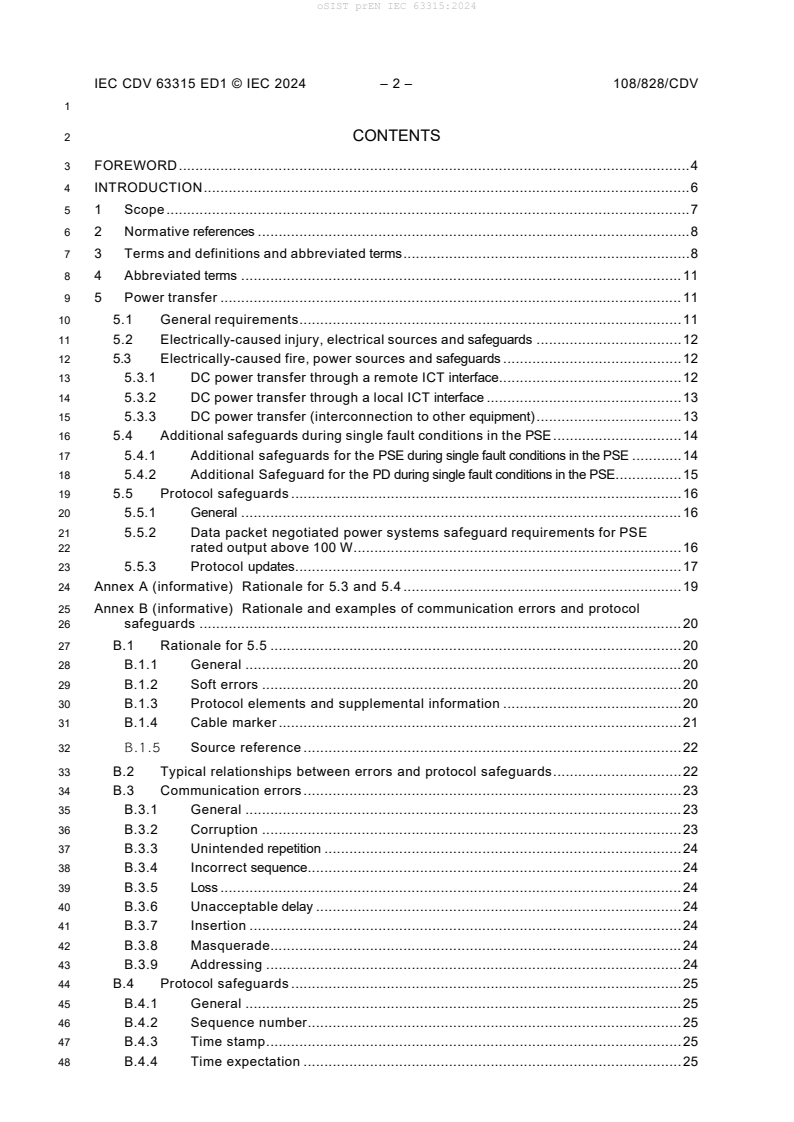
IEC CDV 63315 ED1 © IEC 2024 – 2 – 108/828/CDV
2 CONTENTS
3 FOREWORD . 4
4 INTRODUCTION . 6
5 1 Scope . 7
6 2 Normative references . 8
7 3 Terms and definitions and abbreviated terms . 8
8 4 Abbreviated terms . 11
9 5 Power transfer . 11
10 5.1 General requirements . 11
11 5.2 Electrically-caused injury, electrical sources and safeguards . 12
12 5.3 Electrically-caused fire, power sources and safeguards . 12
13 5.3.1 DC power transfer through a remote ICT interface . 12
14 5.3.2 DC power transfer through a local ICT interface . 13
15 5.3.3 DC power transfer (interconnection to other equipment) . 13
16 5.4 Additional safeguards during single fault conditions in the PSE . 14
17 5.4.1 Additional safeguards for the PSE during single fault conditions in the PSE . 14
18 5.4.2 Additional Safeguard for the PD during single fault conditions in the PSE . 15
19 5.5 Protocol safeguards . 16
20 5.5.1 General . 16
21 5.5.2 Data packet negotiated power systems safeguard requirements for PSE
22 rated output above 100 W . 16
23 5.5.3 Protocol updates . 17
24 Annex A (informative) Rationale for 5.3 and 5.4 . 19
25 Annex B (informative) Rationale and examples of communication errors and protocol
26 safeguards . 20
27 B.1 Rationale for 5.5 . 20
28 B.1.1 General . 20
29 B.1.2 Soft errors . 20
30 B.1.3 Protocol elements and supplemental information . 20
31 B.1.4 Cable marker . 21
32 B.1.5 Source reference . 22
33 B.2 Typical relationships between errors and protocol safeguards . 22
34 B.3 Communication errors . 23
35 B.3.1 General . 23
36 B.3.2 Corruption . 23
37 B.3.3 Unintended repetition . 24
38 B.3.4 Incorrect sequence . 24
39 B.3.5 Loss . 24
40 B.3.6 Unacceptable delay . 24
41 B.3.7 Insertion . 24
42 B.3.8 Masquerade. 24
43 B.3.9 Addressing . 24
44 B.4 Protocol safeguards . 25
45 B.4.1 General . 25
46 B.4.2 Sequence number. 25
47 B.4.3 Time stamp . 25
48 B.4.4 Time expectation . 25
IEC CDV 63315 ED1 © IEC 2024 – 3 – 108/828/CDV
49 B.4.5 Connection authentication . 25
50 B.4.6 Feedback message . 25
51 B.4.7 Data integrity assurance . 25
52 B.4.8 Redundancy with cross checking . 26
53 B.4.9 Different data integrity assurance systems . 26
54 Annex C (informative) Communication errors and USB Power Delivery protocol
55 safeguards . 27
56 C.1 General . 27
57 C.2 USB PD example walk-through . 28
58 Annex D (informative) Example behaviours of non-static power sources and qualified
59 loads . 30
60 D.1 Non-static power sources . 30
61 D.2 Qualified loads . 30
62 Annex E (informative) Examples of common interfaces which are in or out of the scope
63 of this document . 32
64 Bibliography . 33
65 Figure 1 – PSE maximum fault voltage limit . 15
66 Figure C.1 – Flowchart of USB power modes . 29
67 Table B.1 – Overview of the effectiveness of the various measures on the possible
68 errors . 23
69 Table C.1 – Communication error types and USB PD protocol (3.10) safeguards . 27
IEC CDV 63315 ED1 © IEC 2024 – 4 – 108/828/CDV
71 INTERNATIONAL ELECTROTECHNICAL COMMISSION
72 ____________
73 AUDIO/VIDEO, INFORMATION AND COMMUNICATION TECHNOLOGY
74 EQUIPMENT – SAFETY – DC POWER TRANSFER BETWEEN ICT
75 EQUIPMENT PORTS USING ICT WIRING AND CABLES AT ≤ 60 V DC
77 FOREWORD
78 1) The International Electrotechnical Commission (IEC) is a worldwide organization for standardization comprising
79 all national electrotechnical committees (IEC National Committees). The object of IEC is to promote international
80 co-operation on all questions concerning standardization in the electrical and electronic fields. To this end and
81 in addition to other activities, IEC publishes International Standards, Technical Specifications, Technical Reports,
82 Publicly Available Specifications (PAS) and Guides (hereafter referred to as “IEC Publication(s)”). Their
83 preparation is entrusted to technical committees; any IEC National Committee interested in the subject dealt with
84 may participate in this preparatory work. International, governmental and non-governmental organizations liaising
85 with the IEC also participate in this preparation. IEC collaborates closely with the International Organization for
86 Standardization (ISO) in accordance with conditions determined by agreement between the two organizations.
87 2) The formal decisions or agreements of IEC on technical matters express, as nearly as possible, an international
88 consensus of opinion on the relevant subjects since each technical committee has representation from all
89 interested IEC National Committees.
90 3) IEC Publications have the form of recommendations for international use and are accepted by IEC National
91 Committees in that sense. While all reasonable efforts are made to ensure that the technical content of IEC
92 Publications is accurate, IEC cannot be held responsible for the way in which they are used or for any
93 misinterpretation by any end user.
94 4) In order to promote international uniformity, IEC National Committees undertake to apply IEC Publications
95 transparently to the maximum extent possible in their national and regional publications. Any divergence between
96 any IEC Publication and the corresponding national or regional publication shall be clearly indicated in the latter.
97 5) IEC itself does not provide any attestation of conformity. Independent certification bodies provide conformity
98 assessment services and, in some areas, access to IEC marks of conformity. IEC is not responsible for any
99 services carried out by independent certification bodies.
100 6) All users should ensure that they have the latest edition of this publication.
101 7) No liability shall attach to IEC or its directors, employees, servants or agents including individual experts and
102 members of its technical committees and IEC National Committees for any personal injury, property damage or
103 other damage of any nature whatsoever, whether direct or indirect, or for costs (including legal fees) and
104 expenses arising out of the publication, use of, or reliance upon, this IEC Publication or any other IEC
105 Publications.
106 8) Attention is drawn to the Normative references cited in this publication. Use of the referenced publications is
107 indispensable for the correct application of this publication.
108 9) Attention is drawn to the possibility that some of the elements of this IEC Publication may be the subject of patent
109 rights. IEC shall not be held responsible for identifying any or all such patent rights.
110 IEC 63315 has been prepared by IEC technical committee 108: Safety of electronic equipment
111 within the field of audio/video, information technology and communication technology. It is an
112 International Standard.
113 This first edition cancels and replaces IEC 62368-3:2017, Clause 5. This edition constitutes a
114 technical revision.
115 This edition includes the following significant technical changes with respect to IEC 62368-3,
116 Clause 5:
117 a) Establishes unique requirements for local ICT interfaces (3.9) and remote ICT interfaces
118 (3.11);
119 b) Addition of requirements for non-static power sources (3.12), including supplementary
120 safeguards for PS3;
121 c) Addition of protocol (3.10) safeguards for data packet negotiated power systems (3.7);
122 d) Addition of cable requirements.
IEC CDV 63315 ED1 © IEC 2024 – 5 – 108/828/CDV
124 The text of this International Standard is based on the following documents:
Draft Report on voting
XX/XX/FDIS XX/XX/RVD
126 Full information on the voting for its approval can be found in the report on voting indicated in
127 the above table.
128 The language used for the development of this International Standard is English.
129 This document was drafted in accordance with ISO/IEC Directives, Part 2, and developed in
130 accordance with ISO/IEC Directives, Part 1 and ISO/IEC Directives, IEC Supplement, available
131 at www.iec.ch/members_experts/refdocs. The main document types developed by IEC are
132 described in greater detail at www.iec.ch/publications.
133 The committee has decided that the contents of this document will remain unchanged until the
134 stability date indicated on the IEC website under webstore.iec.ch in the data related to the
135 specific document. At this date, the document will be
136 • reconfirmed,
137 • withdrawn,
138 • replaced by a revised edition, or
139 • amended.
IEC CDV 63315 ED1 © IEC 2024 – 6 – 108/828/CDV
140 INTRODUCTION
141 This document prescribes safeguards, test methods and compliance requirements intended to
142 reduce the risk of fire associated with voltage and current used by standardized, common ICT
143 interfaces that are used for power delivery at voltages not exceeding 60 V DC.
144 This document may be used with IEC 62368-1 or other electrotechnical product standards to
145 provide additional safeguards when products with common ICT interfaces are connected.
146 IEC 62368-1 defines power source (PS) energy levels with safeguards to reduce risk of fire. IEC
147 63315 defines interface compatibility safeguards to address disparity between the power expected by
148 the powered device (3.3) and the available power from of power sourcing equipment (3.2) by
149 establishing expected values which can be tested respectively and independently.
150 This document does not replace the requirements of other applicable safety standards.
IEC CDV 63315 ED1 © IEC 2024 – 7 – 108/828/CDV
152 AUDIO/VIDEO, INFORMATION AND COMMUNICATION TECHNOLOGY
153 EQUIPMENT – SAFETY – DC POWER TRANSFER BETWEEN ICT
154 EQUIPMENT PORTS USING ICT WIRING AND CABLES AT ≤ 60 V DC
158 1 Scope
159 This document applies to any equipment intended to supply and/or receive charging and/or
160 operating power from Information and Communication Technology (ICT) interfaces using ICT
161 wiring or cables. It covers particular requirements for circuits that are designed to transfer DC
162 power through an ICT interface from a power sourcing equipment (PSE (3.2)) to a powered
163 device (PD (3.3)) for equipment that uses rated interfaces at voltage not exceeding 60 V DC
164 and PS2 or PS3.
165 Examples of equipment interfaces that are considered to be within the scope of this document:
166 – PoE
167 – USB
168 – HDMI
169 – etc.
170 NOTE 1 Any wiring or cable that permits DC power transfer between ICT equipment is considered a communication
171 cable or ICT cable even if communication does not take place on the conductors. For example, a USB cable can be
172 used just to recharge a portable device battery.
173 PSE (3.2) and PD (3.3) using other power delivery specifications (3.1) that differ from the industry
174 standard power delivery specification (3.1) defined for use with the industry standard connector are
175 in scope of this document.
176 Non-static power sources (3.12) and static power sources (3.13) are covered in this document.
177 Unless otherwise stated, this document does not cover:
178 – power sources with output connectors not associated with a local ICT interface (3.9) or
179 remote ICT interface (3.11);
180 – power sources with custom connectors that are not interchangeable with common ICT
181 interface connectors;
182 – non-static power sources (3.12) which can deliver power to multiple PDs (3.3) through a
183 single port or cable simultaneously;
184 – power sources with only wireless power transfer;
185 – power sources which utilize a wireless communication protocol (3.10) to control the
186 power transfer through a physical cable connection.
187 – remote feeding telecommunication (RFT) circuits and other specific communication
188 technologies within the scope of IEC 63316.
189 NOTE 2 A custom connector is a connector that is not used with an industry communication standard.
190 NOTE 3 Bluetooth® is an example of a wireless communication protocol (3.10) to control the power transfer through
191 a physical cable connection.
192 Refer to Annex E for examples of common interfaces which are in or out of scope of this
193 document.
IEC CDV 63315 ED1 © IEC 2024 – 8 – 108/828/CDV
194 2 Normative references
195 The following documents are referred to in the text in such a way that some or all of their content
196 constitutes requirements of this document. For dated references, only the edition cited applies.
197 For undated references, the latest edition of the referenced document (including any
198 amendments) applies.
199 IEC 60730-1:2022 – Automatic electrical controls – Part 1: General requirements
200 IEC 61784-3:2021, Industrial communication networks – Profiles – Part 3: Functional safety
201 fieldbuses - General rules and profile definitions
202 IEC 62368-1, Audio/video, information and communication technology equipment – Part 1:
203 Safety requirements
204 IEC 62680-1-1:2015, Universal serial bus interfaces for data and power – Part 1-1: Common
205 components – USB Battery Charging Specification, Revision 1.2
206 IEC 62680-1-2:2022, Universal serial bus interfaces for data and power – Part 1-2: Common
207 components – USB Power Delivery specification
208 IEC 63002:2021, Interoperability specifications and communication method for external power
209 supplies used with computing and consumer electronics devices
210 3 Terms and definitions and abbreviated terms
211 For the purposes of this document, the terms and definitions from IEC 62368-1 and in this
212 document are indicated in bold.
213 ISO and IEC maintain terminology databases for use in standardization at the following
214 addresses:
215 • IEC Electropedia: available at https://www.electropedia.org/
216 • ISO Online browsing platform: available at https://www.iso.org/obp
217 3.1
218 power delivery specification
219 formal statement of those characteristics of a particular ICT interface necessary to ensure
220 power delivery compatibility between the power sourcing equipment (3.2), powered device
221 (3.3), cable, and connector interface
222 NOTE 1 to entry: A power delivery specification (3.1) will normally indicate the protocol (3.10) and procedures
223 which determine if the (given) requirements are fulfilled, including voltage, current, and power ranges.
224 NOTE 2 to entry: A power delivery specification (3.1) may include one or more documents, including design,
225 interoperability, and/or test specifications.
226 NOTE 3 to entry: An industry standard power delivery specification (3.1) is the specification for the industry
227 standard connector. Other power delivery specifications (3.1) may exist, including a manufacturer’s specification,
228 which differ from the industry standard power delivery specification (3.1).
229 [SOURCE: IEC ref 716-01-011, modified]
230 3.2
231 power sourcing equipment
232 PSE
233 equipment supplying DC power from an ICT interface to a PD (3.3) through ICT wiring or cables.
234 [ITU-T K.50:2018, 3.2.11, power sourcing equipment, modified]
IEC CDV 63315 ED1 © IEC 2024 – 9 – 108/828/CDV
235 NOTE 1 to entry: It should be noted that ISO/IEC/IEEE 8802-3:2021 has a different definition.
236 3.3
237 powered device
238 PD
239 equipment supplied with DC power through its ICT interface by a PSE (3.2) into an ICT interface
240 via ICT wiring or cables [ITU-T K.50:2018, 3.2.10, powered equipment; PDE, modified]
241 NOTE to entry: It should be noted that ISO/IEC/IEEE 8802-3:2021 has a different definition.
242 3.4
243 information and communication technology network
244 ICT network
245 transmission medium, including its associated equipment, ICT wiring and communication cables
246 NOTE 1 to entry: An ICT cable consists of two or more conductors intended for communication and/or power transfer
247 between the various parts of ICT equipment. The equipment may be located within the same or separate structures,
248 buildings or locations, excluding:
249 – the mains system for supply, transmission and distribution of electrical power, if used as a communication
250 transmission medium;
251 – a dedicated HBES/BACS network. The requirement for interconnection with external circuits in an HBES/BACS
252 network is given in IEC 63044-3.
253 NOTE 2 to entry: This may include some twisted pair circuits, and may include circuits, that are subjected to transients
254 as indicated by Table 13 of IEC 62368-1
255 NOTE 3 to entry: An ICT network may be:
256 – publicly or privately owned;
257 – subject to longitudinal (common mode) as well as transverse (differential) voltages and currents induced from
258 nearby power lines or electric traction lines.
259 NOTE 4 to entry: ICT wiring and cables include common audio and video (AV) connectors used with ICT
260 equipment (e.g. HDMI) but does not include AV connectors providing power for acoustics (e.g. audio amplifiers
261 connectors for speakers)
262 3.5
263 building wiring
264 ICT or AV wires or cables that are intended to be installed wholly within a structure
265 EXAMPLE 1 Wires or cables installed in walls, under floors, in plenums, risers, etc. in a building or structure, that
266 are used to connect ICT and AV equipment in different locations within the building and that is not mains. It also
267 includes devices associated with the interconnection of the equipment, LAN cables, telecommunication cables, data
268 cables, patch panels, connectors, etc.
269 NOTE 1 to entry: Under certain circumstances building wiring (3.5) may run outside the building for connection to
270 equipment (for example, a video camera outside of the building).
271 NOTE 2 to entry: Building wiring (3.5) also includes devices associated with the interconnection of the equipment.
272 The cables may be conductive or non-conductive, such as optical fiber cable.
273 3.6
274 cyclic redundancy check
275 CRC
276 cyclic code used to protect messages from the influence of data corruption
277 NOTE 1 to entry: A CRC’s (3.6) code (i.e. check value) is generated using message data and a generating polynomial.
278 NOTE 2 to entry: A CRC’s (3.6) code can be provided with various lengths in bits, referred to as a n-bit CRC (3.6)
279 where the n is the number bits of the check value.
280 NOTE 3 to entry: A CRC’s (3.6) code is appended to the protocol (3.10) message which is used to validate data
281 integrity on the receiving end.
282 [SOURCE: IEV ref 821-11-10, cyclic redundancy check, modified]
IEC CDV 63315 ED1 © IEC 2024 – 10 – 108/828/CDV
283 3.7
284 data packet negotiated power system
285 type of remote ICT interface (3.11) or local ICT interface (3.9) that requires data packet
286 handshaking negotiation between a PD (3.3) and a PSE (3.2) to establish an agreed upon DC
287 power output from the PSE (3.2)
288 NOTE 1 to entry: USB Power Delivery is an example of a data packet negotiated power system (3.7), which can
289 also be considered a type characterizing a non-static power source (3.12).
290 3.8
291 hamming distance
292 number of digit positions in which the corresponding digits of two n-bit bytes of the same length are
293 different
294 EXAMPLE 1 An example of two data sets having a Hamming distance (3.8) of 3 between these datasets is “111000”
295 and “000000”.
296 NOTE 1 to entry: The Hamming distance (3.8) is relevant to different control messages used in the protocol (3.10).
297 [SOURCE: IEV ref 721-08-25, Hamming distance, modified]
298 3.9
299 local ICT interface
300 ICT interface supplying or receiving DC power to or from local equipment via communication
301 cabling, where the PSE (3.2) and PD (3.3) are located in close proximity and the communication
302 cable is not used for building wiring (3.5)
303 NOTE to entry: Example of local ICT interface (3.9) is USB Power Delivery, typically less than 3 meters of cabling.
304 [ITU-T K.50:2018, 3.2.11, power sourcing equipment, modified]
305 3.10
306 protocol
307 set of rules for data transmission between two devices
308 NOTE to entry: A protocol (3.10) may define the conditions for establishing a connection to a transmission medium
309 (e.g. physical layer), the rules governing access to the medium, the procedures for error protection, the functional
310 and procedural means of data exchange, the transport mechanisms, the communication control, the representation
311 of data and the exchange of application data.
312 EXAMPLE 1 Examples of elements within a protocol (3.10) include:
313 data packets transferred between devices (messages),
314 the meaning of data packets (semantics),
315 the format of data packets (syntax) and
316 the logic time sequence of data exchange.
317 [SOURCE: IEV ref 351-56-14, protocol, modified]
318 3.11
319 remote ICT interface
320 ICT interface supplying or receiving DC power to or from remote equipment via communication
321 cabling, where the PSE (3.2) and PD (3.3) are not located in close proximity and the
322 communication cable is commonly used in building wiring (3.5) or connected through an ICT
323 network (3.4)
324 EXAMPLE 1 An example of remote ICT Interface (3.11) is PoE.
325 [ITU-T K.50:2018, 3.2.11, power sourcing equipment, modified]
IEC CDV 63315 ED1 © IEC 2024 – 11 – 108/828/CDV
326 3.12
327 non-static power source
328 PSE (3.2) that can only deliver the maximum rated voltage, current, and/or power into a
329 qualified load (3.14)
330 3.13
331 static power source
332 PSE (3.2) that is capable of delivering the maximum rated voltage, current, and/or power into a
333 resistive load
334 3.14
335 qualified load
336 PD (3.3) that has been verified by the PSE (3.2)
337 NOTE 1 to entry: Verification includes where the PSE (3.2) has established a contract with the PD (3.3).
338 4 Abbreviated terms
AV audio/video
BACS building automation and control system
CRC cyclic redundancy check
FIFO first in, first out
HBES home and building electronic system
HDMI high-definition media interface
ICT information and communication technology
LPS limited power source
PD powered device
PoE power over ethernet
PSE power sourcing equipment
USB universal serial bus
USB BC USB battery charging
USB PD USB power delivery
USB PD EPR USB PD extended power range
USB PD SPR USB PD standard power range
339 5 Power transfer
340 5.1 General requirements
341 The maximum output voltage of the PSE (3.2) under normal operating conditions and
342 abnormal operating conditions shall not exceed the rated limits of power delivery
343 specification (3.1) under the following load conditions:
344 – for static power sources (3.13), can be an open circuit up to and including short circuit.
345 – for non-static power sources (3.12), can be a minimal qualified load (3.14) (at connection)
346 up to and including short circuit.
347 NOTE 1 Abnormal operating conditions and current in single fault conditions are specified in 5.3.3. Voltage in
348 single fault conditions are specified in 5.4.1.
349 Single fault conditions do not apply to:
350 – isolating components (for example, optocouplers and transformers) complying with the
351 relevant component requirements in Annex G of IEC 62368-1 for reinforced insulation;
IEC CDV 63315 ED1 © IEC 2024 – 12 – 108/828/CDV
352 – other components that serve as a safeguard complying with the relevant requirements of
353 Annex G of IEC 62368-1 or with the relevant safety requirements of the relevant IEC
354 component standard; and
355 – IC current limiters complying with Annex G.9 of IEC 62368-1.
356 Output circuits of PSEs (3.2) which are classified as PS1 as defined in IEC 62368-1 are
357 considered to comply with the requirements of 5.3, 5.4, and 5.5.
358 NOTE 2 For the purpose of this document, when establishing a single fault condition, a PSE (3.2) circuit is one
359 that directly controls the function of the PSE (3.2) interface and does not include consideration of single fault
360 conditions extending to the source of the power (for example, in all circuits extending back to an isolating
361 transformer).
362 If the PSE (3.2) is a non-static power source (3.12), (for example, a data packet negotiated
363 power system (3.7)), the PSE (3.2) shall be connected to a qualified load (3.14) (for example,
364 a terminating device) that turns on the PSE (3.2) and generates the worst case voltage, current,
365 and/or power delivery under normal operating conditions, abnormal operating conditions,
366 and single fault conditions.
367 Where a PSE (3.2) circuit supports more than one output power mode, each mode shall be
368 separately assessed.
369 NOTE 3 Where different power modes have different voltage and current values they have to be considered when
370 applying the relevant clauses.
371 Where a PSE (3.2) has the capability to change power source and power sink roles, the
372 requirements for the PD (3.3) and PSE (3.2) shall apply to the power feeding circuits in each
373 applicable mode.
374 NOTE 4 Equipment can have multiple interfaces serving different PSE (3.2) and PD (3.3) roles simultaneously in any
375 combination.
376 Where a PD (3.3) or PSE (3.2) supports a data packet negotiated power system (3.7),
377 requirements for protocol (3.10) safeguards in 5.5 shall apply.
378 5.2 Electrically-caused injury, electrical sources and safeguards
379 The requirements of Clause 5 of IEC 62368-1 apply for sources classified as ES1 as defined in
380 IEC 62368-1. Alternatively, equivalent safeguards shall be provided to reduce the risk of
381 electrical-caused injury to persons associated with accessible circuits in accordance with a
382 relevant IEC product safety standard referencing this document.
383 5.3 Electrically-caused fire, power sources and safeguards
384 NOTE See Annex A for the rationale.
385 5.3.1 DC power transfer through a remote ICT interface
386 PSE (3.2) circuits that provide power through a remote ICT interface (3.11) to building wiring
387 (3.5) shall comply with the requirements of 6.5.2 of IEC 62368-1.
388 Compliance is checked by test, inspection, and the requirements of Annex Q of IEC 62368-1.
389 NOTE These safeguards typically apply to equipment that are not located in close proximity to each other, such as
390 those associated with PoE and similar ICT cables.
391 EXAMPLES of such PD (3.3) equipment are: a security camera, a network switch or hub, or devices outside the scope
392 of IEC 62368-1, such as lighting or novelty items.
IEC CDV 63315 ED1 © IEC 2024 – 13 – 108/828/CDV
393 5.3.2 DC power transfer through a local ICT interface
394 5.3.2.1 Static PSEs
395 PSEs (3.2) that are a static power source (3.13) providing power to a local ICT interface (3.9)
396 shall comply with 6.6 of IEC 62368-1.
397 Compliance is checked by inspection or measurement.
399 5.3.2.2 Non-Static PSEs
400 PSEs (3.2) that are a non-static power source (3.12) shall comply with all of the following:
401 – Connection to an unknown PD (3.3) shall limit output power to PS2 in accordance with 6.6
402 of IEC 62368-1; and
403 – Validation of basic protocol (3.10) safeguards at initial connection and at disconnection in
404 accordance with 5.5.1.
405 NOTE 1 When the PD (3.3) is known (i.e. after power mode is established between the PSE (3.2) and PD (3.3)), the
406 PSE (3.2) may exceed PS2 limits, as defined in IEC 62368-1, when compliant with 5.3.3, 5.4.1, and 5.5.
407 NOTE 2 An known PD (3.3) is one that is recognized by the PSE (3.2).
408 Compliance is checked in accordance with 6.6 of IEC 62368-1 and 5.5.1 of this document.
409 5.3.2.3 PDs
410 PDs (3.3) intended for connection to PS3 shall comply with the safeguards for PS3 as defined
411 in IEC 62368-1.
412 EXAMPLES for such PDs (3.3) equipment are: cell phones, tablets, laptops, or devices outside the scope of IEC
413 62368-1, such as lighting or novelty items.
414 Compliance is checked in accordance with 6.3 and 6.4 of IEC 62368-1.
415 5.3.2.4 Cables
416 Detachable local ICT interface (3.9) cables shall comply will all of the following:
417 – Connector materials shall comply with 6.4.3 or 6.4.6 in IEC 62368-1;
418 – Wiring shall comply with 6.5.1 in IEC 62368-1.
419 Detachable local ICT interface (3.9) cables longer than 3 meters shall be:
420 – marked with an instructional safeguard, “CAUTION: Cable not intended for installation as
421 building wiring (3.5)” or similar text; or
422 – as an alternative, be marked with an instructional safeguard according to F.5 of IEC
423 62368-1 with element 1b where the complete instructional safeguard shall be in the text
424 of an accompanying document.
425 Compliance is checked by inspection and when applicable, test of F.3.9 of IEC 62368-1.
426 5.3.3 DC power transfer (interconnection to other equipment)
427 For PSE (3.2) circuits, the maximum sustained output current shall not exceed the specified
428 fault current rating in the industry standard power delivery specification (3.1), the
429 manufacturer's specification, or other specification for the referenced standardized interface
430 under abnormal operating conditions and single fault conditions.
431 Where there is no specified maximum fault current in the power delivery specification (3.1) for the
432 standardized interface the following applies:
IEC CDV 63315 ED1 © IEC 2024 – 14 – 108/828/CDV
433 – the available current shall not exceed the rated maximum output current of the power
434 delivery specification (3.1) by more than:
435 • 50 % for circuits with rated maximum output current equal to or less than 2 A after the first
436 5 s;
437 • 30 % or 3A whichever is greater for circuits with rated maximum output current greater
438 than 2 A after the first 5 s.
439 If the operation of a protective device or circuitry is used to limit the current, current that occurs within
440 a period of 5 s after the introduction of the abnormal operating conditions or the single fault
441 condition is ignored.
442 NOTE See Annex C for more information on USB PD.
443 Compliance is checked by inspection and tests with currents measured using an ammeter
444 instead of a wattmeter per the power source circuit measurement methods in 6.2.2.2 and 6.2.2.3
445 of IEC 62368-1.
446 5.4 Additional safeguards during single fault conditions in the PSE
447 NOTE See Annex A for the rationale.
448 5.4.1 Additional safeguards for the PSE during single fault conditions in the PSE
449 To reduce the likelihood of electrically-caused fire under single fault conditions in the PSE
450 (3.2), the PSE (3.2) output voltage shall not exceed the specified fault voltage rating in the
451 industry standard power delivery specification (3.1), the manufacturer’s specifications, or
452 other specification with the relevant qualified load.
453 NOTE See Annex C for more information on USB PD.
454 Where there is no specified fault voltage rating in the power delivery specification (3.1) for
455 the standardized interface the following applies:
456 – For circuits with nominal rated output voltage not exceeding 5 V, the maximum sustained
457 output fault voltage shall not exceed 150% of the maximum negotiated rated output voltage
458 specified in the power delivery specification (3.1);
459 – For circuits with nominal rated output voltage higher than 5V, the maximum sustained output
460 fault voltage shall not exceed 130 % of the maximum negotiated rated output voltage
461 specified in the power delivery specification (3.1), with a minimum of 7,5 V and a
462 maximum of 60 V as indicated in Figure 1.
IEC CDV 63315 ED1 © IEC 2024 – 15 – 108/828/CDV
0 5 10 15 20 25 30 35 40 45 50 55 60
Rated output voltage (V)
465 Figure 1 – PSE maximum fault voltage limit
466 Where a PSE (3.2) supports more than one power mode, the sustained output fault voltage shall
467 not exceed the maximum fault voltage for each power mode.
468 NOTE See 5.3.2.1 of IEC 62368-1 for accessibility consideration of equipment intended for outdoor locations.
469 Compliance is checked by testing under single fault conditions of the PSE (3.2) and voltage
470 measurement at the relevant DC power transfer interface of the PSE (3.2) measured after 5
471 seconds following the introduction of the single fault condition.
472 5.4.2 Additional Safeguard for the PD during single fault conditions in the PSE
473 To reduce the likelihood of electrically-caused fire the PD (3.3) shall be provided with
474 safeguards to withstand an external power source that is supplied with the highest PSE (3.2)
475 fault voltage in 5.4.1 for the PD’s (3.3) intended power mode(s).
476 For the purposes of testing, the power source to the PD (3.3) shall be limited to:
477 – the maximum fault current determined from 5.3.3; and
478 – the maximum fault voltage determined from 5.4.1.
479 The simulated PSE (3.2) fault voltage is applied to the PDs (3.3) input circuit under normal
480 operating conditions after connection and establishment of the negotiated operating mode.
481 NOTE 1 Analysis of the PDs (3.3) circuit should identify the normal operating mode which represents the worst case
482 conditions for the simulated fault voltage.
483 NOTE 2 The application of the maximum fault voltage of the PSE (3.2) to the PD (3.3) is considered as an abnormal
484 operating condition.
Maximum fault voltage (V)
IEC CDV 63315 ED1 © IEC 2024 – 16 – 108/828/CDV
485 Compliance is checked by the test under the above supply condition and the compliance criteria
486 of B.3.8 of IEC 62368-1.
487 5.5 Protocol safeguards
488 5.5.1 General
489 If required under normal operating conditions and abnormal operating conditions, where
490 there is a protocol (3.10) to negotiate the PSE (3.2) output voltage and current the following basic
491 safeguards shall be provided:
492 – at initial connection of the PSE (3.2) to a PD (3.3), prior to establishing the negotiated DC
493 output voltage and/or current (for example, no contract established), the PSE's (3.2) output
494 shall be within the default protocol (3.10) mode voltage and current ranges;
495 – if a request for DC output voltage and/or current is beyond the PSE´s (3.2) allowed protocol
496 (3.10) mode voltage and/or current, the PSE (3.2) shall remain in the active mode or
497 transition to an allowed protocol mode (e.g. default mode);
498 NOTE 1 An active mode is the currently negotiated mode of operation.
499 – when a requested DC output voltage and/or current is within the accepted protocol (3.10)
500 mode and is negotiated (for example, contract established), the output from the PSE (3.2)
501 shall be within the protocol (3.10) mode voltage and current ranges;
502 – during an overload condition as described in 5.3.3, the output of the PSE (3.2) shall be
503 electrically disconnected or revert back to the default protocol (3.10) mode DC output
504 voltage and current ranges.
505 – at disconnection of the PSE (3.2) from the PD (3.3), the output of the PSE (3.2) shall revert
506 back to the default protocol (3.10) mode DC output voltage and current ranges.
507 NOTE 2 A PD (3.3) in the context o
...