

SIST EN 12665:2024
(Main)Light and lighting - Basic terms and criteria for specifying lighting requirements
General Information
- Abstract
This document defines basic terms and definitions for use in all lighting applications. This document also sets out a framework for the specification of lighting requirements, giving details of aspects that are to be considered when setting those requirements.
- Status
- Published
- Public Enquiry End Date
- 30-Jan-2023
- Publication Date
- 07-Oct-2024
- Technical Committee
- STV - Steklo, svetloba in razsvetljava v gradbeništvu
- Current Stage
- 6060 - National Implementation/Publication (Adopted Project)
- Start Date
- 15-May-2024
- Due Date
- 20-Jul-2024
- Completion Date
- 08-Oct-2024

Overview
SIST EN 12665:2024 - Light and lighting - Basic terms and criteria for specifying lighting requirements - is the updated European vocabulary and framework for lighting specification. Superseding EN 12665:2018 and harmonized with CIE S 017:2020, this standard defines core terms and sets out the parameters to be considered when specifying lighting requirements across indoor and outdoor applications. It covers visual, photometric and colourimetric concepts and addresses energy, maintenance and non-image-forming (biological) aspects of illumination.
Key topics and technical scope
SIST EN 12665:2024 provides:
- Comprehensive terminology for eye & vision, light & colour, lighting equipment, daylight, lighting installations and lighting measurements.
- A framework for specifying lighting requirements including:
- Illuminance and luminance considerations
- Glare (disability and discomfort) and control strategies
- Colour aspects: colour rendering and light source colour
- Energy and sustainability considerations
- Maintenance practices and maintenance factors
- Measurements and calculations needed to verify compliance
- Coverage of optical radiation across UV, visible and IR spectral regions where relevant to lighting.
- Cross-references to international vocabularies (CIE S 017:2020, IEC 60050-845) and guidance in Annex A for additional term explanations.
Keywords reflected: SIST EN 12665:2024, light and lighting, lighting requirements, photometry, colour rendering, glare, illuminance.
Practical applications and who uses it
SIST EN 12665:2024 is a foundational standard used to create clear, consistent lighting specifications and to ensure common understanding of terms. Typical users include:
- Lighting designers and consultants preparing lighting briefs and design criteria
- Architects and building services engineers integrating lighting with architecture and daylighting strategies
- Facility managers and maintenance planners setting maintenance factors and performance targets
- Manufacturers and test laboratories using standardized definitions for product data and measurements
- Regulators, procurement teams and specifiers writing tenders, codes or compliance documents
- Researchers and educators requiring a harmonized vocabulary for lighting science
Use cases: developing project specifications, assessing visual comfort and safety, selecting light sources with appropriate colour rendering, controlling glare, performing photometric calculations and energy assessments.
Related standards
- CIE S 017:2020 (International Lighting Vocabulary) - harmonized terminology
- IEC 60050-845 (International Electrotechnical Vocabulary - Lighting)
- EN 12216 and EN 12519 - related to daylight openings and window terminology
- EN 62504 - LED-specific terms (referred to for LED terminology)
SIST EN 12665:2024 is essential for anyone specifying or evaluating illumination performance, ensuring consistent, safe and energy-aware lighting design and documentation.
Relations
- Effective Date
- 28-Jan-2026
- Effective Date
- 28-Jan-2026
- Referred By
SIST EN 12464-2:2025 - Light and lighting - Lighting of work places - Part 2: Outdoor work places - Effective Date
- 28-Jan-2026
- Effective Date
- 28-Jan-2026
- Effective Date
- 28-Jan-2026
- Effective Date
- 28-Jan-2026
- Effective Date
- 28-Jan-2026
- Effective Date
- 28-Jan-2026
- Effective Date
- 28-Jan-2026
- Referred By
SIST EN 12464-1:2011 - Light and lighting - Lighting of work places - Part 1: Indoor work places - Effective Date
- 28-Jan-2026
- Effective Date
- 28-Jan-2026
- Effective Date
- 28-Jan-2026
- Effective Date
- 28-Jan-2026
- Effective Date
- 28-Jan-2026
- Effective Date
- 28-Jan-2026
Get Certified
Connect with accredited certification bodies for this standard

DIBt (Deutsches Institut für Bautechnik)
German Institute for Building Technology.
DIN CERTCO
DIN Group product certification.

Aboma Certification B.V.
Specialized in construction, metal, and transport sectors.
Sponsored listings
Frequently Asked Questions
SIST EN 12665:2024 is a standard published by the Slovenian Institute for Standardization (SIST). Its full title is "Light and lighting - Basic terms and criteria for specifying lighting requirements". This standard covers: This document defines basic terms and definitions for use in all lighting applications. This document also sets out a framework for the specification of lighting requirements, giving details of aspects that are to be considered when setting those requirements.
This document defines basic terms and definitions for use in all lighting applications. This document also sets out a framework for the specification of lighting requirements, giving details of aspects that are to be considered when setting those requirements.
SIST EN 12665:2024 is classified under the following ICS (International Classification for Standards) categories: 01.040.91 - Construction materials and building (Vocabularies); 91.160.01 - Lighting in general. The ICS classification helps identify the subject area and facilitates finding related standards.
SIST EN 12665:2024 has the following relationships with other standards: It is inter standard links to SIST EN 12464-2:2007, SIST EN 13032-4:2015, SIST EN 12464-2:2025, SIST EN 13032-3:2022, SIST EN 14175-3:2019, SIST EN ISO 35101:2020, SIST-TP CEN/TR 16791:2017, SIST-TP CEN/TR 14380:2025, SIST EN 14175-3:2004, SIST EN 12464-1:2011, SIST-TP CEN/TR 15193-2:2017, SIST EN 15193-1:2017+A1:2021, SIST EN 16268:2013, SIST EN 16798-1:2019, SIST-TP CEN/TR 16798-2:2019. Understanding these relationships helps ensure you are using the most current and applicable version of the standard.
SIST EN 12665:2024 is available in PDF format for immediate download after purchase. The document can be added to your cart and obtained through the secure checkout process. Digital delivery ensures instant access to the complete standard document.
Standards Content (Sample)
SLOVENSKI STANDARD
01-november-2024
Svetloba in razsvetljava - Osnovni izrazi in merila za specifikacijo zahtev za
razsvetljavo
Light and lighting - Basic terms and criteria for specifying lighting requirements
Licht und Beleuchtung - Grundlegende Begriffe und Kriterien für die Festlegung von
Anforderungen an die Beleuchtung
Lumière et éclairage - Termes de base et critères pour la spécification des exigences en
éclairage
Ta slovenski standard je istoveten z: EN 12665:2024
ICS:
01.040.91 Gradbeni materiali in gradnja Construction materials and
(Slovarji) building (Vocabularies)
91.160.01 Razsvetljava na splošno Lighting in general
2003-01.Slovenski inštitut za standardizacijo. Razmnoževanje celote ali delov tega standarda ni dovoljeno.
EN 12665
EUROPEAN STANDARD
NORME EUROPÉENNE
May 2024
EUROPÄISCHE NORM
ICS 01.040.91; 91.160.01 Supersedes EN 12665:2018
English Version
Light and lighting - Basic terms and criteria for specifying
lighting requirements
Lumière et éclairage - Termes de base et critères pour Licht und Beleuchtung - Grundlegende Begriffe und
la spécification des exigences en éclairage Kriterien für die Festlegung von Anforderungen an die
Beleuchtung
This European Standard was approved by CEN on 15 March 2024.
CEN members are bound to comply with the CEN/CENELEC Internal Regulations which stipulate the conditions for giving this
European Standard the status of a national standard without any alteration. Up-to-date lists and bibliographical references
concerning such national standards may be obtained on application to the CEN-CENELEC Management Centre or to any CEN
member.
This European Standard exists in three official versions (English, French, German). A version in any other language made by
translation under the responsibility of a CEN member into its own language and notified to the CEN-CENELEC Management
Centre has the same status as the official versions.
CEN members are the national standards bodies of Austria, Belgium, Bulgaria, Croatia, Cyprus, Czech Republic, Denmark, Estonia,
Finland, France, Germany, Greece, Hungary, Iceland, Ireland, Italy, Latvia, Lithuania, Luxembourg, Malta, Netherlands, Norway,
Poland, Portugal, Republic of North Macedonia, Romania, Serbia, Slovakia, Slovenia, Spain, Sweden, Switzerland, Türkiye and
United Kingdom.
EUROPEAN COMMITTEE FOR STANDARDIZATION
COMITÉ EUROPÉEN DE NORMALISATION
EUROPÄISCHES KOMITEE FÜR NORMUNG
CEN-CENELEC Management Centre: Rue de la Science 23, B-1040 Brussels
© 2024 CEN All rights of exploitation in any form and by any means reserved Ref. No. EN 12665:2024 E
worldwide for CEN national Members.
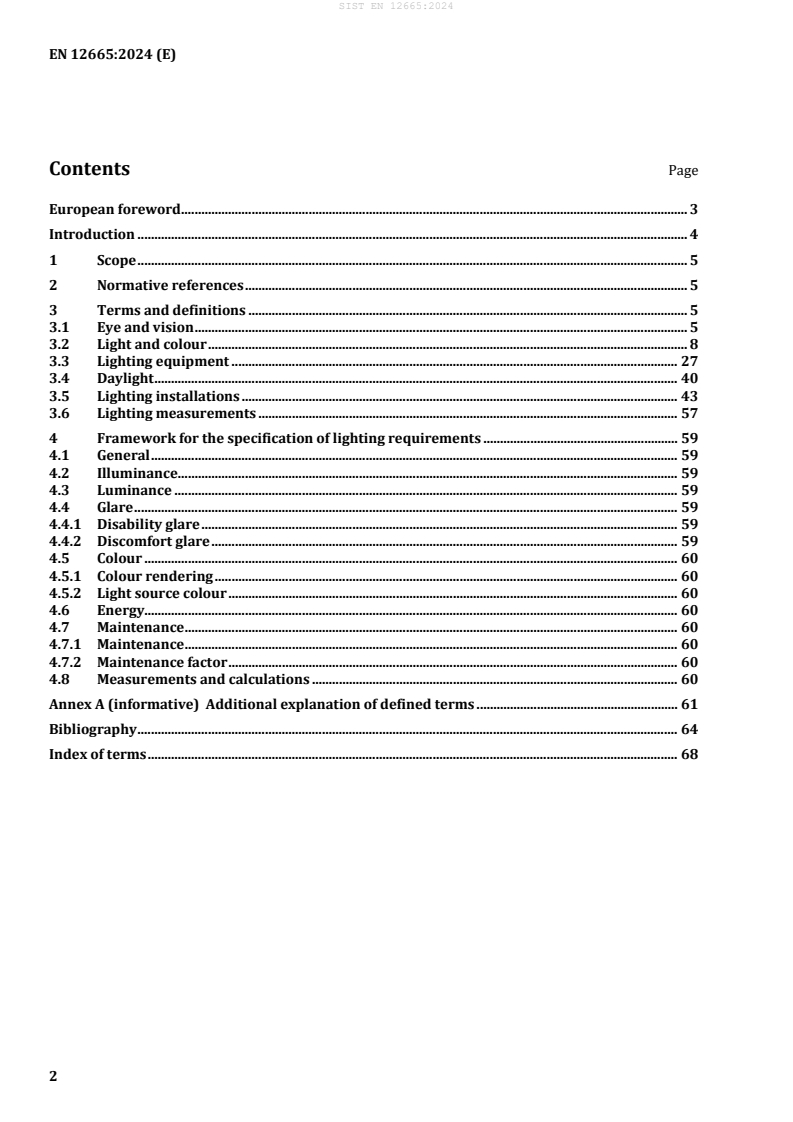
Contents Page
European foreword . 3
Introduction . 4
1 Scope . 5
2 Normative references . 5
3 Terms and definitions . 5
3.1 Eye and vision . 5
3.2 Light and colour . 8
3.3 Lighting equipment . 27
3.4 Daylight . 40
3.5 Lighting installations . 43
3.6 Lighting measurements . 57
4 Framework for the specification of lighting requirements . 59
4.1 General . 59
4.2 Illuminance . 59
4.3 Luminance . 59
4.4 Glare . 59
4.4.1 Disability glare . 59
4.4.2 Discomfort glare . 59
4.5 Colour . 60
4.5.1 Colour rendering . 60
4.5.2 Light source colour . 60
4.6 Energy. 60
4.7 Maintenance . 60
4.7.1 Maintenance . 60
4.7.2 Maintenance factor . 60
4.8 Measurements and calculations . 60
Annex A (informative) Additional explanation of defined terms . 61
Bibliography . 64
Index of terms . 68
European foreword
This document (EN 12665:2024) has been prepared by Technical Committee CEN/TC 169 “Light and
lighting”, the secretariat of which is held by DIN.
This European Standard shall be given the status of a national standard, either by publication of an
identical text or by endorsement, at the latest by November 2024, and conflicting national standards shall
be withdrawn at the latest by November 2024.
Attention is drawn to the possibility that some of the elements of this document may be the subject of
patent rights. CEN shall not be held responsible for identifying any or all such patent rights.
This document supersedes EN 12665:2018.
The main technical changes in this revision of EN 12665:2018 are through harmonization with the
revised CIE International Lighting Vocabulary, CIE S 017:2020.
Any feedback and questions on this document should be directed to the users’ national standards body.
A complete listing of these bodies can be found on the CEN website.
According to the CEN-CENELEC Internal Regulations, the national standards organisations of the
following countries are bound to implement this European Standard: Austria, Belgium, Bulgaria, Croatia,
Cyprus, Czech Republic, Denmark, Estonia, Finland, France, Germany, Greece, Hungary, Iceland, Ireland,
Italy, Latvia, Lithuania, Luxembourg, Malta, Netherlands, Norway, Poland, Portugal, Republic of North
Macedonia, Romania, Serbia, Slovakia, Slovenia, Spain, Sweden, Switzerland, Türkiye and the United
Kingdom.
Introduction
This document specifies a basic framework intended to be used for the specification of lighting
requirements.
Where a term is contained in CIE Publication CIE S 017:2020 ILV, International Lighting Vocabulary or
IEC 60050-845, International Electrotechnical Vocabulary, Part 845: Lighting, a reference is given to the
equivalent term where the terms in both documents are, for all practical purposes, identical.
NOTE Definitions from CIE S 017:2020 and IEC 60050-845:2020 contain notes providing information on the
numbering in previous versions of both documents. These notes were generally omitted as they are not necessary
for application in European standards.
For some terms, additional explanation is given in informative Annex A.
The lighting requirements for a space are determined by the need to provide:
— adequate illumination for safety and movement;
— conditions that will facilitate visual performance and colour perception;
— acceptable visual comfort for the occupants in the space.
The relative importance of these factors will vary for different applications. This basic framework covers
aspects in the field of vision, photometry and colourimetry, involving natural and man-made optical
radiation over the UV, the visible and the IR regions of the spectrum, and application subjects covering
all usages of light, indoors and outdoors, including environmental, energy and sustainability
requirements and aesthetics and non- image forming biological aspects.
Peculiar and specific terms can be defined in application standards.
Considerations should also be given to the energy used by lighting and to maintenance.
The parameters that need to be specified to ensure good visual conditions and an efficient lighting
installation are common to many applications. These are dealt with in Clause 4 of this document.
LED terms and definitions already existing within EN 62504 have not been included in this document.
For terms and definitions concerning daylight openings within a building envelope the following
standards may also be consulted:
— EN 12216, Shutters, external blinds, internal blinds — Terminology, glossary and definitions
— EN 12519, Windows and pedestrian doors — Terminology
1 Scope
This document defines basic terms and definitions for use in all lighting applications. This document also
sets out a framework for the specification of lighting requirements, giving details of aspects that are to be
considered when setting those requirements.
2 Normative references
There are no normative references in this document.
3 Terms and definitions
For the purposes of this document, the following terms and definitions apply.
ISO and IEC maintain terminology databases for use in standardization at the following addresses:
— ISO Online browsing platform: available at https://www.iso.org/obp/ui
— IEC Electropedia: available at https://www.electropedia.org/
3.1 Eye and vision
3.1.1
adaptation
process by which the state of the visual system is modified by previous and present exposure to stimuli
that can have various luminance values, spectral distributions and angular subtenses
Note 1 to entry: Adaptation to specific spatial frequencies, orientations, sizes, etc. is recognized as being included
in this definition.
Note 2 to entry: The terms light adaptation and dark adaptation are also used, the former when the luminances
of the stimuli are of at least several candelas per square metre, and the latter when the luminances are of less than
some hundredths of a candela per square metre.
[SOURCE: IEC 60050-845:2020 845-22-012 / CIE S 017:2020; 17-22-012, modified - Note 2 to entry
replaced]
3.1.2
accommodation
adjustment of the dioptric power of the crystalline lens by which the image of an object, at a given
distance, is focused on the retina
[SOURCE: IEC 60050-845:2020 845-22-086 / CIE S 017:2020; 17-22-086]
3.1.3
visual acuity
visual resolution
capacity for seeing distinctly fine details that have very small angular separation
[SOURCE: IEC 60050-845:2020 845-22-077 / CIE S 017:2020; 17-22-077]
3.1.4
brightness
attribute of a visual perception according to which an area appears to emit, transmit or reflect, more or
less light
Note 1 to entry: The use of this term is not restricted to primary light sources.
[SOURCE: IEC 60050-845:2020 845-22-059 / CIE S 017:2020; 17-22-059]
3.1.5
contrast
perceived contrast
assessment of the difference in appearance of two or more parts of a field seen
simultaneously or successively
EXAMPLE 1 Brightness contrast, lightness contrast, colour contrast, simultaneous contrast, successive contrast.
EXAMPLE 2 By the proportional variation in contrast near the luminance threshold (ΔL/L) or by the ratio of
luminances for much higher luminances (L /L ).
1 2
[SOURCE: IEC 60050-845:2020 845-22-089 / CIE S 017:2020; 17-22-089, modified - example 2 added]
3.1.6
brightness contrast
subjective assessment of the difference in brightness between two or more surfaces seen simultaneously
or successively
3.1.7
colour contrast
subjective assessment of the difference in colour between two or more surfaces seen simultaneously or
successively
3.1.8
glare
condition of vision in which there is discomfort or a reduction in the ability to see details or objects,
caused by an unsuitable distribution or range of luminance, or by extreme luminance contrasts
Note 1 to entry: See also “disability glare”, “discomfort glare”.
[SOURCE: IEC 60050-845:2020 845-22-098 / CIE S 017:2020; 17-22-098]
3.1.9
flicker
perception of visual unsteadiness induced by a light stimulus the luminance or spectral distribution of
which fluctuates with time, for a static observer in a static environment
Note 1 to entry: The fluctuations of the light stimulus with time include periodic and non-periodic fluctuations
and can be induced by the light source itself, the power source or other influencing factors.
[SOURCE: IEC 60050-845:2020 845-22-092 / CIE S 017:2020; 17-22-092]
3.1.10
visual field
part of an external scene that is perceived when an observer gazes at some point in the scene
[SOURCE: IEC 60050-845:2020 845-22-080 / CIE S 017:2020; 17-22-080]
3.1.11
visual performance
quality of performance of the visual system of an observer related to central and peripheral vision
Note 1 to entry: Performance of the visual system can be measured for instance by the speed and accuracy with
which a visual task is performed.
[SOURCE: IEC 60050-845:2020 845-29-005 / CIE S 017:2020; 17-29-005, modified – note 1 to entry
added]
3.1.12
visual comfort
subjective condition of visual well-being induced by the luminous environment
3.1.13
reaction time
minimum time interval between the occurrence of an event demanding immediate action and the
response to the event
Note 1 to entry: The reaction time includes the time needed for perception, taking a decision and acting.
Note 2 to entry: The reaction time is expressed in seconds (s).
3.1.14
visual task
visual elements of the activity being undertaken
Note 1 to entry: The main visual elements are the size of the structure, its luminance, its contrast against the
background, its colour, and its duration.
3.1.15
visual acuity
visual resolution
measure of spatial discrimination such as the reciprocal of the value of the angular
separation in minutes of arc of two neighbouring objects (points or lines or other specified stimuli) which
the observer can just perceive to be separate
[SOURCE: IEC 60050-845:2020 845-22-078 / CIE S 017:2020; 17-22-078]
3.1.16
contrast
quantity intended to correlate with the perceived brightness contrast, usually defined by one
of a number of formulae that involve the luminances of the stimuli considered
EXAMPLE By the proportional variation in contrast near the luminance threshold (ΔL/L) or by the ratio of
luminances for much higher luminances (L /L ).
1 2
3.1.17
field of vision
extent of space in which objects are visible to an eye in a given position
Note 1 to entry: In the horizontal plane meridian the field of vision extends to nearly 190° with both eyes open,
the area seen binocularly is about 120°, and the area seen by one eye only is about 154°.
Note 2 to entry: The extent of the field of vision tends to diminish with age.
[SOURCE: IEC 60050-845:2020 845-22-081 / CIE S 017:2020; 17-22-081]
3.1.18
temporal light artefact
TLA
change in visual perception, induced by a light stimulus the luminance or spectral distribution of which
fluctuates with time, for a human observer in a specified environment
Note 1 to entry: The change of visual perception is a result of comparing the visual perception of the environment
lit by the modulated light to the visual perception of the same person in the same environment, when the
environment is lit by non-modulated light.
[SOURCE: CIE TN 006:2016; 2.4.1]
3.2 Light and colour
3.2.1
luminous flux
Φ , Φ
v
change in luminous energy with time
dQ
v
Φ =
v
dt
where Q is the luminous energy emitted, transferred or received, and t is time
v
Note 1 to entry: Luminous flux is a quantity derived from the radiant flux, Φ , by evaluating the radiation
e
according to its action upon the CIE standard photometric observer. Luminous flux can be derived from the spectral
radiant flux distribution by
∞
Φ = KVΦ λ λλd
( ) ( )
v m e,λ
∫
where K is maximum luminous efficacy, Φ (λ) is spectral radiant flux, V(λ) is spectral luminous efficiency and λ
m e,λ
is wavelength.
Note 2 to entry: The distribution of the luminous intensities as a function of the direction of emission, e.g. given
by the polar angles (ϑ, ϕ ), is used to determine the luminous flux, Φ , within a certain solid angle, Ω, of a source:
v
Φ = I ϑϕ, sinϑdϕdϑ
( )
vv
∫∫
Ω
Note 3 to entry: The corresponding radiometric quantity is “radiant flux”. The corresponding quantity for
photons is “photon flux”.
Note 4 to entry: Luminous flux is expressed in lumens (lm).
[SOURCE: IEC 60050-845:2020 845-21-039, CIE S 017:2020; 17-21-039]
3.2.2
luminous intensity
I , I
v
density of luminous flux with respect to solid angle in a specified
direction
dΦ
v
I =
v
dΩ
where Φ is the luminous flux emitted in a specified direction, and Ω is the solid angle containing that
v
direction
Note 1 to entry: For practical realization of the quantity, the source is approximated by a point source.
Note 2 to entry: The distribution of the luminous intensities as a function of the direction of emission, e.g. given
by the polar angles (ϑ, ), is used to determine the luminous flux, Φ , within a certain solid angle, Ω, of a source:
ϕ
v
Φ = I ϑϕ, sinϑdϕdϑ
( )
∬
vv
Ω
Note 3 to entry: Luminous intensity can be derived from the spectral radiant intensity distribution by
∞
IK= I λ V λλd
( ) ( )
v me∫ ,λ
where K is maximum luminous efficacy, I (λ)is the spectral radiant intensity at wavelength λ, and V(λ) is spectral
m e,λ
luminous efficiency.
Note 4 to entry: The corresponding radiometric quantity is “radiant intensity”. The corresponding quantity for
photons is “photon intensity”.
−1
Note 5 to entry: Luminous intensity is expressed in candelas (cd = lm ⋅ sr ).
[SOURCE: IEC 60050-845:2020 845-21-045 / CIE S 017:2020; 17-21-045]
3.2.3
luminance
L , L
v
density of luminous intensity with respect to projected area in a specified direction at a specified point
on a real or imaginary surface
dI
v
L =
v
dA cosα
where I is luminous intensity, A is area and α is the angle between the normal to the surface at the
v
specified point and the specified direction
Note 1 to entry: In a practical sense, the definition of luminance can be thought of as dividing a real or imaginary
surface into an infinite number of infinitesimally small surfaces which can be considered as point sources, each of
which has a specific luminous intensity, I , in the specified direction. The luminance of the surface is then the integral
v
of these luminance elements over the whole surface.
The formula in the definition can mathematically be interpreted as a derivative (i.e. a rate of change of luminous
intensity with projected area) and could alternatively be rewritten in terms of the average luminous intensity, Ī ,
v
as:
I
v
L = lim
v
A→0 A cosα
Hence, luminance is often considered as a quotient of averaged quantities; the area, A, should be small enough so
that uncertainties due to variations in luminous intensity within that area are negligible; otherwise, the quotient
I
v
gives the average luminance and the specific measurement conditions have to be reported with the
L =
v
A cosα
result.
Note 2 to entry: For a surface being irradiated, an equivalent formula in terms of illuminance, E , and solid angle,
v
dE
v
Ω, is L = where θ is the angle between the normal to the surface being irradiated and the direction of
v
dΩθcos
irradiation. This form is useful when the source has no surface (e.g. the sky, the plasma of a discharge).
dΦ
v
Note 3 to entry: An equivalent formula is L = where Φ is luminous flux and G is geometric extent.
v
v
dG
Note 4 to entry: Luminous flux can be obtained by integrating luminance over projected area, Acosα, and solid
angle, Ω
Φ = LA cosαΩ d d
V v
∫∫
Note 5 to entry: Since the optical extent, expressed by Gn , where G is geometric extent and n is refractive index,
−2
is invariant, the quantity expressed by L n is also invariant along the path of the beam if the losses by absorption,
v
reflection and diffusion are taken as 0. That quantity is called “basic luminance”.
Note 6 to entry: The equation in the definition can also be described as a function of luminous flux, Φ . In this
v
case, it is mathematically interpreted as a second partial derivative of the luminous flux at a specified point (x, y) in
space in a specified direction (ϑ,φ) with respect to projected area, Acosα, and solid angle, Ω,
∂Φ xy, ,,ϑϕ
( )
v
L xy, ,,ϑϕ =
( )
v
∂∂A x, y cosα Ω ϑϕ,
( ) ( )
where α is the angle between the normal to that area at the specified point and the specified direction.
Note 7 to entry: The corresponding radiometric quantity is “radiance”. The corresponding quantity for photons
is “photon radiance”.
−2 −2 −1
Note 8 to entry: Luminance is expressed in candelas per square metre (cd ⋅ m = lm ⋅ m ⋅ sr ).
[SOURCE: IEC 60050-845:2020 845-21-050/ CIE S 017:2020; 17-21-050]
3.2.4
average luminance
L , L , L , L
av v,av v
luminance averaged over a specified surface
Note 1 to entry: In practice, this may be approximated by an average of the luminances at a representative
number of points on the surface. The number and position of these points should be specified in the relevant
application guide.
−2
Note 2 to entry: Average luminance is expressed in candelas per square metre (cd ⋅ m ).
[SOURCE: IEC 60050-845:2020 845-29-151 / CIE S 017:2020; 17-29-151, modified - Note 1 to entry
added]
3.2.5
minimum luminance
L
min
lowest luminance of any relevant point on the specified surface
Note 1 to entry: The relevant points at which the luminances are determined should be specified in the
appropriate application standard.
−2
Note 2 to entry: Minimum luminance is expressed in candelas per square metre (cd ⋅ m ).
3.2.6
maximum luminance
L
max
highest luminance of any relevant point on the specified surface
Note 1 to entry: The relevant points at which the luminances are determined should be specified in the
appropriate application standard.
−2
Note 2 to entry: Maximum luminance is expressed in candelas per square metre (cd ⋅ m ).
3.2.7
maintained average luminance
maintained luminance
L
m
value below which the average luminance of a specified surface is not permitted to fall
Note 1 to entry: The maintained average luminance is the average luminance of the specified surface at the time
maintenance should be carried out.
−2
Note 2 to entry: Maintained average luminance is expressed in candelas per square metre (cd ⋅ m ).
[SOURCE: IEC 60050-845:2020 845-29-153 / CIE S 017:2020; 17-29-153, modified selection of symbols]
3.2.8
initial average luminance
L
i
average luminance of the specified surface when the lighting installation is new
−2
Note 1 to entry: Initial average luminance is expressed in candelas per square metre (cd ⋅ m ).
[SOURCE: IEC 60050-845:2020 845-29-152 / CIE S 017:2020; 17-29-152, modified - selection of
symbols]
3.2.9
luminance contrast
quantity relating to the difference in luminance between two surfaces
Note 1 to entry: Widely accepted definitions include:
C = (L − L ) / L with L > L (positive contrast),
1 2 1 1 2
C = (L − L ) / L with L < L (negative contrast),
1 2 1 1 2
C = (L − L ) / (L + L ) with L > L ,
1 2 1 2 1 2
where C is the luminance contrast and L and L are the luminances of the two surfaces.
1 2
Note 2 to entry: Although luminance contrast is intended to correlate with brightness contrast, it is possible that
it does not do so directly because brightness contrast depends on other factors such as the angular separation, the
luminance gradient, and any size difference between the two surfaces.
3.2.10
illuminance
, E
E
v
density of incident luminous flux with respect to area at a point on a real or imaginary surface
dΦ
v
E =
v
dA
where Φ is luminous flux and A is the area on which the luminous flux is incident
v
Note 1 to entry: Illuminance can be derived from the spectral irradiance distribution by
∞
EK= E λ V λλd
( ) ( )
vm e,λ
∫
where K is maximum luminous efficacy, E (λ) is the spectral irradiance at wavelength λ and V(λ) is spectral
m e,λ
luminous efficiency.
Note 2 to entry: The corresponding radiometric quantity is “irradiance”. The corresponding quantity for photons
is “photon irradiance”.
−2
Note 3 to entry: Illuminance is expressed in lux (lx = lm ⋅ m ).
[SOURCE: IEC 60050-845:2020 845-21-060 / CIE S 017:2020; 17-21-060]
3.2.11
average illuminance
E
E , , E
v,av v
illuminance averaged over a specified surface
Note 1 to entry: When stating the average illuminance it is necessary to provide a clear indication of the type of
illuminance at the points of the surface, i.e. horizontal, vertical, spherical, cylindrical or semi-cylindrical.
Note 2 to entry: In practice this can be derived either from the total luminous flux falling on the surface divided
by the total area of the surface, or alternatively from an average of the illuminances at a representative number of
points on the surface.
Note 3 to entry: Average illuminance is expressed in lux (lx).
[SOURCE: IEC 60050-845:2020 845-29-155 / CIE S 017:2020; 7-29-155, modified - note 2 to entry
added]
3.2.12
minimum illuminance
E
min
lowest illuminance at any relevant point on the specified surface
Note 1 to entry: Minimum illuminance is expressed in lux (lx).
3.2.13
maximum illuminance
E
max
highest illuminance at any relevant point on the specified surface
Note 1 to entry: Maximum illuminance is expressed in lux (lx).
3.2.14
maintained average illuminance
maintained illuminance
E , E , , E
E
m v,av,m v,m av,m
value below which the average illuminance over a specified surface is not permitted to fall
Note 1 to entry: The maintained average illuminance is the average illuminance over the specified surface at the
time maintenance should be carried out.
Note 2 to entry: Maintained average illuminance is expressed in lux (lx).
[SOURCE: IEC 60050-845:2020 845-29-157 / CIE S 017:2020; 17-29-157; modified – second preferred
term added]
3.2.15
initial average illuminance
E E
, E , , E
v,av,i v,i av,i i
average illuminance on the specified surface when the installation is new
Note 1 to entry: Initial average illuminance is expressed in lux (lx).
[SOURCE: IEC 60050-845:2020 845-29-156 / CIE S 017:2020; 17-29-156]
3.2.16
spherical illuminance
E , E
v,o o
mean value of illuminance on the outer curved surface of a very small (real or imaginary) sphere at a
point in space
Note 1 to entry: The spherical illuminance can be expressed by
EL= dΩ
v,o v
∫
4π
where Ω is solid angle and L is luminance.
v
Note 2 to entry: The spherical illuminance is the quotient of the luminous flux of all the light incident on the outer
surface of an infinitely small sphere centred at the given point and the area of the diametrical cross-section of that
sphere.
Note 3 to entry: The analogous quantities “spherical irradiance”, E , and “photon spherical irradiance” (also
e,o
termed “photon fluence rate”), E , are defined in a similar way, replacing luminance, L , by radiance, L , and photon
p,o v e
radiance, L , respectively.
p
Note 4 to entry: Spherical illuminance is expressed in lux (lx).
[SOURCE: IEC 60050-845:2020 845-21-066 / CIE S 017:2020; 17-21-066]
3.2.17
hemispherical illuminance
E
hs
total luminous flux falling on the curved surface of a very small hemisphere located at the
specified point divided by the curved surface area of the hemisphere
Note 1 to entry: The base of the hemisphere is taken to be horizontal unless stated otherwise.
Note 2 to entry: Hemispherical illuminance is expressed in lux (lx).
3.2.18
cylindrical illuminance
E , E , E
z v,c c
mean value of illuminance on the outer curved surface of a very small (real or imaginary) cylinder that is
oriented vertically at a point in space
Note 1 to entry: Cylindrical illuminance is sometimes also defined as the arithmetic mean of the vertical
illuminance, E , at a point
v,v
2π
EE= dϕ
z v,v
∫
2π
where E is the vertical illuminance for an area element with its normal in the direction φ, and φ is the angle in the
v,v
plane perpendicular to the axis of the cylinder.
Note 2 to entry: The corresponding radiometric quantity is “cylindrical irradiance”. The corresponding quantity
for photons is “photon cylindrical irradiance”.
Note 3 to entry: Cylindrical illuminance is expressed in lux (lx).
[SOURCE: IEC 60050-845:2020 845-21-063 / CIE S 017:2020; 17-21-063, modified - alternative symbol
E added]
z
3.2.19
semi-cylindrical illuminance
E , E , E
sz v,sc sc
arithmetic mean of the vertical illuminances, E , at a point in the range of azimuth angles
v,v
ππ
− ≤≤ϕ
π
EE= dϕ
v,,sc v v
∫
π
π
−
Note 1 to entry: The axis of the semi-cylinder is taken to be vertical unless stated otherwise. The direction of the
curved surface should be specified.
Note 2 to entry: Semi-cylindrical illuminance is expressed in lux (lx).
[SOURCE: IEC 60050-845:2020 845-21-064 / CIE S 017:2020; 17-21-064, modified - alternative symbol
E added, note 1 added]
sz
3.2.20
reference surface
surface on which optical quantities are measured or
specified
[SOURCE: IEC 60050-845:2020 845-29-067 / CIE S 017:2020; 17-29-067]
3.2.21
disability glare
glare that impairs the vision of objects without necessarily causing discomfort
[SOURCE: IEC 60050-845:2020 845-22-103 / CIE S 017:2020; 17-22-103]
3.2.22
discomfort glare
glare that causes discomfort without necessarily impairing the vision of objects
[SOURCE: IEC 60050-845:2020 845-22-102 / CIE S 017:2020; 17-22-102]
3.2.23
veiling reflection
specular reflection that appears on the object viewed and that partially or wholly obscures the details by
reducing contrast
[SOURCE: IEC 60050-845:2020 845-22-101 / CIE S 017:2020; 17-22-101]
3.2.24
luminous environment
physical conditions of light in a scene considered in relation to its physiological and psychological effects
on humans
Note 1 to entry: See also IEC 60050-845:2020 845-29-004 / CIE S 017:2020; 17-29-004 luminous environment.
3.2.25
colour rendering
effect of an illuminant on the perceived colour of objects by conscious or subconscious
comparison with their perceived colour under a reference illuminant
Note 1 to entry: In German, the term “Farbwiedergabe” is also applied to colour reproduction.
[SOURCE: IEC 60050-845:2020 845-22-107 / CIE S 017:2020; 17-22-107, modified - note 1 added]
3.2.26
CIE 1974 general colour rendering index
R
a
mean of the CIE 1974 special colour rendering indices for a specified set of eight test colour samples
Note 1 to entry: See also CIE 13.3 Method of Measuring and Specifying Colour Rendering Properties of Light
Sources.
[SOURCE: IEC 60050-845:2020 845-22-111 / CIE S 017:2020; 17-22-111]
3.2.27
colour stimulus
visible radiation entering the eye and producing a sensation of either chromatic colour or achromatic
colour
[SOURCE: IEC 60050-845:2020 845-23-002 / CIE S 017:2020; 17-23-002]
3.2.28
tristimulus values
amounts of the reference colour stimuli, in a given trichromatic system, required
to match the colour of the stimulus considered
Note 1 to entry: In the CIE standard colorimetric systems, the tristimulus values are represented, for example, by
the symbols R, G, B; X, Y, Z; R , G , B or X , Y , Z .
10 10 10 10 10 10
[SOURCE: IEC 60050-845:2020 845-23-038 / CIE S 017:2020; 17-23-038]
3.2.29
chromaticity coordinates
coordinates expressing the quotients of each of a set of three tristimulus values and their sum
Note 1 to entry: As the sum of the three chromaticity coordinates is equal to 1, two of them are sufficient to define
a chromaticity.
Note 2 to entry: In the CIE standard colorimetric systems, the chromaticity coordinates are represented by the
symbols x, y, z and x , y , z .
10 10 10
[SOURCE: IEC 60050-845:2020 845-23-053 / CIE S 017:2020; 17-23-053]
3.2.30
chromaticity
property of a colour stimulus defined by its chromaticity coordinates, or by its dominant or
complementary wavelength and purity taken together
[SOURCE: IEC 60050-845:2020 845-23-052 / CIE S 017:2020; 17-23-052]
3.2.31
colour temperature
T
c
temperature of a Planckian radiator whose radiation has the same chromaticity as that of a given stimulus
Note 1 to entry: Colour temperature is expressed in kelvin (K).
[SOURCE: IEC 60050-845:2020 845-23-067 / CIE S 017:2020; 17-23-067]
3.2.32
correlated colour temperature
CCT
T
cp
temperature of a Planckian radiator having the chromaticity nearest the chromaticity associated with the
given spectral distribution on a modified 1976 UCS diagram where u’, ⅔v’ are the coordinates of the
Planckian locus and the test stimulus
Note 1 to entry: The concept of correlated colour temperature should not be used if the chromaticity of the test
source differs more than
2 2
2
−2
∆C=uu'− ' + v ''− v =5× 10
( ) ( )
t p t p
from the Planckian radiator, where u’ , v’ refer to the test source, u’ , v’ to the Planckian radiator.
t t p p
Note 2 to entry: Correlated colour temperature can be calculated by a simple minimum search computer
program that searches for that Planckian temperature that provides the smallest chromaticity difference between
the test chromaticity and the Planckian locus, or for example by a method recommended by Robertson, A.R.
“Computation of correlated color temperature and distribution temperature”, J. Opt. Soc. Am. 58, 1528-1535, 1968.
(Note that the values in some of the tables in this reference are not up to date.)
Note 3 to entry: The chromaticity diagram originally used to determine the correlated colour temperature was
the CIE 1960 uniform-chromaticity-scale diagram. The CIE 1976 uniform-chromaticity-scale diagram is a modified
version of the CIE 1960 uniform chromaticity-scale diagram and is equivalent to the (u, 3/2 v) diagram.
Note 4 to entry: Correlated colour temperature is expressed in kelvin (K).
[SOURCE: IEC 60050-845:2020 845-23-068 / CIE S 017:2020; 17-23-068]
3.2.33
fusion frequency
critical flicker frequency
for a given set of conditions, the frequency of alternation of stimuli above which flicker is not perceptible
Note 1 to entry: Fusion frequency is expressed in hertz (Hz)
[SOURCE: IEC 60050-845:2020 845-22-093 / CIE S 017:2020; 17-22-093, Note 1 to entry added]
3.2.34
reflectance
total reflectance
ρ
quotient of reflected radiant flux Φ , and incident radiant flux Φ
r m
Φ
r
ρ=
Φ
m
Note 1 to entry: Reflectance is also defined spectrally in terms of wavelength, in which case, “spectral” is added
before the quantity name.
Note 2 to entry: Due to energy conservation, α + ρ + τ = 1 except when polarized radiation is observed, where α
is absorptance and τ is transmittance.
Note 3 to entry: Reflectance, ρ, is the sum of regular reflectance, ρ , and diffuse reflectance, ρ : ρ = ρ + ρ .
r d r d
Note 4 to entry: Reflectance has unit one.
[SOURCE: IEC 60050-845:2020 845-24-064 / CIE S 017:2020; 17-24-064, modified – admitted term ‘total
reflectance’ added]
3.2.35
transmittance
τ
quotient of transmitted radiant flux Φ , and incident radiant flux Φ
t m
Φ
t
τ=
Φ
m
Note 1 to entry: Transmittance is also defined spectrally in terms of wavelength, in which case, “spectral” is added
before the quantity name.
Note 2 to entry: Due to energy conservation, α + ρ + τ = 1 except when polarized radiation is observed, where α
is absorptance and ρ is reflectance.
Note 3 to entry: Transmittance, τ, is the sum of regular transmittance, τ , and diffuse transmittance, τ : τ = τ + τ .
r d r d
Note 4 to entry: Transmittance has unit one.
[SOURCE: IEC 60050-845:2020 845-24-065 / CIE S 017:2020; 17-24-065]
3.2.36
absorptance
α
quotient of absorbed radiant flux Φ , and incident radiant flux Φ
a m
Φ
a
α=
Φ
m
Note 1 to entry: The absorptance is also defined spectrally in terms of wavelength, in which case, “spectral” is
added before the quantity name.
Note 2 to entry: Due to energy conservation, α + ρ + τ = 1 except when polarized radiation is observed, where ρ
is reflectance and τ is transmittance.
Note 3 to entry: Absorptance has unit one.
[SOURCE: IEC 60050-845:2020 845-24-082 / CIE S 017:2020; 17-24-082]
3.2.37
photometry
measurement of quantities referring to radiation as evaluated according to a given spectral luminous
efficiency, e.g. V(λ) or V’(λ)
Note 1 to entry: The term “photometry” is sometimes used in a broader sense covering the science of optical
radiation measurement (radiometry), but this use is deprecated.
[SOURCE: IEC 60050-845:2020 845-25-013 / CIE S 017:2020; 17-25-013]
3.2.38
access zone luminance
eye adaptation luminance in the access zone
−2
Note 1 to entry: Access zone luminance is expressed in candelas per square metre (cd ∙ m ).
3.2.39
contrast revealing coefficient
q
c
quotient of the luminance, L , of a road surface and the vertical
v
illuminance, E , at a specific location in a tunnel
v,v
−2 −1
Note 1 to entry: Contrast revealing coefficient is expressed in candelas per square metre per lux (cd ∙ m ∙ lx )
-1
which may be simplified to steradian to the power minus one (sr ).
[SOURCE: IEC 60050-845:2020 845-31-098 / CIE S 017:2020; 17-31-098; modified – note 1 to entry
modified]
3.2.40
diversity
extreme uniformity
U
d
quotient of minimum illuminance and maximum illuminance on a surface, or of minimum luminance and
maximum luminance of a surface
Note 1 to entry: See also 3.2.53 illuminance uniformity.
[SOURCE: IEC 60050-845:2020 845-31-143 / CIE S 017:2020; 17-31-143, modified - alternative term
added, note to entry added]
3.2.41
equivalent veiling luminance
L
ve
luminance that, when added by superposition to the luminance
of both the adapting background and the object, makes the luminance threshold or the luminance
difference threshold the same under the two following conditions: (1) glare present, but no additional
luminance; (2) additional luminance present, but no glare
−2
Note 1 to entry: Equivalent veiling luminance is expressed in candelas per square metre (cd ∙ m ).
[SOURCE: IEC 60050-845:2020 845-22-104 / CIE S 017:2020; 17-22-104]
3.2.42
glare rating limit
GR
L
R
G,L
maximum allowed value given by the CIE Glare Rating system
Note 1 to entry: See also CIE 112-1994 Glare Evaluation System for Use within Outdoor Sports- and Area
Lighting.
[SOURCE: IEC 60050-845:2020 845-22-106 / CIE S 017:2020; 17-22-106]
3.2.43
interior zone luminance
L
in
average road surface luminance of a transverse strip at a given location in the interior
zone of the tunnel (as a function of the measurement grid)
−2
Note 1 to entry: Interior zone luminance is expressed in candelas per square metre (cd ∙ m ).
3.2.44
L access luminance
average luminance contained in a conical field of view, subtending an angle of 20° with
the apex at the position of the eye of an approaching driver and aimed at the centre of the tunnel mouth
Note 1 to entry: L access luminance is assessed from a point at a distance equal to the stopping distance from
the tunnel portal at the middle of the relevant carriageway or traffic lane.
−2
Note 2 to entry: L access luminance is expressed in candelas per square metre (cd ∙ m ).
3.2.45
longitudinal uniformity
U
l
lowest of the ratios determined for each driving lane of the
carriageway as the ratio of the lowest to the highest road surface luminance found in a line in the centre
along the driving lane
3.2.46
obtrusive light
spill light, which, because of quantitative, directional or spectral attributes in a given context, gives rise
to annoyance, discomfort, distraction, or reduction in the ability to see essential information
Note 1 to entry: In the case of outdoor sports lighting installations, obtrusive light is considered around the
installation and not for spectators, referees or players within the sports area.
Note 2 to entry: In the case of large tertiary buildings with predom
...