


SIST EN 469:2020
(Main)Protective clothing for firefighters - Performance requirements for protective clothing for firefighting activities
Protective clothing for firefighters - Performance requirements for protective clothing for firefighting activities
This document specifies minimum performance requirements for protective clothing designed to be worn during firefighting activities. The requirements detailed in this document cover design, heat and flame, mechanical, chemical, comfort, and visibility.
This document covers the general clothing design, the minimum performance levels of the material used, the methods of test to be used to determine these performance levels, marking and information supplied by the manufacturer.
This document makes distinction between firefighting activities dividing them into two performance levels based on a risk assessment:
- Level 1: specifies the minimum requirements for firefighting clothing involving work associated with outdoor firefighting and their support activities, taking into account the environments and conditions of the expected operational scenarios of such firefighting activities.
The level 1 is not applicable for protection against risks encountered in fighting fires or rescue from fire activities in structures, unless combined to a level 2 or other specialized PPE.
- Level 2: specifies the minimum requirements for firefighting clothing for risks encountered in fighting fires and rescue from fire in structures.
The distinction between Level 1 and Level 2 clothing is restricted to the requirements for heat and flame (X1 or X2 - Heat and Flame). These levels of protection can be reached by a single garment or a combination of separate garments.
Additional marking provides two grades of protection for Y (protection against water penetration) and Z (water vapour resistance). It is essential that these performance grades are indicated on the marking of the clothing and explained in the instructions for use.
This document does not cover protective clothing for wildland firefighting, specialized firefighting in a high amount of radiant heat where reflective clothing is required and/or advanced technical rescue operations dealing with hazardous chemicals, working with chainsaws and water and rope rescue.
This document does not cover protection for the head, hands and feet or specific protection against other hazards e.g. chemical, biological, radiological and electrical hazards. These aspects may be covered in other European Standards.
Schutzkleidung für die Feuerwehr - Leistungsanforderungen für Schutzkleidung für Tätigkeiten der Feuerwehr
Dieses Dokument legt Mindestleistungsanforderungen für Schutzkleidung fest, die dafür vorgesehen ist, bei Tätigkeiten der Feuerwehr getragen zu werden. Die in diesem Dokument beschriebenen Anforderungen betreffen die Ausführung, den Schutz gegen Hitze und Flammen, mechanische und chemische Eigenschaften sowie Komfort und Sichtbarkeit.
In diesem Dokument werden die allgemeine Ausführung der Kleidung, die Mindestleistungsstufen der verwendeten Materialien sowie die bei der Bestimmung dieser Leistungsstufen anzuwendenden Prüf-verfahren, die Kennzeichnung und die vom Hersteller bereitzustellenden Informationen abgedeckt.
In diesem Dokument wird zwischen Tätigkeiten der Feuerwehr unterschieden, die auf Grundlage einer Risikobeurteilung in zwei Leistungsstufen unterteilt werden:
— Stufe 1: legt die Mindestanforderungen an Feuerwehrschutzkleidung für mit der Brandbekämpfung im Außenangriff und ihren Unterstützungstätigkeiten einhergehenden Arbeiten, unter Berücksichtigung der Umgebungen und Bedingungen der bei diesen Tätigkeiten der Feuerwehr erwarteten Betriebsszenarien, fest.
Die Stufe 1 ist nicht anwendbar für den Schutz gegen Risiken bei der Brandbekämpfung oder Brand-rettung beim Innenangriff, außer kombiniert mit PSA der Stufe 2 oder anderer spezialisierter PSA.
— Stufe 2: legt die Mindestanforderungen an Feuerwehrschutzkleidung für Risiken bei der Brand-bekämpfung und Brandrettung beim Innenangriff fest.
Die Unterscheidung zwischen Bekleidung der Stufe 1 und Stufe 2 beschränkt sich auf die Anforderungen für Hitze und Flamme (X1 oder X2 Hitze und Flamme). Diese Schutzstufen können durch ein einzelnes Kleidungsstück oder eine Kombination aus mehreren separaten Kleidungsstücken erreicht werden.
Zusätzlich wird die Kennzeichnung von zwei Schutzgraden, Y (Wasserdichtheit) und Z (Wasserdampf-durchgangswiderstand), angegeben. Es ist von wesentlicher Bedeutung, dass diese Leistungsgrade auf der Kenn¬zeichnung der Bekleidung angegeben und in der Gebrauchsanweisung erläutert werden.
Dieses Dokument erfasst keine Schutzkleidung für Waldbrandbekämpfung, spezialisierte Brandbekämpfung bei starker Strahlungswärme, die reflektierende Bekleidung erfordert und/oder anspruchsvolle technische Rettungseinsätze, die mit gefährlichen Chemikalien, Kettensägearbeiten und Wasser und Seilrettung einhergehen.
Dieses Dokument beinhaltet nicht den Kopfschutz, Handschutz und Fußschutz oder Schutz gegen andere Gefährdungen, wie z. B. chemische, biologische, elektrische und Strahlungsgefährdungen. Diese Aspekte können in anderen Europäischen Normen behandelt sein.
Habillement de protection pour sapeurs-pompiers - Exigences de performance pour les vêtements de protection pour la lutte contre l'incendie
Le présent document spécifie les exigences de performance minimales pour les vêtements de protection conçus pour être portés lors de la lutte contre l'incendie. Les exigences qui sont détaillées dans le présent document couvrent la chaleur et la flamme, les questions mécaniques et chimiques, le confort, la visibilité, etc.
Le présent document couvre la conception générale des vêtements, les niveaux minimaux de performance des matériaux utilisés, les méthodes d'essai à utiliser pour déterminer ces niveaux de performance ainsi que le marquage et les informations fournies par le fabricant.
Le présent document établit une distinction entre les activités de lutte contre l'incendie, en les classant en deux niveaux de performance sur la base d'une appréciation du risque :
- Niveau 1 : spécifie les exigences minimales applicables aux vêtements pour la lutte contre l'incendie impliquant du travail associé à la lutte contre l'incendie en extérieur et ses activités de support, en tenant compte des environnements et des conditions des scénarios opérationnels attendus de ces activités de lutte contre l'incendie.
Le niveau 1 n'est pas applicable à la protection contre les risques rencontrés lors de la lutte contre les incendies ou aux secours liés à des activités de lutte contre l'incendie dans des structures, sauf s'il est associé à un niveau 2 ou à d'autres EPI spécialisés.
- Niveau 2 : spécifie les exigences minimales applicables aux vêtements pour la lutte contre l'incendie pour les risques rencontrés dans la lutte contre les incendies et les secours liés à des incendies dans des structures.
La distinction entre les vêtements de Niveau 1 et de Niveau 2 se limite aux exigences applicables à la chaleur et à la flamme (X1 ou X2 - Chaleur et Flamme). Ces niveaux de protection peuvent être obtenus par un seul vêtement ou par une combinaison de vêtements différents.
Un marquage supplémentaire fournit deux classes de protection pour Y (protection contre la pénétration de l'eau) et Z (résistance évaporative). Il est essentiel que ces classes de performance soient indiquées sur le marquage du vêtement et expliquées dans les instructions d'utilisation.
Le présent document ne couvre pas l’habillement de protection destiné à des tâches spécialisées ou à des situations à risques spécifiques, par exemple : lutte contre les feux d'espaces naturels, opérations spéciales de lutte contre l'incendie et/ou opérations de secours techniques avancées impliquant la gestion de produits chimiques dangereux, l'utilisation de scies à chaîne, ainsi que le sauvetage aquatique et par cordage.
Le présent document ne couvre pas la protection de la tête, des mains et des pieds ou la protection spécifique contre d'autres dangers, par exemple les dangers chimiques, biologiques, radiologiques et électriques. Ces aspects peuvent être traités dans d'autres Normes européennes.
Zaščitna obleka za gasilce - Zahtevane lastnosti za zaščitno obleko pri gašenju požara
General Information
- Status
- Published
- Public Enquiry End Date
- 04-Sep-2018
- Publication Date
- 11-Oct-2020
- Technical Committee
- OVP - Personal protecting equipment
- Current Stage
- 6060 - National Implementation/Publication (Adopted Project)
- Start Date
- 25-Aug-2020
- Due Date
- 30-Oct-2020
- Completion Date
- 12-Oct-2020
- Directive
- 96/98/EC - Marine equipment
Relations
- Effective Date
- 01-Nov-2020
- Effective Date
- 01-Nov-2020
- Effective Date
- 01-Nov-2020
- Effective Date
- 09-Jun-2021
Overview
EN 469:2020 - Protective clothing for firefighters - is a European (CEN) standard that specifies minimum performance requirements for firefighting protective clothing. It covers design, testing methods, required material performance and manufacturer marking/information for garments intended for firefighting activities. EN 469:2020 replaces EN 469:2005 and supports the essential requirements of EU Regulation (EU) 2016/425 for personal protective equipment (PPE).
Key topics and technical requirements
- Performance levels (risk-based)
- Level 1: Minimum requirements for outdoor firefighting and support activities. Not suitable for structural firefighting unless combined with Level 2 or specialized PPE.
- Level 2: Higher thermal protection intended for fighting fires and rescue in structures.
- Heat and flame protection: Distinction between X1/X2 classifications tied to Level 1/2 requirements; protection can be achieved by single garments or garment combinations.
- Water protection and comfort: Two grades for Y (water penetration: Y1/Y2) and Z (water vapour resistance: Z1/Z2). These grades must be marked on garments and explained in user instructions.
- Design and ergonomics: Requirements for garment types, interfaces (with SCBA, gloves, boots), closures, pockets, hoods, visibility, reinforcement, anti-wicking layers, drain mesh and hardware.
- Mechanical and chemical resistance: Minimum material performance levels and methods of test for tearing, abrasion, seam strength and limited liquid chemical penetration resistance.
- Sampling, conditioning and testing: Procedures for sampling, pre-treatment, conditioning and optional whole-garment tests (e.g., instrumented manikin tests and physiological impact assessments).
- Marking and manufacturer information: Mandatory labelling, performance grades, size identification and user guidance (cleaning, limitations, compatibility).
- Exclusions: EN 469 does not cover wildland firefighting, reflective suits for high radiant heat, head/hands/feet protection, specialized chemical/biological/electrical hazards or certain rescue operations.
Practical applications and users
Who benefits from EN 469:2020:
- Fire brigades and emergency services (selection and procurement)
- PPE manufacturers and garment designers (design, testing, certification)
- Safety managers, procurement officers and compliance teams (risk assessment and specification)
- Test laboratories and certification bodies (performance verification)
- Training and maintenance teams (care, cleaning and decontamination guidance)
Use cases:
- Specifying compliant structural or outdoor firefighting garments
- Comparing garment performance using standardised X/Y/Z grades
- Developing maintenance and user-instruction materials that meet regulatory requirements
Related standards and guidance
- EU Regulation (EU) 2016/425 (PPE conformity) - Annex ZA links EN 469 to regulatory requirements
- CEN/TR 14560:2018 - Guidance on Selection, Use, Care and Maintenance (SUCAM) referenced in EN 469
- Other EN standards for head, hand and foot protection, wildland firefighting and specialist chemical PPE (for specific hazards not covered by EN 469)
Keywords: EN 469:2020, protective clothing for firefighters, firefighting garments, heat and flame protection, PPE standard, CEN.


Frequently Asked Questions
SIST EN 469:2020 is a standard published by the Slovenian Institute for Standardization (SIST). Its full title is "Protective clothing for firefighters - Performance requirements for protective clothing for firefighting activities". This standard covers: This document specifies minimum performance requirements for protective clothing designed to be worn during firefighting activities. The requirements detailed in this document cover design, heat and flame, mechanical, chemical, comfort, and visibility. This document covers the general clothing design, the minimum performance levels of the material used, the methods of test to be used to determine these performance levels, marking and information supplied by the manufacturer. This document makes distinction between firefighting activities dividing them into two performance levels based on a risk assessment: - Level 1: specifies the minimum requirements for firefighting clothing involving work associated with outdoor firefighting and their support activities, taking into account the environments and conditions of the expected operational scenarios of such firefighting activities. The level 1 is not applicable for protection against risks encountered in fighting fires or rescue from fire activities in structures, unless combined to a level 2 or other specialized PPE. - Level 2: specifies the minimum requirements for firefighting clothing for risks encountered in fighting fires and rescue from fire in structures. The distinction between Level 1 and Level 2 clothing is restricted to the requirements for heat and flame (X1 or X2 - Heat and Flame). These levels of protection can be reached by a single garment or a combination of separate garments. Additional marking provides two grades of protection for Y (protection against water penetration) and Z (water vapour resistance). It is essential that these performance grades are indicated on the marking of the clothing and explained in the instructions for use. This document does not cover protective clothing for wildland firefighting, specialized firefighting in a high amount of radiant heat where reflective clothing is required and/or advanced technical rescue operations dealing with hazardous chemicals, working with chainsaws and water and rope rescue. This document does not cover protection for the head, hands and feet or specific protection against other hazards e.g. chemical, biological, radiological and electrical hazards. These aspects may be covered in other European Standards.
This document specifies minimum performance requirements for protective clothing designed to be worn during firefighting activities. The requirements detailed in this document cover design, heat and flame, mechanical, chemical, comfort, and visibility. This document covers the general clothing design, the minimum performance levels of the material used, the methods of test to be used to determine these performance levels, marking and information supplied by the manufacturer. This document makes distinction between firefighting activities dividing them into two performance levels based on a risk assessment: - Level 1: specifies the minimum requirements for firefighting clothing involving work associated with outdoor firefighting and their support activities, taking into account the environments and conditions of the expected operational scenarios of such firefighting activities. The level 1 is not applicable for protection against risks encountered in fighting fires or rescue from fire activities in structures, unless combined to a level 2 or other specialized PPE. - Level 2: specifies the minimum requirements for firefighting clothing for risks encountered in fighting fires and rescue from fire in structures. The distinction between Level 1 and Level 2 clothing is restricted to the requirements for heat and flame (X1 or X2 - Heat and Flame). These levels of protection can be reached by a single garment or a combination of separate garments. Additional marking provides two grades of protection for Y (protection against water penetration) and Z (water vapour resistance). It is essential that these performance grades are indicated on the marking of the clothing and explained in the instructions for use. This document does not cover protective clothing for wildland firefighting, specialized firefighting in a high amount of radiant heat where reflective clothing is required and/or advanced technical rescue operations dealing with hazardous chemicals, working with chainsaws and water and rope rescue. This document does not cover protection for the head, hands and feet or specific protection against other hazards e.g. chemical, biological, radiological and electrical hazards. These aspects may be covered in other European Standards.
SIST EN 469:2020 is classified under the following ICS (International Classification for Standards) categories: 13.220.10 - Fire-fighting; 13.340.10 - Protective clothing. The ICS classification helps identify the subject area and facilitates finding related standards.
SIST EN 469:2020 has the following relationships with other standards: It is inter standard links to SIST EN 469:2006/AC:2006, SIST EN 469:2006, SIST EN 469:2006/A1:2007, SIST EN 469:2020/oprA1:2022. Understanding these relationships helps ensure you are using the most current and applicable version of the standard.
SIST EN 469:2020 is associated with the following European legislation: EU Directives/Regulations: 2014/90/EU, 2016/425, 89/686/EEC, 93/68/EEC, 93/95/EEC, 96/58/EC, 96/98/EC; Standardization Mandates: M/031. When a standard is cited in the Official Journal of the European Union, products manufactured in conformity with it benefit from a presumption of conformity with the essential requirements of the corresponding EU directive or regulation.
SIST EN 469:2020 is available in PDF format for immediate download after purchase. The document can be added to your cart and obtained through the secure checkout process. Digital delivery ensures instant access to the complete standard document.
Standards Content (Sample)
SLOVENSKI STANDARD
01-november-2020
Nadomešča:
SIST EN 469:2006
SIST EN 469:2006/A1:2007
SIST EN 469:2006/AC:2006
Zaščitna obleka za gasilce - Zahtevane lastnosti za zaščitno obleko pri gašenju
požara
Protective clothing for firefighters - Performance requirements for protective clothing for
firefighting activities
Schutzkleidung für die Feuerwehr - Leistungsanforderungen für Schutzkleidung für
Tätigkeiten der Feuerwehr
Habillement de protection pour sapeurs-pompiers - Exigences de performance pour les
vêtements de protection pour la lutte contre l'incendie
Ta slovenski standard je istoveten z: EN 469:2020
ICS:
13.220.10 Gašenje požara Fire-fighting
13.340.10 Varovalna obleka Protective clothing
2003-01.Slovenski inštitut za standardizacijo. Razmnoževanje celote ali delov tega standarda ni dovoljeno.
EN 469
EUROPEAN STANDARD
NORME EUROPÉENNE
July 2020
EUROPÄISCHE NORM
ICS 13.340.10 Supersedes EN 469:2005
English Version
Protective clothing for firefighters - Performance
requirements for protective clothing for firefighting
activities
Habillement de protection pour sapeurs-pompiers - Schutzkleidung für die Feuerwehr -
Exigences de performance pour les vêtements de Leistungsanforderungen für Schutzkleidung für
protection pour la lutte contre l'incendie Tätigkeiten der Feuerwehr
This European Standard was approved by CEN on 29 June 2020.
CEN members are bound to comply with the CEN/CENELEC Internal Regulations which stipulate the conditions for giving this
European Standard the status of a national standard without any alteration. Up-to-date lists and bibliographical references
concerning such national standards may be obtained on application to the CEN-CENELEC Management Centre or to any CEN
member.
This European Standard exists in three official versions (English, French, German). A version in any other language made by
translation under the responsibility of a CEN member into its own language and notified to the CEN-CENELEC Management
Centre has the same status as the official versions.
CEN members are the national standards bodies of Austria, Belgium, Bulgaria, Croatia, Cyprus, Czech Republic, Denmark, Estonia,
Finland, France, Germany, Greece, Hungary, Iceland, Ireland, Italy, Latvia, Lithuania, Luxembourg, Malta, Netherlands, Norway,
Poland, Portugal, Republic of North Macedonia, Romania, Serbia, Slovakia, Slovenia, Spain, Sweden, Switzerland, Turkey and
United Kingdom.
EUROPEAN COMMITTEE FOR STANDARDIZATION
COMITÉ EUROPÉEN DE NORMALISATION
EUROPÄISCHES KOMITEE FÜR NORMUNG
CEN-CENELEC Management Centre: Rue de la Science 23, B-1040 Brussels
© 2020 CEN All rights of exploitation in any form and by any means reserved Ref. No. EN 469:2020 E
worldwide for CEN national Members.
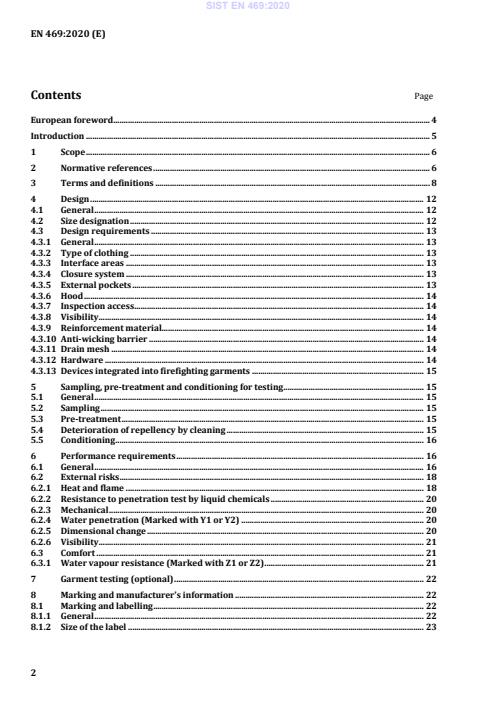
Contents Page
European foreword . 4
Introduction . 5
1 Scope . 6
2 Normative references . 6
3 Terms and definitions . 8
4 Design . 12
4.1 General . 12
4.2 Size designation . 12
4.3 Design requirements . 13
4.3.1 General . 13
4.3.2 Type of clothing . 13
4.3.3 Interface areas . 13
4.3.4 Closure system . 13
4.3.5 External pockets . 13
4.3.6 Hood . 14
4.3.7 Inspection access . 14
4.3.8 Visibility. 14
4.3.9 Reinforcement material. 14
4.3.10 Anti-wicking barrier . 14
4.3.11 Drain mesh . 14
4.3.12 Hardware . 14
4.3.13 Devices integrated into firefighting garments . 15
5 Sampling, pre-treatment and conditioning for testing . 15
5.1 General . 15
5.2 Sampling . 15
5.3 Pre-treatment . 15
5.4 Deterioration of repellency by cleaning . 15
5.5 Conditioning . 16
6 Performance requirements . 16
6.1 General . 16
6.2 External risks . 18
6.2.1 Heat and flame . 18
6.2.2 Resistance to penetration test by liquid chemicals . 20
6.2.3 Mechanical . 20
6.2.4 Water penetration (Marked with Y1 or Y2) . 20
6.2.5 Dimensional change . 20
6.2.6 Visibility. 21
6.3 Comfort . 21
6.3.1 Water vapour resistance (Marked with Z1 or Z2) . 21
7 Garment testing (optional) . 22
8 Marking and manufacturer’s information . 22
8.1 Marking and labelling . 22
8.1.1 General . 22
8.1.2 Size of the label . 23
8.2 Manufacturers information . 23
Annex A (normative) Assessment, evaluation and determination of the property values for
rating and for performance classification . 25
A.1 Expression of results . 25
A.2 Uncertainty of measurement . 25
Annex B (informative) Contamination during use . 26
B.1 General . 26
B.2 Contamination . 26
B.3 Cleaning . 26
B.4 Other actions to reduce human exposure . 26
Annex C (informative) Summary of clothing for heat and flame protection – guidance on
selection, use, care and maintenance (SUCAM) – CEN/TR 14560:2018 . 28
C.1 Introduction. 28
C.2 Personal protective equipment (PPE) – employers and users . 28
C.3 Practical performance test . 28
C.4 Selection, Use, Care and Maintenance guidance (SUCAM) . 28
Annex D (informative) Whole garment flame engulfment test using an instrumented
manikin . 31
Annex E (informative) Physiological impact - sweating torso . 32
Annex F (informative) Significant technical changes between this document and
EN 469:2005 . 33
Annex G (informative) Rationale . 36
Annex ZA (informative) Relationship between this European Standard and the Essential
Requirements of EU Regulation (EU) 2016/425 aimed to be covered . 41
Bibliography . 43
European foreword
This document (EN 469:2020) has been prepared by Technical Committee CEN/TC 162 “Protective
clothing including hand and arm protection and lifejackets”, the secretariat of which is held by DIN.
This European Standard shall be given the status of a national standard, either by publication of an
identical text or by endorsement, at the latest by January 2021, and conflicting national standards shall
be withdrawn at the latest b January 2021.
Attention is drawn to the possibility that some of the elements of this document may be the subject of
patent rights. CEN shall not be held responsible for identifying any or all such patent rights.
This document supersedes EN 469:2005.
This document has been prepared under a standardization request given to CEN by the European
Commission and the European Free Trade Association, and supports essential requirements of EU
Regulation (EU) 2016/425.
For relationship with EU Regulation, see informative Annex ZA, which is an integral part of this
document.
Annex F provides details of significant technical changes between this European Standard and the
previous edition. Annex G provides a rationale for the decisions on the requirements of this document.
It is one of several standards for protective clothing that have been developed to protect persons
against heat and/or flames.
According to the CEN-CENELEC Internal Regulations, the national standards organisations of the
following countries are bound to implement this European Standard: Austria, Belgium, Bulgaria,
Croatia, Cyprus, Czech Republic, Denmark, Estonia, Finland, France, Germany, Greece, Hungary, Iceland,
Ireland, Italy, Latvia, Lithuania, Luxembourg, Malta, Netherlands, Norway, Poland, Portugal, Republic of
North Macedonia, Romania, Serbia, Slovakia, Slovenia, Spain, Sweden, Switzerland, Turkey and the
United Kingdom.
Introduction
The clothing as defined in this document is part of the broader protection system that the wearer uses
to protect against risks which they are likely to be exposed to. Additional personal protective
equipment (PPE) to protect the head, face, hands and feet should also be worn, along with appropriate
respiratory protection where necessary.
The use of the PPE can affect the feelings perceived through our senses. Also, the PPE can have a
paradoxical effect (e.g. heat stress vs thermal protection) in the daily activities of a firefighter.
Although the firefighter role is to extinguish fires, he/she has many other activities where little or no
thermal protection is required. Therefore, finding the balance between thermal protection and comfort
(e.g. avoidance of heat stress), as well as other potential requirements is key. This revised document
gives the fire service options, based on a risk assessment, to make choices that match their specific
requirements and circumstances.
The heat and flame risks have been split into two levels. Level 2 provides higher thermal protection
performance, expected in high risk activities such as fighting fires in structures, e.g. buildings, factories,
gas stations.
This document applies to the design, manufacturing, testing and certification of firefighting protective
clothing. During the revision of the standard, the performance specification of current PPE purchased
across Europe by many fire services was reviewed. In addition, a list and a rationale for the inclusion of
each requirement (new and old) or the changing of existing requirements has been provided in Annexes
F and G.
It is essential that the fire (and rescue) services or their employers carry out a risk assessment and
carry out a compatibility and ergonomics check of all parts of the PPE (SCBA, gloves, boots, etc.) to meet
the requirements of the Regulation (EU) 2016/425. It is essential that firefighters and maintenance
personnel are trained in the selection, use, care and maintenance of all personal protective equipment.
Guidelines for selection, use, care and maintenance of protective clothing against heat and flame are
given in CEN/TR 14560:2018 (Annex C).
There is an increased focus on the contamination of firefighters and/or their PPE from smoke
particulates and fire gases, as well as all the decontamination processes. This document includes an
Annex B to alert firefighters and provide some recommendations.
Although innovation like sensors techniques is fully in development, this document provides
opportunities for implementation by describing the interfaces areas.
Nothing in this document is intended to restrict any jurisdiction, purchaser or manufacturer from
exceeding these minimum requirements.
1 Scope
This document specifies minimum performance requirements for protective clothing designed to be
worn during firefighting activities. The requirements detailed in this document cover design, heat and
flame, mechanical, chemical, comfort, and visibility.
This document covers the general clothing design, the minimum performance levels of the material
used, the methods of test to be used to determine these performance levels, marking and information
supplied by the manufacturer.
This document makes distinction between firefighting activities dividing them into two performance
levels based on a risk assessment:
— Level 1: specifies the minimum requirements for firefighting clothing involving work associated
with outdoor firefighting and their support activities, taking into account the environments and
conditions of the expected operational scenarios of such firefighting activities.
The level 1 is not applicable for protection against risks encountered in fighting fires or rescue from
fire activities in structures, unless combined to a level 2 or other specialized PPE.
— Level 2: specifies the minimum requirements for firefighting clothing for risks encountered in
fighting fires and rescue from fire in structures.
The distinction between Level 1 and Level 2 clothing is restricted to the requirements for heat and
flame (X1 or X2 - Heat and Flame). These levels of protection can be reached by a single garment or a
combination of separate garments.
Additional marking provides two grades of protection for Y (protection against water penetration) and
Z (water vapour resistance). It is essential that these performance grades are indicated on the marking
of the clothing and explained in the instructions for use.
This document does not cover protective clothing for wildland firefighting, specialized firefighting in a
high amount of radiant heat where reflective clothing is required and/or advanced technical rescue
operations dealing with hazardous chemicals, working with chainsaws and water and rope rescue.
This document does not cover protection for the head, hands and feet or specific protection against
other hazards e.g. chemical, biological, radiological and electrical hazards. These aspects may be
covered in other European Standards.
2 Normative references
The following documents are referred to in the text in such a way that some or all of their content
constitutes requirements of this document. For dated references, only the edition cited applies. For
undated references, the latest edition of the referenced document (including any amendments) applies.
CEN/TR 14560:2018, Guidance for selection, use, care and maintenance of protective clothing against
heat and flame
EN ISO 811:2018, Textiles - Determination of resistance to water penetration - Hydrostatic pressure test
(ISO 811:2018)
EN ISO 1421:2016, Rubber- or plastics-coated fabrics - Determination of tensile strength and elongation
at break (ISO 1421:2016)
EN ISO 3146:2000, Plastics - Determination of melting behaviour (melting temperature or melting range)
of semi-crystalline polymers by capillary tube and polarizing-microscope methods (ISO 3146:2000)
EN ISO 4674-1:2016, Rubber- or plastics-coated fabrics - Determination of tear resistance - Part 1:
Constant rate of tear methods (ISO 4674-1:2016)
EN ISO 6530:2005, Protective clothing - Protection against liquid chemicals - Test method for resistance of
materials to penetration by liquids (ISO 6530:2005)
EN ISO 6942:2002, Protective clothing - Protection against heat and fire - Method of test: Evaluation of
materials and material assemblies when exposed to a source of radiant heat (ISO 6942:2002)
EN ISO 9151:2016, Protective clothing against heat and flame - Determination of heat transmission on
exposure to flame (ISO 9151:2016, Corrected version 2017-03)
EN ISO 11092:2014, Textiles - Physiological effects - Measurement of thermal and water-vapour
resistance under steady-state conditions (sweating guarded-hotplate test) (ISO 11092:2014)
EN ISO 12127-1:2015, Clothing for protection against heat and flame - Determination of contact heat
transmission through protective clothing or constituent materials - Part 1: Contact heat produced by
heating cylinder (ISO 12127-1:2015)
EN ISO 13506-1:2017, Protective clothing against heat and flame - Part 1: Test method for complete
garments - Measurement of transferred energy using an instrumented manikin (ISO 13506-1:2017)
EN ISO 13688:2013, Protective clothing - General requirements (ISO 13688:2013)
EN ISO 13934-1:2013, Textiles - Tensile properties of fabrics - Part 1: Determination of maximum force
and elongation at maximum force using the strip method (ISO 13934-1:2013)
EN ISO 13935-2:2014, Textiles - Seam tensile properties of fabrics and made-up textile articles - Part 2:
Determination of maximum force to seam rupture using the grab method (ISO 13935-2:2014)
EN ISO 13937-2:2000, Textiles - Tear properties of fabrics - Part 2: Determination of tear force of trouser-
shaped test specimens (Single tear method) (ISO 13937-2:2000)
EN ISO 14116:2015, Protective clothing - Protection against flame - Limited flame spread materials,
material assemblies and clothing (ISO 14116:2015)
EN ISO 15025:2016, Protective clothing - Protection against flame - Method of test for limited flame
spread (ISO 15025:2016)
EN ISO 20471:2013, High visibility clothing - Test methods and requirements (ISO 20471:2013,
Corrected version 2013-06-01)
ISO 17493:2016, Clothing and equipment for protection against heat - Test method for convective heat
resistance using a hot air circulating oven
Impacted by EN ISO 20471:2013/A1:2016.
3 Terms and definitions
For the purposes of this document, the following terms and definitions apply.
ISO and IEC maintain terminological databases for use in standardization at the following addresses:
• IEC Electropedia: available at http://www.electropedia.org/
• ISO Online browsing platform: available at https://www.iso.org/obp/ui
3.1
ankle
region where the foot and the leg meet and can be marked by lateral and medial malleolus (A malleolus
is the bony prominence on each side of the ankle)
3.2
anti-wicking barrier
material used to prevent the transfer of liquid from outside the garment to inside the garment, usually
in addition to or replacing part of the innermost lining at the edge(s)
3.3
cleaning
process by which an item of personal protective equipment (PPE) is made again serviceable and/or
hygienically wearable by removing any dirt or contamination
Note 1 to entry: Cleaning may include reimpregnation step.
3.4
cleaning cycle
washing plus drying or dry-cleaning cycle
Note 1 to entry: See 3.32 (pre-treatment)
3.5
closure system
method of fastening openings in the garment including combinations of more than one method of
achieving a secure closure
Note 1 to entry: This term does not cover seams.
3.6
(firefighter's protective) clothing
specialized garments providing protection for the firefighter’s torso, neck, arms, and legs, but excluding
the head, hands, and feet
3.7
compatibility
ability of clothing (protective clothing and other clothing) to be used in conjunction with other types of
PPE covering other parts of the body
3.8
component assembly
combination of all materials of a multi-layer garment presented exactly as the finished garment
construction
3.9
conditioning
keeping samples under standard conditions of temperature and relative humidity for a minimum
period of time
[SOURCE EN ISO 11612:2015]
3.10
device
item whether made of fabric or hardware that is integrated into the firefighter garment
3.11
drain mesh material
permeable material to allow drainage of water
3.12
flame heat transfer index 12
HTI
time in seconds expressed to one decimal place, to achieve a calorimeter temperature rise of
(12±0,1) °C
3.13
flame heat transfer index 24
HTI
time in seconds expressed to one decimal place, to achieve a calorimeter temperature rise of
(24±0,1) °C
3.14
garment
single item of clothing which may consist of single or multiple layers
3.15
garment assembly
series of layers of garments arranged in the order as worn, which may contain multilayer materials,
material combinations or a series of separate garments in single layers
3.16
hardware
non-fabric items used in protective clothing including those made of metal or plastic
EXAMPLE Fasteners, rank markings, buttons, zippers, embroideries, braces.
[SOURCE EN ISO 11612:2015]
3.17
re-impregnation
procedure to maintain or regain the repellent properties of the outer fabric and/or chemical
penetration resistance of the clothing
3.18
innermost lining
lining on the innermost face of a component assembly which is intended to be nearest to the wearers
skin
Note 1 to entry: Where the innermost lining forms part of a material combination, the material combination is
regarded as the innermost lining.
3.19
integrated
one or more additional elements attached to the garments functioning as an inseparable whole or a
detachable device (3.10)
3.20
interface area
areas where openings interrupt the continuity of material(s) or garments
3.21
interlining
layer between the outermost layer and the innermost lining in a multilayer garment
3.22
laundering
process intended to remove soils and/or stains by treatment (washing) with an aqueous detergent
solution and normally including rinsing, extracting and drying
[SOURCE: EN ISO 15487:2010]
3.23
material
substances, excluding hardware and labels, of which an item of clothing is made
3.24
material combination
material produced from a series of separate layers, fixed together during the garment manufacturing
stage
Note 1 to entry: See 3.26 (multilayer material).
3.25
moisture barrier
fabric or membrane used in a component assembly to achieve the properties of hydrostatic pressure
and water vapour permeability
Note 1 to entry: Moisture barriers do not prevent the passage of some chemical, biological or radiological
agents and appropriate personal protective equipment (PPE) should be provided to protect the wearer in such
incidents.
3.26
multilayer material
material consisting of different layers intimately combined prior to the garment manufacturing stage,
e.g. by weaving, quilting, coating or gluing
Note 1 to entry: See 3.24 (material combination).
3.27
neck
part of the body that distinguishes the head from the torso or trunk and can be marked as the region
between the collarbones and the lower jawbones
3.28
nonwoven
structures of textile materials, such as fibres, continuous filaments, or chopped yarns of any nature or
origin, that have been formed into webs by any means, and bonded together by any means, excluding
the interlacing of yarns as in woven fabric, knitted fabric, laces, braided fabric or tufted fabric
Note 1 to entry: Film and paper structures are not considered as nonwovens.
[SOURCE: ISO 9092:2011, definition 2.1]
3.29
outer garment
outermost garment of the garment assembly that will be first exposed to the hazard(s)
3.30
outer material
outermost material of which the item of protective clothing is made
3.31
pocket
small textile bag that is sewn into or onto a piece of clothing and that is open so that items can be put
into it and can be closed by various means
3.32
pre-treatment
standard way of preparing the samples before testing or before use
Note 1 to entry: This might include e.g. a number of cleaning cycles, submitting the sample to heat, mechanical
action or any other relevant exposure and is finished by conditioning.
3.33
radiant heat transfer index 12
RHTI
time in seconds expressed to one decimal place to achieve a calorimeter temperature rise of (12±0,1) °C
Note 1 to entry: when tested according to EN ISO 6942:2002
3.34
radiant heat transfer index 24
RHTI
time in seconds expressed to one decimal place to achieve a calorimeter temperature rise of (24±0,1) °C
Note 1 to entry: when tested according to EN ISO 6942:2002
3.35
reinforcement
any material used to improve the garment properties either to increase the mechanical properties or to
provide comfort through reducing the pressure on parts of the body
3.36
self-contained breathing apparatus
SCBA
respirator that has a portable supply of breathing gas and is independent of the ambient atmosphere
3.37
seam
permanent fastening between two or more materials
3.38
structural seam
seam which holds the outer garment together and which if broken would expose the layers underneath
the outer garment and reduce protection
3.39
structure
type of building with an open, semi-open or closed construction with or without roof
3.40
torso
trunk of the human body, i.e. without arms, neck, legs and head
3.41
washing
to remove contamination from clothing by or as by the action of water, detergent and mechanics
3.42
wrist
region where the hand and the arm meet and can be marked by the radiocarpal joint, the joint between
the radius and the carpus
3.43
wristlet
part of a garment that encircles the wrist
4 Design
4.1 General
Firefighter's protective clothing shall be designed to provide protection for the firefighter's torso, neck,
arms to the wrists, and legs to the ankles during firefighting.
NOTE The design requirements do not differ whether the garment or garment assembly is marked as a Level
1 or Level 2.
4.2 Size designation
Size designation shall be in accordance with the requirements of EN ISO 13688:2013.
4.3 Design requirements
4.3.1 General
Design requirements shall be in accordance with the requirements given in EN ISO 13688:2013.
4.3.2 Type of clothing
The levels of performance can be achieved by a garment or a garment assembly which may contain
multilayer materials or material combinations. The items comprising the garment assembly that are
intended to meet the minimum and/or maximum requirement shall be tested together. To ensure this
level of protection, these shall also be worn as marked in 8.1.1.
If separate garment(s) (e.g. station wear, polo-shirt) are combined with turn-out gear, to meet the
protection levels, they shall be tested together to meet the minimum requirements of this document.
Any change, of for example the undergarment (e.g. different manufacturer or composition), invalidates
the compliance with the requirements of this document including the marking.
The performance levels of, for example, a jacket and trouser can be different, as they are separate
garments. Testing and approval shall be as completely separate items of PPE.
4.3.3 Interface areas
Where protection is provided by a two piece suit, it shall be determined that an overlap between the
jacket and trousers shall always be retained, whilst raising both hands fully above the head and bending
over from an upright position until fingertips reach the ground without bending the knees. The wrists
and ankles shall remain covered, when wearing appropriate sized clothing in an upright position.
Verification of the fulfilment of this requirement shall be made by visual inspection based on the
procedure outlined in this paragraph.
4.3.4 Closure system
The area of closure systems shall provide the same level of protection as the rest of the garment.
The distance between discontinuous closure system (e.g. buttonholes or press-fasteners) shall not lead
to unprotected openings in the garment. If zippers are used, the slide fastener shall be designed to lock
when completely closed including when using a fast release mechanism zipper. The closure system shall
not open accidentally. Verification of the fulfilment of this requirement shall be made by visual
inspection and manual test.
NOTE Slide fasteners classification and test methods can be found in EN 16732.
4.3.5 External pockets
Where garments are constructed with pockets, the pockets shall be constructed to the following design:
a) external patch pocket is a pocket made of a separate piece of outer-shell material sewn onto the
outside of a garment and shall conform to 6.2.1.1 and 6.2.1.6.;
b) external inset pocket is a pocket made inside the garment and made of materials which shall be
conform to 6.2.1.1 and 6.2.1.6.
All external pocket flaps shall be stitched down or capable of fastening the pocket closed. They shall be
20 mm wider than the opening (10 mm on each side) to prevent the flap from being tucked into the
pocket. Exception is possible for radio pockets and side pockets below the waist which do not extend
more than 10° forward of the side seam.
All pockets in the garment shall be designed in such a way to prevent entry of heat, flame, or hot
material, exception for external radio pockets.
Conformity shall be checked by visual inspection and physical measurement.
NOTE Increasing the number of pockets can lead to additional weight and insulation of the garment which
could increase the physiological impact on the wearer. It could also result in the accumulation of more
contaminants.
4.3.6 Hood
Where a garment is designed with a hood (not a balaclava), the hood shall be constructed meeting as a
minimum the requirements of the 6.2.1.1 and 6.2.1.6.
NOTE The use of a hood might have a negative effect on the heat build-up or the wearer’s perception (e.g.
hearing).
4.3.7 Inspection access
If present the inspection access(es) shall be closed by a means that cannot be opened accidentally.
NOTE The inspection accesses provide the possibility to inspect the protective layers or liners and the
various seams.
From a design perspective, it may not be possible to check all layers or liners in all areas of the garment.
4.3.8 Visibility
If claimed, the retro-reflective, fluorescent or combined performance material(s) (retro-reflective and
fluorescent properties) shall be designed to give visibility, meeting the requirements given in 6.2.6,
6.2.1.1 and 6.2.1.6 following the pre-treatment of 5.3.
If the outer material of the garment is a retro-reflective or a fluorescent material, it shall meet all the
requirements of Clause 6.
4.3.9 Reinforcement material
Any reinforcement material as part of the component assembly, shall meet the requirements of 6.2.1.1
and 6.2.1.6.
4.3.10 Anti-wicking barrier
Any anti-wicking barrier used in a garment either as part of an interlining at the edge part of a moisture
barrier or as the edge part of an innermost lining e.g. at the end of the sleeves, the trouser legs or
bottom of a jacket, the width of material shall not exceed 10 cm for jackets and 15 cm for trousers. The
anti-wicking barrier shall meet the requirements of 6.2.1.1 and 6.2.1.6.
4.3.11 Drain mesh
For any drain mesh material used, the width shall not exceed the 3 cm and will also become part of the
component assembly and shall meet the requirements of 6.2.1.1, and 6.2.1.6 (see Annex G).
4.3.12 Hardware
Hardware penetrating the outer material shall not be exposed on the innermost surface of the garment
or garment assembly.
Protective clothing shall be designed to ensure that the hardware shall not have sharp edges, roughness
or projections which are likely to cause injury to the wearer. Verification of the fulfilment of this
requirement shall be made by manual and visual inspection.
4.3.13 Devices integrated into firefighting garments
Any devices that are integrated (whether permanently fixed or not), the interfaced areas or areas of
interaction shall be designed so that the level of protection is maintained and shall be tested together
with the garment.
5 Sampling, pre-treatment and conditioning for testing
5.1 General
For all tests mentioned in Clause 6 and 7, all samples shall meet the requirements in the subclauses
below.
The value of each property defined in Clause 6 and 7 shall be used for performance classification.
5.2 Sampling
The size of the specimens subjected to the different test methods shall be in accordance with the
respective test standards specified in the requirements of Clause 6. Samples for testing shall be taken
from the original garment or shall be representative of the component assembly, as used in the finished
garment. Materials not having sufficient surface area shall be taken in combination with the outer layer
to make it possible to take samples with the dimensions as needed.
5.3 Pre-treatment
Each test specified in Clause 6, except test in 6.1.2.5 and 6.1.2.6, shall be pre-treated by cleaning. Tests
specified in 6.2.1.1, 6.2.1.2, 6.2.1.3 and 6.2.1.4 shall be carried out before (as received) and after pre-
treatment by cleaning. Test in 6.2.5 shall be carried out after only 5 cleaning cycles according to
manufacturer’s instructions.
The cleaning shall be in line with the manufacturer’s instructions on the basis of standardized
processes.
If the number of cleaning cycles is not specified, the tests shall be carried out – in case of laundering
after 5 laundering cycles (one laundering cycle consisting of one washing and one drying), or – in case
of dry cleaning after 5 cycles of dry cleaning. This shall be reflected in the information supplied by the
manufacturer.
If the manufacturer’s instructions indicate that both cleaning methods are allowed, the test specimen
shall undergo the laundering procedure only.
NOTE Manufacturer’s instructions typically indicate one or several of the various methods and processes of
EN ISO 6330, EN ISO 15797, EN ISO 3175-2 or equivalent as standardized processes for cleaning.
5.4 Deterioration of repellency by cleaning
Where the finishing, applied to improve or maintain the repellency for liquids resistance performance
of the garment, can be deteriorated by the cleaning procedures indicated by the manufacturer, the
manufacturer shall indicate the maximum number of cleaning cycles that can be carried out before the
garment needs to be re-treated or re-impregnated to restore its performance.
Testing according to 6.2.2 shall be carried out before the cleaning cycle for which the manufacturer
guarantees the performance.
For example, if the instructions state “re-impregnation during each third cleaning cycle”, tests shall be
performed after the second cleaning cycle, i.e. before re-impregnation. Then after reimpregation is
applied, the test should be performed again in order to demonstrate meeting the requirement.
If the instructions state “re-impregnation after each cleaning cycle”, the tests shall be performed on new
items. Later, the item shall be cleaned, reimpregnation is applied and test repeated again in order to
demonstrate meeting the requirement.
In all cases, cleaning shall be according 5.3.
5.5 Conditioning
Unless otherwise specified in the relevant test standard specimens shall be conditioned as follows:
a) for at least 24 h in an atmosphere having a temperature of (20 ± 2) °C and a relative humidity of
(65 ± 5) %;
b) testing shall be done in the same atmosphere or shall be started within 5 min of removal from this
atmosphere.
NOTE The requirements are based on EN ISO 139.
6 Performance requirements
6.1 General
All materials and structural seams of the component and/or garment assembly shall be tested with the
outermost surface exposed, except for flame spread testing of innermost lining (6.2.1.1) and the water
vapour resistance (6.3.1).
The distinction between Level 1 and Level 2 clothing is restricted to the requirements for heat and
flame (X1 or X2 – Heat and Flame). Where performance levels 1 and 2 (6.2.1.3 to 6.2.1.4) exist in the
same garment, it shall be classified as level 1. For all other attributes, the requirements for level 1 and 2
are treated the same.
Table 1 — Summary of performance requirements of Clause 6 and 7, levels, grades and marking
codes
Property Applicable Pre- Performance attribute 1 Performance
subclause treatment and Marking (where attribute 2 and
applicable) Marking (where
applicable)
Flame spread 6.2.1.1 before and Index 3 of EN ISO 14116:2015
after
Contact heat 6.2.1.2 before and Not required 10 s time
after according to
(Level)
EN ISO 12127-1
Heat transfer 6.2.1.3 before and HTI ≥ 9,0 s HTI ≥ 13,0 s
24 24
X1 X2
(flame) after
HTI ≥ 3,0 s HTI ≥ 4,0 s
24–12 24–12
(Level)
Heat transfer 6.2.1.4 before and RHTI ≥ 10,0 s RHTI ≥ 18,0 s
24 24
(radiation) after RHTI ≥ 4,0 s
24–12
RHTI ≥ 3,0 s
24–12
Residual tensile 6.2.1.5 after ≥ 450 N
strength exposure
to radiant
heat
Property Applicable Pre- Performance attribute 1 Performance
subclause treatment and Marking (where attribute 2 and
applicable) Marking (where
applicable)
Heat resistance 6.2.1.6 before shrinkage ≤ ± 5 %
No ignition
No melting
Requirements also for slide fasteners and hardware
Heat resistance 6.2.1.7 — No melting at a temperature of (260 ± 5) °C.
sewing thread
Resistance to 6.2.2 see 5.4 No penetration to innermost surface,
penetration of
Index of repellency ≥ 80 %
chemicals
Tensile strength 6.2.3.1 after Outer material ≥ 450N
Structural seams ≥ 300 N
Tear strength 6.2.3
...
Questions, Comments and Discussion
Ask us and Technical Secretary will try to provide an answer. You can facilitate discussion about the standard in here.
Loading comments...