

SIST EN 13892-1:2003
(Main)Methods of test for screed materials - Part 1: Sampling, making and curing specimens for test
- Abstract
This European standard specifies a method for sampling of mixed screed materials, making and curing of specimens for subsequent testing. This method applies to dry material (bagged or bulk) or to freshly mixed screed materials (ready mixed or site mixed) or to products supplied in pre-packaged form or in packs ready for mixing. This method applies for mortars of cementitious-, calcium sulfate-, magnesite- and synthetic resin screed material. For mastic asphalt screed material see EN 12697-20 and EN 12697-21.
- Status
- Published
- Publication Date
- 31-Aug-2003
- Technical Committee
- BBB - Concrete, reinforced concrete and prestressed concrete
- Current Stage
- 6060 - National Implementation/Publication (Adopted Project)
- Start Date
- 01-Sep-2003
- Due Date
- 01-Sep-2003
- Completion Date
- 01-Sep-2003



SIST EN 13892-1:2003 is the Slovenian standard identical to EN 13892-1:2002, published by SIST. It specifies how to sample screed materials and how to make and cure test specimens for later testing. It is used for cementitious, calcium sulphate, magnesite and synthetic resin screed materials in manufacturing, site work and laboratory testing.
What does SIST EN 13892-1:2003 specify?
SIST EN 13892-1:2003 sets the sampling and specimen-preparation method for screed materials, then links those specimens to later test methods. The standard covers dry material, freshly mixed material, and pre-packaged products ready for mixing.
The scope includes samples taken by the manufacturer, contractor, client or another interested party, including dispute cases and fully mixed product before laying. Mastic asphalt screed material is handled by EN 12697-20 and EN 12697-21, and special synthetic resin screed material may require manufacturer-specific methods.
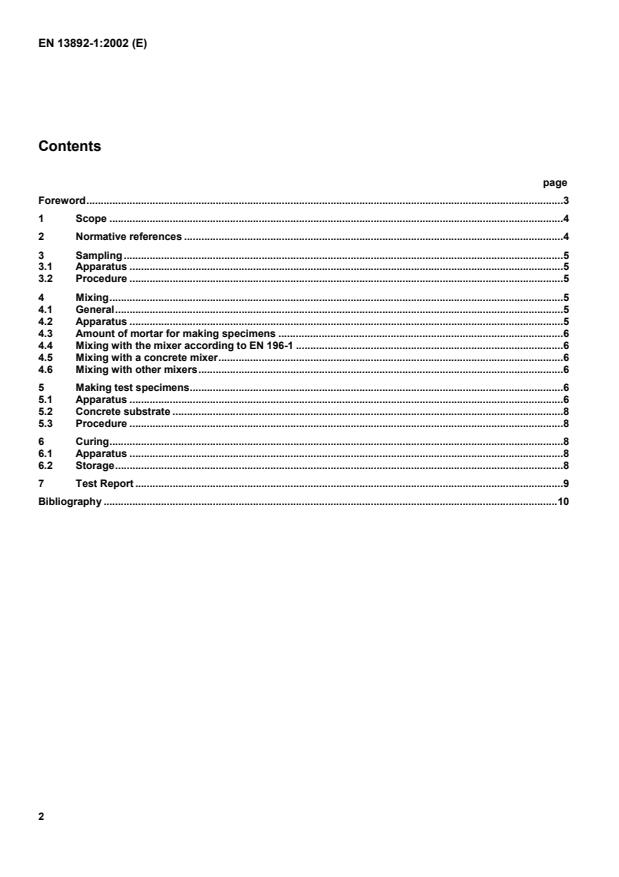
The document is organized into clauses on:
- Scope
- Normative references
- Sampling
- Mixing
- Making test specimens
- Curing
- Test report
- Bibliography
What are the key requirements of SIST EN 13892-1:2003?
Clause 3 requires representative sampling of the average material. In practice, the sample has to reflect what is actually being supplied or laid, so the test results can be trusted in production checks or disputes. The test report also has to identify whether the sample was a spot sample or a composite sample.
Clause 3 also sets handling rules for fresh or sensitive material. Samples that may change in air are placed in airtight containers quickly, and specimens should be prepared as soon as possible, within the manufacturer’s working time. This matters because moisture loss, unwanted water gain or time delay can change the test outcome.
Clause 4 requires mixing to follow the manufacturer’s instructions, including the stated water or liquid content. If a range is given, the standard uses the middle value, and the declared consistency should be achieved. The mixing equipment can be the EN 196-1 mixer, a concrete mixer, or another mixer when the product instructions allow it.
Clause 4 also links mixing quantity to the mixer type through Table 1. That helps the user prepare a batch large enough for the later tests without wasting material or underfilling the apparatus. The temperature of the room, equipment and materials is also controlled so mixing is repeatable.
Clause 5 covers specimen moulds and forming. The mould material should be steel or another non-reactive material, and the size and shape depend on the later test in Table 2. For a concrete substrate, the standard requires a suitable tensile strength, and a bonding agent is used when the product instructions call for it.
Clause 5 also distinguishes between flowing and other screed materials. Flowing material is cast in one pour, while other materials are placed in layers and compacted, or prepared exactly as the manufacturer instructs. This matters because specimen density and surface finish affect strength, wear, bond and impact results.
Clause 6 sets curing and storage conditions before testing. The storage chamber must control temperature and relative humidity, and Table 3 links those conditions to the screed material type and storage stage. In practice, this is what makes specimens comparable from one laboratory or site to another.
Clause 7 requires a traceable test report. It records the product identity, supplier, batch reference, sampling place and time, sampling method, sample identification, mixing and curing details, and the date and signature of the report. That information is what allows later test results to be checked against the actual material and preparation history.
What terms does SIST EN 13892-1:2003 define?
- Screed material - the material sampled and prepared for later test as a floor screed or screed layer.
- Spot sample - a sample taken from one point or moment to represent that specific portion of material.
- Composite sample - a combined sample made from several increments to represent the average composition.
- Working time - the period within which the mixed material can still be prepared into specimens.
- Curing - controlled storage of test specimens before testing so their condition is stable and repeatable.
- Relative humidity (RH) - the moisture level in the storage chamber, which the curing conditions control.
- Synthetic resin screed material - screed material based on synthetic resin, treated separately in the curing and sampling guidance.
Who uses SIST EN 13892-1:2003?
SIST EN 13892-1:2003 is used by screed material manufacturers, contractors, clients, and testing laboratories. Manufacturers use it for production control and for samples taken before dispatch. Contractors and clients use it on site or during use, and laboratories use it to prepare specimens for strength, wear, hardness, bond and impact testing.
What changed in SIST EN 13892-1:2003 from the previous edition?
SIST EN 13892-1:2003 is identical with EN 13892-1:2002.
Which standards are used with SIST EN 13892-1:2003?
| Reference | What it contributes |
|---|---|
| EN 196-1 | Mixer and mixing procedure reference, and the apparatus used for some specimen preparation steps |
| EN 196-7:1989 | Sample-taking and sample-preparation conventions, including spot and composite sampling |
| EN 13813 | Product standard reference used to identify the screed material in the test report |
| EN 13892-2 to EN 13892-8 | The companion test methods for which these specimens are prepared |
| EN ISO 178 | Flexural properties reference used for specimen geometry and related testing |
| EN ISO 6272 | Impact resistance test reference |
| prEN 12697-20 and prEN 12697-21 | Methods for mastic asphalt screed material |
| prEN 13454-2 | Related method for calcium sulphate screed material and shrinkage/swelling curing guidance |
What does the SIST EN 13892-1:2003 document contain?
The document gives the working steps for sampling, mixing, making specimens and curing them before later testing. It includes apparatus lists, procedures for different mixers, and guidance for casting on a concrete substrate. Table 1 controls the batch size for mixing, Table 2 links specimen and mould geometry to the later test, and Table 3 sets storage conditions and curing time by screed material. The report section gives the traceability information needed for quality control, disputes and laboratory records.
Relations
- Effective Date
- 28-Jan-2026
- Refers
SIST EN 196-7:1995 - Methods of testing cement - Methods of taking and preparing samples of cement - Effective Date
- 28-Jan-2026
- Effective Date
- 28-Jan-2026
- Effective Date
- 28-Jan-2026
- Effective Date
- 28-Jan-2026
- Effective Date
- 28-Jan-2026
- Referred By
SIST EN 13892-9:2025 - Methods of test for screed materials - Part 9: Dimensional stability - Effective Date
- 28-Jan-2026
- Effective Date
- 28-Jan-2026
- Effective Date
- 28-Jan-2026
- Effective Date
- 28-Jan-2026
- Referred By
SIST EN 13454-2:2019 - Binders for floor screeds based on calcium sulphate - Part 2: Test methods - Effective Date
- 28-Jan-2026
- Effective Date
- 28-Jan-2026
- Effective Date
- 28-Jan-2026
- Referred By
SIST EN 13892-9:2018 - Methods of test for screed materials - Part 9: Dimensional stability - Effective Date
- 28-Jan-2026
- Effective Date
- 28-Jan-2026
Get Certified
Connect with accredited certification bodies for this standard

DIBt (Deutsches Institut für Bautechnik)
German Institute for Building Technology.
DIN CERTCO
DIN Group product certification.

Aboma Certification B.V.
Specialized in construction, metal, and transport sectors.
Sponsored listings
Frequently Asked Questions
SIST EN 13892-1:2003 is a standard published by the Slovenian Institute for Standardization (SIST). Its full title is "Methods of test for screed materials - Part 1: Sampling, making and curing specimens for test". This standard covers: This European standard specifies a method for sampling of mixed screed materials, making and curing of specimens for subsequent testing. This method applies to dry material (bagged or bulk) or to freshly mixed screed materials (ready mixed or site mixed) or to products supplied in pre-packaged form or in packs ready for mixing. This method applies for mortars of cementitious-, calcium sulfate-, magnesite- and synthetic resin screed material. For mastic asphalt screed material see EN 12697-20 and EN 12697-21.
This European standard specifies a method for sampling of mixed screed materials, making and curing of specimens for subsequent testing. This method applies to dry material (bagged or bulk) or to freshly mixed screed materials (ready mixed or site mixed) or to products supplied in pre-packaged form or in packs ready for mixing. This method applies for mortars of cementitious-, calcium sulfate-, magnesite- and synthetic resin screed material. For mastic asphalt screed material see EN 12697-20 and EN 12697-21.
SIST EN 13892-1:2003 is classified under the following ICS (International Classification for Standards) categories: 91.100.10 - Cement. Gypsum. Lime. Mortar. The ICS classification helps identify the subject area and facilitates finding related standards.
SIST EN 13892-1:2003 has the following relationships with other standards: It is inter standard links to SIST EN 196-1:2016, SIST EN 196-7:1995, SIST EN ISO 178:2019, SIST EN 13892-3:2015, SIST EN ISO 6272-1:2011, SIST EN 13892-7:2003, SIST EN 13892-9:2025, SIST EN 13892-2:2003, SIST EN ISO 16000-11:2024, SIST EN 13892-4:2003, SIST EN 13454-2:2019, SIST EN ISO 20361:2015, SIST EN 13813:2003, SIST EN 13892-9:2018, SIST EN 13892-5:2003. Understanding these relationships helps ensure you are using the most current and applicable version of the standard.
SIST EN 13892-1:2003 is associated with the following European legislation: EU Directives/Regulations: 305/2011, 89/106/EEC; Standardization Mandates: M/EXP. When a standard is cited in the Official Journal of the European Union, products manufactured in conformity with it benefit from a presumption of conformity with the essential requirements of the corresponding EU directive or regulation.
SIST EN 13892-1:2003 is available in PDF format for immediate download after purchase. The document can be added to your cart and obtained through the secure checkout process. Digital delivery ensures instant access to the complete standard document.
Standards Content (Sample)
2003-01.Slovenski inštitut za standardizacijo. Razmnoževanje celote ali delov tega standarda ni dovoljeno.Methods of test for screed materials - Part 1: Sampling, making and curing specimens for testMéthodes d'essai des matériaux pour chapes - Partie 1: Echantillonnage, confection et cure des éprouvettes d'essaiPrüfverfahren für Estrichmörtel und Estrichmassen - Teil 1: Probenahme, Herstellung und Lagerung der Prüfkörper91.100.10Cement. Mavec. Apno. MaltaCement. Gypsum. Lime. MortarICS:SIST EN 13892-1:2003enTa slovenski standard je istoveten z:EN 13892-1:200201-september-2003SIST EN 13892-1:2003SLOVENSKI
STANDARD
EUROPEAN STANDARDNORME EUROPÉENNEEUROPÄISCHE NORMEN 13892-1November 2002ICS 91.100.10English versionMethods of test for screed materials - Part 1: Sampling, makingand curing specimens for testMéthodes d'essai des matériaux pour chapes - Partie 1:Echantillonnage, confection et cure des éprouvettes d'essaiPrüfverfahren für Estrichmörtel und Estrichmassen - Teil 1:Probenahme, Herstellung und Lagerung der PrüfkörperThis European Standard was approved by CEN on 9 October 2002.CEN members are bound to comply with the CEN/CENELEC Internal Regulations which stipulate the conditions for giving this EuropeanStandard the status of a national standard without any alteration. Up-to-date lists and bibliographical references concerning such nationalstandards may be obtained on application to the Management Centre or to any CEN member.This European Standard exists in three official versions (English, French, German). A version in any other language made by translationunder the responsibility of a CEN member into its own language and notified to the Management Centre has the same status as the officialversions.CEN members are the national standards bodies of Austria, Belgium, Czech Republic, Denmark, Finland, France, Germany, Greece,Iceland, Ireland, Italy, Luxembourg, Malta, Netherlands, Norway, Portugal, Spain, Sweden, Switzerland and United Kingdom.EUROPEAN COMMITTEE FOR STANDARDIZATIONCOMITÉ EUROPÉEN DE NORMALISATIONEUROPÄISCHES KOMITEE FÜR NORMUNGManagement Centre: rue de Stassart, 36
B-1050 Brussels© 2002 CENAll rights of exploitation in any form and by any means reservedworldwide for CEN national Members.Ref. No. EN 13892-1:2002 E
wear resistance-Böhme.EN 13892-4,Test Methods for screed materials – Part 4 : Determination of wear resistance-BCA.prEN 13892-5,Methods of test for screed materials – Part 5 : Determination of wear resistance to rolling wheel -Methods for screed material for wearing layer. EN 13892-6,Test Methods for screed materials –Part 6 : Determination of surface hardness.prEN 13892-7,Test Methods for screed materials – Part 7 : Determination of resistance to rolling wheel –Methods for screed material with floor coverings. EN 13892-8,Test Methods
...