

SIST-TP CEN/TR 17603-31-17:2022
(Main)Space engineering - Thermal analysis handbook
General Information
- Abstract
This handbook is dedicated to the subject of thermal analysis for space applications. Thermal analysis is an important method of verification during the development of space systems. The purpose of this handbook is to provide thermal analysts with practical guidelines which support efficient and high quality thermal modelling and analysis.
Specifically, the handbook aims to improve:
1.the general comprehension of the context, drivers and constraints for thermal analysis campaigns;
2.the general quality of thermal models through the use of a consistent process for thermal modelling;
3.the credibility of thermal model predictions by rigorous verification of model results and outputs;
4.long term maintainability of thermal models via better model management, administration and documentation;
5.the efficiency of inter-organisation collaboration by setting out best practice for model transfer and conversion.
The intended users of the document are people, working in the domain of space systems, who use thermal analysis as part of their work. These users can be in industry, in (inter)national agencies, or in academia. Moreover, the guidelines are designed to be useful to users working on products at every level of a space project - that is to say at system level, sub-system level, unit level etc.
In some cases a guideline could not be globally applicable (for example not relevant for very high temperature applications). In these cases the limitations are explicitly given in the text of the handbook.
- Status
- Published
- Public Enquiry End Date
- 27-Oct-2021
- Publication Date
- 01-Feb-2022
- Technical Committee
- I13 - Imaginarni 13
- Current Stage
- 6060 - National Implementation/Publication (Adopted Project)
- Start Date
- 31-Jan-2022
- Due Date
- 07-Apr-2022
- Completion Date
- 02-Feb-2022

Overview
SIST-TP CEN/TR 17603-31-17:2022 - Space engineering: Thermal analysis handbook - is a technical report (SIST/CEN) that provides practical, non‑normative guidance for performing thermal analysis of space systems. Drawn from ECSS guidance, the handbook targets the full lifecycle of thermal modelling and analysis - from concept and design through test correlation to final in‑flight predictions - and focuses on improving model quality, credibility and maintainability.
Key topics and technical coverage
The handbook collects best practice and guidance across a broad set of thermal analysis topics, including:
- Modelling guidelines and model management
- Model configuration, version control, modularity and discretisation (spatial/time meshes, observability).
- Thermal radiation and radiative environment
- Treatment of thermo‑optical properties, transparent elements, spectral dependencies and radiative cavities.
- Model verification
- Topology checks, steady‑state verification, finite element and radiative computation verification.
- Uncertainty analysis
- Sources of uncertainty (environmental, physical, modelling, test facility), classical and stochastic approaches, and parameter accuracy guidance.
- Model transfer, conversion and reduction
- Best practice for transferring models between organisations, conversion workflows, portability, verification of conversions and model reduction methods.
- Specific guidance annexes
- Practical modelling patterns for multilayer insulation (MLI), heat pipes, layered materials and electronic unit thermal networks.
Note: as a Technical Report, this document provides guidance rather than normative requirements.
Practical applications
This handbook is designed to increase efficiency and confidence in thermal analysis activities that are critical to space projects:
- Supporting thermal control design and trade‑offs during concept and detailed design.
- Producing mission thermal predictions and worst‑case hot/cold analyses.
- Predicting and correlating thermal test campaigns (ground tests, thermal vacuum).
- Improving inter‑organisation collaboration through standardized model transfer and conversion practices.
- Enabling long‑term model maintainability via documentation and configuration control.
Who should use this standard
Intended users include thermal analysts, systems engineers and researchers in:
- Space industry (prime contractors, subsystem suppliers)
- National and international space agencies
- Research institutions and academia
It is applicable at system, sub‑system and unit levels.
Related standards and references
- References and alignment with ECSS documents (for example ECSS‑E‑ST‑31 family and ECSS design handbooks) are included in the report. The handbook complements normative standards by providing practical modelling and verification guidance for space thermal analysis.
Keywords: thermal analysis, space engineering, thermal models, model verification, uncertainty analysis, thermal radiation, model conversion, multilayer insulation, heat pipes, thermal control.
Get Certified
Connect with accredited certification bodies for this standard

BUREAU VERITAS Certification Germany
Bureau Veritas certification in Germany.

Element Materials Technology
Materials testing and product certification.

AQMS Ltd.
AQMS provides ISO certification to SMEs across the UK.
Sponsored listings
Frequently Asked Questions
SIST-TP CEN/TR 17603-31-17:2022 is a technical report published by the Slovenian Institute for Standardization (SIST). Its full title is "Space engineering - Thermal analysis handbook". This standard covers: This handbook is dedicated to the subject of thermal analysis for space applications. Thermal analysis is an important method of verification during the development of space systems. The purpose of this handbook is to provide thermal analysts with practical guidelines which support efficient and high quality thermal modelling and analysis. Specifically, the handbook aims to improve: 1.the general comprehension of the context, drivers and constraints for thermal analysis campaigns; 2.the general quality of thermal models through the use of a consistent process for thermal modelling; 3.the credibility of thermal model predictions by rigorous verification of model results and outputs; 4.long term maintainability of thermal models via better model management, administration and documentation; 5.the efficiency of inter-organisation collaboration by setting out best practice for model transfer and conversion. The intended users of the document are people, working in the domain of space systems, who use thermal analysis as part of their work. These users can be in industry, in (inter)national agencies, or in academia. Moreover, the guidelines are designed to be useful to users working on products at every level of a space project - that is to say at system level, sub-system level, unit level etc. In some cases a guideline could not be globally applicable (for example not relevant for very high temperature applications). In these cases the limitations are explicitly given in the text of the handbook.
This handbook is dedicated to the subject of thermal analysis for space applications. Thermal analysis is an important method of verification during the development of space systems. The purpose of this handbook is to provide thermal analysts with practical guidelines which support efficient and high quality thermal modelling and analysis. Specifically, the handbook aims to improve: 1.the general comprehension of the context, drivers and constraints for thermal analysis campaigns; 2.the general quality of thermal models through the use of a consistent process for thermal modelling; 3.the credibility of thermal model predictions by rigorous verification of model results and outputs; 4.long term maintainability of thermal models via better model management, administration and documentation; 5.the efficiency of inter-organisation collaboration by setting out best practice for model transfer and conversion. The intended users of the document are people, working in the domain of space systems, who use thermal analysis as part of their work. These users can be in industry, in (inter)national agencies, or in academia. Moreover, the guidelines are designed to be useful to users working on products at every level of a space project - that is to say at system level, sub-system level, unit level etc. In some cases a guideline could not be globally applicable (for example not relevant for very high temperature applications). In these cases the limitations are explicitly given in the text of the handbook.
SIST-TP CEN/TR 17603-31-17:2022 is classified under the following ICS (International Classification for Standards) categories: 49.140 - Space systems and operations. The ICS classification helps identify the subject area and facilitates finding related standards.
SIST-TP CEN/TR 17603-31-17:2022 is associated with the following European legislation: Standardization Mandates: M/496. When a standard is cited in the Official Journal of the European Union, products manufactured in conformity with it benefit from a presumption of conformity with the essential requirements of the corresponding EU directive or regulation.
SIST-TP CEN/TR 17603-31-17:2022 is available in PDF format for immediate download after purchase. The document can be added to your cart and obtained through the secure checkout process. Digital delivery ensures instant access to the complete standard document.
Standards Content (Sample)
SLOVENSKI STANDARD
01-marec-2022
Vesoljska tehnika - Priročnik o toplotni analizi
Space engineering - Thermal analysis handbook
Raumfahrttechnik - Handbuch für thermische Analyse
Ingénierie spatiale - Manuel d'analyse thermique
Ta slovenski standard je istoveten z: CEN/TR 17603-31-17:2022
ICS:
49.140 Vesoljski sistemi in operacije Space systems and
operations
2003-01.Slovenski inštitut za standardizacijo. Razmnoževanje celote ali delov tega standarda ni dovoljeno.
TECHNICAL REPORT CEN/TR 17603-31-17
RAPPORT TECHNIQUE
TECHNISCHER BERICHT
January 2022
ICS 49.140
English version
Space engineering - Thermal analysis handbook
Ingénierie spatiale - Manuel d'analyse thermique Raumfahrttechnik - Handbuch für thermische Analyse
This Technical Report was approved by CEN on 29 November 2021. It has been drawn up by the Technical Committee
CEN/CLC/JTC 5.
CEN and CENELEC members are the national standards bodies and national electrotechnical committees of Austria, Belgium,
Bulgaria, Croatia, Cyprus, Czech Republic, Denmark, Estonia, Finland, France, Germany, Greece, Hungary, Iceland, Ireland, Italy,
Latvia, Lithuania, Luxembourg, Malta, Netherlands, Norway, Poland, Portugal, Republic of North Macedonia, Romania, Serbia,
Slovakia, Slovenia, Spain, Sweden, Switzerland, Turkey and United Kingdom.
CEN-CENELEC Management Centre:
Rue de la Science 23, B-1040 Brussels
© 2022 CEN/CENELEC All rights of exploitation in any form and by any means
Ref. No. CEN/TR 17603-31-17:2022 E
reserved worldwide for CEN national Members and for
CENELEC Members.
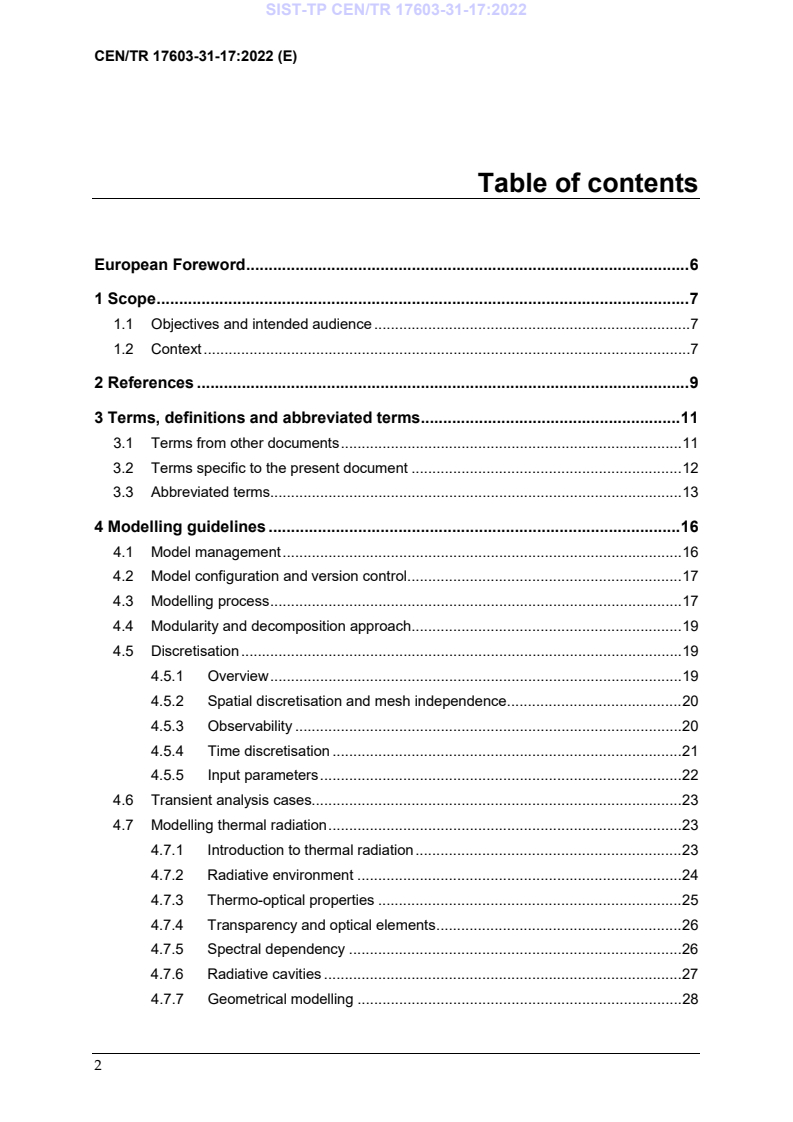
Table of contents
European Foreword . 6
1 Scope . 7
1.1 Objectives and intended audience . 7
1.2 Context .7
2 References . 9
3 Terms, definitions and abbreviated terms . 11
3.1 Terms from other documents . 11
3.2 Terms specific to the present document . 12
3.3 Abbreviated terms. 13
4 Modelling guidelines . 16
4.1 Model management . 16
4.2 Model configuration and version control . 17
4.3 Modelling process . 17
4.4 Modularity and decomposition approach . 19
4.5 Discretisation . 19
4.5.1 Overview . 19
4.5.2 Spatial discretisation and mesh independence . 20
4.5.3 Observability . 20
4.5.4 Time discretisation . 21
4.5.5 Input parameters . 22
4.6 Transient analysis cases. 23
4.7 Modelling thermal radiation . 23
4.7.1 Introduction to thermal radiation . 23
4.7.2 Radiative environment . 24
4.7.3 Thermo-optical properties . 25
4.7.4 Transparency and optical elements . 26
4.7.5 Spectral dependency . 26
4.7.6 Radiative cavities . 27
4.7.7 Geometrical modelling . 28
4.8 Considerations for non-vacuum environments . 29
4.8.1 General . 29
4.8.2 Specific regimes . 29
4.8.3 Conduction or convection . 29
4.8.4 Heat transfer coefficient correlation . 30
4.8.5 Charge/discharge of gas inside pressurised systems . 30
5 Model verification . 31
5.1 Introduction to model verification . 31
5.2 Topology checks . 31
5.3 Steady state analysis . 32
5.4 Finite element models . 33
5.5 Verification of radiative computations. 34
6 Uncertainty analysis . 35
6.1 Uncertainty philosophy . 35
6.2 Sources of uncertainties . 36
6.2.1 General . 36
6.2.2 Environmental parameters . 36
6.2.3 Physical parameters . 37
6.2.4 Modelling parameters . 37
6.2.5 Test facility parameters . 37
6.3 Classical uncertainty analysis . 38
6.4 Stochastic uncertainty analysis . 39
6.5 Typical parameter inaccuracies . 39
6.6 Uncertainty analysis for heater controlled items . 41
7 Model transfer, conversion and reduction . 42
7.1 Model transfer . 42
7.1.1 Introduction to model transfer . 42
7.1.2 Analysis files and reference results . 42
7.1.3 Documentation . 44
7.1.4 Portability of thermal models . 44
7.2 Model conversion. 45
7.2.1 Introduction to model conversion . 45
7.2.2 Management of thermal model conversions . 46
7.2.3 Model conversion workflow . 47
7.2.4 Verification of radiative model conversions . 50
7.2.5 Verification of thermal model (TMM) conversions . 52
7.3 Model reduction . 52
7.3.1 Introduction to model reduction . 52
7.3.2 Management . 53
7.3.3 Model reduction guidelines . 53
7.3.4 Model reduction correlation success criteria . 54
7.3.5 Model reduction approaches . 55
Annex A Specific guidelines . 57
A.1 Multilayer insulation . 57
A.1.1 Introduction . 57
A.1.2 Modelling principles . 57
A.1.3 Modelling patterns . 58
A.2 Heat pipes . 58
A.2.1 Introduction . 58
A.2.2 Modelling principles . 59
A.2.3 Modelling patterns . 59
A.2.4 Design verification . 59
A.2.5 Model verification . 60
A.3 Layered materials . 60
A.3.1 Modelling principles . 60
A.3.2 Modelling patterns . 60
A.4 Electronic units . 63
A.4.1 Introduction . 63
A.4.2 Physical data and modelling advice . 64
Figures
Figure 1-1: Thermal analysis in the context of a space project . 8
Figure 4-1: Modelling process . 18
Figure 4-2: Examples of cavities: top showing two completely closed cavities, bottom
showing two almost separated cavities with a small opening . 27
Figure 7-1: Diagram for the ideal model conversion workflow . 47
Figure 7-2: Activity diagram for conversion workflow - Conversion done by developer. . 48
Figure 7-3: Activity diagram for conversion workflow - Conversion done by recipient. . 48
Figure 7-4: Comparison of converted GMM radiative couplings . 51
: Typical heat pipe nodal topology . 59
: Example of verifying heat pipe heat transport capability . 60
: Typical electronic unit thermal network . 63
Tables
Table 6-1: Typical parameter inaccuracies (pre-phase A and phase B) . 39
Table 6-2: Typical parameter inaccuracies (phase B and phase C/D) . 40
Table 7-1: Model reduction methods . 55
European Foreword
This document (CEN/TR 17603-31-17:2022) has been prepared by Technical Committee
CEN/CLC/JTC 5 “Space”, the secretariat of which is held by DIN.
It is highlighted that this technical report does not contain any requirement but only collection of data
or descriptions and guidelines about how to organize and perform the work in support of EN16603-
31.
This Technical report (CEN/TR 17603-31-17:2022) originates from ECSS-E-HB-31-03A.
Attention is drawn to the possibility that some of the elements of this document may be the subject of
patent rights. CEN shall not be held responsible for identifying any or all such patent rights.
This document has been prepared under a mandate given to CEN by the European Commission and
the European Free Trade Association.
This document has been developed to cover specifically space systems and has therefore precedence
over any TR covering the same scope but with a wider domain of applicability (e.g.: aerospace).
Scope
1.1 Objectives and intended audience
This handbook is dedicated to the subject of thermal analysis for space applications. Thermal analysis
is an important method of verification during the development of space systems. The purpose of this
handbook is to provide thermal analysts with practical guidelines which support efficient and high
quality thermal modelling and analysis.
Specifically, the handbook aims to improve:
a. the general comprehension of the context, drivers and constraints for thermal analysis
campaigns;
b. the general quality of thermal models through the use of a consistent process for thermal
modelling;
c. the credibility of thermal model predictions by rigorous verification of model results and
outputs;
d. long term maintainability of thermal models via better model management, administration and
documentation;
e. the efficiency of inter-organisation collaboration by setting out best practice for model transfer
and conversion.
The intended users of the document are people, working in the domain of space systems, who use
thermal analysis as part of their work. These users can be in industry, in (inter)national agencies, or in
academia. Moreover, the guidelines are designed to be useful to users working on products at every
level of a space project – that is to say at system level, sub-system level, unit level etc.
In some cases a guideline could not be globally applicable (for example not relevant for very high
temperature applications). In these cases the limitations are explicitly given in the text of the
handbook.
1.2 Context
The use of computational analysis to support the development of products is standard in modern
industry. Figure 1-1 illustrates the typical thermal modelling and analysis activities to be performed at
each phase of the development of a space system.
NOTE More information about the project lifecycle can be found in ECSS-
M-ST-10 [RD5].
• Adapt thermal models for mission
• Analyse requirements
• Define final design of TCS • Perform mission predictions
• Define TCS concept
• Update thermal models (ground & flight)
• Perform trade-off
• Perform calculations covering all • Perform flight correlation
• Assess TRL of TCS
mission cases • Perform analysis in support of
products
operations
Phase B Phase C Phase D
Phase A Phase E
Preliminary Detailed Qualification
Feasibility Utilization
definition Definition production
PRR PDR CDR QR
• Adapt thermal models for test configuration
• Define preliminary design of TCS • Perform test prediction
• Develop thermal models • Perform test correlation
• Perform calculation for worst hot/cold • Update flight thermal models with outcomes
cases of test correlation
• Perform and correlate development tests • Perform analysis in support of production
activities
Figure 1-1: Thermal analysis in the context of a space project
It can be seen that thermal models are used during all phases of the space system development to
support a large number of activities, ranging from conceptual design right through to final in-flight
predictions.
Indeed, in some cases, thermal analysis is the only way that certain thermal requirements can be
verified; as physical tests are either too expensive or unrealisable. It is therefore vital for the credibility
of the predictions made that the quality of the models is as high as possible.
References
RD # EN Reference Reference in text Title
[RD1] E N 16603-31 ECSS-E-ST-31, Space engineering - Thermal control general
requirements
[RD2] E N 16603-32-03 ECSS-E-ST-32-03 Space engineering - Structural finite element
models
[RD3] E N 16603-31-02 ECSS-E-ST-31-02 Space engineering - Two-phase heat transport
equipment
[RD4] T R 16603-31-01 ECSS-E-HB-31-01 Space engineering - Thermal design handbook
[RD5] E N-16601-10 ECSS-M-ST-10 Space project management - Project planning and
implementation
[RD6] E N 16601-00-01 ECSS-S-ST-00-01 ECSS system – Glossary of terms
[RD7] Gilmore, D., G., “Spacecraft Thermal Control
Handbook – Volume 1: Fundamental
Technologies”, 2002
[RD8] Anderson, B. J. and Smith, R. E. “Natural Orbital
Environment Guidelines for Use in Aerospace
Vehicle Development”, NASA Technical
Memorandum 4527, June 1994
[RD9] Anderson, B. J., Justus, C. G., and Batts, G. W.
“Guidelines for the Selection of Near-Earth
Thermal Environmental Parameters for Spacecraft
Design”, NASA Technical Memorandum 2001-
211221, October 2001
[RD10] Anderson, B. J., James, B. F., Justus, C. G., Batts
“Simple Thermal Environment Model (STEM)
User’s Guide, NASA Technical Memorandum
2001-211222, October 2001
[RD11] Sauer, A. “Implementation of the Equation of
Time in Sun Synchronous Orbit Modelling and
ESARAD Planet Temperature Mapping Error at
the Poles “, 22nd European Workshop on Thermal
and ECLS Software. October 2008.
https://exchange.esa.int/thermal-
workshop/attachments/workshop2008/
RD # EN Reference Reference in text Title
[RD12] “Feasibility of Using a Stochastic Approach for
Space Thermal Analysis”, Blue Engineering &
Alenia Spazio, 2004,
https://exchange.esa.int/stochastic/
[RD13] “Guide for Verification and Validation in
Computational Solid Mechanics,” The American
Society of Mechanical Engineers, Revised Draft:
[RD14] Remaury, S., Nabarra, P., Bellouard, E.,
d’Escrivan, S., “In-Flight Thermal Coatings
Ageing on the THERME Experiment” CNES,
Proceedings of the 9th International Symposium
on Materials in a Space Environment, 2003
Noordwijk, The Netherlands
[RD15] M. Molina & C. Clemente, “Thermal Model
Automatic Reduction: Algorithm and Validation
Techniques”, ICES 2006.
[RD16] F. Jouffroy, D. Charvet, M. Jacquiau and A.
Capitaine, “Automated Thermal Model Reduction
for Telecom S/C Walls”, 18th European Workshop
on Thermal and ECLS Software, 6–7 October 2004
[RD17] Gorlani M., Rossi M., “Thermal Model Reduction
with Stochastic Optimization”, 2007-01-3119, 37th
ICES Conference, 2007, Chicago
[RD18] M. Bernard, T. Basset, S. Leroy, F. Brunetti and J.
Etchells, “TMRT, a thermal model reduction tool”,
23rd European Workshop on Thermal and ECLS
Software, 6–7 October 2009
[RD19] STEP-TAS Technical Details
http://www.esa.int/TEC/Thermal_control/SEME7
NN0LYE_0.html
[RD20] CRTech, “How to Model a Heat Pipe”,
http://www.crtech.com/docs/papers/HowToMode
lHeatpipe.pdf
[RD21] Juhasz, A., “An Analysis and Procedure for
Determining Space Environmental Sink
Temperatures with Selected Computational
Results”, NASA Technical Memorandum 2001-
Terms, definitions and abbreviated terms
3.1 Terms from other documents
a. For the purpose of this document, the terms and definitions from ECSS-ST-00-01 [RD6] apply,
in particular for the following terms:
1. validation
NOTE Validation is the process of determining the degree to which a
computational model is an accurate representation of the real
world from the perspective of the intended uses of the model.
2. verification
NOTE 1 Verification is the process of determining that a computational
model accurately represents the underlying mathematical model
and its solution
NOTE 2 The topic of V&V is well known in the context of quality assurance
and systems engineering (including software systems). There has
also been some work in other domains such as Computational
Fluid Dynamics (CFD) and structural mechanics to develop
processes for V&V of simulation models. In the particular context
of computational analysis the formal definitions usually apply
[RD13].
NOTE 3 More informally the following questions are often used to explain
V&V in the context of computational analysis:
• Verification “did we solve the equations correctly?”
• Validation “did we solve the correct equations?”
b. For the purpose of this document, the terms and definitions from ECSS-E-ST-31 apply, in
particular for the following terms:
1. geometrical mathematical model
mathematical model in which an item and its surroundings are represented by radiation
exchanging surfaces characterised by their thermo-optical properties
2. thermal mathematical model
numerical representation of an item and its surroundings represented by concentrated
thermal capacitance nodes or elements, coupled by a network made of thermal
conductors (radiative, conductive and convective)
NOTE The current trend is towards integrated thermal modelling tools, in
which case the distinction between Geometrical Mathematical
Model (GMM) and Thermal Mathematical Model (TMM) becomes
ill-defined. Nonetheless the terms GMM and TMM are still used in
the everyday language of thermal engineers and so the terms are
retained in this document.
3. thermal node
representation of a specific volume of an item with a representative temperature,
representative material properties and representative pressure (diffusion node) used in a
mathematical lumped parameter approach
NOTE The current document is written to be, as far as possible, tool and
method independent. It is therefore useful to generalise the
concept of thermal node to cover other numerical methods (e.g. the
finite element method). Mathematically speaking a thermal node
represents a “degree of freedom” in the equation system. More
practically, the purpose of a thermal node is to provide a
temperature evaluation (and output) at a selected location.
4. uncertainties
inaccuracies in temperature calculations due to inaccurate physical, environmental and
modelling parameters
NOTE This definition of uncertainty refers specifically to temperature
calculations. In the context of this document this is widened to
calculations of other key model outputs such as heater power or
duty cycle.
3.2 Terms specific to the present document
3.2.1 accuracy
degree of conformance between an output of a thermal analysis and the true value
NOTE The true value is usually a measurement from a physical test, for
example a thermal balance test. The purpose of the verification and
validation effort is thus to improve and quantify modelling
accuracy.
3.2.2 arithmetic thermal node
thermal node with zero thermal capacitance
NOTE 1 Arithmetic nodes are normally treated specially by thermal solvers
and a quasi-steady state solution is obtained for them during
transient runs. This is useful to avoid excessively small time steps
when lightweight items need to be represented in large models.
NOTE 2 Additionally arithmetic nodes are often used to represent thermal
interfaces or the edges of region
3.2.3 computational model
numerical implementation of a mathematical model
NOTE 1 This is usually comprises numerical discretisation, solution
algorithm, and convergence criteria.
NOTE 2 This definition is taken from RD11, where a more detailed
discussion of the relationship between mathematical and
computation models can be found.
3.2.4 CSG
ratio of capacitance to sum of connected conductances for a thermal node
NOTE No specific acronym is available for CSG, most likely the C
represents capacitance, the S represents the sum, and the G
represents the conductors.
3.2.5 error
difference between an output of a thermal analysis and the true value
NOTE 1 High accuracy analyses therefore produce outputs with small
associated errors.
NOTE 2 This is a typical dictionary definition of error and generic. More
specific and formal definitions occur in a number of other sources,
for example ASME [RD13].
3.2.6 key model output(s)
output(s) from the thermal model having high level of importance
NOTE Examples of key model outputs are TRP temperatures, heater duty
cycles, and any other output form the model with special
significance for the verification of the TCS.
3.2.7 radiative cavity
collection of radiative surfaces of the thermal-radiative model, having the property that its surfaces
cannot exchange heat through thermal radiation with the surfaces belonging to another cavity
NOTE This term is synonymous with “radiative enclosure”.
3.2.8 radiative enclosure
See “radiative cavity”.
3.3 Abbreviated terms
For the purpose of this document, the abbreviated terms from ECSS-S-ST-00-01 and the following
apply:
Abbreviation Meaning
BOL beginning-of-life
CCHP constant conductance heat pipe
CFD computational fluid dynamics
CLA
coupled launcher analysis
CNES Centre National d'Etudes Spatiales
COTS commercial off-the-shelf
DGMM detailed geometrical mathematical model
Abbreviation Meaning
DRD document requirements definition
DTMM detailed thermal mathematical model
EEE electrical, electronic and electromechanical
EOL
end-of-life
ESATAN
thermal/fluid analyser from ITP Engines
FEM finite element method
GMM geometrical mathematical model
HP heat pipe
HTC heat transfer coefficient
I/O
input / output
ICD
interface control document
ICES International Conference on Environmental Systems
IR infrared
KMO key model output(s)
LHP loop heat pipe
LP lumped parameter
MCRT
Monte Carlo ray tracing
MLI multi-layer insulation
OS open source
PCB printed circuit board
PID proportional integral derivative
PLM product lifecycle management
REF
radiation exchange factor
RGMM reduced geometrical mathematical model
RTMM reduced thermal mathematical model
S/C spacecraft
SDM simulation data management
SINDA thermal/fluid analyser from C&R technologies
SVD
singular value decomposition
TB
thermal balance
TCS thermal control system
TMG thermal/fluid analyser from MAYA HTT Engineering Software Solutions
TMM thermal mathematical model
TMRT thermal model reduction tool
TRL
technology readiness level
TRP
temperature reference point
Abbreviation Meaning
V&V verification and validation
VCHP variable conductance heat pipe
Modelling guidelines
4.1 Model management
The observed trend towards larger and more complex thermal models - coupled with an increase in
the number of analysis cases to respond to challenging customer requirements - means that proper
model management is essential.
Most thermal analysis campaigns have become an intricate series of activities that provide results in
different scenarios and which can be a combination of a huge number of factors. This complexity calls
for strategy and thoroughness and a key tool is the “TCS mathematical model specification” DRD in
ECSS-E-ST-31. This DRD specifies the requirements for development and delivery of mathematical
models to be used for thermal analysis.
Beyond this TCS mathematical model specification it is important to consider the analysis in the wider
context of a project. A number of general considerations are listed below, some of which are covered
in more detail in this document (as indicated). These points can be considered by thermal engineers
when planning an analysis campaign.
a. management:
1. adequate computing resources;
2. sufficient and trained manpower;
3. availability of analysis tool licenses.
b. software tools:
1. the features of the analysis tools with respect to the intended use.
c. administration and configuration: (see section 4.2)
1. configuration control system;
2. architecture of data and files repository;
3. physical configuration of the system of interest;
4. management of the different thermal cases;
5. way to ensure a robust link between TMM and GMM.
d. model transfer and results distribution (see section 7.1):
1. thermal analysis tools used by different stakeholders (e.g. is a format conversions
required?);
2. which models are deliverable and with what level of fidelity (e.g. detailed, reduced).
4.2 Model configuration and version control
Most thermal models of spacecraft are under some form of version control. However, this is often
implemented as plain text headers at the top of analysis files and manual incrementing of version
numbers in file names. At present there are number of options to support configuration control,
ranging from software configuration control tools (e.g. subversion, git), to full Product Lifecycle
Management (PLM) solutions.
These environments can be directly applied to thermal model configuration control, especially for
ASCII formats. Moreover, many binary formats for documentation are also supported (e.g. .doc, .pdf).
The use of such configuration control tools is not a burden and actually improves the efficiency and
productivity of the analysts. In addition to this, the maintainability of models over a number of years
is improved via the use of formal version control.
Guideline 4-1
Place thermal models under configuration control using a system that supports:
a. tracking of model changes with informative remarks
b. tracking of the engineer and organisation making the changes (author ,editor etc.)
c. comparison (differencing) between distinct versions of the model in the repository
d. tagging of model releases at critical milestones (e.g. PDR, CDR)
Guideline 4-2
Ensure results of all production runs are traceable to a specific version of the model inside the
configuration control repository.
Guideline 4-3:
Where a multiple GMMs and TMMs are used ensure the link between the two is tracked in the
configuration control environment (i.e. the GMM required as input to a given TMM)
As indicated in Guideline 4-3 above, often multiple models are needed in order to cover all of the
different cases and scenarios to be simulated, for example: thermal test scenarios, stowed and
deployed configurations. Additionally multiple GMMs are often used to represent distinct cavities
(see section 4.7.6). It is therefore important to clearly configure the relations ship between the different
models (and version of those model) in the configuration control environment.
4.3 Modelling process
As the analysis tools and methods used by thermal engineers evolve, so the modelling process evolves
accordingly. For example, historically the analysis process typically started with the construction of a
GMM which was used to compute the radiative couplings and environmental heat exchanges, which
drive the thermal behaviour of a spacecraft. The results of the radiative analysis computed with the
GMM were then fed into the TMM which was used to compute temperatures and heat flows. This
process is shown in Figure 4-1.
Fundamentally the sequence of this process has not changed – radiation is still of fundamental interest
and a geometrical representation is essential for radiative computations. However, as the tools
develop, the tendency is towards integrated modelling environments where the TMM and GMM
merge into a single entity; with most thermal couplings generated automatically by the tool. Thus the
construction of the GMM/TMM becomes a single activity; although the actual analysis sequence
necessarily starts with the radiative part, before running the thermal solution.
Mission Requirements
Environmental Functional Requirements, Operational
Requirements, e.g. as e.g. as attitude, Requirements, e.g.
orbit date configuration pointing, dissipations
Spacecraft Design
Physical design
Geometry, configuration Operation, e.g.
Material distribution,
Thermo-optical properties heater setpoint
masses
Thermo-physical
Thermo-optical
Radiative representation, e.g. operational
geometrical
environment setup, Thermal representation, e.g.
Representation, e.g.
e.g. orbit, attitude conductance, Equipment peration
thermal radiative
thermal capacity
active faces
Physical and operational
Radiative representative
representative thermal model
thermal model
TMM template
GMM input deck
“model without thermal
“model used for radiative
radiation”
outputs creation”
Radiative Solver
Radaitive results, e.g.
View Factors
Radiative couplings,
environmental heat fluxes
Radiative, physical
and operational
representative
thermal model
Thermal Solver
Thermal results, e.g.
Temperatures,
heat fluxes,
heater duty cycles,
Thermo-hydraulic parameters
Results presentation
credibility checks
Result analysis as design
verification or input to
design modifications
Figure 4-1: Modelling process
Radiative Modelling
Post Processing
Thermal modelling
4.4 Modularity and decomposition approach
In order to manage model complexity, and to take into account the possible distribution of
responsibilities over different partners/providers/suppliers, it is important to break down the overall
system into individual modules. A module represents an element, sub-system or equipment which
can be treated as a separate entity. From the perspective of the thermal engineer the module has its
own thermal control requirements and likely its own TCS, with a clearly defined thermal interface.
These thermal interfaces often correspond to mechanical interfaces but can also be defined through
radiative exchanges, for instance using sink temperatures [RD21].
Guideline 4-4:
Break thermal models of complex items down into separate modules.
For the thermal analyst the decomposition of the model into modules can be facilitated by features of
the analysis software, such as sub-models or predefined external elements. This brings significant
benefits such as:
a. it creates an opportunity to speed up the modelling process allowing parallel developments and
verification of the different modules;
b. it is a means to secure the whole process by confining the intrinsic risks of model development
to local areas;
c. it helps the management of the different spacecraft configurations - or even failure cases - and
their impact at the interfaces level.
Guideline 4-5
Use groups to organise thermal models.
The use of groups (sometimes also called sets, depending upon the terminology of the analysis tool) is
useful in order to organise the model. It is recommended to use groups from the very start of the
modelling and analysis activities.
The use of groups also facilitates the verification of the model using features such as heat flow reports
etc. These groups can be defined using features of the tools, but node labelling or node numbering can
also be used if this is convenient.
4.5 Discretisation
4.5.1 Overview
Aside from the simplest analytical models, the usual modelling process involves a spatial
discretisation, a temporal discretisation and most probably a discretisation of input parameters (e.g.
time or temperature dependent properties). The discretisation approach that is taken has major
implications for the quality of the analysis predictions: it is important that the layout and
configuration of the physical hardware is properly captured and also that the expected heat paths can
be adequately resolved in the model.
4.5.2 Spatial discretisation and mesh independence
Guideline 4-6
Make sure that the spatial discretisation used for thermal models is fine enough that key model
outputs are no longer dependent upon it within an acceptable range.
For many years the predominant discretisation method for space thermal models has been the lumped
parameter method. The basic justification for this spatial discretisation is the isothermal assumption;
meaning that each node can be reasonably considered as isothermal and temperature gradients within
it are limited to a given value. Thus in regions with large spatial temperature gradients, more nodes
are needed for this isothermal assumption to be valid.
More generally when other spatial discretisation methods are considered (e.g. finite element, finite
volume) this concept is usually referred to as mesh independence. Therefore in the fields of
computational fluid dynamics, or stress analysis, a mesh sensitivity study can be carried out to
determine how fine the mesh needs to be to achieve a given accuracy.
Irrespective of the method being used the conclusion is the same: the spatial discretisation needs to be
assessed with respect to the targeted accuracy for the analysis. It is difficult to put a figure on the
acceptable variation in key model outputs due to changes discretisation, but it is ideally much less
than the uncertainty applied to the calculated values (typically 5-10 times less).
Beyond this objective, a finer discretisation is counterproductive, as:
• it implies a useless increase of the amount of data to be processed, (e.g. the number of
conductive and radiative couplings) which incur penalties in terms of performance, runtime
and storage;
• it means more risk for errors, more effort and time for debugging, maintenance and verification
purposes;
• it brings most of all an illusion of better accuracy, as inaccuracies on input parameters cannot be
recovered by a finer meshing.
Another consideration concerning the spatial discretisation is that the convergence of some common
transient solvers can be disturbed, or the run completion drastically slowed down, when a large
dispersion exists in the magnitude or nodal couplings (typically a factor 1000). Meeting this criterion
can demand an appropriate grid.
As an additional remark on spatial discretisation, there are situations where a much coarser
representation of the geometry is used. For example during the conceptual design of a spacecraft
when the configuration is unclear and geometrical details are unavailable. In these case more
simplified lumped parameter models can be appropriate and different considerations apply, such as
introducing heat spreading conductors – based on a circular heat path - to account for the reduced
mesh density.
4.5.3 Observability
When setting up a thermal model it is essential to account for the necessary observables. In particular
TRPs need to be properly resolved in the thermal model breakdown. This allows a straightforward
assessment of the interface requirements and facilitates the correlation exercise against test or flight
measurements.
Additionally, if performance requirements need to be properly assessed then local refinements can be
further instigated, for instance:
• ensure nodes fall at both end points of regions where a temperature gradient is to be verified,
such to allow actual conductance computation;
• from a thermal control perspective, meshing can normally be coarse in high thermal
conductivity areas but if a detailed temperature map is required – for example feeding into a
thermo-elastic analysis – then the meshing can be reconsidered.
4.5.4 Time discretisation
Transient solution routines use a step-by-step approach to approximate the evolution of temperatures
with time, starting from initial conditions and accounting for the time-varying parameters (e.g.
boundary conditions, thermal loads).
Guideline 4-7
Evaluate the sensitivity of key model outputs to transient solver criteria and agree upon appropriate
limits for the model.
Evaluate the following criteria:
a. Primary convergence criteria for iterative solutions
b. Transient time step
Guideline 4-8
Use a time step smaller than the CSG limit for transient runs that use explicit solvers.
NOTE Even when using Crank-Nicolson solvers the CSG limit can still
give a useful indication about the time step to use in the model.
The previous guideline concerning the CSG limit is necessary to ensure the stability of explicit solvers.
Whilst this is a well-known constraint from the theory of transient solvers, the use of explicit solvers is
not common for space thermal analysis. Therefore checking the sensitivity of KMOs to time step is
more important when using implicit and Crank–Nicolson type solvers. There is an intrinsic inter-
relation between convergence criteria and time step, and it is important to find a balance such that the
truncation and convergence errors are minimised. Ideally the model outputs are independent of the
transient solver criteria although, in practice, the objective is to reduce these errors to acceptable
levels.
For
...