

SIST EN 16510-1:2023
(Main)Residential solid fuel burning appliances - Part 1: General requirements and test methods
General Information
- Abstract
This document is applicable to residential solid fuel burning appliances of which the nominal space heat output is more than 6 % of the combined nominal space heat output and nominal water heat output (total heat output).
This document specifies requirements relating to the design, manufacture, construction, safety and performance (efficiency and emission) of appliances fired by solid fuel (hereafter referred to as “appliance(s)”) and provides instructions for them. Furthermore, it also gives provisions for the evaluation of conformity, i.e. initial type testing (ITT) and factory production control (FPC) and marking of these appliances.
This document specifies CO, NOx, OGC and particulate matter (PM) emission test methods.
This document is as well applicable to appliances intended to carry the load of a chimney.
Appliances receiving combustion air through ductwork from outside the external envelope, which is not air tight, are not considered roomsealed.
This document is not applicable to appliances with boiler parts in contact with fire or flue gases other than when the boiler parts are manufactured from steel or cast iron.
This document is not applicable to appliances with a boiler intended for water systems having:
- water temperatures above 110 °C and/or an operating pressure of more than 300 kPa (3 bar);
- direct contact with sanitary hot water.
This document is not applicable to appliances to be operated with ventilating systems which are intended to operate with pressure below -15 Pa in the room of installation of the appliance in relation to the outside atmosphere.
- Status
- Published
- Public Enquiry End Date
- 04-May-2021
- Publication Date
- 23-Jan-2023
- Technical Committee
- OGS - Heating for buildings
- Current Stage
- 6060 - National Implementation/Publication (Adopted Project)
- Start Date
- 28-Dec-2022
- Due Date
- 04-Mar-2023
- Completion Date
- 24-Jan-2023



Overview
SIST EN 16510-1:2023 - "Residential solid fuel burning appliances - Part 1: General requirements and test methods" is the European (CEN) standard adopted by SIST for solid fuel heaters used in homes. It applies to residential solid fuel appliances whose nominal space heat output exceeds 6% of the combined space and water heat output. The standard defines design, manufacture, construction, safety, performance (efficiency and emissions), testing and user/instruction requirements, and includes provisions for conformity assessment (initial type testing - ITT, and factory production control - FPC) and product marking.
Key technical topics and requirements
- Scope and applicability: Covers a wide range of residential solid fuel appliances, including appliances designed to carry chimney loads; excludes certain boilers (e.g., water systems with temps >110 °C or pressures >300 kPa, or direct sanitary hot-water contact) and appliances operating with room pressures below -15 Pa.
- Design, construction and materials: Requirements for integral boilers, flueways, cleaning access, ash handling, combustion air supply, doors, dampers and other components to ensure safe and maintainable construction.
- Safety requirements: Strength and leak-tightness of boiler shells, temperature limits for components and fuel storage, protection of combustibles, safety devices for appliances with boilers, electrical and functional safety, and roomsealed appliance tightness (CO-related).
- Performance and operation: Methods for measuring flue gas temperature, flue draught, space and water heat output, recovery tests and refuelling intervals. Requirements for sound level and load-bearing capacity are included.
- Emissions and test methods: Specifies test methods for carbon monoxide (CO), nitrogen oxides (NOx), organic gaseous carbon (OGC) and particulate matter (PM), and defines threshold/emission evaluation according to appliance type.
- Efficiency and classification: Seasonal space heating efficiency, Energy Efficiency Index (EEI) and energy efficiency class metrics are covered.
- Conformity, marking and documentation: AVCP procedures, requirements for technical datasheets, user/installation instructions, and marking details.
- Environmental sustainability: Lifecycle-related information and reporting rules (production, use and end-of-life stages) to support environmental declarations.
Practical applications - who uses this standard
- Manufacturers: design, verify and document compliance, set up FPC and prepare technical datasheets and user instructions.
- Testing and certification bodies: perform ITT, emissions and efficiency tests, and AVCP.
- Product designers and R&D teams: ensure component choices meet safety, emissions and efficiency requirements.
- Installers and specifiers: follow installation and operation guidance to meet regulatory and safety obligations.
- Regulators and procurement: reference for conformity assessment, market surveillance and procurement specifications.
Related standards
- Part of the EN 16510 series (residential solid fuel appliances). SIST EN 16510-1:2023 supersedes earlier EN standards including EN 12809, EN 12815, EN 13229, EN 13240 and the 2018 EN 16510-1 edition.
Keywords: residential solid fuel appliances, solid fuel heaters, emissions testing CO NOx OGC PM, efficiency, test methods, conformity assessment, factory production control, EN 16510-1.
Relations
- Replaces
SIST EN 12815:2003 - Residential cookers fired by solid fuel - Requirements and test methods - Effective Date
- 01-Mar-2023
- Effective Date
- 01-Mar-2023
- Replaces
SIST EN 12815:2003/A1:2005 - Residential cookers fired by solid fuel - Requirements and test methods - Effective Date
- 01-Mar-2023
- Effective Date
- 01-Mar-2023
- Replaces
SIST EN 12815:2003/AC:2006 - Residential cookers fired by solid fuel - Requirements and test methods - Effective Date
- 01-Mar-2023
- Replaces
SIST EN 13240:2003/A2:2005/AC:2008 - Roomheaters fired by solid fuel - Requirements and test methods - Effective Date
- 01-Mar-2023
- Effective Date
- 01-Mar-2023
- Effective Date
- 01-Mar-2023
- Effective Date
- 01-Mar-2023
- Replaces
SIST EN 13240:2003/AC:2006 - Roomheaters fired by solid fuel - Requirements and test methods - Effective Date
- 01-Mar-2023
- Effective Date
- 01-Mar-2023
- Replaces
SIST EN 13240:2003/A2:2005 - Roomheaters fired by solid fuel - Requirements and test methods - Effective Date
- 01-Mar-2023
- Effective Date
- 01-Mar-2023
- Effective Date
- 01-Mar-2023
- Replaces
SIST EN 13240:2003/A2:2005/AC:2006 - Roomheaters fired by solid fuel - Requirements and test methods - Effective Date
- 01-Mar-2023
Frequently Asked Questions
SIST EN 16510-1:2023 is a standard published by the Slovenian Institute for Standardization (SIST). Its full title is "Residential solid fuel burning appliances - Part 1: General requirements and test methods". This standard covers: This document is applicable to residential solid fuel burning appliances of which the nominal space heat output is more than 6 % of the combined nominal space heat output and nominal water heat output (total heat output). This document specifies requirements relating to the design, manufacture, construction, safety and performance (efficiency and emission) of appliances fired by solid fuel (hereafter referred to as “appliance(s)”) and provides instructions for them. Furthermore, it also gives provisions for the evaluation of conformity, i.e. initial type testing (ITT) and factory production control (FPC) and marking of these appliances. This document specifies CO, NOx, OGC and particulate matter (PM) emission test methods. This document is as well applicable to appliances intended to carry the load of a chimney. Appliances receiving combustion air through ductwork from outside the external envelope, which is not air tight, are not considered roomsealed. This document is not applicable to appliances with boiler parts in contact with fire or flue gases other than when the boiler parts are manufactured from steel or cast iron. This document is not applicable to appliances with a boiler intended for water systems having: - water temperatures above 110 °C and/or an operating pressure of more than 300 kPa (3 bar); - direct contact with sanitary hot water. This document is not applicable to appliances to be operated with ventilating systems which are intended to operate with pressure below -15 Pa in the room of installation of the appliance in relation to the outside atmosphere.
This document is applicable to residential solid fuel burning appliances of which the nominal space heat output is more than 6 % of the combined nominal space heat output and nominal water heat output (total heat output). This document specifies requirements relating to the design, manufacture, construction, safety and performance (efficiency and emission) of appliances fired by solid fuel (hereafter referred to as “appliance(s)”) and provides instructions for them. Furthermore, it also gives provisions for the evaluation of conformity, i.e. initial type testing (ITT) and factory production control (FPC) and marking of these appliances. This document specifies CO, NOx, OGC and particulate matter (PM) emission test methods. This document is as well applicable to appliances intended to carry the load of a chimney. Appliances receiving combustion air through ductwork from outside the external envelope, which is not air tight, are not considered roomsealed. This document is not applicable to appliances with boiler parts in contact with fire or flue gases other than when the boiler parts are manufactured from steel or cast iron. This document is not applicable to appliances with a boiler intended for water systems having: - water temperatures above 110 °C and/or an operating pressure of more than 300 kPa (3 bar); - direct contact with sanitary hot water. This document is not applicable to appliances to be operated with ventilating systems which are intended to operate with pressure below -15 Pa in the room of installation of the appliance in relation to the outside atmosphere.
SIST EN 16510-1:2023 is classified under the following ICS (International Classification for Standards) categories: 97.100.30 - Solid fuel heaters. The ICS classification helps identify the subject area and facilitates finding related standards.
SIST EN 16510-1:2023 has the following relationships with other standards: It is inter standard links to SIST EN 12815:2003, SIST EN 12809:2003/AC:2004, SIST EN 12815:2003/A1:2005, SIST EN 13229:2003/A2:2005/AC:2006, SIST EN 12815:2003/AC:2006, SIST EN 13240:2003/A2:2005/AC:2008, SIST EN 13229:2003/A1:2004, SIST EN 13240:2003, SIST EN 13229:2003/A2:2005, SIST EN 13240:2003/AC:2006, SIST EN 13229:2003, SIST EN 13240:2003/A2:2005, SIST EN 13229:2003/A2:2005/AC:2008, SIST EN 12815:2003/A1:2005/AC:2006, SIST EN 13240:2003/A2:2005/AC:2006. Understanding these relationships helps ensure you are using the most current and applicable version of the standard.
SIST EN 16510-1:2023 is associated with the following European legislation: EU Directives/Regulations: 2019-01-2272, 305/2011, EUR-PUB; Standardization Mandates: M/129. When a standard is cited in the Official Journal of the European Union, products manufactured in conformity with it benefit from a presumption of conformity with the essential requirements of the corresponding EU directive or regulation.
SIST EN 16510-1:2023 is available in PDF format for immediate download after purchase. The document can be added to your cart and obtained through the secure checkout process. Digital delivery ensures instant access to the complete standard document.
Standards Content (Sample)
SLOVENSKI STANDARD
01-marec-2023
Nadomešča:
SIST EN 12809:2003
SIST EN 12815:2003
SIST EN 13229:2003
SIST EN 13240:2003
SIST EN 16510-1:2018
Grelne naprave na trdna goriva za stanovanjske stavbe - 1. del: Splošne zahteve in
preskusne metode
Residential solid fuel burning appliances - Part 1: General requirements and test
methods
Häusliche Heizgeräte für feste Brennstoffe - Teil 1: Allgemeine Anforderungen und
Prüfverfahren
Equipement de chauffage domestique - Partie 1 : Exigences et méthodes d'essai
generales
Ta slovenski standard je istoveten z: EN 16510-1:2022
ICS:
97.100.30 Grelniki na trdo gorivo Solid fuel heaters
2003-01.Slovenski inštitut za standardizacijo. Razmnoževanje celote ali delov tega standarda ni dovoljeno.
EN 16510-1
EUROPEAN STANDARD
NORME EUROPÉENNE
December 2022
EUROPÄISCHE NORM
ICS 97.100.30 Supersedes EN 12809:2001, EN 12815:2001,
EN 13229:2001, EN 13240:2001, EN 16510-1:2018
English Version
Residential solid fuel burning appliances - Part 1: General
requirements and test methods
Appareils de chauffage domestiques à combustible Häusliche Feuerstätten für feste Brennstoffe - Teil 1:
solide - Partie 1 : Exigences générales et méthodes Allgemeine Anforderungen und Prüfverfahren
d'essai
This European Standard was approved by CEN on 23 October 2022.
CEN members are bound to comply with the CEN/CENELEC Internal Regulations which stipulate the conditions for giving this
European Standard the status of a national standard without any alteration. Up-to-date lists and bibliographical references
concerning such national standards may be obtained on application to the CEN-CENELEC Management Centre or to any CEN
member.
This European Standard exists in three official versions (English, French, German). A version in any other language made by
translation under the responsibility of a CEN member into its own language and notified to the CEN-CENELEC Management
Centre has the same status as the official versions.
CEN members are the national standards bodies of Austria, Belgium, Bulgaria, Croatia, Cyprus, Czech Republic, Denmark, Estonia,
Finland, France, Germany, Greece, Hungary, Iceland, Ireland, Italy, Latvia, Lithuania, Luxembourg, Malta, Netherlands, Norway,
Poland, Portugal, Republic of North Macedonia, Romania, Serbia, Slovakia, Slovenia, Spain, Sweden, Switzerland, Türkiye and
United Kingdom.
EUROPEAN COMMITTEE FOR STANDARDIZATION
COMITÉ EUROPÉEN DE NORMALISATIO N
EUROPÄISCHES KOMITEE FÜR NORMUN G
CEN-CENELEC Management Centre: Rue de la Science 23, B-1040 Brussels
© 2022 CEN All rights of exploitation in any form and by any means reserved Ref. No. EN 16510-1:2022 E
worldwide for CEN national Members.
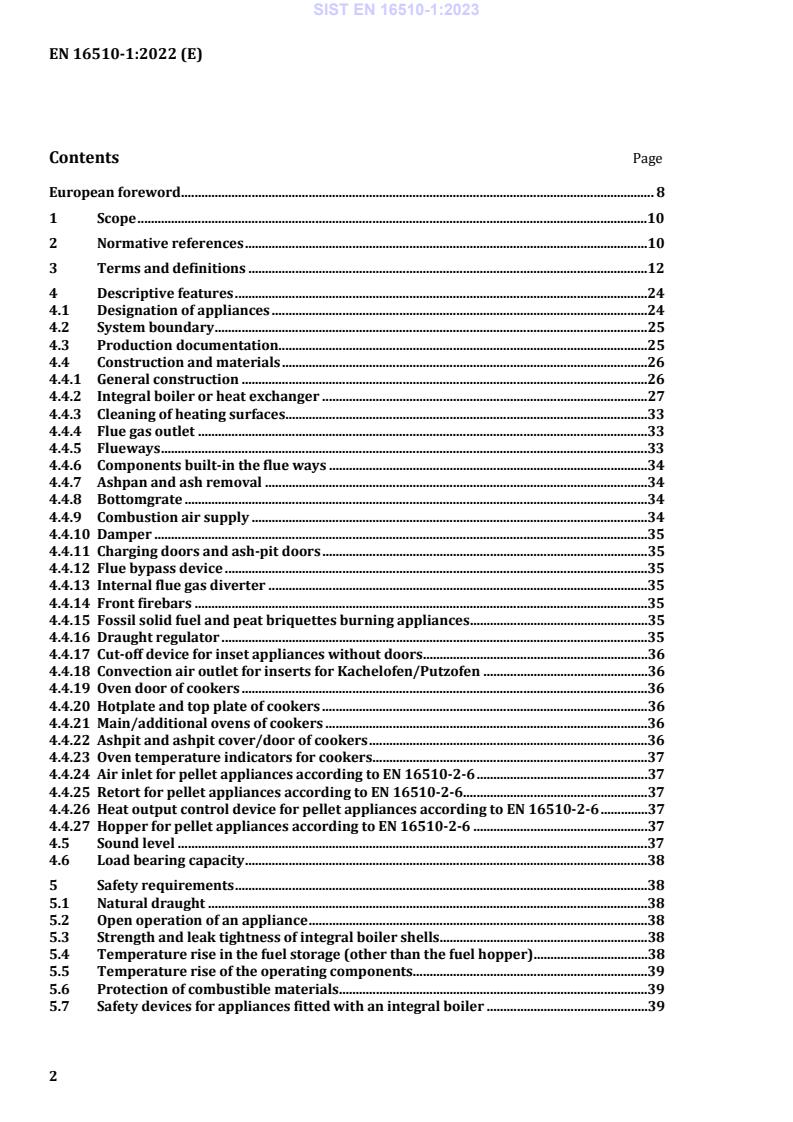
Contents Page
European foreword . 8
1 Scope .10
2 Normative references .10
3 Terms and definitions .12
4 Descriptive features .24
4.1 Designation of appliances .24
4.2 System boundary .25
4.3 Production documentation.25
4.4 Construction and materials .26
4.4.1 General construction .26
4.4.2 Integral boiler or heat exchanger .27
4.4.3 Cleaning of heating surfaces.33
4.4.4 Flue gas outlet .33
4.4.5 Flueways .33
4.4.6 Components built-in the flue ways .34
4.4.7 Ashpan and ash removal .34
4.4.8 Bottomgrate .34
4.4.9 Combustion air supply .34
4.4.10 Damper .35
4.4.11 Charging doors and ash-pit doors .35
4.4.12 Flue bypass device .35
4.4.13 Internal flue gas diverter .35
4.4.14 Front firebars .35
4.4.15 Fossil solid fuel and peat briquettes burning appliances .35
4.4.16 Draught regulator .35
4.4.17 Cut-off device for inset appliances without doors .36
4.4.18 Convection air outlet for inserts for Kachelofen/Putzofen .36
4.4.19 Oven door of cookers .36
4.4.20 Hotplate and top plate of cookers .36
4.4.21 Main/additional ovens of cookers .36
4.4.22 Ashpit and ashpit cover/door of cookers .36
4.4.23 Oven temperature indicators for cookers.37
4.4.24 Air inlet for pellet appliances according to EN 16510-2-6 .37
4.4.25 Retort for pellet appliances according to EN 16510-2-6.37
4.4.26 Heat output control device for pellet appliances according to EN 16510-2-6 .37
4.4.27 Hopper for pellet appliances according to EN 16510-2-6 .37
4.5 Sound level .37
4.6 Load bearing capacity .38
5 Safety requirements .38
5.1 Natural draught .38
5.2 Open operation of an appliance .38
5.3 Strength and leak tightness of integral boiler shells .38
5.4 Temperature rise in the fuel storage (other than the fuel hopper) .38
5.5 Temperature rise of the operating components .39
5.6 Protection of combustible materials .39
5.7 Safety devices for appliances fitted with an integral boiler .39
5.7.1 General . 39
5.7.2 Appliances intended for sealed water systems . 39
5.7.3 Safety devices for appliances fitted with a heat exchanger that are not directly in
contact with fire . 40
5.8 Electrical safety and functional safety of electrical components . 40
5.8.1 General . 40
5.8.2 Electrical safety . 40
5.8.3 Functional safety of control functions with electrical components . 40
5.8.4 Risk assessment . 40
5.9 Safety requirements of roomsealed appliances . 41
5.9.1 Tightness related to CO-emission . 41
5.9.2 Overall leakage rate . 41
5.10 Minimum distances from non-combustible walls. 41
5.11 Requirements for appliances suitable for a shared flue system . 42
5.12 General safety aspects of the water system . 42
6 Operation requirements . 42
6.1 General . 42
6.2 Flue gas temperature and flue gas outlet temperature . 43
6.2.1 General . 43
6.2.2 Flue gas temperature at safety test . 43
6.3 Emissions . 43
6.3.1 General . 43
6.3.2 Carbon monoxide emission . 44
6.3.3 NO emissions . 44
x
6.3.4 Emission of organic gaseous carbon (OGC) . 44
6.3.5 Particulate matter (PM) emissions . 44
6.3.6 Threshold levels for emissions according to appliance types . 45
6.4 Efficiency . 45
6.4.1 General . 45
6.4.2 Seasonal space heating efficiency . 46
6.4.3 Energy efficiency index (EEI) . 46
6.4.4 Energy efficiency class . 46
6.5 Flue draught . 47
6.6 Recovery test . 48
6.7 Refuelling intervals . 48
6.8 Space heat output . 48
6.9 Water heat output . 48
6.10 User operations . 48
6.11 Auxiliary electrical energy consumption . 49
6.12 Flue gas mass flow . 49
7 Appliance instructions . 49
7.1 General . 49
7.2 Installation instructions . 49
7.3 User operating and maintenance instructions . 52
8 Environmental sustainability . 54
8.1 General . 54
8.2 Calculation rules . 55
8.2.1 Declared and functional unit . 55
8.2.2 Reference lifetime . 55
8.3 Product stage . 55
8.3.1 General . 55
8.3.2 Production processes .56
8.3.3 Processes to be reported .56
8.3.4 Transport from the manufacturer to the site of use .57
8.4 Use stage .58
8.5 End-of-life stage .58
8.5.1 General .58
8.5.2 Scenarios for end-of-life .58
8.5.3 Transport to waste processing .59
8.6 Data collection/quality/basis .59
8.7 Content of environmental sustainability information .60
9 Assessment and verification of constancy of performance – AVCP.61
10 Marking and technical datasheet .62
Annex A (normative) Test methods .67
A.1 Test environment .67
A.1.1 Ambient room temperature .67
A.1.2 Cross-draught .67
A.1.3 External sources .67
A.2 Test assembly .67
A.2.1 General .67
A.2.2 Trihedron .68
A.2.3 Measurement section .69
A.2.4 Connection of appliance to measurement section .71
A.2.5 Water circuit for appliances with integral boilers .71
A.3 Measurement equipment .72
A.4 Test procedures .73
A.4.1 Appliance installation .73
A.4.2 Fuel load and basic firebed .73
A.4.3 Fuelling and de-ashing the fire .74
A.4.4 Flue gas losses .74
A.4.5 Water heat output .75
A.4.6 Combustible heat losses in the residue .75
A.4.7 Performance test at nominal heat output .75
A.4.8 Part load heat output test .79
A.4.9 Slow combustion and recovery test .80
A.4.10 Safety tests .81
A.4.11 Safety tests of roomsealed appliances .88
A.5 Test results .90
A.6 Calculation methods .91
A.6.1 Notations and units used .91
A.6.2 Formulae . 93
A.7 Test report . 99
Annex B (normative) Test fuels and recommended fuels . 115
B.1 General . 115
B.2 Test fuel . 115
B.2.1 Selection of test fuel . 115
B.2.2 Storage, preparation and analysis . 115
B.3 Tests for recommended fuels . 116
B.3.1 Basis of testing . 116
B.3.2 Test methods and criteria . 117
Annex C (informative) Arrangement for measuring the leakage rate . 122
Annex D (normative) Measuring procedure for nitrogen oxides (NO ) . 123
x
D.1 General procedure . 123
D.2 Measuring principle of analysers . 123
D.2.1 General description . 123
D.2.2 Chemiluminescence method (EN 14792:2017) . 124
D.2.3 Non-dispersive infrared (NDIR) method (ISO 10849:1996) . 125
D.2.4 Other methods . 126
D.3 Description of measuring equipment . 126
D.3.1 General . 126
D.3.2 Sampling line . 126
D.3.3 Filter . 127
D.3.4 Sample pump . 127
D.3.5 Secondary filter . 127
D.3.6 Flow controller and flow meter . 127
D.3.7 Converter . 127
D.4 Setting of measurement system . 127
D.4.1 General . 127
D.4.2 Preliminary zero and span check and adjustments . 128
D.5 Calculation method . 129
Annex E (normative) Measuring procedure for organic gaseous carbon (OGC) . 131
E.1 General procedure . 131
E.2 Description of measuring equipment . 131
E.2.1 General . 131
E.2.2 Sampling probe and filter . 131
E.2.3 Sampling line . 132
E.2.4 Sample pump . 132
E.2.5 Secondary filter . 132
E.2.6 Analyser (FID) . 132
E.2.7 FID fuel . 132
E.2.8 FID combustion air . 132
E.3 Setting of measurement system . 132
E.3.1 General . 132
E.3.2 Preliminary zero and span check and adjustments . 133
E.4 Calculation of OGC . 134
E.4.1 General . 134
E.4.2 Calculation assumptions. 134
E.4.3 Calculation of organic gaseous compounds . 134
Annex F (normative) Measurement procedure for particulate matter (PM) . 136
F.1 General . 136
F.2 Test set-up . 136
F.2.1 Sampling train . 136
F.2.2 Sample probe . 137
F.2.3 Particulate matter filter . 137
F.2.4 Filter holder . 137
F.2.5 Gas dryer . 138
F.2.6 Pressure gauge . 138
F.2.7 Indicating gas flow meter . 138
F.2.8 Pump . 138
F.2.9 Dry gas meter . 138
F.2.10 Flue gas sample temperature at the filter . 138
F.3 Test procedure . 138
F.3.1 Pre procedure . 138
F.3.2 Sampling . 139
F.3.3 Analysis . 142
F.3.4 Determination of the probe deposit weight . 142
F.4 Calculations . 142
F.4.1 Gas volume sampled (STP, 273,15 K, 1013 hPa) . 142
F.4.2 PM mass . 143
F.4.3 PM concentration . 143
F.4.4 PM concentration at 13 % oxygen . 143
Annex G (normative) Guideline for the characteristics to be taken into account in order to
decide on families of appliances . 144
G.1 Principles . 144
G.2 Example for the determination of the appliances to be tested . 144
G.3 Overview of the items related to design and construction to take account in order to
decide family of appliances . 145
G.4 Principles for determination of efficiency, carbon monoxide emission and safety
distances to combustible materials in initial type tests of a family of appliances . 146
Annex H (informative) Deviation of measuring results as a basis for market surveillance
measurements . 151
Annex I (informative) Standing air loss . 152
I.1 General . 152
I.2 Requirements . 152
I.3 Test method . 152
I.3.1 Type B appliance . 152
I.3.2 Type BE appliance . 152
Annex J (normative) Energy label . 154
Annex K (normative) Guide to carry out a risk assessment . 159
Bibliography . 162
European foreword
This document (EN 16510-1:2022) has been prepared by Technical Committee CEN/TC 295 “Residential
solid fuel burning appliances”, the secretariat of which is held by BSI.
This European Standard shall be given the status of a national standard, either by publication of an
identical text or by endorsement, at the latest by June 2023, and conflicting national standards shall be
withdrawn at the latest by November 2025.
Attention is drawn to the possibility that some of the elements of this document may be the subject of
patent rights. CEN shall not be held responsible for identifying any or all such patent rights.
This document supersedes EN 16510-1:2018, EN 12815:2001, EN 13240:2001, EN 13229:2001 and
EN 12809:2001 as amended and corrected.
In relation to EN 16510-1:2018 the following changes have been made:
— modifications to align the document with the standardisation request M/577 and the parts 2 (to be
harmonized);
— emission test procedures optimized;
— new test procedure for particulate matter (PM) measurement integrated;
— Clause 8 “Environmental sustainability” completely revised;
— Annex J “A-deviations” deleted.
The structure of EN 16510, Residential solid fuel burning appliances, is as follows:
— Part 1: General requirements and test methods;
— Part 2-1: Roomheaters;
— Part 2-2: Inset appliances including open fires;
— Part 2-3: Cookers;
— Part 2-4: Independent boilers — Nominal heat output up to 50 kW;
— Part 2-5: Slow heat release appliances;
— Part 2-6: Mechanically by wood pellets fed roomheaters, inset appliances and cookers.
Other sections of Part 2 will be added to cover residential solid fuel burning appliances not included in
parts 2-1 to 2-6.
EN 16510-1 is used in conjunction with the appropriate Part 2. The Parts 2-1 to 2-6 contain clauses that
supplement or modify the corresponding clauses in this Part 1. Part 1 together with the relevant Part 2
provides the requirements for each type of appliance.
Any feedback and questions on this document should be directed to the users’ national standards body.
A complete listing of these bodies can be found on the CEN website.
According to the CEN-CENELEC Internal Regulations, the national standards organisations of the
following countries are bound to implement this European Standard: Austria, Belgium, Bulgaria, Croatia,
Cyprus, Czech Republic, Denmark, Estonia, Finland, France, Germany, Greece, Hungary, Iceland, Ireland,
Italy, Latvia, Lithuania, Luxembourg, Malta, Netherlands, Norway, Poland, Portugal, Republic of North
Macedonia, Romania, Serbia, Slovakia, Slovenia, Spain, Sweden, Switzerland, Türkiye and the United
Kingdom.
1 Scope
This document is applicable to residential solid fuel burning appliances of which the nominal space heat
output is more than 6 % of the combined nominal space heat output and nominal water heat output (total
heat output).
This document specifies requirements relating to the design, manufacture, construction, safety and
performance (efficiency and emission) of appliances fired by solid fuel (hereafter referred to as
“appliance(s)”) and provides instructions for them. Furthermore, it also gives provisions for the
evaluation of conformity, i.e. initial type testing (ITT) and factory production control (FPC) and marking
of these appliances.
This document specifies CO, NO , OGC and particulate matter (PM) emission test methods.
x
This document is as well applicable to appliances intended to carry the load of a chimney.
Appliances receiving combustion air through ductwork from outside the external envelope, which is not
air tight, are not considered roomsealed.
This document is not applicable to appliances with boiler parts in contact with fire or flue gases other
than when the boiler parts are manufactured from steel or cast iron.
This document is not applicable to appliances with a boiler intended for water systems having:
— water temperatures above 110 °C and/or an operating pressure of more than 300 kPa (3 bar);
— direct contact with sanitary hot water.
This document is not applicable to appliances to be operated with ventilating systems which are intended
to operate with pressure below -15 Pa in the room of installation of the appliance in relation to the
outside atmosphere.
2 Normative references
The following documents are referred to in the text in such a way that some or all of their content
constitutes requirements of this document. For dated references, only the edition cited applies. For
undated references, the latest edition of the referenced document (including any amendments) applies.
EN 303-5:2021, Heating boilers — Part 5: Heating boilers for solid fuels, manually and automatically
stoked, nominal heat output of up to 500 kW — Terminology, requirements, testing and marking
EN 613:2000 , Independent gas-fired convection heaters
EN 1561:2011, Founding — Grey cast irons
EN 1563:2018, Founding — Spheroidal graphite cast irons
EN 10029:2010, Hot-rolled steel plates 3 mm thick or above — Tolerances on dimensions and shape
EN 12828:2012+A1:2014, Heating systems in buildings — Design for water-based heating systems
EN 13384-2:2015+A1:2019, Chimneys — Thermal and fluid dynamic calculation methods — Part 2:
Chimneys serving more than one combustion appliance
As impacted by EN 613:2000/A1:2003.
EN 13501-1:2018, Fire classification of construction products and building elements — Part 1:
Classification using data from reaction to fire tests
EN 14597:2012, Temperature control devices and temperature limiters for heat generating systems
EN 14792:2017, Stationary source emissions — Determination of mass concentration of nitrogen oxides —
Standard reference method: chemiluminescence
EN 14793:2017, Stationary source emissions — Demonstration of equivalence of an alternative method
with a reference method
EN 15456:2008, Heating boilers — Electrical power consumption for heat generators — System boundaries
— Measurements
EN 15804:2012+A2:2019, Sustainability of construction works — Environmental product declarations —
Core rules for the product category of construction products
EN 60335-2-102:2016, Household and similar electrical appliances — Safety — Part 2-102: Particular
requirements for gas, oil and solid-fuel burning appliances having electrical connections (IEC 60335-2-
102:2004)
EN 60730-1:2016 , Automatic electrical controls — Part 1: General requirements (IEC 60730-1:2013,
modified)
EN ISO 228-1:2003, Pipe threads where pressure-tight joints are not made on the threads — Part 1:
Dimensions, tolerances and designation (ISO 228-1:2000)
EN ISO 228-2:2003, Pipe threads where pressure-tight joints are not made on the threads — Part 2:
Verification by means of limit gauges (ISO 228-2:1987)
EN ISO 9606-1:2017, Qualification testing of welders — Fusion welding — Part 1: Steels (ISO 9606-1:2012
including Cor 1:2012 and Cor 2:2013)
EN ISO 9606-2:2004, Qualification test of welders — Fusion welding — Part 2: Aluminium and aluminium
alloys (ISO 9606-2:2004)
EN ISO 16948:2015, Solid biofuels — Determination of total content of carbon, hydrogen and nitrogen
(ISO 16948:2015)
EN ISO 16994:2016, Solid biofuels — Determination of total content of sulfur and chlorine
(ISO 16994:2016)
EN ISO 18122:2015, Solid biofuels — Determination of ash content (ISO 18122:2015)
EN ISO 18123:2015, Solid biofuels — Determination of the content of volatile matter (ISO 18123:2015)
EN ISO 18125:2017, Solid biofuels — Determination of calorific value (ISO 18125:2017)
EN ISO 18134-1:2015, Solid biofuels — Determination of moisture content — Oven dry method — Part 1:
Total moisture — Reference method (ISO 18134-1:2015)
As impacted by EN 60730-1:2016/A1:2019 and EN 60730-1:2016/A2:2022.
ISO 7-1:1994, Pipe threads where pressure-tight joints are made on the threads — Part 1: Dimensions,
tolerances and designation
ISO 7-2:2000, Pipe threads where pressure-tight joints are made on the threads — Part 2: Verification
...