

oSIST prEN 50340:2026
(Main)Hydraulic cable cutting devices to be used on electrical installations with nominal voltage up to 60 kV AC
- Abstract
This document is applicable to cable cutting devices to be used to verify that a cable is dead in accordance with the rules given in EN 50110.
NOTE It can also be used as an example when dismantling cable installations.
The following limits apply to the cable cutting devices:
- pressure less than 1 000 bar or pressure (bar) x volume (l) less than 10 000;
- fluid outside the categories listed in Article 13 Group 1 (explosive, extremely flammable, highly flammable, flammable (where the maximum allowable temperature is above flashpoint), very toxic, toxic, oxidizing) of the Pressure Equipment Directive 2014/68/EU.
Cable cutting devices specified in this document are for use on systems with nominal voltage up to 60 kV AC and nominal frequencies up to 60 Hz and are only suitable for operation by foot or by hand. This document does not cover motorised cable cutting devices.
This document is intended to be used as a guide for devices to be used on systems with nominal voltages above 60 kV AC, but additional requirements and tests can be agreed between manufacturer and customer to provide an equivalent level of safety.
Cable cutting devices are not designed to be used on cables with special armour, or with steel wires or steel tapes more than 1 mm in diameter or thickness.
The products designed and manufactured according to this document contribute to the safety of the users provided they are used by skilled persons, in accordance with safe methods of work and the instructions for use.
- Status
- Not Published
- Public Enquiry End Date
- 30-Jul-2026
- Technical Committee
- DPN - Live Working
- Current Stage
- 4020 - Public enquire (PE) (Adopted Project)
- Start Date
- 21-May-2026
- Due Date
- 08-Oct-2026
- Completion Date
- 03-Aug-2026

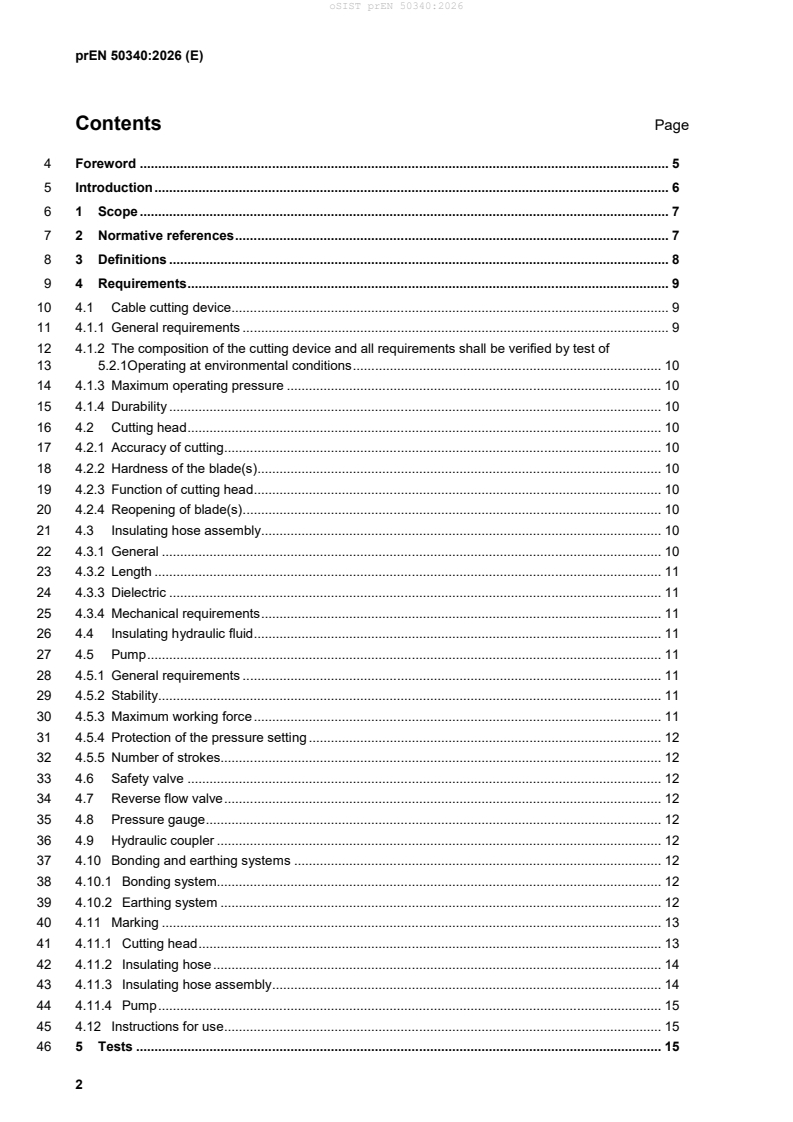
oSIST prEN 50340:2026 is the Slovenian publication of the CENELEC draft European Standard prEN 50340:2026, prepared by CLC/TC 78. It specifies requirements and tests for hydraulic cable cutting devices used on electrical installations with nominal voltage up to 60 kV AC to verify that a cable is dead in accordance with EN 50110. The document is written for hand-operated or foot-operated devices used by skilled persons.
What does oSIST prEN 50340:2026 specify?
oSIST prEN 50340:2026 applies to portable hydraulic cable cutting devices used to verify that a cable is dead, and it can also be used as an example when dismantling cable installations. It sets the scope, the product limits, the main construction requirements, the type tests, and the production-phase defect assessment method.
The scope is limited to devices that stay below the stated pressure limit and use fluids outside the listed Pressure Equipment Directive 2014/68/EU Group 1 categories. The devices are for systems up to 60 kV AC and up to 60 Hz, and the document excludes motorised cable cutting devices. It also states that the devices are not designed for special armour or for steel wires or steel tapes above 1 mm in diameter or thickness.
Document structure
| Annex | What it covers |
|---|---|
| Annex A | Normative instructions for use |
| Annex B | Informative additional recommendations and information for the instructions for use |
| Annex C | Normative list of type tests |
| Annex D | Normative classification of defects and tests to be allocated |
| Annex E | Informative rationale for the defect classification |
| Annex F | Informative background |
What are the key requirements of oSIST prEN 50340:2026?
oSIST prEN 50340:2026 requires a complete device to be built from the cutting head, pump and bonding system, insulating hose assembly, insulating hydraulic fluid, and earthing system if required. In practice, this matters because the device is treated as a safety system, not as separate loose parts.
Construction and operating limits
Clause 4.1 requires the cutting head to be easy and safe to position on the cable, to stay within the stated mass limit, and to accept the cable diameter declared by the manufacturer. The cutting head and pump must be compatible, and dismantled equipment must have means for storage and transport that protect insulating parts from damage and contamination.
Clause 4.1.2 and 4.1.3 require correct operation indoors and outdoors over the stated ambient temperature range, and safe endurance at maximum operating pressure. Clause 4.1.4 ties durability to the complete-device test. For a buyer or specifier, this means the device is not just checked for cutting performance, but also for handling and robustness in field use.
Cutting head and blade performance
Clause 4.2 requires the cut to be accurate, the blade(s) to have the required hardness, the head to keep cutting until the cable is fully severed, and the blade(s) to reopen automatically if hydraulic pressure is lost. This matters because the user must not be left with a partly cut cable or a jammed blade after pressure release.
Insulating hose assembly and hydraulic fluid
Clause 4.3 requires the insulating hose assembly to be a single piece with a defined minimum length, to provide electrical insulation under operating conditions, and to withstand hydrostatic, bending and burst stresses. It also limits leakage current and links the electrical test to the hose assembly under wet and contaminated conditions.
Clause 4.4 requires the insulating hydraulic fluid to withstand the stated dielectric strength test. In practice, this means the fluid is part of the safety barrier and must be controlled as a technical component, not just a consumable.
Pump, valves and pressure control
Clause 4.5 requires the pump to have a safety valve, reverse flow valve and pressure gauge, and to remain stable during operation. It also limits the working force for hand or foot operation and requires the pressure-setting adjustment to be protected against easy access. Clause 4.6, 4.7 and 4.8 define how the safety valve, reverse flow valve and pressure gauge must behave and be marked.
The pressure system must reach the safety-valve operating pressure within a limited number of strokes, and the gauge must clearly show the operating range. For the user, this affects how quickly the tool can be brought into service and how clearly pressure can be monitored during cutting.
Bonding, earthing, marking and instructions
Clause 4.10 requires the bonding system and, when required, the earthing system to have the defined terminations and conductor sizes. The earthing terminal position must not be vulnerable to fault-current damage, and the earthing system must withstand the prospective short-circuit current.
Clause 4.11 requires durable marking on the cutting head, hose, hose assembly and pump, including origin, type, year, pressure and voltage information, and the double triangle symbol. Clause 4.12 requires instructions for use covering assembly, safe use and maintenance, with Annex A providing the required content.
Testing and production follow-up
Clause 5 says the document uses type testing to demonstrate compliance, with tests listed in Annex C and performed in the stated sequence. The tests cover inspection, insulation performance, mechanical strength, cutting function, stability, safety-valve operation, complete-device endurance, and earthing-system performance.
Clause 6 uses EN IEC 61318:2021 for production-phase assessment and links defects to the tests in Annex D. It also uses ISO 2859-1:2026 for sampling of major and minor defects. This matters for quality managers because it connects design approval with routine production checks.
What terms does oSIST prEN 50340:2026 define?
- Blade(s) - the metallic cutting part or parts that penetrate the cable and separate it into two pieces.
- Cable cutting device - a portable device used to cut cables in a safe manner and to verify that a cable is dead at the work site.
- Cutting head - the part that contains the blade(s) and is applied to the cable.
- Insulating hose assembly - the insulating, pressure-resistant hose with fittings that connects hydraulic equipment at different electric potentials.
- Insulating hydraulic fluid - the fluid with insulating properties that transmits pressure between pump and cutting head.
- Maximum operating pressure - the highest operating pressure specified by the manufacturer that must not be exceeded in use.
- Safety valve - the valve that releases pressure when the hydraulic system reaches the maximum operating pressure.
- Type test - a conformity test made on one or more items representative of production.
Who uses oSIST prEN 50340:2026?
oSIST prEN 50340:2026 is used by manufacturers designing hydraulic cable cutting devices, pumps, hose assemblies and cutting heads. It is also used by test laboratories that carry out type tests, production tests and defect checks.
Utilities, cable contractors, maintenance teams and dismantling crews use it when they need a portable device to verify that a cable is dead before cutting. Quality managers and buyers use it to check the required construction, markings, instructions, compatible combinations and production follow-up method.
What changed in oSIST prEN 50340:2026 from the previous edition?
oSIST prEN 50340:2026 will supersede EN 50340:2010 and all of its amendments and corrigenda, if any. The document states these significant technical changes:
- definitions revised;
- standard references updated;
- requirements and tests extended to 60 kV;
- only one method kept for determining the insulating hose assembly;
- a mechanical endurance test added;
- the dielectric test for the insulating hose assembly changed.
Which standards are used with oSIST prEN 50340:2026?
The document relies on several other standards for test methods, materials and production control:
- EN 50110-1:2023 - provides the operating rules for electrical installations and the context for verifying that a cable is dead.
- EN 60060-1:2010 and EN 60060-2:2011 - give the general definitions, test requirements and measuring systems for high-voltage tests.
- EN IEC 60156:2025 - gives the test method for insulating liquids and the breakdown-voltage check for the hydraulic fluid.
- EN 60212:2011 - defines standard atmospheric conditions for testing.
- EN 61111 - provides the insulating matting used in the inclined-position stability test.
- EN 61230:2008 - supports the earthing-system requirements and the short-circuit test.
- EN IEC 61318:2021 - is used for defect assessment and production-phase verification.
- EN 62237:2005 - provides the test basis for insulating hoses with fittings.
- EN ISO 6508-1:2023 - gives the Rockwell hardness test for the blade(s).
- EN ISO 16120-2:2017 - specifies the steel wire rod used in the self-acting opening test.
- EN 12164:2024 - supplies the brass rod material for the pressure test probe.
- ISO 2859-1:2026 - gives the sampling rules for routine inspection by attributes.
What does the oSIST prEN 50340:2026 document contain?
The document contains an example of the cable cutting device, marking examples, and test arrangements for the main performance checks. Its figures show the hose-preparation method, leakage-current test setup, self-acting opening test, pump-force measurement, inclined stability test, endurance test on a complete device, and earthing-system test.
Its tables set out the voltage-related test conditions, the force applied in the blade-opening test, the chronological order of type tests, and the sampling plan for production inspection. Annex D links requirements to critical, major and minor defects, which is useful for certification, quality control and production release decisions.
Get Certified
Connect with accredited certification bodies for this standard

IMQ S.p.A. (Certification)
Italian electrical product certification.

SLG Prüf- und Zertifizierungs GmbH
German testing and certification body.

UL Solutions
Global safety science company with testing, inspection and certification.
Sponsored listings
Frequently Asked Questions
oSIST prEN 50340:2026 is a draft published by the Slovenian Institute for Standardization (SIST). Its full title is "Hydraulic cable cutting devices to be used on electrical installations with nominal voltage up to 60 kV AC". This standard covers: This document is applicable to cable cutting devices to be used to verify that a cable is dead in accordance with the rules given in EN 50110. NOTE It can also be used as an example when dismantling cable installations. The following limits apply to the cable cutting devices: - pressure less than 1 000 bar or pressure (bar) x volume (l) less than 10 000; - fluid outside the categories listed in Article 13 Group 1 (explosive, extremely flammable, highly flammable, flammable (where the maximum allowable temperature is above flashpoint), very toxic, toxic, oxidizing) of the Pressure Equipment Directive 2014/68/EU. Cable cutting devices specified in this document are for use on systems with nominal voltage up to 60 kV AC and nominal frequencies up to 60 Hz and are only suitable for operation by foot or by hand. This document does not cover motorised cable cutting devices. This document is intended to be used as a guide for devices to be used on systems with nominal voltages above 60 kV AC, but additional requirements and tests can be agreed between manufacturer and customer to provide an equivalent level of safety. Cable cutting devices are not designed to be used on cables with special armour, or with steel wires or steel tapes more than 1 mm in diameter or thickness. The products designed and manufactured according to this document contribute to the safety of the users provided they are used by skilled persons, in accordance with safe methods of work and the instructions for use.
This document is applicable to cable cutting devices to be used to verify that a cable is dead in accordance with the rules given in EN 50110. NOTE It can also be used as an example when dismantling cable installations. The following limits apply to the cable cutting devices: - pressure less than 1 000 bar or pressure (bar) x volume (l) less than 10 000; - fluid outside the categories listed in Article 13 Group 1 (explosive, extremely flammable, highly flammable, flammable (where the maximum allowable temperature is above flashpoint), very toxic, toxic, oxidizing) of the Pressure Equipment Directive 2014/68/EU. Cable cutting devices specified in this document are for use on systems with nominal voltage up to 60 kV AC and nominal frequencies up to 60 Hz and are only suitable for operation by foot or by hand. This document does not cover motorised cable cutting devices. This document is intended to be used as a guide for devices to be used on systems with nominal voltages above 60 kV AC, but additional requirements and tests can be agreed between manufacturer and customer to provide an equivalent level of safety. Cable cutting devices are not designed to be used on cables with special armour, or with steel wires or steel tapes more than 1 mm in diameter or thickness. The products designed and manufactured according to this document contribute to the safety of the users provided they are used by skilled persons, in accordance with safe methods of work and the instructions for use.
oSIST prEN 50340:2026 is classified under the following ICS (International Classification for Standards) categories: 13.260 - Protection against electric shock. Live working; 29.240.20 - Power transmission and distribution lines; 29.260.99 - Other electrical equipment for working in special conditions. The ICS classification helps identify the subject area and facilitates finding related standards.
oSIST prEN 50340:2026 is available in PDF format for immediate download after purchase. The document can be added to your cart and obtained through the secure checkout process. Digital delivery ensures instant access to the complete standard document.
Standards Content (Sample)
SLOVENSKI STANDARD
01-julij-2026
Hidravlične rezalne naprave za kable za uporabo v električnih inštalacijah z
nazivno napetostjo do 60 kV AC
Hydraulic cable cutting devices to be used on electrical installations with nominal voltage
up to 60 kV AC
Hydraulische Kabelschneidgeräte für den Einsatz an elektrischen Anlagen mit
Nennspannung bis 60 kV AC
Dispositifs coupe-câbles hydrauliques à utiliser sur des installations électriques de
tension nominale jusqu’à 60 kV en courant alternatif
Ta slovenski standard je istoveten z: prEN 50340:2026
ICS:
13.260 Varstvo pred električnim Protection against electric
udarom. Delo pod napetostjo shock. Live working
29.240.20 Daljnovodi Power transmission and
distribution lines
29.260.99 Druga električna oprema za Other electrical equipment for
delo v posebnih razmerah working in special conditions
2003-01.Slovenski inštitut za standardizacijo. Razmnoževanje celote ali delov tega standarda ni dovoljeno.
EUROPEAN STANDARD DRAFT
prEN 50340
NORME EUROPÉENNE
EUROPÄISCHE NORM
May 2026
ICS 13.260; 29.240.20; 29.260.99 Will supersede EN 50340:2010
English Version
Hydraulic cable cutting devices to be used on electrical
installations with nominal voltage up to 60 kV AC
Dispositifs de coupe de câbles hydrauliques à utiliser sur Hydraulische Kabelschneidgeräte für den Einsatz an
des installations électriques avec une tension nominale elektrischen Anlagen mit Nennspannung bis 60 kV AC
jusqu'à 60 kV AC
This draft European Standard is submitted to CENELEC members for enquiry.
Deadline for CENELEC: 2026-07-24.
It has been drawn up by CLC/TC 78.
If this draft becomes a European Standard, CENELEC members are bound to comply with the CEN/CENELEC Internal Regulations which
stipulate the conditions for giving this European Standard the status of a national standard without any alteration.
This draft European Standard was established by CENELEC in three official versions (English, French, German).
A version in any other language made by translation under the responsibility of a CENELEC member into its own language and notified to
the CEN-CENELEC Management Centre has the same status as the official versions.
CENELEC members are the national electrotechnical committees of Austria, Belgium, Bulgaria, Croatia, Cyprus, the Czech Republic,
Denmark, Estonia, Finland, France, Germany, Greece, Hungary, Iceland, Ireland, Italy, Latvia, Lithuania, Luxembourg, Malta, the
Netherlands, Norway, Poland, Portugal, Republic of North Macedonia, Romania, Serbia, Slovakia, Slovenia, Spain, Sweden, Switzerland,
Türkiye and the United Kingdom.
Recipients of this draft are invited to submit, with their comments, notification of any relevant patent rights of which they are aware and to
provide supporting documentation.
Warning : This document is not a European Standard. It is distributed for review and comments. It is subject to change without notice and
shall not be referred to as a European Standard.
European Committee for Electrotechnical Standardization
Comité Européen de Normalisation Electrotechnique
Europäisches Komitee für Elektrotechnische Normung
CEN-CENELEC Management Centre: Rue de la Science 23, B-1040 Brussels
© 2026 CENELEC All rights of exploitation in any form and by any means reserved worldwide for CENELEC Members.
Project: 82151 Ref. No. prEN 50340:2026 E
Contents Page
4 Foreword . 5
5 Introduction . 6
6 1 Scope . 7
7 2 Normative references . 7
8 3 Definitions . 8
9 4 Requirements . 9
10 4.1 Cable cutting device . 9
11 4.1.1 General requirements . 9
12 4.1.2 The composition of the cutting device and all requirements shall be verified by test of
13 5.2.1Operating at environmental conditions . 10
14 4.1.3 Maximum operating pressure . 10
15 4.1.4 Durability . 10
16 4.2 Cutting head . 10
17 4.2.1 Accuracy of cutting . 10
18 4.2.2 Hardness of the blade(s). 10
19 4.2.3 Function of cutting head. 10
20 4.2.4 Reopening of blade(s) . 10
21 4.3 Insulating hose assembly. 10
22 4.3.1 General . 10
23 4.3.2 Length . 11
24 4.3.3 Dielectric . 11
25 4.3.4 Mechanical requirements . 11
26 4.4 Insulating hydraulic fluid . 11
27 4.5 Pump . 11
28 4.5.1 General requirements . 11
29 4.5.2 Stability. 11
30 4.5.3 Maximum working force . 11
31 4.5.4 Protection of the pressure setting . 12
32 4.5.5 Number of strokes . 12
33 4.6 Safety valve . 12
34 4.7 Reverse flow valve . 12
35 4.8 Pressure gauge . 12
36 4.9 Hydraulic coupler . 12
37 4.10 Bonding and earthing systems . 12
38 4.10.1 Bonding system. 12
39 4.10.2 Earthing system . 12
40 4.11 Marking . 13
41 4.11.1 Cutting head . 13
42 4.11.2 Insulating hose . 14
43 4.11.3 Insulating hose assembly . 14
44 4.11.4 Pump . 15
45 4.12 Instructions for use . 15
46 5 Tests . 15
47 5.1 General . 15
48 5.2 Inspection, instructions for use and marking . 15
49 5.2.1 Inspection . 15
50 5.2.2 Instructions for use . 15
51 5.2.3 Marking . 16
52 5.3 Test of the insulating hose assembly . 16
53 5.3.1 General . 16
54 5.3.2 Measurement of the length of the insulating hose assembly. 16
55 5.3.3 Electrical testing . 16
56 5.3.4 Mechanical testing . 18
57 5.4 Dielectric strength of the hydraulic fluid . 18
58 5.5 Hardness of the blade(s). 18
59 5.6 Test under maximum pressure . 19
60 5.7 Self-acting opening test . 19
61 5.8 Accuracy of cutting . 20
62 5.9 Working force of the pump . 20
63 5.10 Operation and stability in inclined position . 21
64 5.11 Operation of the safety valve . 22
65 5.12 Pressure strength of the cable cutting device . 22
66 5.13 Functional test . 23
67 5.14 Test on a complete device . 23
68 5.14.1 General . 23
69 5.14.2 Test arrangement . 23
70 5.14.3 Test execution . 24
71 5.15 Test on earthing system. 25
72 6 Method for assessment of defects and verification of performance applicable to cable cutting
73 device having completed the production phase . 26
74 6.1 General . 26
75 6.2 Alternative tests for critical defects on device having completed the production phase . 26
76 6.2.1 General . 26
77 6.2.2 Alternative routine test on operation of the safety valve and on pressure strength . 26
78 6.3 no insulating hydraulic fluid has leaked. Alternative tests for major and minor defects on devices
79 having completed the production phase . 27
80 6.3.1 General . 27
81 6.3.2 Sampling plan . 27
82 7 Modifications . 27
83 Annex A (normative) Instructions for use . 28
84 Annex B (informative) Additional recommendations and information to the instructions for use30
85 Annex C (normative) List of type tests . 32
86 Annex D (normative) Classification of defects and tests to be allocated . 33
87 Annex E (informative) Rationale for the classification of defects . 34
88 Annex F (informative) Background . 35
89 Bibliography . 36
90 Figures
91 Figure 1 — Example of cable cutting device . 9
92 Figure 2 — Examples of writing the highest nominal voltage and “Double triangle” symbol –
93 IEC 60417-5216 . 14
94 Figure 3 — Depiction of outer jacket removal . 17
95 Figure 4 — Test configuration for measurement of the leakage current . 18
96 Figure 5 — Self-acting opening test — Tackle-points to strain the blade(s) . 20
97 Figure 6 — Pump force - Test arrangement . 21
98 Figure 7 — Stability — Test arrangement . 22
99 Figure 8 — Test on a complete device arrangement principle . 24
100 Figure 9 — Principle of a test cycle . 25
101 Figure 10 — Earthing system - Test arrangement . 26
102 Tables
103 Table 1 — maximum permissible operating voltage . 11
104 Table 2 — Test voltage for test of insulating hose assembly . 17
105 Table 3 — Forces to be applied to the blade(s) to oppose the opening action . 19
106 Table 4 — Sampling plan . 27
107 Table C.1 — Chronological order for type testing on a complete device . 32
108 Table C.2 — List of type tests on components . 32
109 Table D.1 — Classification of defects and associated requirements and tests . 33
110 Table E.1 — Justification for the type of defect ‘to be worked on’ . 34
111 Foreword
112 This document (prEN 50340:2026) has been prepared by the Technical Committee CENELEC TC 78,
113 Equipment and tools for live working.
114 This document is currently submitted to the Enquiry.
115 The following dates are proposed:
– latest date by which the existence of this edition (doa) dav + 6 months
has to be announced at national level
– latest date by which this edition has to be implemented (dop) dav + 12 months
at national level by publication of an identical
national standard or by endorsement
– latest date by which the national standards conflicting (dow) dav + 36 months
with this edition have to be withdrawn (to be confirmed or
modified when voting)
116 This document will supersede EN 50340:2010 and all of its amendments and corrigenda (if any).
117 prEN 50340:2026 includes the following significant technical changes with respect to EN 50340:2010:
118 — definitions revised;
119 — standard references were updated;
120 — requirements and tests of the nominal voltages were extended to 60 kV;
121 — only one method of determining the insulating hose assembly was chosen;
122 — a mechanical endurance test was inserted;
123 — dielectric test of insulating hose assembly was changed.
124 Introduction
125 The cable cutting devices specified here are designed to protect the user while verifying whether the cable is
126 dead.
127 In some countries, it is necessary where the cable to be cut is live that the first action of the cutting device is
128 to make, on a multi-phases cable, only a single-phase fault to earth so that the protective devices of the network
129 can operate on a single-phase fault.
130 This revision specifies requirements and tests for these cable cutting devices.
131 1 Scope
132 This document is applicable to cable cutting devices to be used to verify that a cable is dead in accordance
133 with the rules given in EN 50110.
134 NOTE It can also be used as an example when dismantling cable installations.
135 The following limits apply to the cable cutting devices:
136 — pressure less than 1 000 bar or pressure (bar) x volume (l) less than 10 000;
137 — fluid outside the categories listed in Article 13 Group 1 (explosive, extremely flammable, highly flammable,
138 flammable (where the maximum allowable temperature is above flashpoint), very toxic, toxic, oxidizing) of
139 the Pressure Equipment Directive 2014/68/EU.
140 Cable cutting devices specified in this document are for use on systems with nominal voltage up to 60 kV AC
141 and nominal frequencies up to 60 Hz and are only suitable for operation by foot or by hand. This document
142 does not cover motorised cable cutting devices.
143 This document is intended to be used as a guide for devices to be used on systems with nominal voltages
144 above 60 kV AC, but additional requirements and tests can be agreed between manufacturer and customer to
145 provide an equivalent level of safety.
146 Cable cutting devices are not designed to be used on cables with special armour, or with steel wires or steel
147 tapes more than 1 mm in diameter or thickness.
148 The products designed and manufactured according to this document contribute to the safety of the users
149 provided they are used by skilled persons, in accordance with safe methods of work and the instructions for
150 use.
151 2 Normative references
152 The following referenced documents are indispensable for the application of this document. For dated
153 references, only the edition cited applies. For undated references, the latest edition of the referenced document
154 (including any amendments) applies.
155 EN 12164:2024, Copper and copper alloys - Rod for free machining purposes
156 EN 60060-1:2010, High-voltage test techniques - Part 1: General definitions and test requirements (IEC 60060-
157 1:2010)
158 EN 60060-2:2011, High-voltage test techniques - Part 2: Measuring systems (IEC 60060-2:2010)
159 EN IEC 60156:2025, Insulating liquids - Determination of the breakdown voltage at power frequency - Test
160 method
161 EN 60212:2011, Standard conditions for use prior to and during the testing of solid electrical insulating
162 materials (IEC 60212:2010)
163 EN 61111, Live working - Electrical insulating matting (IEC 61111:2009)
164 EN 61230:2008, Live working - Portable equipment for earthing or earthing and short-circuiting (IEC
165 61230:2008)
166 EN IEC 61318:2021, Live working - Methods for assessment of defects and verification of performance
167 applicable to tools, devices and equipment (IEC 61318:2021)
168 EN 62237:2005, Live working - Insulating hoses with fittings for use with hydraulic tools and equipment (IEC
169 62237:2003, mod.)
170 EN ISO 6508-1:2023, Metallic materials - Rockwell hardness test - Part 1: Test method (ISO 6508-1:2023)
171 EN ISO 16120-2:2017, Non-alloy steel wire rod for conversion to wire - Part 2: Specific requirements for
172 general purpose wire rod (ISO 16120-2:2017)
173 ISO 2859-1:2026, Sampling procedures for inspection by attributes — Part 1: Sampling schemes indexed by
174 acceptance quality limit (AQL) for lot-by-lot inspection
175 3 Definitions
176 For the purposes of this document, the following terms and definitions apply.
177 ISO and IEC maintain terminology databases for use in standardization at the following addresses:
178 • ISO Online browsing platform: available at https://www.iso.org/obp
179 • IEC Electropedia: available at https://www.electropedia.org/
180 3.1
181 blade(s)
182 metallic part(s) with a sharp edge or edges which is designed to penetrate the cable in such a way that the
183 cable will be cut into two separate parts
184 3.2
185 cable cutting device
186 portable device which is used to cut cables in a safe manner
187 Note 1 to entry: This device is used to verify that a cable is dead at the work site.
188 3.3
189 cutting head
190 part (component) of the device which contains the cutting blade(s) and which is applied to the cable to be cut
191 3.4
192 earthing system
193 all necessary connections, conductors and fittings used to ensure that the electrical potential of an equipment
194 is as close as practicable to the earth potential (i.e., at or about 0 V to earth)
195 3.5
196 hydraulic coupler
197 pair of fittings to permit a connection of hydraulic components
198 Note 1 to entry: Some couplers can be separated by hand, others may require the use of a tool.
199 3.6
200 insulating hose
201 insulating and pressure resistant hose used as part of an insulating hose assembly
202 3.7
203 insulating hose assembly
204 insulating and pressure resistant component consisting of an insulating hose with fittings at each end for the
205 connection of parts of hydraulic equipment at different electric potentials
206 3.8
207 insulating hydraulic fluid
208 fluid with suitable electrical insulating properties used to equalize the pressure between the pump and the
209 cutting head
210 3.9
211 maximum operating pressure
212 operating pressure specified by the manufacturer which is not allowed to be exceeded during the functioning
213 of the cable cutting device
214 3.10
215 pump
216 part of the device which generates pressure in the insulating hydraulic fluid within the hose to operate the
217 cutting head
218 3.11
219 reverse flow valve
220 valve for manual operation which is designed and installed for the reverse flow of fluid from the pressure
221 compartment to the storage compartment after having cut through the cable completely
222 3.12
223 safety valve
224 valve designed and installed to release the pressure of fluid in the pressure compartment when the maximum
225 operating pressure of the hydraulic system is reached, so that it protects the system against overpressure
226 3.13
227 type test
228 conformity test made on one or more items representative to the production
229 [SOURCE: IEC 60050-151:2001,151-16-16]
230 4 Requirements
231 4.1 Cable cutting device
232 4.1.1 General requirements
233 The cable cutting device shall be composed of (see Figure 1):
234 — a cutting head, this contains the cutting blade(s);
235 — a hydraulic pump and its bonding system;
236 — a length of insulating hose with fittings (insulating hose assembly) to connect the cutting head and the
237 pump;
238 — an insulating hydraulic fluid;
239 — an earthing system, if required.
241 Key
242 1 Cutting head
243 2 Insulating hose assembly
244 3 Pump
245 4 Insulating hydraulic fluid
246 Figure 1 — Example of cable cutting device
247 For cable cutting devices which can be dismantled, suitable means for the storage and transportation of the
248 separate components shall be provided. These means shall be designed to prevent damage to the component
249 parts in transit and pollution/contamination of all the insulating parts (i.e. hydraulic fluid, insulating hose
250 assemblies).
251 The design of the cutting head shall be such that it can be transported in a safe manner and is safe and easy
252 to locate on a cable.
253 The mass of the cutting head shall not exceed 20 kg so that it can be safely and readily operated by one
254 person.
255 The cutting head shall be capable of accepting all cables up to the maximum diameter indicated by the
256 manufacturer.
257 The cutting head shall be connected to the insulating hose assembly by a coupler which requires the use of a
258 tool to separate it.
259 The cutting head(s) shall be compatible with the pump as specified by the manufacturer of the pump.
260 4.1.2 The composition of the cutting device and all requirements shall be verified by test of
261 5.2.1Operating at environmental conditions
262 The cable cutting device shall operate correctly and safely indoor, outdoor and with a range of ambient
263 temperature between –20 °C to +40 °C. This shall be verified by tests of 5.3.3 and 5.13.
264 4.1.3 Maximum operating pressure
265 The complete cable cutting device shall safely withstand the maximum operating pressure. This shall be
266 verified by test of 5.6 and 5.12.
267 4.1.4 Durability
268 The complete cable cutting device shall be durable. This shall be verified by test of 5.14.
269 4.2 Cutting head
270 4.2.1 Accuracy of cutting
271 The cutting head shall be designed so that when properly applied, the cable is cut as accurate as intended.
272 This shall be verified by test of 5.8.
273 4.2.2 Hardness of the blade(s)
274 The blade(s) of the cutting head shall be made of a durable metallic material with a core hardness ranging
275 between 50 HRC and 60 HRC (see EN ISO 6508-1:2023). This shall be verified by test of 5.5.
276 4.2.3 Function of cutting head
277 The cutting head shall be designed to ensure that cutting is done continuously until the cable is cut through
278 completely. This shall be verified by test of 5.13.
279 4.2.4 Reopening of blade(s)
280 If the hydraulic pressure disappears for any reason the blade(s) shall re-open. This shall be verified by test of
281 5.7.
282 4.3 Insulating hose assembly
283 4.3.1 General
284 The insulating hose assembly shall fulfil the following requirements. This shall be verified by test of 5.3.
285 The insulating hose of the hose assembly shall be made of insulating material and be flexible.
286 4.3.2 Length
287 The insulating hose assembly shall be a single piece and be not less than 10 m long under all operating
288 conditions. The minimum length of the insulating hose assemblies can be set to lower amounts with a minimum
289 of 8 m.
290 4.3.3 Dielectric
291 Insulating hose assemblies shall provide sufficient insulation between the hydraulic coupler based on the
292 maximum permissible operating voltage at the supply frequency, even with external contamination and wear
293 (e.g. damage of external layer).
294 Insulating hose assemblies shall have a maximum permissible operating voltage according to Table°1.
295 Table 1 — maximum permissible operating voltage
Nominal voltage maximum permissible
operating voltage
30 kV 36 kV
60 kV 72,5 kV
296 The leakage current shall not exceed a value of 50 µA.
297 This requirement shall be verified by tests of 5.3.3
298 4.3.4 Mechanical requirements
299 The insulating hose assembly shall withstand mechanical stress and be verified by the following:
300 4.3.4.1 The insulating hose assembly shall withstand hydrostatic loads under the conditions at maximum
301 operation pressure. This shall be verified by test of 5.3.4.1
302 4.3.4.2 The insulating hose assembly shall withstand the loads under the conditions with the smallest
303 bending radius specified by the manufacturer and at maximum operation pressure. This shall be verified by
304 test of 5.3.4.2
305 4.3.4.3 The insulating hose assembly shall withstand the loads against burst under conditions at four
306 times the maximum operation pressure. This shall be verified by test of 5.3.4.3
307 4.4 Insulating hydraulic fluid
308 The insulating hydraulic fluid shall withstand a test voltage of at least 10 kV according to EN IEC 60156:2025
309 and verified by test 5.4.
310 4.5 Pump
311 4.5.1 General requirements
312 The pump shall be fitted with a safety valve, a reverse flow valve and a pressure gauge to indicate the operating
313 pressure and verified by test 5.2.1.
314 4.5.2 Stability
315 To ensure that the pump does not move or tip during pumping, the part of the pump in contact with the ground
316 shall be designed to provide sufficient stability during operation and verified by test 5.10.
317 4.5.3 Maximum working force
318 The pump shall be suitable for operation by foot or by hand. The maximum force for pressing the pump shall
319 not exceed 500 N for units operated by foot and 300 N for units operated by hand. This shall be verified by
320 tests of 5.9 and 5.13.
321 4.5.4 Protection of the pressure setting
322 Any means provided to adjust the maximum operating pressure shall only be accessible via a cover/plate, or
323 enclosure which needs a tool for removal. This shall be verified by test of 5.2.1.
324 4.5.5 Number of strokes
325 The pressure level at which the safety valve shall function shall be reached with no more than 100 strokes of
326 the pump operating mechanism. This shall be verified by 5.12.
327 4.6 Safety valve
328 The safety valve shall release pressure in excess of the operating pressure by diverting the flow of the
329 insulating fluid back into the storage compartment and verified by test 5.11.
330 The safety valve shall close automatically when the pressure in the system decreases below the maximum
331 operating pressure and verified by test 5.11.
332 4.7 Reverse flow valve
333 The reverse flow valve shall be readily operated from the operating position and verified by test 5.2.1.
334 4.8 Pressure gauge
335 The pressure indicated by the pressure gauge shall be clear and unambiguous when viewed from the operating
336 position and verified by test 5.2.1.
337 The pressure gauge shall either be protected against mechanical damage or be sufficiently robust in
338 construction and verified by test 5.2.1.
339 The range of pressure shown by the pressure gauge shall extend from «No pressure» to a value not less than
340 1,2 times the maximum operating pressure. The «maximum operating pressure» shall be clearly indicated by
341 a marking in red. The indication shall be clear and unambiguous when viewed from the operating position and
342 verified by test 5.2.1.
343 4.9 Hydraulic coupler
344 The mating parts of the coupler shall be capable of being easily connected and disconnected by hand on the
345 pump and with a tool on the head. This shall be verified by test 5.2.1.
346 The mating parts of the coupler, once properly connected, shall neither separate itself under pressure nor leak
347 and verified by test 5.2.1.
348 To protect against the ingress of foreign bodies and pollutants, each part of the coupler for hand-connection
349 shall be provided with a readily removable cover or cap and verified by test 5.2.1.
350 NOTE These covers and caps can be made captive to their individual parts of the couplers, so they are not lost.
351 4.10 Bonding and earthing systems
352 4.10.1 Bonding system
353 The pump shall be equipped with termination fittings to allow the connection of a cable for equipotential bonding
2 2
354 with a minimum cross section of at least 16 mm (copper) or 25 mm (aluminium). This shall be verified by test
355 of 5.2.1.
356 4.10.2 Earthing system
357 The cutting head shall be equipped with termination fittings to allow the connection of earthing cables with a
2 2
358 minimum cross section of at least 25 mm (copper) or 50 mm (aluminium) which meet the requirements of
359 EN 61230:2008.
360 The earthing terminal shall be placed on the cutting head in such a position that the function of the cutting
361 head will not be affected by possible damages caused by the occurrence of fault currents.
362 The earthing system comprising fittings and cables, when required, shall withstand the prospective short
363 circuit, this shall be verified by test of 5.15.
364 4.11 Marking
365 4.11.1 General
366 Marking shall be legible and durable. This shall be verified by test of 5.2.3.
367 The following marking shall appear on each part of the cable cutting device as follows. This shall be verified
368 by test of 5.2.3.
369 4.11.2 Cutting head
370 The marking shall be as follows and verified by 5.2.3.
371 — mark of origin (name or trademark of the manufacturer);
372 — year of manufacture;
373 — type;
374 — number of production or serial number;
375 — maximum operating pressure expressed in bar;
376 — maximum cable diameter;
377 — highest nominal voltage expressed in V or kV
378 — double triangle symbol (see Figure 2);
379 — number and date of EN 50340:2025, adjacent to the symbol.
380 Dimensions in millimetres
382 a) – Writing in Volts
384 Key
385 1 Indication of the highest nominal voltage in V/kV
386 2 Year of manufacture
387 b) – Writing in kilovolts
388 Figure 2 — Examples of writing the highest nominal voltage and “Double triangle” symbol –
389 IEC 60417-5216
390 4.11.3 Insulating hose
391 The marking specified shall appear along the length of the hose and the interval between the end of a mark
392 and the beginning of the next identical mark shall not be greater than 500 mm as follows:
393 — mark of origin (name or trademark of the manufacturer);
394 — year of manufacture;
395 — type;
396 — nominal diameter.
397 4.11.4 Insulating hose assembly
398 The marking specified may be placed on the coupler parts or adjacent to the coupler parts. If marking is placed
399 on the hydraulic hose it shall be clearly distinguished from the marking of 4.11.2 as follows:
400 — mark of origin (name or trademark of manufacturer);
401 — year and month of manufacture;
402 — type;
403 — maximum operating pressure expressed in bar;
404 — nominal voltage (30 or 60 kV);
405 — double triangle symbol (see Figure 2);
406 — number and date of prEN 50340:2026, adjacent to the symbol.
407 4.11.5 Pump
408 The marking shall be as follows:
409 — mark of origin (name or trademark of the manufacturer),
410 — year of manufacture,
411 — type,
412 — number of production or serial number,
413 — maximum operating pressure expressed in bar,
414 — in case of dismantled equipment: indication of the types of cutting head(s) to be used with the pump,
415 — double triangle symbol (see Figure 2);
416 — number and date of prEN 50340:2026, adjacent to the symbol.
417 4.12 Instructions for use
418 Each cable cutting device shall be accompanied by «Instructions for use». These instructions shall contain all
419 the necessary information concerning the assembly, the use and maintenance of the device so that it is safe
420 in use (see Annex A). Additional information for use and maintenance are given in Annex B. This shall be
421 verified by test of 5.2.2.
422 5 Tests
423 5.1 General
424 This document provides testing provisions to demonstrate that the cable cutting device complies with the
425 requirements of Clause 4. These testing provisions are primarily intended to be used for type testing to validate
426 the design input.
427 The tests to be carried out are listed in Annex C. The sequence of tests shall follow the sequences as set out
428 in the text.
429 A single complete cable cutting device of a particular design shall be subjected to all the tests in the sequence
430 shown.
431 The type tests shall be carried out on one device.
432 Unless otherwise indicated the tests shall be carried out under standard atmospheric conditions according to
433 EN 60212:2011, i.e. an ambient temperature of +15 °C to +35 °C and a relative humidity of 45 % to 75 %.
434 The tolerance limits for the applied test values shall be 5 %.
435 5.2 Inspection, instructions for use and marking
436 5.2.1 Inspection
437 The requirements of 4.1.1, 4.5.1, 4.5.4, 4.7, 4.8, 4.9 and 4.10 shall be verified by visual or functional inspection
438 and measurements.
439 Visual inspection means visual inspection by a person with normal or corrected vision without additional
440 magnification.
441 5.2.2 Instructions for use
442 The requirements of 4.12 shall be verified by examination of the instructions for use.
443 5.2.3 Marking
444 The content of marking defined in 4.11 shall be verified by visual inspection.
445 The durability of the marking shall be verified by rubbing the marking for 15 s with a piece of lint-free cloth
446 soaked into water and then rubbing it for further 15 s with a lint-free cloth soaked into ethyl alcohol.
447 The test shall be considered as passed if the marking is clearly legible and shows no curling or becomes
448 detached after this rubbing.
449 Marking made by engraving or moulding need not be subjected to this test.
450 5.3 Test of the insulating hose assembly
451 5.3.1 General
452 The insulating hose assembly shall be tested as follows.
453 The requirements of 4.3.1 shall be verified by visual inspection and inspection of data sheets of the materials.
454 5.3.2 Measurement of the length of the insulating hose assembly
455 The insulating hose assembly shall be completely filled with fluid and subsequently sealed on one end with
456 suitable connecting element fittings.
457 The other end of the insulating hose assembly shall be connected to the pressure source via a pressure gauge.
458 The length of the insulating hose assembly shall be measured.
459 The pump shall be operated until reaching the maximum permissible operating pressure. The length of the
460 insulating hose assembly shall again be measured after one minute.
461 The test shall be considered as passed when the hose length is not less than the length described in 4.3.2 in
462 both measurements.
463 5.3.3 Electrical testing
464 5.3.3.1 General
465 The insulating hose assembly shall be electrically tested after the infliction of a cut on hoses and immersion in
466 water.
467 5.3.3.2 Preparation of the test pieces
468 Testing shall to be carried out on 3 test pieces with free hose lengths of (2000 ± 50) mm and without fluid. The
469 ends of the test pieces shall be sealed with the hydraulic coupler.
470 Each test piece shall be prepared by cleaning using isopropanol (CH3-CH(OH)-CH3) and dried in air at room
471 temperature for a period of minimum 15 min.
472 The outer jacket layer of each test piece is to be removed down to the webbing layer to a distance of
473 (990° ± °25)°mm from the hydraulic coupler; centred over a length of (20 ± 2) mm and a width of (5° ± °1)°mm
474 (see Figure 3). The webbed layer shall not be damaged.
475 As an example, this cut can be done by cutting into the outer jacket with a cutter, longitudinally over a length
476 of (20 ± 2) mm, until the webbing is visible. A second cut can be made parallel to the first cut at a distance of
477 (5 ± 1) mm. Incisions can then be made with a knife into the outer jacket and, starting at the cut ends and
478 progressing from cut-to-cut along the partial circumference.
479 5.3.3.3 Conditioning before testing
480 Each test piece shall be immersed for moisture absorption by total immersion in water (specific resistivity of
481 (100 ± 15) Ωm and a temperature of (20 ± 5) °C) for a period of (96 ± 0,5) h.
482 At the end of the immersion period, any residual moisture on the test pieces shall be wiped off using a clean
483 lint-free cloth.
oSIST prEN 50340:2
...