

kSIST FprEN 12350-13:2026
(Main)Testing fresh concrete - Part 13: Bleeding test - Static and pressure
- Abstract
This document specifies the procedures for determining the static and pressure bleed of fresh concrete.
The tests are suitable for specimens having a declared value of the coarsest fraction of aggregates used in concrete (Dmax) not greater than 40 mm. It can be carried out in the laboratory or on site.
- Status
- Not Published
- Public Enquiry End Date
- 24-Apr-2025
- Technical Committee
- BBB - Concrete, reinforced concrete and prestressed concrete
- Current Stage
- 5020 - Formal vote (FV) (Adopted Project)
- Start Date
- 10-Jun-2026
- Due Date
- 29-Jul-2026

kSIST FprEN 12350-13:2026 is the SIST draft of the European standard for testing fresh concrete. It specifies procedures for determining static bleed and pressure bleed, so users can measure how much water separates from fresh concrete after placing. The methods are intended for laboratory or on-site use on specimens with a declared Dmax not greater than 40 mm.
What does kSIST FprEN 12350-13:2026 specify?
kSIST FprEN 12350-13:2026 sets out two test methods for fresh concrete bleeding and the way to report the results. Clause 1 gives the scope, Clauses 2 to 4 cover references, terms and principle, Clause 5 covers the static bleeding test, and Clause 6 covers the pressure bleeding test.
The standard applies to fresh concrete specimens with Dmax up to 40 mm. That matters in practice because the test method is tied to the aggregate size and to the specimen preparation, so results are meaningful only when the concrete falls within the stated range.
What are the key requirements of kSIST FprEN 12350-13:2026?
Clause 4 defines the two principles: static bleed is measured by collecting surface water over time, while pressure bleed is measured from water released when a sample is loaded at 1 bar for 3 min. In practice, this means the user chooses the method that matches the information needed - natural bleeding after placing or bleeding under pressure.
Clause 5.1 and 5.2 specify the static test setup: a watertight cylindrical container, cover, plastic film to limit evaporation, a shim for draining the surface water, and suitable compaction equipment. The test may be run in the laboratory or on site, and the container must stay free from vibration. This helps keep bleeding losses from being distorted by handling or evaporation.
Clause 5.2 also sets the timing and environmental controls. Bleed water is collected every 10 min during the first 40 min and every 30 min afterwards until bleeding stops or final set is reached; laboratory temperature is 20 ± 2 °C, and site temperature and concrete temperature are recorded. For a reader, this means timing and temperature control are part of the test result, not just background conditions.
Clause 5.2 requires the concrete consistence and fresh density to be measured before the bleeding test, and it requires the filling and compaction method to be reported. Self-compacting concrete is filled in one operation with no compaction. That matters because the method used can change the amount of bleed water collected.
Clause 5.3 expresses the static result as bleeding rate
B_Rand, where required, total bleedB_T. The result is based on collected water volume and specimen volume, so the user has to measure mass and volume carefully and keep the calculation trail.Clause 6.1 to 6.4 define the pressure bleeding test: a filter-press unit, a manometer, a graduated cylinder, and two specimens from the same sample. Pressure is raised to
(1 ± 0.05) bar, then maintained, and the result is the average pressure bleedPBof the two specimens. If the two mass results differ too much, the test is invalid and must be repeated on another sample.Clause 6.6 provides precision data for
PBover a stated measuring range. That gives users a benchmark for judging whether two results are close enough under repeatability and reproducibility conditions.
What terms does kSIST FprEN 12350-13:2026 define?
- static bleed - the upward movement of water in fresh concrete after placing, caused by settlement of the solid particles.
- bleeding rate - the amount of bleed water collected over a defined period divided by the time of that period.
- total bleed - the total mass of bleed water collected during the full test.
- pressure bleed - the water released from fresh concrete after placing when pressure is applied in a special cell.
- Dρ - the fresh density used to convert mass measurements into specimen volume for the calculations.
B_R- the static bleeding rate reported from the first bleeding phase.PB- the pressure bleed of a test specimen or the average of the two test specimens.
Who uses kSIST FprEN 12350-13:2026?
kSIST FprEN 12350-13:2026 is used by concrete testing laboratories, site technicians, quality managers, and engineers who need to check bleeding behaviour in fresh concrete. It is relevant when comparing mixes, checking delivery quality, or documenting how a concrete mix behaves after placement. The pressure method is especially relevant where pressure filtration is used to assess bleed in concrete for applications such as deep foundations.
Which standards are used with kSIST FprEN 12350-13:2026?
| Standard | What it contributes |
|---|---|
| EN 12350-1 | Sampling and common apparatus for fresh concrete testing |
| EN 12350-5 | Flow table test, used to determine consistence |
| EN 12350-6 | Density of fresh concrete, used in the bleed calculations |
| EN 12350-8 | Slump-flow test for self-compacting concrete |
| EN 12390-2 | Method for making and curing specimens for strength tests, used for compaction guidance |
| EN ISO 10414-1 | Filter-press unit specification used for the pressure bleeding test |
| EN 837-1 | Manometer accuracy class and pressure gauge requirements |
What does the kSIST FprEN 12350-13:2026 document contain?
The document contains a worked structure for two test methods, including apparatus lists, step-by-step procedures, calculation methods, and test-report items. It also includes a figure showing an example pressure test apparatus and a table of precision data for pressure bleed. For users, the main practical outputs are the measured bleeding rate, total bleed, and pressure bleed values, together with the information needed to report how the test was performed.
Relations
- Effective Date
- 07-Oct-2026
- Effective Date
- 07-Oct-2026
- Effective Date
- 07-Oct-2026
- Effective Date
- 07-Oct-2026
- Refers
SIST EN 12350-8:2019 - Testing fresh concrete - Part 8: Self-compacting concrete - Slump-flow test - Effective Date
- 07-Oct-2026
- Effective Date
- 07-Oct-2026
- Effective Date
- 07-Oct-2026
- Effective Date
- 07-Oct-2026
- Effective Date
- 28-Jan-2026
Get Certified
Connect with accredited certification bodies for this standard

DIBt (Deutsches Institut für Bautechnik)
German Institute for Building Technology.

DIN CERTCO
DIN Group product certification.

Aboma Certification B.V.
Specialized in construction, metal, and transport sectors.
Sponsored listings
Frequently Asked Questions
kSIST FprEN 12350-13:2026 is a draft published by the Slovenian Institute for Standardization (SIST). Its full title is "Testing fresh concrete - Part 13: Bleeding test - Static and pressure". This standard covers: This document specifies the procedures for determining the static and pressure bleed of fresh concrete. The tests are suitable for specimens having a declared value of the coarsest fraction of aggregates used in concrete (Dmax) not greater than 40 mm. It can be carried out in the laboratory or on site.
This document specifies the procedures for determining the static and pressure bleed of fresh concrete. The tests are suitable for specimens having a declared value of the coarsest fraction of aggregates used in concrete (Dmax) not greater than 40 mm. It can be carried out in the laboratory or on site.
kSIST FprEN 12350-13:2026 is classified under the following ICS (International Classification for Standards) categories: 91.100.30 - Concrete and concrete products. The ICS classification helps identify the subject area and facilitates finding related standards.
kSIST FprEN 12350-13:2026 has the following relationships with other standards: It is inter standard links to SIST EN 12350-5:2019, SIST EN 837-3:1997, SIST EN 12350-2:2019, SIST EN 12350-6:2019, SIST EN 12350-8:2019, SIST EN ISO 10414-1:2009, SIST EN 12350-1:2019, SIST EN 12390-2:2019, SIST EN ISO 12944-5:2020. Understanding these relationships helps ensure you are using the most current and applicable version of the standard.
kSIST FprEN 12350-13:2026 is available in PDF format for immediate download after purchase. The document can be added to your cart and obtained through the secure checkout process. Digital delivery ensures instant access to the complete standard document.
Standards Content (Sample)
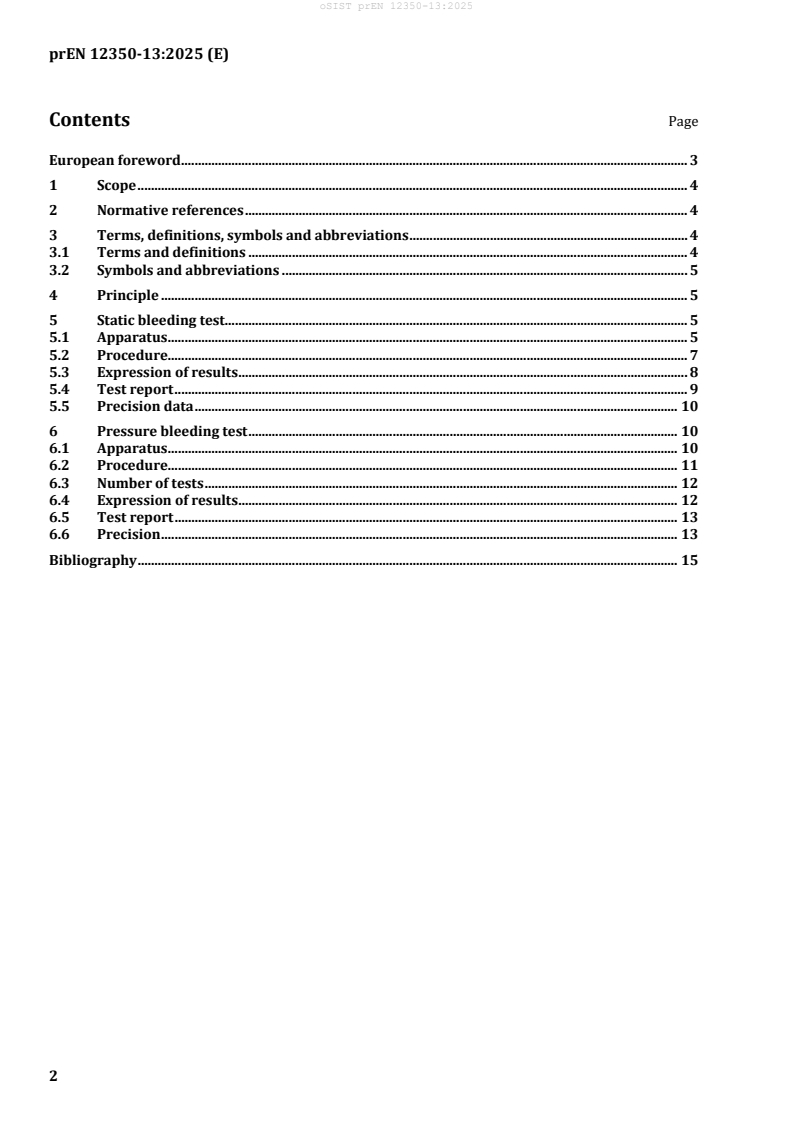
Contents
- 1 Scope
- 2 Normative references
- 3 Terms, definitions, symbols and abbreviations
- 3.1 Terms and definitions
- 3.1.1 static bleed
- 3.1.2 bleeding rate
- 3.1.3 total bleed
- 3.1.4 pressure bleed
- 3.2 Symbols and abbreviations
- 4 Principle
- 5 Static bleeding test
- 5.1 Apparatus
- 5.2 Procedure
- 5.3 Expression of results
- 5.4 Test report
- 5.5 Precision data
- 6 Pressure bleeding test
- 6.1 Apparatus
- 6.2 Procedure
- 6.3 Number of tests
- 6.4 Expression of results
- 6.5 Test report
- 6.6 Precision
- Bibliography
1 Scope
This document specifies the procedures for determining the static and pressure bleed of fresh concrete. The tests are suitable for specimens having a declared value of the coarsest fraction of aggregates actually used in the concrete (D ) not greater than 40 mm. It can be carried out in the laboratory or on site. max
2 Normative references
The following documents are referred to in the text in such a way that some or all of their content constitutes requirements of this document. For dated references, only the edition cited applies. For undated references, the latest edition of the referenced document (including any amendments) applies. EN 12350-1, Testing fresh concrete — Part 1: Sampling and common apparatus EN 12350-5, Testing fresh concrete — Part 5: Flow table test EN 12350-6, Testing fresh concrete — Part 6: Density EN 12350-8, Testing fresh concrete — Part 8: Self-compacting concrete — Slump-flow test EN 12390-2, Testing hardened concrete — Part 2: Making and curing specimens for strength tests EN ISO 10414-1, Petroleum and natural gas industries — Field testing of drilling fluids — Part 1:
Water-based fluids (ISO 10414-1)
3 Terms, definitions, symbols and abbreviations
For the purposes of this document, the following terms and definitions apply. ISO and IEC maintain terminology databases for use in standardization at the following addresses:
- IEC Electropedia: available at https://www.electropedia.org/
- ISO Online browsing platform: available at https://www.iso.org/obp
3.1 Terms and definitions
3.1.1 static bleed
the upwards flow of water of fresh concrete after placing caused by the settlement of the solid materials within the mass
3.1.2 bleeding rate
accumulated mass of bleed water during a defined period of time divided by the duration of this period
3.1.3 total bleed
accumulated mass of the bleed water during the duration of the test
3.1.4 pressure bleed
the release of water from fresh concrete after placing caused by the application of a pressure on the concrete mass placed in a special cell
oSIST prEN 12350-13:2025 prEN 12350-13:2025 (E)
3.2 Symbols and abbreviations
For the purposes of this document, the following common symbols apply. D density according to EN 12350-6 kg/m3 ρ volume of the collected water (ml) at time ti Vi V volume of the collected water (ml) up to time ti
V total collected water volume (ml) ctotal m mass of the container (g)
m mass of the sample and container (g) at the beginning of the test
m mass of the sample and container (g) at the end of the test
B total bleed T T starting time of concrete production (1st water-cement contact)
t test starting time
ti time at which a volume of water Vi is collected V volume of the concrete test specimen (l) conc B bleeding rate (ml/min) R m mass of the filtration cell (g) 1p m mass of the sample and filtration of cell (g) at the beginning of the test 2p m mass of the graduated cylinder (g) 3p m mass of the graduated cylinder and filtered water (g) 4p PB pressure bleed of the test specimen (n) at the end of each pressure n bleeding test (mm/m)
4 Principle
In the static bleeding test, the water on the surface of the fresh concrete is collected at different time intervals to determine the bleeding rate, and until the end of bleeding to determine the total bleed of concrete.
In the pressure bleeding test, the water extracted from a concrete sample subject to a pressure of 1 bar (0,1 MPa) for a period of 3 min is collected to determine the pressure bleed of the concrete. This value may allow to estimate the maximum settlement of the concrete.
5 Static bleeding test
5.1 Apparatus
5.1.1 Common apparatus
The apparatus listed below for the execution of this test method shall be in accordance with the specification given in EN 12350-1 and as specified below.
oSIST prEN 12350-13:2025 prEN 12350-13:2025 (E)
5.1.2 Cylindrical container
Watertight, of sufficient rigidity to retain its shape, made from a non-absorbent material not readily attacked by cement paste, having a smooth internal face.
The reference container shall have an internal diameter of 255 ± 5 mm and internal height of 280 ± 5mm. NOTE Where a container having different dimensions is used the test might not produce the same result as that obtained when using the reference container.
5.1.3 Container cover
Made of the same material as the container or of glass, plexiglass or plastic.
5.1.4 Plastic film
Placed between the top part of the container and the cover to minimize water evaporation from the concrete.
Any contact between the plastic film and the surface of the concrete shall be avoided.
5.1.5 Shim
Between 30 and 50 mm thick, strong enough not to deform under the weight of the concrete and container.
5.1.6 Means of compacting the concrete, which may be one of the following
a) internal (poker) vibrator; b) vibrating table; c) compacting rod; d) compacting bar.
5.1.7 Balance or scales
For the determination of the mass of the concrete sample having a maximum instrumental measurement uncertainty of 0.1 % of the mass.
5.1.8 Balance or scales
For the determination of bleed water mass having a maximum instrumental measurement uncertainty of 0,5 g.
5.1.9 Pipette or similar instrument
Having a capacity of up to 10 ml, graduated to 0,5 ml.
5.1.10 Test tube
Having a capacity of 100 ml.
oSIST prEN 12350-13:2025 prEN 12350-13:2025 (E)
5.1.11 Scoop
5.1.12 Timer or clock
5.1.13 Steel trowel or float
5.1.14 Thermometer
5.2 Procedure
5.2.1 General
The test can be carried out in a laboratory or on site. If carried out on site, the container should be kept in the shade and placed on a horizontal platform or floor free from vibration. The sample shall be taken in accordance with EN 12350-1.
5.2.2 Container mass
Weigh the container and record the value (m ) to the nearest g.
5.2.3 Filling and compacting
If the purpose of the test is to give information on the behaviour of the concrete after placing, and if the filling and compacting of the concrete are carried out in the laboratory, it shall be done at a time after batching of the concrete reflecting the time of delivery and use on site, but no greater than 2 hours except where specific consistence retention times had been specified. Determine the consistence (slump, flow or slump-flow) of the concrete in accordance with EN 12350-2, EN 12350-5 or EN 12350-8.
Measure the fresh density D of the concrete in accordance with EN 12350-6 expressed in kg/m . ρ Fill the container to a height of 250 ± 5 mm.
Compact the concrete according to EN 12390-2 for the minimum duration necessary to achieve full compaction of the concrete.
...