

oSIST prEN 4709-008:2024
(Main)Aerospace series - Unmanned Aircraft Systems - Part 008: C5 Accessories kits
- Status
- Not Published
- Public Enquiry End Date
- 21-May-2024
- Technical Committee
- I13 - Imaginarni 13
- Current Stage
- 4020 - Public enquire (PE) (Adopted Project)
- Start Date
- 08-Mar-2024
- Due Date
- 26-Jul-2024
- Completion Date
- 22-May-2024

oSIST prEN 4709-008:2024 is the Slovenian publication of draft European Standard prEN 4709-008 from CEN. It specifies technical requirements and verification methods for C5 accessories kits used to convert a class C3 unmanned aircraft system (UAS) into a class C5 UAS, for kit providers, manufacturers, qualified integrators and others responsible for installation and compliance.
This draft standard supports compliance with the EU unmanned aircraft rules and CE marking technical requirements. In practice, it tells you what the kit must do, how to check it, and what the instructions and records must contain so that the original C3 compliance of the unmanned aircraft (UA) is not altered.
What does oSIST prEN 4709-008:2024 specify?
oSIST prEN 4709-008:2024 specifies the technical specification and verification methods for C5 accessories kits, with a focus on accessories that transform a C3-class UAS into a C5-class UAS. Clause 4 contains the product requirements and the related verification and pass criteria.
The scope is narrow and practical. It applies only to UA with lift provided by rotary wings and only to UA with electro-chemical energy sources. It excludes security and IT security, fixed-wing, VTOL and other hybrid UA, and additional hazards created by the payload remain under the responsibility of the UAS manufacturer and operator.
The document is organized into:
- Clause 1 - Scope
- Clause 2 - Normative references
- Clause 3 - Terms and definitions
- Clause 4 - Product requirements and compliance
- Annexes A to D and ZA - informative material, examples and EU legal correspondence
| Annex | What it covers |
|---|---|
| Annex A | Example test procedure for accessories kit functionalities |
| Annex B | Functionalities added to convert a C3 UA to C5 class |
| Annex C | Accessories kit elements and an integration example |
| Annex D | Example structure of the accessory kit manual |
| Annex ZA | Relationship with the essential requirements of Delegated Regulation (EU) 2019/945 as amended by (EU) 2020/1058 |
What are the key requirements of oSIST prEN 4709-008:2024?
oSIST prEN 4709-008:2024 sets out what a C5 accessories kit may change, and what it must not change, when fitted to a C3 UAS. The central idea is simple: the kit may add C5 functions, but the original C3 characteristics must remain valid.
Conversion is limited to specific C3 UAS
Clause 4.1 allows conversion only of a class C3 UAS, and only when the UAS is not a fixed-wing design and provides the necessary interfaces for the kit. The kit instructions must list the compatible UAS, their versions, and the software versions where relevant. In practice, this means a buyer or integrator must check exact model compatibility before installation.
The kit must not alter original C3 compliance
Clause 4.3 requires the kit to preserve the original C3 compliance of the UAS. That includes mass, size, controllability, tether strength where applicable, electrical power supply, protection of the command-and-control link, and conspicuity lighting.
For mass, the combined UA and kit items must stay within the C3 MTOM, and the verification method requires weighing the fitted items. For size, the maximum characteristic dimension of the UA plus kit must remain below 3 m. In practice, manufacturers and integrators need to know the fitted configuration, not just the base aircraft.
Software independence is required
Clause 4.2 requires the kit not to include changes to the original software of the class C3 UAS. The kit may include configuration instructions, but its functions must remain independent from the drone software, and the design review must identify the compatible software versions. This matters because the kit must not create hidden firmware dependencies or change the original aircraft behavior.
The kit needs traceable identification and installation documentation
Clause 4.4 requires each accessory to be identified and marked with the C5 label. The kit documentation must include a bill of materials (BOM), part numbers, software versions where applicable, quantities, drawings or other means to identify the parts, and a functional verification check where relevant. Clause 4.5 then requires installation instructions, tool descriptions if special tools are needed, and a way to record installation, upgrades and modifications.
For users, this means the kit should be installable and auditable. A quality manager can trace which parts were fitted, and a technician can follow the correct mounting procedure.
The installed kit must deliver the C5 functions
Clause 4.6 sets the post-installation C5 requirements. Unless tethered, the UAS must have a selectable low-speed mode limited to not more than 5 m/s, with operating instructions for activation, deactivation, limits and conditions.
The UAS and the kit must also monitor their command-and-control links and provide at least four signal-strength levels, plus caution and warning alerts. The warning after link loss should appear within the time stated by the manufacturer, with 5 s treated as an acceptable delay. If the kit or UAS can operate without a link, such as automatic FTS activation with geocaging, the link requirement may not apply.
Clause 4.6 also requires a description of the means to terminate flight, including how it works, how it is activated, the sequence of events, what equipment is required, its limitations, pre-flight verification methods, and the distance travelled after activation. This is important for operational risk planning.
The kit manual must cover operation, maintenance and removal
Clause 4.7 requires instructions for operating, maintaining and unmounting the kit. The manual must explain the tasks, the tools needed, the skills required, the maintenance frequency, and how to remove the kit without altering C3 compliance. In practice, this supports safe use after installation and safe return of the UAS to its original state.
What terms does oSIST prEN 4709-008:2024 define?
oSIST prEN 4709-008:2024 defines the terms used to describe the kit, the aircraft and the people handling compliance.
- CE marking - the marking used by the manufacturer to show conformity with the applicable Union harmonization legislation.
- kit provider - the legal entity that provides the C5 accessory kit and accompanying requisites under its name or trademark.
- qualified kit integrator - a legal or natural entity with suitable expertise and knowledge to install and verify the kit.
- manufacturer serial number - the unique alphanumeric sequence assigned by the UA manufacturer in ANSI/CTA-2063-A-2019 format.
- means to reduce the effect of the UA impact dynamics - a technical means that helps prevent major impact damage if the remote pilot does not terminate flight in time.
- payload - equipment or accessories installed in or attached to the aircraft that are not used to operate or control it in flight.
- UA - an aircraft designed to operate autonomously or be piloted remotely without a pilot on board.
- UAS software modification - a software change not documented by the original UA manufacturer in its instructions.
Who uses oSIST prEN 4709-008:2024?
oSIST prEN 4709-008:2024 is used by C5 accessory kit providers, UAS manufacturers, qualified kit integrators, conformity assessment teams, and organizations that prepare technical files for CE marking. It is also relevant for remote pilots and UAS operators who need to understand the installed functions, maintenance needs and operating limits.
In practice, it is useful for:
- product design teams developing FTS, parachute systems or other impact-energy reduction means
- compliance and quality teams checking C3-to-C5 conversion claims
- installers and service organizations performing mounting, testing and maintenance
- buyers and operators verifying that a kit matches a specific UA model and software version
Which standards are used with oSIST prEN 4709-008:2024?
oSIST prEN 4709-008:2024 relies on several companion draft standards for methods and pass criteria.
| Referenced standard | Contribution to this document |
|---|---|
| prEN 4709-001:2021 | Base product requirements and verification methods, including compatibility checks, mass, controllability, tethering, power and data link protection |
| prEN 4709-004:2020 | Lighting requirements, used for conspicuity lighting checks |
| prEN 4709-006:2023 | Means to terminate flight, used for flight-termination description and verification |
| prEN 4709-007:2024 | General product requirements for C5 and C6, used for link monitoring and alerting requirements |
The document also points readers to EN 61310-1 for guidance on aural, visual and haptic alerts.
What does the oSIST prEN 4709-008:2024 document contain?
oSIST prEN 4709-008:2024 contains clause-by-clause requirements, verification methods and pass criteria for the kit and the fitted UAS. It also includes example material that shows how the kit can be tested, integrated and documented.
Annex A gives example test procedures for FTS, parachute systems and other means to reduce impact dynamics. Annex B lists example functionalities added for C3-to-C5 conversion, including FTS and impact-energy reduction means. Annex C shows kit elements and an integration example, while Annex D gives an example manual structure with sections for compatibility, kit components, testing, installation, instructions and operation records. Annex ZA maps the document to the relevant essential requirements of Delegated Regulation (EU) 2019/945 as amended by (EU) 2020/1058.
Get Certified
Connect with accredited certification bodies for this standard

BSI Group
BSI (British Standards Institution) is the business standards company that helps organizations make excellence a habit.

Bureau Veritas
Bureau Veritas is a world leader in laboratory testing, inspection and certification services.

DNV
DNV is an independent assurance and risk management provider.
Sponsored listings
Frequently Asked Questions
oSIST prEN 4709-008:2024 is a draft published by the Slovenian Institute for Standardization (SIST). Its full title is "Aerospace series - Unmanned Aircraft Systems - Part 008: C5 Accessories kits". This standard covers: Aerospace series - Unmanned Aircraft Systems - Part 008: C5 Accessories kits
Aerospace series - Unmanned Aircraft Systems - Part 008: C5 Accessories kits
oSIST prEN 4709-008:2024 is classified under the following ICS (International Classification for Standards) categories: 49.020 - Aircraft and space vehicles in general. The ICS classification helps identify the subject area and facilitates finding related standards.
oSIST prEN 4709-008:2024 is associated with the following European legislation: EU Directives/Regulations: 2019/945; Standardization Mandates: M/567. When a standard is cited in the Official Journal of the European Union, products manufactured in conformity with it benefit from a presumption of conformity with the essential requirements of the corresponding EU directive or regulation.
oSIST prEN 4709-008:2024 is available in PDF format for immediate download after purchase. The document can be added to your cart and obtained through the secure checkout process. Digital delivery ensures instant access to the complete standard document.
Standards Content (Sample)
SLOVENSKI STANDARD
01-maj-2024
Aeronavtika - Letalski sistemi brez posadke - 008. del: C5 Dodatni kompleti
Aerospace series - Unmanned Aircraft Systems - Part 008: C5 Accessories kits
Luft- und Raumfahrt - Unbemannte Luftfahrzeugsysteme - Teil 008: Zubehörsätze der
Klasse C5
Série aérospatiale - Aéronefs télépilotés - Partie 008 : Kits d'accessoires classe C5
Ta slovenski standard je istoveten z: prEN 4709-008
ICS:
49.020 Letala in vesoljska vozila na Aircraft and space vehicles in
splošno general
2003-01.Slovenski inštitut za standardizacijo. Razmnoževanje celote ali delov tega standarda ni dovoljeno.
DRAFT
EUROPEAN STANDARD
prEN 4709-008
NORME EUROPÉENNE
EUROPÄISCHE NORM
February 2024
ICS
English Version
Aerospace series - Unmanned Aircraft Systems - Part 008:
C5 Accessories kits
Luft- und Raumfahrt - Unbemannte
Luftfahrzeugsysteme - Verifizierungsmethode für die
Geocaging Funktion.
This draft European Standard is submitted to CEN members for enquiry. It has been drawn up by the Technical Committee
CEN/TC 471.
If this draft becomes a European Standard, CEN members are bound to comply with the CEN/CENELEC Internal Regulations
which stipulate the conditions for giving this European Standard the status of a national standard without any alteration.
This draft European Standard was established by CEN in three official versions (English, French, German). A version in any other
language made by translation under the responsibility of a CEN member into its own language and notified to the CEN-CENELEC
Management Centre has the same status as the official versions.
CEN members are the national standards bodies of Austria, Belgium, Bulgaria, Croatia, Cyprus, Czech Republic, Denmark, Estonia,
Finland, France, Germany, Greece, Hungary, Iceland, Ireland, Italy, Latvia, Lithuania, Luxembourg, Malta, Netherlands, Norway,
Poland, Portugal, Republic of North Macedonia, Romania, Serbia, Slovakia, Slovenia, Spain, Sweden, Switzerland, Türkiye and
United Kingdom.
Recipients of this draft are invited to submit, with their comments, notification of any relevant patent rights of which they are
aware and to provide supporting documentation.
Warning : This document is not a European Standard. It is distributed for review and comments. It is subject to change without
notice and shall not be referred to as a European Standard.
EUROPEAN COMMITTEE FOR STANDARDIZATION
COMITÉ EUROPÉEN DE NORMALISATION
EUROPÄISCHES KOMITEE FÜR NORMUNG
CEN-CENELEC Management Centre: Rue de la Science 23, B-1040 Brussels
© 2024 CEN All rights of exploitation in any form and by any means reserved Ref. No. prEN 4709-008:2024 E
worldwide for CEN national Members.
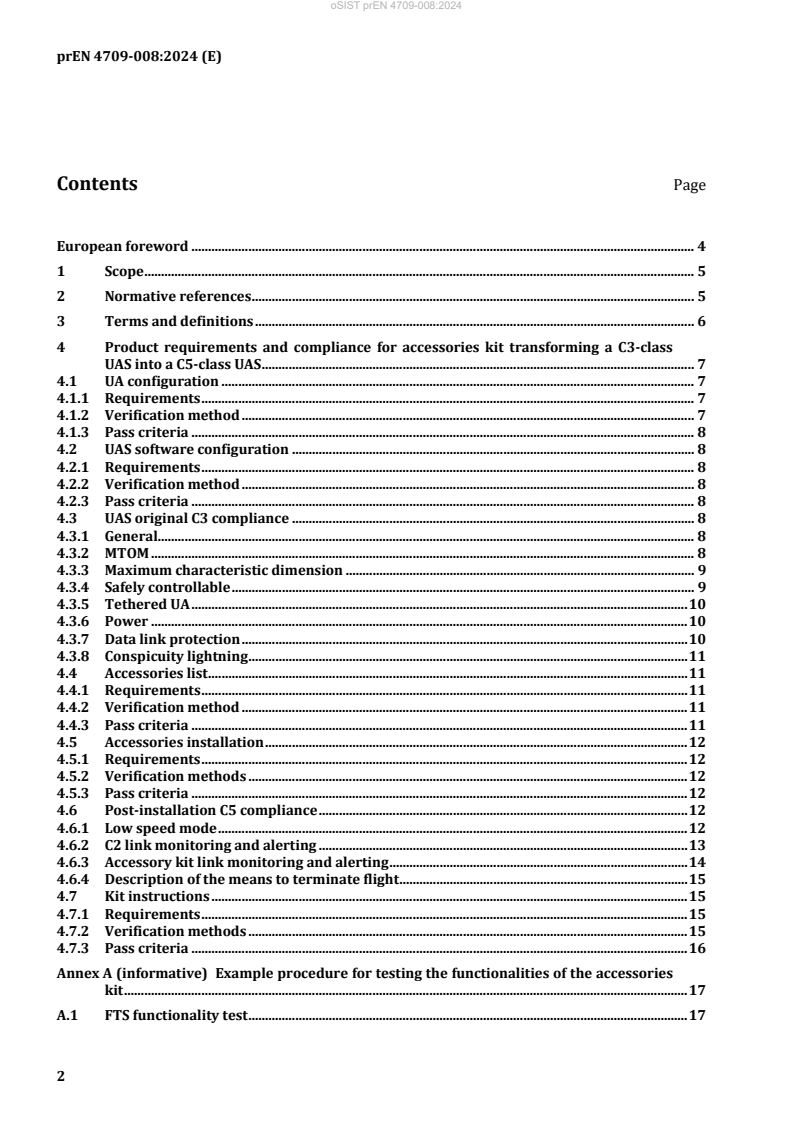
prEN 4709-008:2024 (E)
Contents Page
European foreword . 4
1 Scope . 5
2 Normative references . 5
3 Terms and definitions . 6
4 Product requirements and compliance for accessories kit transforming a C3-class
UAS into a C5-class UAS . 7
4.1 UA configuration . 7
4.1.1 Requirements . 7
4.1.2 Verification method . 7
4.1.3 Pass criteria . 8
4.2 UAS software configuration . 8
4.2.1 Requirements . 8
4.2.2 Verification method . 8
4.2.3 Pass criteria . 8
4.3 UAS original C3 compliance . 8
4.3.1 General. 8
4.3.2 MTOM . 8
4.3.3 Maximum characteristic dimension . 9
4.3.4 Safely controllable . 9
4.3.5 Tethered UA . 10
4.3.6 Power . 10
4.3.7 Data link protection . 10
4.3.8 Conspicuity lightning . 11
4.4 Accessories list . 11
4.4.1 Requirements . 11
4.4.2 Verification method . 11
4.4.3 Pass criteria . 11
4.5 Accessories installation . 12
4.5.1 Requirements . 12
4.5.2 Verification methods . 12
4.5.3 Pass criteria . 12
4.6 Post-installation C5 compliance . 12
4.6.1 Low speed mode . 12
4.6.2 C2 link monitoring and alerting . 13
4.6.3 Accessory kit link monitoring and alerting . 14
4.6.4 Description of the means to terminate flight . 15
4.7 Kit instructions . 15
4.7.1 Requirements . 15
4.7.2 Verification methods . 15
4.7.3 Pass criteria . 16
Annex A (informative) Example procedure for testing the functionalities of the accessories
kit . 17
A.1 FTS functionality test . 17
prEN 4709-008:2024 (E)
A.2 Parachute system functionality test . 17
A.3 Other means to reduce the effects of impact dynamics functionality test . 17
Annex B (informative) Functionalities added to perform conversion of C3 UA to C5 class . 18
B.1 FTS (refer to prEN 4709-006:2023, Annex A) . 18
B.2 Means to reduce the effect of impact dynamics (refer to prEN 4709-006:2023,
Annex D) . 19
Annex C (informative) Accessories kits elements . 20
C.1 Accessories kit integration example . 20
C.2 Details of the parts . 21
Annex D (informative) Example of the structure of the accessory kit manual. 22
D.1 UA compatibility . 22
D.2 Kit components . 22
D.3 Kit testing . 23
D.4 Kit installation . 23
D.5 Kit instructions . 23
D.6 Operation recording . 24
Annex ZA (informative) Relationship between this document and the essential
requirements of Delegated regulation (EU) 2019/945 of 12th March 2019 amended
by (EU) 2020/1058 on unmanned aircraft systems and on third-country operators of
unmanned aircraft systems aimed to be covered . 26
Bibliography . 27
prEN 4709-008:2024 (E)
European foreword
This document (prEN 4709-008:2024) has been prepared by Technical Committee CEN/TC 471 UAS,
the secretariat of which is held by BNAE.
This document is currently submitted to the CEN Enquiry.
This document has been prepared under a standardization request addressed to CEN by the European
Commission. The Standing Committee of the EFTA States subsequently approves these requests for its
Member States.
For the relationship with EU Legislation, see informative Annex ZA, which is an integral part of this
document.
prEN 4709-008:2024 (E)
1 Scope
This document provides technical specification and verification methods to support compliance with
Commission Delegated Regulation (EU) 2020/1058 of 27 April 2020 amending Delegated Regulation
(EU) 2019/945 on unmanned aircraft systems and on third-country operators of unmanned aircraft
systems.
More specifically, it addresses compliance with class C5 accessories kit requirements.
Even if security, including IT security, may be useful from an operational point of view, it falls outside
the scope of this document.
This document delineates how a product compliance for the C5 accessories performance and reliability
of the safety equipment can be ensure. The specifications will ensure that the manufacturer’s C3
compliance is not altered by the accessories kit.
This document only addresses UA with lift provided by rotary wings. Fixed wings, VTOL and other
hybrid UA are out of this scope.
Compliance with this document assists in complying with CE marking technical requirements.
This document is only applicable for UA with energy sources based on electro-chemical technologies.
Additional hazards that occur from the characteristics of the payload are excluded and are, conversely,
under the responsibility of the UAS manufacturer and UAS operator.
2 Normative references
The following documents are referred to in the text in such a way that some or all of their content
constitutes requirements of this document. For dated references, only the edition cited applies. For
undated references, the latest edition of the referenced document (including any amendments) applies.
prEN 4709-001:2021, Aerospace series — Unmanned Aircraft Systems — Part 001: Product
requirements and verification methods
prEN 4709-004:2020, Aerospace series — Unmanned Aircraft Systems — Part 004: Lighting
requirements
prEN 4709-006:2023, Aerospace series - Unmanned Aircraft Systems - Part 006: Means to terminate
flight, requirements, and verification
prEN 4709-007:2024, Aerospace series - Unmanned Aircraft Systems - Part 007: General product
requirements for UAS of classes C5 and C6
At draft stage.
prEN 4709-008:2024 (E)
3 Terms and definitions
For the purposes of this document, the following terms and definitions apply.
ISO and IEC maintain terminology databases for use in standardization at the following addresses:
— ISO Online browsing platform: available at https://www.iso.org/obp/
— IEC Electropedia: available at https://www.electropedia.org/
3.1
CE marking
marking by which the manufacturer indicates that the product is in conformity with the applicable
requirements set out in Union harmonization legislation providing for its affixing
3.2
kit provider
legal entity that provides the C5 accessory kit and accompanying requisites under their name or
trademark
3.3
qualified kit integrator
legal or natural entity with a suitable level of expertise and knowledge qualified to proceed with the
installation and the verification of the kit
3.4
manufacturer serial number
unique sequence of alphanumerical characters assigned to the UA by its manufacturer in ANSI/CTA-
2063-A-2019 format
3.5
means to reduce the effect of the UA impact dynamics
technical means as part of a UAS that prevent major impact damage to mitigate the risk that the remote
pilot does not activate the means to terminate the flight in time, fearing the damage and the potential
destruction of the UA
3.6
payload
instrument, mechanism, equipment, part, apparatus, appurtenance, or accessory, including
communications equipment, that is installed in or attached to the aircraft, and is not used or intended to
be used in operating or controlling an aircraft in flight, and is not part of an airframe, engine, or
propeller
3.7
UA
aircraft operating, or designed to operate, autonomously or to be piloted remotely without a pilot on
board
3.8
UA class
C0 to C6 class identification label of UA as defined in Regulation (EU) 2019/945
3.9
UA configuration
basic design arrangement of the UA: fixed-wing, rotary wing, or multicopter
prEN 4709-008:2024 (E)
3.10
UAS
unmanned aircraft and its associated elements which are operated with no pilot on board
3.11
UAS software
software running on board UA or at its associated elements such as the command unit
3.12
UAS software modification
modification of UA software that is not documented by the original UA manufacturer in its instructions
[SOURCE: ISO/CD 21384-2.]
4 Product requirements and compliance for accessories kit transforming a C3-
class UAS into a C5-class UAS
4.1 UA configuration
4.1.1 Requirements
(1) An accessories kit may only ensure conversion of a class C3 UAS.
(2) The class C3 UAS is not a fixed wing one.
(3) The class C3 UAS provides the necessary interfaces to the accessories.
4.1.2 Verification method
Requirement (1)
Verify that the kit comes with a list of compatible UAS and that each one of them is of class C3. If the
UAS has different possible configurations (payloads, etc.), the list shall provide details of the compatible
configurations. Each compliant UAS shall be identified by its version and its software version.
Requirement (2)
Verify that the UAS listed in the manufacturer’s instructions for which the kit provides conversion is not
fixed wings whether or not equipped with a VTOL capability ones unless tethered.
Requirement (3)
Review the installation instructions provided with the kit and test the mounting of the kit on all the
compliant UAS. The compliant UAS addressed by the kit shall have the necessary interface so that the
kit can be integrated on them. The kit shall describe the interface needed for its mounting. Interfaces
can be not mandatory if the kit can be fitted without any interfaces. As of the published date of this
specification, no standard has defined an interface for FTS or PRS. In the absence of a defined interface,
the accessory kit manufacturer may describe an acceptable existing interface present on the compatible
UAS.
Refer to 4.3.2.1 for description of the means to check compatibility.
prEN 4709-008:2024 (E)
4.1.3 Pass criteria
(1) The manufacturer's instructions of the kit include a list of compatible UAS. The list describes the
compatible configurations for each UAS for which several configurations are possible. A Declaration of
Conformity covering Regulation (EU) 2019/945 and indicating a C3 type is provided (in the technical
file) for each UAS included in the list.
(2) The design of the UA does not include features that can be assimilated to wings generating lift
and enabling the aircraft flying horizontally.
(3) The interface proposed is an existing interface (for example, battery connectors for FTS).
No interface is specifically added on the UAS for the accessory kit.
The kit is well mounted on the proposed interface following the installation instructions provided by
the kit.
4.2 UAS software configuration
4.2.1 Requirements
(1) The accessories kit shall not include changes to the original software of the class C3 UAS.
NOTE The kit can include software configuration instructions for setting some parameters in the original
software present in the UA.
4.2.2 Verification method
Requirement (1)
Verify by design review that the kit functionalities are independent from the software of the drone. If
there is software communication between the kit and the drone, those shall be described and there
shall have no impact on the main functionalities: FTS and means to reduce impact energy. The design
shall indicate which software version the kit is applicable to.
4.2.3 Pass criteria
(1) The design review proves independence of the kit from the software of the UA. The kit comes
with a list of compatible software versions.
4.3 UAS original C3 compliance
4.3.1 General
The kit shall not alter the original compliance of the class C3 UAS.
4.3.2 MTOM
4.3.2.1 Requirements
(1) The mass of the combination of the UA with items included in the kit shall not exceed the MTOM
of class C3.
4.3.2.2 Verification method
Requirement (1)
— Review the packaging, identify all the items provided with the kit in the different packaging and
draw-up the list of items that are fitted to the UA.
— Determine the masses of all items that are fitted to the UA in the list of items and determinate the
mass according to the weighing procedure described below.
prEN 4709-008:2024 (E)
— Determine the total mass of the different compatible configurations of the UA in combination with
the items of the kit.
Weighing procedure:
1. weigh the item;
2. record the mass.
The weighing device with a resolution of at least 10 g shall be calibrated and the determined accuracy
shall be < ± 50 g.
4.3.2.3 Pass criteria
(1) Verify that the take-off mass of the UA in combination with the accessories declared in the
accessories manufacturer’s instruction that are fitted to the UA is not exceeding the MTOM of the C3
UAS as declared by the C3 UAS manufacturer with a ± 2 % margin.
4.3.3 Maximum characteristic dimension
4.3.3.1 Requirements
(1) The maximum characteristic dimension of the UA in combination with the kit shall be less than
3 m. If the manufacturer of the C3 compatible UA has defined some limitation regarding payloads
dimensions, those shall be taken into account.
4.3.3.2 Verification method
Requirement (1)
Apply verification method of prEN 4709-001:2021, 7.2.2.1 to the UA in combination with the
accessories.
4.3.3.3 Pass criteria
(1) Verify that the maximum characteristic dimension of the UA in combination with the items of
the kit is less than 3 m.
4.3.4 Safely controllable
4.3.4.1 Requirements
(1) The class C3 UA in addition with the kit installed on it shall be safely controllable with regard to
stability, maneuverability and the command-and-control link performance, by a remote pilot with
adequate competency and following the manufacturer’s instructions, as necessary under all
anticipated operating conditions including following the failure of one or, if appropriate, more systems.
4.3.4.2 Verification method
Requirement (1)
To show compliance with this requirement, manufacturers of kit shall apply the requirements and
verification methodology given in prEN 4709-001:2021, 6.3.1 and 6.3.2 to the UA in combination with
the items of the kit installed.
More information can be found in Regulation (EU) 2019/947.
prEN 4709-008:2024 (E)
4.3.4.3 Pass criteria
The pass criteria given in prEN4709-001:2021, 7.4.2 apply to the UA in combination with the items of
the kit installed.
4.3.5 Tethered UA
4.3.5.1 Requirements
(1) If tethered heavier-than-air aircraft, the strength of the tethering system is 10 times the weight
of the UA in combination with the accessories kit.
4.3.5.2 Verification method
Requirement (1)
To show compliance with this requirement, manufacturers of kit shall apply the requirements and
verification methodology given in prEN 4709-001:2021, 7.5.2 to the UA in combination with the items
of the kit installed.
4.3.5.3 Pass criteria
The pass criteria given in prEN 4709-001:2021, 7.5.3 apply to the UA in combination with the items of
the kit installed.
4.3.6 Power
4.3.6.1 Requirements
(1) The items of the kit are powered by electricity.
4.3.6.2 Verification method
Requirement (1)
To show compliance with this requirement manufacturers of kit shall apply the methodology given in
prEN 4709-001:2021, 4.6 to the items of the kit.
4.3.6.3 Pass criteria
The pass criteria given in prEN 4709-001:2021, 4.6.2 apply to the items of the kit.
4.3.7 Data link protection
4.3.7.1 Requirements
(1) The items of the kit, unless tethered, shall be equipped with a command-and-control link
protected against unauthorized access.
4.3.7.2 Verification method
Requirement (1)
To show compliance with this requirement manufacturers of kit shall apply the methodology given in
prEN 4709-001:2021, 6.7.2 to the command-and-control link of the items of the kit.
NOTE The kit can consist of items that don’t need data link to operate (ex. FTS activated automatically with
geocaging functions). In this case, this requirement doesn’t apply.
prEN 4709-008:2024 (E)
4.3.7.3 Pass
...