

SIST EN 16603-50-21:2022
(Main)Space engineering - Adoption Notice of CCSDS 131.0-B-3, TM Synchronization and Channel Coding
General Information
- Abstract
This document identifies the clauses and requirements modified w ith respect to the standard CCSDS 131.0-B-3, TM
Synchronization and Channel Coding, Issue 3, September 2017 for application in ECSS.
- Status
- Published
- Public Enquiry End Date
- 30-Sep-2021
- Publication Date
- 17-Jul-2022
- Technical Committee
- I13 - Imaginarni 13
- Current Stage
- 6060 - National Implementation/Publication (Adopted Project)
- Start Date
- 13-Jul-2022
- Due Date
- 17-Sep-2022
- Completion Date
- 18-Jul-2022



Overview
EN 16603-50-21:2022 is the CEN/ECSS adoption notice of CCSDS 131.0‑B‑3, TM Synchronization and Channel Coding (Issue 3, Sep 2017). It identifies the specific clauses and requirements modified for application within the ECSS system and replaces the earlier EN 16603-50-01:2014. The document aligns CCSDS telemetry synchronization and channel coding requirements with European space engineering practice and mandates how national bodies must adopt the text.
Key topics and technical requirements
This Adoption Notice keeps CCSDS 131.0‑B‑3 as the normative base while introducing targeted modifications to ensure consistent ECSS integration. Major technical topics include:
- TM synchronization and channel coding: Adoption of CCSDS rules for telemetry frame synchronization and error-correcting codes used on space data links.
- Modifications to decoder inputs:
- Soft-bit decisions: Where previously “should be used whenever constraints permit,” the Adoption Notice requires that soft-bit decisions with at least three-bit quantization shall be used for the decoder.
- Reed–Solomon (RS) code usage:
- E = 8 restriction: RS codes with E=8 shall not be used unless the modulation is 4D‑8PSK trellis-coded modulation (4D‑8PSK‑TCM).
- Allowed interleaving depths: Interleaving depths I = 1, 2, 3, 4, 5, 8. When E=16, I = 1,2,3,4,5,8; when E=8, I = 8.
- Interleaving depth fixed: The interleaving depth shall be fixed on a Physical Channel for a Mission Phase (word “normally” removed).
- Concatenated codes: Concatenation of RS with convolutional codes is restricted to RS E=16 (note clarifies RS E=8 is not concatenated).
- Additional CCSDS features highlighted (informative Annex A):
- LDPC codes added in CCSDS 131.0‑B‑3 (new compared with prior ECSS edition).
- Normative transfer frame lengths, managed parameters, formal service interface specifications, and security considerations are included in CCSDS 131.0‑B‑3 and referenced by the Adoption Notice.
Applications and users
This standard is intended for:
- Satellite communications and spacecraft systems engineers implementing telemetry links and channel coding.
- Mission architects specifying space data link protocols and mission configuration parameters.
- Avionics and RF modem developers implementing decoders (soft-decision quantizers, RS/LDPC, interleaving).
- Test labs and compliance officers verifying ECSS/EN conformity for European space programmes. Practical benefits include improved interoperability, consistent mission-level parameter management, and clear constraints for coder/modem design and procurement.
Related standards
- CCSDS 131.0‑B‑3 (source document)
- EN 16603‑50‑22 / EN 16603‑50‑23 / EN 16603‑50‑24 (related space data link adoption notices)
- ECSS-E-AS-50-21 (originating ECSS document)
Keywords: EN 16603-50-21, CCSDS 131.0-B-3, TM Synchronization, Channel Coding, Reed‑Solomon, LDPC, interleaving depth, soft-bit decisions, 4D‑8PSK‑TCM, space engineering, telemetry, space data links.
Relations
- Effective Date
- 13-Jul-2022
Get Certified
Connect with accredited certification bodies for this standard

BUREAU VERITAS Certification Germany
Bureau Veritas certification in Germany.

Element Materials Technology
Materials testing and product certification.

AQMS Ltd.
AQMS provides ISO certification to SMEs across the UK.
Sponsored listings
Frequently Asked Questions
SIST EN 16603-50-21:2022 is a standard published by the Slovenian Institute for Standardization (SIST). Its full title is "Space engineering - Adoption Notice of CCSDS 131.0-B-3, TM Synchronization and Channel Coding". This standard covers: This document identifies the clauses and requirements modified w ith respect to the standard CCSDS 131.0-B-3, TM Synchronization and Channel Coding, Issue 3, September 2017 for application in ECSS.
This document identifies the clauses and requirements modified w ith respect to the standard CCSDS 131.0-B-3, TM Synchronization and Channel Coding, Issue 3, September 2017 for application in ECSS.
SIST EN 16603-50-21:2022 is classified under the following ICS (International Classification for Standards) categories: 49.140 - Space systems and operations. The ICS classification helps identify the subject area and facilitates finding related standards.
SIST EN 16603-50-21:2022 has the following relationships with other standards: It is inter standard links to SIST EN 16603-50-01:2015. Understanding these relationships helps ensure you are using the most current and applicable version of the standard.
SIST EN 16603-50-21:2022 is associated with the following European legislation: Standardization Mandates: M/496. When a standard is cited in the Official Journal of the European Union, products manufactured in conformity with it benefit from a presumption of conformity with the essential requirements of the corresponding EU directive or regulation.
SIST EN 16603-50-21:2022 is available in PDF format for immediate download after purchase. The document can be added to your cart and obtained through the secure checkout process. Digital delivery ensures instant access to the complete standard document.
Standards Content (Sample)
SLOVENSKI STANDARD
01-september-2022
Nadomešča:
SIST EN 16603-50-01:2015
Vesoljska tehnika - Sprejem obvestila CCSDS 131.0-B-3, sinhronizacija TM in
kodiranje kanalov
Space engineering - Adoption Notice of CCSDS 131.0-B-3, TM Synchronization and
Channel Coding
Raumfahrttechnik - Adaption CCSDS 131.0-B-3, Telemetrie-Synchronisation und -
Kanalkodierung
Ingénierie spatiale - Notice d’adoption de la CCSDS 131.0-B-3, TM Synchronization and
Channel Coding
Ta slovenski standard je istoveten z: EN 16603-50-21:2022
ICS:
49.140 Vesoljski sistemi in operacije Space systems and
operations
2003-01.Slovenski inštitut za standardizacijo. Razmnoževanje celote ali delov tega standarda ni dovoljeno.
EUROPEAN STANDARD EN 16603-50-21
NORME EUROPÉENNE
EUROPÄISCHE NORM
July 2022
ICS 49.140
Supersedes EN 16603-50-01:2014
English version
Space engineering - Adoption Notice of CCSDS 131.0-B-3,
TM Synchronization and Channel Coding
Ingénierie spatiale - Notice d'adoption de la CCSDS Raumfahrttechnik - Adaption CCSDS 131.0-B-3,
131.0-B-3, TM Synchronization and Channel Coding Telemetrie-Synchronisation und -Kanalkodierung
This European Standard was approved by CEN on 13 March 2022.
CEN and CENELEC members are bound to comply with the CEN/CENELEC Internal Regulations which stipulate the conditions for
giving this European Standard the status of a national standard without any alteration. Up-to-date lists and bibliographical
references concerning such national standards may be obtained on application to the CEN-CENELEC Management Centre or to
any CEN and CENELEC member.
This European Standard exists in three official versions (English, French, German). A version in any other language made by
translation under the responsibility of a CEN and CENELEC member into its own language and notified to the CEN-CENELEC
Management Centre has the same status as the official versions.
CEN and CENELEC members are the national standards bodies and national electrotechnical committees of Austria, Belgium,
Bulgaria, Croatia, Cyprus, Czech Republic, Denmark, Estonia, Finland, France, Germany, Greece, Hungary, Iceland, Ireland, Italy,
Latvia, Lithuania, Luxembourg, Malta, Netherlands, Norway, Poland, Portugal, Republic of North Macedonia, Romania, Serbia,
Slovakia, Slovenia, Spain, Sweden, Switzerland, Turkey and United Kingdom.
CEN-CENELEC Management Centre:
Rue de la Science 23, B-1040 Brussels
© 2022 CEN/CENELEC All rights of exploitation in any form and by any means
Ref. No. EN 16603-50-21:2022 E
reserved worldwide for CEN national Members and for
CENELEC Members.
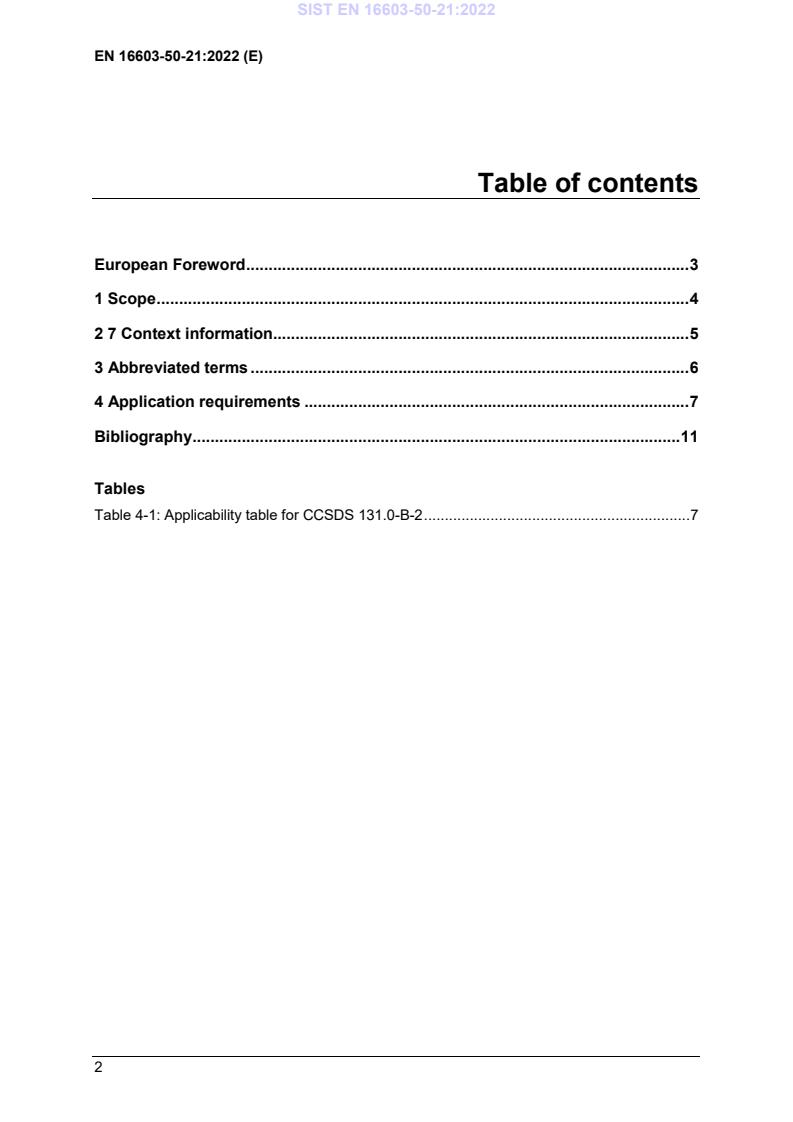
Table of contents
European Foreword . 3
1 Scope . 4
2 7 Context information. 5
3 Abbreviated terms . 6
4 Application requirements . 7
Bibliography . 11
Tables
Table 4-1: Applicability table for CCSDS 131.0-B-2 . 7
European Foreword
This document (EN 16603-50-21:2022) has been prepared by Technical Committee CEN-
CENELEC/TC 5 “Space”, the secretariat of which is held by DIN.
This standard (EN 16603-50-21:2022) originates from ECSS-E-AS-50-21C.
This European Standard shall be given the status of a national standard, either by publication of an
identical text or by endorsement, at the latest by January 2023, and conflicting national standards shall
be withdrawn at the latest by January 2023.
Attention is drawn to the possibility that some of the elements of this document may be the subject of
patent rights. CEN shall not be held responsible for identifying any or all such patent rights.
This document supersedes EN 16603-50-01:2014.
The main changes with respect to EN 16603-50-01:2014 are listed below:
- Replacement of the Standard by an Adoption Notice.
This document has been prepared under a standardization request given to CEN by the European
Commission and the European Free Trade Association.
This document has been developed to cover specifically space systems and has therefore precedence
over any EN covering the same scope but with a wider domain of applicability (e.g. : aerospace).
According to the CEN-CENELEC Internal Regulations, the national standards organizations of the
following countries are bound to implement this European Standard: Austria, Belgium, Bulgaria,
Croatia, Cyprus, Czech Republic, Denmark, Estonia, Finland, Former Yugoslav Republic of
Macedonia, France, Germany, Greece, Hungary, Iceland, Ireland, Italy, Latvia, Lithuania,
Luxembourg, Malta, Netherlands, Norway, Poland, Portugal, Romania, Serbia, Slovakia, Slovenia,
Spain, Sweden, Switzerland, Turkey and the United Kingdom.
Scope
This document identifies the clauses and requirements modified with respect to
the standard CCSDS 131.0-B-3, TM Synchronization and Channel Coding, Issue 3,
September 2017 for application in ECSS.
Context information
The standard CCSDS 131.0-B-3, TM Synchronization and Channel Coding, has
been developed by CCSDS for use in developing synchronization and channel
coding systems.
With this Adoption Notice ECSS is adopting and applying CCSDS 131.0-B-3
with a minimum set of modifications, identified in the present document, to
allow for reference and for a consistent integration in the ECSS system of
standards.
CCSDS 131.0-B-3 is similar to the EN 16603-50-01 (based on ECSS-E-ST-50-01)
Space data links - Telemetry synchronization and channel codin.
EN 16603-50-01 (based on ECSS-E-ST-50-01) is superseded by EN 16603-50-21
(based on ECSS-E-AS-50-21).
Differences between these standards that are not covered by the normative
modifications in clause 4 are described in the informative Annex A.
Overview of superseded EN 16603-50-xx Standards
Superseded EN New EN Based on CCSDS
EN 16603-50-01:2014 EN 16603-50-21 CCSDS 131.0-B-3 (Sept. 2017)
EN 16603-50-03:2014 EN 16603-50-22 CCSDS 132.0-B-2 (Sept. 2015)
EN 16603-50-23 CCSDS 732.0-B-3 (Sept. 2015)
EN 16603-50-04:2014 EN 16603-50-24 CCSDS 231.0-B-3 (Sept. 2017)
EN 16603-50-25 CCSDS 232.0-B-3 (Sept. 2015)
EN 16603-50-26 CCSDS 232.1-B-2
...