

SIST EN 17016-2:2026
(Main)Electronic Public Procurement - Ordering - Part 2: Transactions
General Information
- Abstract
This document describes the transaction information requirements of the transactions used in the collaborations described in EN 17016-1:2024. For each transaction are specified the transaction business requirements, the transaction information data model containing definitions of terms, usage descriptions and cardinality of the information elements and the transaction business rules.
This document describes the following transactions:
1) Order;
2) Order Change;
3) Order Cancellation;
4) Order Response Simple
5) Order Confirmation;
6) Order Rejection;
7) Order Response;
8) Order Change Confirmation;
9) Order Change Rejection;
10) Order Cancellation Confirmation;
11) Order Cancellation Rejection;
12) Order Agreement.
How to claim compliance to a transaction is specified in Clause 6.
How to claim conformance to a transaction is also specified in Clause 6.
- Status
- Published
- Public Enquiry End Date
- 13-Nov-2024
- Publication Date
- 28-May-2026
- Technical Committee
- ITC - Information technology
- Current Stage
- 6060 - National Implementation/Publication (Adopted Project)
- Start Date
- 23-Apr-2026
- Due Date
- 28-Jun-2026
- Completion Date
- 29-May-2026

Overview
SIST EN 17016-2:2026 - Electronic Public Procurement - Ordering - Part 2: Transactions is an international standard developed by SIST and CEN/TC 440. This standard defines the requirements for electronic ordering transactions within public procurement processes, closely aligned with the business interactions specified in EN 17016-1:2024. The document details information content, business rules, and data models necessary for various electronic order-related transactions exchanged between buyers and sellers in public procurement.
The standard aims to ensure interoperability, transparency, and efficiency in digital procurement systems across Europe and beyond by standardizing the way procurement orders and related communications are structured and exchanged.
Key Topics
Transaction Types:
SIST EN 17016-2:2026 encompasses a comprehensive suite of procurement transactions, including:
- Order
- Order Change
- Order Cancellation
- Order Response Simple
- Order Confirmation
- Order Rejection
- Order Response (full/with changes)
- Order Change Confirmation
- Order Change Rejection
- Order Cancellation Confirmation
- Order Cancellation Rejection
- Order Agreement
Transaction Requirements:
For each transaction type, the standard specifies:
- Business requirements and goals
- Transaction information data model (definitions, usage, cardinality)
- Business rules guiding transaction creation and exchange
- How to claim compliance and conformance for each procurement transaction
Collaboration and Choreography:
Describes how transactions support basic collaboration between procurement agents, delineating roles (buyer/seller), capabilities, and the sequence of interactions throughout the ordering process.
Interoperability and Reference Architecture:
Positions the standard within the European Interoperability Reference Architecture (EIRA), supporting consistent digital public procurement solutions and promoting the reuse of established interoperability building blocks (e.g., eDelivery, eSignature).
Terminology and Definitions:
The standard clarifies procurement-specific terms such as agent, business process, choreography, collaboration, transaction, and role, creating a common foundation for implementers.
Applications
For Public Sector Organizations:
Enables government agencies and public institutions to automate and standardize order management, order changes, acknowledgments, and agreements in procurement workflows, improving efficiency and auditability.
For Software Providers:
Guides the development and implementation of eProcurement and procurement management systems that meet European requirements for transaction structure, data integrity, and interoperability.
For Buyers and Suppliers:
Facilitates clear, structured, and fully digital communication around orders, confirmations, changes, and cancellations, reducing errors and administrative burdens through standardized electronic transactions.
For National and International Authorities:
Supports digital transformation and harmonization of procurement practices across borders, fostering transparent and efficient public expenditure management.
Related Standards
Organizations looking to implement SIST EN 17016-2:2026 should also consider these closely related standards in the electronic procurement ecosystem:
- EN 17016-1:2024 - Electronic Public Procurement - Ordering - Part 1: Choreographies (defines process choreography)
- 17011-series - eProcurement Architecture (business interoperability specifications)
- 17014-series - Pre-Award Business Interoperability Specifications
- 17015-series - eCatalogue Business Interoperability Specifications
- 17017-series - eFulfilment Business Interoperability Specifications
These standards collectively support the full eProcurement lifecycle-from catalogue management to ordering and fulfillment.
Practical Value
By adhering to SIST EN 17016-2:2026, organizations and IT vendors ensure:
- Reliability in transaction exchanges: All procurement transaction types are precisely defined and supported by robust data models and business rules.
- Legal and regulatory compliance: Meets EU directives and national eProcurement mandates.
- Cross-border compatibility: Common terminology and interoperable data structures simplify integration between suppliers and buyers across different jurisdictions.
- Operational efficiency: Streamlining order management reduces manual intervention, mitigates errors, and enhances visibility into the procurement process.
Keywords: electronic public procurement, eProcurement, order transaction, procurement standard, interoperability, digital procurement, ordering process, public sector procurement, European procurement standards, procurement data model, transaction business requirements.
Relations
- Effective Date
- 28-Jan-2026
- Effective Date
- 28-Jan-2026
- Effective Date
- 28-Jan-2026
- Effective Date
- 28-Jan-2026
- Effective Date
- 28-Jan-2026
- Effective Date
- 28-Jan-2026
- Referred By
SIST EN 474-9:2022 - Earth-moving machinery - Safety - Part 9: Requirements for pipelayers - Effective Date
- 28-Jan-2026
Get Certified
Connect with accredited certification bodies for this standard

BSI Group
BSI (British Standards Institution) is the business standards company that helps organizations make excellence a habit.

Bureau Veritas
Bureau Veritas is a world leader in laboratory testing, inspection and certification services.

DNV
DNV is an independent assurance and risk management provider.
Sponsored listings
Frequently Asked Questions
SIST EN 17016-2:2026 is a standard published by the Slovenian Institute for Standardization (SIST). Its full title is "Electronic Public Procurement - Ordering - Part 2: Transactions". This standard covers: This document describes the transaction information requirements of the transactions used in the collaborations described in EN 17016-1:2024. For each transaction are specified the transaction business requirements, the transaction information data model containing definitions of terms, usage descriptions and cardinality of the information elements and the transaction business rules. This document describes the following transactions: 1) Order; 2) Order Change; 3) Order Cancellation; 4) Order Response Simple 5) Order Confirmation; 6) Order Rejection; 7) Order Response; 8) Order Change Confirmation; 9) Order Change Rejection; 10) Order Cancellation Confirmation; 11) Order Cancellation Rejection; 12) Order Agreement. How to claim compliance to a transaction is specified in Clause 6. How to claim conformance to a transaction is also specified in Clause 6.
This document describes the transaction information requirements of the transactions used in the collaborations described in EN 17016-1:2024. For each transaction are specified the transaction business requirements, the transaction information data model containing definitions of terms, usage descriptions and cardinality of the information elements and the transaction business rules. This document describes the following transactions: 1) Order; 2) Order Change; 3) Order Cancellation; 4) Order Response Simple 5) Order Confirmation; 6) Order Rejection; 7) Order Response; 8) Order Change Confirmation; 9) Order Change Rejection; 10) Order Cancellation Confirmation; 11) Order Cancellation Rejection; 12) Order Agreement. How to claim compliance to a transaction is specified in Clause 6. How to claim conformance to a transaction is also specified in Clause 6.
SIST EN 17016-2:2026 is classified under the following ICS (International Classification for Standards) categories: 03.100.10 - Purchasing. Procurement. Logistics; 35.240.20 - IT applications in office work; 35.240.63 - IT applications in trade. The ICS classification helps identify the subject area and facilitates finding related standards.
SIST EN 17016-2:2026 has the following relationships with other standards: It is inter standard links to SIST EN 17106-1:2021, SIST EN 16228-1:2014+A1:2022, SIST-TS CEN/TS 17011-3:2025, SIST EN 17016-1:2024, SIST EN 474-1:2022, SIST EN ISO 19472-2:2022, SIST EN 474-9:2022. Understanding these relationships helps ensure you are using the most current and applicable version of the standard.
SIST EN 17016-2:2026 is available in PDF format for immediate download after purchase. The document can be added to your cart and obtained through the secure checkout process. Digital delivery ensures instant access to the complete standard document.
Standards Content (Sample)
SLOVENSKI STANDARD
01-julij-2026
Elektronska javna naročila - Naročanje - 2. del: Transakcije
Electronic Public Procurement - Ordering - Part 2: Transactions
Elektronisches öffentliches Beschaffungswesen - Bestellung - Teil 2: Transaktionen
Passation électronique des marchés publics - Gestion des commandes - Partie 2 :
Transactions
Ta slovenski standard je istoveten z: EN 17016-2:2026
ICS:
03.100.10 Nabava. Dobava. Logistika Purchasing. Procurement.
Logistics
35.240.20 Uporabniške rešitve IT pri IT applications in office work
pisarniškem delu
35.240.63 Uporabniške rešitve IT v IT applications in trade
trgovini
2003-01.Slovenski inštitut za standardizacijo. Razmnoževanje celote ali delov tega standarda ni dovoljeno.
EN 17016-2
EUROPEAN STANDARD
NORME EUROPÉENNE
April 2026
EUROPÄISCHE NORM
ICS 35.240.63
English Version
Electronic Public Procurement - Ordering - Part 2:
Transactions
Passation électronique des marchés publics - Gestion Elektronisches öffentliches Beschaffungswesen -
des commandes - Partie 2 : Transactions Bestellung - Teil 2: Transaktionen
This European Standard was approved by CEN on 9 February 2026.
CEN members are bound to comply with the CEN/CENELEC Internal Regulations which stipulate the conditions for giving this
European Standard the status of a national standard without any alteration. Up-to-date lists and bibliographical references
concerning such national standards may be obtained on application to the CEN-CENELEC Management Centre or to any CEN
member.
This European Standard exists in three official versions (English, French, German). A version in any other language made by
translation under the responsibility of a CEN member into its own language and notified to the CEN-CENELEC Management
Centre has the same status as the official versions.
CEN members are the national standards bodies of Austria, Belgium, Bulgaria, Croatia, Cyprus, Czech Republic, Denmark, Estonia,
Finland, France, Germany, Greece, Hungary, Iceland, Ireland, Italy, Latvia, Lithuania, Luxembourg, Malta, Netherlands, Norway,
Poland, Portugal, Republic of North Macedonia, Romania, Serbia, Slovakia, Slovenia, Spain, Sweden, Switzerland, Türkiye and
United Kingdom.
EUROPEAN COMMITTEE FOR STANDARDIZATION
COMITÉ EUROPÉEN DE NORMALISATION
EUROPÄISCHES KOMITEE FÜR NORMUNG
CEN-CENELEC Management Centre: Rue de la Science 23, B-1040 Brussels
© 2026 CEN All rights of exploitation in any form and by any means reserved Ref. No. EN 17016-2:2026 E
worldwide for CEN national Members.
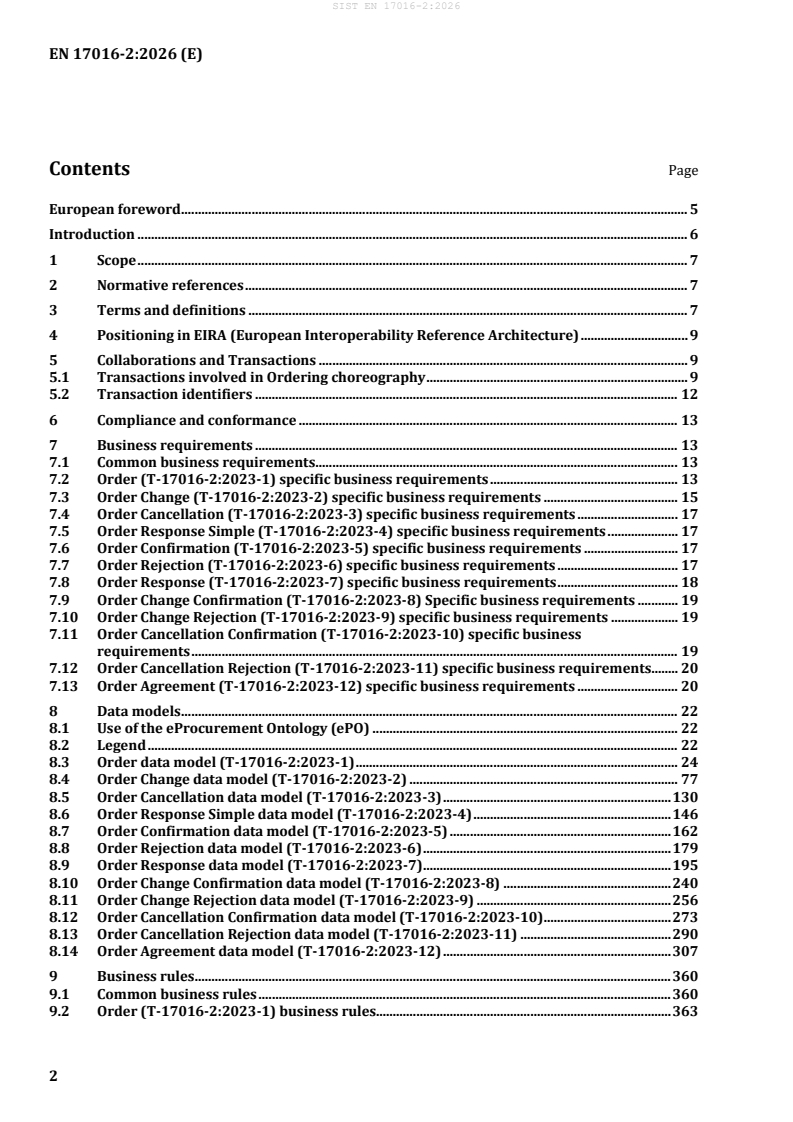
Contents Page
European foreword . 5
Introduction . 6
1 Scope . 7
2 Normative references . 7
3 Terms and definitions . 7
4 Positioning in EIRA (European Interoperability Reference Architecture) . 9
5 Collaborations and Transactions . 9
5.1 Transactions involved in Ordering choreography . 9
5.2 Transaction identifiers . 12
6 Compliance and conformance . 13
7 Business requirements . 13
7.1 Common business requirements . 13
7.2 Order (T-17016-2:2023-1) specific business requirements . 13
7.3 Order Change (T-17016-2:2023-2) specific business requirements . 15
7.4 Order Cancellation (T-17016-2:2023-3) specific business requirements . 17
7.5 Order Response Simple (T-17016-2:2023-4) specific business requirements . 17
7.6 Order Confirmation (T-17016-2:2023-5) specific business requirements . 17
7.7 Order Rejection (T-17016-2:2023-6) specific business requirements . 17
7.8 Order Response (T-17016-2:2023-7) specific business requirements . 18
7.9 Order Change Confirmation (T-17016-2:2023-8) Specific business requirements . 19
7.10 Order Change Rejection (T-17016-2:2023-9) specific business requirements . 19
7.11 Order Cancellation Confirmation (T-17016-2:2023-10) specific business
requirements . 19
7.12 Order Cancellation Rejection (T-17016-2:2023-11) specific business requirements. 20
7.13 Order Agreement (T-17016-2:2023-12) specific business requirements . 20
8 Data models . 22
8.1 Use of the eProcurement Ontology (ePO) . 22
8.2 Legend . 22
8.3 Order data model (T-17016-2:2023-1) . 24
8.4 Order Change data model (T-17016-2:2023-2) . 77
8.5 Order Cancellation data model (T-17016-2:2023-3) . 130
8.6 Order Response Simple data model (T-17016-2:2023-4) . 146
8.7 Order Confirmation data model (T-17016-2:2023-5) . 162
8.8 Order Rejection data model (T-17016-2:2023-6) . 179
8.9 Order Response data model (T-17016-2:2023-7) . 195
8.10 Order Change Confirmation data model (T-17016-2:2023-8) . 240
8.11 Order Change Rejection data model (T-17016-2:2023-9) . 256
8.12 Order Cancellation Confirmation data model (T-17016-2:2023-10) . 273
8.13 Order Cancellation Rejection data model (T-17016-2:2023-11) . 290
8.14 Order Agreement data model (T-17016-2:2023-12) . 307
9 Business rules . 360
9.1 Common business rules . 360
9.2 Order (T-17016-2:2023-1) business rules. 363
9.3 Order Change (T-17016-2:2023-2) business rules . 368
9.4 Order Cancellation (T-17016-2:2023-3) business rules . 374
9.5 Order Response Simple (T-17016-2:2023-4) business rules . 375
9.6 Order Confirmation (T-17016-2:2023-5) business rules . 375
9.7 Order Rejection (T-17016-2:2023-6) business rules . 376
9.8 Order Response (T-17016-2:2023-7) business rules . 376
9.9 Order Change Confirmation (T-17016-2:2023-8) business rules . 381
9.10 Order Change Rejection (T-17016-2:2023-9) business rules . 382
9.11 Order Cancellation Confirmation (T-17016-2:2023-10) business rules . 382
9.12 Order Cancellation Rejection (T-17016-2:2023-11) business rules . 383
9.13 Order Agreement (T-17016-2:2023-12) business rules . 383
Annex A (informative) Overview of the clauses and subclauses which fall under derivative
use . 390
Annex B (informative) Relationship between business terms and corresponding concepts
in the eProcurement Ontology (ePO) . 391
Bibliography . 392
Tables
Table 1 — Positioning in EIRA .9
Table 2 — Roles, capabilities, basic collaborations and transactions per variant . 10
Table 3 — Transaction identifiers . 12
Table 4 — Common business requirements. 13
Table 5 — Order business requirements . 14
Table 6 — Order Change business requirements . 15
Table 7 — Order cancellation business requirements . 17
Table 8 — Order Response Simple business requirements . 17
Table 9 — Order Confirmation business requirements. 17
Table 10 — Order Rejection business requirements . 18
Table 11 — Order Response business requirements . 18
Table 12 — Order Change Confirmation business requirements . 19
Table 13 — Order Change Rejection business requirements . 19
Table 14 — Order Cancellation Confirmation business requirements . 19
Table 15 — Order Cancellation Rejection business requirements . 20
Table 16 — Order Agreement business requirements . 20
Table 17 — Order semantic data model . 24
Table 18 — Order Change semantic data model . 77
Table 19 — Order Cancellation semantic data model . 130
Table 20 — Order Response Simple semantic data model . 146
Table 21 — Order Confirmation semantic data model . 162
Table 22 — Order Rejection semantic data model . 179
Table 23 — Order Response semantic data model . 195
Table 24 — Order Change Confirmation semantic data model . 240
Table 25 — Order Change Rejection data model . 256
Table 26 — Order Cancellation Confirmation data model . 273
Table 27 — Order Cancellation Rejection data model . 290
Table 28 — Order Agreement data model . 307
Table 29 — Common business rules. 360
Table 30 — Order business rules . 363
Table 31 — Order Change business rules . 368
Table 32 — Order Cancellation business rules . 375
Table 33 — Order Response Simple business rules . 375
Table 34 — Order Confirmation business rules . 376
Table 35 — Order Rejection business rules . 376
Table 36 — Order Response business rules . 377
Table 37 — Order Change Confirmation business rules . 381
Table 38 — Order Change Rejection business rules . 382
Table 39 — Order Cancellation Confirmation business rules . 382
Table 40 — Order Cancellation Rejection business rules . 383
Table 41 — Order Agreement business rules . 383
European foreword
This document (EN 17016-2:2026) has been prepared by the Technical Committee CEN/TC 440
“Electronic public procurement”, the secretariat of which is held by DIN.
This European Standard shall be given the status of a national standard, either by publication of an
identical text or by endorsement, at the latest by October 2026 and conflicting national standards shall
be withdrawn at the latest by October 2026.
Attention is drawn to the possibility that some of the elements of this document may be the subject of
patent rights. CEN shall not be held responsible for identifying any or all such patent rights.
This document falls under a CEN-CENELEC pilot on derivative use (as approved by the CEN/CA
(Administrative Board) through decision 37/2019). For more information about the implementation of
derivative use in CEN/TC 440, see here.
This document is part of a series of multi-part documents prepared, or under preparation, by
CEN/TC 440:
— 17011-series: eProcurement Architecture, providing a set of specifications outlining different
aspects of the eProcurement architecture for Business Interoperability Specifications.
— 17014-series: Pre-Award Business Interoperability Specifications, providing a set of specifications
outlining business choreography, transaction, syntax binding specifications and guidelines required
to support the Pre-Award phase in Public Procurement.
— 17015-series: eCatalogue Business Interoperability Specifications, providing a set of specifications
outlining business choreography, transaction, syntax binding specifications and guidelines required
to support the catalogue process.
— 17016-series: eOrdering Business Interoperability Specifications, providing a set of specifications
outlining business choreography, transaction, syntax binding specifications and guidelines required
to support the ordering process.
— 17017-series: eFulfilment Business Interoperability Specifications, providing a set of specifications
outlining business choreography, transaction, syntax binding specifications and guidelines required
to support the fulfilmet process.
The terms "shall", "shall not", "should", "should not", "may", "can" and "cannot" are interpreted according
to Clause 7 of the CEN-CENELEC Internal Regulations Part 3 .
Any feedback and questions on this document should be directed to the users’ national standards body.
A complete listing of these bodies can be found on the CEN website.
According to the CEN-CENELEC Internal Regulations, the national standards organizations of the
following countries are bound to implement this European Standard: Austria, Belgium, Bulgaria, Croatia,
Cyprus, Czech Republic, Denmark, Estonia, Finland, France, Germany, Greece, Hungary, Iceland, Ireland,
Italy, Latvia, Lithuania, Luxembourg, Malta, Netherlands, Norway, Poland, Portugal, Republic of North
Macedonia, Romania, Serbia, Slovakia, Slovenia, Spain, Sweden, Switzerland, Türkiye and the United
Kingdom.
https://boss.cen.eu/reference-material/refdocs/pages/
Introduction
Derivative use pilot
This document falls under a CEN-CENELEC pilot on derivative use (as approved by the CEN/CA
(Administrative Board) through decision 38/2019).
CEN has the copyright to all CEN publications, including their entire content and associated metadata, as
specified in CEN-CENELEC Guide 10 "Policy on the distribution, sale and copyright of CEN and CENELEC
Content". However, through the derivative use pilot, CEN gives permission to the copying, replication and
translation of content from CEN/TC 440 deliverables in specific circumstances.
Under the derivative use pilot, specific sections of CEN/TC 440 publications may be copied, replicated
and translated in cases where this is a necessary condition for the meaningful implementation of the
publication. The sections which fall under derivative use will typically be elements such as semantic
definitions and rules related to the use of information elements and the name, definition and description
of processes and transactions, which are needed in software solutions, whether intended for sale in the
private market or for use in the public sector, and documents guiding the implementation and use in
specific countries and/or business sectors.
Under derivative use, any use of content which has been copied, replicated or translated from a
CEN/TC 440 publication, should comply with the intended use of the publication. Derivative use cannot
be applied in use cases other than those the publication is intended to support. The intended use of this
publication is set out below.
Intended use of this publication
This document has been developed for any organization looking for guidance on the implementation and
use of electronic procurement deliverables as well as for organizations developing or implementing
software applications related to electronic procurement, such as software providers, business entities
and national authorities. These software applications should be in conformance with this publication.
Parts of the document to which derivative use apply
Each subclause which falls under derivative use will be clearly marked with a note. The degree to which
the specific content can be modified is specified in CEN/TS 17011-3:2024, Electronic Public Procurement
— Architecture — Part 3: Customisation Guideline.
Annex A provides an overview of the line number references to all subclauses of the publication which
fall under derivative use.
Use of eProcurement Ontology (ePO)
This document uses the eProcurement Ontology (ePO), owned by the European Union, available here
(https://github.com/OP-TED/ePO) and licensed under a CC BY 4.0 licence.
1 Scope
This document describes the transaction information requirements of the transactions used in the
collaborations described in EN 17016-1:2024. For each transaction are specified the transaction business
requirements, the transaction information data model containing definitions of terms, usage descriptions
and cardinality of the information elements and the transaction business rules.
This document describes the following transactions:
1) Order;
2) Order Change;
3) Order Cancellation;
4) Order Response Simple
5) Order Confirmation;
6) Order Rejection;
7) Order Response;
8) Order Change Confirmation;
9) Order Change Rejection;
10) Order Cancellation Confirmation;
11) Order Cancellation Rejection;
12) Order Agreement.
How to claim compliance to a transaction is specified in Clause 6.
How to claim conformance to a transaction is also specified in Clause 6.
2 Normative references
The following documents are referred to in the text in such a way that some or all of their content
constitutes requirements of this document. For dated references, only the edition cited applies. For
undated references, the latest edition of the referenced document (including any amendments) applies.
ISO/IEC 6523 (all parts), Information technology — Structure for the identification of organizations and
organization parts
3 Terms and definitions
For the purposes of this document, the following terms and definitions apply.
ISO and IEC maintain terminology databases for use in standardization at the following addresses:
— IEC Electropedia: available at https://www.electropedia.org/
— ISO Online browsing platform: available at https://www.iso.org/obp/
3.1
agent
person, organization, or system that acts in procurement or has the power to act in procurement
3.2
business process
sequence or network of activities and collaborations between two or more agents
3.3
business process variant
specification of a business process belonging to a choreography
Note 1 to entry: Different variants may support different electronic information exchange or collaborations.
Agents may publicly advertise their capability to support one or more variants in an automated fashion.
3.4
choreography
set of business processes having the same goals
3.5
collaboration
interaction between two or more agents that result in the exchange of data between the agents involved
as part of a business process
3.6
role
part played by an agent in a particular business process, including its responsibilities (options and
obligations) to perform certain activities and collaborations in that business process
Note 1 to entry: The role is used to show the division of labour and responsibility amongst the agents involved in
the process or within the organization of an agent.
3.7
state
set of options and obligations of the participating agents at a defined step in a business process to perform
specific activities and collaborations
Note 1 to entry: Additional information: an activity of an agent or a collaboration may cause the transition of one
state to another in a predefined set of next steps.
3.8
transaction
content of data exchanged or shared between the agents in a collaboration
Note 1 to entry: A transaction is the atomic unit that leads to a synchronized state in the information systems of
collaborating agents. It is the basic building block to specify the choreography between agents. When an agent
recognizes an event that changes the state of a business object within a business process, it uses a transaction to
synchronize with the collaborating agent. A transaction therefore changes the state of a business process. It carries
the intention of the initiating agent and is represented by a data structure that is specified by a data model. The
exchange of a transaction may alter legal obligations between business partners.
4 Positioning in EIRA (European Interoperability Reference Architecture)
EIRA (European Interoperability Reference Architecture) provides a reference model that enables
architects to position the IOP (InterOPerability) specifications. This document provides a domain-specific
IOP specification to which any SBB (Solution Building Block) implementing the ABB (Architecture
Building Block) should be compliant to. The positioning of this document in the EIRA context is specified
in Table 1.
IoP specifications provide a valuable source of information to formulate requirements during
architecture development and solution development. By identifying architectural building blocks
through a common terminology, it:
— helps the reuse of cross domain building blocks such as e.g. eSignature Verification and Validation
Service, and eTimestamp Creation Service;
— helps the synchronization with European solutions such as CEF eDelivery; and
— will provide guidance in using them to provide the prescribed capability enabling, thus managing
and rationalizing IT portfolios.
Table 1 — Positioning in EIRA
EIRA ID Title Domain Interface Scope Modality
Endorsing
Public /Customer extension of
Procurement ABB176
Machine
- Ordering - Organizational
/Seller
Transactions Interoperability
Specification
• eProcurement
extension of
ABB170 Exchange
of Business
Information
• eProcurement
extension of ABB16
Business Rule
5 Collaborations and Transactions
5.1 Transactions involved in Ordering choreography
Table 2 lists the transactions and the collaborations in which they are used .
See EN 17016-1:2024, Electronic Public Procurement – Ordering – Part 1: Choreographies, Clause 7.
Table 2 — Roles, capabilities, basic collaborations and transactions per variant
Variant
Collaboration Transaction
Role Capability Collaboration Transaction
ID ID
A B C D E F G H
BC-17016- Buyer sends T-17016-
Buyer Send Order Order M M M M M M M -
1:2023-1 Order 2:2023-1
BC-17016- Buyer sends T-17016-
Seller Receive Order Order M M M M M M M -
1:2023-1 Order 2:2023-1
Change an BC-17016- Buyer changes T-17016-
Buyer Order Change - M - M - M M -
Order 1:2023-2 Order 2:2023-2
Receive an BC-17016- Buyer changes T-17016-
Seller Order Change - M - M - M M -
Order Change 1:2023-2 Order 2:2023-2
Cancel an BC-17016- Buyer cancels T-17016- Order
Buyer - M - M - M M -
Order 1:2023-3 Order 2:2023-3 Cancellation
Receive an
BC-17016- Buyer cancels T-17016- Order
Seller Order - M - M - M M -
1:2023-3 Order 2:2023-3 Cancellation
Cancellation
Seller Oder
Acknowledge BC-17016- T-17016-
Seller acknowledges Response - - - - M M - -
an Order 1:2023-4 2:2023-4
Order Simple
Receive an
Seller Oder
Order BC-17016- T-17016-
Buyer acknowledges Response - - - - M M - -
Response 1:2023-4 2:2023-4
Order Simple
Simple
Accept an
BC-17016- Seller confirms T-17016- Order
Seller Order without - - M M M M M -
1:2023-5 Order 2:2023-5 Confirmation
changes
Receive an
BC-17016- Seller confirms T-17016- Order
Buyer Order - - M M M M M -
1:2023-5 Order 2:2023-5 Confirmation
Confirmation
- BC-17016- Seller rejects T-17016- Order
Reject an Order - - M M M M M -
Seller 1:2023-6 Order 2:2023-6 Rejection
Receive an
BC-17016- Seller rejects T-17016- Order
Buyer Order - - M M M M M -
1:2023-6 Order 2:2023-6 Rejection
Rejection
Accept changes BC-17016- Seller confirms T-17016- Order Change
Seller - - - M M M -
to an Order 1:2023-7 Order Change 2:2023-8 Confirmation
Receive an
BC-17016- Seller confirms T-17016- Order Change
Buyer Order Change - - - M - M M -
1:2023-7 Order Change 2:2023-8 Confirmation
Confirmation
Reject changes BC-17016- Seller rejects T-17016- Order Change
Seller - - - M - M M -
to an Order 1:2023-8 Order Change 2:2023-9 Rejection
Variant
Collaboration Transaction
Role Capability Collaboration Transaction
ID ID
A B C D E F G H
Receive an
BC-17016- Order Change
Seller rejects T-17016-
Buyer Order Change - - - M - M M -
1:2023-8 Order Change 2:2023-9 Rejection
Rejection
Accept an Seller confirms Order
BC-17016- T-17016-
Seller Order Order Cancellation - - - M - M M -
1:2023-9 2:2023-10
Cancellation Cancellation Confirmation
Receive Order Seller confirms Order
BC-17016- T-17016-
Buyer Cancellation Order Cancellation - - - - - M M -
1:2023-9 2:2023-10
Confirmation Cancellation Confirmation
Seller rejects Order
Reject an Order BC-17016- T-17016-
Seller Order Cancellation - - - - - M M -
cancellation 1:2023-10 2:2023-11
Cancellation Rejection
Receive an
Seller rejects Order
Order BC-17016- T-17016-
Buyer Order Cancellation - - - - - M M -
Cancellation 1:2023-10 2:2023-11
Cancellation Rejection
Rejection
Accept an
Seller accepts
Order partially BC-17016- T-17016- Order
Seller Order partially - - - - M M M -
or with 1:2023-11 2:2023-7 Response
or with changes
changes
Receive an Seller accepts
BC-17016- T-17016- Order
Buyer Order Order partially - - - - M M M -
1:2023-11 2:2023-7 Response
Response or with changes
Change a
BC-17016- Seller changes T-17016- Order
Seller confirmed - - - - M M M -
1:2023-12 Order 2:2023-7 Response
Order
Receive an BC-17016- Seller changes T-17016- Order
Buyer - - - - M M M -
Order Change 1:2023-12 Order 2:2023-7 Response
Accept an
BC-17016- Buyer confirms T-17016- Order Change
Buyer Order - - - - - M M -
1:2023-13 Order Response 2:2023-8 Confirmation
Response
Receive an
Order BC-17016- Buyer confirms T-17016- Order Change
Seller - - - - - M M -
Response 1:2023-13 Order Response 2:2023-8 Confirmation
Confirmation
Reject an Order BC-17016- Buyer rejects T-17016- Order Change
Buyer - - - - - M M -
Response 1:2023-14 Order Response 2:2023-9 Rejection
Receive an
Order BC-17016- Buyer rejects T-17016- Order Change
Seller - - - - - M M -
Response 1:2023-14 Order Response 2:2023-9 Rejection
Rejection
Variant
Collaboration Transaction
Role Capability Collaboration Transaction
ID ID
A B C D E F G H
Accept changes BC-17016- Buyer confirms T-17016- Order Change
Buyer - - - - M M -
-
to an Order 1:2023-15 Order Change 2:2023-8 Confirmation
Receive an
BC-17016- Buyer confirms T-17016- Order Change
Seller Order Change - - - - M M -
-
1:2023-15 Order Change 2:2023-8 Confirmation
Confirmation
Reject changes BC-17016- Buyer rejects T-17016- Order Change
Buyer - - - - - M M -
to an Order 1:2023-16 Order Change 2:2023-9 Rejection
Receive an
BC-17016- Buyer rejects T-17016- Order Change
Seller Order Change - - - - - M M -
1:2023-16 Order Change 2:2023-9 Rejection
Rejection
Seller sends
Send Order BC-17016- T-17016- Order
Seller Order - - - - - - - M
Agreement 1:2023-17 2:2023-12 Agreement
Agreement
Seller sends
Receive Order BC-17016- T-17016- Order
Buyer Order - - - - - - - M
Agreement 1:2023-17 2:2023-12 Agreement
Agreement
Key
M Mandatory for the capability in the variant.
- Not to be used in the variant.
5.2 Transaction identifiers
Table 3 specifies the identifier of the transactions described in this document.
Table 3 — Transaction identifiers
ID Name of the transaction
T-17016-2:2023-1 Order
T-17016-2:2023-2 Order Change
T-17016-2:2023-3 Order Cancellation
T-17016-2:2023-4 Order Response Simple
T-17016-2:2023-5 Order Confirmation
T-17016-2:2023-6 Order Rejection
T-17016-2:2023-7 Order Response
T-17016-2:2023-8 Order Change Confirmation
T-17016-2:2023-9 Order Change Rejection
T-17016-2:2023-10 Order Cancellation Confirmation
T-17016-2:2023-11 Order Cancellation Rejection
T-17016-2:2023-12 Order Agreement
6 Compliance and conformance
For definition and application of compliance and conformance to the content of this document, see
CEN/TS 17011-3:2024.
7 Business requirements
7.1 Common business requirements
Table 4 specifies the business requirements common to all transactions.
Table 4 — Common business requirements
ID Description
R-TC440-1 A transaction shall provide information about its identity, type (Order,
Order Change, etc.), business process variant and issue date.
R-TC440-2 All amounts in a transaction shall be stated in the same currency.
R-TC440-3 A transaction shall contain non-negative prices and non-negative
quantities.
R-TC440-4 A transaction shall contain elements for identifying the Buyer and Seller
with legal name, legal registration ID or VAT identifier and the country of
establishment-residence.
R-TC440-5 A transaction shall provide for the Buyer’s and the Seller’s electronic
address.
R-TC440-6 Each line in a transaction shall be clearly identified to enable referencing
from other transactions.
R-TC440-7 For any information, the specific business term shall be used, if existing.
R-TC440-8 It shall be possible to add special properties for an item
R-TC440-9 It shall be possible to specify certain Item information such as Item serial
number and Item lot identification
7.2 Order (T-17016-2:2023-1) specific business requirements
Table 5 specifies the business requirements of the Order.
Subclause 7.1 falls under derivative use (as set out in the introduction). When replicating the section, the content
can be modified as specified in CEN/TS 17011-3, Electronic Public Procurement – Architecture – Part 3:
Customization Guideline.
Subclause 7.2 falls under derivative use (as set out in the introduction). When replicating the section, the content
can be modified as specified in CEN/TS 17011-3, Electronic Public Procurement – Architecture – Part 3:
Customization Guideline.
Table 5 — Order business requirements
ID Description
T-17016-2:2023-1-R-1 An Order shall enable the Buyer to reference tenders, contracts and
documents that are relevant to prices and terms, including terms of
delivery.
T-17016-2:2023-1-R-2 In an Order it shall be possible to reference another Order.
T-17016-2:2023-1-R-3 In an Order it shall be possible to specify a Buyer’s accounting reference.
T-17016-2:2023-1-R-4 In an Order it shall be possible to provide for contact details of the
department of the Buyer or natural person inside the Buyer who
originated the order as a whole.
T-17016-2:2023-1-R-5 In an Order it shall be possible to provide for information about the
department of the Buyer or the external organization that is in charge of
receiving and treating the invoice(s) related to the Order.
T-17016-2:2023-1-R-6 In an Order it shall be possible to provide for details about delivery
location (address and ID), some basic delivery terms, delivery time and
contact person for the purpose of delivery.
T-17016-2:2023-1-R-7 In an Order it shall be possible to provide for information about the
external organization to which the goods are to be sent and that will take
possession of them after delivery.
T-17016-2:2023-1-R-8 In an Order it shall be possible to provide for information about the dates
before and/or after which the Order lines shall be delivered.
T-17016-2:2023-1-R-9 In an Order it shall be possible provide information needed to specify
estimated allowance and charges on document level that apply to the
order as a whole.
T-17016-2:2023-1-R-10 In an Order it shall be possible to specify amounts to be paid in advance.
T-17016-2:2023-1-R-11 An Order line shall provide for information about the quantity ordered
and its unit of measure.
T-17016-2:2023-1-R-12 An Order line shall provide for the name of the item.
T-17016-2:2023-1-R-13 In an Order line it shall be possible to specify a Seller’s identifier for the
item.
T-17016-2:2023-1-R-14 In an Order line it shall be possible to specify a standard identifier for the
item.
T-17016-2:2023-1-R-15 In an Order line it shall be possible to specify a Buyer’s identifier for the
item.
T-17016-2:2023-1-R-16 An Order line shall provide for the price of the item.
T-17016-2:2023-1-R-17 In an Order line it shall be possible to provide for the base quantity to
which the price applies.
T-17016-2:2023-1-R-18 In an Order line it shall be possible to state a price discount as a per unit
discount.
T-17016-2:2023-1-R-19 In an Order line it shall be possible to state estimated allowances or
charges.
ID Description
T-17016-2:2023-1-R-20 In an Order line it shall be possible to specify a Buyer’s accounting
reference.
T-17016-2:2023-1-R-21 In an Order line it shall be possible to specify the delivery location.
T-17016-2:2023-1-R-22 In an Order line it shall be possible to specify a referenced catalogue line.
T-17016-2:2023-1-R-23 In an Order line it shall be possible to specify a referenced document.
T-17016-2:2023-1-R-24 In an Order line it shall be possible to specify the item VAT category.
T-17016-2:2023-1-R-25 In an Order line it shall be possible to specify the item VAT percentage.
T-17016-2:2023-1-R-26 An Order line shall provide for the total amount excluding VAT.
T-17017-2:2023-1-R-27 In an Order Line it shall be possible to inform the Seller if partial delivery
is allowed or not
7.3 Order Change (T-17016-2:2023-2) specific business requirements
Table 6 specifies the business requirements of the Order change.
Table 6 — Order Change business requirements
ID Description
T-17016-2:2023-2-R-1 An Order Change shall enable the Buyer to reference tenders, contracts
and documents that are relevant to prices and terms, including terms of
delivery.
T-17016-2:2023-2-R-2 An Order Change shall specify the Order that has to be changed.
T-17016-2:2023-2-R-3 It shall be possible to substitute an Order by sending an Order Change
referred to that Order.
T-17016-2:2023-2-R-4 In an Order Change it shall be possible to specify a Buyer’s accounting
reference.
T-17016-2:2023-2-R-5 In an Order Change it shall be possible to provide for contact details of the
department of the Buyer or natural person inside the Buyer who
originated the order as a whole.
T-17016-2:2023-2-R-6 In an Order Change it shall be possible to provide for information about
the department of the Buyer or the external organization that is in charge
of receiving and treating the invoice(s) related to the Order Change.
In an Order Change it shall be possible to provide for details about delivery
T-17016-2:2023-2-R-7 location (address and ID), some basic delivery terms, delivery time and
contact person for the purpose of delivery.
T-17016-2:2023-2-R-8 In an Order Change it shall be possible to provide for information about
the external organization to which the goods are to be sent and that will
take possession of them after delivery.
Subclause 7.3 falls under derivative use (as set out in the introduction). When replicating the section, the content
can be modified as specified in CEN/TS 17011-3, Electronic Public Procurement – Architecture – Part 3:
Customization Guideline.
ID Description
T-17016-2:2023-2-R-9 In an Order Change it shall be possible to provide for information about
the dates before and/or after which the Order Change lines shall be
delivered.
T-17016-2:2023-2-R-10 In an Order Change it shall be possible provide information needed to
specify estimated allowance and charges on document level that apply to
the order as a whole.
T-17016-2:2023-2-R-11 In an Order Change it shall be possible to specify amounts already paid.
T-17016-2:2023-2-R-12 In an Order Change it shall be possible to add lines not referenced to Order
lines.
T-17016-2:2023-2-R-13 An Order Change line shall provide for information about the type of
change made to the referenced Order line.
T-17016-2:2023-2-R-14 An Order Change line shall provide for information about the quantity
ordered and its unit of measure.
T-17016-2:2023-2-R-15 An Order Change line shall provide for the name of the item.
T-17016-2:2023-2-R-16 In an Order Change line it shall be possible to specify a Seller’s identifier
for the item.
T-17016-2:2023-2-R-17 In an Order Change line it shall be possible to specify a standard identifier
for the item.
T-17016-2:2023-2-R-18 In an Order Change line it shall be possible to specify a Buyer’s identifier
for the item.
T-17016-2:2023-2-R-19 An Order Change line shall provide for the price of the item.
T-17016-2:2023-2-R-20 In an Order Change line it shall be possible to provide for the base quantity
to which the price applies.
T-17016-2:2023-2-R-21 In an Order Change line it shall be possible to state a price discount as a
per unit discount.
T-17016-2:2023-2-R-22 In an Order Change line it shall be possible to state estimated allowanc
...