

SIST EN 303 919 V1.1.1:2026
(Main)Emergency Communications (EMTEL) - Accessibility and Interoperability of Emergency Communications
- Abstract
The present document specifies accessibility and interoperability characteristics for the following types of products and services when used in emergency communications. They form together a chain of items involved in accessible emergency communications:
• Communication terminals used in electronic communications
• Electronic communication services
• Emergency communications systems including PSAPs
• Assisting services used in electronic communication services (relay services, language translation services, expert services) The present document addresses technical aspects of interoperability between user equipment, originating services and emergency communications systems, and the interoperability and functionality required to be able to route emergency communications to the most appropriate PSAP and include assisting services when required. It specifies interoperable and accessible emergency communications, which incorporates voice, video, and real-time text. Focus is on SIP and IMS technologies for user equipment and originating services, and SIP technology for the emergency communications systems. Brief information is provided on how to arrange emergency communications access also for other technologies. General accessibility requirements on emergency communications as well as everyday communications including media performance aspects, functional details of the accessible media and general user interface requirements for accessibility are specified in EN 301 549 [1]. NOTE: The relationship between the present document and essential requirements of Directive (EU) 2019/882 [i.3], Annex I and Annex V is given in Annex AA and Annex AB.
- Status
- Published
- Publication Date
- 09-Sep-2026
- Technical Committee
- MOC - Mobile Communications
- Current Stage
- 6060 - National Implementation/Publication (Adopted Project)
- Start Date
- 07-Sep-2026
- Due Date
- 12-Nov-2026
- Completion Date
- 10-Sep-2026
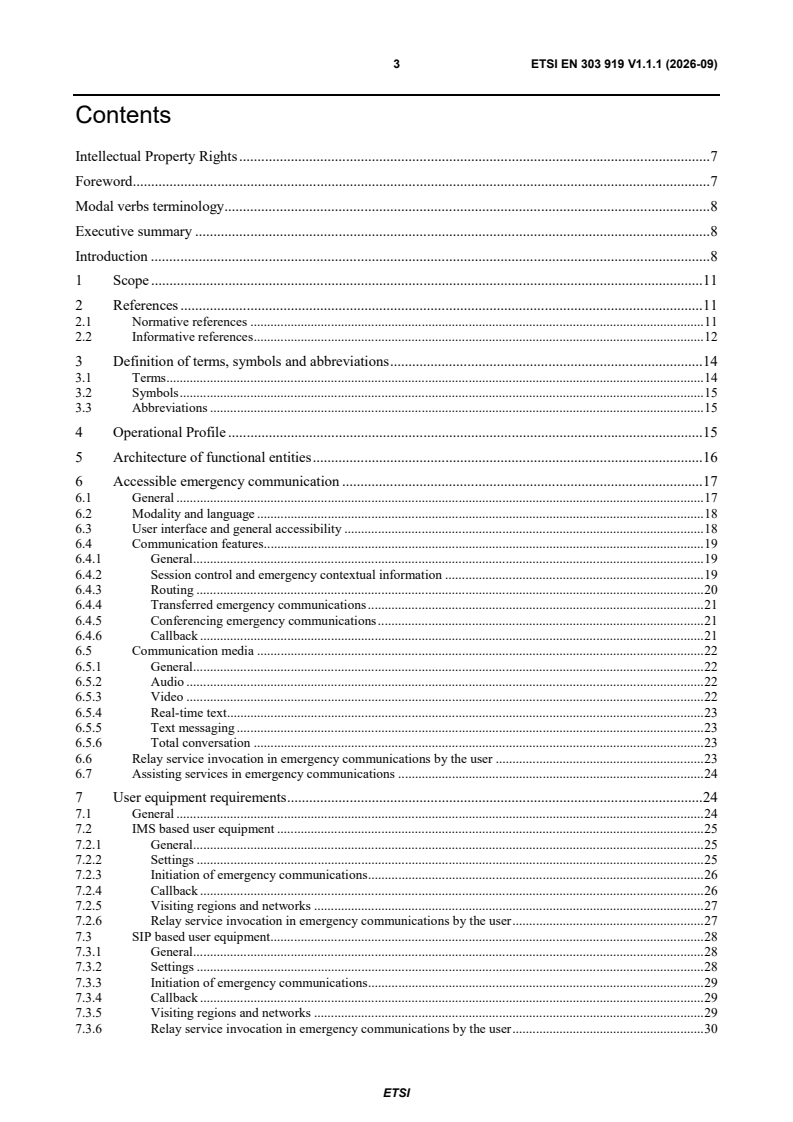
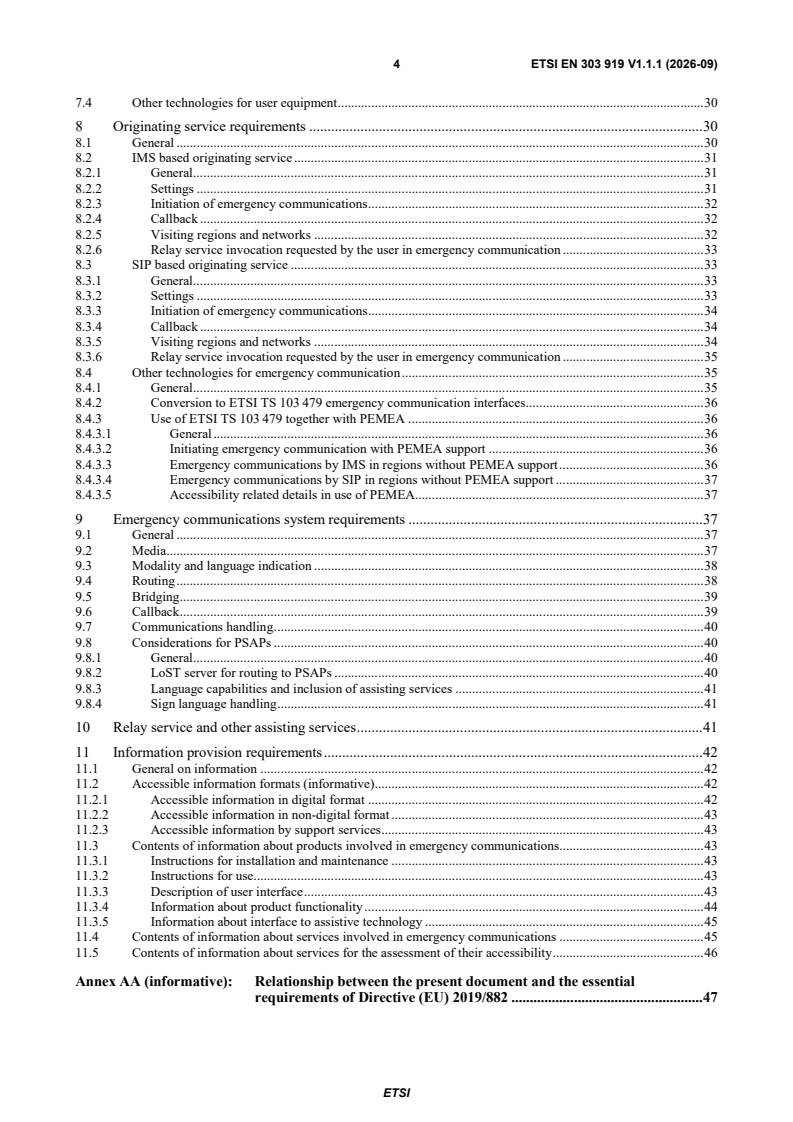

SIST EN 303 919 V1.1.1:2026 is the Slovenian adoption of ETSI EN 303 919 V1.1.1, a harmonized European standard for emergency communications accessibility and interoperability. It specifies how communication terminals, electronic communication services, emergency communications systems including PSAPs, and assisting services work together so that emergency calls can carry voice, video, and real-time text. The standard is aimed at manufacturers, service providers, PSAP operators, and others who need emergency communications to route and operate in a way that supports users with different accessibility needs.
What does SIST EN 303 919 V1.1.1:2026 specify?
SIST EN 303 919 V1.1.1:2026 specifies the accessibility and interoperability characteristics needed for accessible emergency communications across the whole communication chain. That chain includes user equipment, originating services, emergency communications systems including PSAPs, and assisting services such as relay, language translation, and expert services.
The document focuses on technical interoperability between user equipment, originating services, and emergency communications systems, including the routing of emergency communications to the most appropriate PSAP and the inclusion of assisting services when needed. Its main focus is on SIP and IMS technologies for user equipment and originating services, and SIP for emergency communications systems, while also giving brief guidance for other technologies.
| Annex | What it covers |
|---|---|
| Annex AA | Relationship with the essential requirements of Directive (EU) 2019/882 |
| Annex AB | Relationship with essential requirements of other Union acts under Directive 2019/882 Section VI |
| Annex B | Normative test methods and test cases for compliance with the technical requirements |
| Annex C | Informative use cases for emergency communication situations involving users with disabilities |
| Annex D | Informative cross references between requirement labels and clauses |
| Annex E | Informative use considerations for emergency communications by persons with disabilities |
The document is organized into clause 4 on operational profile, clause 5 on the architecture of functional entities, clause 6 on accessible emergency communication, clauses 7 to 10 on the UE, originating service, emergency communications system, and assisting services, and clause 11 on information provision.
What are the key requirements of SIST EN 303 919 V1.1.1:2026?
SIST EN 303 919 V1.1.1:2026 requires the emergency communications chain to support accessible use in everyday devices and services, not as a separate afterthought. In practice, that means the user interface, media handling, routing, callback, and supporting services must all work together for voice, video, and real-time text.
Accessibility, media, and user interaction
Clause 6.2 requires users to be able to set modality and language preferences in a user profile. This matters because PSAPs and services need those preferences to route the communication and choose how to interact with the caller.
Clause 6.3 requires the user interface and communication features to comply with the applicable accessibility requirements of EN 301 549, and to provide means to initiate an emergency communication recognized as 112. Clause 6.3 also requires support for voice, real-time text, and video input and output. In practice, the emergency function must be reachable through accessible controls and must support the media a user needs.
Clause 6.5 requires support for the emergency communication media themselves: audio, video, real-time text, text messaging, and total conversation. Total conversation means voice, video, and real-time text together, with audio and video synchronized within 100 milliseconds. That is important because many users need more than voice alone to communicate effectively in an emergency.
Routing, transfer, conferencing, and callback
Clause 6.4 requires session control, emergency contextual information, routing, transfer, conferencing, and callback capabilities to keep the communication usable as it moves through the chain. Clause 9.4 adds that routing must use location information, the emergency service subtype, and accessibility-related factors to reach the most appropriate PSAP, with interconnected regional infrastructures for international routing.
Clause 9.5 requires multiparty bridging when a call must be transferred or expanded to include other parties. Clause 9.5 also allows the bridge to include call takers in other countries, experts, first responders, assisting services, relay services, interpreters, and foreign PSAPs. In practice, the call must remain usable while the response team changes or grows.
Clause 9.6 requires PSAP callback using the routable URI from the original emergency communication, with the same media by default and the same assisting service by default if one was included. The call taker must also be able to choose other media or other assisting services. This matters because callback should preserve the communication setup the user already managed to establish.
Relay and assisting services
Clause 6.6 requires relay service invocation in emergency communications to create a three-party communication between the user, the relay service, and the PSAP, with the communication established as soon as any party answers. Clause 6.6 also requires both the relay service and the PSAP to receive information about the emergency situation.
Clause 6.7 and clause 10 require means to invoke assisting services in multiparty form, to include addresses automatically or manually, and to chain assisting services when needed. That supports situations where a modality translation service and a spoken language translation service must both be involved.
Information provision
Clause 11 requires accessible information about the products and services involved in emergency communications. That includes instructions for installation and maintenance, user interface descriptions, product functionality, interface to assistive technology, and accessible information about service accessibility and service involvement in emergency communications. For buyers and quality managers, this means the vendor or service provider has to document how the emergency-related functions are meant to be used and assessed.
What terms does SIST EN 303 919 V1.1.1:2026 define?
SIST EN 303 919 V1.1.1:2026 defines the core terms used to describe accessible emergency communications.
- Accessibility - the extent to which a product, system, service, environment, or facility can be used by people with the widest range of needs and capabilities to achieve their goals in a given context.
- Assisting service - a service invoked during a communication to help the user or call taker with specific tasks; typical examples are relay services and language translation services.
- Assistive technology - any item, equipment, service, or software used to increase, maintain, substitute, or improve functional capabilities of persons with disabilities.
- Total conversation - bidirectional, symmetric real-time transfer of motion video, real-time text, and voice between users in two or more locations.
- User equipment (UE) - the combined hardware and software used by a user.
- User initiation of emergency communication - the human action that starts emergency communications through the UE, such as dialling 112, selecting an emergency contact, pressing a dedicated button, or using an audio or visual command.
- PSAP - Public Safety Answering Point, the emergency answering center that receives and processes the emergency communication.
- RTT - Real-Time Text, text transmitted character by character in real time during the communication.
Who uses SIST EN 303 919 V1.1.1:2026?
SIST EN 303 919 V1.1.1:2026 is used by organizations that design, operate, test, or assess emergency communications. That includes handset and emergency-app manufacturers, electronic communication service providers, PSAP and emergency network operators, and providers of relay, translation, and expert assisting services.
It is also relevant to test laboratories and conformity teams because Annex B gives compliance test cases. Accessibility, quality, procurement, and regulatory teams use it to check whether emergency communication products and services support the required media, routing, callback, and documentation features.
Which standards are used with SIST EN 303 919 V1.1.1:2026?
SIST EN 303 919 V1.1.1:2026 relies on several related standards for accessibility, emergency-session handling, and media control.
- EN 301 549 - provides the general ICT accessibility requirements that apply to user interfaces, functionality, and assistive-technology interaction.
- ETSI TS 103 479 - gives the core elements for network-independent access to emergency services and underpins the emergency communication procedures, routing, callback, and multiparty handling.
- ETSI TS 103 698 - defines the Lightweight Messaging Protocol for Emergency Service Accessibility.
- ETSI TS 122 173 - covers IMS Multimedia Telephony Service and supplementary services at stage 1.
- ETSI TS 123 167 - covers IMS emergency sessions.
- ETSI TS 124 229 - covers SIP-based call control and session setup.
- ETSI TS 126 114 - covers IMS multimedia telephony media handling and interaction.
The document also names related PEMEA specifications, including ETSI TS 103 755, ETSI TS 103 871, ETSI TS 103 872, and ETSI TS 103 945, for shared services, RTT, service discovery, and audio-video extensions.
What does the SIST EN 303 919 V1.1.1:2026 document contain?
SIST EN 303 919 V1.1.1:2026 contains functional requirements labeled with AEC prefixes for modality and language, user interface accessibility, session control, media, routing, communication transfer, conferencing, callback, relay service invocation, assisting services, and information provision. Clause 11 then turns those functions into information requirements for products and services.
Annex B turns the requirements into testable procedures and operational scenarios, with human-in-the-loop tests for UE, originating services, PSAPs, and assisting services. Annex C provides practical use cases for mobile phones and app- or web-based total conversation, including voice, RTT, video, transfer, callback, and cross-border situations.
Annex D maps the requirement labels back to the relevant clauses, which is useful when tracing a test result or a compliance report. Annex E gives use considerations for persons with disabilities and helps explain why the technical requirements exist in real emergency situations.
Get Certified
Connect with accredited certification bodies for this standard

ANCE
Mexican certification and testing association.

CIS Institut d.o.o.
Personal Protective Equipment (PPE) certification body. Notified Body NB-2890 for EU Regulation 2016/425 PPE.

Intertek Slovenia
Intertek testing, inspection, and certification services in Slovenia.
Sponsored listings
Frequently Asked Questions
SIST EN 303 919 V1.1.1:2026 is a standard published by the Slovenian Institute for Standardization (SIST). Its full title is "Emergency Communications (EMTEL) - Accessibility and Interoperability of Emergency Communications". This standard covers: The present document specifies accessibility and interoperability characteristics for the following types of products and services when used in emergency communications. They form together a chain of items involved in accessible emergency communications: • Communication terminals used in electronic communications • Electronic communication services • Emergency communications systems including PSAPs • Assisting services used in electronic communication services (relay services, language translation services, expert services) The present document addresses technical aspects of interoperability between user equipment, originating services and emergency communications systems, and the interoperability and functionality required to be able to route emergency communications to the most appropriate PSAP and include assisting services when required. It specifies interoperable and accessible emergency communications, which incorporates voice, video, and real-time text. Focus is on SIP and IMS technologies for user equipment and originating services, and SIP technology for the emergency communications systems. Brief information is provided on how to arrange emergency communications access also for other technologies. General accessibility requirements on emergency communications as well as everyday communications including media performance aspects, functional details of the accessible media and general user interface requirements for accessibility are specified in EN 301 549 [1]. NOTE: The relationship between the present document and essential requirements of Directive (EU) 2019/882 [i.3], Annex I and Annex V is given in Annex AA and Annex AB.
The present document specifies accessibility and interoperability characteristics for the following types of products and services when used in emergency communications. They form together a chain of items involved in accessible emergency communications: • Communication terminals used in electronic communications • Electronic communication services • Emergency communications systems including PSAPs • Assisting services used in electronic communication services (relay services, language translation services, expert services) The present document addresses technical aspects of interoperability between user equipment, originating services and emergency communications systems, and the interoperability and functionality required to be able to route emergency communications to the most appropriate PSAP and include assisting services when required. It specifies interoperable and accessible emergency communications, which incorporates voice, video, and real-time text. Focus is on SIP and IMS technologies for user equipment and originating services, and SIP technology for the emergency communications systems. Brief information is provided on how to arrange emergency communications access also for other technologies. General accessibility requirements on emergency communications as well as everyday communications including media performance aspects, functional details of the accessible media and general user interface requirements for accessibility are specified in EN 301 549 [1]. NOTE: The relationship between the present document and essential requirements of Directive (EU) 2019/882 [i.3], Annex I and Annex V is given in Annex AA and Annex AB.
SIST EN 303 919 V1.1.1:2026 is classified under the following ICS (International Classification for Standards) categories: 13.200 - Accident and disaster control; 33.020 - Telecommunications in general. The ICS classification helps identify the subject area and facilitates finding related standards.
SIST EN 303 919 V1.1.1:2026 is available in PDF format for immediate download after purchase. The document can be added to your cart and obtained through the secure checkout process. Digital delivery ensures instant access to the complete standard document.
Standards Content (Sample)
Draft ETSI EN 303 919 V1.0.0 (2026-02)
HARMONISED EUROPEAN STANDARD
Emergency Communications (EMTEL);
Accessibility and Interoperability of
Emergency Communications
2 Draft ETSI EN 303 919 V1.0.0 (2026-02)
Reference
DEN/EMTEL-00067
Keywords
accessibility, emergency communications,
language, location information, PSAP, real-time
text, relay services, roaming, sign language, SIP,
total conversation
ETSI
650 Route des Lucioles
F-06921 Sophia Antipolis Cedex - FRANCE
Tel.: +33 4 92 94 42 00 Fax: +33 4 93 65 47 16
Siret N° 348 623 562 00017 - APE 7112B
Association à but non lucratif enregistrée à la
Sous-Préfecture de Grasse (06) N° w061004871
Important notice
The present document can be downloaded from the
ETSI Search & Browse Standards application.
The present document may be made available in electronic versions and/or in print. The content of any electronic and/or
print versions of the present document shall not be modified without the prior written authorization of ETSI. In case of any
existing or perceived difference in contents between such versions and/or in print, the prevailing version of an ETSI
deliverable is the one made publicly available in PDF format on ETSI deliver repository.
Users should be aware that the present document may be revised or have its status changed,
this information is available in the Milestones listing.
If you find errors in the present document, please send your comments to
the relevant service listed under Committee Support Staff.
If you find a security vulnerability in the present document, please report it through our
Coordinated Vulnerability Disclosure (CVD) program.
Notice of disclaimer & limitation of liability
The information provided in the present deliverable is directed solely to professionals who have the appropriate degree of
experience to understand and interpret its content in accordance with generally accepted engineering or
other professional standard and applicable regulations.
No recommendation as to products and services or vendors is made or should be implied.
In no event shall ETSI be held liable for loss of profits or any other incidental or consequential damages.
Any software contained in this deliverable is provided "AS IS" with no warranties, express or implied, including but not
limited to, the warranties of merchantability, fitness for a particular purpose and non-infringement of intellectual property
rights and ETSI shall not be held liable in any event for any damages whatsoever (including, without limitation, damages
for loss of profits, business interruption, loss of information, or any other pecuniary loss) arising out of or related to the use
of or inability to use the software.
Copyright Notification
No part may be reproduced or utilized in any form or by any means, electronic or mechanical, including photocopying and
microfilm except as authorized by written permission of ETSI.
The content of the PDF version shall not be modified without the written authorization of ETSI.
The copyright and the foregoing restriction extend to reproduction in all media.
© ETSI 2026.
All rights reserved.
ETSI
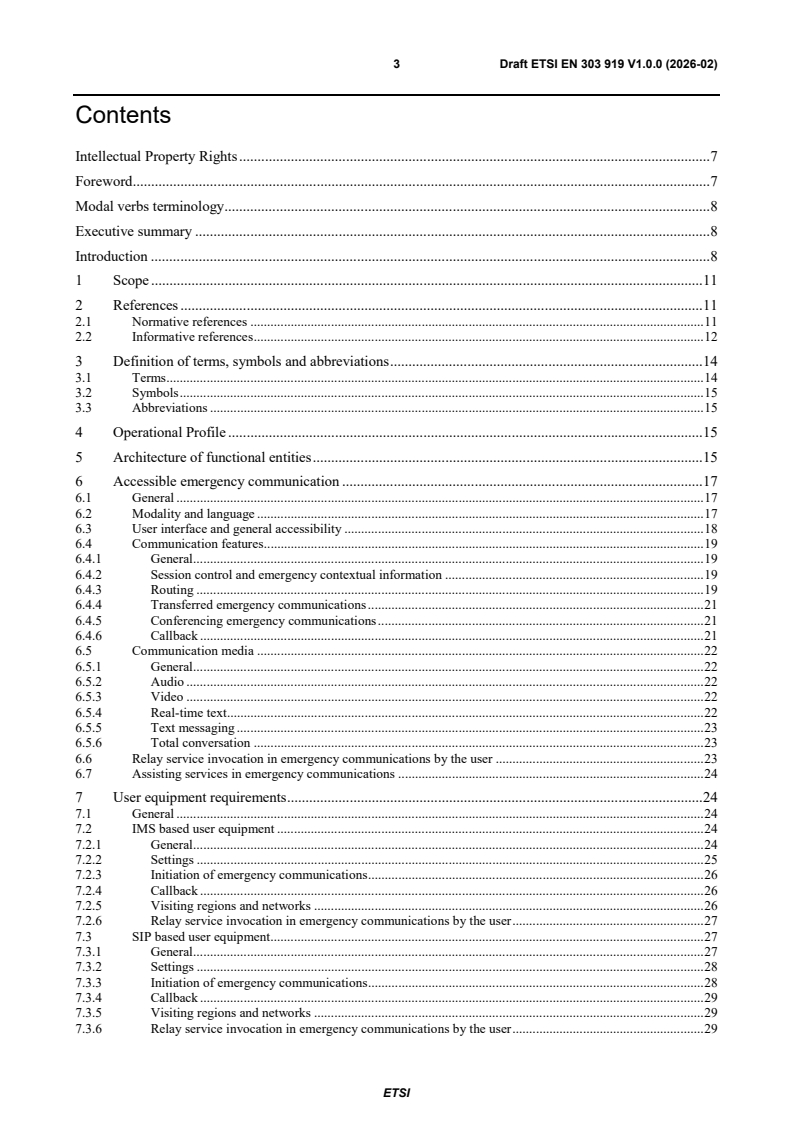
3 Draft ETSI EN 303 919 V1.0.0 (2026-02)
Contents
Intellectual Property Rights . 7
Foreword . 7
Modal verbs terminology . 8
Executive summary . 8
Introduction . 8
1 Scope . 11
2 References . 11
2.1 Normative references . 11
2.2 Informative references . 12
3 Definition of terms, symbols and abbreviations . 14
3.1 Terms . 14
3.2 Symbols . 15
3.3 Abbreviations . 15
4 Operational Profile . 15
5 Architecture of functional entities . 15
6 Accessible emergency communication . 17
6.1 General . 17
6.2 Modality and language . 17
6.3 User interface and general accessibility . 18
6.4 Communication features . 19
6.4.1 General . 19
6.4.2 Session control and emergency contextual information . 19
6.4.3 Routing . 19
6.4.4 Transferred emergency communications . 21
6.4.5 Conferencing emergency communications . 21
6.4.6 Callback . 21
6.5 Communication media . 22
6.5.1 General . 22
6.5.2 Audio . 22
6.5.3 Video . 22
6.5.4 Real-time text . 22
6.5.5 Text messaging . 23
6.5.6 Total conversation . 23
6.6 Relay service invocation in emergency communications by the user . 23
6.7 Assisting services in emergency communications . 24
7 User equipment requirements . 24
7.1 General . 24
7.2 IMS based user equipment . 24
7.2.1 General . 24
7.2.2 Settings . 25
7.2.3 Initiation of emergency communications . 26
7.2.4 Callback . 26
7.2.5 Visiting regions and networks . 26
7.2.6 Relay service invocation in emergency communications by the user . 27
7.3 SIP based user equipment . 27
7.3.1 General . 27
7.3.2 Settings . 28
7.3.3 Initiation of emergency communications . 28
7.3.4 Callback . 29
7.3.5 Visiting regions and networks . 29
7.3.6 Relay service invocation in emergency communications by the user . 29
ETSI
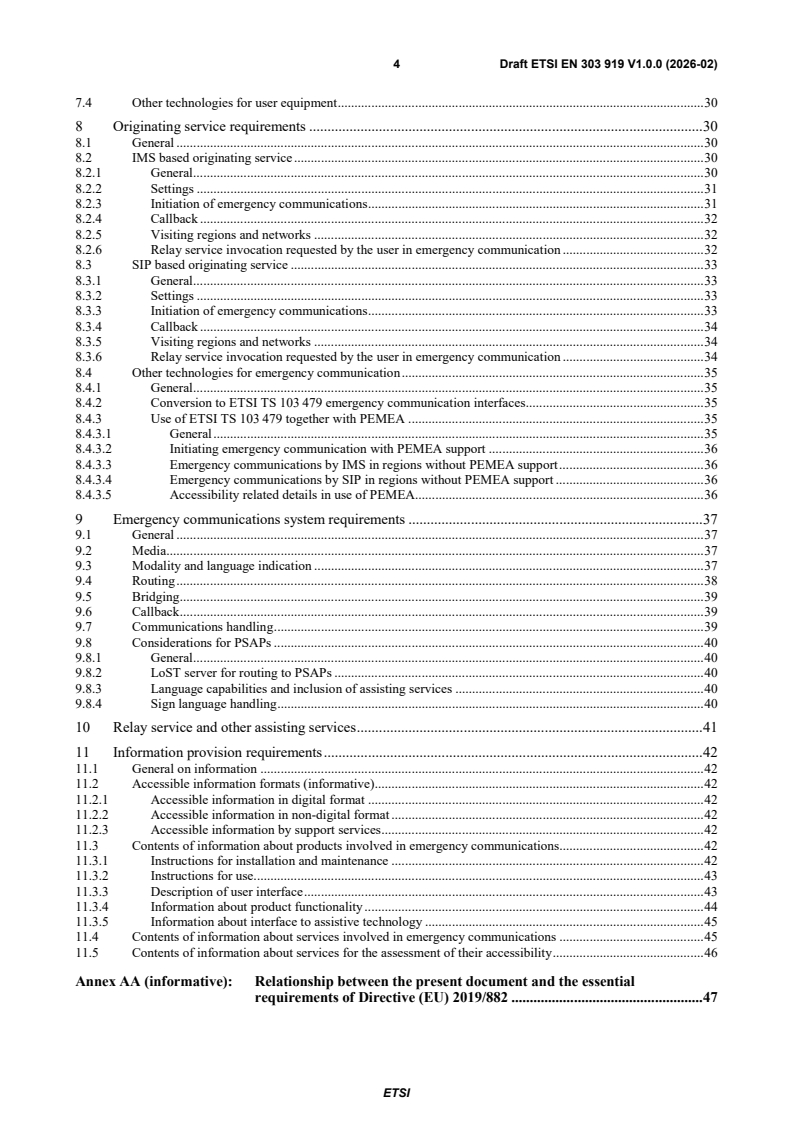
4 Draft ETSI EN 303 919 V1.0.0 (2026-02)
7.4 Other technologies for user equipment . 30
8 Originating service requirements . 30
8.1 General . 30
8.2 IMS based originating service . 30
8.2.1 General . 30
8.2.2 Settings . 31
8.2.3 Initiation of emergency communications . 31
8.2.4 Callback . 32
8.2.5 Visiting regions and networks . 32
8.2.6 Relay service invocation requested by the user in emergency communication . 32
8.3 SIP based originating service . 33
8.3.1 General . 33
8.3.2 Settings . 33
8.3.3 Initiation of emergency communications . 33
8.3.4 Callback . 34
8.3.5 Visiting regions and networks . 34
8.3.6 Relay service invocation requested by the user in emergency communication . 34
8.4 Other technologies for emergency communication . 35
8.4.1 General . 35
8.4.2 Conversion to ETSI TS 103 479 emergency communication interfaces . 35
8.4.3 Use of ETSI TS 103 479 together with PEMEA . 35
8.4.3.1 General . 35
8.4.3.2 Initiating emergency communication with PEMEA support . 36
8.4.3.3 Emergency communications by IMS in regions without PEMEA support . 36
8.4.3.4 Emergency communications by SIP in regions without PEMEA support . 36
8.4.3.5 Accessibility related details in use of PEMEA. 36
9 Emergency communications system requirements . 37
9.1 General . 37
9.2 Media . 37
9.3 Modality and language indication . 37
9.4 Routing . 38
9.5 Bridging . 39
9.6 Callback . 39
9.7 Communications handling . 39
9.8 Considerations for PSAPs . 40
9.8.1 General . 40
9.8.2 LoST server for routing to PSAPs . 40
9.8.3 Language capabilities and inclusion of assisting services . 40
9.8.4 Sign language handling . 40
10 Relay service and other assisting services . 41
11 Information provision requirements . 42
11.1 General on information . 42
11.2 Accessible information formats (informative). 42
11.2.1 Accessible information in digital format . 42
11.2.2 Accessible information in non-digital format . 42
11.2.3 Accessible information by support services . 42
11.3 Contents of information about products involved in emergency communications. 42
11.3.1 Instructions for installation and maintenance . 42
11.3.2 Instructions for use. 43
11.3.3 Description of user interface . 43
11.3.4 Information about product functionality . 44
11.3.5 Information about interface to assistive technology . 45
11.4 Contents of information about services involved in emergency communications . 45
11.5 Contents of information about services for the assessment of their accessibility . 46
Annex AA (informative): Relationship between the present document and the essential
requirements of Directive (EU) 2019/882 . 47
ETSI
5 Draft ETSI EN 303 919 V1.0.0 (2026-02)
Annex AB (informative): Relationship between the present document and the essential
requirements of other Directives according to Directive 2019/882
Section VI of Annex I . 51
Annex B (normative): Testing for compliance with technical requirements . 54
B.1 Introduction . 54
B.2 Specific concerns when testing emergency communications. 54
B.3 Testing methods . 54
B.4 Operational scenarios for testing . 55
B.4.1 Introduction of operational scenarios for testing . 55
B.4.2 Set of operational scenarios for testing. 55
B.5 Architecture of functional entities . 55
B.6 Accessible emergency communication . 56
B.6.1 General (informative) . 56
B.6.2 Modality and language . 56
B.6.3 User interface and general accessibility . 58
B.6.4 Communication Features . 60
B.6.4.1 General . 60
B.6.4.2 Session control and emergency contextual information . 60
B.6.4.3 Routing . 62
B.6.4.4 Communication transfer . 64
B.6.4.5 Conferencing. 65
B.6.4.6 Callback . 66
B.6.5 Communication media . 68
B.6.5.1 General . 68
B.6.5.2 Audio . 68
B.6.5.3 Video . 69
B.6.5.4 Real-time text . 70
B.6.5.5 Text messaging . 71
B.6.5.6 Total conversation . 71
B.6.6 Relay service invocation in emergency communications by the user . 72
B.6.7 Assisting services in emergency communications . 73
B.7 User equipment . 74
B.7.1 General . 74
B.7.2 IMS based user equipment . 75
B.7.2.1 General . 75
B.7.2.2 Settings . 76
B.7.2.3 Initiation of emergency communications . 77
B.7.2.4 Callback . 77
B.7.2.5 Visiting regions and networks . 78
B.7.2.6 Relay service invocation in emergency communications by the user . 78
B.7.3 SIP based user equipment . 79
B.7.3.1 General . 79
B.7.3.2 Settings . 80
B.7.3.3 Initiation of emergency communications . 81
B.7.3.4 Callback . 81
B.7.3.5 Visiting regions and networks . 81
B.7.3.6 Relay service invocation in emergency communications by the user . 82
B.7.4 Other technologies for emergency communication . 82
B.8 Originating service . 83
B.8.1 General . 83
B.8.2 IMS based originating service . 84
B.8.2.1 General . 84
B.8.2.2 Settings . 84
B.8.2.3 Initiation of emergency communications . 85
B.8.2.4 Callback . 85
ETSI
6 Draft ETSI EN 303 919 V1.0.0 (2026-02)
B.8.2.5 Visiting regions and networks . 86
B.8.2.6 Relay service invocation in emergency communications by the user . 86
B.8.3 SIP Based originating service . 87
B.8.3.1 General . 87
B.8.3.2 Settings . 87
B.8.3.3 Initiation of emergency communications . 88
B.8.3.4 Callback . 88
B.8.3.5 Visited region . 88
B.8.3.6 Relay service invocation in emergency communications by the user . 89
B.8.4 Other technologies for emergency communication . 90
B.8.4.1 General . 90
B.8.4.2 Conversion to ETSI TS 103 479 emergency communication interfaces . 91
B.8.4.3 Use of ETSI TS 103 479 together with PEMEA . 91
B.8.4.3.1 General . 91
B.8.4.3.2 Initiating emergency communication with PEMEA support . 92
B.8.4.3.3 Emergency communications by IMS in regions without PEMEA support . 92
B.8.4.3.4 Emergency communications by SIP in regions without PEMEA support . 93
B.8.4.3.5 Accessibility related details in use of PEMEA. 93
B.9 Emergency communications system including PSAP . 94
B.9.1 General . 94
B.9.2 Media . 94
B.9.3 Modality and language indication . 95
B.9.4 Routing . 96
B.9.5 Bridging . 97
B.9.6 Callback . 98
B.9.7 Communications handling . 99
B.9.8 Considerations for PSAP . 99
B.9.8.1 General . 99
B.9.8.2 LoST Server for routing to PSAPs . 99
B.9.8.3 Call taker's language capabilities and inclusion of assisting services . 100
B.9.8.4 Sign language handling . 101
B.10 Relay service and other assisting services . 102
B.11 Information . 102
B.11.1 General on information . 102
B.11.2 Accessible format of information . 103
B.11.3 Contents of information about products involved in emergency communications. 103
B.11.3.1 Instructions for installation and maintenance . 103
B.11.3.2 Instructions for use. 103
B.11.3.3 Description of user interface . 103
B.11.3.4 Information about product functionality . 103
B.11.3.5 Information about interface to assistive technology . 104
B.11.4 Contents of information about services involved in emergency communications . 104
B.11.5 Contents of information about services for the assessment of their accessibility . 104
Annex C (informative): User Level Use Cases . 105
C.1 Introduction . 105
C.2 Users with mobile phones with voice and RTT . 105
C.3 Users with mobile phones with total conversation . 106
C.4 Users with app or web based total conversation . 106
Annex D (informative): Cross references between requirements labels and clauses . 108
Annex E (informative): Emergency communications use by persons with disabilities . 112
History . 113
ETSI
7 Draft ETSI EN 303 919 V1.0.0 (2026-02)
Intellectual Property Rights
Essential patents
IPRs essential or potentially essential to normative deliverables may have been declared to ETSI. The declarations
pertaining to these essential IPRs, if any, are publicly available for ETSI members and non-members, and can be
found in ETSI SR 000 314: "Intellectual Property Rights (IPRs); Essential, or potentially Essential, IPRs notified to
ETSI in respect of ETSI standards", which is available from the ETSI Secretariat. Latest updates are available on the
ETSI IPR online database.
Pursuant to the ETSI Directives including the ETSI IPR Policy, no investigation regarding the essentiality of IPRs,
including IPR searches, has been carried out by ETSI. No guarantee can be given as to the existence of other IPRs not
referenced in ETSI SR 000 314 (or the updates on the ETSI Web server) which are, or may be, or may become,
essential to the present document.
Trademarks
The present document may include trademarks and/or tradenames which are asserted and/or registered by their owners.
ETSI claims no ownership of these except for any which are indicated as being the property of ETSI, and conveys no
right to use or reproduce any trademark and/or tradename. Mention of those trademarks in the present document does
not constitute an endorsement by ETSI of products, services or organizations associated with those trademarks.
DECT™, PLUGTESTS™, UMTS™ and the ETSI logo are trademarks of ETSI registered for the benefit of its
Members. 3GPP™, LTE™ and 5G™ logo are trademarks of ETSI registered for the benefit of its Members and of the
3GPP Organizational Partners. oneM2M™ logo is a trademark of ETSI registered for the benefit of its Members and of ®
the oneM2M Partners. GSM and the GSM logo are trademarks registered and owned by the GSM Association.
Foreword
This draft Harmonised European Standard (EN) has been produced by ETSI Special Committee Emergency
Communications (EMTEL), and is now submitted for the combined Public Enquiry and Vote phase of the ETSI
Standardisation Request deliverable Approval Procedure (SRdAP).
The present document has been prepared under the Commission's standardisation request C(2022) 6456 final [i.1] to
provide one voluntary means of conforming to the essential requirements of Directive (EU) 2019/882 on the
accessibility requirements for products and services [i.3].
Once the present document is cited in the Official Journal of the European Union under that Directive, compliance with
the normative clauses of the present document given in table AA.1 confers, within the limits of the scope of the present
document, a presumption of conformity with the corresponding requirements of that Directive and associated EFTA
regulations.
Proposed national transposition dates
Date of latest announcement of this EN (doa): 3 months after ETSI publication
Date of latest publication of new National Standard
or endorsement of this EN (dop/e): 6 months after doa
Date of withdrawal of any conflicting National Standard (dow): 18 months after doa
ETSI
8 Draft ETSI EN 303 919 V1.0.0 (2026-02)
Modal verbs terminology
In the present document "shall", "shall not", "should", "should not", "may", "need not", "will", "will not", "can" and
"cannot" are to be interpreted as described in clause 3.2 of the ETSI Drafting Rules (Verbal forms for the expression of
provisions).
"must" and "must not" are NOT allowed in ETSI deliverables except when used in direct citation.
Executive summary
Accessible emergency communications are needed to provide equal opportunities for all persons to get assistance in
emergency situations. The present document specifies technical, and accessibility means to provide accessible
emergency communications. The communications environment is based on packet switched communications
technologies, and ETSI TS 103 479 [2] specifies the details for emergency communications. The present document
requires a set of functions to ensure access to other media than voice, namely real-time text and video, additional
functions such as text messaging and access to assisting services are also specified.
When voice, video and real-time text are provided together, the communication is called total conversation and makes
communication more accessible than voice communication.
Video is commonly used for sign language communication. The provision of total conversation in emergency
communications enables rapid and fluent emergency communications for sign language users, when competence in the
sign language favoured by the user in emergency can be provided. In many cases, interpreters need to be invoked in the
communication in a three-party fashion. The present document tells which technical solutions are to be implemented to
support such interaction.
Technical details are provided for SIP based technologies, in particular communication services known as IMS and SIP
based VoIP. Since the intention is that users shall be able to request emergency assistance through efficient emergency
communications anywhere in Europe, it is essential that communication interoperability is established for travelling
users. That requires few and well specified interfaces for the communication. Openings for emergency apps and other
technologies are briefly mentioned. The present document describes these interfaces, which are consistent with the
default interoperability solutions prescribed in EN 301 549 [1], clause 6, enhancing them with the specific requirements
needed for accessible emergency communications.
General accessibility requirements are specified in EN 301 549 [1].
Introduction
When communication is made accessible for persons they are provided with accessible complements in
communications. This may be done in the communication media, where real-time text and video are accessible
complements for voice in various situations. Larger fonts and a spoken user interface are also used as complements to
regular visual user interfaces.
The emergency communications related requirements on accessible electronic communications are specified in the
present document, including media and technical details for interoperability in emergency communication situations as
well as addressing, routing, and providing location information and other contextual information. The inclusion of relay
services and other assisting services during emergency communication is also covered.
General accessibility requirements on emergency communications as well as everyday communications including
media performance aspects, functional details of the accessible media and general user interface requirements for
accessibility are specified in EN 301 549 [1].
The present document presents in clause 4 the operational profile concept for expressing a scope for the requirements.
Clause 5 of the present document provides a symbolic technical architecture with the division in the components
involved in emergency communications from user terminal to PSAP.
In clause 6 the functional accessibility and interoperability requirements are expressed, in most cases on the whole
chain involved in an emergency communication.
ETSI
9 Draft ETSI EN 303 919 V1.0.0 (2026-02)
Clauses 7 through 10 show how these different parts of the emergency communications chain fulfil their requirements
when providing accessible and interoperable emergency communications, referring to the functional requirements of
clause 6 by a set of labels for requirements established in clause 6, and cross referenced in Annex D.
The division between clauses 7 through 10 is:
• Clause 7: user equipment requirements.
• Clause 8: originating service requirements.
• Clause 9: emergency communications system including PSAP.
• Clause 10: assisting services.
Clause 11 contains the requirements on provision and contents of information.
The annexes contain the following:
• Annex AA provides a table showing how the essential requirements of Directive (EU) 2019/882 [i.3]
...
HARMONISED EUROPEAN STANDARD
Emergency Communications (EMTEL);
Accessibility and Interoperability of
Emergency Communications
2 ETSI EN 303 919 V1.1.1 (2026-09)
Reference
DEN/EMTEL-00067
Keywords
accessibility, emergency communications,
language, location information, PSAP, real-time
text, relay services, roaming, sign language, SIP,
total conversation
ETSI
650 Route des Lucioles
F-06921 Sophia Antipolis Cedex - FRANCE
Tel.: +33 4 92 94 42 00 Fax: +33 4 93 65 47 16
Siret N° 348 623 562 00017 - APE 7112B
Association à but non lucratif enregistrée à la
Sous-Préfecture de Grasse (06) N° w061004871
Important notice
The present document can be downloaded from the
ETSI Search & Browse Standards application.
The present document may be made available in electronic versions and/or in print. The content of any electronic and/or
print versions of the present document shall not be modified without the prior written authorization of ETSI. In case of any
existing or perceived difference in contents between such versions and/or in print, the prevailing version of an ETSI
deliverable is the one made publicly available in PDF format on ETSI deliver repository.
Users should be aware that the present document may be revised or have its status changed,
this information is available in the Milestones listing.
If you find errors in the present document, please send your comments to
the relevant service listed under Committee Support Staff.
If you find a security vulnerability in the present document, please report it through our
Coordinated Vulnerability Disclosure (CVD) program.
Notice of disclaimer & limitation of liability
The information provided in the present deliverable is directed solely to professionals who have the appropriate degree of
experience to understand and interpret its content in accordance with generally accepted engineering or
other professional standard and applicable regulations.
No recommendation as to products and services or vendors is made or should be implied.
In no event shall ETSI be held liable for loss of profits or any other incidental or consequential damages.
Any software contained in this deliverable is provided "AS IS" with no warranties, express or implied, including but not
limited to, the warranties of merchantability, fitness for a particular purpose and non-infringement of intellectual property
rights and ETSI shall not be held liable in any event for any damages whatsoever (including, without limitation, damages
for loss of profits, business interruption, loss of information, or any other pecuniary loss) arising out of or related to the use
of or inability to use the software.
Copyright Notification
No part may be reproduced or utilized in any form or by any means, electronic or mechanical, including photocopying and
microfilm except as authorized by written permission of ETSI.
The content of the PDF version shall not be modified without the written authorization of ETSI.
The copyright and the foregoing restriction extend to reproduction in all media.
© ETSI 2026.
All rights reserved.
ETSI
3 ETSI EN 303 919 V1.1.1 (2026-09)
Contents
Intellectual Property Rights . 7
Foreword . 7
Modal verbs terminology . 8
Executive summary . 8
Introduction . 8
1 Scope . 11
2 References . 11
2.1 Normative references . 11
2.2 Informative references . 12
3 Definition of terms, symbols and abbreviations . 14
3.1 Terms . 14
3.2 Symbols . 15
3.3 Abbreviations . 15
4 Operational Profile . 15
5 Architecture of functional entities . 16
6 Accessible emergency communication . 17
6.1 General . 17
6.2 Modality and language . 18
6.3 User interface and general accessibility . 18
6.4 Communication features . 19
6.4.1 General . 19
6.4.2 Session control and emergency contextual information . 19
6.4.3 Routing . 20
6.4.4 Transferred emergency communications . 21
6.4.5 Conferencing emergency communications . 21
6.4.6 Callback . 21
6.5 Communication media . 22
6.5.1 General . 22
6.5.2 Audio . 22
6.5.3 Video . 22
6.5.4 Real-time text . 23
6.5.5 Text messaging . 23
6.5.6 Total conversation . 23
6.6 Relay service invocation in emergency communications by the user . 23
6.7 Assisting services in emergency communications . 24
7 User equipment requirements . 24
7.1 General . 24
7.2 IMS based user equipment . 25
7.2.1 General . 25
7.2.2 Settings . 25
7.2.3 Initiation of emergency communications . 26
7.2.4 Callback . 26
7.2.5 Visiting regions and networks . 27
7.2.6 Relay service invocation in emergency communications by the user . 27
7.3 SIP based user equipment . 28
7.3.1 General . 28
7.3.2 Settings . 28
7.3.3 Initiation of emergency communications . 29
7.3.4 Callback . 29
7.3.5 Visiting regions and networks . 29
7.3.6 Relay service invocation in emergency communications by the user . 30
ETSI
4 ETSI EN 303 919 V1.1.1 (2026-09)
7.4 Other technologies for user equipment . 30
8 Originating service requirements . 30
8.1 General . 30
8.2 IMS based originating service . 31
8.2.1 General . 31
8.2.2 Settings . 31
8.2.3 Initiation of emergency communications . 32
8.2.4 Callback . 32
8.2.5 Visiting regions and networks . 32
8.2.6 Relay service invocation requested by the user in emergency communication . 33
8.3 SIP based originating service . 33
8.3.1 General . 33
8.3.2 Settings . 33
8.3.3 Initiation of emergency communications . 34
8.3.4 Callback . 34
8.3.5 Visiting regions and networks . 34
8.3.6 Relay service invocation requested by the user in emergency communication . 35
8.4 Other technologies for emergency communication . 35
8.4.1 General . 35
8.4.2 Conversion to ETSI TS 103 479 emergency communication interfaces . 36
8.4.3 Use of ETSI TS 103 479 together with PEMEA . 36
8.4.3.1 General . 36
8.4.3.2 Initiating emergency communication with PEMEA support . 36
8.4.3.3 Emergency communications by IMS in regions without PEMEA support . 36
8.4.3.4 Emergency communications by SIP in regions without PEMEA support . 37
8.4.3.5 Accessibility related details in use of PEMEA. 37
9 Emergency communications system requirements . 37
9.1 General . 37
9.2 Media . 37
9.3 Modality and language indication . 38
9.4 Routing . 38
9.5 Bridging . 39
9.6 Callback . 39
9.7 Communications handling . 40
9.8 Considerations for PSAPs . 40
9.8.1 General . 40
9.8.2 LoST server for routing to PSAPs . 40
9.8.3 Language capabilities and inclusion of assisting services . 41
9.8.4 Sign language handling . 41
10 Relay service and other assisting services . 41
11 Information provision requirements . 42
11.1 General on information . 42
11.2 Accessible information formats (informative). 42
11.2.1 Accessible information in digital format . 42
11.2.2 Accessible information in non-digital format . 43
11.2.3 Accessible information by support services . 43
11.3 Contents of information about products involved in emergency communications. 43
11.3.1 Instructions for installation and maintenance . 43
11.3.2 Instructions for use. 43
11.3.3 Description of user interface . 43
11.3.4 Information about product functionality . 44
11.3.5 Information about interface to assistive technology . 45
11.4 Contents of information about services involved in emergency communications . 45
11.5 Contents of information about services for the assessment of their accessibility . 46
Annex AA (informative): Relationship between the present document and the essential
requirements of Directive (EU) 2019/882 . 47
ETSI
5 ETSI EN 303 919 V1.1.1 (2026-09)
Annex AB (informative): Relationship between the present document and the essential
requirements of other Directives according to Directive 2019/882
Section VI of Annex I . 51
Annex B (normative): Testing for compliance with technical requirements . 54
B.1 Introduction . 54
B.2 Specific concerns when testing emergency communications. 54
B.3 Testing methods . 54
B.4 Operational scenarios for testing . 55
B.4.1 Introduction of operational scenarios for testing . 55
B.4.2 Set of operational scenarios for testing. 55
B.5 Architecture of functional entities . 55
B.6 Accessible emergency communication . 56
B.6.1 General (informative) . 56
B.6.2 Modality and language . 56
B.6.3 User interface and general accessibility . 58
B.6.4 Communication Features . 60
B.6.4.1 General . 60
B.6.4.2 Session control and emergency contextual information . 60
B.6.4.3 Routing . 62
B.6.4.4 Communication transfer . 64
B.6.4.5 Conferencing. 65
B.6.4.6 Callback . 66
B.6.5 Communication media . 68
B.6.5.1 General . 68
B.6.5.2 Audio . 68
B.6.5.3 Video . 69
B.6.5.4 Real-time text . 70
B.6.5.5 Text messaging . 71
B.6.5.6 Total conversation . 71
B.6.6 Relay service invocation in emergency communications by the user . 72
B.6.7 Assisting services in emergency communications . 73
B.7 User equipment . 74
B.7.1 General . 74
B.7.2 IMS based user equipment . 75
B.7.2.1 General . 75
B.7.2.2 Settings . 76
B.7.2.3 Initiation of emergency communications . 77
B.7.2.4 Callback . 77
B.7.2.5 Visiting regions and networks . 78
B.7.2.6 Relay service invocation in emergency communications by the user . 78
B.7.3 SIP based user equipment . 79
B.7.3.1 General . 79
B.7.3.2 Settings . 80
B.7.3.3 Initiation of emergency communications . 81
B.7.3.4 Callback . 81
B.7.3.5 Visiting regions and networks . 81
B.7.3.6 Relay service invocation in emergency communications by the user . 82
B.7.4 Other technologies for emergency communication . 82
B.8 Originating service . 83
B.8.1 General . 83
B.8.2 IMS based originating service . 84
B.8.2.1 General . 84
B.8.2.2 Settings . 84
B.8.2.3 Initiation of emergency communications . 85
B.8.2.4 Callback . 85
ETSI
6 ETSI EN 303 919 V1.1.1 (2026-09)
B.8.2.5 Visiting regions and networks . 86
B.8.2.6 Relay service invocation in emergency communications by the user . 86
B.8.3 SIP Based originating service . 87
B.8.3.1 General . 87
B.8.3.2 Settings . 87
B.8.3.3 Initiation of emergency communications . 88
B.8.3.4 Callback . 88
B.8.3.5 Visited region . 88
B.8.3.6 Relay service invocation in emergency communications by the user . 89
B.8.4 Other technologies for emergency communication . 90
B.8.4.1 General . 90
B.8.4.2 Conversion to ETSI TS 103 479 emergency communication interfaces . 91
B.8.4.3 Use of ETSI TS 103 479 together with PEMEA . 91
B.8.4.3.1 General . 91
B.8.4.3.2 Initiating emergency communication with PEMEA support . 92
B.8.4.3.3 Emergency communications by IMS in regions without PEMEA support . 92
B.8.4.3.4 Emergency communications by SIP in regions without PEMEA support . 93
B.8.4.3.5 Accessibility related details in use of PEMEA. 93
B.9 Emergency communications system including PSAP . 94
B.9.1 General . 94
B.9.2 Media . 94
B.9.3 Modality and language indication . 95
B.9.4 Routing . 96
B.9.5 Bridging . 97
B.9.6 Callback . 98
B.9.7 Communications handling . 99
B.9.8 Considerations for PSAP . 99
B.9.8.1 General . 99
B.9.8.2 LoST Server for routing to PSAPs . 99
B.9.8.3 Call taker's language capabilities and inclusion of assisting services . 100
B.9.8.4 Sign language handling . 101
B.10 Relay service and other assisting services . 102
B.11 Information . 102
B.11.1 General on information . 102
B.11.2 Accessible format of information . 103
B.11.3 Contents of information about products involved in emergency communications. 103
B.11.3.1 Instructions for installation and maintenance . 103
B.11.3.2 Instructions for use. 103
B.11.3.3 Description of user interface . 103
B.11.3.4 Information about product functionality . 103
B.11.3.5 Information about interface to assistive technology . 104
B.11.4 Contents of information about services involved in emergency communications . 104
B.11.5 Contents of information about services for the assessment of their accessibility . 104
Annex C (informative): User Level Use Cases . 105
C.1 Introduction . 105
C.2 Users with mobile phones with voice and RTT . 105
C.3 Users with mobile phones with total conversation . 106
C.4 Users with app or web based total conversation . 106
Annex D (informative): Cross references between requirements labels and clauses . 108
Annex E (informative): Emergency communications use by persons with disabilities . 112
History . 113
ETSI
7 ETSI EN 303 919 V1.1.1 (2026-09)
Intellectual Property Rights
Essential patents
IPRs essential or potentially essential to normative deliverables may have been declared to ETSI. The declarations
pertaining to these essential IPRs, if any, are publicly available for ETSI members and non-members, and can be
found in ETSI SR 000 314: "Intellectual Property Rights (IPRs); Essential, or potentially Essential, IPRs notified to
ETSI in respect of ETSI standards", which is available from the ETSI Secretariat. Latest updates are available on the
ETSI IPR online database.
Pursuant to the ETSI Directives including the ETSI IPR Policy, no investigation regarding the essentiality of IPRs,
including IPR searches, has been carried out by ETSI. No guarantee can be given as to the existence of other IPRs not
referenced in ETSI SR 000 314 (or the updates on the ETSI Web server) which are, or may be, or may become,
essential to the present document.
Trademarks
The present document may include trademarks and/or tradenames which are asserted and/or registered by their owners.
ETSI claims no ownership of these except for any which are indicated as being the property of ETSI, and conveys no
right to use or reproduce any trademark and/or tradename. Mention of those trademarks in the present document does
not constitute an endorsement by ETSI of products, services or organizations associated with those trademarks.
DECT™, PLUGTESTS™, UMTS™ and the ETSI logo are trademarks of ETSI registered for the benefit of its
Members. 3GPP™, LTE™ and 5G™ logo are trademarks of ETSI registered for the benefit of its Members and of the
3GPP Organizational Partners. oneM2M™ logo is a trademark of ETSI registered for the benefit of its Members and of ®
the oneM2M Partners. GSM and the GSM logo are trademarks registered and owned by the GSM Association.
Foreword
This Harmonised European Standard (EN) has been produced by ETSI Special Committee Emergency Communications
(EMTEL).
The present document has been prepared under the Commission's standardisation request C(2022) 6456 final [i.1] to
provide one voluntary means of conforming to the essential requirements of Directive (EU) 2019/882 on the
accessibility requirements for products and services [i.3].
Once the present document is cited in the Official Journal of the European Union under that Directive, compliance with
the normative clauses of the present document given in table AA.1 confers, within the limits of the scope of the present
document, a presumption of conformity with the corresponding requirements of that Directive and associated EFTA
regulations.
National transposition dates
Date of adoption of this EN: 20 May 2026
Date of latest announcement of this EN (doa): 31 August 2026
Date of latest publication of new National Standard
or endorsement of this EN (dop/e): 28 February 2027
Date of withdrawal of any conflicting National Standard (dow): 29 February 2028
ETSI
8 ETSI EN 303 919 V1.1.1 (2026-09)
Modal verbs terminology
In the present document "shall", "shall not", "should", "should not", "may", "need not", "will", "will not", "can" and
"cannot" are to be interpreted as described in clause 3.2 of the ETSI Drafting Rules (Verbal forms for the expression of
provisions).
"must" and "must not" are NOT allowed in ETSI deliverables except when used in direct citation.
Executive summary
Accessible emergency communications are needed to provide equal opportunities for all persons to get assistance in
emergency situations. The present document specifies technical, and accessibility means to provide accessible
emergency communications. The communications environment is based on packet switched communications
technologies, and ETSI TS 103 479 [2] specifies the details for emergency communications. The present document
requires a set of functions to ensure access to other media than voice, namely real-time text and video, additional
functions such as text messaging and access to assisting services are also specified.
When voice, video and real-time text are provided together, the communication is called total conversation and makes
communication more accessible than voice communication.
Video is commonly used for sign language communication. The provision of total conversation in emergency
communications enables rapid and fluent emergency communications for sign language users, when competence in the
sign language favoured by the user in emergency can be provided. In many cases, interpreters need to be invoked in the
communication in a three-party fashion. The present document tells which technical solutions are to be implemented to
support such interaction.
Technical details are provided for SIP based technologies, in particular communication services known as IMS and SIP
based VoIP. Since the intention is that users shall be able to request emergency assistance through efficient emergency
communications anywhere in Europe, it is essential that communication interoperability is established for travelling
users. That requires few and well specified interfaces for the communication. Openings for emergency apps and other
technologies are briefly mentioned. The present document describes these interfaces, which are consistent with the
default interoperability solutions prescribed in EN 301 549 [1], clause 6, enhancing them with the specific requirements
needed for accessible emergency communications.
General accessibility requirements are specified in EN 301 549 [1].
Introduction
When communication is made accessible for persons they are provided with accessible complements in
communications. This may be done in the communication media, where real-time text and video are accessible
complements for voice in various situations. Larger fonts and a spoken user interface are also used as complements to
regular visual user interfaces.
The emergency communications related requirements on accessible electronic communications are specified in the
present document, including media and technical details for interoperability in emergency communication situations as
well as addressing, routing, and providing location information and other contextual information. The inclusion of relay
services and other assisting services during emergency communication is also covered.
General accessibility requirements on emergency communications as well as everyday communications including
media performance aspects, functional details of the accessible media and general user interface requirements for
accessibility are specified in EN 301 549 [1].
The present document presents in clause 4 the operational profile concept for expressing a scope for the requirements.
Clause 5 of the present document provides a symbolic technical architecture with the division in the components
involved in emergency communications from user terminal to PSAP.
In clause 6 the functional accessibility and interoperability requirements are expressed, in most cases on the whole
chain involved in an emergency communication.
ETSI
9 ETSI EN 303 919 V1.1.1 (2026-09)
Clauses 7 through 10 show how these different parts of the emergency communications chain fulfil their requirements
when providing accessible and interoperable emergency communications, referring to the functional requirements of
clause 6 by a set of labels for requirements established in clause 6, and cross referenced in Annex D.
The division between clauses 7 through 10 is:
• Clause 7: user equipment requirements.
• Clause 8: originating service requirements.
• Clause 9: emergency communications system including PSAP.
• Clause 10: assisting services.
Clause 11 contains the requirements on provision and contents of information.
The annexes contain the following:
• Annex AA provides a table showing how the essential requirements of Directive (EU) 2019/882 [i.3]
regarding the emergency communications are addressed in the present document.
• Annex AB provides a table showing how requirements from other directives relate to the clauses of the present
d
...
SLOVENSKI STANDARD
01-november-2026
Komunikacije v sili (EMTEL) - Dostopnost in interoperabilnost komunikacij v sili
Emergency Communications (EMTEL) - Accessibility and Interoperability of Emergency
Communications
Ta slovenski standard je istoveten z: ETSI EN 303 919 V1.1.1 (2026-09)
ICS:
13.200 Preprečevanje nesreč in Accident and disaster control
katastrof
33.020 Telekomunikacije na splošno Telecommunications in
general
2003-01.Slovenski inštitut za standardizacijo. Razmnoževanje celote ali delov tega standarda ni dovoljeno.
HARMONISED EUROPEAN STANDARD
Emergency Communications (EMTEL);
Accessibility and Interoperability of
Emergency Communications
2 ETSI EN 303 919 V1.1.1 (2026-09)
Reference
DEN/EMTEL-00067
Keywords
accessibility, emergency communications,
language, location information, PSAP, real-time
text, relay services, roaming, sign language, SIP,
total conversation
ETSI
650 Route des Lucioles
F-06921 Sophia Antipolis Cedex - FRANCE
Tel.: +33 4 92 94 42 00 Fax: +33 4 93 65 47 16
Siret N° 348 623 562 00017 - APE 7112B
Association à but non lucratif enregistrée à la
Sous-Préfecture de Grasse (06) N° w061004871
Important notice
The present document can be downloaded from the
ETSI Search & Browse Standards application.
The present document may be made available in electronic versions and/or in print. The content of any electronic and/or
print versions of the present document shall not be modified without the prior written authorization of ETSI. In case of any
existing or perceived difference in contents between such versions and/or in print, the prevailing version of an ETSI
deliverable is the one made publicly available in PDF format on ETSI deliver repository.
Users should be aware that the present document may be revised or have its status changed,
this information is available in the Milestones listing.
If you find errors in the present document, please send your comments to
the relevant service listed under Committee Support Staff.
If you find a security vulnerability in the present document, please report it through our
Coordinated Vulnerability Disclosure (CVD) program.
Notice of disclaimer & limitation of liability
The information provided in the present deliverable is directed solely to professionals who have the appropriate degree of
experience to understand and interpret its content in accordance with generally accepted engineering or
other professional standard and applicable regulations.
No recommendation as to products and services or vendors is made or should be implied.
In no event shall ETSI be held liable for loss of profits or any other incidental or consequential damages.
Any software contained in this deliverable is provided "AS IS" with no warranties, express or implied, including but not
limited to, the warranties of merchantability, fitness for a particular purpose and non-infringement of intellectual property
rights and ETSI shall not be held liable in any event for any damages whatsoever (including, without limitation, damages
for loss of profits, business interruption, loss of information, or any other pecuniary loss) arising out of or related to the use
of or inability to use the software.
Copyright Notification
No part may be reproduced or utilized in any form or by any means, electronic or mechanical, including photocopying and
microfilm except as authorized by written permission of ETSI.
The content of the PDF version shall not be modified without the written authorization of ETSI.
The copyright and the foregoing restriction extend to reproduction in all media.
© ETSI 2026.
All rights reserved.
ETSI
3 ETSI EN 303 919 V1.1.1 (2026-09)
Contents
Intellectual Property Rights . 7
Foreword . 7
Modal verbs terminology . 8
Executive summary . 8
Introduction . 8
1 Scope . 11
2 References . 11
2.1 Normative references . 11
2.2 Informative references . 12
3 Definition of terms, symbols and abbreviations . 14
3.1 Terms . 14
3.2 Symbols . 15
3.3 Abbreviations . 15
4 Operational Profile . 15
5 Architecture of functional entities . 16
6 Accessible emergency communication . 17
6.1 General . 17
6.2 Modality and language . 18
6.3 User interface and general accessibility . 18
6.4 Communication features . 19
6.4.1 General . 19
6.4.2 Session control and emergency contextual information . 19
6.4.3 Routing . 20
6.4.4 Transferred emergency communications . 21
6.4.5 Conferencing emergency communications . 21
6.4.6 Callback . 21
6.5 Communication media . 22
6.5.1 General . 22
6.5.2 Audio . 22
6.5.3 Video . 22
6.5.4 Real-time text . 23
6.5.5 Text messaging . 23
6.5.6 Total conversation . 23
6.6 Relay service invocation in emergency communications by the user . 23
6.7 Assisting services in emergency communications . 24
7 User equipment requirements . 24
7.1 General . 24
7.2 IMS based user equipment . 25
7.2.1 General . 25
7.2.2 Settings . 25
7.2.3 Initiation of emergency communications . 26
7.2.4 Callback . 26
7.2.5 Visiting regions and networks . 27
7.2.6 Relay service invocation in emergency communications by the user . 27
7.3 SIP based user equipment . 28
7.3.1 General . 28
7.3.2 Settings . 28
7.3.3 Initiation of emergency communications . 29
7.3.4 Callback . 29
7.3.5 Visiting regions and networks . 29
7.3.6 Relay service invocation in emergency communications by the user . 30
ETSI
4 ETSI EN 303 919 V1.1.1 (2026-09)
7.4 Other technologies for user equipment . 30
8 Originating service requirements . 30
8.1 General . 30
8.2 IMS based originating service . 31
8.2.1 General . 31
8.2.2 Settings . 31
8.2.3 Initiation of emergency communications . 32
8.2.4 Callback . 32
8.2.5 Visiting regions and networks . 32
8.2.6 Relay service invocation requested by the user in emergency communication . 33
8.3 SIP based originating service . 33
8.3.1 General . 33
8.3.2 Settings . 33
8.3.3 Initiation of emergency communications . 34
8.3.4 Callback . 34
8.3.5 Visiting regions and networks . 34
8.3.6 Relay service invocation requested by the user in emergency communication . 35
8.4 Other technologies for emergency communication . 35
8.4.1 General . 35
8.4.2 Conversion to ETSI TS 103 479 emergency communication interfaces . 36
8.4.3 Use of ETSI TS 103 479 together with PEMEA . 36
8.4.3.1 General . 36
8.4.3.2 Initiating emergency communication with PEMEA support . 36
8.4.3.3 Emergency communications by IMS in regions without PEMEA support . 36
8.4.3.4 Emergency communications by SIP in regions without PEMEA support . 37
8.4.3.5 Accessibility related details in use of PEMEA. 37
9 Emergency communications system requirements . 37
9.1 General . 37
9.2 Media . 37
9.3 Modality and language indication . 38
9.4 Routing . 38
9.5 Bridging . 39
9.6 Callback . 39
9.7 Communications handling . 40
9.8 Considerations for PSAPs . 40
9.8.1 General . 40
9.8.2 LoST server for routing to PSAPs . 40
9.8.3 Language capabilities and inclusion of assisting services . 41
9.8.4 Sign language handling . 41
10 Relay service and other assisting services . 41
11 Information provision requirements . 42
11.1 General on information . 42
11.2 Accessible information formats (informative). 42
11.2.1 Accessible information in digital format . 42
11.2.2 Accessible information in non-digital format . 43
11.2.3 Accessible information by support services . 43
11.3 Contents of information about products involved in emergency communications. 43
11.3.1 Instructions for installation and maintenance . 43
11.3.2 Instructions for use. 43
11.3.3 Description of user interface . 43
11.3.4 Information about product functionality . 44
11.3.5 Information about interface to assistive technology . 45
11.4 Contents of information about services involved in emergency communications . 45
11.5 Contents of information about services for the assessment of their accessibility . 46
Annex AA (informative): Relationship between the present document and the essential
requirements of Directive (EU) 2019/882 . 47
ETSI
5 ETSI EN 303 919 V1.1.1 (2026-09)
Annex AB (informative): Relationship between the present document and the essential
requirements of other Directives according to Directive 2019/882
Section VI of Annex I . 51
Annex B (normative): Testing for compliance with technical requirements . 54
B.1 Introduction . 54
B.2 Specific concerns when testing emergency communications. 54
B.3 Testing methods . 54
B.4 Operational scenarios for testing . 55
B.4.1 Introduction of operational scenarios for testing . 55
B.4.2 Set of operational scenarios for testing. 55
B.5 Architecture of functional entities . 55
B.6 Accessible emergency communication . 56
B.6.1 General (informative) . 56
B.6.2 Modality and language . 56
B.6.3 User interface and general accessibility . 58
B.6.4 Communication Features . 60
B.6.4.1 General . 60
B.6.4.2 Session control and emergency contextual information . 60
B.6.4.3 Routing . 62
B.6.4.4 Communication transfer . 64
B.6.4.5 Conferencing. 65
B.6.4.6 Callback . 66
B.6.5 Communication media . 68
B.6.5.1 General . 68
B.6.5.2 Audio . 68
B.6.5.3 Video . 69
B.6.5.4 Real-time text . 70
B.6.5.5 Text messaging . 71
B.6.5.6 Total conversation . 71
B.6.6 Relay service invocation in emergency communications by the user . 72
B.6.7 Assisting services in emergency communications . 73
B.7 User equipment . 74
B.7.1 General . 74
B.7.2 IMS based user equipment . 75
B.7.2.1 General . 75
B.7.2.2 Settings . 76
B.7.2.3 Initiation of emergency communications . 77
B.7.2.4 Callback . 77
B.7.2.5 Visiting regions and networks . 78
B.7.2.6 Relay service invocation in emergency communications by the user . 78
B.7.3 SIP based user equipment . 79
B.7.3.1 General . 79
B.7.3.2 Settings . 80
B.7.3.3 Initiation of emergency communications . 81
B.7.3.4 Callback . 81
B.7.3.5 Visiting regions and networks . 81
B.7.3.6 Relay service invocation in emergency communications by the user . 82
B.7.4 Other technologies for emergency communication . 82
B.8 Originating service . 83
B.8.1 General . 83
B.8.2 IMS based originating service . 84
B.8.2.1 General . 84
B.8.2.2 Settings . 84
B.8.2.3 Initiation of emergency communications . 85
B.8.2.4 Callback . 85
ETSI
6 ETSI EN 303 919 V1.1.1 (2026-09)
B.8.2.5 Visiting regions and networks . 86
B.8.2.6 Relay service invocation in emergency communications by the user . 86
B.8.3 SIP Based originating service . 87
B.8.3.1 General . 87
B.8.3.2 Settings . 87
B.8.3.3 Initiation of emergency communications . 88
B.8.3.4 Callback . 88
B.8.3.5 Visited region . 88
B.8.3.6 Relay service invocation in emergency communications by the user . 89
B.8.4 Other technologies for emergency communication . 90
B.8.4.1 General . 90
B.8.4.2 Conversion to ETSI TS 103 479 emergency communication interfaces . 91
B.8.4.3 Use of ETSI TS 103 479 together with PEMEA . 91
B.8.4.3.1 General . 91
B.8.4.3.2 Initiating emergency communication with PEMEA support . 92
B.8.4.3.3 Emergency communications by IMS in regions without PEMEA support . 92
B.8.4.3.4 Emergency communications by SIP in regions without PEMEA support . 93
B.8.4.3.5 Accessibility related details in use of PEMEA. 93
B.9 Emergency communications system including PSAP . 94
B.9.1 General . 94
B.9.2 Media . 94
B.9.3 Modality and language indication . 95
B.9.4 Routing . 96
B.9.5 Bridging . 97
B.9.6 Callback . 98
B.9.7 Communications handling . 99
B.9.8 Considerations for PSAP . 99
B.9.8.1 General . 99
B.9.8.2 LoST Server for routing to PSAPs . 99
B.9.8.3 Call taker's language capabilities and inclusion of assisting services . 100
B.9.8.4 Sign language handling . 101
B.10 Relay service and other assisting services . 102
B.11 Information . 102
B.11.1 General on information . 102
B.11.2 Accessible format of information . 103
B.11.3 Contents of information about products involved in emergency communications. 103
B.11.3.1 Instructions for installation and maintenance . 103
B.11.3.2 Instructions for use. 103
B.11.3.3 Description of user interface . 103
B.11.3.4 Information about product functionality . 103
B.11.3.5 Information about interface to assistive technology . 104
B.11.4 Contents of information about services involved in emergency communications . 104
B.11.5 Contents of information about services for the assessment of their accessibility . 104
Annex C (informative): User Level Use Cases . 105
C.1 Introduction . 105
C.2 Users with mobile phones with voice and RTT . 105
C.3 Users with mobile phones with total conversation . 106
C.4 Users with app or web based total conversation . 106
Annex D (informative): Cross references between requirements labels and clauses . 108
Annex E (informative): Emergency communications use by persons with disabilities . 112
History . 113
ETSI
7 ETSI EN 303 919 V1.1.1 (2026-09)
Intellectual Property Rights
Essential patents
IPRs essential or potentially essential to normative deliverables may have been declared to ETSI. The declarations
pertaining to these essential IPRs, if any, are publicly available for ETSI members and non-members, and can be
found in ETSI SR 000 314: "Intellectual Property Rights (IPRs); Essential, or potentially Essential, IPRs notified to
ETSI in respect of ETSI standards", which is available from the ETSI Secretariat. Latest updates are available on the
ETSI IPR online database.
Pursuant to the ETSI Directives including the ETSI IPR Policy, no investigation regarding the essentiality of IPRs,
including IPR searches, has been carried out by ETSI. No guarantee can be given as to the existence of other IPRs not
referenced in ETSI SR 000 314 (or the updates on the ETSI Web server) which are, or may be, or may become,
essential to the present document.
Trademarks
The present document may include trademarks and/or tradenames which are asserted and/or registered by their owners.
ETSI claims no ownership of these except for any which are indicated as being the property of ETSI, and conveys no
right to use or reproduce any trademark and/or tradename. Mention of those trademarks in the present document does
not constitute an endorsement by ETSI of products, services or organizations associated with those trademarks.
DECT™, PLUGTESTS™, UMTS™ and the ETSI logo are trademarks of ETSI registered for the benefit of its
Members. 3GPP™, LTE™ and 5G™ logo are trademarks of ETSI registered for the benefit of its Members and of the
3GPP Organizational Partners. oneM2M™ logo is a trademark of ETSI registered for the benefit of its Members and of ®
the oneM2M Partners. GSM and the GSM logo are trademarks registered and owned by the GSM Association.
Foreword
This Harmonised European Standard (EN) has been produced by ETSI Special Committee Emergency Communications
(EMTEL).
The present document has been prepared under the Commission's standardisation request C(2022) 6456 final [i.1] to
provide one voluntary means of conforming to the essential requirements of Directive (EU) 2019/882 on the
accessibility requirements for products and services [i.3].
Once the present document is cited in the Official Journal of the European Union under that Directive, compliance with
the normative clauses of the present document given in table AA.1 confers, within the limits of the scope of the present
document, a presumption of conformity with the corresponding requirements of that Directive and associated EFTA
regulations.
National transposition dates
Date of adoption of this EN: 20 May 2026
Date of latest announcement of this EN (doa): 31 August 2026
Date of latest publication of new National Standard
or endorsement of this EN (dop/e): 28 February 2027
Date of withdrawal of any conflicting National Standard (dow): 29 February 2028
ETSI
8 ETSI EN 303 919 V1.1.1 (2026-09)
Modal verbs terminology
In the present document "shall", "shall not", "should", "should not", "may", "need not", "will", "will not", "can" and
"cannot" are to be interpreted as described in clause 3.2 of the ETSI Drafting Rules (Verbal forms for the expression of
provisions).
"must" and "must not" are NOT allowed in ETSI deliverables except when used in direct citation.
Executive summary
Accessible emergency communications are needed to provide equal opportunities for all persons to get assistance in
emergency situations. The present document specifies technical, and accessibility means to provide accessible
emergency communications. The communications environment is based on packet switched communications
technologies, and ETSI TS 103 479 [2] specifies the details for emergency communications. The present document
requires a set of functions to ensure access to other media than voice, namely real-time text and video, additional
functions such as text messaging and access to assisting services are also specified.
When voice, video and real-time text are provided together, the communication is called total conversation and makes
communication more accessible than voice communication.
Video is commonly used for sign language communication. The provision of total conversation in emergency
communications enables rapid and fluent emergency communications for sign language users, when competence in the
sign language favoured by the user in emergency can be provided. In many cases, interpreters need to be invoked in the
communication in a three-party fashion. The present document tells which technical solutions are to be implemented to
support such interaction.
Technical details are provided for SIP based technologies, in particular communication services known as IMS and SIP
based VoIP. Since the intention is that users shall be able to request emergency assistance through efficient emergency
communications anywhere in Europe, it is essential that communication interoperability is established for travelling
users. That requires few and well specified interfaces for the communication. Openings for emergency apps and other
technologies are briefly mentioned. The present document describes these interfaces, which are consistent with the
default interoperability solutions prescribed in EN 301 549 [1], clause 6, enhancing them with the specific requirements
needed for accessible emergency communications.
General accessibility requirements are specified in EN 301 549 [1].
Introduction
When communication is made accessible for persons they are provided with accessible complements in
communications. This may be done in the communication media, where real-time text and video are accessible
complements for voice in various situations. Larger fonts and a spoken user interface are also used as complements to
regular visual user interfaces.
The emergency communications related requirements on accessible electronic communications are specified in the
present document, including media and technical details for interoperability in emergency communication situations as
well as addressing, routing, and providing location information and other contextual information. The inclusion of relay
services and other assisting services during emergency communication is also covered.
General accessibility requirements on emergency communications as well as everyday communications including
media performance aspects, functional details of the accessible media and general user interface requirements for
accessibility are specified in EN 301 549 [1].
The present document presents in clause 4 the operational profile concept for expressing a scope for the requirements.
Clause 5 of the present document provides a symbolic technical architecture with the division in the components
involved in emergency communications from user terminal to PSAP.
In clause 6 the functional accessibility and interoperability requirements are expressed, in most cases on the whole
chain involved in an emergency communication.
ETSI
9 E
...