


SIST EN 12101-2:2017
(Main)Smoke and heat control systems - Part 2: Natural smoke and heat exhaust ventilators
Smoke and heat control systems - Part 2: Natural smoke and heat exhaust ventilators
This European Standard applies to natural smoke and heat exhaust ventilators (NSHEV) operating as part of smoke and heat exhaust systems (NSHEVS), placed on the market. This standard specifies requirements and gives test methods for natural smoke and heat exhaust ventilators which are intended to be installed in smoke and heat control systems in buildings.
Rauch- und Wärmefreihaltung - Teil 2: Natürliche Rauch- und Wärmeabzugsgeräte
Diese Europäische Norm gilt für natürliche Rauch- und Wärmeabzugsgeräte (NRWG), die als Teil von natürlichen Rauch- und Wärmeabzugsanlagen (RWA) betrieben und in Verkehr gebracht werden. Diese Norm legt die Anforderungen fest und gibt Prüfverfahren für natürliche Rauch- und Wärmeabzugsgeräte an, die zum Einbau als Teil einer Rauch- und Wärmeabzugsanlage in Gebäuden vorgesehen sind.
Systèmes pour le contrôle des fumées et de la chaleur - Partie 2 : Dispositifs d'évacuation naturelle de fumées et de chaleur
La présente Norme européenne s’applique aux dispositifs d’évacuation naturelle de fumées et de chaleur (DENFC) conçus pour fonctionner comme partie intégrante des systèmes d’évacuation de fumées et de chaleur (SEFC) mis sur le marché. La présente norme spécifie les exigences et fournit les méthodes d’essai pour les dispositifs d’évacuation naturelle de fumées et de chaleur destinés à être installés dans les systèmes pour le contrôle des fumées et de la chaleur des bâtiments.
Sistemi za nadzor dima in toplote - 2. del: Odvod dima in toplote z naravnim prezračevanjem
Ta evropski standard se uporablja za odvod dima in toplote z naravnim prezračevanjem (NSHEV), ki deluje kot del prezračevalnih sistemov za odvod dima in toplote (NSHEVS), ki so na voljo na tržišču. Ta standard določa zahteve in podaja metode za preskušanje naravnih prezračevalnikov za odstranjevanje dima in toplote, ki so predvideni za vgradnjo v sistem za nadzor dima in toplote v stavbah.
General Information
- Status
- Published
- Public Enquiry End Date
- 29-Oct-2014
- Publication Date
- 18-May-2017
- Technical Committee
- POZ - Požarna varnost
- Current Stage
- 6060 - National Implementation/Publication (Adopted Project)
- Start Date
- 11-Apr-2017
- Due Date
- 16-Jun-2017
- Completion Date
- 19-May-2017
Relations
- Effective Date
- 01-Jun-2017
Overview
SIST EN 12101-2:2017 is the European standard that specifies requirements and test methods for natural smoke and heat exhaust ventilators (NSHEV) used in building smoke and heat control systems (NSHEVS). The standard applies to NSHEV products placed on the market and intended for installation in smoke and heat control systems in buildings. It covers performance, durability and conformity assessment to ensure NSHEV operate reliably under fire and adverse environmental conditions.
Key Topics and Technical Requirements
The standard sets out structured technical requirements and normative test procedures, including:
- Nominal activation conditions / sensitivity and initiation device requirements
- Response delay (response time) and reliability criteria for activation
- Operational reliability and durability over service life
- Effectiveness of smoke/hot gas extraction, expressed via aerodynamic free area and related test methods (Annex B)
- Performance under fire conditions: resistance to heat, mechanical stability and reaction to fire
- Environmental performance: opening under snow/wind load, low ambient temperature, stability under wind load, and resistance to wind-induced vibration
- Durability tests for long-term operational performance
- Testing, assessment and sampling methods, including detailed normative test methods (Annexes B–G) covering operational reliability, opening under load, low temperature, wind stability and heat resistance
- Assessment and Verification of Constancy of Performance (AVCP) and Factory Production Control (FPC) requirements
- Marking, labelling and packaging procedures and classification schemes for reporting results
Practical Applications and Users
SIST EN 12101-2:2017 is used to ensure NSHEV products meet minimum safety and performance requirements for smoke control and building fire safety. Typical users include:
- Manufacturers and product designers - to design NSHEV that comply with European performance and testing requirements.
- Test laboratories and certification bodies - to perform the normative tests and AVCP procedures.
- Fire safety engineers and consultants - to specify appropriate NSHEV performance for smoke control strategies.
- Architects, building services engineers and installers - to select compliant ventilators for building projects and coordinate installation with smoke control systems.
- Regulatory authorities and product assessors - to verify conformity and approve products for market placement.
Related Standards
- Part of the EN 12101 series of European standards for smoke and heat control systems. SIST EN 12101-2:2017 should be applied alongside other relevant parts of the series and national building/fire regulations when designing, specifying or certifying NSHEV.
Keywords: SIST EN 12101-2:2017, natural smoke and heat exhaust ventilators, NSHEV, smoke and heat control systems, aerodynamic free area, response time, operational reliability, fire safety testing.

Frequently Asked Questions
SIST EN 12101-2:2017 is a standard published by the Slovenian Institute for Standardization (SIST). Its full title is "Smoke and heat control systems - Part 2: Natural smoke and heat exhaust ventilators". This standard covers: This European Standard applies to natural smoke and heat exhaust ventilators (NSHEV) operating as part of smoke and heat exhaust systems (NSHEVS), placed on the market. This standard specifies requirements and gives test methods for natural smoke and heat exhaust ventilators which are intended to be installed in smoke and heat control systems in buildings.
This European Standard applies to natural smoke and heat exhaust ventilators (NSHEV) operating as part of smoke and heat exhaust systems (NSHEVS), placed on the market. This standard specifies requirements and gives test methods for natural smoke and heat exhaust ventilators which are intended to be installed in smoke and heat control systems in buildings.
SIST EN 12101-2:2017 is classified under the following ICS (International Classification for Standards) categories: 13.220.20 - Fire protection; 91.140.30 - Ventilation and air-conditioning systems. The ICS classification helps identify the subject area and facilitates finding related standards.
SIST EN 12101-2:2017 has the following relationships with other standards: It is inter standard links to SIST EN 12101-2:2003. Understanding these relationships helps ensure you are using the most current and applicable version of the standard.
SIST EN 12101-2:2017 is associated with the following European legislation: EU Directives/Regulations: 2006/42/EC, 305/2011, TRRTP127; Standardization Mandates: M/109, M/139. When a standard is cited in the Official Journal of the European Union, products manufactured in conformity with it benefit from a presumption of conformity with the essential requirements of the corresponding EU directive or regulation.
SIST EN 12101-2:2017 is available in PDF format for immediate download after purchase. The document can be added to your cart and obtained through the secure checkout process. Digital delivery ensures instant access to the complete standard document.
Standards Content (Sample)
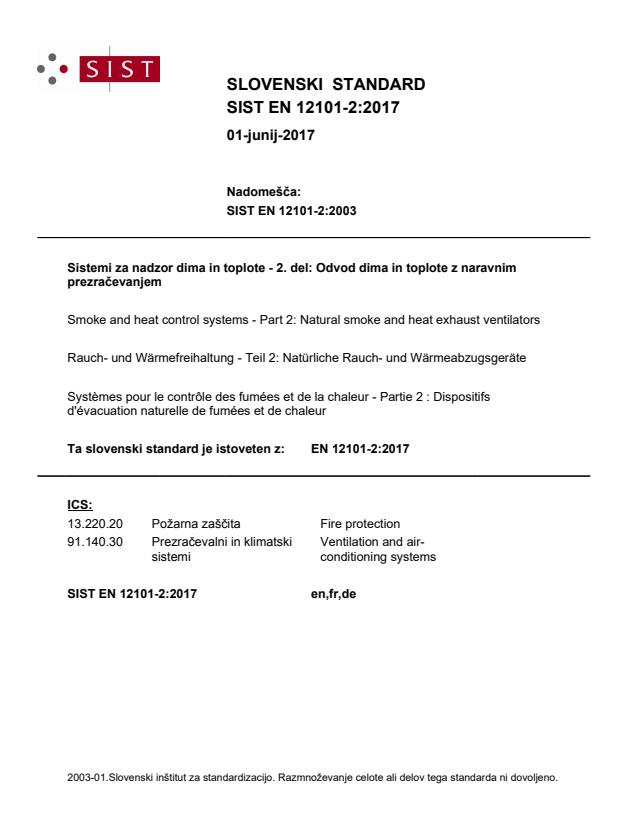
2003-01.Slovenski inštitut za standardizacijo. Razmnoževanje celote ali delov tega standarda ni dovoljeno.SUH]UDþHYDQMHPRauch- und Wärmefreihaltung - Teil 2: Natürliche Rauch- und WärmeabzugsgeräteSystèmes pour le contrôle des fumées et de la chaleur - Partie 2 : Dispositifs d'évacuation naturelle de fumées et de chaleurSmoke and heat control systems - Part 2: Natural smoke and heat exhaust ventilators91.140.30VLVWHPLVentilation and air-conditioning systems13.220.20Fire protectionICS:Ta slovenski standard je istoveten z:EN 12101-2:2017SIST EN 12101-2:2017en,fr,de01-junij-2017SIST EN 12101-2:2017SLOVENSKI
STANDARDSIST EN 12101-2:20031DGRPHãþD
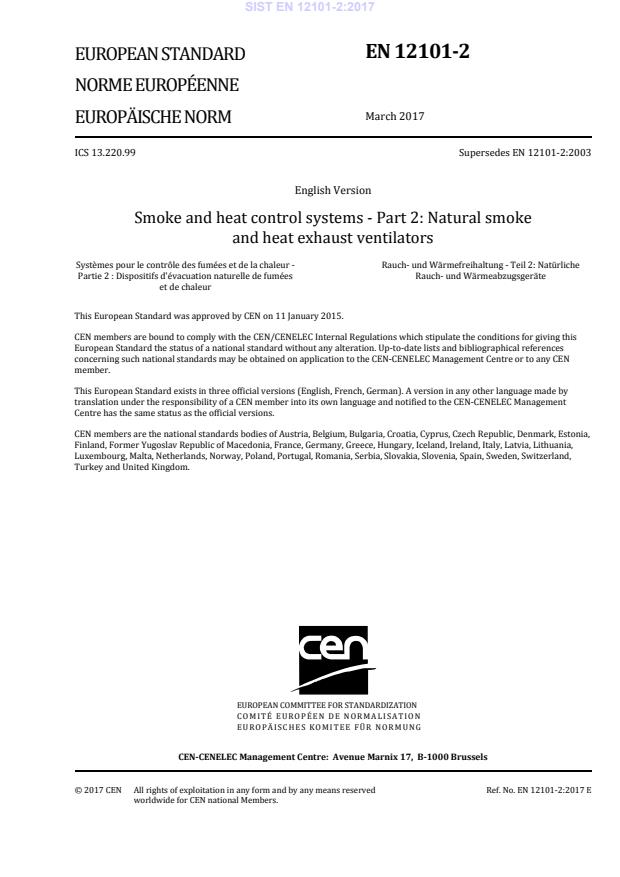
EUROPEAN STANDARD NORME EUROPÉENNE EUROPÄISCHE NORM
EN 12101-2
March
t r s y ICS
s uä t t rä { { Supersedes EN
s t s r sæ tã t r r uEnglish Version
Smoke and heat control systems æ Part
tã Natural smoke and heat exhaust ventilators Systèmes pour le contrôle des fumées et de la chaleur æPartie
t ã Dispositifs d 5évacuation naturelle de fumées et de chaleur
Rauchæ und Wärmefreihaltung æ Teil
tã Natürliche Rauchæ und Wärmeabzugsgeräte This European Standard was approved by CEN on
s s January
t r s wä
egulations which stipulate the conditions for giving this European Standard the status of a national standard without any alterationä Upætoædate lists and bibliographical references concerning such national standards may be obtained on application to the CENæCENELEC Management Centre or to any CEN memberä
translation under the responsibility of a CEN member into its own language and notified to the CENæCENELEC Management Centre has the same status as the official versionsä
CEN members are the national standards bodies of Austriaá Belgiumá Bulgariaá Croatiaá Cyprusá Czech Republicá Denmarká Estoniaá Finlandá Former Yugoslav Republic of Macedoniaá Franceá Germanyá Greeceá Hungaryá Icelandá Irelandá Italyá Latviaá Lithuaniaá Luxembourgá Maltaá Netherlandsá Norwayá Polandá Portugalá Romaniaá Serbiaá Slovakiaá Sloveniaá Spainá Swedená Switzerlandá Turkey and United Kingdomä
EUROPEAN COMMITTEE FOR STANDARDIZATION COMITÉ EUROPÉEN DE NORMALISATION EUROPÄISCHES KOMITEE FÜR NORMUNG
CEN-CENELEC Management Centre:
Avenue Marnix 17,
B-1000 Brussels
t r s y CEN All rights of exploitation in any form and by any means reserved worldwide for CEN national Membersä Refä Noä EN
s t s r sæ tã t r s y ESIST EN 12101-2:2017
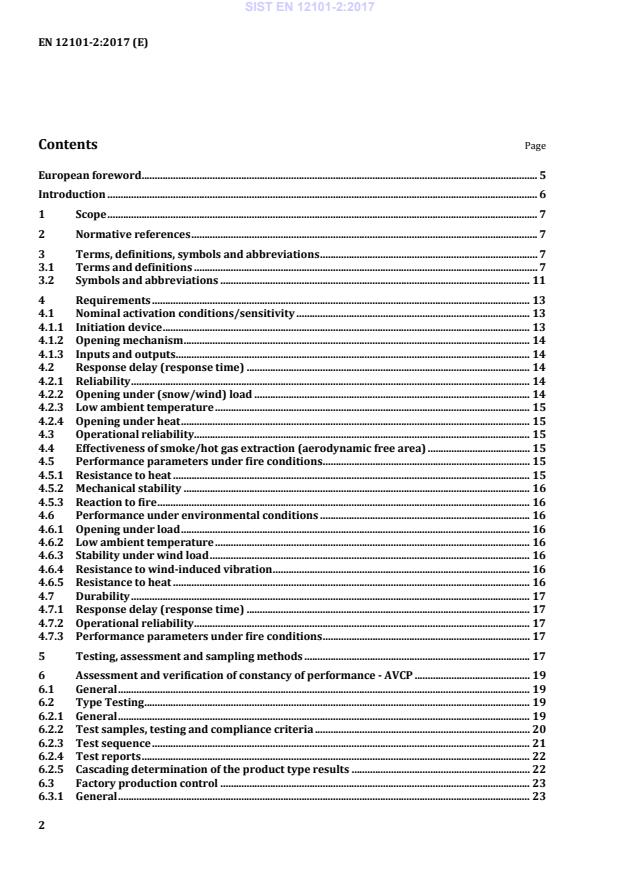
Classification . 29 A.1 Nominal activation condition/sensitivity . 29 A.2 Response delay . 29 A.3 Operational Reliability . 29 A.4 Effectiveness of smoke/hot gas extraction (aerodynamic free area) . 29 A.5 Performance parameters under fire conditions . 29 A.6 Performance under environmental conditions . 30 A.7 Durability. 31 A.7.1 Response delay (response time) . 31 A.7.2 Operational reliability . 31 A.7.3 Performance parameters under fire conditions . 31 Annex B (normative)
Effectiveness of smoke/hot gas extraction (aerodynamic free area) . 32 B.1 Determination of the aerodynamic free area . 32 B.2 Simple assessment procedure . 32 B.2.1 General . 32 B.2.2 Roof mounted NSHEV . 32 B.2.3 Wall mounted NSHEV . 32 B.3 Experimental procedure . 33 B.3.1 General . 33 B.3.2 Test apparatus . 33 B.3.3 Test specimen . 34 B.3.4 Test procedure . 35 B.3.5 Evaluation of test results . 36 B.3.6 Calculation of the coefficient of discharge for a family of NSHEV . 37 B.4 Test to check the aerodynamic test installations. 38 B.4.1 General . 38 B.4.2 Reference test without side wind . 39 B.4.3 Reference tests with side wind . 39 B.4.4 Evaluation of test results . 39 Annex C (normative)
Test method for operational reliability and response time . 54 C.1 Objective of test . 54 C.2 Test conditions . 54 C.3 Test apparatus . 54 C.4 Test specimen . 54 C.5 Test procedure . 54 Annex D (normative)
Test method for opening under load . 56 D.1 Objective of test . 56 D.2 Test conditions . 56 D.3 Test apparatus . 56 D.4 Test specimen . 57 D.5 Test procedure . 57 Annex E (normative)
Test method for low ambient temperature . 58 E.1 Objective of test . 58 SIST EN 12101-2:2017
Test method for stability under wind load . 59 F.1 Objective of test . 59 F.2 Test conditions . 59 F.3 Test apparatus. 59 F.4 Test specimen . 59 F.5 Test procedure . 60 F.5.1 Wind load . 60 F.5.2 Vibration . 60 Annex G (normative)
Test method for resistance to heat . 61 G.1 Objective of the test . 61 G.2 Test apparatus. 61 G.2.1 Test furnace . 61 G.2.2 Temperature measurement . 61 G.2.3 NSHEV mount . 61 G.3 Test specimen . 62 G.3.1 General . 62 G.3.2 NSHEV mounted to a glazed partition construction . 62 G.3.3 Roof mounted NSHEV as part of a continuous rooflight . 62 G.3.4 Wall mounted NSHEV . 63 G.3.5 Roof mounted NSHEV . 63 G.4 Test procedure . 64 Annex H (normative)
Mounting and fixing conditions for the SBI or small flame tests . 72 H.1 General . 72 H.2 Class E . 73 H.2.1 General . 73 H.2.2 Small flame test in accordance to EN ISO 11925-2 . 73 H.3 Class A2 to class D . 73 H.3.1 General . 73 H.3.2 Single Burning Item test (SBI) . 74 H.4 Heat of combustion test . 74 Annex I (normative)
Handling changes affecting declared performances for NSHEV . 75 I.1 General . 75 I.2 Effectiveness of smoke/hot gas extraction . 75 I.3 Reliability . 75 I.4 Opening under load . 76 I.5 Opening at low ambient temperatures . 76 I.6 Wind load . 77 I.7 Resistance to heat . 77 Annex J (informative)
Installation and maintenance information . 78 J.1 Installation information . 78 J.2 Maintenance information. 78 Bibliography . 88
cv ratio of actual flow rate, measured under specified conditions, to the theoretical flow rate through the NSHEV, as defined in Annex B Note 1 to entry: The coefficient takes into account any obstructions in the NSHEV such as controls, louvres and vanes and the effect of external side wind. 3.1.8 dual purpose NSHEV NSHEV which has provision to allow its use for comfort (i.e. day to day) ventilation 3.1.9 fire open position configuration of the NSHEV specified by its designer to be achieved and sustained while venting smoke and heat 3.1.10 gas container vessel containing gas in a compressed form, the energy of which, when the gas is released from the vessel, will open the NSHEV 3.1.11 geometric area
Av area of the opening through a NSHEV, measured in the plane defined by the surface of the construction works, where it contacts the structure of the NSHEV Note 1 to entry: No reduction is made for controls, louvres or other obstructions. Note 2 to entry: Specific configurations are given in Figures B.1 and B.4. SIST EN 12101-2:2017
smallest geometric cross section area through which the air flows (m2) Av geometric area of the NSHEV, expressed in square metres (m2) B width of the open hole of the settling chamber, expressed in metres (m) b width of the geometric opening of a NSHEV, expressed in metres (m) Bn width of nozzle exit area in open jet facilities, width of the test section in closed test section facilities, expressed in metres (m) Bv maximum width of the NSHEV in the fire open position, expressed in metres above the upper surface of the settling chamber (m) Cv coefficient of discharge, dimensionless - Cv0 coefficient of discharge without side wind influence, dimensionless - Cvw coefficient of discharge with side wind influence, dimensionless - dh hydraulic diameter of the settling chamber (dh = (4 Asc)/P), expressed in metres (m) dh, g hydraulic diameter of the geometric NSHEV area, expressed in metres (m) Hn height of nozzle exit area in open jet facilities, height of the test section in closed test section facilities, expressed in metres (m) Hv maximum height of the NSHEV in the fire open position above the upper surface of the settling chamber, expressed in metres (m) SIST EN 12101-2:2017
opening angle of the NSHEV, expressed in degrees and referenced to the closed flap position - ß angle of attack, expressed in degrees - ßcrit incidence angle at which the smallest value of Cvw obtained with side wind, occurs, expressed in degrees -
relative wall thickness (= hUS/dh), dimensionless - SIST EN 12101-2:2017
angle of installation of NSHEV on a roof or in a wall, expressed in degrees - p pressure difference, expressed in Pascal (Pa) pv0 reference pressure difference between the static pressure in the settling chamber and the ambient pressure without side wind, expressed in Pascal (Pa) pvw reference pressure difference between the static pressure in the settling chamber and the ambient pressure with side wind, expressed in Pascal (Pa) pint pressure difference between the static pressure in the settling chamber and the ambient pressure, expressed in Pascal (Pa) T temperature difference, expressed in Kelvin (K) air density of air, expressed in kilograms per cubic metre (kg/m3) 4 Requirements 4.1 Nominal activation conditions/sensitivity 4.1.1 Initiation device 4.1.1.1 General To ensure the natural smoke and heat exhaust ventilator (NSHEV) opens in the event of a fire, it shall be fitted with one or more of the following automatic initiation devices: a) a thermal initiation device; b) an initiation device activated by an electrical signal from a remote source, e.g. a smoke and heat detector system, the interruption of electrical power supply; c) a pneumatic initiation device, e.g. a pneumatic signal or a loss of compressed air; d) an initiation device able to respond to other types of release signals. In addition, remote initiation can take place by means of a manually operated initiation device. e) A pneumatic non fail safe NSHEV, which does not open automatically on loss of power, shall have at least a thermal device and one power source in accordance with EN 12101-10, which is mounted directly in the NSHEV, unless the required control panel monitors the lines to the NSHEV and indicates a failure. In some specific design cases where it is suitable to initiate the NSHEV manually only, the NSHEV may be installed without an automatic initiation device. SIST EN 12101-2:2017
The specimen shall be installed in a heat tunnel in its most unfavourable position. The release behaviour for each test shall conform to (v + 3T) / 0,35 ≥ u where v is the nominal operating temperature of the thermal element and u is the release time (s). The static response behaviour of the thermal device shall be measured three times in accordance with the requirements of EN 54-5:2017, 5.3. The nominal release temperature for each test shall not vary by more than –3K to +8K. Smoke detectors shall comply with the requirements of EN 54-7 and heat detectors with EN 54-5. 4.1.2 Opening mechanism 4.1.2.1 General The NSHEV shall be provided with an opening mechanism with energy within the NSHEV, (e.g. gas containers, spring systems, electrical power supply) and/or with an external energy source. For the external links the manufacturer of the NSHEV shall specify the operating requirements for the initiation device and the opening mechanism, e.g. voltage, energy. 4.1.2.2 Integral gas containers Any gas container forming an integral part of the NSHEV shall be equipped with a pressure release device to prevent an explosion if the container overheats. The energy supply shall comply with EN 12101-10. 4.1.3 Inputs and outputs If the NSHEV is intended to operate with an external energy source it shall be equipped with inputs and/or outputs to allow connection of the NSHEV to the control panel and power supplies in accordance with EN 12101-10. 4.2 Response delay (response time) 4.2.1 Reliability The NSHEV shall when tested in accordance with Annex C open, i.e. reach its fire open position, within 60 s after actuation. 4.2.2 Opening under (snow/wind) load Roof mounted NSHEV shall open, reach its fire open position not more than 60 s after actuation and remain in position without an external energy supply (until reset), when tested under the snow load appropriate to its classification and under the specified side wind in accordance with Annex D. SIST EN 12101-2:2017
...
Questions, Comments and Discussion
Ask us and Technical Secretary will try to provide an answer. You can facilitate discussion about the standard in here.
Loading comments...