


oSIST prEN IEC 63593:2025
(Main)Railway applications - Rolling stock - Specification and verification of energy consumption
Railway applications - Rolling stock - Specification and verification of energy consumption
Applications ferroviaires - Matériel roulant - Spécification et vérification de la consommation d'énergie
Železniške naprave - Vozna sredstva - Specifikacija in preverjanje porabe energije
General Information
- Status
- Not Published
- Public Enquiry End Date
- 30-Jul-2025
- Technical Committee
- ŽEN - Electrical applications for railways
- Current Stage
- 4020 - Public enquire (PE) (Adopted Project)
- Start Date
- 11-Jun-2025
- Due Date
- 29-Oct-2025
- Completion Date
- 23-Jul-2025
Overview
The oSIST prEN IEC 63593:2025 standard, titled Railway applications - Rolling stock - Specification and verification of energy consumption, is a comprehensive framework developed by the CLC and IEC TC 9 Committee. It focuses on establishing clear specifications and verification methods for the energy consumption of railway rolling stock. This standard plays a critical role in enhancing energy efficiency within railway systems, addressing operational, environmental, and technical conditions that affect energy use in trains.
Scheduled for publication in July 2025, oSIST prEN IEC 63593:2025 targets energy consumption measurement, simulation, and verification-ensuring consistent and reliable evaluation of traction, auxiliaries, and HVAC (Heating, Ventilation, and Air Conditioning) systems across various operational modes. It is designed to support sustainable railway operations and facilitate procurement and regulatory compliance regarding energy performance.
Key Topics
Train Modes and Energy Categories
Defines operational modes covering in-service commercial operation, non-commercial operation, parking, and environmental conditions that influence energy consumption.Simulation and Verification Requirements
Details standardized procedures for modeling energy use, including timetable simulation, infrastructure conditions, and environmental variables like ambient temperature and energy supply characteristics.Traction and Auxiliary Systems
Specifies energy consumption measurement for traction and auxiliary equipment, excluding HVAC initially, covering operational requirements, test protocols, and data documentation.HVAC Energy Consumption
Separate section focused on HVAC systems, clarifying methods to determine energy use during in-service and parking modes, with detailed climatic and operational requirements.Service Profiles and Operational Point Matrices
Includes annexes with definitions of standard and user-defined service profiles reflecting different railway operation scenarios, including suburban, regional, intercity, high-speed, freight, and metro configurations across Europe and Japan.Post-Processing and Reporting
Instructions on how to analyze and report test results, accounting for external factors such as running time, environmental conditions, and energy supply network characteristics.
Applications
oSIST prEN IEC 63593:2025 serves multiple practical purposes in the railway industry:
Procurement and Contractual Specifications
Enables manufacturers, operators, and procurement teams to set verifiable energy consumption targets during vehicle design and acquisition processes, promoting energy-efficient rolling stock.Energy Efficiency Assessment
Provides a standardized methodology for measuring and verifying energy performance, supporting operational improvements and benchmarking across different fleets and routes.Regulatory Compliance and Sustainability Goals
Assists railway companies and infrastructure managers in meeting national and international energy efficiency regulations, while aiding efforts to reduce carbon footprint and operational costs.Design and Engineering Optimization
Supports vehicle engineers and designers in evaluating energy use under realistic service profiles and environmental conditions, facilitating technical enhancements and innovation in traction systems and auxiliary equipment.
Related Standards
- IEC 60050 Series – Standardized terminology for electrical, electronic, and related fields relevant to railway systems.
- CLC/TS 50673 – Energy measurement and management in railway applications.
- EN 50591 – Electrical and electronic equipment energy efficiency requirements.
- ISO 50001 – Energy management systems applicable across transportation sectors for continual energy performance improvement.
By implementing oSIST prEN IEC 63593:2025, stakeholders in the railway industry can achieve a harmonized approach to energy consumption specification and verification. This ensures reliable data, facilitates operational energy savings, and drives the development of greener, more efficient railway rolling stock worldwide.

Frequently Asked Questions
oSIST prEN IEC 63593:2025 is a draft published by the Slovenian Institute for Standardization (SIST). Its full title is "Railway applications - Rolling stock - Specification and verification of energy consumption". This standard covers: Railway applications - Rolling stock - Specification and verification of energy consumption
Railway applications - Rolling stock - Specification and verification of energy consumption
oSIST prEN IEC 63593:2025 is classified under the following ICS (International Classification for Standards) categories: 45.060.01 - Railway rolling stock in general. The ICS classification helps identify the subject area and facilitates finding related standards.
oSIST prEN IEC 63593:2025 is available in PDF format for immediate download after purchase. The document can be added to your cart and obtained through the secure checkout process. Digital delivery ensures instant access to the complete standard document.
Standards Content (Sample)
SLOVENSKI STANDARD
01-julij-2025
Železniške naprave - Vozna sredstva - Specifikacija in preverjanje porabe energije
Railway applications - Rolling stock - Specification and verification of energy
consumption
Applications ferroviaires - Matériel roulant - Spécification et vérification de la
consommation d'énergie
Ta slovenski standard je istoveten z: prEN IEC 63593:2025
ICS:
45.060.01 Železniška vozila na splošno Railway rolling stock in
general
2003-01.Slovenski inštitut za standardizacijo. Razmnoževanje celote ali delov tega standarda ni dovoljeno.
9/3216/CDV
COMMITTEE DRAFT FOR VOTE (CDV)
PROJECT NUMBER:
IEC 63593 ED1
DATE OF CIRCULATION: CLOSING DATE FOR VOTING:
2025-06-06 2025-08-29
SUPERSEDES DOCUMENTS:
9/3108/CD, 9/3139A/CC
IEC TC 9 : ELECTRICAL EQUIPMENT AND SYSTEMS FOR RAILWAYS
SECRETARIAT: SECRETARY:
France Mr Denis MIGLIANICO
OF INTEREST TO THE FOLLOWING COMMITTEES: HORIZONTAL FUNCTION(S):
ASPECTS CONCERNED:
Energy Efficiency
SUBMITTED FOR CENELEC PARALLEL VOTING NOT SUBMITTED FOR CENELEC PARALLEL VOTING
Attention IEC-CENELEC parallel voting
The attention of IEC National Committees, members of CENELEC,
is drawn to the fact that this Committee Draft for Vote (CDV) is
submitted for parallel voting.
The CENELEC members are invited to vote through the CENELEC
online voting system.
This document is still under study and subject to change. It should not be used for reference purposes.
Recipients of this document are invited to submit, with their comments, notification of any relevant patent rights of which they are aware
and to provide supporting documentation.
Recipients of this document are invited to submit, with their comments, notification of any relevant “In Some Countries” clau ses to be
included should this proposal proceed. Recipients are reminded that the CDV stage is the final stage for submitting ISC c lauses. (SEE
AC/22/2007 OR NEW GUIDANCE DOC).
TITLE:
Railway applications – Rolling stock – Specification and verification of energy consumption
PROPOSED STABILITY DATE: 2028
NOTE FROM TC/SC OFFICERS:
electronic file, to make a copy and to print out the content for the sole purpose of preparing National Committee positions.
You may not copy or "mirror" the file or printed version of the document, or any part of it, for any other purpose without
permission in writing from IEC.
– 2 – IEC CDV 63593 © IEC 2025
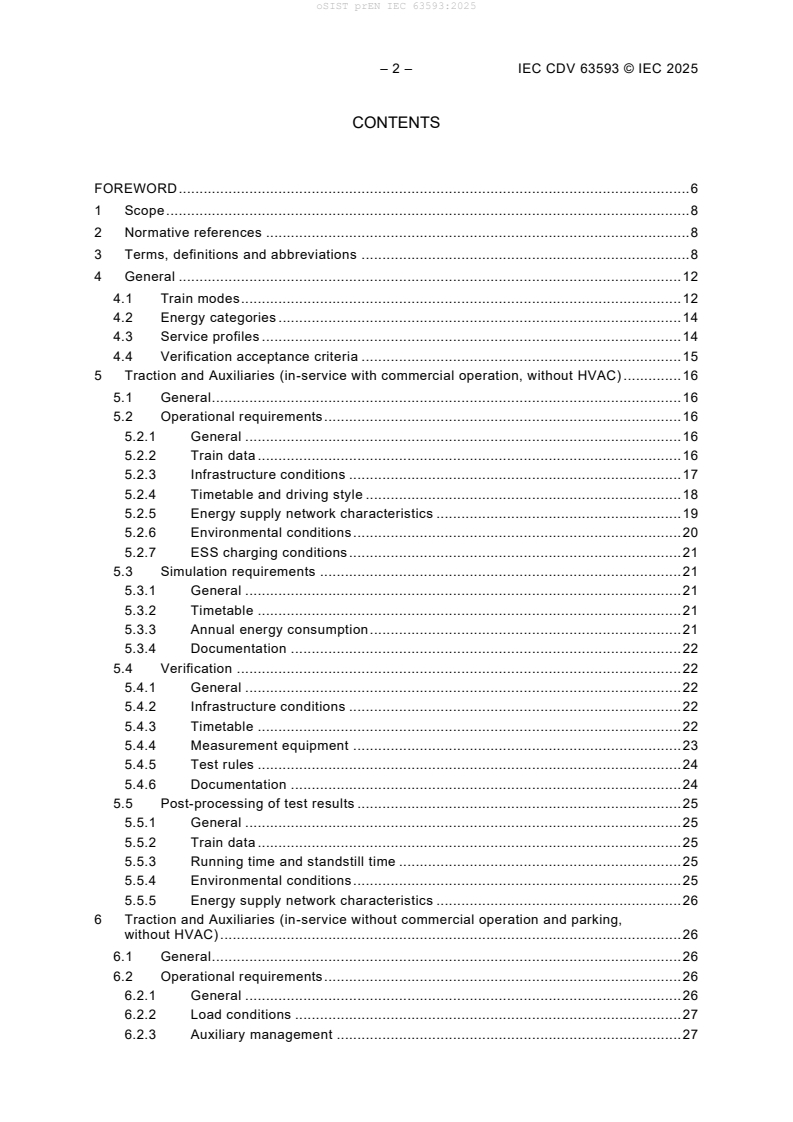
CONTENTS
FOREWORD . 6
1 Scope . 8
2 Normative references . 8
3 Terms, definitions and abbreviations . 8
4 General . 12
4.1 Train modes . 12
4.2 Energy categories . 14
4.3 Service profiles . 14
4.4 Verification acceptance criteria . 15
5 Traction and Auxiliaries (in-service with commercial operation, without HVAC) . 16
5.1 General . 16
5.2 Operational requirements . 16
5.2.1 General . 16
5.2.2 Train data . 16
5.2.3 Infrastructure conditions . 17
5.2.4 Timetable and driving style . 18
5.2.5 Energy supply network characteristics . 19
5.2.6 Environmental conditions . 20
5.2.7 ESS charging conditions . 21
5.3 Simulation requirements . 21
5.3.1 General . 21
5.3.2 Timetable . 21
5.3.3 Annual energy consumption . 21
5.3.4 Documentation . 22
5.4 Verification . 22
5.4.1 General . 22
5.4.2 Infrastructure conditions . 22
5.4.3 Timetable . 22
5.4.4 Measurement equipment . 23
5.4.5 Test rules . 24
5.4.6 Documentation . 24
5.5 Post-processing of test results . 25
5.5.1 General . 25
5.5.2 Train data . 25
5.5.3 Running time and standstill time . 25
5.5.4 Environmental conditions . 25
5.5.5 Energy supply network characteristics . 26
6 Traction and Auxiliaries (in-service without commercial operation and parking,
without HVAC) . 26
6.1 General . 26
6.2 Operational requirements . 26
6.2.1 General . 26
6.2.2 Load conditions . 27
6.2.3 Auxiliary management . 27
IEC CDV 63593 © IEC 2025 – 3 –
6.2.4 Energy supply network characteristics . 27
6.2.5 Environmental conditions . 27
6.2.6 ESS charging conditions . 27
6.3 Simulation requirements . 27
6.3.1 General . 27
6.3.2 Thermal stability . 27
6.3.3 Auxiliary conversion losses caused by HVAC supply . 27
6.3.4 Energy storage systems . 27
6.3.5 Annual energy consumption . 28
6.3.6 Documentation . 28
6.4 Verification . 28
6.4.1 General . 28
6.4.2 Test preparation . 28
6.4.3 Environmental conditions . 28
6.4.4 Measurement equipment . 28
6.4.5 ESS charging conditions . 28
6.4.6 Test duration . 28
6.4.7 Documentation . 29
6.5 Post-processing of test results . 29
7 HVAC . 30
7.1 General . 30
7.2 Methods . 30
7.3 Climatic and operational requirements . 30
7.3.1 In-service with commercial operation mode . 30
7.3.2 In-service without commercial operation mode . 31
7.3.3 Parking mode . 31
7.3.4 Total annual consumption . 31
7.4 Simulation requirements . 32
7.4.1 General . 32
7.4.2 Documentation . 32
7.5 Verification . 32
7.5.1 General . 32
7.5.2 Test rules . 32
7.5.3 Documentation . 32
7.6 Post-processing . 32
Annex A (normative) Definition of parameters for user-defined service profile . 33
A.1 General . 33
A.2 Infrastructure characteristics . 33
A.3 Electric traction system characteristics . 34
A.4 Service characteristics . 34
A.5 Fuel characteristics . 36
Annex B (informative) Example of standard service profiles . 37
B.1 General . 37
B.2 Profile B.1 Europe – Suburban on flat track . 38
B.3 Profile B.2 Europe - Regional on flat track . 39
B.4 Profile B.3 Europe - Intercity on flat track . 40
B.5 Profile B.4 Europe - High speed on flat track . 42
B.6 Profile B.5 Europe - Freight with gradients . 43
– 4 – IEC CDV 63593 © IEC 2025
B.7 Profile B.6 Europe – Metro on flat track. 45
B.8 Profile B.7 Japan – Urban and suburban on flat track. 47
B.9 Profile B.8 Japan - Regional with gradients . 48
B.10 Profile B.9 Japan – Local with gradients . 50
B.11 Profile B.10 Japan – High speed on flat track . 51
B.12 Profile B.11 Japan - High speed with gradients . 53
Annex C (normative) Definition of operational point matrix and operating hours for
Europe . 55
C.1 General . 55
C.2 In-service with commercial operation . 55
C.3 In-service without commercial operation . 57
C.4 Parking mode . 59
Annex D (informative) Application Guide . 60
D.1 Objectives for use in procurement projects . 60
D.2 Application guide . 60
Bibliography . 63
Figure 1 — Winter parking mode . 13
Figure B.1 – Standard profile B.1 Europe - Suburban on flat track . 38
Figure B.2 – Standard profile B.2 Europe - Regional on flat track . 39
Figure B.3 – Standard profile B.3 Europe - Intercity on flat track . 41
Figure B.4 – Standard profile B.4 Europe - High speed on flat track . 42
Figure B.5 – Standard profile B.5 Europe - Freight with gradients . 44
Figure B.6 – Standard profile B.6 Europe – Metro on flat track . 46
Figure B.7 – Standard profile B.7 Japan – Urban and suburban on flat track . 47
Figure B.8 – Combinations of speed limit and frequency . 47
Figure B.9 – Standard profile B.8 Japan - Regional with gradients . 49
Figure B.10 – Standard profile B.9 Japan – Local with gradients . 50
Figure B.11 – Standard profile B.10 Japan – High speed on flat track . 52
Figure B.12 – Combinations of speed limit and frequency . 52
Figure B.13 – Standard profile B.11 Japan - High speed with gradients . 53
Figure B.14 – Combination of speed limit and frequency . 54
Figure D.1 – Use of this standard in procurement process . 60
Figure D.2 – Example of infrastructure data . 61
Figure D.3 – Example of a simulated driving style . 62
Table A.1 – Tables in Annex A . 33
Table A.2 – Infrastructure characteristics . 33
Table A.3 – Electric traction system characteristics. 34
Table A.4 – Service characteristics . 35
Table A.5 – Fuel characteristics . 36
Table B.1 – Comparison of user-defined versus standard service profiles . 37
Table B.2 – Overview of the standard service profiles . 38
Table B.3 – Data of the profile B.1 Europe - Suburban on flat track . 39
IEC CDV 63593 © IEC 2025 – 5 –
Table B.4 – Data of the profile B.2 Europe - Regional on flat track . 40
Table B.5 – Data of the profile B.3 Europe - Intercity on flat track . 41
Table B.6 – Data of the profile B.4 Europe - High speed on flat track . 42
Table B.7 – Data of the profile B.5 Europe - Freight with gradients . 44
Table B.8 – Train data for freight assessment . 45
Table B.9 – Data of the profile B.6 Europe – Metro on flat track . 46
Table B.10 – Data of the profile B.7 Japan – Urban and suburban on flat track . 48
Table B.11 – Data of the profile B.8 Japan - Regional with gradients . 49
Table B.12 – Data of the profile B.9 Japan – Local with gradients . 50
Table B.13 – Data of the profile B.10 Japan – High speed on flat track . 53
Table B.14 – Data of the profile B.11 Japan - High speed with gradients . 54
Table C.1 – Operational point matrix for Europe – In-service with commercial operation
mode . 55
Table C.2 – HVAC annual operating hours – In-service with commercial operation
mode (12 h per day) Train category 1 . 56
Table C.3 – HVAC annual operating hours – In-service with commercial operation
mode (14 h per day) Train categories 2 and 3 . 56
Table C.4 – Operational point matrix in Europe – In-service without commercial
operation . 57
Table C.5 – HVAC annual operating hours – In-service without commercial operation
mode (4h per day) Train category 1 . 58
Table C.6 – HVAC annual operating hours – In-service without commercial operation
mode (2 h per day) Train categories 2 and 3 . 58
Table C.7 – Operational point matrix in Europe – Parking mode. 59
Table C.8 – HVAC annual operating hours – Parking mode (5 h during night and 3 h
during day) Train categories 1, 2 and 3 . 59
Table D.1 – Example of timetable . 61
– 6 – IEC CDV 63593 © IEC 2025
INTERNATIONAL ELECTROTECHNICAL COMMISSION
____________
RAILWAY APPLICATIONS – ROLLING STOCK –
SPECIFICATION AND VERIFICATION OF ENERGY CONSUMPTION
FOREWORD
1) The International Electrotechnical Commission (IEC) is a worldwide organization for standardization comprising
all national electrotechnical committees (IEC National Committees). The object of IEC is to promote international
co-operation on all questions concerning standardization in the electrical and electronic fields. To this end and
in addition to other activities, IEC publishes International Standards, Technical Specifications, Technical Reports,
Publicly Available Specifications (PAS) and Guides (hereafter referred to as "IEC Publication(s)"). Their
preparation is entrusted to technical committees; any IEC National Committee interested in the subject dealt with
may participate in this preparatory work. International, governmental and non-governmental organizations liaising
with the IEC also participate in this preparation. IEC collaborates closely with the International Organization for
Standardization (ISO) in accordance with conditions determined by agreement between the two organizations.
2) The formal decisions or agreements of IEC on technical matters express, as nearly as possible, an international
consensus of opinion on the relevant subjects since each technical committee has representation from all
interested IEC National Committees.
3) IEC Publications have the form of recommendations for international use and are accepted by IEC National
Committees in that sense. While all reasonable efforts are made to ensure that the technical content of IEC
Publications is accurate, IEC cannot be held responsible for the way in which they are used or for any
misinterpretation by any end user.
4) In order to promote international uniformity, IEC National Committees undertake to apply IEC Publications
transparently to the maximum extent possible in their national and regional publications. Any divergence between
any IEC Publication and the corresponding national or regional publication shall be clearly indicated in the latter.
5) IEC itself does not provide any attestation of conformity. Independent certification bodies provide conformity
assessment services and, in some areas, access to IEC marks of conformity. IEC is not responsible for any
services carried out by independent certification bodies.
6) All users should ensure that they have the latest edition of this publication.
7) No liability shall attach to IEC or its directors, employees, servants or agents including individual experts and
members of its technical committees and IEC National Committees for any personal injury, property damage or
other damage of any nature whatsoever, whether direct or indirect, or for costs (including legal fees) and
expenses arising out of the publication, use of, or reliance upon, this IEC Publication or any other IEC
Publications.
8) Attention is drawn to the Normative references cited in this publication. Use of the referenced publications is
indispensable for the correct application of this publication.
9) IEC draws attention to the possibility that the implementation of this document may involve the use of (a)
patent(s). IEC takes no position concerning the evidence, validity or applicability of any claimed patent rights in
respect thereof. As of the date of publication of this document, IEC had not received notice of (a) patent(s), which
may be required to implement this document. However, implementers are cautioned that this may not represent
the latest information, which may be obtained from the patent database available at https://patents.iec.ch. IEC
shall not be held responsible for identifying any or all such patent rights.
IEC 63593 has been prepared by subcommittee PT 63593: Railway Applications - Rolling Stock -
Specification and verification of energy consumption, of IEC technical committee 9: Electrical
equipment and systems for railways. It is an International Standard.
The text of this International Standard is based on the following documents:
Draft Report on voting
9/XXXX/FDIS 9/XXXX/RVD
Full information on the voting for its approval can be found in the report on voting indicated in
the above table.
The language used for the development of this International Standard is English.
IEC CDV 63593 © IEC 2025 – 7 –
This document was drafted in accordance with ISO/IEC Directives, Part 2, and developed in
accordance with ISO/IEC Directives, Part 1 and ISO/IEC Directives, IEC Supplement, available
at www.iec.ch/members_experts/refdocs. The main document types developed by IEC are
described in greater detail at www.iec.ch/publications.
The committee has decided that the contents of this document will remain unchanged until the
stability date indicated on the IEC website under webstore.iec.ch in the data related to the
specific document. At this date, the document will be
• reconfirmed,
• withdrawn,
• replaced by a revised edition, or
• amended.
– 8 – IEC CDV 63593 © IEC 2025
1 RAILWAY APPLICATIONS – ROLLING STOCK –
2 SPECIFICATION AND VERIFICATION OF ENERGY CONSUMPTION
5 1 Scope
6 This document is applicable to rolling stock energy consumption specification and verification and
7 establishes a methodology for the calculation of energy consumption which can be used to determine
8 the total net energy consumed from a primary power source (e.g. at current collector or from the fuel
9 tank), over a predefined service profile. It gives guidance to rolling stock procurement and life cycle cost
10 (LCC) assessments.
11 This document specifies the methodology for simulation and measurement of energy consumed and
12 regenerated by rolling stock. The results obtained from this methodology can be directly compared to,
13 or be representative of, the operation of a train.
14 This document establishes a framework on the generation of common, comparable energy performance
15 values for rolling stock which supports the benchmarking and improvement of the energy efficiency of
16 rolling stock.
17 This document, as a whole or in part, applies to all railway vehicles except coal-powered vehicles,
18 special purpose vehicles (e.g. shunting locomotives, vehicles for track construction and maintenance)
19 and magnetically supported vehicles.
20 This document does not apply to the comparison of energy consumption with other modes of
21 transportation, or comparison between diesel and electric traction; it applies only to the energy
22 consumption of rolling stock itself.
23 2 Normative references
24 The following documents are referred to in the text in such a way that some or all of their content
25 constitutes requirements of this document. For dated references, only the edition cited applies.
26 For undated references, the latest edition of the referenced document (including any
27 amendments) applies.
28 ISO 19659-3:2022, Railway applications — Heating, ventilation and air conditioning systems for rolling
29 stock — Part 3: Energy efficiency
30 ISO/DIS 10516:2024, Railway applications – Vehicle reference masses
31 IEC 60850, Railway applications - Supply voltages of traction
32 IEC 62888-2:2018, Railway applications - Energy measurement on board trains - Part 2: Energy
33 3 Terms, definitions and abbreviations
34 3.1 Terms and definitions
35 For the purposes of this document, the following terms and definitions apply.
36 ISO and IEC maintain terminology databases for use in standardisation at the following
37 addresses:
38 • IEC Electropedia: available at https://www.electropedia.org/
39 • ISO Online browsing platform: available at https://www.iso.org/obp
IEC CDV 63593 © IEC 2025 – 9 –
40 3.1.1
41 rolling stock
42 all vehicles with or without motors
43 Note 1 to entry: Examples of vehicles include a locomotive, a coach and a wagon.
44 [SOURCE: IEC 60050-811:2017/AMD1:2021, 811-02-01]
45 3.1.2
46 train
47 combination of rolling stock coupled together
48 [SOURCE: IEC 60050-811:2017/AMD1:2021, 811-01-08, modified – the Note 1 to entry has
49 been omitted.]
50 3.1.3
51 consist
52 single vehicle or a group of vehicles which are not separated during normal operation
53 [SOURCE: IEC 60050-811:2017/AMD1:2021, 811-37-20, modified – the Note 1 to entry has
54 been omitted.]
55 3.1.4
56 traction unit
57 locomotive, motor coach or train-unit
58 [SOURCE: IEC 60050-811:2017/AMD1:2021, 811-02-04]
59 3.1.5
60 infrastructure
61 fixed installations of the railway system (for example tracks, power supply, signalling,
62 communication)
63 3.1.6
64 electric traction system
65 railway electric distribution network (infrastructure) used to provide energy for rolling stock
66 [SOURCE: IEC 60050-811:2017/AMD1:2021, 811-36-21, modified – “(infrastructure)” has been
67 added and the Note 1 to entry has been omitted.]
68 3.1.7
69 contact line
70 conductor system for supplying electric energy to vehicles through current-collecting equipment
71 [SOURCE: IEC 60050-811:2017/AMD1:2021, 811-33-01, modified – the Note 1 to entry has
72 been omitted.]
73 3.1.8
74 net energy
75 difference between the energy taken (consumed) from the contact line, fuel tank by the traction
76 unit, and the energy fed back (regenerated) into the contact line by the traction unit
77 3.1.9
78 service profile
79 outline of the expected range and variation in the mission with respect to parameters such as
80 time, loading, speed, distance, stops, tunnels, etc., in the commercial exploitation of the train
– 10 – IEC CDV 63593 © IEC 2025
81 3.1.10
82 standard service profile
83 service profile which is characterised by definitions of standard values
84 Note 1 to entry: See Annex B.
85 3.1.11
86 user-defined service profile
87 service profile which is agreed by the involved parties for the comparison of the energy
88 consumption of trains
89 Note 1 to entry: It is also intended for the comparison of simulations and real tests of the energy consumption of
90 trains on an existing infrastructure.
91 3.1.12
92 single train run
93 run of one train over a part of the infrastructure without inclusion of effects of other trains
94 3.1.13
95 regenerative braking
96 electro-dynamic braking in which the energy produced by the motors is fed into the contact line
97 or used by on-board devices
98 [SOURCE: IEC 60050-811:2017/AMD1:2021, 811-06-25, “into energy storage” has been
99 replaced with “or used by”, and the Note 1 to entry has been omitted.]
100 3.1.14
101 primary power source
102 subsystem with the primary purpose of which is to supply energy to other subsystems by either
103 consuming the fuel stored on-board or taking in energy from external source
104 3.1.15
105 traction equipment
106 equipment on-board of the train directly needed to produce tractive or dynamic braking effort
107 (for example transformers, converters, motors, gearboxes, internal combustion engines, fuel
108 cells, energy storage systems)
109 3.1.16
110 traction chain
111 complete set of traction equipment on-board of the train
112 3.1.17
113 traction auxiliaries
114 equipment needed to operate the traction equipment and the train in normal operation mode,
115 but not producing tractive or dynamic braking efforts themselves
116 Note 1 to entry: For example cooling fans, oil and water pumps, compressor, air supply for brakes, HVAC for the
117 leading driver’s cabin, train control and management system and signalling equipment .
118 3.1.18
119 comfort systems
120 all equipment consuming energy for passenger and crew comfort belonging neither to the
121 traction equipment nor to traction auxiliaries, mainly for the provision of a comfortable
122 environment (for example lighting, heating, air conditioning, toilets, information and
123 entertainment systems, laptop supplies)
124 Note 1 to entry: Comfort systems are split in two groups for use in this document: Heating, Ventilation and Air
125 Conditioning (HVAC) and Other comfort functions.
IEC CDV 63593 © IEC 2025 – 11 –
126 3.1.19
127 heating, ventilation and air conditioning
128 HVAC
129 system to provide heating, ventilation and air conditioning for comfort
130 Note 1 to entry: ”without HVAC” means, the HVAC system is switched off.
131 3.1.20
132 auxiliary power supply line
133 electric cable running throughout a train and supplying the heating or other services on each
134 coach
135 [SOURCE: IEC 60050-811:2017/AMD1:2021, 811-23-11]
136 3.1.21
137 energy storage system
138 ESS
139 physical system which comprises energy storage technologies such as batteries, double -layer
140 capacitors, flywheel, etc. and other equipment to connect the storage technologies to traction
141 equipment, including control, cooling and monitoring systems
142 Note 1 to entry: The auxiliary batteries are not covered by this term.
143 3.1.22
144 state of energy
145 SoE
146 remaining energy to be discharged
147 Note 1 to entry: It is normally expressed as a percentage of full energy.
148 Note 2 to entry: Reference for full energy is begin of life of the ESS and usable energy, i.e. energy available to be discharged
149 depending upon applications.”
150 [SOURCE: IEC 62864-1:2016, 3.1.14, modified – the end of the definition “as expressed in relevant standards” has
151 been removed and the Note 1 to entry has been replaced.]
152 3.2 Abbreviations
153 For the purposes of this document, the following abbreviations apply.
AC Alternating Current
BEMU Battery Electric Multiple Unit
DC Direct Current
ESS Energy Storage System
HMI Human Machine Interface
HVAC Heating, Ventilation and Air Conditioning System
ID Identifier
LCC Life Cycle Cost
LHV Lower Heating Value
LRV Light Rail Vehicle
SoE State of Energy
WLAN Wireless Local Area Network
– 12 – IEC CDV 63593 © IEC 2025
154 4 General
155 4.1 Train modes
156 Train operation always takes place under the constraints of infrastructure and operational requirements.
157 Only normal operation is considered in this document. During normal operation, all systems function as
158 intended. Degraded modes, in which a system is not fully available, are not considered in this document.
159 The following train modes are used in this document:
160 — In-service with commercial operation mode:
161 The operation of a train, including several passenger load cases or a locomotive hauling a consist
162 of freight wagons. The train can be moving or stationary and the HVAC system is running in its
163 normal operation mode.
164 — In-service without commercial operation mode:
165 A stationary train where the HVAC system is in operation as for commercial operation but no
166 passengers are in the train. This situation can occur, for example, when the train is waiting between
167 two commercial train runs or when a freight train is waiting for proceeding with driver on-board.
168 — Parking mode:
169 A stationary train in a depot, without staff or passengers on board. In this mode, systems that are
170 not required can be switched off.
171 The HVAC system typically operates with different set points for temperature and airflow, or
172 alternatively, is shut down to save energy. The purpose of parking mode usually includes frost
173 protection and maintaining the interior temperature to a reasonable level.
174 Figure 1 is an example illustration of different phases in parking mode during winter.
175 NOTE It can be that not all phases are implemented in the train design. Parking mode in the summer can follow
176 the same phases with cooling instead of heating.
IEC CDV 63593 © IEC 2025 – 13 –
179 Key
1 Time [h]
2 Interior temperature [°C]
3 Start of parking mode
4 Start of heating to maintain temperature
5 Start of pre-heating
6 End of pre-heating, start of in-service without commercial operation mode for HVAC
7 Train ready for: in-service without commercial operation (can be at the same point of time as
6)
8 Interior temperature setting during parking mode
9 Interior temperature setting during in-service without commercial operation mode
10 Phase 1 : In-service without commercial operation mode
11 Phase 2 : Parking mode without heating
12 Phase 3 : Parking mode with heating (maintain interior temperature)
13 Phase 4 : Parking mode with pre conditioning (pre-heating)
14 Phase 5 : Parking mode to prepare for in-service without commercial operation mode (e.g.
brake tests, etc.)
15 Phase 6 : In-service without commercial operation mode
180 Figure 1 — Winter parking mode
181 Parking mode in winter is composed of different phases (from key 11 to key 14 of Figure 1).
182 During phase 1, the system operates with a nominal interior temperature setting for in-service without
183 commercial operation. After this phase 1 (key 3), the parking mode is starting.
184 During phase 2, the train heating does not operate because the mean interior temperature is higher than
185 the temperature setting.
186 During phase 3, the train maintains a mean interior temperature to avoid a temperature that is too cool.
187 Generally, this temperature is set to around 3 °C or 5 °C.
– 14 – IEC CDV 63593 © IEC 2025
188 During phase 4, the train operates in heating (pre-heating).
189 At the end of phase 4 (key 6), the train reaches the interior temperature setting for in-service without
190 commercial operation.
191 Phase 5 is the remaining time to finish parking mode. For example, if the duration of the parking mode
192 is 8 h and if the pre-heating mode finishes after 7 h 30 min, the duration of phase 5 is 30 min. Similarly,
193 if pre-conditioning is ongoing for other systems, the train maintains the mean interior temperature
194 according to the temperature setting in-service without commercial operation mode during this time.
195 The pre-conditioning of other systems need to be considered during parking as well.
196 Other train modes, for example empty carriage stock movements, are not considered in this document.
197 If the empty carriage stock has a significant impact to the annual energy consumption, it can be treated
198 as part of in-service with commercial operation mode without load.
199 In this document, cleaning is not considered separately. The corresponding hours should be counted in
200 the in-service without commercial operation mode.
201 NOTE 1 Activation and deactivation of parking mode can be done in different ways, such as automatically after
202 a given condition, e.g. when the train is in the previous state “In-service without commercial operation mode” after a
203 time duration, or manually, by an action from the train crew (driver, maintenance worker, etc.) on a device located
204 on-board (e.g. a switch in driving cab, HMI, etc.) and on-ground remotely.
205 NOTE 2 Where a train is switched off for maintenance periods, this can be considered either in a reduced annual sum of
206 mileage and operating hours or by additional reserve trains outside the energy calculation.
207 4.2 Energy categories
208 To simplify the verification process and ensure reproducible results, the energy consumption of
209 the entire train is subdivided into the following three distinct energy categories:
210 1) Traction and Auxiliaries (in-service with commercial operation mode, without HVAC);
211 2) Traction and Auxiliaries (in-service without commercial operation mode and parking
212 mode, without HVAC);
213 3) HVAC.
214 Unless otherwise specified by the purchaser, the following conditions are applied for Energy
215 categories “1) and 2) Traction and Auxiliaries”:
216 • Losses in the traction chain and auxiliary converters shall be included.
217 • All traction auxiliaries as e.g. cooling fans, oil and water pumps, compressor, air supply
218 for brakes, HVAC for the leading driver’s cabin, train control and management system
219 and signalling equipment shall be included.
220 • Subsystems, where the usage depends on staff or passengers, shall be switched off, if
221 not defined otherwise by the purchaser (e.g. kitchen, toilet flush, reading lights).
222 • All additional subsystems excluding HVAC for passenger compartments and inactive
223 driver’s cabins shall be considered according to normal operation in the respective train
224 mode (including, for example, lighting, passenger information systems).
225 4.3 Service profiles
226 This document combines infrastructure and operational conditions into “service profiles” for the
227 train. The user-defined service profile for traction and auxiliaries is assessed via train runs
228 along a line for in-service with commercial operation and stationary for in-service without
229 commercial operation. HVAC is assessed via a set of operational points for different operational
230 modes.
231 The methodology for the specification and verification of energy consumption is based on the
232 evaluation of service profiles. The selected approach has two steps:
IEC CDV 63593 © IEC 2025 – 15 –
233 a) simulation of the energy consumption of the train for the three energy categories
234 mentioned in 4.2;
235 b) verification of the simulation by undertaking measurements.
236 User-defined service profiles for traction and auxiliaries are based on data from a real railway
237 line, normally one or several lines of the railway network where the train will be operated.
238 Definitions of relevant parameters for these user-defined service profiles are set out in Annex A
239 and the values shall be given by the purchaser.
240 In the case that the energy consumption of trains is compared without the context of real
241 operation, such as for research, the standard service profiles from Annex B could be used. The
242 standard service profiles cannot replace user-defined service profiles for representative energy
243 consumption calculation and verification, as pointed out in Table B.1.
...
Questions, Comments and Discussion
Ask us and Technical Secretary will try to provide an answer. You can facilitate discussion about the standard in here.
Loading comments...