

SIST EN 15429-2:2013
(Main)Sweepers - Part 2: Performance requirements and test methods
General Information
- Abstract
This document applies to surface cleaning machines for outdoor applications in public areas, roads, airports and industrial complexes. Cleaning machines for winter maintenance and/or indoor applications are not included within the scope of this European Standard. Surface cleaning machines in terms of this standard, are self-propelled, truck mounted, attached sweeping equipment or pedestrian controlled.
This standard deals with the performance and functional characteristics and the test methods applied to the sweeping equipment when used as intended and under the conditions foreseen by the manufacturer.
This document does not include carrier vehicles (e.g. trucks). These are covered in national or EU Directives for vehicles.
This document does not apply to road surface cleaning equipment that would be front mounted on tractors according to EN 13524, or other vehicles.
This standard does not apply to machines or components that are specifically designed for cleaning tramlines and rail tracks.
This standard does not cover noise emission or any overload protection as these are covered by regulatory requirements.
Industrial sweepers, within the scope of EN 60335-2-72 are excluded from this standard.
- Status
- Published
- Publication Date
- 27-Jan-2013
- Technical Committee
- I13 - Imaginarni 13
- Current Stage
- 6060 - National Implementation/Publication (Adopted Project)
- Start Date
- 24-Jan-2013
- Due Date
- 31-Mar-2013
- Completion Date
- 28-Jan-2013

Overview
SIST EN 15429-2:2013 - "Sweepers - Part 2: Performance requirements and test methods" - is a key European Standard developed by CEN for surface cleaning machines designed for outdoor environments. It establishes the performance requirements and consistent test methods that apply to sweepers used for cleaning public areas, roads, airports, and industrial complexes. This standard increases reliability and comparability in sweeper performance across the industry, benefiting manufacturers, operators, and regulatory bodies.
Specifically, SIST EN 15429-2:2013 covers self-propelled, truck-mounted, attached sweeping equipment, and pedestrian-controlled machines. It explicitly excludes winter maintenance, indoor cleaning machines, carrier vehicles, tramline and rail track sweepers, and road cleaning equipment covered by other standards such as EN 13524 or EN 60335-2-72.
Key Topics
Performance Requirements: The standard sets out criteria related to theoretical sweeping capability, sweep ability (the maximum speed at which a sweeper effectively operates), airflow capabilities, conveyor or elevator capacity, grade-ability, kerb climbing, ramp/approach/departure angles, ground pressure, and fuel consumption.
Test Methods: SIST EN 15429-2:2013 details the test procedures to objectively measure each aspect of sweeper performance, ensuring repeatable and consistent evaluation regardless of the manufacturer.
Functional Characteristics: Requirements are given for water systems (drainage, impurity tolerance) and sweeping gear (deflection on obstacle contact), which are critical for reliable field operation.
Exclusions and Limitations: This standard does not address noise emissions or overload protection, which are governed by regulatory requirements. Industrial sweepers for indoor use and specialty equipment for tram or rail cleaning are also outside its scope.
Applications
SIST EN 15429-2:2013 is crucial for:
- Manufacturers: Enables uniform product development, ensuring that machines meet recognized benchmarks for performance and functionality when used in outdoor municipal, industrial, airport, and commercial settings.
- Procurement and Operations: Facility managers, municipalities, and industry operators can use the standard to specify, compare, and select surface sweepers based on objective, tested criteria.
- Quality Assurance: Offers a framework for ongoing product validation during production and routine fleet assessment to ensure continued compliance and optimal performance.
- Regulatory Compliance: Helps local authorities and industry regulators ensure that cleaning machines used in public and high-traffic areas adhere to best practices for efficiency and effectiveness.
Related Standards
Organizations working with or referencing SIST EN 15429-2:2013 may also consider the following standards:
EN 15429-1: Sweepers - Part 1: Classification and Terminology
Standardizes terms and types of sweepers to ensure clarity and alignment across European regulatory and procurement activities.prEN 15429-3: Sweepers - Part 3: Efficiency of Particulate Matter Collection - Testing and Evaluation
Sets procedures for evaluating the environmental and dust-collection efficiency of sweepers.prEN 15429-4: Sweepers - Part 4: Symbols for Operator Controls and Other Displays
Provides a harmonized set of symbols for equipment controls to promote operator safety and usability.EN 13524: Front-mounted equipment on tractors
Applies to some cleaning machines explicitly excluded from the scope of SIST EN 15429-2:2013.EN 60335-2-72
Covers industrial floor scrubbers and sweepers intended primarily for indoor applications.
Practical Value
Adherence to SIST EN 15429-2:2013 assures end-users and procurement professionals that surface cleaning machines have been rigorously tested and reliably perform under real-world conditions. The standard promotes transparency, safety, and efficiency in the maintenance of large outdoor paved areas, contributing to cleaner, safer, and more visually appealing public and industrial environments.
Keywords: SIST EN 15429-2:2013, sweeper performance, test methods, surface cleaning machines, outdoor sweepers, CEN standard, fuel consumption, kerb climbing, airflow capability, industrial cleaning equipment, public area maintenance, road cleaning standards.
Relations
- Effective Date
- 10-Jun-2026
- Effective Date
- 28-Jan-2026
- Effective Date
- 28-Jan-2026
- Effective Date
- 28-Jan-2026
- Referred By
SIST EN 15429-4:2015 - Sweepers - Part 4: Symbols for operator controls and other displays - Effective Date
- 28-Jan-2026
Get Certified
Connect with accredited certification bodies for this standard

TÜV Rheinland
TÜV Rheinland is a leading international provider of technical services.

TÜV SÜD
TÜV SÜD is a trusted partner of choice for safety, security and sustainability solutions.

DEKRA Certification Inc.
DEKRA US certification services.
Sponsored listings
Frequently Asked Questions
SIST EN 15429-2:2013 is a standard published by the Slovenian Institute for Standardization (SIST). Its full title is "Sweepers - Part 2: Performance requirements and test methods". This standard covers: This document applies to surface cleaning machines for outdoor applications in public areas, roads, airports and industrial complexes. Cleaning machines for winter maintenance and/or indoor applications are not included within the scope of this European Standard. Surface cleaning machines in terms of this standard, are self-propelled, truck mounted, attached sweeping equipment or pedestrian controlled. This standard deals with the performance and functional characteristics and the test methods applied to the sweeping equipment when used as intended and under the conditions foreseen by the manufacturer. This document does not include carrier vehicles (e.g. trucks). These are covered in national or EU Directives for vehicles. This document does not apply to road surface cleaning equipment that would be front mounted on tractors according to EN 13524, or other vehicles. This standard does not apply to machines or components that are specifically designed for cleaning tramlines and rail tracks. This standard does not cover noise emission or any overload protection as these are covered by regulatory requirements. Industrial sweepers, within the scope of EN 60335-2-72 are excluded from this standard.
This document applies to surface cleaning machines for outdoor applications in public areas, roads, airports and industrial complexes. Cleaning machines for winter maintenance and/or indoor applications are not included within the scope of this European Standard. Surface cleaning machines in terms of this standard, are self-propelled, truck mounted, attached sweeping equipment or pedestrian controlled. This standard deals with the performance and functional characteristics and the test methods applied to the sweeping equipment when used as intended and under the conditions foreseen by the manufacturer. This document does not include carrier vehicles (e.g. trucks). These are covered in national or EU Directives for vehicles. This document does not apply to road surface cleaning equipment that would be front mounted on tractors according to EN 13524, or other vehicles. This standard does not apply to machines or components that are specifically designed for cleaning tramlines and rail tracks. This standard does not cover noise emission or any overload protection as these are covered by regulatory requirements. Industrial sweepers, within the scope of EN 60335-2-72 are excluded from this standard.
SIST EN 15429-2:2013 is classified under the following ICS (International Classification for Standards) categories: 13.030.40 - Installations and equipment for waste disposal and treatment; 43.160 - Special purpose vehicles. The ICS classification helps identify the subject area and facilitates finding related standards.
SIST EN 15429-2:2013 has the following relationships with other standards: It is inter standard links to SIST ISO 612:2000, SIST EN 12276:2000/AC:2002, SIST EN 12281:2003, SIST EN 15429-1:2008, SIST EN 15429-4:2015. Understanding these relationships helps ensure you are using the most current and applicable version of the standard.
SIST EN 15429-2:2013 is available in PDF format for immediate download after purchase. The document can be added to your cart and obtained through the secure checkout process. Digital delivery ensures instant access to the complete standard document.
Standards Content (Sample)
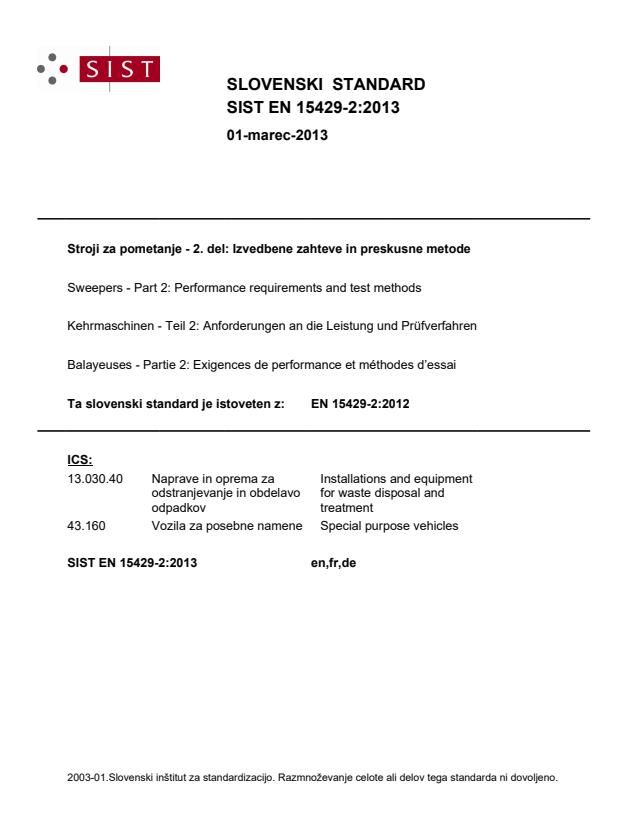
2003-01.Slovenski inštitut za standardizacijo. Razmnoževanje celote ali delov tega standarda ni dovoljeno.Stroji za pometanje - 2. del: Izvedbene zahteve in preskusne metodeKehrmaschinen - Teil 2: Anforderungen an die Leistung und PrüfverfahrenBalayeuses - Partie 2: Exigences de performance et méthodes d’essaiSweepers - Part 2: Performance requirements and test methods43.160Vozila za posebne nameneSpecial purpose vehicles13.030.40Naprave in oprema za odstranjevanje in obdelavo odpadkovInstallations and equipment for waste disposal and treatmentICS:Ta slovenski standard je istoveten z:EN 15429-2:2012SIST EN 15429-2:2013en,fr,de01-marec-2013SIST EN 15429-2:2013SLOVENSKI
STANDARD
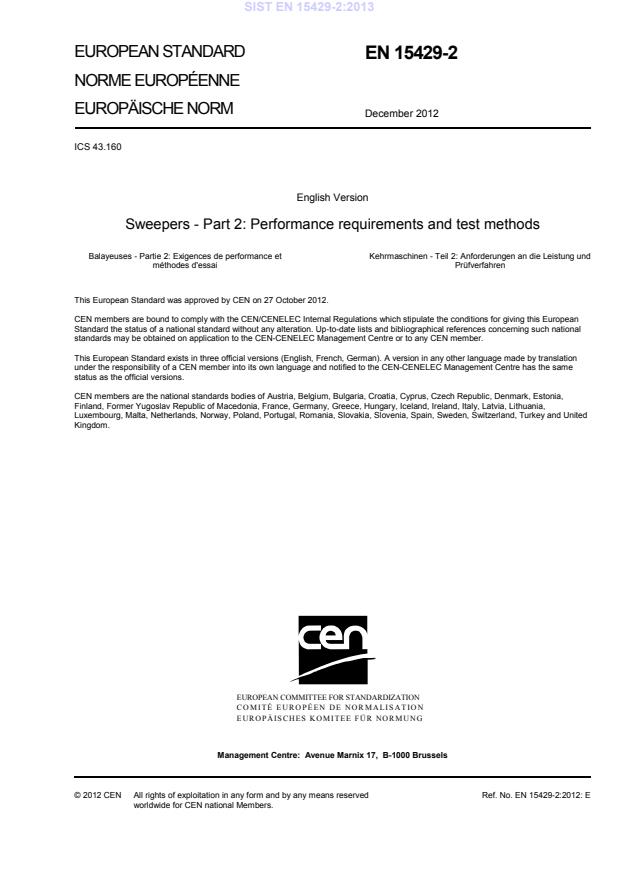
EUROPEAN STANDARD NORME EUROPÉENNE EUROPÄISCHE NORM
EN 15429-2
December 2012 ICS 43.160 English Version
Sweepers - Part 2: Performance requirements and test methods Balayeuses - Partie 2: Exigences de performance et méthodes d'essai
Kehrmaschinen - Teil 2: Anforderungen an die Leistung undPrüfverfahren This European Standard was approved by CEN on 27 October 2012.
CEN members are bound to comply with the CEN/CENELEC Internal Regulations which stipulate the conditions for giving this European Standard the status of a national standard without any alteration. Up-to-date lists and bibliographical references concerning such national standards may be obtained on application to the CEN-CENELEC Management Centre or to any CEN member.
This European Standard exists in three official versions (English, French, German). A version in any other language made by translation under the responsibility of a CEN member into its own language and notified to the CEN-CENELEC Management Centre has the same status as the official versions.
CEN members are the national standards bodies of Austria, Belgium, Bulgaria, Croatia, Cyprus, Czech Republic, Denmark, Estonia, Finland, Former Yugoslav Republic of Macedonia, France, Germany, Greece, Hungary, Iceland, Ireland, Italy, Latvia, Lithuania, Luxembourg, Malta, Netherlands, Norway, Poland, Portugal, Romania, Slovakia, Slovenia, Spain, Sweden, Switzerland, Turkey and United Kingdom.
EUROPEAN COMMITTEE FOR STANDARDIZATION
COMITÉ EUROPÉEN DE NORMALISATION EUROPÄISCHES KOMITEE FÜR NORMUNG
Management Centre:
Avenue Marnix 17,
B-1000 Brussels © 2012 CEN All rights of exploitation in any form and by any means reserved worldwide for CEN national Members. Ref. No. EN 15429-2:2012: ESIST EN 15429-2:2013
Air velocity and volume measurement using the Pilot tube method . 15Annex B (informative)
Test Report - Fuel consumption . 17Annex C (informative)
Example - Grade-ability test and calculation . 18C.1 Introduction . 18C.2 Test Procedure – Tractive Effort – Ability to start on and climb a gradient . 18C.2.1 General . 18C.2.2 Test result and calculation . 19C.3 Test Procedure – Braking Effort - Ability to slow, stop and hold on a gradient . 19C.3.1 General . 19C.3.2 Test Result and Calculation . 19Bibliography . 20 SIST EN 15429-2:2013
Most of these sweepers are equipped with sweep gear to scarify debris with a pick-up system that collects and conveys the spoil into a hopper. This hopper can be discharged at dumping grounds, unloading stations, into containers or at refuse transfer stations. Sweeping applications are mainly related to the physical size and dimensions of the sweeper. Sweepers of larger dimensions are designed to operate mainly on streets, highways, motorways, large parking areas and within industrial complexes. Sweepers of smaller dimensions are designed for the cleaning of inner town streets, pedestrian zones, pavements, bicycle lanes, car parking facilities market places and within industrial plants etc. Manœuvrability is one of the main features of this category of sweeper. Depending on the dimensions, sweeping attachment equipment (e.g. equipment temporally mounted on multi-purpose carrier vehicles or other machines) may be used in similar applications as above. Additional equipment for specialised cleaning applications; that may be attached to a sweeper is not covered by this standard. This document (EN 15429-2:2012) is part of a series of documents made up of the following parts: EN 15429-1, Sweepers - Part 1: Classification and Terminology; EN 15429-2, Sweepers - Part 2: Performance requirements and test methods; prEN 15429-3, Sweepers - Part 3: Efficiency of particulate matter collection - Testing and Evaluation; prEN 15429-4, Sweepers - Part 4: Symbols for operator controls and other displays. According to the CEN/CENELEC Internal Regulations, the national standards organisations of the following countries are bound to implement this European Standard: Austria, Belgium, Bulgaria, Croatia, Cyprus, Czech Republic, Denmark, Estonia, Finland, Former Yugoslav Republic of Macedonia, France, Germany, Greece, Hungary, Iceland, Ireland, Italy, Latvia, Lithuania, Luxembourg, Malta, Netherlands, Norway, Poland, Portugal, Romania, Slovakia, Slovenia, Spain, Sweden, Switzerland, Turkey and the United Kingdom. SIST EN 15429-2:2013
The following information shall accompany the air flow capability declaration: sweeper - model/type; declaration expressed in m3/sec at 20 °C and at 101,3 kPa atmospheric pressure; settings and running speeds. 4.3.2 Test method The average air velocity within the duct may be measured using suitable means. Prior to any test, the machine shall be inspected to ensure that it is in good working order, clean and that any filters and/or communicating ductwork are free of restrictions and or blockages. During tests, the machine shall be set up according to the manufactures recommended settings. In addition, a record of these settings and running speeds shall accompany the performance results. Annex A describes a technique to measure duct velocity using the Pitot tube method.
4.4 Conveyor or elevator capability 4.4.1 Performance Machines that employ a mechanical means to transfer swept debris to the collection hopper may use a conveyor or elevator system (see figure 1). These systems may be of typical designs arranged vertically or inclined using a number of elevating catchments, e.g. flights/ribs on a conveyor belt, flights dragging up an inclined ramp or other similar mechanisms. In each case, the catchment (C) has a calculated volume in its transfer position, gauged when loaded with dry sand having an angle of repose of 35°. The conveyor system will have an operating speed where the catchment discharge (Cd) rate and its volume can be equated to a maximum loading capability – VMLC, expressed in m3/min. Performance is assessed by calculation. The following information shall accompany the conveyor or elevator capability declaration: sweeper - model/type; SIST EN 15429-2:2013
a) Belt conveyor
b) Flight elevator Key H catchment height W catchment width 1 catchment (volume) 2 horizontal plane 3 discharge 35° angle of repose (dry sand) α elevator inclination Figure 1 — Conveyor/elevator load catchment volume 4.4.2 Calculation Maximum loading capability VMLC is determined by calculation and disclosed as a theoretical value, thus: ()235-tand2MLC×°××=αCWHV (1)
where VMLC
is the maximum loading capability in (m3/min); Cd
is the number of catchments discharging per minute (1/min); H
is the catchment height in metres; W
is the catchment width in metres. SIST EN 15429-2:2013
In the case of attached sweeping equipment, the sweeping/collection mechanisms may have their own prime mover or be driven by power-take-off facilities from the carrier vehicle. Fuel consumption declaration in these cases shall be according to the closest similarity to either of the other two other classification type of sweeper. An example test report of the fuel consumption is given in Annex B. Table 1 shows prime mover configuration according to machine type. Table 1 — Classification of sweeper – according to EN 15429-1 Sub-Type Machine Type Prime Mover Configuration
Single (S) Engine Twin (T) Engine Large Truck mounted sweeper Mainly T / Some S Small Truck mounted sweeper Mainly T / Some S Maxi-Compact-Sweeper Self propelled sweeper S Compact-Sweeper Self propelled sweeper S Midi-Compact-Sweeper Self propelled sweeper S Mini-Compact-Sweeper Self propelled sweeper S with hopper Attached sweeping equipment Mainly S / Some T
Fuel consumption(s) shall be declared in litres per hour (l/h) rounded to the first decimal point and d
...