

SIST ISO 9011:1998
(Main)Synchronous belt drives -- Automotive pulleys
General Information
- Abstract
- Status
- Published
- Publication Date
- 31-Oct-1998
- Technical Committee
- DTN - Lift and transport appliances
- Current Stage
- 6060 - National Implementation/Publication (Adopted Project)
- Start Date
- 01-Nov-1998
- Due Date
- 01-Nov-1998
- Completion Date
- 01-Nov-1998
Buy Documents





ISO 9011:1997 - Synchronous belt drives — Automotive pulleys Released:4/10/1997

ISO 9011:1997 - Transmissions synchrones par courroies — Poulies pour la construction automobile Released:4/10/1997


ISO 9011:1997 - Transmissions synchrones par courroies — Poulies pour la construction automobile Released:4/10/1997
Overview
SIST ISO 9011:1998 - Synchronous Belt Drives – Automotive Pulleys establishes internationally recognized requirements for synchronous pulleys used in automotive belt drive systems. This standard, developed by the International Organization for Standardization (ISO) and adopted by SIST, provides a comprehensive framework for defining key characteristics, dimensions, tolerances, quality, and designation methods for synchronous automotive pulleys. Its specifications are crucial for ensuring compatibility, reliability, and performance in automotive applications involving synchronous endless belt drives.
Key Topics
- Pulley Types: The standard covers various pulley types used in automotive applications, including trapezoidal and curvilinear tooth profiles (types ZA, ZB, ZH, YH, ZR, YR, ZS, YS).
- Tooth Profiles and Dimensions: Defines precise measurements for different tooth profiles, in line with respective belt standards, ensuring accurate engagement and transmission.
- Pulley Designation: Provides a standardized method for identifying pulleys based on the number of teeth, tooth pitch and profile, and nominal width.
- Dimensional Tolerances: Specifies tolerances for:
- Tooth dimensions and pitch
- Outside diameter
- Minimum pulley width
- Flange dimensions
- Axial and radial runout
- Parallelism and taper
- Quality Specification: Aligns requirements for pulley finish and balance with ISO 254, helping ensure product consistency and dependability.
Applications
Automotive synchronous pulleys covered by ISO 9011 are essential components in vehicle power transmission systems. Key areas of application include:
- Internal Combustion Engines: Synchronous pulleys are used to drive timing belts, ensuring synchronization between the crankshaft and camshaft and optimizing engine performance.
- Auxiliary Automotive Systems: Pulleys are integral in systems that require precision timing and synchronized motion, such as water pumps or alternators.
- Component Standardization: Enables manufacturers and suppliers to design, produce, and interchange pulleys and belts with confidence in fit, function, and quality.
- Maintenance and Replacement: Clear specifications on dimensions and tolerances facilitate straightforward maintenance, repair, and parts replacement for automotive service providers.
Implementing the guidelines of SIST ISO 9011:1998 contributes to improved efficiency, reduced noise, and increased longevity of automotive synchronous belt drives. Using standardized pulleys mitigates risk of mismatch and mechanical failures, a priority for both manufacturers and end users.
Related Standards
For comprehensive coverage of automotive belt drive systems, the following ISO standards are closely interlinked with ISO 9011:
- ISO 254: Focuses on the quality, finish, and balance requirements for pulleys in belt drives, as referenced for finish and balance criteria.
- ISO 9010: Specifies requirements for automotive synchronous belts, ensuring proper meshing and operation with pulleys defined in ISO 9011.
Working within this standardized framework ensures optimal compatibility and interchangeability between components in the automotive industry, streamlining supply chains and maintenance operations.
By adhering to SIST ISO 9011:1998, automotive industry stakeholders can ensure the consistent quality, safety, and efficiency of synchronous belt drive systems, meeting international expectations for engineering precision and reliability. This standard is essential for anyone involved in automotive engineering, component manufacturing, or vehicle maintenance.
Relations
- Effective Date
- 15-Apr-2008
Buy Documents
ISO 9011:1997 - Synchronous belt drives — Automotive pulleys Released:4/10/1997
ISO 9011:1997 - Transmissions synchrones par courroies — Poulies pour la construction automobile Released:4/10/1997
ISO 9011:1997 - Transmissions synchrones par courroies — Poulies pour la construction automobile Released:4/10/1997
Get Certified
Connect with accredited certification bodies for this standard

TÜV Rheinland
TÜV Rheinland is a leading international provider of technical services.

TÜV SÜD
TÜV SÜD is a trusted partner of choice for safety, security and sustainability solutions.

DEKRA Certification Inc.
DEKRA US certification services.
Sponsored listings
Frequently Asked Questions
SIST ISO 9011:1998 is a standard published by the Slovenian Institute for Standardization (SIST). Its full title is "Synchronous belt drives -- Automotive pulleys". This standard covers: Synchronous belt drives -- Automotive pulleys
Synchronous belt drives -- Automotive pulleys
SIST ISO 9011:1998 is classified under the following ICS (International Classification for Standards) categories: 21.220.10 - Belt drives and their components; 43.060.10 - Engine block and internal components. The ICS classification helps identify the subject area and facilitates finding related standards.
SIST ISO 9011:1998 has the following relationships with other standards: It is inter standard links to ISO 9011:1987. Understanding these relationships helps ensure you are using the most current and applicable version of the standard.
SIST ISO 9011:1998 is available in PDF format for immediate download after purchase. The document can be added to your cart and obtained through the secure checkout process. Digital delivery ensures instant access to the complete standard document.
Standards Content (Sample)
SLOVENSKI STANDARD
01-november-1998
Jermenski pogoni - Jermenice za avtomobilske zobate jermene
Synchronous belt drives -- Automotive pulleys
Transmissions synchrones par courroies -- Poulies pour la construction automobile
Ta slovenski standard je istoveten z: ISO 9011:1997
ICS:
21.220.10 Jermenski pogoni in njihovi Belt drives and their
deli components
43.060.10 Blok motorja in notranji deli Engine block and internal
motorja components
2003-01.Slovenski inštitut za standardizacijo. Razmnoževanje celote ali delov tega standarda ni dovoljeno.
INTERNATIONAL IS0
STANDARD 9011
Second edition
1997-04-O 1
Synchronous belt drives - Automotive
pulleys
Transmissions synchrones par courroies
- Poulies pour la construction
automobile
Reference number
IS0 9011 :I 997(E)
IS09011:1997(E)
Foreword
IS0 (the International Organization for Standardization) is a worldwide
federation of national standards bodies (IS0 member bodies). The work of
preparing International Standards is normally carried out through IS0
technical committees. Each member body interested in a subject for
which a technical committee has been established has the right to be
represented on that committee. International organizations, governmental
and non-governmental, in liaison with ISO, also take part in the work. IS0
collaborates closely with the International Electrotechnical Commission
(IEC) on all matters of electrotechnical standardization.
Draft International Standards adopted by the technical committees are
circulated to the member bodies for voting. Publication as an International
Standard requires approval by at least 75 % of the member bodies casting
a vote.
International Standard IS0 9011 was prepared by Technical Committee
ISO/TC 41, Pulleys and belts (including veebelts), Subcommittee SC 4,
Synchronous belt drives.
This second edition cancels and replaces the first edition (IS0 9011 :I 987),
which has been technically revised.
0 IS0 1997
All rights reserved. Unless otherwise specified, no part of this publication may be
reproduced or utilized in any form or by any means, electronic or mechanical, Including
photocopying and microfilm, without permission in writing from the publisher.
International Organization for Standardization
Case postale 56 l CH-I 211 Geneve 20 l Switzerland
Internet central@iso.ch
x.400 c=ch; a=400net; p=iso; o=isocs; s=central
Printed in Switzerland
ii
IS0 9011:1997(E)
INTERNATIONAL STANDARD @ IS0
- Automotive pulleys
Synchronous belt drives
1 Scope
This International Standard specifies the characteristics of synchronous pulleys for use in automotive applications
of synchronous endless belt drives.
The characteristics include
- tooth dimensions and tolerances;
- pulley tolerances and quality specifications.
2 Normative references
The following standards contain provisions which, through reference in this text, constitute provisions of this
International Standard. At the time of publication, the editions indicated were valid. All standards are subject to
revision, and parties to agreements based on this International Standard are encouraged to investigate the
possibility of applying the most recent editions of the standards indicated below. Members of IEC and IS0 maintain
registers of currently valid International Standards.
IS0 254:- 1), Belt drives - Pulleys - Quality, finish and balance.
IS0 9010: 1997, Synchronous belt drives - Automotive belts.
3 Pulley types
The following types of synchronous pulleys for automotive applications are standardized:
- type ZA: trapezoidal tooth;
- type ZB: trapezoidal tooth;
- type ZH: curvilinear tooth, “H” system;
- type YH: curvilinear tooth, “H” system;
1) To be published. (Revision of IS0 254:1990)
IS0 9011:1997(E)
- type ZR: curvilinear tooth, “R” system;
type YR: curvilinear tooth, “R” system;
-
- type ZS: curvilinear tooth, “S” system;
- type YS: curvilinear tooth, “S” system.
Corresponding belts are standardized in IS0 9010.
4 Designation
A pulley for a synchronous drive for automobiles is characterized by the number of teeth, the tooth pitch and profile
and the width. It is identified, as is the belt, by a series of numbers and letters as follows:
- the first letter “P” indicates a pulley;
the first set of numbers indicates the number of teeth;
-
- the second letter indicates tooth pitch;
- the third letter indicates tooth profile;
- the second set of numbers indicates the corresponding nominal belt width in millimetres as specified in
IS0 9010 (see 6.3 for the actual pulley width recommended).
EXAMPLE
P”,,.,i T i f 4
Number of teeth
Tooth pitch 7
Tooth profile
I
Width (mm)
5 Tooth profile
5.1 Pulleys of types ZA and ZB (involute tooth profile)
Dimensions and tolerances for the generating tool rack for the involute profile of automotive synchronous pulleys
of
...
INTERNATIONAL IS0
STANDARD 9011
Second edition
1997-04-O 1
Synchronous belt drives - Automotive
pulleys
Transmissions synchrones par courroies
- Poulies pour la construction
automobile
Reference number
IS0 9011 :I 997(E)
IS09011:1997(E)
Foreword
IS0 (the International Organization for Standardization) is a worldwide
federation of national standards bodies (IS0 member bodies). The work of
preparing International Standards is normally carried out through IS0
technical committees. Each member body interested in a subject for
which a technical committee has been established has the right to be
represented on that committee. International organizations, governmental
and non-governmental, in liaison with ISO, also take part in the work. IS0
collaborates closely with the International Electrotechnical Commission
(IEC) on all matters of electrotechnical standardization.
Draft International Standards adopted by the technical committees are
circulated to the member bodies for voting. Publication as an International
Standard requires approval by at least 75 % of the member bodies casting
a vote.
International Standard IS0 9011 was prepared by Technical Committee
ISO/TC 41, Pulleys and belts (including veebelts), Subcommittee SC 4,
Synchronous belt drives.
This second edition cancels and replaces the first edition (IS0 9011 :I 987),
which has been technically revised.
0 IS0 1997
All rights reserved. Unless otherwise specified, no part of this publication may be
reproduced or utilized in any form or by any means, electronic or mechanical, Including
photocopying and microfilm, without permission in writing from the publisher.
International Organization for Standardization
Case postale 56 l CH-I 211 Geneve 20 l Switzerland
Internet central@iso.ch
x.400 c=ch; a=400net; p=iso; o=isocs; s=central
Printed in Switzerland
ii
IS0 9011:1997(E)
INTERNATIONAL STANDARD @ IS0
- Automotive pulleys
Synchronous belt drives
1 Scope
This International Standard specifies the characteristics of synchronous pulleys for use in automotive applications
of synchronous endless belt drives.
The characteristics include
- tooth dimensions and tolerances;
- pulley tolerances and quality specifications.
2 Normative references
The following standards contain provisions which, through reference in this text, constitute provisions of this
International Standard. At the time of publication, the editions indicated were valid. All standards are subject to
revision, and parties to agreements based on this International Standard are encouraged to investigate the
possibility of applying the most recent editions of the standards indicated below. Members of IEC and IS0 maintain
registers of currently valid International Standards.
IS0 254:- 1), Belt drives - Pulleys - Quality, finish and balance.
IS0 9010: 1997, Synchronous belt drives - Automotive belts.
3 Pulley types
The following types of synchronous pulleys for automotive applications are standardized:
- type ZA: trapezoidal tooth;
- type ZB: trapezoidal tooth;
- type ZH: curvilinear tooth, “H” system;
- type YH: curvilinear tooth, “H” system;
1) To be published. (Revision of IS0 254:1990)
IS0 9011:1997(E)
- type ZR: curvilinear tooth, “R” system;
type YR: curvilinear tooth, “R” system;
-
- type ZS: curvilinear tooth, “S” system;
- type YS: curvilinear tooth, “S” system.
Corresponding belts are standardized in IS0 9010.
4 Designation
A pulley for a synchronous drive for automobiles is characterized by the number of teeth, the tooth pitch and profile
and the width. It is identified, as is the belt, by a series of numbers and letters as follows:
- the first letter “P” indicates a pulley;
the first set of numbers indicates the number of teeth;
-
- the second letter indicates tooth pitch;
- the third letter indicates tooth profile;
- the second set of numbers indicates the corresponding nominal belt width in millimetres as specified in
IS0 9010 (see 6.3 for the actual pulley width recommended).
EXAMPLE
P”,,.,i T i f 4
Number of teeth
Tooth pitch 7
Tooth profile
I
Width (mm)
5 Tooth profile
5.1 Pulleys of types ZA and ZB (involute tooth profile)
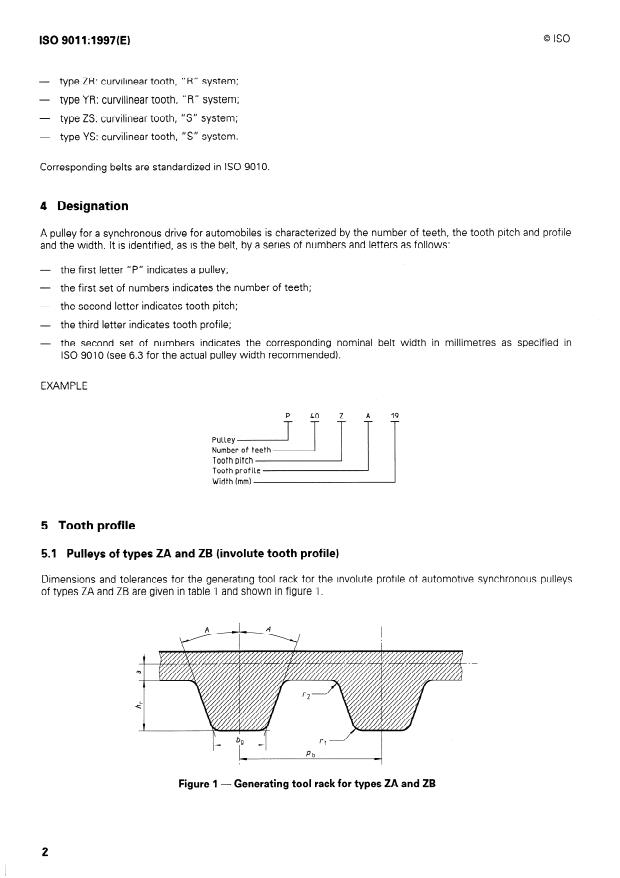
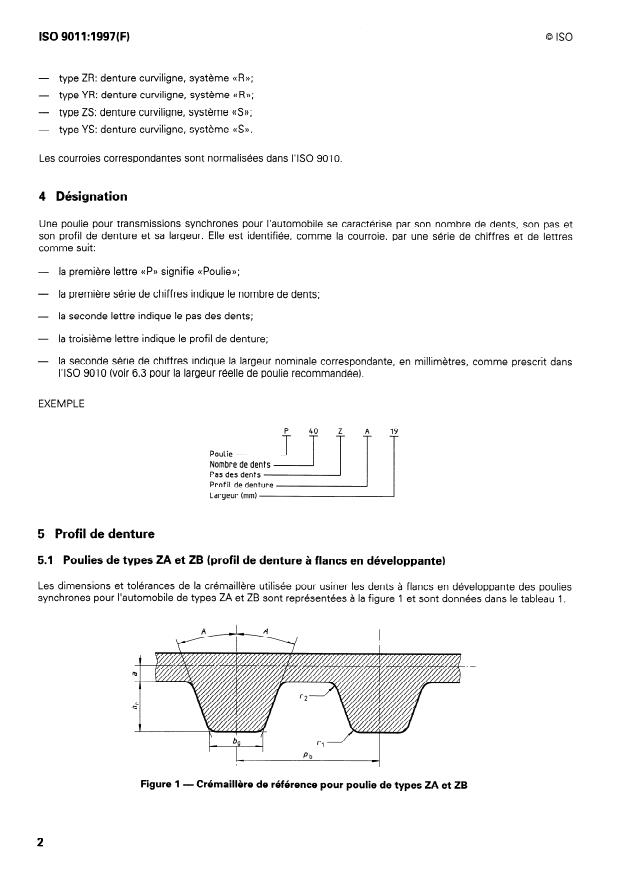
Dimensions and tolerances for the generating tool rack for the involute profile of automotive synchronous pulleys
of types ZA and ZB are given in table 1 and shown in figure 1 n
Figure 1 - Generating tool rack for types ZA and ZB
IS0 9011:1997(E]
Table 1 - Generating tool rack dimensions and tolerances for types ZA andl ZB
LIimensions in millimetres, angle in degrees
Number of A a
TYPe
hr r1 r2
pb b,
teeth in
pulley
z k 0,012 AI 0,12 + 0,05 + 0,05
+ 0,03 + 0,03
0 0
ZA 23 19 9,525 20 2,13 311 0,86 0,71 0,686
19GzS20
I,04
ZB
9,525 20 4,24
2,59 I,47
0,686
z 3 21 I,42
...
NORME ISO
INTERNATIONALE 9011
Deuxième édition
1997-04-O 1
Transmissions synchrones par courroies -
Poulies pour la construction automobile
Synchronous belt drives - Automotive pulleys
Numéro de référence
ISO 9011 :1997(F)
IS09011:1997(F)
Avant-propos
L’ISO (Organisation internationale de normalisation) est une fédération
mondiale d’organismes nationaux de normalisation (comités membres de
I’ISO). L’élaboration des Normes internationales est en général confiée aux
comités techniques de I’ISO. Chaque comité membre intéressé par une
étude a le droit de faire partie du comité technique créé a cet effet. Les
organisations internationales, gouvernementales et non gouvernemen-
tales, en liaison avec I’ISO participent également aux travaux. L’ISO colla-
bore étroitement avec la Commission électrotechnique internationale (CEI)
en ce qui concerne la normalisation électrotechnique.
Les projets de Normes internationales adoptés par les comités techniques
sont soumis aux comités membres pour vote. Leur publication comme
Normes internationales requiert l’approbation de 75 % au moins des co-
mités membres votants.
La Norme internationale ISO 9011 a été élaborée par le comité technique
ISOfK 41, Poulies et courroies (y compris les courroies trapézoi’dales),
sous-comite SC 4, Transmissions synchrones par courroies.
Cette deuxième édition annule et remplace la première édition
(ISO 9011 :1987), dont elle constitue une révision technique.
0 ISO 1997
Droits de reproduction réservés. Sauf prescription différente, aucune partie de cette publi-
cation ne peut être reproduite ni utilisée sous quelque forme que ce soit et par aucun pro-
cédé, électronique ou mécanique, y compris la photocopie et les microfilms, sans l’accord
écrit de l’éditeur.
Organisation internationale de normalisation
Case postale 56 l CH-l 211 Genève 20 l Suisse
Internet central@iso.ch
x.400 c=ch; a=4OOnet; p=iso; o=isocs; s=central
Imprimé en Suisse
NORME INTERNATIONALE @ ISO
Transmissions synchrones par courroies - Poulies pour la
construction automobile
1 Domaine d’application
La présente Norme internationale prescrit les caractéristiques des poulies synchrones utilisées dans la construction
automobile pour les transmissions synchrones par courroies sans fin.
Ces caractéristiques comprennent
- les dimensions des dents et leurs tolérances;
- les tolérances des poulies et les spécifications de qualité.
2 Références normatives
Les normes suivantes contiennent des dispositions qui, par suite de la référence qui en est faite, constituent des
dispositions valables pour la présente Norme internationale. Au moment de la publication, les éditions indiquées
étaient en vigueur. Toute norme est sujette à révision et les parties prenantes des accords fondés sur la présente
Norme internationale sont invitées à rechercher la possibilité d’appliquer les éditions les plus récentes des normes
indiquées ci-après. Les membres de la CEI et de I’ISO possèdent le registre des Normes internationales en vigueur
à un moment donne.
-11, Transmissions par courroies - Poulies
ISO 254: - Qualité, état de surface et équilibrage.
ISO 9010: 1997, Transmissions synchrones par courroies - Courroies pour la construction automobile.
3 Types de poulies
Les types suivants de poulies pour transmissions synchrones pour l’automobile sont normalisés:
- type ZA: denture trapézoïdale;
- type ZB: denture trapézoïdale;
- type ZH: denture curviligne, système «H»;
- type YH: denture curviligne, système (( H»;
1) À publier. (Révision de I’ISO 254:1990)
@ ISO
- type ZR: denture curviligne, système ((R));
- type YR: denture curviligne, système ((R»;
type ZS: denture curviligne, système 6));
-
- type YS: denture curviligne, système (4)).
Les courroies correspondantes sont normalisées dans I’ISO 9010.
4 Désignation
Une poulie pour transmissions synchrones pour l’automobile se caractérise par son nombre de dents, son pas et
son profil de denture et sa largeur. Elle est identifiée, comme la courroie, par une série de chiffres et de lettres
comme suit:
- la première lettre «P)) signifie ((Poulie));
- la première série de chiffres indique le nombre de dents;
- la seconde lettre indique le pas des dents;
la troisième lettre indique le profil de denture;
- la seconde série de chiffres indique la largeur nominale correspondante, en millimètres, comme prescrit dans
I’ISO 9010 (voir 6.3 pour la largeur réelle de poulie recommandée).
EXEMPLE
Poulie 2 7 i i T
Nombre de dents
Pas des dents I
Profil de denture 1
Largeur (mm)
5 Profil de denture
5.1 Poulies de types ZA et ZB (profil de denture à flancs en développante)
Les dimensions et tolérances de la crémaillère utilisée pour usiner les dents à flancs en développante des poulies
synchrones pour l’automobile de types ZA et ZB sont représentées à la figure 1 et sont données dans le tableau 1.
b,
pb
Crémaillère de référence pour poulie de types ZA et ZB
Figure 1 -
@ ISO
- Dimensions et tolérances de la crémaillère de référence pour poulies de types ZA et ZB
Tableau 1
Dimensions en millimètres, angle en degrés
Nombre Nombre de de A A
a a
TYPe TYPe f’b f'b
h, h, r1 r1
b, bg
dents dents de de la la
poulie poulie
-: -: 0,012 0,012 f0,12 f0,12 + + 0,05 0,05 + + 0,05 0,05
z z + + 0,03 0,03 rt rt 0,03 0,03
0 0
0 0
ZA 23 23 19 19 9,525 9,525 20 20 2,13 2,13
3,l 3,l
- -
1,04 1,04
ZB
9,525 9,525 20 20 4,24 4,24
2,59 2,59 1,47 1,47 0,686 0,686
1,42 1,42
52 . Poulies de types ZH et YH
L
...
NORME ISO
INTERNATIONALE 9011
Deuxième édition
1997-04-O 1
Transmissions synchrones par courroies -
Poulies pour la construction automobile
Synchronous belt drives - Automotive pulleys
Numéro de référence
ISO 9011 :1997(F)
IS09011:1997(F)
Avant-propos
L’ISO (Organisation internationale de normalisation) est une fédération
mondiale d’organismes nationaux de normalisation (comités membres de
I’ISO). L’élaboration des Normes internationales est en général confiée aux
comités techniques de I’ISO. Chaque comité membre intéressé par une
étude a le droit de faire partie du comité technique créé a cet effet. Les
organisations internationales, gouvernementales et non gouvernemen-
tales, en liaison avec I’ISO participent également aux travaux. L’ISO colla-
bore étroitement avec la Commission électrotechnique internationale (CEI)
en ce qui concerne la normalisation électrotechnique.
Les projets de Normes internationales adoptés par les comités techniques
sont soumis aux comités membres pour vote. Leur publication comme
Normes internationales requiert l’approbation de 75 % au moins des co-
mités membres votants.
La Norme internationale ISO 9011 a été élaborée par le comité technique
ISOfK 41, Poulies et courroies (y compris les courroies trapézoi’dales),
sous-comite SC 4, Transmissions synchrones par courroies.
Cette deuxième édition annule et remplace la première édition
(ISO 9011 :1987), dont elle constitue une révision technique.
0 ISO 1997
Droits de reproduction réservés. Sauf prescription différente, aucune partie de cette publi-
cation ne peut être reproduite ni utilisée sous quelque forme que ce soit et par aucun pro-
cédé, électronique ou mécanique, y compris la photocopie et les microfilms, sans l’accord
écrit de l’éditeur.
Organisation internationale de normalisation
Case postale 56 l CH-l 211 Genève 20 l Suisse
Internet central@iso.ch
x.400 c=ch; a=4OOnet; p=iso; o=isocs; s=central
Imprimé en Suisse
NORME INTERNATIONALE @ ISO
Transmissions synchrones par courroies - Poulies pour la
construction automobile
1 Domaine d’application
La présente Norme internationale prescrit les caractéristiques des poulies synchrones utilisées dans la construction
automobile pour les transmissions synchrones par courroies sans fin.
Ces caractéristiques comprennent
- les dimensions des dents et leurs tolérances;
- les tolérances des poulies et les spécifications de qualité.
2 Références normatives
Les normes suivantes contiennent des dispositions qui, par suite de la référence qui en est faite, constituent des
dispositions valables pour la présente Norme internationale. Au moment de la publication, les éditions indiquées
étaient en vigueur. Toute norme est sujette à révision et les parties prenantes des accords fondés sur la présente
Norme internationale sont invitées à rechercher la possibilité d’appliquer les éditions les plus récentes des normes
indiquées ci-après. Les membres de la CEI et de I’ISO possèdent le registre des Normes internationales en vigueur
à un moment donne.
-11, Transmissions par courroies - Poulies
ISO 254: - Qualité, état de surface et équilibrage.
ISO 9010: 1997, Transmissions synchrones par courroies - Courroies pour la construction automobile.
3 Types de poulies
Les types suivants de poulies pour transmissions synchrones pour l’automobile sont normalisés:
- type ZA: denture trapézoïdale;
- type ZB: denture trapézoïdale;
- type ZH: denture curviligne, système «H»;
- type YH: denture curviligne, système (( H»;
1) À publier. (Révision de I’ISO 254:1990)
@ ISO
- type ZR: denture curviligne, système ((R));
- type YR: denture curviligne, système ((R»;
type ZS: denture curviligne, système 6));
-
- type YS: denture curviligne, système (4)).
Les courroies correspondantes sont normalisées dans I’ISO 9010.
4 Désignation
Une poulie pour transmissions synchrones pour l’automobile se caractérise par son nombre de dents, son pas et
son profil de denture et sa largeur. Elle est identifiée, comme la courroie, par une série de chiffres et de lettres
comme suit:
- la première lettre «P)) signifie ((Poulie));
- la première série de chiffres indique le nombre de dents;
- la seconde lettre indique le pas des dents;
la troisième lettre indique le profil de denture;
- la seconde série de chiffres indique la largeur nominale correspondante, en millimètres, comme prescrit dans
I’ISO 9010 (voir 6.3 pour la largeur réelle de poulie recommandée).
EXEMPLE
Poulie 2 7 i i T
Nombre de dents
Pas des dents I
Profil de denture 1
Largeur (mm)
5 Profil de denture
5.1 Poulies de types ZA et ZB (profil de denture à flancs en développante)
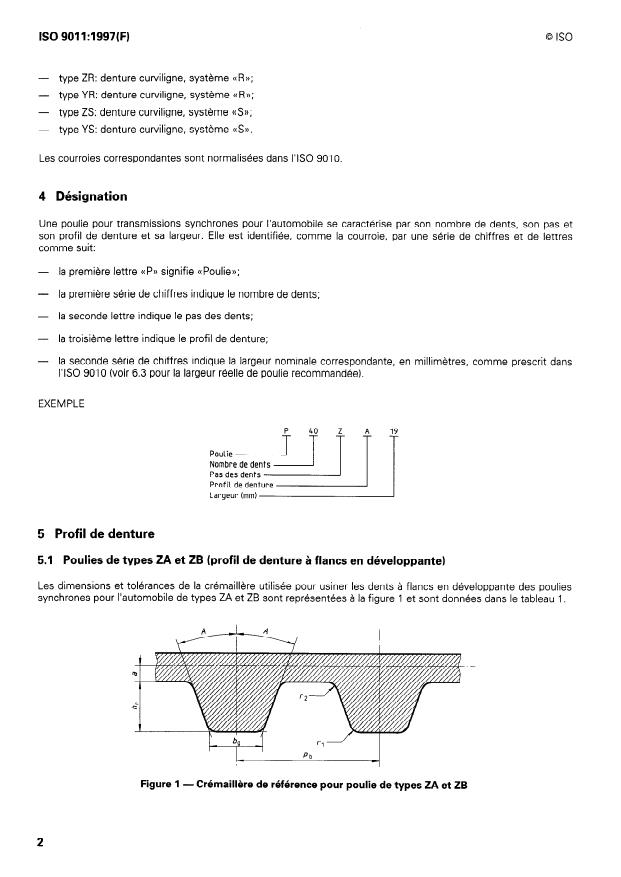
Les dimensions et tolérances de la crémaillère utilisée pour usiner les dents à flancs en développante des poulies
synchrones pour l’automobile de types ZA et ZB sont représentées à la figure 1 et sont données dans le tableau 1.
b,
pb
Crémaillère de référence pour poulie de types ZA et ZB
Figure 1 -
@ ISO
- Dimensions et tolérances de la crémaillère de référence pour poulies de types ZA et ZB
Tableau 1
Dimensions en millimètres, angle en degrés
Nombre Nombre de de A A
a a
TYPe TYPe f’b f'b
h, h, r1 r1
b, bg
dents dents de de la la
poulie poulie
-: -: 0,012 0,012 f0,12 f0,12 + + 0,05 0,05 + + 0,05 0,05
z z + + 0,03 0,03 rt rt 0,03 0,03
0 0
0 0
ZA 23 23 19 19 9,525 9,525 20 20 2,13 2,13
3,l 3,l
- -
1,04 1,04
ZB
9,525 9,525 20 20 4,24 4,24
2,59 2,59 1,47 1,47 0,686 0,686
1,42 1,42
52 . Poulies de types ZH et YH
L
...