


SIST EN 50397-1:2021
(Main)Covered conductors for overhead lines and the related accessories for rated voltages above 1 kV AC and not exceeding 36 kV AC - Part 1: Covered conductors
Covered conductors for overhead lines and the related accessories for rated voltages above 1 kV AC and not exceeding 36 kV AC - Part 1: Covered conductors
This document contains the requirements for covered conductors with or without integrated longitudinal water tightness and/or semi-conductive conductor screen for applications in overhead lines with rated voltages U above 1 kV a.c. and not exceeding 36 kV a.c.
Kunststoffumhüllte Leiter und zugehörige Armaturen für Freileitungen mit Nennspannungen über 1 kV und nicht mehr als 36 kV Wechselspannung - Teil 1: Kunststoffumhüllte Freileitungsseile
Conducteurs gainés pour lignes aériennes et accessoires associés pour des tensions assignées supérieures à 1 kV en courant alternatif et ne dépassant pas 36 kV en courant alternatif - Partie 1: Conducteurs gainés
Le présent document contient les exigences relatives aux conducteurs gainés avec ou sans étanchéité longitudinale intégrée et/ou un écran semiconducteur autour de l’âme pour les applications dans les lignes aériennes avec une tension assignée U supérieure à 1 kV en courant alternatif et ne dépassant pas 36 kV en courant alternatif.
Oplaščeni vodniki za nadzemne vode in ustrezen pribor za naznačene izmenične napetosti nad 1 kV, ki ne presegajo 36 kV - 1. del: Oplaščeni vodniki
General Information
- Status
- Published
- Public Enquiry End Date
- 11-Jun-2020
- Publication Date
- 01-Dec-2020
- Technical Committee
- IEKA - Electric cables
- Current Stage
- 6060 - National Implementation/Publication (Adopted Project)
- Start Date
- 27-Nov-2020
- Due Date
- 01-Feb-2021
- Completion Date
- 02-Dec-2020
Relations
- Effective Date
- 24-Nov-2020
- Effective Date
- 24-Sep-2019
Overview
EN 50397-1:2020 (CLC) specifies requirements for covered conductors for overhead lines with rated voltages above 1 kV AC and not exceeding 36 kV AC. Part 1 of the EN 50397 series covers the construction, marking and testing of the covered conductor itself (with or without integrated longitudinal watertightness and/or a semi‑conductive conductor screen). The standard clarifies performance expectations for coverings that provide protection against accidental contacts while acknowledging that covered conductors remain unscreened and are not touch‑proof.
Key topics and technical requirements
- Scope and definitions: Rated voltage (U), test types (type, sample, routine) and terms used throughout the document.
- Construction requirements: Designation and coding (example: “CCX 66‑AL3 WK 20kV”), conductor materials and cross‑sections, filling, covering materials (e.g., XLPE, thermoplastic polyethylene) and options for watertight or compacted conductors.
- Marking and traceability: Indication of origin, continuity and durability of marks, and legibility requirements for product identification.
- Testing and performance: Type, sample and routine tests covering electrical and non‑electrical performance. Normative annexes specify test procedures for:
- Measurement of leakage current
- Tracking resistance
- Slippage (mechanical retention of the covering)
- Resistance to UV rays
- Normative references: Cross‑references to related test and conductor standards (EN 50182, EN 60811 series, EN 62219, EN 62230, HD 605 S3, IEC 60502‑2).
Applications and users
EN 50397-1:2020 is intended for stakeholders involved in the specification, manufacture, testing and deployment of covered overhead conductors:
- Utilities and distribution network operators specifying conductors for rural and urban overhead lines
- Cable and covered‑conductor manufacturers for product design, quality control and type testing
- Test laboratories performing electrical and environmental tests (leakage current, tracking, UV)
- Engineers and designers ensuring compliance with product selection and procurement requirements
- Regulators and standards bodies aligning national rules with CENELEC harmonized requirements
Related standards
- EN 50397-2 (Accessories for covered conductors: tests and acceptance criteria)
- EN 50397-3 (Guide to use)
- EN 50182, EN 60811 series, EN 62219, EN 62230, HD 605 S3, IEC 60502‑2
Keywords: EN 50397-1, covered conductors, overhead lines, XLPE, thermoplastic polyethylene, watertight conductor, tracking resistance, leakage current, CLC.

Frequently Asked Questions
SIST EN 50397-1:2021 is a standard published by the Slovenian Institute for Standardization (SIST). Its full title is "Covered conductors for overhead lines and the related accessories for rated voltages above 1 kV AC and not exceeding 36 kV AC - Part 1: Covered conductors". This standard covers: This document contains the requirements for covered conductors with or without integrated longitudinal water tightness and/or semi-conductive conductor screen for applications in overhead lines with rated voltages U above 1 kV a.c. and not exceeding 36 kV a.c.
This document contains the requirements for covered conductors with or without integrated longitudinal water tightness and/or semi-conductive conductor screen for applications in overhead lines with rated voltages U above 1 kV a.c. and not exceeding 36 kV a.c.
SIST EN 50397-1:2021 is classified under the following ICS (International Classification for Standards) categories: 29.060.20 - Cables; 29.240.20 - Power transmission and distribution lines. The ICS classification helps identify the subject area and facilitates finding related standards.
SIST EN 50397-1:2021 has the following relationships with other standards: It is inter standard links to SIST EN 50397-1:2007, SIST EN 50397-1:2007. Understanding these relationships helps ensure you are using the most current and applicable version of the standard.
SIST EN 50397-1:2021 is available in PDF format for immediate download after purchase. The document can be added to your cart and obtained through the secure checkout process. Digital delivery ensures instant access to the complete standard document.
Standards Content (Sample)
SLOVENSKI STANDARD
01-januar-2021
Nadomešča:
SIST EN 50397-1:2007
Oplaščeni vodniki za nadzemne vode in ustrezen pribor za naznačene izmenične
napetosti nad 1 kV, ki ne presegajo 36 kV - 1. del: Oplaščeni vodniki
Covered conductors for overhead lines and the related accessories for rated voltages
above 1 kV AC and not exceeding 36 kV AC - Part 1: Covered conductors
Kunststoffumhüllte Leiter und zugehörige Armaturen für Freileitungen mit
Nennspannungen über 1 kV und nicht mehr als 36 kV Wechselspannung - Teil 1:
Kunststoffumhüllte Freileitungsseile
Conducteurs gainés pour lignes aériennes et accessoires associés pour des tensions
assignées supérieures à 1 kV en courant alternatif et ne dépassant pas 36 kV en courant
alternatif - Partie 1: Conducteurs gainés
Ta slovenski standard je istoveten z: EN 50397-1:2020
ICS:
29.060.20 Kabli Cables
29.240.20 Daljnovodi Power transmission and
distribution lines
2003-01.Slovenski inštitut za standardizacijo. Razmnoževanje celote ali delov tega standarda ni dovoljeno.
EUROPEAN STANDARD EN 50397-1
NORME EUROPÉENNE
EUROPÄISCHE NORM
November 2020
ICS 29.240.20 Supersedes EN 50397-1:2006 and all of its amendments
and corrigenda (if any)
English Version
Covered conductors for overhead lines and the related
accessories for rated voltages above 1 kV AC and not exceeding
36 kV AC - Part 1: Covered conductors
Conducteurs gainés pour lignes aériennes et accessoires Kunststoffumhüllte Leiter und zugehörige Armaturen für
associés pour des tensions assignées supérieures à 1 kV Freileitungen mit Nennspannungen über 1 kV und nicht
en courant alternatif et ne dépassant pas 36 kV en courant mehr als 36 kV Wechselspannung - Teil 1:
alternatif - Partie 1: Conducteurs gainés Kunststoffumhüllte Freileitungsseile
This European Standard was approved by CENELEC on 2020-10-26. CENELEC members are bound to comply with the CEN/CENELEC
Internal Regulations which stipulate the conditions for giving this European Standard the status of a national standard without any alteration.
Up-to-date lists and bibliographical references concerning such national standards may be obtained on application to the CEN-CENELEC
Management Centre or to any CENELEC member.
This European Standard exists in three official versions (English, French, German). A version in any other language made by translation
under the responsibility of a CENELEC member into its own language and notified to the CEN-CENELEC Management Centre has the
same status as the official versions.
CENELEC members are the national electrotechnical committees of Austria, Belgium, Bulgaria, Croatia, Cyprus, the Czech Republic,
Denmark, Estonia, Finland, France, Germany, Greece, Hungary, Iceland, Ireland, Italy, Latvia, Lithuania, Luxembourg, Malta, the
Netherlands, Norway, Poland, Portugal, Republic of North Macedonia, Romania, Serbia, Slovakia, Slovenia, Spain, Sweden, Switzerland,
Turkey and the United Kingdom.
European Committee for Electrotechnical Standardization
Comité Européen de Normalisation Electrotechnique
Europäisches Komitee für Elektrotechnische Normung
CEN-CENELEC Management Centre: Rue de la Science 23, B-1040 Brussels
© 2020 CENELEC All rights of exploitation in any form and by any means reserved worldwide for CENELEC Members.
Ref. No. EN 50397-1:2020 E
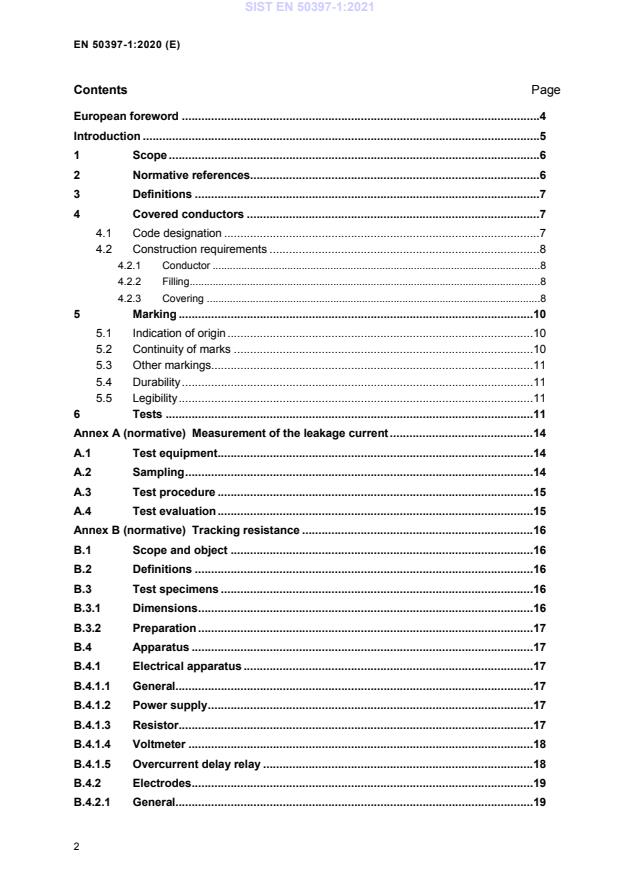
Contents Page
European foreword . 4
Introduction .5
1 Scope . 6
2 Normative references . 6
3 Definitions . 7
4 Covered conductors . 7
4.1 Code designation . 7
4.2 Construction requirements . 8
4.2.1 Conductor . 8
4.2.2 Filling. 8
4.2.3 Covering . 8
5 Marking . 10
5.1 Indication of origin . 10
5.2 Continuity of marks . 10
5.3 Other markings. 11
5.4 Durability . 11
5.5 Legibility . 11
6 Tests . 11
Annex A (normative) Measurement of the leakage current . 14
A.1 Test equipment . 14
A.2 Sampling . 14
A.3 Test procedure . 15
A.4 Test evaluation . 15
Annex B (normative) Tracking resistance . 16
B.1 Scope and object . 16
B.2 Definitions . 16
B.3 Test specimens . 16
B.3.1 Dimensions . 16
B.3.2 Preparation . 17
B.4 Apparatus . 17
B.4.1 Electrical apparatus . 17
B.4.1.1 General. 17
B.4.1.2 Power supply . 17
B.4.1.3 Resistor. 17
B.4.1.4 Voltmeter . 18
B.4.1.5 Overcurrent delay relay . 18
B.4.2 Electrodes . 19
B.4.2.1 General. 19
B.4.2.2 Top electrode. 19
B.4.2.3 Bottom electrode . 20
B.4.3 Contamination . 20
B.4.3.1 Contaminant . 20
B.4.3.2 Applicator paper . 20
B.4.3.3 Contaminant flow . 21
B.4.3.4 Flow rate . 21
B.4.4 Timing device . 21
B.4.5 Depth gauge . 21
B.5 Procedure . 22
B.5.1 Preparation of the test . 22
B.5.1.1 Ambient conditions . 22
B.5.1.2 Mounting . 22
B.5.1.3 Adjustment of the contaminant flow . 22
B.5.2 Application of the voltage. 22
B.5.3 Test evaluation . 22
B.6 Test report . 22
Annex C (normative) Slippage test . 23
C.1 Scope and object . 23
C.2 Definitions . 23
C.3 Test specimens . 23
C.3.1 Dimensions . 23
C.3.2 Preparation . 23
C.4 Apparatus — clamp. 24
C.5 Procedure and requirements . 24
C.5.1 General. 24
C.5.2 Test conditions . 24
C.6 Test report . 25
Annex D (normative) Non-electrical test on samples of complete cable — Resistance
to UV rays 26
D.1 Resistance to UV rays . 26
Bibliography . 28
European foreword
This document (EN 50397-1:2020) has been prepared by WG 13 “Covered Overhead Line Conductors” of
CLC/TC 20 “Electric cables”.
The following dates are fixed:
• latest date by which this document has (dop) 2021-10-26
to be implemented at national level by
publication of an identical national
standard or by endorsement
• latest date by which the national (dow) 2023-10-26
standards conflicting with this document
have to be withdrawn
This document supersedes EN 50397-1:2006 and all of its amendments and corrigenda (if any).
— new references to HD 605 S3 2019.
Attention is drawn to the possibility that some of the elements of this document may be the subject of patent
rights. CENELEC shall not be held responsible for identifying any or all such patent rights.
The EN 50397 series consists of three parts:
— Part 1, “Covered conductors”;
— Part 2, “Accessories for covered conductors: Tests and acceptance criteria”; and
— Part 3, “Guide to use”
Introduction
The EN 50397 series covers the construction, performance and test requirements for covered conductors
for overhead lines having a nominal voltage U above 1 kV AC up to and including 36 kV AC, and for the
related accessories.
Covered conductors consist of a conductor surrounded by a covering made of insulating material as
protection against accidental contacts with other covered conductors and with grounded parts such as tree
branches, etc. In comparison with insulated conductors, this covering has reduced properties, but is able
to withstand the phase-to-earth voltage temporarily.
Since covered conductors are unscreened, they are not touch-proof, i.e. they should be treated as bare
conductors with respect to electric shock.
This document does not cover aspects related to the installation of overhead lines such as determination
of clearances, spans, sags, etc.
1 Scope
This document contains the requirements for covered conductors with or without integrated longitudinal
water tightness and/or semi-conductive conductor screen for applications in overhead lines with rated
voltages U above 1 kV a.c. and not exceeding 36 kV a.c.
2 Normative references
The following documents are referred to in the text in such a way that some or all of their content constitutes
requirements of this document. For dated references, only the edition cited applies. For undated references,
the latest edition of the referenced document (including any amendments) applies.
EN 50182:2001, Conductors for overhead lines - Round wire concentric lay stranded conductors
EN 60811-201, Electric and optical fibre cables - Test methods for non-metallic materials - Part 201:
General tests - Measurement of insulation thickness (IEC 60811-201)
EN 60811-401:2012, Electric and optical fibre cables - Test methods for non-metallic materials - Part 401:
Miscellaneous tests - Thermal ageing methods - Ageing in an air oven (IEC 60811-401:2012)
EN 60811-402, Electric and optical fibre cables - Test methods for non-metallic materials - Part 402:
Miscellaneous tests - Water absorption tests (IEC 60811-402)
EN 60811-501:2012, Electric and optical fibre cables - Test methods for non-metallic materials - Part 501:
Mechanical tests - Tests for determining the mechanical properties of insulating and sheathing compounds
(IEC 60811-501:2012)
EN 60811-502, Electric and optical fibre cables - Test methods for non-metallic materials - Part 502:
Mechanical tests - Shrinkage test for insulations (IEC 60811-502)
EN 60811-507, Electric and optical fibre cables - Test methods for non-metallic materials - Part 507:
Mechanical tests - Hot set test for cross-linked materials (IEC 60811-507)
EN 60811-508:2012, Electric and optical fibre cables - Test methods for non-metallic materials - Part 508:
Mechanical tests - Pressure test at high temperature for insulation and sheaths (IEC 60811-508:2012)
EN 60811-605:2012, Electric and optical fibre cables - Test methods for non-metallic materials - Part 605:
Physical tests - Measurement of carbon black and/or mineral filler in polyethylene compounds
(IEC 60811-605:2012)
EN 62219, Overhead electrical conductors - Formed wire, concentric lay, stranded conductors (IEC 62219)
EN 62230, Electric cables - Spark-test method (IEC 62230)
HD 605 S3:2019, Electric cables - Additional test methods
IEC 60502-2:2014, Power cables with extruded insulation and their accessories for rated voltages from 1
kV (U = 1,2 kV) up to 30 kV (U = 36 kV) - Part 2: Cables for rated voltages from 6 kV (U = 7,2 kV) up
m m m
to 30 kV (U = 36 kV)
m
———————
As impacted by EN 60811-401:2012/A1:2017.
As impacted by EN 60811-501:2012/A1:2018.
As impacted by EN 60811-508:2012/A1:2017.
3 Definitions
For the purpose of this document, the following definitions apply.
ISO and IEC maintain terminological databases for use in standardization at the following addresses:
— IEC Electropedia: available at http://www.electropedia.org/
— ISO Online browsing platform: available at https://www.iso.org/obp
3.1 Definitions relating to tests
3.1.1
type tests
T
tests required to be made before supplying a type of product covered by this document on a general
commercial basis in order to demonstrate satisfactory performance characteristics to meet the intended
application
Note 1 to entry: These tests are of such nature that, after they have been made, they need not be repeated unless
changes are made in the material, design or manufacturing process, which might change the performance
characteristics.
3.1.2
sample tests
S
tests made on samples of completed product or components taken from the completed product adequate
to verify that the finished product meets the design specifications
3.1.3
routine tests
R
tests made on all production lengths to demonstrate their integrity
3.2
rated voltage
reference voltage for which the conductor is designed and which serves to define the electrical tests
Note 1 to entry: The rated voltage is expressed by the value U, expressed in kilovolts, where U is the r.m.s. value
between any two-phase conductors.
4 Covered conductors
4.1 Code designation
Covered conductors shall be designated as follows:
Type code CC;
Covering material S (for semi-conductive conductor screen, if any),
X (for cross-linked polyethylene),
T (for thermoplastic polyethylene);
Conductor material and cross-section according to EN 50182;
Conductor design W (for watertight),
K (for compacted);
Rated voltage U in kV …kV.
EXAMPLE 1 OF DESIGNATION
“CCX 66-AL3 WK 20kV” is a XLPE-covered conductor with a rated voltage of 20 kV, longitudinal watertight
compacted conductor of aluminium alloy AL3 and a nominal conductor cross-section of 66 mm .
EXAMPLE 2 OF DESIGNATION
“CCST 66-A3F W 20 kV” is a thermoplastic polyethylene covered conductor with a rated voltage of 20 kV,
longitudinal watertight conductor with formed aluminium alloy wire AF3 and a nominal conductor cross-
section of 66mm .
4.2 Construction requirements
4.2.1 Conductor
Number of 1
conductors:
Conductor material: aluminium alloy or steel reinforced aluminium
2 2
Nom. cross-section: 25 mm to 400 mm for all conductors
Conductor design: the conductors may be compacted or non-compacted, with round wire or
profiled wire.
Information on bare conductors with round wires in frequent use can be found in the national lists, contained
in EN 50182:2001, Annex F. However, for the purpose of this document, conductors may be selected from
any national table. Conductors deviating in design from the standard values shall be given by the
manufacturer, but fulfilling all requirements given in EN 50182.
Information about conductors made from profiled wires shall be provided by the manufacturer.
Non-compacted conductors shall comply with EN 50182 or EN 62219 (with the exception of the filling, if
any).
For compacted conductors, based on conductors according to EN 50182, the following paragraph applies:
The outer diameter of the compacted conductor shall be 95 % (±1 % for 7 and 19-wire
constructions, ± 1,5 % for 37-wire constructions) of the diameter given in EN 50182. The rated tensile
strength (RTS) shall be at least 95 % of the value given in EN 50182. The DC resistance shall not exceed
the value given in EN 50182 by more than 5 %.
4.2.2 Filling
The stranded conductor may be longitudinally watertight by means of adequate measures as e.g. filling
with an adequate mass. The filling mass or other materials for obtaining the longitudinal watertightness,
shall be compatible with the conductor material and the material of the covering (see Table 2).
4.2.3 Covering
The covering shall consist of a cross-linked polyethylene compound, which shall comply with the
requirements according to Table 1, column 3 or of a thermoplastic polyethylene compound, complying with
the requirements according Table 1, column 4.
It shall be possible to remove the covering without damage to the conductor.
Table 1 — Properties of the covering materials
1 2 3 4
Unit
Compound designation X T
Basic material XLPE PE
1 2 3 4
Unit
a
Maximum operating temperature of the conductor °C 70
Mechanical properties
before ageing on sample (EN 60811-501:2012, 4.2)
minimum tensile strength MPa 12,5 12,5
minimum elongation at break % 200 300
after ageing on sample (of EN 60811-401:2012 , 4.2.3.2)
Temperature °C 135 110
Duration h 168 336
minimum tensile strength MPa - 12,5
maximum variation T1/T0 % ± 25 -
minimum elongation at break % - 300
maximum variation T1/T0 % ± 25 -
b
after ageing on complete product sample
(EN 60811-401:2012 , 4.2.3.4)
Temperature °C 100 ± 2 100 ± 2
Duration h 168 168
minimum tensile strength MPa - 12,5
maximum variation T2/T0 % ± 25 -
minimum elongation at break % - 300
maximum variation T2/T0 % ± 25 -
Physical and chemical properties
hot set test (EN 60811-507)
temperature °C 200 -
duration min 15 -
mechanical stress MPa 0,2 -
maximum elongation under load % 175 -
maximum residual elongation % 15 -
pressure test at high temperature (EN 60811-508:2012 ,
4.3)
temperature °C - 80
duration h - 4
coefficient k - - 0,8
maximum depth of indentation % - 50
Gravimetric water absorption (EN 60811-402)
temperature °C 85 85
duration h 336 336
maximum variation of mass mg/cm 1 1
shrinkage test (EN 60811-502)
distance L between marks mm 200 200
duration h 1 1
1 2 3 4
Unit
temperature °C 130 ± 3 100 ± 3
maximum shrinkage % 4 4
Shore D hardness (HD 605 S3:2019, 2.2.1)
minimum hardness ShD - 55
a
Maximum operating temperature of the conductor is limited to 80 °C due to mechanical reasons.
b
For use together with watertight conductors only. Adequate measures e.g. neutral capping to prevent leakage of filling
material shall be taken.
An UV-protection shall be provided. Covering materials having a content of carbon black of (2,5 ± 0,5) %
are considered to have adequate protection. Otherwise protection against UV shall be demonstrated
fulfilling the UV-test specified in Chapter 6, Table 2, No.4.3.
The nominal thickness of the covering shall be calculated according to the following formula:
S = 0,11 U
where
S is the nominal thickness of the covering in mm (rounded to one decimal place);
U is the rated voltage (see 3.2) in kV.
The nominal thickness of the covering shall be not less
...
Questions, Comments and Discussion
Ask us and Technical Secretary will try to provide an answer. You can facilitate discussion about the standard in here.
Loading comments...