

SIST EN 13926:2003
(Main)Surface active agents - Alkoxylated derivatives - Determination of hydroxyl value - N-methyl imidazole method
General Information
- Abstract
This draft European Standard specifies a method for the determination of hydroxyl value of aliphatic and alicyclic hydroxyl compounds such as polyols, sorbitan esters, plasticisers and surface active agent alcohols and ethoxylates with hydroxyl values greater than 20 mg/g KOH.
- Status
- Published
- Publication Date
- 30-Apr-2003
- Technical Committee
- KDS - Cosmetics, chemical disinfectants and surface active agents
- Current Stage
- 6060 - National Implementation/Publication (Adopted Project)
- Start Date
- 01-May-2003
- Due Date
- 01-May-2003
- Completion Date
- 01-May-2003

Overview
EN 13926:2003 - Surface active agents - Alkoxylated derivatives - Determination of hydroxyl value - N‑methyl imidazole method is a CEN European Standard that specifies a laboratory procedure to determine the hydroxyl value of aliphatic and alicyclic hydroxyl compounds (for example polyols, sorbitan esters, plasticisers, surface active agent alcohols and ethoxylates) when the hydroxyl value is greater than 20 mg KOH/g. The method uses acetylation with an acetic anhydride/tetrahydrofuran reagent catalysed by N‑methyl imidazole, followed by potentiometric titration of the resulting acetic acid with ethanolic potassium hydroxide.
Key topics and technical requirements
- Scope and applicability: designed for alkoxylated derivatives and other hydroxyl-bearing surfactant-related materials with I(OH) > 20 mg KOH/g.
- Analytical principle: esterification of sample hydroxyl groups; hydrolysis of excess acetylating reagent; potentiometric titration to quantify formed acetic acid; hydroxyl value calculated from blank-corrected titration volumes.
- Reagents: tetrahydrofuran (THF), acetic anhydride, N‑methyl imidazole (catalyst), ethanol, and ethanolic KOH standard volumetric solution (c ≈ 0.5 mol/L).
- Apparatus: analytical balance, water bath (45 ± 1 °C), air cooler, and a potentiometric titrator with combined electrode and automatic burette.
- Procedure essentials: calculated test portion based on expected hydroxyl value; controlled acetylation at 45 °C; potentiometric detection of the first inflection point for titration end-point.
- Quality and safety: use analytical-grade reagents; THF and N‑methyl imidazole are hazardous - perform operations in a fume hood.
- Performance data: includes interlaboratory precision results (repeatability and reproducibility) from ring testing (Annex A) and examples of potentiometric settings and titration curves (Annices B–C).
- Reporting: require sample ID, reference to EN 13926:2003, results, and deviations from the standard procedure.
Applications and users
- Quality control and batch release testing in surfactant, detergent, polymer and specialty chemical manufacturing.
- R&D laboratories developing alkoxylated surfactants, polyols and plasticisers requiring precise hydroxyl quantification.
- Contract testing laboratories performing standardized hydroxyl value determination for compliance, product specification, or comparative analysis.
- Regulatory and procurement specialists needing traceable, standardized test methods for material specifications.
Related standards
- ISO 607 - sample division for surfactants and detergents.
- ISO 4314 - determination of free acidity/alkalinity (used for correction when samples contain free acid or base).
- EN 13926:2003 provides a standardized, potentiometric titration method that integrates with common ISO sample handling and acidity/alkalinity measurement practices.
Keywords: EN 13926:2003, hydroxyl value determination, N‑methyl imidazole method, alkoxylated derivatives, surface active agents, potentiometric titration, polyols, ethoxylates.
Relations
- Effective Date
- 25-Aug-2026
- Effective Date
- 28-Jan-2026
- Effective Date
- 28-Jan-2026
Get Certified
Connect with accredited certification bodies for this standard

ECOCERT
Organic and sustainability certification.

Eurofins Food Testing Global
Global leader in food, environment, and pharmaceutical product testing.

Intertek Bangladesh
Intertek certification and testing services in Bangladesh.
Sponsored listings
Frequently Asked Questions
SIST EN 13926:2003 is a standard published by the Slovenian Institute for Standardization (SIST). Its full title is "Surface active agents - Alkoxylated derivatives - Determination of hydroxyl value - N-methyl imidazole method". This standard covers: This draft European Standard specifies a method for the determination of hydroxyl value of aliphatic and alicyclic hydroxyl compounds such as polyols, sorbitan esters, plasticisers and surface active agent alcohols and ethoxylates with hydroxyl values greater than 20 mg/g KOH.
This draft European Standard specifies a method for the determination of hydroxyl value of aliphatic and alicyclic hydroxyl compounds such as polyols, sorbitan esters, plasticisers and surface active agent alcohols and ethoxylates with hydroxyl values greater than 20 mg/g KOH.
SIST EN 13926:2003 is classified under the following ICS (International Classification for Standards) categories: 71.100.40 - Surface active agents. The ICS classification helps identify the subject area and facilitates finding related standards.
SIST EN 13926:2003 has the following relationships with other standards: It is inter standard links to SIST ISO 607:1995, SIST EN 13766:2003, SIST EN 14960:2007. Understanding these relationships helps ensure you are using the most current and applicable version of the standard.
SIST EN 13926:2003 is available in PDF format for immediate download after purchase. The document can be added to your cart and obtained through the secure checkout process. Digital delivery ensures instant access to the complete standard document.
Standards Content (Sample)
2003-01.Slovenski inštitut za standardizacijo. Razmnoževanje celote ali delov tega standarda ni dovoljeno.GURNVLOQHGrenzflächenaktive Stoffe - Alkoxylierte Derivate - Bestimmung der Hydroxylzahl - N-Methylimidazol-VerfahrenAgents de surface - Dérivés alkyloxylés - Détermination de l'indice d'hydroxyle - Méthode a la N-méthylimidazoleSurface active agents - Alkoxylated derivatives - Determination of hydroxyl value - N-methyl imidazole method71.100.40Površinsko aktivna sredstvaSurface active agentsICS:Ta slovenski standard je istoveten z:EN 13926:2003SIST EN 13926:2003en01-maj-2003SIST EN 13926:2003SLOVENSKI
STANDARD
EUROPEAN STANDARDNORME EUROPÉENNEEUROPÄISCHE NORMEN 13926March 2003ICS 71.100.40English versionSurface active agents - Alkoxylated derivatives - Determinationof hydroxyl value - N-methyl imidazole methodAgents de surface - Dérivés alkyloxylés - Détermination del'indice d'hydroxyle - Méthode à la N-méthylimidazoleGrenzflächenaktive Stoffe - Alkoxylierte Derivate -Bestimmung der Hydroxylzahl - N-Methylimidazol-VerfahrenThis European Standard was approved by CEN on 29 November 2002.CEN members are bound to comply with the CEN/CENELEC Internal Regulations which stipulate the conditions for giving this EuropeanStandard the status of a national standard without any alteration. Up-to-date lists and bibliographical references concerning such nationalstandards may be obtained on application to the Management Centre or to any CEN member.This European Standard exists in three official versions (English, French, German). A version in any other language made by translationunder the responsibility of a CEN member into its own language and notified to the Management Centre has the same status as the officialversions.CEN members are the national standards bodies of Austria, Belgium, Czech Republic, Denmark, Finland, France, Germany, Greece,Hungary, Iceland, Ireland, Italy, Luxembourg, Malta, Netherlands, Norway, Portugal, Slovakia, Spain, Sweden, Switzerland and UnitedKingdom.EUROPEAN COMMITTEE FOR STANDARDIZATIONCOMITÉ EUROPÉEN DE NORMALISATIONEUROPÄISCHES KOMITEE FÜR NORMUNGManagement Centre: rue de Stassart, 36
B-1050 Brussels© 2003 CENAll rights of exploitation in any form and by any means reservedworldwide for CEN national Members.Ref. No. EN 13926:2003 ESIST EN 13926:2003
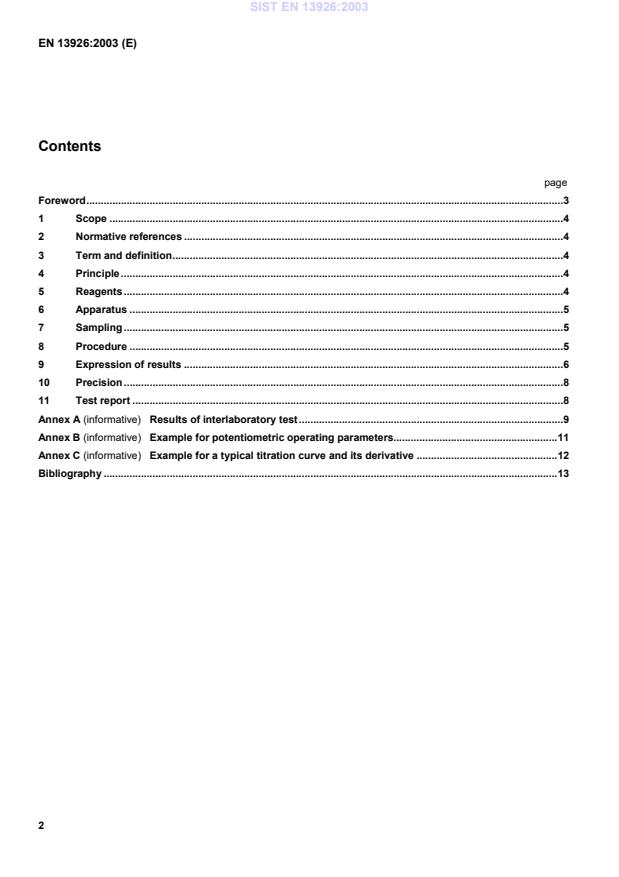
Results of interlaboratory test.9Annex B (informative)
Example for potentiometric operating parameters.11Annex C (informative)
Example for a typical titration curve and its derivative.12Bibliography.13SIST EN 13926:2003
% dried at (105 ± 1) °C.SIST EN 13926:2003
% (m/m) to the nearest 0,1 g and dissolve it in 250 mlfreshly boiled water. Then transfer the solution into a 2 l volumetric flask and complete to the mark with ethanol(5.6). Allow the solution to stand for 24 h before standardization.5.8Acetylation reagentCarefully mix 92 ml of tetrahydrofuran (5.2) and 8 ml of acetic anhydride (5.3). This solution is stable for up to onemon
...