

ASTM D3231-24
(Test Method)Standard Test Method for Phosphorus in Gasoline
General Information
- Abstract
SIGNIFICANCE AND USE
5.1 Phosphorus in gasoline will damage catalytic convertors used in automotive emission control systems, and its level therefore is kept low.
SCOPE
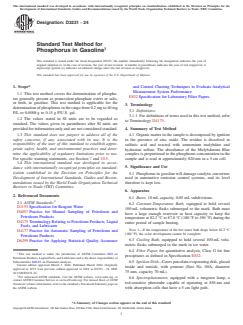
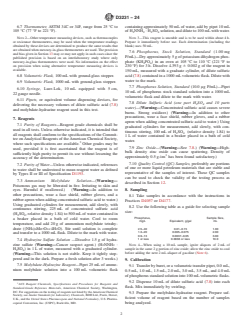
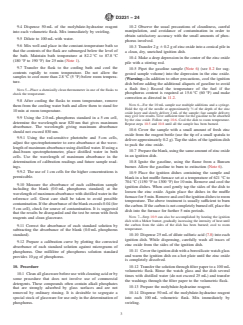
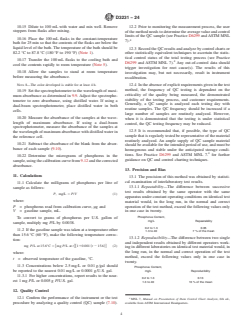
1.1 This test method covers the determination of phosphorus generally present as pentavalent phosphate esters or salts, or both, in gasoline. This test method is applicable for the determination of phosphorus in the range from 0.2 mg to 40 mg P/L or 0.0008 g to 0.15 g P/U.S. gal.
1.2 The values stated in SI units are to be regarded as standard. The values given in parentheses after SI units are provided for information only and are not considered standard.
1.3 This standard does not purport to address all of the safety concerns, if any, associated with its use. It is the responsibility of the user of this standard to establish appropriate safety, health, and environmental practices and determine the applicability of regulatory limitations prior to use. For specific warning statements, see Section 7 and 10.5.
1.4 This international standard was developed in accordance with internationally recognized principles on standardization established in the Decision on Principles for the Development of International Standards, Guides and Recommendations issued by the World Trade Organization Technical Barriers to Trade (TBT) Committee.
- Status
- Published
- Publication Date
- 29-Feb-2024
- Technical Committee
- D02 - Petroleum Products, Liquid Fuels, and Lubricants
- Drafting Committee
- D02.03 - Elemental Analysis
Overview
ASTM D3231-24: Standard Test Method for Phosphorus in Gasoline provides a precise method for determining phosphorus content in gasoline, applicable to concentrations generally present as pentavalent phosphate esters or salts. This international standard ensures that phosphorus levels in gasoline remain within limits that prevent damage to automotive catalytic converters and meet emissions regulatory requirements. The method enables laboratories and fuel producers to monitor and control phosphorus concentrations in finished gasoline, supporting better air quality and protecting vehicle emission control systems.
Key Topics
- Scope of Measurement
- Applicable to determining phosphorus in the range of 0.2 mg to 40 mg per liter (0.0008 g to 0.15 g per U.S. gallon) in gasoline.
- Covers phosphorus found predominantly as pentavalent phosphate esters or salts.
- SI units are standard; values in parentheses are for informational purposes.
- Significance and Use
- Excess phosphorus can harm automotive emission systems, specifically catalytic converters, leading to higher emissions and lower performance.
- Regular monitoring ensures compliance with environmental regulations and helps maintain vehicle efficiency.
- Test Method Overview
- The procedure involves oxidizing the organic matter in the gasoline sample, extracting phosphorus, and then measuring the phosphorus concentration spectrophotometrically.
- Critical steps include reacting phosphorus with ammonium molybdate and hydrazine sulfate and measuring the Molybdenum Blue complex's absorbance.
- Laboratory best practices stress strict avoidance of contamination, reliable calibration, and comprehensive quality control procedures.
- Safety and Environmental Considerations
- Users must observe rigorous laboratory safety protocols due to the use of toxic chemicals and high temperatures.
- The standard reminds users to be responsible for relevant safety, health, and environmental practices, and to consider local regulatory compliance before use.
Applications
- Fuel Quality Assurance
- Routine analysis of gasoline by refiners, suppliers, and regulatory bodies to confirm conformance to phosphorus limits.
- Supports quality control during fuel processing and blending operations.
- Automotive and Transportation
- Protects catalytic converters and other emission control systems in vehicles, helping to extend their operational life and reduce maintenance costs.
- Environmental Compliance
- Helps meet domestic and international regulations aimed at reducing air pollutants from vehicle exhaust.
- Key for organizations needing to demonstrate compliance with legislative mandates regarding gasoline composition.
- Research and Testing Laboratories
- Widely used in chemical laboratories specializing in petroleum product analysis to obtain consistent, reproducible results for both internal and external reporting.
Related Standards
- ASTM D1193 - Specification for Reagent Water, necessary for sample preparation and analysis.
- ASTM D4057 - Practice for Manual Sampling of Petroleum and Petroleum Products, covering sample collection protocols.
- ASTM D4175 - Terminology Relating to Petroleum Products, Liquid Fuels, and Lubricants, for consistent vocabulary in reporting and documentation.
- ASTM D4177 - Practice for Automatic Sampling of Petroleum and Petroleum Products.
- ASTM D6299 - Practice for Statistical Quality Assurance and Control Charting Techniques, guiding laboratory quality control.
- ASTM E832 - Specification for Laboratory Filter Papers, relevant for filtration steps during sample preparation.
By implementing ASTM D3231-24, organizations enhance their ability to deliver high-quality, low-emission fuels, protect automotive components, and fulfill regulatory obligations for gasoline phosphorus content measurement. This standard is a vital resource for maintaining environmental and engineering standards within the petroleum and automotive sectors.
Relations
- Effective Date
- 01-Mar-2024
- Effective Date
- 01-Mar-2024
- Effective Date
- 01-Mar-2024
- Effective Date
- 01-Mar-2024
- Effective Date
- 01-Mar-2024
- Effective Date
- 01-Mar-2024
- Effective Date
- 01-Mar-2024
- Effective Date
- 01-Mar-2024
- Effective Date
- 01-Mar-2024
- Effective Date
- 01-Mar-2024
- Effective Date
- 01-Mar-2024
- Effective Date
- 01-Mar-2024
- Effective Date
- 01-Mar-2024
- Effective Date
- 01-Mar-2024
- Effective Date
- 01-Mar-2024
Get Certified
Connect with accredited certification bodies for this standard

Element Materials Technology
Materials testing and product certification.

ABS Group Brazil
ABS Group certification services in Brazil.

ABS Quality Evaluations Inc.
American Bureau of Shipping quality certification.
Sponsored listings
Frequently Asked Questions
ASTM D3231-24 is a standard published by ASTM International. Its full title is "Standard Test Method for Phosphorus in Gasoline". This standard covers: SIGNIFICANCE AND USE 5.1 Phosphorus in gasoline will damage catalytic convertors used in automotive emission control systems, and its level therefore is kept low. SCOPE 1.1 This test method covers the determination of phosphorus generally present as pentavalent phosphate esters or salts, or both, in gasoline. This test method is applicable for the determination of phosphorus in the range from 0.2 mg to 40 mg P/L or 0.0008 g to 0.15 g P/U.S. gal. 1.2 The values stated in SI units are to be regarded as standard. The values given in parentheses after SI units are provided for information only and are not considered standard. 1.3 This standard does not purport to address all of the safety concerns, if any, associated with its use. It is the responsibility of the user of this standard to establish appropriate safety, health, and environmental practices and determine the applicability of regulatory limitations prior to use. For specific warning statements, see Section 7 and 10.5. 1.4 This international standard was developed in accordance with internationally recognized principles on standardization established in the Decision on Principles for the Development of International Standards, Guides and Recommendations issued by the World Trade Organization Technical Barriers to Trade (TBT) Committee.
SIGNIFICANCE AND USE 5.1 Phosphorus in gasoline will damage catalytic convertors used in automotive emission control systems, and its level therefore is kept low. SCOPE 1.1 This test method covers the determination of phosphorus generally present as pentavalent phosphate esters or salts, or both, in gasoline. This test method is applicable for the determination of phosphorus in the range from 0.2 mg to 40 mg P/L or 0.0008 g to 0.15 g P/U.S. gal. 1.2 The values stated in SI units are to be regarded as standard. The values given in parentheses after SI units are provided for information only and are not considered standard. 1.3 This standard does not purport to address all of the safety concerns, if any, associated with its use. It is the responsibility of the user of this standard to establish appropriate safety, health, and environmental practices and determine the applicability of regulatory limitations prior to use. For specific warning statements, see Section 7 and 10.5. 1.4 This international standard was developed in accordance with internationally recognized principles on standardization established in the Decision on Principles for the Development of International Standards, Guides and Recommendations issued by the World Trade Organization Technical Barriers to Trade (TBT) Committee.
ASTM D3231-24 is classified under the following ICS (International Classification for Standards) categories: 75.160.20 - Liquid fuels. The ICS classification helps identify the subject area and facilitates finding related standards.
ASTM D3231-24 has the following relationships with other standards: It is inter standard links to ASTM D3231-18, ASTM D6984-18e1, ASTM D8111-23a, ASTM D7455-19, ASTM D8226-21ae1, ASTM D5798-21, ASTM D8114-23a, ASTM D7578-20, ASTM D8291-23a, ASTM D7320-18e1, ASTM D7589-16e1, ASTM D6709-23, ASTM D6227-24, ASTM D5797-21, ASTM D4814-23a. Understanding these relationships helps ensure you are using the most current and applicable version of the standard.
ASTM D3231-24 is available in PDF format for immediate download after purchase. The document can be added to your cart and obtained through the secure checkout process. Digital delivery ensures instant access to the complete standard document.
Standards Content (Sample)
This international standard was developed in accordance with internationally recognized principles on standardization established in the Decision on Principles for the
Development of International Standards, Guides and Recommendations issued by the World Trade Organization Technical Barriers to Trade (TBT) Committee.
Designation: D3231 − 24
Standard Test Method for
Phosphorus in Gasoline
This standard is issued under the fixed designation D3231; the number immediately following the designation indicates the year of
original adoption or, in the case of revision, the year of last revision. A number in parentheses indicates the year of last reapproval. A
superscript epsilon (´) indicates an editorial change since the last revision or reapproval.
This standard has been approved for use by agencies of the U.S. Department of Defense.
1. Scope* and Control Charting Techniques to Evaluate Analytical
Measurement System Performance
1.1 This test method covers the determination of phospho-
E832 Specification for Laboratory Filter Papers
rus generally present as pentavalent phosphate esters or salts,
or both, in gasoline. This test method is applicable for the
3. Terminology
determination of phosphorus in the range from 0.2 mg to 40 mg
3.1 Definitions:
P/L or 0.0008 g to 0.15 g P/U.S. gal.
3.1.1 For definitions of terms used in this test method, refer
1.2 The values stated in SI units are to be regarded as
to Terminology D4175.
standard. The values given in parentheses after SI units are
provided for information only and are not considered standard. 4. Summary of Test Method
1.3 This standard does not purport to address all of the
4.1 Organic matter in the sample is decomposed by ignition
safety concerns, if any, associated with its use. It is the
in the presence of zinc oxide. The residue is dissolved in
responsibility of the user of this standard to establish appro-
sulfuric acid and reacted with ammonium molybdate and
priate safety, health, and environmental practices and deter-
hydrazine sulfate. The absorbance of the Molybdenum Blue
mine the applicability of regulatory limitations prior to use.
complex is proportional to the phosphorus concentration in the
For specific warning statements, see Section 7 and 10.5.
sample and is read at approximately 820 nm in a 5 cm cell.
1.4 This international standard was developed in accor-
5. Significance and Use
dance with internationally recognized principles on standard-
ization established in the Decision on Principles for the
5.1 Phosphorus in gasoline will damage catalytic convertors
Development of International Standards, Guides and Recom-
used in automotive emission control systems, and its level
mendations issued by the World Trade Organization Technical
therefore is kept low.
Barriers to Trade (TBT) Committee.
6. Apparatus
2. Referenced Documents
6.1 Buret, 10 mL capacity, 0.05 mL subdivisions.
2.1 ASTM Standards:
6.2 Constant-Temperature Bath, equipped to hold several
D1193 Specification for Reagent Water
100 mL volumetric flasks submerged to the mark. Bath must
D4057 Practice for Manual Sampling of Petroleum and
have a large enough reservoir or heat capacity to keep the
Petroleum Products
temperature at 82.2 °C to 87.8 °C (180 °F to 190 °F) during the
D4175 Terminology Relating to Petroleum Products, Liquid
entire period of sample heating.
Fuels, and Lubricants
NOTE 1—If the temperature of the hot water bath drops below 82.2 °C
D4177 Practice for Automatic Sampling of Petroleum and
(180 °F), the color development cannot be complete.
Petroleum Products
6.3 Cooling Bath, equipped to hold several 100 mL volu-
D6299 Practice for Applying Statistical Quality Assurance
metric flasks submerged to the mark in ice water.
6.4 Filter Paper, for quantitative analysis, Class G for fine
This test method is under the jurisdiction of ASTM Committee D02 on
precipitates as defined in Specification E832.
Petroleum Products, Liquid Fuels, and Lubricants and is the direct responsibility of
Subcommittee D02.03 on Elemental Analysis.
6.5 Ignition Dish—Coors porcelain evaporating dish, glazed
Current edition approved March 1, 2024. Published March 2024. Originally
inside and outside, with pourout (Size No. 00A, diameter
approved in 1973. Last previous edition approved in 2018 as D3231 – 18. DOI:
75 mm, capacity 70 mL).
10.1520/D3231-24.
For referenced ASTM standards, visit the ASTM website, www.astm.org, or
6.6 Spectrophotometer, equipped with a tungsten lamp, a
contact ASTM Customer Service at service@astm.org. For Annual Book of ASTM
red-sensitive phototube capable of operating at 830 nm and
Standards volume information, refer to the standard’s Document Summary page on
the ASTM website. with absorption cells that have a 5 cm light path.
*A Summary of Changes section appears at the end of this standard
Copyright © ASTM International, 100 Barr Harbor Drive, PO Box C700, West Conshohocken, PA 19428-2959. United States
D3231 − 24
6.7 Thermometer, ASTM 34C or 34F, range from 25 °C to containing approximately 50 mL of water, add by pipet 10 mL
105 °C (77 °F to 221 °F). of H NNH · H SO solution, and dilute to 100 mL with water.
2 2 2 4
NOTE 2—Other temperature measuring devices, such as thermocouples NOTE 3—This reagent is unstable and is to be used within about 4 h.
or resistance thermometers, may be used when the temperature readings Prepare it immediately before use. Each determination (including the
obtained by these devices are determined to produce the same results that blank) uses 50 mL.
are obtained when mercury-in-glass thermometers are used. The precision
7.6 Phosphorus, Stock Solution, Standard (1.00 mg
and bias given in Section 13 may or may not apply in such cases since the
P/mL)—Dry approximately 5 g of potassium dihydrogen phos-
published precision is based on an interlaboratory study where only
phate (KH PO ) in an oven at 105 °C to 110 °C (221 °F to
mercury-in-glass thermometers were used. No information on the effect
2 4
on precision when using alternative temperature measuring devices is
230 °F) for 3 h. Dissolve 4.393 g 6 0.002 g of the reagent in
available.
150 mL, measured with a graduate cylinder, of dilute sulfuric
6.8 Volumetric Flask, 100 mL with ground-glass stopper. acid (7.8) contained in a 1000 mL volumetric flask. Dilute with
water to the mark.
6.9 Volumetric Flask, 1000 mL with ground-glass stopper.
7.7 Phosphorus Solution, Standard (10.0 μg P/mL)—Pipet
6.10 Syringe, Luer-Lok, 10 mL equipped with 5 cm,
10 mL of phosphorus stock standard solution into a 1000 mL
22 gauge needle.
volumetric flask and dilute to the mark with water.
6.11 Pipets, or equivalent volume dispensing devices, for
7.8 Dilute Sulfuric Acid (one part H SO and 10 parts
2 4
delivering the necessary volumes of dilute sulfuric acid (7.8)
water)—(Warning—Concentrated sulfuric acid causes severe
and molybdate-hydrazine reagent used in this test.
burns. Strong oxidizer.) (Warning—In addition to other
precautions, wear a face shield, rubber gloves, and a rubber
7. Reagents
apron when adding concentrated sulfuric acid to water.) Using
7.1 Purity of Reagents—Reagent grade chemicals shall be
graduated cylinders for measurement, add slowly, with con-
used in all tests. Unless otherwise indicated, it is intended that
tinuous stirring, 100 mL of H SO (relative density 1.84) to
2 4
all reagents shall conform to the specifications of the Commit-
1 L of water contained in a beaker placed in a bath of cold
tee on Analytical Reagents of the American Chemical Society,
water.
where such specifications are available. Other grades may be
7.9 Zinc Oxide—(Warning—See 7.8.) (Warning—High-
used, provided it is first ascertained that the reagent is of
bulk density zinc oxide can cause spattering. Density of
sufficiently high purity to permit its use without lessening the
approximately 0.5 g ⁄cm has been found satisfactory.)
accuracy of the determination.
7.10 Quality Control (QC) Samples, preferably are portions
7.2 Purity of Water—Unless otherwise indicated, references
of one or more liquid petroleum materials that are stable and
to water shall be understood to mean reagent water as defined
representative of the samples of interest. These QC samples
by Types II or III of Specification D1193.
can be used to check the validity of the testing process as
7.3 Ammonium Molybdate Solution—(Warning—
described in Section 12.
Poisonous gas may be liberated in fire. Irritating to skin and
8. Sampling
eyes. Harmful if swallowed.) (Warning—In addition to
other precautions, wear a face shield, rubber gloves, and a
8.1 Take samples in accordance with the instructions in
rubber apron when adding concentrated sulfuric acid to water.)
Practices D4057 or D4177.
Using graduated cylinders for measurement, add slowly, with
8.2 Use the following table as a guide for selecting sample
continuous stirring, 225 mL of concentrated sulfuric acid
size:
(H SO , relative density 1.84) to 500 mL of water contained in
2 4
Phosphorus, Sample Size,
a beaker placed in a bath of cold water. Cool to room
mg/L Equivalent, g/gal mL
temperature, and add 20 g of ammonium molybdate tetrahy-
2.5–40 0.01–0.15 1.00
drate ((NH ) Mo O ·4H O). Stir until solution is complete
4 6 7 24 2
1.3–20 0.005–0.075 2.00
and transfer to a 1000 mL flask. Dilute to the mark with water.
0.9–13 0.0037–0.05 3.00
1 or less 0.0038 or less 10.0
7.4 Hydrazine Sulfate Solution —Dissolve 1.5 g of hydra-
zine sulfate (Warning—Cancer suspect agent.) (H NNH ·
2 2 NOTE 4—When using a 10 mL sample, ignite aliquots of 2 mL of
H SO ) in 1 L of water, measured with a graduated cylinder. sample in the same 2 g portion of zinc oxide; allow the zinc oxide to cool
2 4
before adding the next 2 mL aliquot of gasoline (Note 6).
(Warning—This solution is not stable. Keep it tightly stop-
pered and in the dark. Prepare a fresh solution after 3 weeks.)
9. Calibration
7.5 Molybdate-Hydrazine Reagent—Pipet 25 mL of ammo-
9.1 Transfer by buret, or a volumetric transfer pipet, 0.0 mL,
nium molybdate solution into a 100 mL volumetric flask
0.5 mL, 1.0 mL, 1.5 mL, 2.0 mL, 3.0 mL, 3.5 mL, and 4.0 mL
of phosphorus standard solution into 100 mL volumetric flasks.
9.2 Dispense 10 mL of dilute sulfuric acid (7.8) into each
ACS Reagent Chemicals, Specifications and Procedures for Reagents and
flask. Mix immediately by swirling.
Standard-Grade Reference Materials, American Chemical Society, Washington,
DC. For suggestions on the testing of reagents not listed by the American Chemical
9.3 Prepare the molybdate-hydrazine reagent. Prepare suf-
Society, see Analar Standards for Laboratory Chemicals, BDH Ltd., Poole, Dorset,
ficient volume of reagent based on the number of samples
U.K., and the United States Pharmacopeia and National Formulary, U.S. Pharma-
copeial Convention, Inc. (USPC), Rockville, MD. being analyzed.
D3231 − 24
9.4 Dispense 50 mL of the molybdate-hydrazine reagent 10.2 Observe the usual precautions of cleanliness, careful
into each volumetric flask. Mix immediately by swirling. manipulation, and avoidance of contamination in order to
obtain satisfactory accuracy with the small amounts of phos-
9.5 Dilute to 100 mL with water.
phorus involved.
9.6 Mix well and place in the constant-temperature bath so
10.3 Transfer 2 g 6 0.2 g of zinc oxide into a conical pile in
that the contents of the flask are submerged below the level of
a clean, dry, unetched ignition dish.
the bath. Maintain bath temperature at 82.2 °C to 87.8 °C
10.4 Make a deep depression in the center of the zinc oxide
(180 °F to 190 °F) for 25 min (Note 1).
pile with a stirring rod.
9.7 Transfer the flask to the cooling bath and cool the
10.5 Pipet the gasoline sample (Note 6) (see 8.2 for sug-
contents rapidly to
...
This document is not an ASTM standard and is intended only to provide the user of an ASTM standard an indication of what changes have been made to the previous version. Because
it may not be technically possible to adequately depict all changes accurately, ASTM recommends that users consult prior editions as appropriate. In all cases only the current version
of the standard as published by ASTM is to be considered the official document.
Designation: D3231 − 18 D3231 − 24
Standard Test Method for
Phosphorus in Gasoline
This standard is issued under the fixed designation D3231; the number immediately following the designation indicates the year of
original adoption or, in the case of revision, the year of last revision. A number in parentheses indicates the year of last reapproval. A
superscript epsilon (´) indicates an editorial change since the last revision or reapproval.
This standard has been approved for use by agencies of the U.S. Department of Defense.
1. Scope*
1.1 This test method covers the determination of phosphorus generally present as pentavalent phosphate esters or salts, or both,
in gasoline. This test method is applicable for the determination of phosphorus in the range from 0.2 mg to 40 mg P/L or 0.0008 g
to 0.15 g P/U.S. gal.
1.2 The values stated in SI units are to be regarded as standard. The values given in parentheses after SI units are provided for
information only and are not considered standard.
1.3 This standard does not purport to address all of the safety concerns, if any, associated with its use. It is the responsibility
of the user of this standard to establish appropriate safety, health, and environmental practices and determine the applicability of
regulatory limitations prior to use. For specific warning statements, see Section 67 and 9.510.5.
1.4 This international standard was developed in accordance with internationally recognized principles on standardization
established in the Decision on Principles for the Development of International Standards, Guides and Recommendations issued
by the World Trade Organization Technical Barriers to Trade (TBT) Committee.
2. Referenced Documents
2.1 ASTM Standards:
D1193 Specification for Reagent Water
D4057 Practice for Manual Sampling of Petroleum and Petroleum Products
D4175 Terminology Relating to Petroleum Products, Liquid Fuels, and Lubricants
D4177 Practice for Automatic Sampling of Petroleum and Petroleum Products
D6299 Practice for Applying Statistical Quality Assurance and Control Charting Techniques to Evaluate Analytical Measure-
ment System Performance
E832 Specification for Laboratory Filter Papers
3. Terminology
3.1 Definitions:
3.1.1 For definitions of terms used in this test method, refer to Terminology D4175.
This test method is under the jurisdiction of ASTM Committee D02 on Petroleum Products, Liquid Fuels, and Lubricants and is the direct responsibility of Subcommittee
D02.03 on Elemental Analysis.
Current edition approved April 1, 2018March 1, 2024. Published April 2018March 2024. Originally approved in 1973. Last previous edition approved in 20132018 as
D3231 – 13.D3231 – 18. DOI: 10.1520/D3231-18.10.1520/D3231-24.
For referenced ASTM standards, visit the ASTM website, www.astm.org, or contact ASTM Customer Service at service@astm.org. For Annual Book of ASTM Standards
volume information, refer to the standard’s Document Summary page on the ASTM website.
*A Summary of Changes section appears at the end of this standard
Copyright © ASTM International, 100 Barr Harbor Drive, PO Box C700, West Conshohocken, PA 19428-2959. United States
D3231 − 24
4. Summary of Test Method
4.1 Organic matter in the sample is decomposed by ignition in the presence of zinc oxide. The residue is dissolved in sulfuric acid
and reacted with ammonium molybdate and hydrazine sulfate. The absorbance of the Molybdenum Blue complex is proportional
to the phosphorus concentration in the sample and is read at approximately 820 nm in a 5 cm cell.
5. Significance and Use
5.1 Phosphorus in gasoline will damage catalytic convertors used in automotive emission control systems, and its level therefore
is kept low.
6. Apparatus
6.1 Buret, 10 mL capacity, 0.05 mL subdivisions.
6.2 Constant-Temperature Bath, equipped to hold several 100 mL volumetric flasks submerged to the mark. Bath must have a large
enough reservoir or heat capacity to keep the temperature at 82.2 °C to 87.8 °C (180 °F to 190 °F) during the entire period of
sample heating.
NOTE 1—If the temperature of the hot water bath drops below 82.2 °C (180 °F), the color development cannot be complete.
6.3 Cooling Bath, equipped to hold several 100 mL volumetric flasks submerged to the mark in ice water.
6.4 Filter Paper, for quantitative analysis, Class G for fine precipitates as defined in Specification E832.
6.5 Ignition Dish—Coors porcelain evaporating dish, glazed inside and outside, with pourout (Size No. 00A, diameter 75 mm,
capacity 70 mL).
6.6 Spectrophotometer, equipped with a tungsten lamp, a red-sensitive phototube capable of operating at 830 nm and with
absorption cells that have a 5 cm light path.
6.7 Thermometer, ASTM 34C or 34F, range from 25 °C to 105 °C (77 °F to 221 °F).
NOTE 2—Other temperature measuring devices, such as thermocouples or resistance thermometers, may be used when the temperature readings obtained
by these devices are determined to produce the same results that are obtained when mercury-in-glass thermometers are used. The precision and bias given
in Section 1213 may or may not apply in such cases since the published precision is based on an interlaboratory study where only mercury-in-glass
thermometers were used. No information on the effect on precision when using alternative temperature measuring devices is available.
6.8 Volumetric Flask, 100 mL with ground-glass stopper.
6.9 Volumetric Flask, 1000 mL with ground-glass stopper.
6.10 Syringe, Luer-Lok, 10 mL equipped with 5 cm, 22 gauge needle.
6.11 Pipets, or equivalent volume dispensing devices, for delivering the necessary volumes of dilute sulfuric acid (6.87.8) and
molybdate-hydrazine reagent used in this test.
7. Reagents
7.1 Purity of Reagents—Reagent grade chemicals shall be used in all tests. Unless otherwise indicated, it is intended that all
reagents shall conform to the specifications of the Committee on Analytical Reagents of the American Chemical Society, where
D3231 − 24
such specifications are available. Other grades may be used, provided it is first ascertained that the reagent is of sufficiently high
purity to permit its use without lessening the accuracy of the determination.
7.2 Purity of Water—Unless otherwise indicated, references to water shall be understood to mean reagent water as defined by
Types II or III of Specification D1193.
7.3 Ammonium Molybdate Solution—(Warning—Poisonous gas may be liberated in fire. Irritating to skin and eyes. Harmful if
swallowed.) (Warning—In addition to other precautions, wear a face shield, rubber gloves, and a rubber apron when adding
concentrated sulfuric acid to water.) Using graduated cylinders for measurement, add slowly, with continuous stirring, 225 mL of
concentrated sulfuric acid (H SO , relative density 1.84) to 500 mL of water contained in a beaker placed in a bath of cold water.
2 4
Cool to room temperature, and add 20 g of ammonium molybdate tetrahydrate ((NH ) Mo O ·4H O). Stir until solution is
4 6 7 24 2
complete and transfer to a 1000 mL flask. Dilute to the mark with water.
7.4 Hydrazine Sulfate Solution —Dissolve 1.5 g of hydrazine sulfate (Warning—Cancer suspect agent.) (H NNH · H SO ) in
2 2 2 4
1 L of water, measured with a graduated cylinder. (Warning—This solution is not stable. Keep it tightly stoppered and in the dark.
Prepare a fresh solution after 3 weeks.)
7.5 Molybdate-Hydrazine Reagent—Pipet 25 mL of ammonium molybdate solution into a 100 mL volumetric flask containing
approximately 50 mL of water, add by pipet 10 mL of H NNH · H SO solution, and dilute to 100 mL with water.
2 2 2 4
NOTE 3—This reagent is unstable and is to be used within about 4 h. Prepare it immediately before use. Each determination (including the blank) uses
50 mL.
7.6 Phosphorus, Stock Solution, Standard (1.00 mg P/mL)—Dry approximately 5 g of potassium dihydrogen phosphate (KH PO )
2 4
in an oven at 105 °C to 110 °C (221 °F to 230 °F) for 3 h. Dissolve 4.393 g 6 0.002 g of the reagent in 150 mL, measured with
a graduate cylinder, of dilute sulfuric acid (6.87.8) contained in a 1000 mL volumetric flask. Dilute with water to the mark.
7.7 Phosphorus Solution, Standard (10.0 μg P/mL)—Pipet 10 mL of phosphorus stock standard solution into a 1000 mL
volumetric flask and dilute to the mark with water.
7.8 Dilute Sulfuric Acid (one part H SO and 10 parts water)—(Warning—Concentrated sulfuric acid causes severe burns. Strong
2 4
oxidizer.) (Warning—In addition to other precautions, wear a face shield, rubber gloves, and a rubber apron when adding
concentrated sulfuric acid to water.) Using graduated cylinders for measurement, add slowly, with continuous stirring, 100 mL of
H SO (relative density 1.84) to 1 L of water contained in a beaker placed in a bath of cold water.
2 4
7.9 Zinc Oxide—(Warning—See 6.87.8.) (Warning—High-bulk density zinc oxide can cause spattering. Density of approxi-
mately 0.5 g ⁄cm has been found satisfactory.)
7.10 Quality Control (QC) Samples, preferably are portions of one or more liquid petroleum materials that are stable and
representative of the samples of interest. These QC samples can be used to check the validity of the testing process as described
in Section 1112.
8. Sampling
8.1 Take samples in accordance with the instructions in Practices D4057 or D4177.
8.2 Use the following table as a guide for selecting sample size:
Reagent Chemicals, American Chemical Society SpecificationsACS Reagent Chemicals, Specifications and Procedures for Reagents and Standard-Grade Reference
Materials, , American Chemical Society, Washington, DC. For suggestions on the testing of reagents not listed by the American Chemical Society, see Analar Standards for
Laboratory Chemicals, BDH Ltd., Poole, Dorset, U.K., and the United States Pharmacopeia and National Formulary, U.S. Pharmacopeial Convention, Inc. (USPC),
Rockville, MD.
D3231 − 24
Phosphorus, Sample Size,
mg/L Equivalent, g/gal mL
2.5–40 0.01–0.15 1.00
1.3–20 0.005–0.075 2.00
0.9–13 0.0037–0.05 3.00
1 or less 0.0038 or less 10.0
NOTE 4—When using a 10 mL sample, ignite aliquots of 2 mL of sample in the same 2 g portion of zinc oxide; allow the zinc oxide to cool before adding
the next 2 mL aliquot of gasoline (Note 6).
9. Calibration
9.1 Transfer by buret, or a volumetric transfer pipet, 0.0 mL, 0.5 mL, 1.0 mL, 1.5 mL, 2.0 mL, 3.0 mL, 3.5 mL, and 4.0 mL of
phosphorus standard solution into 100 mL volumetric flasks.
9.2 Dispense 10 mL of dilute sulfuric acid (6.87.8) into each flask. Mix immediately by swirling.
9.3 Prepare the molybdate-hydrazine reagent. Prepare sufficient volume of reagent based on the number of samples being
analyzed.
9.4 Dispense 50 mL of the molybdate-hydrazine reagent into each volumetric flask. Mix immediately by swirling.
9.5 Dilute to 100 mL with water.
9.6 Mix well and place in the constant-temperature bath so that the contents of the flask are submerged below the level of the bath.
Maintain bath temperature at 82.2 °C to 87.8 °C (180 °F to 190 °F) for 25 min (Note 1).
9.7 Transfer the flask to the cooling bath and cool the contents rapidly to room temperature. Do not allow the samples to cool more
than 2.8 °C (5 °F) below room temperature.
NOTE 5—Place a chemically clean thermometer in one of the flasks to check the temperature.
9.8 After cooling the flasks to room temperature, remove them from the cooling water bath and allow them to stand for 10 min
at room temperature.
9.9 Using the 2.0 mL phosphorus standard in a 5 cm cell,
...