

ASTM C595/C595M-23
(Specification)Standard Specification for Blended Hydraulic Cements
General Information
- Abstract
ABSTRACT
This specification pertains to blended hydraulic cements for both general and special applications, using slag or pozzolan, or both, with portland cement or portland cement clinker or slag with lime. These cements are classified into two types: Type IS which is portland blast-furnace slag cement and Type IP which is portland-pozzolan cement. They can also be described according to air-entraining, moderate sulfate resistance, moderate heat of hydration, high sulfate resistance, or low heat of hydration properties. The cement shall conform to the chemical requirements prescribed. In addition, the cement shall undergo different tests to determine the following properties: chemical analysis, fineness by sieving, fineness by air-permeability, autoclave expansion, time of setting, air content of mortar, compressive strength, heat of hydration, normal consistency, specific gravity, water requirement, mortar expansions of blended cement and pozzolan, drying shrinkage, activity index with Portland cement, and sulfate resistance.
SCOPE
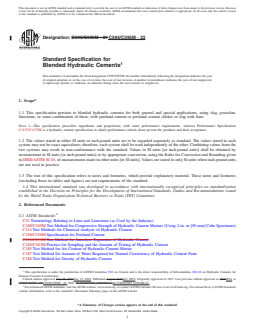
1.1 This specification pertains to blended hydraulic cements for both general and special applications, using slag, pozzolan, limestone, or some combination of these, with portland cement or portland cement clinker or slag with lime.
Note 1: This specification prescribes ingredients and proportions, with some performance requirements, whereas Performance Specification C1157/C1157M is a hydraulic cement specification in which performance criteria alone govern the products and their acceptance.
1.2 The values stated in either SI units or inch-pound units are to be regarded separately as standard. The values stated in each system may not be exact equivalents; therefore, each system shall be used independently of the other. Combining values from the two systems may result in non-conformance with the standard. Values in SI units [or inch-pound units] shall be obtained by measurement in SI units [or inch-pound units] or by appropriate conversion, using the Rules for Conversion and Rounding given in IEEE/ASTM SI 10, of measurements made in other units [or SI units]. Values are stated in only SI units when inch-pound units are not used in practice.
1.3 The text of this specification refers to notes and footnotes, which provide explanatory material. These notes and footnotes (excluding those in tables and figures) are not requirements of the standard.
1.4 This international standard was developed in accordance with internationally recognized principles on standardization established in the Decision on Principles for the Development of International Standards, Guides and Recommendations issued by the World Trade Organization Technical Barriers to Trade (TBT) Committee.
- Status
- Published
- Publication Date
- 14-Jul-2023
- Technical Committee
- C01 - Cement
- Drafting Committee
- C01.10 - Hydraulic Cements for General Concrete Construction
Overview
ASTM C595/C595M-23 sets the standard specification for blended hydraulic cements, establishing comprehensive requirements for products incorporating one or more supplementary cementitious materials (SCMs) such as slag, pozzolan, and limestone. Developed by ASTM International, this standard supports both general and specialized construction applications. The specification addresses ingredients, proportions, chemical composition, physical properties, and a robust system for classifying and naming blended cements. These guidelines are crucial for ensuring blended hydraulic cements meet performance demands in varying service environments.
Key Topics
Classification of Blended Cements:
ASTM C595/C595M-23 identifies several cement types:- Type IS: Portland blast-furnace slag cement
- Type IP: Portland-pozzolan cement
- Type IL: Portland-limestone cement
- Type IT: Ternary blended cement (various combinations of slag, pozzolan, limestone)
Material Requirements:
Acceptable ingredients include portland cement/clinker, slag, pozzolan, limestone, hydrated lime, and allowed chemical additions. Each has detailed quality specifications, covering aspects such as calcium carbonate content (limestone) and loss on ignition (pozzolan).Performance and Testing:
Cements must conform to rigorous chemical (e.g., sulfate, insoluble residue) and physical requirements, verified through standardized testing:- Fineness (by sieving and air-permeability)
- Compressive strength
- Setting time
- Air content
- Heat of hydration
- Sulfate resistance (as required)
- Drying shrinkage
- Density
Special Properties:
Cements may be customized for:- Air entrainment (improving freeze-thaw durability)
- Moderate or high sulfate resistance
- Moderate or low heat of hydration (important for mass concrete work)
- High early strength
Packaging, Marking & Certification:
Clear requirements ensure traceability of product type, manufacturer, ingredient proportions, and any special additions or enhancements. Certification and test reports are mandatory for quality assurance.
Applications
Blended hydraulic cements produced under ASTM C595/C595M-23 are widely employed in construction projects where enhanced durability, sustainability, or tailored performance is required. Common applications include:
General Concrete Construction:
Used for structural concrete, pavements, and precast elements thanks to improved workability and potential cost savings.Infrastructure Projects:
Suited for bridges, highways, tunnels, and dams, particularly where resistance to sulfate attack or heat management is critical.Sustainable Building:
Blended cements can lower embodied carbon by replacing a portion of portland cement with industrial byproducts such as slag and fly ash.Specialized Environments:
Specified for use in settings requiring tailored resistance to chemical attack (e.g., wastewater facilities, marine structures) or freeze-thaw cycles.
By enabling manufacturers and specifiers to select cements with specific properties, the standard supports innovation and sustainability within the cement and concrete sectors.
Related Standards
- ASTM C150/C150M: Standard Specification for Portland Cement
- ASTM C1157/C1157M: Performance Specification for Hydraulic Cement
- ASTM C311/C311M: Sampling and Testing Fly Ash or Natural Pozzolans for Use in Portland-Cement Concrete
- ASTM C1012/C1012M: Test Method for Length Change of Hydraulic-Cement Mortars Exposed to a Sulfate Solution
- ASTM C191, C204, C430: Test methods covering setting time, fineness, and other key properties
- IEEE/ASTM SI 10: Standard for Use of the International System of Units (SI)
- ASTM C226, C465, C688: Specifications for additives and admixtures
ASTM C595/C595M-23 provides a foundational reference for those involved in the production, selection, and application of blended hydraulic cements, supporting quality, durability, and performance in modern construction.
Keywords: ASTM C595, blended hydraulic cement, portland blast-furnace slag cement, portland-pozzolan cement, construction materials, cement standards, concrete durability, sustainable cement, sulfate resistance, heat of hydration.
Relations
- Effective Date
- 01-Apr-2024
- Effective Date
- 01-Apr-2024
- Effective Date
- 01-Apr-2024
- Effective Date
- 01-Jan-2024
- Refers
ASTM C204-24 - Standard Test Methods for Fineness of Hydraulic Cement by Air-Permeability Apparatus - Effective Date
- 01-Jan-2024
- Effective Date
- 15-Dec-2023
- Effective Date
- 01-Dec-2023
- Effective Date
- 01-Oct-2023
- Effective Date
- 01-Oct-2023
- Effective Date
- 01-Aug-2020
- Effective Date
- 01-Apr-2020
- Effective Date
- 01-Apr-2020
- Effective Date
- 15-Jan-2020
- Effective Date
- 15-Dec-2019
- Effective Date
- 01-Dec-2019
Get Certified
Connect with accredited certification bodies for this standard

DIBt (Deutsches Institut für Bautechnik)
German Institute for Building Technology.
DIN CERTCO
DIN Group product certification.

Aboma Certification B.V.
Specialized in construction, metal, and transport sectors.
Sponsored listings
Frequently Asked Questions
ASTM C595/C595M-23 is a technical specification published by ASTM International. Its full title is "Standard Specification for Blended Hydraulic Cements". This standard covers: ABSTRACT This specification pertains to blended hydraulic cements for both general and special applications, using slag or pozzolan, or both, with portland cement or portland cement clinker or slag with lime. These cements are classified into two types: Type IS which is portland blast-furnace slag cement and Type IP which is portland-pozzolan cement. They can also be described according to air-entraining, moderate sulfate resistance, moderate heat of hydration, high sulfate resistance, or low heat of hydration properties. The cement shall conform to the chemical requirements prescribed. In addition, the cement shall undergo different tests to determine the following properties: chemical analysis, fineness by sieving, fineness by air-permeability, autoclave expansion, time of setting, air content of mortar, compressive strength, heat of hydration, normal consistency, specific gravity, water requirement, mortar expansions of blended cement and pozzolan, drying shrinkage, activity index with Portland cement, and sulfate resistance. SCOPE 1.1 This specification pertains to blended hydraulic cements for both general and special applications, using slag, pozzolan, limestone, or some combination of these, with portland cement or portland cement clinker or slag with lime. Note 1: This specification prescribes ingredients and proportions, with some performance requirements, whereas Performance Specification C1157/C1157M is a hydraulic cement specification in which performance criteria alone govern the products and their acceptance. 1.2 The values stated in either SI units or inch-pound units are to be regarded separately as standard. The values stated in each system may not be exact equivalents; therefore, each system shall be used independently of the other. Combining values from the two systems may result in non-conformance with the standard. Values in SI units [or inch-pound units] shall be obtained by measurement in SI units [or inch-pound units] or by appropriate conversion, using the Rules for Conversion and Rounding given in IEEE/ASTM SI 10, of measurements made in other units [or SI units]. Values are stated in only SI units when inch-pound units are not used in practice. 1.3 The text of this specification refers to notes and footnotes, which provide explanatory material. These notes and footnotes (excluding those in tables and figures) are not requirements of the standard. 1.4 This international standard was developed in accordance with internationally recognized principles on standardization established in the Decision on Principles for the Development of International Standards, Guides and Recommendations issued by the World Trade Organization Technical Barriers to Trade (TBT) Committee.
ABSTRACT This specification pertains to blended hydraulic cements for both general and special applications, using slag or pozzolan, or both, with portland cement or portland cement clinker or slag with lime. These cements are classified into two types: Type IS which is portland blast-furnace slag cement and Type IP which is portland-pozzolan cement. They can also be described according to air-entraining, moderate sulfate resistance, moderate heat of hydration, high sulfate resistance, or low heat of hydration properties. The cement shall conform to the chemical requirements prescribed. In addition, the cement shall undergo different tests to determine the following properties: chemical analysis, fineness by sieving, fineness by air-permeability, autoclave expansion, time of setting, air content of mortar, compressive strength, heat of hydration, normal consistency, specific gravity, water requirement, mortar expansions of blended cement and pozzolan, drying shrinkage, activity index with Portland cement, and sulfate resistance. SCOPE 1.1 This specification pertains to blended hydraulic cements for both general and special applications, using slag, pozzolan, limestone, or some combination of these, with portland cement or portland cement clinker or slag with lime. Note 1: This specification prescribes ingredients and proportions, with some performance requirements, whereas Performance Specification C1157/C1157M is a hydraulic cement specification in which performance criteria alone govern the products and their acceptance. 1.2 The values stated in either SI units or inch-pound units are to be regarded separately as standard. The values stated in each system may not be exact equivalents; therefore, each system shall be used independently of the other. Combining values from the two systems may result in non-conformance with the standard. Values in SI units [or inch-pound units] shall be obtained by measurement in SI units [or inch-pound units] or by appropriate conversion, using the Rules for Conversion and Rounding given in IEEE/ASTM SI 10, of measurements made in other units [or SI units]. Values are stated in only SI units when inch-pound units are not used in practice. 1.3 The text of this specification refers to notes and footnotes, which provide explanatory material. These notes and footnotes (excluding those in tables and figures) are not requirements of the standard. 1.4 This international standard was developed in accordance with internationally recognized principles on standardization established in the Decision on Principles for the Development of International Standards, Guides and Recommendations issued by the World Trade Organization Technical Barriers to Trade (TBT) Committee.
ASTM C595/C595M-23 is classified under the following ICS (International Classification for Standards) categories: 91.100.10 - Cement. Gypsum. Lime. Mortar. The ICS classification helps identify the subject area and facilitates finding related standards.
ASTM C595/C595M-23 has the following relationships with other standards: It is inter standard links to ASTM C219-24, ASTM C1038/C1038M-24, ASTM C1012/C1012M-24, ASTM C311/C311M-24, ASTM C204-24, ASTM C109/C109M-23, ASTM C1778-23, ASTM C114-23, ASTM C51-23, ASTM C219-20a, ASTM C219-20, ASTM C185-20, ASTM C1891-20, ASTM C1038/C1038M-19, ASTM C185-19. Understanding these relationships helps ensure you are using the most current and applicable version of the standard.
ASTM C595/C595M-23 is available in PDF format for immediate download after purchase. The document can be added to your cart and obtained through the secure checkout process. Digital delivery ensures instant access to the complete standard document.
Standards Content (Sample)
This international standard was developed in accordance with internationally recognized principles on standardization established in the Decision on Principles for the
Development of International Standards, Guides and Recommendations issued by the World Trade Organization Technical Barriers to Trade (TBT) Committee.
Designation: C595/C595M − 23
Standard Specification for
Blended Hydraulic Cements
This standard is issued under the fixed designation C595/C595M; the number immediately following the designation indicates the year
of original adoption or, in the case of revision, the year of last revision. A number in parentheses indicates the year of last reapproval.
A superscript epsilon (´) indicates an editorial change since the last revision or reapproval.
1. Scope* C51 Terminology Relating to Lime and Limestone (as Used
by the Industry)
1.1 This specification pertains to blended hydraulic cements
C109/C109M Test Method for Compressive Strength of
for both general and special applications, using slag, pozzolan,
Hydraulic Cement Mortars (Using 2-in. or [50 mm] Cube
limestone, or some combination of these, with portland cement
Specimens)
or portland cement clinker or slag with lime.
C114 Test Methods for Chemical Analysis of Hydraulic
NOTE 1—This specification prescribes ingredients and proportions, with
Cement
some performance requirements, whereas Performance Specification
C1157/C1157M is a hydraulic cement specification in which performance
C150/C150M Specification for Portland Cement
criteria alone govern the products and their acceptance.
C183/C183M Practice for Sampling and the Amount of
1.2 The values stated in either SI units or inch-pound units
Testing of Hydraulic Cement
are to be regarded separately as standard. The values stated in
C185 Test Method for Air Content of Hydraulic Cement
each system may not be exact equivalents; therefore, each
Mortar
system shall be used independently of the other. Combining
C187 Test Method for Amount of Water Required for Nor-
values from the two systems may result in non-conformance
mal Consistency of Hydraulic Cement Paste
with the standard. Values in SI units [or inch-pound units] shall
C188 Test Method for Density of Hydraulic Cement
be obtained by measurement in SI units [or inch-pound units]
C191 Test Methods for Time of Setting of Hydraulic Cement
or by appropriate conversion, using the Rules for Conversion
by Vicat Needle
and Rounding given in IEEE/ASTM SI 10, of measurements
C204 Test Methods for Fineness of Hydraulic Cement by
made in other units [or SI units]. Values are stated in only SI
Air-Permeability Apparatus
units when inch-pound units are not used in practice.
C219 Terminology Relating to Hydraulic and Other Inor-
ganic Cements
1.3 The text of this specification refers to notes and
C226 Specification for Air-Entraining Additions for Use in
footnotes, which provide explanatory material. These notes and
the Manufacture of Air-Entraining Hydraulic Cement
footnotes (excluding those in tables and figures) are not
C311/C311M Test Methods for Sampling and Testing Fly
requirements of the standard.
Ash or Natural Pozzolans for Use in Portland-Cement
1.4 This international standard was developed in accor-
Concrete
dance with internationally recognized principles on standard-
C430 Test Method for Fineness of Hydraulic Cement by the
ization established in the Decision on Principles for the
45-μm (No. 325) Sieve
Development of International Standards, Guides and Recom-
C465 Specification for Processing Additions for Use in the
mendations issued by the World Trade Organization Technical
Manufacture of Hydraulic Cements
Barriers to Trade (TBT) Committee.
C563 Guide for Approximation of Optimum SO in Hydrau-
lic Cement
2. Referenced Documents
C688 Specification for Functional Additions for Use in
2.1 ASTM Standards:
Hydraulic Cements
C821 Specification for Lime for Use with Pozzolans
C1012/C1012M Test Method for Length Change of
This specification is under the jurisdiction of ASTM Committee C01 on
Hydraulic-Cement Mortars Exposed to a Sulfate Solution
Cement and is the direct responsibility of Subcommittee C01.10 on Hydraulic
C1038/C1038M Test Method for Expansion of Hydraulic
Cements for General Concrete Construction.
Cement Mortar Bars Stored in Water
Current edition approved July 15, 2023. Published July 2023. Originally
C1157/C1157M Performance Specification for Hydraulic
approved in 1967. Last previous edition approved in 2021 as C595/C595M – 21.
DOI: 10.1520/C0595_C0595M-23.
Cement
For referenced ASTM standards, visit the ASTM website, www.astm.org, or
C1702 Test Method for Measurement of Heat of Hydration
contact ASTM Customer Service at service@astm.org. For Annual Book of ASTM
of Hydraulic Cementitious Materials Using Isothermal
Standards volume information, refer to the standard’s Document Summary page on
the ASTM website. Conduction Calorimetry
*A Summary of Changes section appears at the end of this standard
Copyright © ASTM International, 100 Barr Harbor Drive, PO Box C700, West Conshohocken, PA 19428-2959. United States
C595/C595M − 23
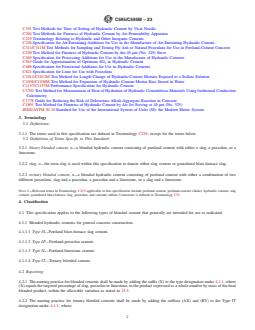
C1778 Guide for Reducing the Risk of Deleterious Alkali- 4.2.2 The naming practice for ternary blended cements shall
Aggregate Reaction in Concrete be made by adding the suffixes (AX) and (BY) to the Type IT
C1891 Test Method for Fineness of Hydraulic Cement by designation under 4.1.1, where:
Air Jet Sieving at 45-μm (No. 325) A is either “S” for slag, “P” for pozzolan, or “L” for
IEEE/ASTM SI 10 Standard for Use of the International limestone, whichever is present in larger amount by mass,
System of Units (SI): the Modern Metric System X is the targeted percentage by mass of constituent A,
B is either “S” for slag, “P” for pozzolan, or “L” for
3. Terminology
limestone, and
Y is the targeted percentage by mass of constituent B.
3.1 Definitions:
Both X and Y values are expressed as a whole number by
3.1.1 The terms used in this specification are defined in
mass of the final blended product, within the allowable
Terminology C219, except for the terms below.
variation as stated in 15.3. If X and Y are the same, list the two
3.2 Definitions of Terms Specific to This Standard:
constituents in alphabetical order by constituent type
3.2.1 binary blended cement, n—a blended hydraulic ce-
(limestone, pozzolan, or slag).
ment consisting of portland cement with either a slag, a
pozzolan, or a limestone.
NOTE 3—Examples of the naming practice in accordance with 4.2.1 and
4.2.2 are shown below (all percentages by mass):
3.2.2 slag, n—the term slag is used within this specification
Binary blended cement with 80 % portland cement and 20 % slag
to denote either slag cement or granulated blast-furnace slag.
= Type IS(20).
3.2.3 ternary blended cement, n—a blended hydraulic ce- Binary blended cement with 85 % portland cement and 15 % pozzolan
= Type IP(15).
ment consisting of portland cement with either a combination
Binary blended cement with 90 % portland cement and 10 % limestone
of two different pozzolans, slag and a pozzolan, a pozzolan and
= Type IL(10).
a limestone, or a slag and a limestone.
Ternary blended cement with 70 % portland cement, 20 % slag
and 10 % pozzolan = Type IT(S20)(P10).
NOTE 2—Relevant terms in Terminology C219 applicable to this
Ternary blended cement with 65 % portland cement, 25 % of one
specification include portland cement, portland-cement clinker, hydraulic
pozzolan and 10 % of another pozzolan = Type IT(P25)(P10).
cement, slag cement, granulated blast-furnace slag, pozzolan, and calcium
Ternary blended cement with 60 % portland cement and 20 % of
sulfate. Limestone is defined in Terminology C51.
slag and 20 % pozzolan = Type IT(P20)(S20).
Ternary blended cement with 80 % portland cement, 10 % limestone
4. Classification
and 10 % pozzolan = Type IT(L10)(P10).
Ternary blended cement with 75 % portland cement, 15 % slag
4.1 This specification applies to the following types of
and 10 % limestone = Type IT(S15)(L10).
blended cement that generally are intended for use as indicated.
4.1.1 Blended hydraulic cements for general concrete con-
4.2.3 A simplified naming practice is used in this specifica-
struction.
tion for practicality and clarity when referring to specific
4.1.1.1 Type IS—Portland blast-furnace slag cement.
requirements for binary and ternary blended cements that are
4.1.1.2 Type IP—Portland-pozzolan cement. applicable to a range of products or in ternary blended cements
4.1.1.3 Type IL—Portland-limestone cement.
when requirements are applicable to only one constituent
4.1.1.4 Type IT—Ternary blended cement. within a specific range (%) (see Note 4).
4.2 Reporting:
NOTE 4—Examples of the simplified naming practices in accordance
4.2.1 The naming practice for blended cements shall be with 4.2.3 are shown below:
(1) An example when requirements are applicable to a range of
made by adding the suffix (X) to the type designation under
products can be found in Table 1, where the maximum SO content of 3 %
4.1.1, where (X) equals the targeted percentage of slag,
applies to: binary blended cements with slag contents <70 %, indicated as
pozzolan or limestone, in the product expressed as a whole
IS(<70); and ternary blended cements with a pozzolan content less than
number by mass of the final blended product, within the
the slag content and the slag content is less than 70 %, indicated as
allowable variation as stated in 15.3. IT(P
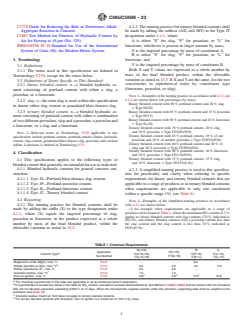
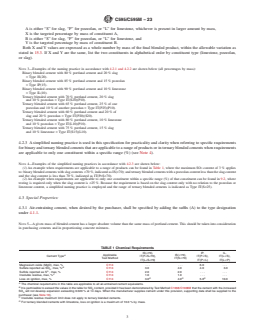
TABLE 1 Chemical Requirements
IS(<70), IP, IL,
Applicable IS($70),
A
Cement Type IT(P
Test Method IT(S$70)
IT(L
Magnesium oxide (MgO), max, % C114 . . . . . . 6.0 . . .
B
Sulfate reported as SO , max, % C114 3.0 4.0 4.0 3.0
2-
Sulfide reported as S , max, % C114 2.0 2.0 . . . . . .
C
Insoluble residue, max, % C114 1.0 1.0 . . . . . .
D D D
Loss on ignition, max, % C114 3.0 4.0 5.0 10.0
A
The chemical requirements in this table are applicable to all air-entrained cement equivalents.
B
It is permissible to exceed the values in the table for SO content, provided it has been demonstrated by Test Method C1038/C1038M that the cement with the increased
SO will not develop expansion exceeding 0.020 % at 14 days. When the manufacturer supplies cement under this provision, supporting data shall be supplied to the
purchaser (see Note 10).
C
Insoluble residue maximum limit does not apply to ternary blended cements.
D
For ternary blended cements with limestone, loss on ignition is a maximum of 10.0 % by mass.
C595/C595M − 23
(2) An example when requirements are applicable to only one constitu-
6. Materials
ent within a specific range (%) of that constituent can be found in 9.2,
6.1 Materials permitted to be used as ingredients in cements
where testing is required only when the slag content is <25 %. Because the
manufactured to comply with this specification are:
requirement is based on the slag content only with no relation to the
pozzolan or limestone content, a simplified naming practice is employed
6.1.1 Portland Cement—For purposes of this specification,
and the range of ternary blended cements is indicated as Type IT(S<25).
portland cement meeting the requirements of Specification
4.3 Special Properties:
C150/C150M is suitable.
4.3.1 Air-entraining cement, when desired by the purchaser, 6.1.2 Portland Cement Clinker.
shall be specified by adding the suffix (A) to the type
6.1.3 Slag—Slag shall be slag cement or granulated blast-
designation under 4.1.1. furnace slag and comply with requirements in Section 9.
6.1.4 Pozzolan—Pozzolan shall comply with requirements
NOTE 5—A given mass of blended cement has a larger absolute volume
in Section 9.
than the same mass of portland cement. This should be taken into
consideration in purchasing cements and in proportioning concrete mix- 6.1.5 Limestone—Limestone, as defined in Terminology
tures.
C51, shall be naturally occurring and comply with the require-
ments indicated in 8.2.
4.3.2 Moderate heat of hydration, when desired by the
6.1.6 Hydrated Lime—Hydrated lime used as part of a
purchaser, shall be specified by adding the suffix (MH) to the
blended cement shall meet the requirements of Specification
type designation under 4.1.1.
C821, except that when interground in the production process
4.3.3 Moderate sulfate resistance, when desired by the
there shall be no minimum fineness requirement.
purchaser, shall be specified by adding the suffix (MS) to the
6.1.7 Air-entraining Addition—When air-entraining cement
type designation under 4.1.1.
is specified, an addition meeting the requirements of Specifi-
4.3.4 High sulfate resistance, when desired by the
cation C226 shall be used.
purchaser, shall be specified by adding the suffix (HS) to the
6.1.8 When processing additions are used in the manufac-
type designation under 4.1.1.
ture of cement, they shall have been shown to meet the
4.3.5 Low heat of hydration, when desired by the purchaser,
requirements of Specification C465 in the amounts used or
shall be specified by adding the suffix (LH) to the type
greater (see 15.2).
designation under 4.1.1.
6.1.9 When functional additions (used at the sole option of
NOTE 6—Special properties attributable to slag, pozzolan or limestone
the purchaser) are used they shall have been shown to meet the
will vary based on quantities contained within the blended cements.
requirements of Specification C688 when tested with the
NOTE 7—Guide C1778 provides guidance on use of blended hydraulic
cements in concrete mixtures where potential for deleterious alkali-silica cement to be used, in the amount used or greater (see 15.2).
reaction is of concern.
6.1.10 Other Additions—The cement covered by this speci-
fication shall contain no additions except as provided for above
4.3.6 High early strength, when desired by the purchaser,
except that water or calcium sulfate (see Terminology C219),
shall be specified by adding the suffix (HE) to the type
or both, if added, shall be in amounts so that the limits shown
designation under 4.1.1.
in Table 1 for sulfate reported as SO and loss on ignition are
5. Ordering Information
not exceeded.
5.1 Orders for material under this specification shall include
7. Manufacture
the following:
5.1.1 Specification number,
7.1 Binary Blended Cement—Binary blended cement shall
5.1.2 Type or types required.
be a hydraulic cement consisting of an intimate and uniform
5.1.2.1 Indicate allowable slag, pozzolan, or limestone
blend (see Note 9) produced either by intergrinding or blending
maximum or minimum percentage by mass, if required,
or by a combination of intergrinding and blending portland
5.1.3 Optional special properties required (see 4.3),
cement clinker or portland cement with a pozzolan or a slag, or
5.1.3.1 MS if moderate sulfate resistance is required,
a limestone. Any slag, pozzolan, or limestone used as an
5.1.3.2 HS if high sulfate resistance is required,
ingredient or addition in portland cement used to manufacture
5.1.3.3 MH if moderate heat of hydration is required,
a binary blended cement shall be included in the total amount
5.1.3.4 LH if low heat of hydration is required,
of those materials reported in 4.2 or 15.1. The following
5.1.3.5 HE if high early strength is required,
requirements shall apply:
5.1.3.6 A if air entraining is required,
7.1.1 Portland Blast-furnace Slag Cement—Portland blast-
5.1.3.7 Accelerating addition, if required,
furnace slag cement shall be a hydraulic cement in which the
5.1.3.8 Retarding addition, if required,
slag constituent is up to 95 % by mass of the blended cement.
5.1.3.9 Water reducing addition, if required,
Portland blast-furnace slag cement with a slag content equal to
5.1.3.10 Water reducing and accelerating addition, if
or exceeding 70 % by mass, is permitted to contain hydrated
required, and
lime.
5.1.3.11 Water reducing and retarding addition, if required,
7.1.2 Air-entraining Portland Blast-furnace Slag Cement—
and.
Air-entraining portland blast-furnace slag cement shall be
5.1.4 Certification, if desired (see Section 15).
portland blast-furnace slag cement to which sufficient air-
entraining addition has been added so that the resulting product
NOTE 8—It is important to check for availability of various options.
Some multiple options are mutually incompatible or unattainable. complies with the air content of mortar requirements.
C595/C595M − 23
NOTE 10—There are cases where performance of a cement is improved
7.1.3 Portland-pozzolan Cement—Portland-pozzolan ce-
with SO in excess of the Table 1 limits in this specification. Guide C563
ment shall be a hydraulic cement in which the pozzolan
is one of several methods a manufacturer can use to evaluate the effect of
constituent is up to 40 % by mass of the blended cement.
sulfate content on cement characteristics. Whenever SO content of a
7.1.4 Air-entraining Portland-pozzolan Cement—Air-
cement exceeds Table 1 limits, Test Method C1038/C1038M results
entraining portland-pozzolan cement shall be portland-
provide evidence that excessive expansion does not occur at this higher
sulfate content.
pozzolan cement to which sufficient air-entraining addition has
been added so that the resulting product complies with the air
8.1.1 If the purchaser has requested the manufacturer to
content of mortar requirements.
state in writing the composition of the blended cement
7.1.5 Portland-limestone Cement—Portland-limestone ce-
purchased, the composition of the cement furnished shall
ment shall be a hydraulic cement in which the limestone
conform to that shown in the statement within the following
content is more than 5 % but less than or equal to 15 % by mass
tolerances (see Note 11).
of the blended cement.
Tolerance, ± %
7.1.6 Air-entraining Portland-limestone Cement—Air-
Silicon dioxide (SiO ) 3
entraining portland-limestone cement shall be portland-
Aluminum oxide (Al O ) 2
2 3
limestone cement to which sufficient air-entraining addition
Calcium oxide (CaO) 3
has been added so that the resulting product complies with the
NOTE 11—This means that if the manufacturer’s statement of the
air content of mortar requirements.
composition says “SiO : 32 %,” the cement when analyzed, shall be found
to contain between 29 and 35 % SiO .
7.2 Ternary Blended Cement—Ternary blended cement shall
be a hydraulic cement consisting of an intimate and uniform
8.2 Limestone—Limestone for use in the manufacture of
blend (see Note 9) produced either by intergrinding, by
portland-limestone cement, or a ternary blended cement in
blending, or a combination of intergrinding, and blending
which limestone is an ingredient, shall have a calcium carbon-
portland cement clinker or portland cement with (1) two
ate content of at least 70 % by mass. The calcium carbonate
different pozzolans, (2) slag and a pozzolan, (3) a pozzolan and
content of limestone shall be determined by multiplying the
a limestone, or (4) a slag and a limestone. Ternary blended
CaO content of the limestone, determined by Test Methods
cement Type IT(S≥70) shall have a maximum limestone
C114, by a factor of 1.785.
content of 15 % by mass and is permitted to contain hydrated
8.3 Pozzolan—Pozzolan for use in the manufacture of
lime. All other ternary blended cements shall have a maximum
portland-pozzolan cement, or a ternary blended cement in
pozzolan content of 40 % by mass of the blended cement, a
which pozzolan is an ingredient, shall meet the loss-on-ignition
maximum limestone content of 15 % by mass of the blended
requirement of Table 4.
cement, and the total content of pozzolan, limestone, and slag
shall be less than 70 % by mass of the blended cement. Any
9. Physical Properties
slag, pozzolan, or limestone used as ingredient in portland
9.1 Blended Cement—Blended cement of the type specified
cement used to manufacture a blended cement shall be in-
shall conform to the applicable physical requirements pre-
cluded in the total amount of those materials reported in 4.2 or
scribed in Table 2. When specified, blended cement with
15.1.
NOTE 9—The attainment of an intimate and uniform blend of two or special properties shall conform to applicable physical require-
more types of fine materials is difficult. Consequently, adequate equipment
ments in Table 3, and requirements for compressive strength
and controls must be provided by the manufacturer. The purchasers should
and air content in Table 3 supersede those in Table 2.
assure themselves of the adequacy of the blending operation.
9.2 Pozzolan or Slag—Pozzolan or slag that is to be blended
8. Chemical Composition
with cement shall be tested in the same state of subdivision as
8.1 Blended Cement—Cement of the type specified shall that in which it is to be blended. Pozzolan shall conform to the
conform to the applicable chemical requirements prescribed in fineness requirement and the activity index requirement of
Table 1. Table 4. Slag that is to be used for portland blast-furnace slag
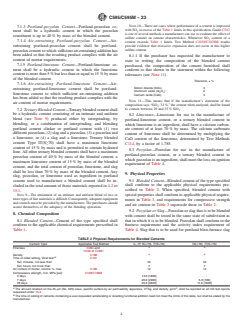
TABLE 2 Physical Requirements for Blended Cements
Cement Type Applicable Test Method IL, IP, IS(<70), IT(S<70) IS($70), IT(S$70)
A A
Fineness C204 and
C430 or C1891
A A
Density C188
B
Time of initial setting, Vicat test: C191
Set, minutes, not less than 45 45
Set, hours, not more than 7 7
Air content of mortar, volume %, max C18
...
This document is not an ASTM standard and is intended only to provide the user of an ASTM standard an indication of what changes have been made to the previous version. Because
it may not be technically possible to adequately depict all changes accurately, ASTM recommends that users consult prior editions as appropriate. In all cases only the current version
of the standard as published by ASTM is to be considered the official document.
Designation: C595/C595M − 21 C595/C595M − 23
Standard Specification for
Blended Hydraulic Cements
This standard is issued under the fixed designation C595/C595M; the number immediately following the designation indicates the year
of original adoption or, in the case of revision, the year of last revision. A number in parentheses indicates the year of last reapproval.
A superscript epsilon (´) indicates an editorial change since the last revision or reapproval.
1. Scope*
1.1 This specification pertains to blended hydraulic cements for both general and special applications, using slag, pozzolan,
limestone, or some combination of these, with portland cement or portland cement clinker or slag with lime.
NOTE 1—This specification prescribes ingredients and proportions, with some performance requirements, whereas Performance Specification
C1157/C1157M is a hydraulic cement specification in which performance criteria alone govern the products and their acceptance.
1.2 The values stated in either SI units or inch-pound units are to be regarded separately as standard. The values stated in each
system may not be exact equivalents; therefore, each system shall be used independently of the other. Combining values from the
two systems may result in non-conformance with the standard. Values in SI units [or inch-pound units] shall be obtained by
measurement in SI units [or inch-pound units] or by appropriate conversion, using the Rules for Conversion and Rounding given
in IEEE/ASTM SI 10, of measurements made in other units [or SI units]. Values are stated in only SI units when inch-pound units
are not used in practice.
1.3 The text of this specification refers to notes and footnotes, which provide explanatory material. These notes and footnotes
(excluding those in tables and figures) are not requirements of the standard.
1.4 This international standard was developed in accordance with internationally recognized principles on standardization
established in the Decision on Principles for the Development of International Standards, Guides and Recommendations issued
by the World Trade Organization Technical Barriers to Trade (TBT) Committee.
2. Referenced Documents
2.1 ASTM Standards:
C51 Terminology Relating to Lime and Limestone (as Used by the Industry)
C109/C109M Test Method for Compressive Strength of Hydraulic Cement Mortars (Using 2-in. or [50 mm] Cube Specimens)
C114 Test Methods for Chemical Analysis of Hydraulic Cement
C150/C150M Specification for Portland Cement
C151/C151M Test Method for Autoclave Expansion of Hydraulic Cement
C183/C183M Practice for Sampling and the Amount of Testing of Hydraulic Cement
C185 Test Method for Air Content of Hydraulic Cement Mortar
C187 Test Method for Amount of Water Required for Normal Consistency of Hydraulic Cement Paste
C188 Test Method for Density of Hydraulic Cement
This specification is under the jurisdiction of ASTM Committee C01 on Cement and is the direct responsibility of Subcommittee C01.10 on Hydraulic Cements for
General Concrete Construction.
Current edition approved July 15, 2021July 15, 2023. Published August 2021July 2023. Originally approved in 1967. Last previous edition approved in 20202021 as
C595/C595M – 20.C595/C595M – 21. DOI: 10.1520/C0595_C0595M-21.10.1520/C0595_C0595M-23.
For referenced ASTM standards, visit the ASTM website, www.astm.org, or contact ASTM Customer Service at service@astm.org. For Annual Book of ASTM Standards
volume information, refer to the standard’s Document Summary page on the ASTM website.
*A Summary of Changes section appears at the end of this standard
Copyright © ASTM International, 100 Barr Harbor Drive, PO Box C700, West Conshohocken, PA 19428-2959. United States
C595/C595M − 23
C191 Test Methods for Time of Setting of Hydraulic Cement by Vicat Needle
C204 Test Methods for Fineness of Hydraulic Cement by Air-Permeability Apparatus
C219 Terminology Relating to Hydraulic and Other Inorganic Cements
C226 Specification for Air-Entraining Additions for Use in the Manufacture of Air-Entraining Hydraulic Cement
C311/C311M Test Methods for Sampling and Testing Fly Ash or Natural Pozzolans for Use in Portland-Cement Concrete
C430 Test Method for Fineness of Hydraulic Cement by the 45-μm (No. 325) Sieve
C465 Specification for Processing Additions for Use in the Manufacture of Hydraulic Cements
C563 Guide for Approximation of Optimum SO in Hydraulic Cement
C688 Specification for Functional Additions for Use in Hydraulic Cements
C821 Specification for Lime for Use with Pozzolans
C1012/C1012M Test Method for Length Change of Hydraulic-Cement Mortars Exposed to a Sulfate Solution
C1038/C1038M Test Method for Expansion of Hydraulic Cement Mortar Bars Stored in Water
C1157/C1157M Performance Specification for Hydraulic Cement
C1702 Test Method for Measurement of Heat of Hydration of Hydraulic Cementitious Materials Using Isothermal Conduction
Calorimetry
C1778 Guide for Reducing the Risk of Deleterious Alkali-Aggregate Reaction in Concrete
C1891 Test Method for Fineness of Hydraulic Cement by Air Jet Sieving at 45-μm (No. 325)
IEEE/ASTM SI 10 Standard for Use of the International System of Units (SI): the Modern Metric System
3. Terminology
3.1 Definitions:
3.1.1 The terms used in this specification are defined in Terminology C219, except for the terms below.
3.2 Definitions of Terms Specific to This Standard:
3.2.1 binary blended cement, n—a blended hydraulic cement consisting of portland cement with either a slag, a pozzolan, or a
limestone.
3.2.2 slag, n—the term slag is used within this specification to denote either slag cement or granulated blast-furnace slag.
3.2.3 ternary blended cement, n—a blended hydraulic cement consisting of portland cement with either a combination of two
different pozzolans, slag and a pozzolan, a pozzolan and a limestone, or a slag and a limestone.
NOTE 2—Relevant terms in Terminology C219 applicable to this specification include portland cement, portland-cement clinker, hydraulic cement, slag
cement, granulated blast-furnace slag, pozzolan, and calcium sulfate. Limestone is defined in Terminology C51.
4. Classification
4.1 This specification applies to the following types of blended cement that generally are intended for use as indicated.
4.1.1 Blended hydraulic cements for general concrete construction.
4.1.1.1 Type IS—Portland blast-furnace slag cement.
4.1.1.2 Type IP—Portland-pozzolan cement.
4.1.1.3 Type IL—Portland-limestone cement.
4.1.1.4 Type IT—Ternary blended cement.
4.2 Reporting:
4.2.1 The naming practice for blended cements shall be made by adding the suffix (X) to the type designation under 4.1.1, where
(X) equals the targeted percentage of slag, pozzolan or limestone, in the product expressed as a whole number by mass of the final
blended product, within the allowable variation as stated in 15.3.
4.2.2 The naming practice for ternary blended cements shall be made by adding the suffixes (AX) and (BY) to the Type IT
designation under 4.1.1, where:
C595/C595M − 23
A is either “S” for slag, “P” for pozzolan, or “L” for limestone, whichever is present in larger amount by mass,
X is the targeted percentage by mass of constituent A,
B is either “S” for slag, “P” for pozzolan, or “L” for limestone, and
Y is the targeted percentage by mass of constituent B.
Both X and Y values are expressed as a whole number by mass of the final blended product, within the allowable variation as
stated in 15.3. If X and Y are the same, list the two constituents in alphabetical order by constituent type (limestone, pozzolan,
or slag).
NOTE 3—Examples of the naming practice in accordance with 4.2.1 and 4.2.2 are shown below (all percentages by mass):
Binary blended cement with 80 % portland cement and 20 % slag
= Type IS(20).
Binary blended cement with 85 % portland cement and 15 % pozzolan
= Type IP(15).
Binary blended cement with 90 % portland cement and 10 % limestone
= Type IL(10).
Ternary blended cement with 70 % portland cement, 20 % slag
and 10 % pozzolan = Type IT(S20)(P10).
Ternary blended cement with 65 % portland cement, 25 % of one
pozzolan and 10 % of another pozzolan = Type IT(P25)(P10).
Ternary blended cement with 60 % portland cement and 20 % of
slag and 20 % pozzolan = Type IT(P20)(S20).
Ternary blended cement with 80 % portland cement, 10 % limestone
and 10 % pozzolan = Type IT(L10)(P10).
Ternary blended cement with 75 % portland cement, 15 % slag
and 10 % limestone = Type IT(S15)(L10).
4.2.3 A simplified naming practice is used in this specification for practicality and clarity when referring to specific requirements
for binary and ternary blended cements that are applicable to a range of products or in ternary blended cements when requirements
are applicable to only one constituent within a specific range (%) (see Note 4).
NOTE 4—Examples of the simplified naming practices in accordance with 4.2.3 are shown below:
(1) An example when requirements are applicable to a range of products can be found in Table 1, where the maximum SO content of 3 % applies
to: binary blended cements with slag contents <70 %, indicated as IS(<70); and ternary blended cements with a pozzolan content less than the slag content
and the slag content is less than 70 %, indicated as IT(P
(2) An example when requirements are applicable to only one constituent within a specific range (%) of that constituent can be found in 9.2, where
testing is required only when the slag content is <25 %. Because the requirement is based on the slag content only with no relation to the pozzolan or
limestone content, a simplified naming practice is employed and the range of ternary blended cements is indicated as Type IT(S<25).
4.3 Special Properties:
4.3.1 Air-entraining cement, when desired by the purchaser, shall be specified by adding the suffix (A) to the type designation
under 4.1.1.
NOTE 5—A given mass of blended cement has a larger absolute volume than the same mass of portland cement. This should be taken into consideration
in purchasing cements and in proportioning concrete mixtures.
TABLE 1 Chemical Requirements
IS(<70), IP, IL,
Applicable IS($70),
A
Cement Type IT(P
Test Method IT(S$70)
IT(L
Magnesium oxide (MgO), max, % C114 . . . . . . 6.0 . . .
B
Sulfate reported as SO , max, % C114 3.0 4.0 4.0 3.0
2-
Sulfide reported as S , max, % C114 2.0 2.0 . . . . . .
C
Insoluble residue, max, % C114 1.0 1.0 . . . . . .
D D D
Loss on ignition, max, % C114 3.0 4.0 5.0 10.0
A
The chemical requirements in this table are applicable to all air-entrained cement equivalents.
B
It is permissible to exceed the values in the table for SO content, provided it has been demonstrated by Test Method C1038/C1038M that the cement with the increased
SO will not develop expansion exceeding 0.020 % at 14 days. When the manufacturer supplies cement under this provision, supporting data shall be supplied to the
purchaser (see Note 10).
C
Insoluble residue maximum limit does not apply to ternary blended cements.
D
For ternary blended cements with limestone, loss on ignition is a maximum of 10.0 % by mass.
C595/C595M − 23
4.3.2 Moderate heat of hydration, when desired by the purchaser, shall be specified by adding the suffix (MH) to the type
designation under 4.1.1.
4.3.3 Moderate sulfate resistance, when desired by the purchaser, shall be specified by adding the suffix (MS) to the type
designation under 4.1.1.
4.3.4 High sulfate resistance, when desired by the purchaser, shall be specified by adding the suffix (HS) to the type designation
under 4.1.1.
4.3.5 Low heat of hydration, when desired by the purchaser, shall be specified by adding the suffix (LH) to the type designation
under 4.1.1.
NOTE 6—Special properties attributable to slag, pozzolan or limestone will vary based on quantities contained within the blended cements.
NOTE 7—Guide C1778 provides guidance on use of blended hydraulic cements in concrete mixtures where potential for deleterious alkali-silica reaction
is of concern.
4.3.6 High early strength, when desired by the purchaser, shall be specified by adding the suffix (HE) to the type designation under
4.1.1.
5. Ordering Information
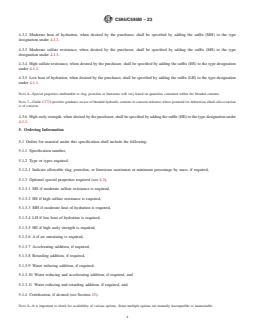
5.1 Orders for material under this specification shall include the following:
5.1.1 Specification number,
5.1.2 Type or types required.
5.1.2.1 Indicate allowable slag, pozzolan, or limestone maximum or minimum percentage by mass, if required,
5.1.3 Optional special properties required (see 4.3),
5.1.3.1 MS if moderate sulfate resistance is required,
5.1.3.2 HS if high sulfate resistance is required,
5.1.3.3 MH if moderate heat of hydration is required,
5.1.3.4 LH if low heat of hydration is required,
5.1.3.5 HE if high early strength is required,
5.1.3.6 A if air entraining is required,
5.1.3.7 Accelerating addition, if required,
5.1.3.8 Retarding addition, if required,
5.1.3.9 Water reducing addition, if required,
5.1.3.10 Water reducing and accelerating addition, if required, and
5.1.3.11 Water reducing and retarding addition, if required, and.
5.1.4 Certification, if desired (see Section 15).
NOTE 8—It is important to check for availability of various options. Some multiple options are mutually incompatible or unattainable.
C595/C595M − 23
6. Materials
6.1 Materials permitted to be used as ingredients in cements manufactured to comply with this specification are:
6.1.1 Portland Cement—For purposes of this specification, portland cement meeting the requirements of Specification
C150/C150M is suitable. Portland cement or other hydraulic materials, or both, containing high free lime are not prohibited from
use as long as the autoclave test limits for the blended cement are met.
6.1.2 Portland Cement Clinker.
6.1.3 Slag—Slag shall be slag cement or granulated blast-furnace slag and comply with requirements in Section 9.
6.1.4 Pozzolan—Pozzolan shall comply with requirements in Section 9.
6.1.5 Limestone—Limestone, as defined in Terminology C51, shall be naturally occurring and comply with the requirements
indicated in 8.2.
6.1.6 Hydrated Lime—Hydrated lime used as part of a blended cement shall meet the requirements of Specification C821, except
that when interground in the production process there shall be no minimum fineness requirement.
6.1.7 Air-entraining Addition—When air-entraining cement is specified, an addition meeting the requirements of Specification
C226 shall be used.
6.1.8 When processing additions are used in the manufacture of cement, they shall have been shown to meet the requirements of
Specification C465 in the amounts used or greater (see 15.2).
6.1.9 When functional additions (used at the sole option of the purchaser) are used they shall have been shown to meet the
requirements of Specification C688 when tested with the cement to be used, in the amount used or greater (see 15.2).
6.1.10 Other Additions—The cement covered by this specification shall contain no additions except as provided for above except
that water or calcium sulfate (see Terminology C219), or both, if added, shall be in amounts so that the limits shown in Table 1
for sulfate reported as SO and loss on ignition are not exceeded.
7. Manufacture
7.1 Binary Blended Cement—Binary blended cement shall be a hydraulic cement consisting of an intimate and uniform blend (see
Note 9) produced either by intergrinding or blending or by a combination of intergrinding and blending portland cement clinker
or portland cement with a pozzolan or a slag, or a limestone. Any slag, pozzolan, or limestone used as an ingredient or addition
in portland cement used to manufacture a binary blended cement shall be included in the total amount of those materials reported
in 4.2 or 15.1. The following requirements shall apply:
7.1.1 Portland Blast-furnace Slag Cement—Portland blast-furnace slag cement shall be a hydraulic cement in which the slag
constituent is up to 95 % by mass of the blended cement. Portland blast-furnace slag cement with a slag content equal to or
exceeding 70 % by mass, is permitted to contain hydrated lime.
7.1.2 Air-entraining Portland Blast-furnace Slag Cement—Air-entraining portland blast-furnace slag cement shall be portland
blast-furnace slag cement to which sufficient air-entraining addition has been added so that the resulting product complies with the
air content of mortar requirements.
7.1.3 Portland-pozzolan Cement—Portland-pozzolan cement shall be a hydraulic cement in which the pozzolan constituent is up
to 40 % by mass of the blended cement.
7.1.4 Air-entraining Portland-pozzolan Cement—Air-entraining portland-pozzolan cement shall be portland-pozzolan cement to
which sufficient air-entraining addition has been added so that the resulting product complies with the air content of mortar
requirements.
7.1.5 Portland-limestone Cement—Portland-limestone cement shall be a hydraulic cement in which the limestone content is more
than 5 % but less than or equal to 15 % by mass of the blended cement.
C595/C595M − 23
7.1.6 Air-entraining Portland-limestone Cement—Air-entraining portland-limestone cement shall be portland-limestone cement to
which sufficient air-entraining addition has been added so that the resulting product complies with the air content of mortar
requirements.
7.2 Ternary Blended Cement—Ternary blended cement shall be a hydraulic cement consisting of an intimate and uniform blend
(see Note 9) produced either by intergrinding, by blending, or a combination of intergrinding, and blending portland cement clinker
or portland cement with (1) two different pozzolans, (2) slag and a pozzolan, (3) a pozzolan and a limestone, or (4) a slag and a
limestone. Ternary blended cement Type IT(S≥70) shall have a maximum limestone content of 15 % by mass and is permitted to
contain hydrated lime. All other ternary blended cements shall have a maximum pozzolan content of 40 % by mass of the blended
cement, a maximum limestone content of 15 % by mass of the blended cement, and the total content of pozzolan, limestone, and
slag shall be less than 70 % by mass of the blended cement. Any slag, pozzolan, or limestone used as ingredient in portland cement
used to manufacture a blended cement shall be included in the total amount of those materials reported in 4.2 or 15.1.
NOTE 9—The attainment of an intimate and uniform blend of two or more types of fine materials is difficult. Consequently, adequate equipment and
controls must be provided by the manufacturer. The purchasers should assure themselves of the adequacy of the blending operation.
8. Chemical Composition
8.1 Blended Cement—Cement of the type specified shall conform to the applicable chemical requirements prescribed in Table 1.
NOTE 10—There are cases where performance of a cement is improved with SO in excess of the Table 1 limits in this specification. Guide C563 is one
of several methods a manufacturer can use to evaluate the effect of sulfate content on cement characteristics. Whenever SO content of a cement exceeds
Table 1 limits, Test Method C1038/C1038M results provide evidence that excessive expansion does not occur at this higher sulfate content.
8.1.1 If the purchaser has requested the manufacturer to state in writing the composition of the blended cement purchased, the
composition of the cement furnished shall conform to that shown in the statement within the following tolerances (see Note 11).
Tolerance, ± %
Silicon dioxide (SiO ) 3
Aluminum oxide (Al O ) 2
2 3
Calcium oxide (CaO) 3
NOTE 11—This means that if the manufacturer’s statement of the composition says “SiO : 32 %,” the cement when analyzed, shall be found to contain
between 29 and 35 % SiO .
8.2 Limestone—Limestone for use in the manufacture of portland-limestone cement, or a ternary blended cement in which
limestone is an ingredient, shall have a calcium carbonate content of at least 70 % by mass. The calcium carbonate content of
limestone shall be determined by multiplying the CaO content of the limestone, determined by Test Methods C114, by a factor of
1.785.
8.3 Pozzolan—Pozzolan for use in the manufacture of portland-pozzolan cement, or a ternary blended cement in which pozzolan
is an ingredient, shall meet the loss-on-ignition requirement of Table 4.
9. Physical Properties
9.1 Blended Cement—Blended cement of the type specified shall conform to the applicable physical requirements prescribed in
Table 2. When specified, blended cement with special properties shall conform to applicable physical requirements in Table 3, and
requirements for compressive strength and air content in Table 3 supersede those in Table 2.
9.2 Pozzolan or Slag—Pozzolan or slag that is to be blended with cement shall be tested in the same state of subdivision as that
in which it is to be blended. Pozzolan shall conform to the fineness requirement and the activity index requirement of Table 4. Slag
that is to be used for portland blast-furnace slag cements Type IS(<25) or ternary blended cements Type IT(S<25) shall conform
to the activity index requirement of Table 4. Such pozzolan, or slag that is to be interground with portland cement clinker shall,
before testing for conformance with requirements of Table 4, be ground in the laboratory to a fineness at which it is believed to
be present in the finished cement. It is the manufacturer’s responsibility to decide on the fineness at which the testing is to be
carried out, and when requested to do so by a purchaser, to report the information upon which the decision was based.
C595/C595M − 23
TABLE 2 Physical Requirements for Blended Cements
Cement Type Applicable Test Method IL, IP, IS(<70), IT(S<70) IS($70), IT(S$70)
A A
Fineness C2
...