

ASTM D6699-16
(Practice)Standard Practice for Sampling Liquids Using Bailers
General Information
- Abstract
SIGNIFICANCE AND USE
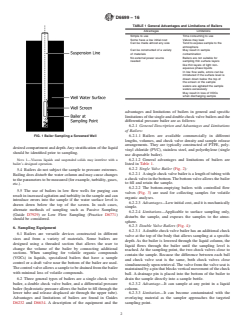
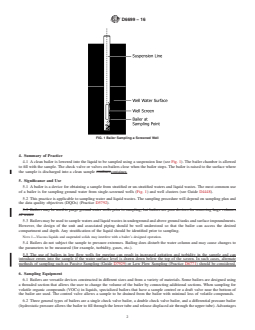
5.1 A bailer is a device for obtaining a sample from stratified or un-stratified waters and liquid wastes. The most common use of a bailer is for sampling ground water from single-screened wells (Fig. 1) and well clusters (see Guide D4448).
5.2 This practice is applicable to sampling water and liquid wastes. The sampling procedure will depend on sampling plan and the data quality objectives (DQOs) (Practice D5792).
5.3 Bailers may be used to sample waters and liquid wastes in underground and above ground tanks and surface impoundments. However, the design of the unit and associated piping should be well understood so that the bailer can access the desired compartment and depth. Any stratification of the liquid should be identified prior to sampling.
Note 1: Viscous liquids and suspended solids may interfere with a bailer's designed operation.
5.4 Bailers do not subject the sample to pressure extremes. Bailing does disturb the water column and may cause changes to the parameters to be measured (for example, turbidity, gases, etc.).
5.5 The use of bailers in low flow wells for purging can result in increased agitation and turbidity in the sample and can introduce errors into the sample if the water surface level is drawn down below the top of the screen. In such cases, alternate methods of sampling such as Passive Sampling (Guide D7929) or Low Flow Sampling (Practice D6771) should be considered.
SCOPE
1.1 This practice covers the procedure for sampling stratified or un-stratified waters and liquid waste using bailers.
1.2 Three specific bailers are discussed in this practice. The bailers are the single and double check valve and differential pressure.
1.3 This standard does not cover all of the bailing devices available to the user. The bailers chosen for this practice are typical of those commercially available.
1.4 This practice should be used in conjunction with Guide D4687, Practice D5088, and Practice D5283.
1.5 This standard does not purport to address all of the safety concerns, if any, associated with its use. It is the responsibility of the user of this standard to establish appropriate safety and health practices and determine the applicability of regulatory limitations prior to use.
- Status
- Published
- Publication Date
- 31-Aug-2016
- Technical Committee
- D34 - Waste Management
- Drafting Committee
- D34.01.03 - Sampling Equipment
Overview
ASTM D6699-16: Standard Practice for Sampling Liquids Using Bailers provides comprehensive guidelines for obtaining representative liquid samples from stratified or un-stratified waters and liquid wastes using bailer devices. Covering key aspects of sample collection, handling, and equipment, this standard is widely utilized in environmental monitoring, groundwater sampling, and waste management. ASTM D6699-16 addresses practical requirements for sample integrity, quality assurance, and safety throughout the sampling process.
Key Topics
- Types of Bailers: Describes three main bailer designs-single check valve, double check valve, and differential pressure bailers-common in commercial applications.
- Sampling Procedures:
- Preparation and cleaning of bailers and suspension lines to avoid contamination.
- Detailed procedures for sampling at various liquid depths while minimizing sample disturbance.
- Handling protocols to ensure representative sampling for volatile and non-volatile constituents.
- Applications:
- Groundwater sampling from monitoring wells and well clusters.
- Sampling from surface and subsurface tanks, impoundments, and liquid waste sites.
- Considerations for stratified layers and potential interference from suspended solids or viscous liquids.
- Sample Integrity:
- Bailer use avoids subjecting samples to pressure extremes but may increase turbidity or loss of volatile compounds due to atmospheric exposure.
- Special instructions for collecting volatile organic compound (VOC) samples using controlled-flow or bottom-discharging bailers.
- Limitations and Best Practices:
- Not ideal for thin surface layers or high-solids content.
- Alternative methods may be required in low-flow wells or where reduced sample agitation is critical (e.g., passive or low-flow sampling).
- Emphasizes safety, contamination prevention, and regulatory compliance.
Applications
ASTM D6699-16 is widely used for:
- Environmental Monitoring: Standard groundwater and waste liquid sampling for site assessments and regulatory compliance.
- Waste Management: Collection of representative samples for characterization in underground/above-ground tanks or surface impoundments.
- Field Investigations: Reliable procedures for environmental consultants and site operators collecting liquid samples at various depths.
- Quality Assurance: Used with data quality objectives (DQOs) and sampling plans to ensure consistent, accurate data.
- Regulatory Sampling: Supports EPA and RCRA-mandated sampling methodologies for liquid wastes.
Practical Value:
- Simple, versatile sampling device suitable for many site conditions.
- Accommodates a range of sample volumes and chemical compatibility through material options like PTFE, PVC, stainless steel, and polyethylene.
- Can be used as both a purging and sampling tool in certain well configurations.
Related Standards
The use of ASTM D6699-16 is frequently complemented by other ASTM guides and practices to address broader data quality, equipment selection, and field handling requirements:
- ASTM D4448 - Guide for Sampling Ground-Water Monitoring Wells
- ASTM D4687 - Guide for General Planning of Waste Sampling
- ASTM D5088 - Practice for Decontamination of Field Equipment Used at Waste Sites
- ASTM D5283 - Practice for Quality Assurance and Quality Control Planning in Waste Management
- ASTM D5792 - Practice for Development of Data Quality Objectives
- ASTM D6517 - Guide for Field Preservation of Groundwater Samples
- ASTM D6564 - Guide for Field Filtration of Groundwater Samples
- ASTM D6634 - Guide for Selection of Purging and Sampling Devices for Monitoring Wells
- ASTM D6771 - Practice for Low-Flow Purging and Sampling
- ASTM D7929 - Guide for Passive Groundwater Sampling
By adhering to ASTM D6699-16 and referenced best practices, organizations ensure robust, defensible, and reproducible sampling results critical for environmental compliance and site management.
Keywords: ASTM D6699-16, sampling liquids, bailers, groundwater sampling, waste liquid sampling, environmental monitoring, liquid sampling practice, bailer types, sampling procedures, data quality objectives.
Relations
- Effective Date
- 01-Sep-2016
- Effective Date
- 01-Nov-2023
- Effective Date
- 01-Nov-2023
- Effective Date
- 01-Nov-2023
- Effective Date
- 01-May-2020
- Effective Date
- 15-Feb-2020
- Effective Date
- 01-Feb-2019
- Effective Date
- 01-Dec-2018
- Effective Date
- 01-Nov-2018
- Effective Date
- 01-May-2018
- Effective Date
- 01-Sep-2017
- Effective Date
- 01-Nov-2016
- Effective Date
- 01-Feb-2016
- Effective Date
- 01-Sep-2015
- Effective Date
- 01-Aug-2015
Get Certified
Connect with accredited certification bodies for this standard

BRCGS (Brand Reputation Compliance Global Standards)
Global food safety and quality standards owner.
CIS Institut d.o.o.
Personal Protective Equipment (PPE) certification body. Notified Body NB-2890 for EU Regulation 2016/425 PPE.

Kiwa BDA Testing
Building and construction product certification.
Sponsored listings
Frequently Asked Questions
ASTM D6699-16 is a standard published by ASTM International. Its full title is "Standard Practice for Sampling Liquids Using Bailers". This standard covers: SIGNIFICANCE AND USE 5.1 A bailer is a device for obtaining a sample from stratified or un-stratified waters and liquid wastes. The most common use of a bailer is for sampling ground water from single-screened wells (Fig. 1) and well clusters (see Guide D4448). 5.2 This practice is applicable to sampling water and liquid wastes. The sampling procedure will depend on sampling plan and the data quality objectives (DQOs) (Practice D5792). 5.3 Bailers may be used to sample waters and liquid wastes in underground and above ground tanks and surface impoundments. However, the design of the unit and associated piping should be well understood so that the bailer can access the desired compartment and depth. Any stratification of the liquid should be identified prior to sampling. Note 1: Viscous liquids and suspended solids may interfere with a bailer's designed operation. 5.4 Bailers do not subject the sample to pressure extremes. Bailing does disturb the water column and may cause changes to the parameters to be measured (for example, turbidity, gases, etc.). 5.5 The use of bailers in low flow wells for purging can result in increased agitation and turbidity in the sample and can introduce errors into the sample if the water surface level is drawn down below the top of the screen. In such cases, alternate methods of sampling such as Passive Sampling (Guide D7929) or Low Flow Sampling (Practice D6771) should be considered. SCOPE 1.1 This practice covers the procedure for sampling stratified or un-stratified waters and liquid waste using bailers. 1.2 Three specific bailers are discussed in this practice. The bailers are the single and double check valve and differential pressure. 1.3 This standard does not cover all of the bailing devices available to the user. The bailers chosen for this practice are typical of those commercially available. 1.4 This practice should be used in conjunction with Guide D4687, Practice D5088, and Practice D5283. 1.5 This standard does not purport to address all of the safety concerns, if any, associated with its use. It is the responsibility of the user of this standard to establish appropriate safety and health practices and determine the applicability of regulatory limitations prior to use.
SIGNIFICANCE AND USE 5.1 A bailer is a device for obtaining a sample from stratified or un-stratified waters and liquid wastes. The most common use of a bailer is for sampling ground water from single-screened wells (Fig. 1) and well clusters (see Guide D4448). 5.2 This practice is applicable to sampling water and liquid wastes. The sampling procedure will depend on sampling plan and the data quality objectives (DQOs) (Practice D5792). 5.3 Bailers may be used to sample waters and liquid wastes in underground and above ground tanks and surface impoundments. However, the design of the unit and associated piping should be well understood so that the bailer can access the desired compartment and depth. Any stratification of the liquid should be identified prior to sampling. Note 1: Viscous liquids and suspended solids may interfere with a bailer's designed operation. 5.4 Bailers do not subject the sample to pressure extremes. Bailing does disturb the water column and may cause changes to the parameters to be measured (for example, turbidity, gases, etc.). 5.5 The use of bailers in low flow wells for purging can result in increased agitation and turbidity in the sample and can introduce errors into the sample if the water surface level is drawn down below the top of the screen. In such cases, alternate methods of sampling such as Passive Sampling (Guide D7929) or Low Flow Sampling (Practice D6771) should be considered. SCOPE 1.1 This practice covers the procedure for sampling stratified or un-stratified waters and liquid waste using bailers. 1.2 Three specific bailers are discussed in this practice. The bailers are the single and double check valve and differential pressure. 1.3 This standard does not cover all of the bailing devices available to the user. The bailers chosen for this practice are typical of those commercially available. 1.4 This practice should be used in conjunction with Guide D4687, Practice D5088, and Practice D5283. 1.5 This standard does not purport to address all of the safety concerns, if any, associated with its use. It is the responsibility of the user of this standard to establish appropriate safety and health practices and determine the applicability of regulatory limitations prior to use.
ASTM D6699-16 is classified under the following ICS (International Classification for Standards) categories: 13.030.20 - Liquid wastes. Sludge; 55.100 - Bottles. Pots. Jars. The ICS classification helps identify the subject area and facilitates finding related standards.
ASTM D6699-16 has the following relationships with other standards: It is inter standard links to ASTM D6699-01(2010), ASTM D6517-18(2023), ASTM D5792-10(2023), ASTM D5681-23, ASTM D5088-20, ASTM D7929-20, ASTM D4448-01(2019), ASTM D6517-18, ASTM D5681-18, ASTM D5283-18, ASTM D5681-17, ASTM D5681-16a, ASTM D5681-16, ASTM D5792-10(2015), ASTM D5088-15a. Understanding these relationships helps ensure you are using the most current and applicable version of the standard.
ASTM D6699-16 is available in PDF format for immediate download after purchase. The document can be added to your cart and obtained through the secure checkout process. Digital delivery ensures instant access to the complete standard document.
Standards Content (Sample)
This international standard was developed in accordance with internationally recognized principles on standardization established in the Decision on Principles for the
Development of International Standards, Guides and Recommendations issued by the World Trade Organization Technical Barriers to Trade (TBT) Committee.
Designation: D6699 − 16
Standard Practice for
Sampling Liquids Using Bailers
This standard is issued under the fixed designation D6699; the number immediately following the designation indicates the year of
original adoption or, in the case of revision, the year of last revision. A number in parentheses indicates the year of last reapproval. A
superscript epsilon (´) indicates an editorial change since the last revision or reapproval.
1. Scope D6232 Guide for Selection of Sampling Equipment for
WasteandContaminatedMediaDataCollectionActivities
1.1 This practice covers the procedure for sampling strati-
D6517 Guide for Field Preservation of Groundwater
fied or un-stratified waters and liquid waste using bailers.
Samples
1.2 Three specific bailers are discussed in this practice. The
D6564 Guide for Field Filtration of Groundwater Samples
bailers are the single and double check valve and differential
D6634 Guide for Selection of Purging and Sampling De-
pressure.
vices for Groundwater Monitoring Wells
D6771 Practice for Low-Flow Purging and Sampling for
1.3 This standard does not cover all of the bailing devices
available to the user. The bailers chosen for this practice are Wells and Devices Used for Ground-Water Quality Inves-
tigations (Withdrawn 2011)
typical of those commercially available.
D7929 Guide for Selection of Passive Techniques for Sam-
1.4 This practice should be used in conjunction with Guide
pling Groundwater Monitoring Wells
D4687, Practice D5088, and Practice D5283.
2.2 EPA Standard:
1.5 This standard does not purport to address all of the
EPA SW 846 Test Methods for Evaluating Solid Waste:
safety concerns, if any, associated with its use. It is the
Physical/Chemical Methods
responsibility of the user of this standard to establish appro-
priate safety and health practices and determine the applica-
3. Terminology
bility of regulatory limitations prior to use.
3.1 See Terminology D5681.
2. Referenced Documents
4. Summary of Practice
2.1 ASTM Standards:
4.1 A clean bailer is lowered into the liquid to be sampled
D4448 Guide for Sampling Ground-Water Monitoring Wells
using a suspension line (see Fig. 1). The bailer chamber is
D4687 Guide for General Planning of Waste Sampling
allowed to fill with the sample. The check valve or valves on
D5088 Practice for Decontamination of Field Equipment
bailers close when the bailer stops. The bailer is raised to the
Used at Waste Sites
surface where the sample is discharged into a clean sample
D5283 Practice for Generation of Environmental Data Re-
container.
lated to Waste ManagementActivities: QualityAssurance
and Quality Control Planning and Implementation 5. Significance and Use
D5681 Terminology for Waste and Waste Management
5.1 A bailer is a device for obtaining a sample from
D5792 Practice for Generation of Environmental Data Re-
stratified or un-stratified waters and liquid wastes. The most
lated to Waste Management Activities: Development of
common use of a bailer is for sampling ground water from
Data Quality Objectives
single-screened wells (Fig. 1) and well clusters (see Guide
D6051 Guide for Composite Sampling and Field Subsam-
D4448).
pling for Environmental Waste Management Activities
5.2 This practice is applicable to sampling water and liquid
wastes. The sampling procedure will depend on sampling plan
and the data quality objectives (DQOs) (Practice D5792).
This practice is under the jurisdiction of ASTM Committee D34 on Waste
Management and is the direct responsibility of Subcommittee D34.01.03 on 5.3 Bailers may be used to sample waters and liquid wastes
Sampling Equipment.
in underground and above ground tanks and surface impound-
Current edition approved Sept. 1, 2016. Published October 2016. Originally
ments. However, the design of the unit and associated piping
approved in 2001. Last previous edition approved in 2010 as D6699 – 01 (2010).
should be well understood so that the bailer can access the
DOI: 10.1520/D6699-16.
For referenced ASTM standards, visit the ASTM website, www.astm.org, or
contact ASTM Customer Service at service@astm.org. For Annual Book of ASTM
Standards volume information, refer to the standard’s Document Summary page on The last approved version of this historical standard is referenced on
the ASTM website. www.astm.org.
Copyright © ASTM International, 100 Barr Harbor Drive, PO Box C700, West Conshohocken, PA 19428-2959. United States
D6699 − 16
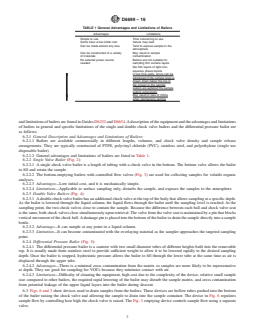
TABLE 1 General Advantages and Limitations of Bailers
Advantages Limitations
Simple to use Time consuming to use
Some have a low initial cost Valves may leak
Can be made almost any size Tend to expose sample to the
atmosphere
Can be constructed of a variety May result in sample
of materials contamination
No external power source Bailers are not suitable for
needed sampling thin surface layers
like thin layers of light non-
aqueous phase liquids
In low flow wells, errors can be
introduced if the surface level is
drawn down below the top of
the screen or the sample
waters are agitated the sample
waters excessively
May result in loss of VOCs
when discharging sample
advantages and limitations of bailers in general and specific
limitations of the single and double check valve bailers and the
differential pressure bailer are as follows:
6.2.1 General Description and Advantages and Limitations
of Bailers:
6.2.1.1 Bailers are available commercially in different
FIG. 1 Bailer Sampling a Screened Well
lengths, volumes, and check valve density and sample release
arrangements. They are typically constructed of PTFE, poly-
desired compartment and depth.Any stratification of the liquid
vinyl chloride (PVC), stainless steel, and polyethylene (single
should be identified prior to sampling.
use disposable bailer).
6.2.1.2 General advantages and limitations of bailers are
NOTE 1—Viscous liquids and suspended solids may interfere with a
bailer’s designed operation.
listed in Table 1.
6.2.2 Single Valve Bailer (Fig. 2):
5.4 Bailers do not subject the sample to pressure extremes.
6.2.2.1 Asingle check valve bailer is a length of tubing with
Bailing does disturb the water column and may cause changes
acheckvalveinthebottom.Thebottomvalveallowsthebailer
totheparameterstobemeasured(forexample,turbidity,gases,
to fill and retain the sample.
etc.).
6.2.2.2 The bottom-emptying bailers with controlled flow
5.5 The use of bailers in low flow wells for purging can
valves (Fig. 3) are used for collecting samples for volatile
result in increased agitation and turbidity in the sample and can
organic analyses.
introduce errors into the sample if the water surface level is
6.2.2.3 Advantages—Lowinitialcost,anditismechanically
drawn down below the top of the screen. In such cases,
simple.
alternate methods of sampling such as Passive Sampling
6.2.2.4 Limitations—Applicable to surface sampling only,
(Guide D7929) or Low Flow Sampling (Practice D6771)
disturbs the sample, and exposes the samples to the atmo-
should be considered.
sphere.
6.2.3 Double Valve Bailers (Fig. 4):
6. Sampling Equipment
6.2.3.1 Adouble check valve bailer has an additional check
6.1 Bailers are versatile devices constructed in different
valve at the top of the body that allows sampling at a specific
sizes and from a variety of materials. Some bailers are
depth. As the bailer is lowered through the liquid column, the
designed using a threaded section that allows the user to
liquid flows through the bailer until the sampling level is
change the volume of the bailer by connecting additional
reached. At the sampling point, the two check valves close to
sections. When sampling for volatile organic compounds
contain the sample. Because the difference between each ball
(VOCs) in liquids, specialized bailers that have a sample
and check valve seat is the same, both check valves close
control or a draft valve near the bottom of the bailer are used.
simultaneously upon retrieval. The valve from the valve seat is
Thecontrolvalveallowsasampletobedrainedfromthebailer
maintainedbyapinthatblocksverticalmovementofthecheck
with minimal loss of volatile compounds.
ball. A drainage pin is placed into the bottom of the bailer to
6.2 Three general types of bailers are a single check valve drain the sample directly into a sample bottle.
bailer, a double check valve bailer, and a differential pressure 6.2.3.2 Advantage—It can sample at any point in a liquid
bailer (hydrostatic pressure allows the bailer to fill through the column.
lower tube and release displaced air through the upper tube). 6.2.3.3 Limitation—It can become contaminated with the
Advantages
...
This document is not an ASTM standard and is intended only to provide the user of an ASTM standard an indication of what changes have been made to the previous version. Because
it may not be technically possible to adequately depict all changes accurately, ASTM recommends that users consult prior editions as appropriate. In all cases only the current version
of the standard as published by ASTM is to be considered the official document.
Designation: D6699 − 01 (Reapproved 2010) D6699 − 16
Standard Practice for
Sampling Liquids Using Bailers
This standard is issued under the fixed designation D6699; the number immediately following the designation indicates the year of
original adoption or, in the case of revision, the year of last revision. A number in parentheses indicates the year of last reapproval. A
superscript epsilon (´) indicates an editorial change since the last revision or reapproval.
1. Scope
1.1 This practice covers the procedure for sampling stratified or un-stratified waters and liquid waste using bailers.
1.2 Three specific bailers are discussed in this practice. The bailers are the single and double check valve and differential
pressure.
1.3 This standard does not cover all of the bailing devices available to the user. The bailers chosen for this practice are typical
of those commercially available.
1.4 This practice should be used in conjunction with Guide D4687, Practice D5088, and Practice D5283.
1.5 This standard does not purport to address all of the safety concerns, if any, associated with its use. It is the responsibility
of the user of this standard to establish appropriate safety and health practices and determine the applicability of regulatory
limitations prior to use.
2. Referenced Documents
2.1 ASTM Standards:
D4448 Guide for Sampling Ground-Water Monitoring Wells
D4687 Guide for General Planning of Waste Sampling
D4750 Test Method for Determining Subsurface Liquid Levels in a Borehole or Monitoring Well (Observation Well)
(Withdrawn 2010)
D5088 Practice for Decontamination of Field Equipment Used at Waste Sites
D5283 Practice for Generation of Environmental Data Related to Waste Management Activities: Quality Assurance and Quality
Control Planning and Implementation
D5681 Terminology for Waste and Waste Management
D5792 Practice for Generation of Environmental Data Related to Waste Management Activities: Development of Data Quality
Objectives
D6051 Guide for Composite Sampling and Field Subsampling for Environmental Waste Management Activities
D6232 Guide for Selection of Sampling Equipment for Waste and Contaminated Media Data Collection Activities
D6517 Guide for Field Preservation of Groundwater Samples
D6564 Guide for Field Filtration of Groundwater Samples
D6634 Guide for Selection of Purging and Sampling Devices for Groundwater Monitoring Wells
D6771 Practice for Low-Flow Purging and Sampling for Wells and Devices Used for Ground-Water Quality Investigations
(Withdrawn 2011)
D7929 Guide for Selection of Passive Techniques for Sampling Groundwater Monitoring Wells
2.2 EPA Standard:
EPA SW 486846 RCRA SamplesTest Methods for Evaluating Solid Waste: Physical/Chemical Methods
3. Terminology
3.1 See Terminology D5681.
This practice is under the jurisdiction of ASTM Committee D34 on Waste Management and is the direct responsibility of Subcommittee D34.01.03 on Sampling
Equipment.
Current edition approved Dec. 1, 2010Sept. 1, 2016. Published January 2011October 2016. Originally approved in 2001. Last previous edition approved in 20062010 as
D6699D6699 – 01 (2010).-01 (2006). DOI: 10.1520/D6699-01R10.10.1520/D6699-16.
For referenced ASTM standards, visit the ASTM website, www.astm.org, or contact ASTM Customer Service at service@astm.org. For Annual Book of ASTM Standards
volume information, refer to the standard’s Document Summary page on the ASTM website.
The last approved version of this historical standard is referenced on www.astm.org.
Copyright © ASTM International, 100 Barr Harbor Drive, PO Box C700, West Conshohocken, PA 19428-2959. United States
D6699 − 16
FIG. 1 Bailer Sampling a Screened Well
4. Summary of Practice
4.1 A clean bailer is lowered into the liquid to be sampled using a suspension line (see Fig. 1). The bailer chamber is allowed
to fill with the sample. The check valve or valves on bailers close when the bailer stops. The bailer is raised to the surface where
the sample is discharged into a clean sample confiner.container.
5. Significance and Use
5.1 A bailer is a device for obtaining a sample from stratified or un-stratified waters and liquid wastes. The most common use
of a bailer is for sampling ground water from single-screened wells (Fig. 1) and well clusters (see Guide D4448).
5.2 This practice is applicable to sampling water and liquid wastes. The sampling procedure will depend on sampling plan and
the data quality objectives (DQOs) (Practice D5792).
5.3 Bailers may be used to purge ground water wells prior to sampling, but bailers are poor devices for removing large volumes
of water.
5.3 Bailers may be used to sample waters and liquid wastes in underground and above ground tanks and surface impoundments.
However, the design of the unit and associated piping should be well understood so that the bailer can access the desired
compartment and depth. Any stratification of the liquid should be identified prior to sampling.
NOTE 1—Viscous liquids and suspended solids may interfere with a bailer’s designed operation.
5.4 Bailers do not subject the sample to pressure extremes. Bailing does disturb the water column and may cause changes to
the parameters to be measured (for example, turbidity, gases, etc.).
5.5 The use of bailers in low flow wells for purging can result in increased agitation and turbidity in the sample and can
introduce errors into the sample if the water surface level is drawn down below the top of the screen. In such cases, alternate
methods of sampling such as Passive Sampling (Guide D7929) or Low Flow Sampling (Practice D6771) should be considered.
6. Sampling Equipment
6.1 Bailers are versatile devices constructed in different sizes and from a variety of materials. Some bailers are designed using
a threaded section that allows the user to change the volume of the bailer by connecting additional sections. When sampling for
volatile organic compounds (VOCs) in liquids, specialized bailers that have a sample control or a draft valve near the bottom of
the bailer are used. The control valve allows a sample to be drained from the bailer with minimal loss of volatile compounds.
6.2 Three general types of bailers are a single check valve bailer, a double check valve bailer, and a differential pressure bailer
(hydrostatic pressure allows the bailer to fill through the lower tube and release displaced air through the upper tube). Advantages
D6699 − 16
TABLE 1 General Advantages and Limitations of Bailers
Advantages Limitations
Simple to use Time consuming to use
Some have a low initial cost Valves may leak
Can be made almost any size Tend to expose sample to the
atmosphere
Can be constructed of a variety May result in sample
of materials contamination
No external power source Bailers are not suitable for
needed sampling thin surface layers
like thin layers of light non-
aqueous phase liquids
In low flow wells, errors can be
introduced if the surface level is
drawn down below the top of
the screen or the sample
waters are agitated the sample
waters excessively
May result in loss of VOCs
when discharging sample
and limitations of bailers are found in Guides D6232 and D6634. A description of the equipment and the advantages and limitations
of bailers in general and specific limitations of the single and double check valve bailers and the differential pressure bailer are
as follows:
6.2.1 General Description and Advantages and Limitations of Bailers:
6.2.1.1 Bailers are available commercially in different lengths, volumes, and check valve density and sample release
arrangements. They are typically constructed of PTFE, polyvinyl chloride (PVC), stainless steel, and polyethylene (single use
disposable bailer).
6.2.1.2 General advantages and limitations of bailers are listed in Table 1.
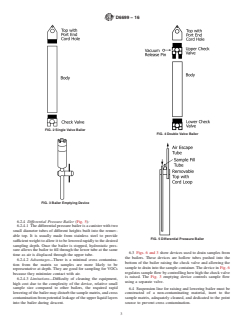
6.2.2 Single Valve Bailer (Fig. 2):
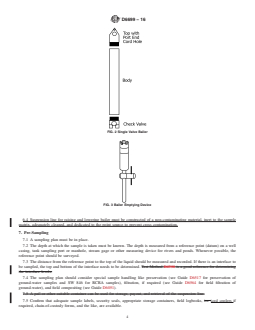
6.2.2.1 A single check valve bailer is a length of tubing with a check valve in the bottom. The bottom valve allows the bailer
to fill and retain the sample.
6.2.2.2 The bottom-emptying bailers with controlled flow valves (Fig. 3) are used for collecting samples for volatile organic
analyses.
6.2.2.3 Advantages—Low initial cost, and it is mechanically simple.
6.2.2.4 Limitations—Applicable to surface sampling only, disturbs the sample, and exposes the samples to the atmosphere.
6.2.3 Double Valve Bailers (Fig. 4):
6.2.3.1 A double check valve bailer has an additional check valve at the top of the body that allows sampling at a specific depth.
As the bailer is lowered through the liquid column, the liquid flows through the bailer until the sampling level is reached. At the
sampling point, the two check valves close to contain the sample. Because the difference between each ball and check valve seat
is the same, both check valves close simultaneously upon retrieval. The valve from the valve seat is maintained by a pin that blocks
vertical movement of the check ball. A drainage pin is placed into the bottom of the bailer to drain the samp
...