

ASTM D3872-05(2019)
(Test Method)Standard Test Method for Ferrous Iron in Iron Oxides
General Information
- Abstract
SIGNIFICANCE AND USE
3.1 This test method may be used for production quality control or specification acceptance.
SCOPE
1.1 This test method covers the quantitative determination of ferrous oxide (FeO) by oxidation of ferrous iron (Fe++) in an acid solution to the ferric state (Fe+++) and titration with potassium dichromate using diphenylamine as the indicator.
1.2 This test method is applicable to synthetic black iron oxide, natural black iron oxide, magnetite or brown iron oxide where part of the iron content is present in the ferrous state (Note 1). It is applicable to iron oxides where the ferrous iron content ranges from 50 to 0.20 %.
Note 1: Natural iron oxides and magnetite may contain traces of metallic iron that will be combined with and analyzed as FeO.
1.3 This standard does not purport to address the safety concerns if any, problems associated with its use. It is the responsibility of the user of this standard to establish appropriate safety, health, and environmental practices and determine the applicability of regulatory limitations prior to use.
1.4 This international standard was developed in accordance with internationally recognized principles on standardization established in the Decision on Principles for the Development of International Standards, Guides and Recommendations issued by the World Trade Organization Technical Barriers to Trade (TBT) Committee.
- Status
- Published
- Publication Date
- 30-Apr-2019
- Technical Committee
- D01 - Paint and Related Coatings, Materials, and Applications
- Drafting Committee
- D01.31 - Pigment Specifications


Overview
ASTM D3872-05(2019): Standard Test Method for Ferrous Iron in Iron Oxides defines a quantitative procedure for determining ferrous oxide (FeO) in iron oxide materials by oxidizing ferrous iron (Fe++) to ferric iron (Fe+++) in acid solution, followed by titration with standard potassium dichromate using diphenylamine as an indicator. Developed by ASTM International, this standard is widely used for quality control and specification acceptance in the production and analysis of iron oxide pigments and related materials. This method provides reliable results for both synthetic and natural black iron oxides, magnetite, and brown iron oxide, particularly where the ferrous iron content is between 0.20% and 50%.
Key Topics
- Quantitative Determination of Ferrous Oxide: The core of ASTM D3872-05(2019) involves oxidizing Fe++ to Fe+++ in an acid solution and titrating with potassium dichromate, allowing precise measurement of ferrous iron in various iron oxides.
- Applicable Materials: The method applies to a broad range of materials, including:
- Synthetic black iron oxide
- Natural black iron oxide
- Magnetite
- Brown iron oxide These materials often contain both ferrous and ferric forms of iron, impacting pigment properties and performance.
- Range of Analysis: Suitable for iron oxides containing ferrous iron in a wide concentration range, from as low as 0.20% to as high as 50%, making it versatile for numerous product types.
- Quality Control and Specification Acceptance: The method is essential for verifying material conformity in manufacturing and procurement.
Applications
ASTM D3872-05(2019) has practical value across industries where iron oxides are fundamental components:
- Pigment Manufacturing: Ensures iron oxide pigments meet composition requirements for use in coatings, paints, plastics, construction materials, and ceramics.
- Materials Testing and Certification: Used by quality control laboratories for acceptance testing and certification of bulk iron oxide shipments.
- Process Optimization: Helps manufacturers monitor and adjust production processes to maintain consistent quality, particularly regarding pigment tint strength and chemical stability.
- Research and Development: Supports material characterization in research settings, allowing accurate assessment of pigment properties in new product development.
Proper implementation of this test method provides:
- Reliable and comparable results across laboratories
- Confidence in meeting both customer specifications and regulatory requirements
- Assurance of pigment performance in end-use applications
Related Standards
For users of ASTM D3872-05(2019), the following standards are also relevant to iron oxide testing and quality assurance:
- ASTM D280: Test Methods for Hygroscopic Moisture (and Other Matter Volatile Under the Test Conditions) in Pigments
- ASTM D1193: Specification for Reagent Water
- Iron Ore, Standard (Sibley No. 27f): Reference material for standardization of titration solutions
These associated standards support the accurate preparation and execution of the ferrous iron test, ensuring reliable, repeatable results within a robust QA/QC framework.
Keywords: ferrous iron in iron oxides, ASTM D3872, iron oxide testing, FeO determination, pigment quality control, potassium dichromate titration, synthetic black iron oxide, magnetite analysis, brown iron oxide, iron oxide pigment standards.
Relations
- Effective Date
- 01-May-2019
- Effective Date
- 01-Nov-2012
- Effective Date
- 01-Feb-2007
- Effective Date
- 01-Mar-2006
- Effective Date
- 10-May-2001
- Effective Date
- 10-May-2001
- Effective Date
- 10-Feb-1999
- Effective Date
- 10-Feb-1999
- Effective Date
- 01-May-2019
- Effective Date
- 01-May-2019
Get Certified
Connect with accredited certification bodies for this standard

ECOCERT
Organic and sustainability certification.

Element Materials Technology
Materials testing and product certification.

Eurofins Food Testing Global
Global leader in food, environment, and pharmaceutical product testing.
Sponsored listings
Frequently Asked Questions
ASTM D3872-05(2019) is a standard published by ASTM International. Its full title is "Standard Test Method for Ferrous Iron in Iron Oxides". This standard covers: SIGNIFICANCE AND USE 3.1 This test method may be used for production quality control or specification acceptance. SCOPE 1.1 This test method covers the quantitative determination of ferrous oxide (FeO) by oxidation of ferrous iron (Fe++) in an acid solution to the ferric state (Fe+++) and titration with potassium dichromate using diphenylamine as the indicator. 1.2 This test method is applicable to synthetic black iron oxide, natural black iron oxide, magnetite or brown iron oxide where part of the iron content is present in the ferrous state (Note 1). It is applicable to iron oxides where the ferrous iron content ranges from 50 to 0.20 %. Note 1: Natural iron oxides and magnetite may contain traces of metallic iron that will be combined with and analyzed as FeO. 1.3 This standard does not purport to address the safety concerns if any, problems associated with its use. It is the responsibility of the user of this standard to establish appropriate safety, health, and environmental practices and determine the applicability of regulatory limitations prior to use. 1.4 This international standard was developed in accordance with internationally recognized principles on standardization established in the Decision on Principles for the Development of International Standards, Guides and Recommendations issued by the World Trade Organization Technical Barriers to Trade (TBT) Committee.
SIGNIFICANCE AND USE 3.1 This test method may be used for production quality control or specification acceptance. SCOPE 1.1 This test method covers the quantitative determination of ferrous oxide (FeO) by oxidation of ferrous iron (Fe++) in an acid solution to the ferric state (Fe+++) and titration with potassium dichromate using diphenylamine as the indicator. 1.2 This test method is applicable to synthetic black iron oxide, natural black iron oxide, magnetite or brown iron oxide where part of the iron content is present in the ferrous state (Note 1). It is applicable to iron oxides where the ferrous iron content ranges from 50 to 0.20 %. Note 1: Natural iron oxides and magnetite may contain traces of metallic iron that will be combined with and analyzed as FeO. 1.3 This standard does not purport to address the safety concerns if any, problems associated with its use. It is the responsibility of the user of this standard to establish appropriate safety, health, and environmental practices and determine the applicability of regulatory limitations prior to use. 1.4 This international standard was developed in accordance with internationally recognized principles on standardization established in the Decision on Principles for the Development of International Standards, Guides and Recommendations issued by the World Trade Organization Technical Barriers to Trade (TBT) Committee.
ASTM D3872-05(2019) is classified under the following ICS (International Classification for Standards) categories: 71.060.20 - Oxides; 77.080.10 - Irons. The ICS classification helps identify the subject area and facilitates finding related standards.
ASTM D3872-05(2019) has the following relationships with other standards: It is inter standard links to ASTM D3872-05(2011), ASTM D280-01(2012), ASTM D280-01(2007), ASTM D1193-06, ASTM D280-81(1995), ASTM D280-01, ASTM D1193-99, ASTM D1193-99e1, ASTM D769-01(2019), ASTM D3724-01(2019). Understanding these relationships helps ensure you are using the most current and applicable version of the standard.
ASTM D3872-05(2019) is available in PDF format for immediate download after purchase. The document can be added to your cart and obtained through the secure checkout process. Digital delivery ensures instant access to the complete standard document.
Standards Content (Sample)
This international standard was developed in accordance with internationally recognized principles on standardization established in the Decision on Principles for the
Development of International Standards, Guides and Recommendations issued by the World Trade Organization Technical Barriers to Trade (TBT) Committee.
Designation: D3872 − 05 (Reapproved 2019)
Standard Test Method for
Ferrous Iron in Iron Oxides
This standard is issued under the fixed designation D3872; the number immediately following the designation indicates the year of
original adoption or, in the case of revision, the year of last revision. A number in parentheses indicates the year of last reapproval. A
superscript epsilon (´) indicates an editorial change since the last revision or reapproval.
1. Scope 4. Apparatus
1.1 This test method covers the quantitative determination
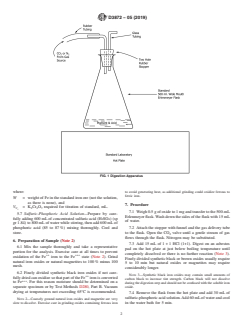
4.1 The digestion apparatus consists of a standard 500-mL
++
of ferrous oxide (FeO) by oxidation of ferrous iron (Fe )inan
Erlenmeyer flask fitted with a two-hole rubber stopper and
+++
acid solution to the ferric state (Fe ) and titration with
glass tubing, as shown in Fig. 1, to provide for the introduction
potassium dichromate using diphenylamine as the indicator.
of the inert gas and vent for gas and digestion fumes.
1.2 This test method is applicable to synthetic black iron
oxide, natural black iron oxide, magnetite or brown iron oxide 5. Reagents
where part of the iron content is present in the ferrous state
5.1 Purity of Reagents—Reagent grade chemicals shall be
(Note 1). It is applicable to iron oxides where the ferrous iron
used in all tests. Unless otherwise indicated, it is intended that
content ranges from 50 to 0.20 %.
all reagents shall conform to the specifications of the Commit-
NOTE 1—Natural iron oxides and magnetite may contain traces of
tee onAnalytical Reagents of theAmerican Chemical Society,
metallic iron that will be combined with and analyzed as FeO. 3
where such specifications are available. Other grades may be
1.3 This standard does not purport to address the safety
used, provided it is first ascertained that the reagent is of
concerns if any, problems associated with its use. It is the
sufficiently high purity to permit its use without lessening the
responsibility of the user of this standard to establish appro-
accuracy of the determination.
priate safety, health, and environmental practices and deter-
5.2 Purity of Water—Unless otherwise indicated, references
mine the applicability of regulatory limitations prior to use.
to water shall be understood to mean Type II of Specification
1.4 This international standard was developed in accor-
D1193.
dance with internationally recognized principles on standard-
ization established in the Decision on Principles for the
5.3 Diphenylamine Indicator—Dissolve1gof diphenylam-
Development of International Standards, Guides and Recom-
ine in 100 mL of concentrated (H SO ) (sp gr 1.84).
2 4
mendations issued by the World Trade Organization Technical
Barriers to Trade (TBT) Committee.
5.4 Hydrochloric Acid (1+1)—Dilute concentrated hydro-
chloric acid (HCl, sp gr 1.19) with an equal volume of reagent
2. Referenced Documents
water.
2.1 ASTM Standards:
5.5 Iron Ore, Standard, Sibley No. 27-f.
D280 Test Methods for Hygroscopic Moisture (and Other
5.6 Potassium Dichromate, Standard Solution (0.1 N)—
Matter Volatile Under the Test Conditions) in Pigments
D1193 Specification for Reagent Water Dissolve 4.904 g of K Cr O in water and dilute to 1 L.
2 2 7
Standardize against National Institute of Standards and Tech-
3. Significance and Use
nology standard sample No. 27f of Sibley iron ore. Calculate
the Fe factor in grams per millilitre for the solution as:
3.1 This test method may be used for production quality
control or specification acceptance.
Fe 5 W/V (1)
This test method is under the jurisdiction of ASTM Committee D01 on Paint
and Related Coatings, Materials, andApplications and is the direct responsibility of Reagent Chemicals, American Chemical Society Specifications, American
Subcommittee D01.31 on Pigment Specifications. Chemical Society, Washington, DC. For suggestions on the testing of reagents not
Current edition approved May 1, 2019. Published May 2019. Originally listed by the American Chemical Society, see Analar Standards for Laboratory
approved in 1979. Last previous edition approved in 2011 as D3872 – 05 (2011). Chemicals, BDH Ltd., Poole, Dorset, U.K., and the United States Pharmacopeia
DOI: 10.1520/D3872-05R19. and National Formulary, U.S. Pharmacopeial Convention, Inc. (USPC), Rockville,
For referenced ASTM standards, visit the ASTM website, www.astm.org, or MD.
contact ASTM Customer Service at service@astm.org. For Annual Book of ASTM May be secured from National Institute of Standards and Technology, Depart-
Standards volume information, refer to the standard’s Document Summary page on ment of Commerce, Washington, DC 20234. Other recognized primary iron
the ASTM website. standard may be substituted.
Copyright © ASTM International, 100 Barr Harbor Drive, PO Box C700, West Conshohocken, PA 19428-2959. United States
D3872 − 05 (2019)
FIG. 1 Digestion Apparatus
to avoid generating heat, as additional grinding could oxidize ferrous to
where:
ferric iron.
W = weight of Fe in the standard iron ore (not the solution,
as there is none), and
7. Procedure
V =K Cr O required f
...