

ASTM D7893-13(2018)
(Guide)Standard Guide for Corrosion Test Panel Preparation, Testing, and Rating of Coil-Coated Building Products
General Information
- Abstract
SIGNIFICANCE AND USE
5.1 Coil-coated metals are subjected to a wide range of environmental stresses. Corrosion at cut edges, damage points, and fabricated areas can occur and lead to premature failure. Proper preparation and rating of test panels produces meaningful test results that allows comparisons between metal substrates and their pretreatments as well as between coating systems.
5.2 Laboratory-prepared test panels give a relative comparison of the substrates and coating systems under test, but may not duplicate all of the stresses imposed on manufactured components. Validation of results on a manufactured product is recommended.
5.3 Laboratory accelerated corrosion testing is useful in evaluating relative performance of new and existing metal coatings, pretreatments, and paints. It is up to the participating parties to agree on the significance of these tests to actual use.
SCOPE
1.1 This guide has been written specifically for coil-coated metal building products.
1.2 This guide applies to preparation, testing, and rating of line-coated and laboratory-coated test panels for the purpose of comparing and ranking the panels for corrosion resistance and other related properties.
1.3 Testing may include accelerated laboratory corrosion tests and outdoor exposure tests.
1.4 The values stated in SI units are to be regarded as standard. No other units of measurement are included in this standard.
1.5 This standard does not purport to address all of the safety concerns, if any, associated with its use. It is the responsibility of the user of this standard to establish appropriate safety, health, and environmental practices and determine the applicability of regulatory limitations prior to use.
1.6 This international standard was developed in accordance with internationally recognized principles on standardization established in the Decision on Principles for the Development of International Standards, Guides and Recommendations issued by the World Trade Organization Technical Barriers to Trade (TBT) Committee.
- Status
- Published
- Publication Date
- 31-May-2018
- Technical Committee
- D01 - Paint and Related Coatings, Materials, and Applications
- Drafting Committee
- D01.53 - Coil Coated Metal
Overview
ASTM D7893-13(2018): Standard Guide for Corrosion Test Panel Preparation, Testing, and Rating of Coil-Coated Building Products provides guidance on preparing, testing, and rating test panels for evaluating corrosion resistance in coil-coated metal building products. This standard, developed by ASTM International, addresses the need for reliable, comparative data on the durability and performance of different coatings and pretreatment systems applied to metal substrates used in construction. Proper preparation and evaluation of test panels are crucial for simulating real-world environmental stresses and supporting quality assurance, research, and product development within the steel coating industry.
Key Topics
- Test Panel Preparation: Guidance on configuring test panels to simulate real building components, including methods for applying coatings, forming edges, punching holes, and adding scribe lines or bends.
- Corrosion Testing Methods: Covers both accelerated laboratory testing and outdoor exposure tests. Accelerated methods enable faster comparative performance evaluation, although results may not fully replicate all real-world stresses.
- Performance Rating: Procedures for measuring and rating corrosion, including assessments of cut-edge creep, face blistering, scribe creep, adhesion, and red rust formation.
- Statistical Analysis: Recommendations for using statistical methods to interpret results, rank product performance, and address variability in test data.
- Safety and Compliance: Notes requirements for users to establish proper safety, health, and environmental practices and review regulatory applicability before conducting tests.
Applications
This standard is especially valuable for:
- Manufacturers of Coil-Coated Metals: Ensuring product coatings meet durability requirements before market release.
- Quality Control Laboratories: Conducting consistent and reproducible corrosion tests to compare substrate and coating system performance.
- Research and Development: Screening new metal coatings, pretreatments, and paints for improved corrosion resistance.
- Specifications and Certification: Providing a standardized approach for procurement, technical specifications, and certification of coil-coated building products.
Practical uses of ASTM D7893-13(2018) include:
- Comparing new coatings to proven technologies under controlled laboratory or outdoor conditions.
- Validating the suitability of specific coil-coated products for building applications subject to harsh environments, such as coastal or industrial areas.
- Supporting claims of product performance in marketing and technical documentation.
- Troubleshooting and benchmarking existing coating systems to identify and resolve issues related to corrosion at cut edges, formed sections, and other vulnerable areas.
Related Standards
The following referenced standards are commonly used in conjunction with ASTM D7893-13(2018):
- ASTM B117: Practice for Operating Salt Spray (Fog) Apparatus
- ASTM D1654: Test Method for Evaluation of Painted or Coated Specimens Subjected to Corrosive Environments
- ASTM D610: Practice for Evaluating Degree of Rusting on Painted Steel Surfaces
- ASTM D714: Method for Evaluating Degree of Blistering of Paints
- ASTM D1735 / D2247 / D4585: Practices for Testing Water Resistance of Coatings
- ASTM D2803: Guide for Testing Filiform Corrosion Resistance of Organic Coatings
- ASTM D3359: Test Methods for Rating Adhesion by Tape Test
- ASTM D4138 / D7091 / D5796: Practices and Test Methods for Measurement of Dry Film Thickness
- ASTM G7: Practice for Atmospheric Environmental Exposure Testing of Nonmetallic Materials
- ASTM G85 / G87: Practices for Modified Salt Spray Testing
- SAE J2334: Laboratory Cyclic Corrosion Test
These standards collectively support a comprehensive approach to evaluating the corrosion resistance and durability of coil-coated building products in accordance with internationally recognized principles.
Keywords: coil coating, corrosion resistance, test panel preparation, metal coatings, building products, laboratory corrosion testing, ASTM standards.
Relations
- Effective Date
- 01-Jun-2018
- Effective Date
- 01-Jun-2020
- Effective Date
- 01-Jun-2020
- Effective Date
- 01-Jun-2020
- Effective Date
- 01-Nov-2019
- Refers
ASTM D610-08(2019) - Standard Practice for Evaluating Degree of Rusting on Painted Steel Surfaces - Effective Date
- 01-Jan-2019
- Effective Date
- 01-Dec-2016
- Effective Date
- 01-Dec-2015
- Effective Date
- 01-Jun-2015
- Effective Date
- 01-Jun-2015
- Effective Date
- 01-May-2013
- Refers
ASTM D610-08(2012) - Standard Practice for Evaluating Degree of Rusting on Painted Steel Surfaces - Effective Date
- 01-Nov-2012
- Effective Date
- 01-Apr-2012
- Effective Date
- 01-Oct-2011
- Effective Date
- 01-May-2011
Get Certified
Connect with accredited certification bodies for this standard

DIBt (Deutsches Institut für Bautechnik)
German Institute for Building Technology.
DIN CERTCO
DIN Group product certification.
DVS-ZERT GmbH
German welding certification society.
Sponsored listings
Frequently Asked Questions
ASTM D7893-13(2018) is a guide published by ASTM International. Its full title is "Standard Guide for Corrosion Test Panel Preparation, Testing, and Rating of Coil-Coated Building Products". This standard covers: SIGNIFICANCE AND USE 5.1 Coil-coated metals are subjected to a wide range of environmental stresses. Corrosion at cut edges, damage points, and fabricated areas can occur and lead to premature failure. Proper preparation and rating of test panels produces meaningful test results that allows comparisons between metal substrates and their pretreatments as well as between coating systems. 5.2 Laboratory-prepared test panels give a relative comparison of the substrates and coating systems under test, but may not duplicate all of the stresses imposed on manufactured components. Validation of results on a manufactured product is recommended. 5.3 Laboratory accelerated corrosion testing is useful in evaluating relative performance of new and existing metal coatings, pretreatments, and paints. It is up to the participating parties to agree on the significance of these tests to actual use. SCOPE 1.1 This guide has been written specifically for coil-coated metal building products. 1.2 This guide applies to preparation, testing, and rating of line-coated and laboratory-coated test panels for the purpose of comparing and ranking the panels for corrosion resistance and other related properties. 1.3 Testing may include accelerated laboratory corrosion tests and outdoor exposure tests. 1.4 The values stated in SI units are to be regarded as standard. No other units of measurement are included in this standard. 1.5 This standard does not purport to address all of the safety concerns, if any, associated with its use. It is the responsibility of the user of this standard to establish appropriate safety, health, and environmental practices and determine the applicability of regulatory limitations prior to use. 1.6 This international standard was developed in accordance with internationally recognized principles on standardization established in the Decision on Principles for the Development of International Standards, Guides and Recommendations issued by the World Trade Organization Technical Barriers to Trade (TBT) Committee.
SIGNIFICANCE AND USE 5.1 Coil-coated metals are subjected to a wide range of environmental stresses. Corrosion at cut edges, damage points, and fabricated areas can occur and lead to premature failure. Proper preparation and rating of test panels produces meaningful test results that allows comparisons between metal substrates and their pretreatments as well as between coating systems. 5.2 Laboratory-prepared test panels give a relative comparison of the substrates and coating systems under test, but may not duplicate all of the stresses imposed on manufactured components. Validation of results on a manufactured product is recommended. 5.3 Laboratory accelerated corrosion testing is useful in evaluating relative performance of new and existing metal coatings, pretreatments, and paints. It is up to the participating parties to agree on the significance of these tests to actual use. SCOPE 1.1 This guide has been written specifically for coil-coated metal building products. 1.2 This guide applies to preparation, testing, and rating of line-coated and laboratory-coated test panels for the purpose of comparing and ranking the panels for corrosion resistance and other related properties. 1.3 Testing may include accelerated laboratory corrosion tests and outdoor exposure tests. 1.4 The values stated in SI units are to be regarded as standard. No other units of measurement are included in this standard. 1.5 This standard does not purport to address all of the safety concerns, if any, associated with its use. It is the responsibility of the user of this standard to establish appropriate safety, health, and environmental practices and determine the applicability of regulatory limitations prior to use. 1.6 This international standard was developed in accordance with internationally recognized principles on standardization established in the Decision on Principles for the Development of International Standards, Guides and Recommendations issued by the World Trade Organization Technical Barriers to Trade (TBT) Committee.
ASTM D7893-13(2018) is classified under the following ICS (International Classification for Standards) categories: 25.220.60 - Organic coatings; 91.080.10 - Metal structures. The ICS classification helps identify the subject area and facilitates finding related standards.
ASTM D7893-13(2018) has the following relationships with other standards: It is inter standard links to ASTM D7893-13, ASTM D870-15(2020), ASTM D2247-15(2020), ASTM D2803-09(2020), ASTM G85-19, ASTM D610-08(2019), ASTM D1654-08(2016), ASTM D2247-15, ASTM D2803-09(2015), ASTM D5796-10(2015), ASTM G87-02(2013), ASTM D610-08(2012), ASTM D7091-12, ASTM B117-11, ASTM G85-11. Understanding these relationships helps ensure you are using the most current and applicable version of the standard.
ASTM D7893-13(2018) is available in PDF format for immediate download after purchase. The document can be added to your cart and obtained through the secure checkout process. Digital delivery ensures instant access to the complete standard document.
Standards Content (Sample)
This international standard was developed in accordance with internationally recognized principles on standardization established in the Decision on Principles for the
Development of International Standards, Guides and Recommendations issued by the World Trade Organization Technical Barriers to Trade (TBT) Committee.
Designation: D7893 − 13 (Reapproved 2018)
Standard Guide for
Corrosion Test Panel Preparation, Testing, and Rating of
Coil-Coated Building Products
This standard is issued under the fixed designation D7893; the number immediately following the designation indicates the year of
original adoption or, in the case of revision, the year of last revision. A number in parentheses indicates the year of last reapproval. A
superscript epsilon (´) indicates an editorial change since the last revision or reapproval.
1. Scope D870 Practice for Testing Water Resistance of Coatings
Using Water Immersion
1.1 This guide has been written specifically for coil-coated
D1654 Test Method for Evaluation of Painted or Coated
metal building products.
Specimens Subjected to Corrosive Environments
1.2 This guide applies to preparation, testing, and rating of
D1735 Practice for Testing Water Resistance of Coatings
line-coated and laboratory-coated test panels for the purpose of
Using Water Fog Apparatus
comparing and ranking the panels for corrosion resistance and
D2247 Practice for Testing Water Resistance of Coatings in
other related properties.
100 % Relative Humidity
1.3 Testing may include accelerated laboratory corrosion D2803 Guide for Testing Filiform Corrosion Resistance of
Organic Coatings on Metal
tests and outdoor exposure tests.
D3359 Test Methods for Rating Adhesion by Tape Test
1.4 The values stated in SI units are to be regarded as
D4138 Practices for Measurement of Dry Film Thickness of
standard. No other units of measurement are included in this
Protective Coating Systems by Destructive, Cross-
standard.
Sectioning Means
1.5 This standard does not purport to address all of the
D4585 Practice for Testing Water Resistance of Coatings
safety concerns, if any, associated with its use. It is the
Using Controlled Condensation
responsibility of the user of this standard to establish appro-
D5796 TestMethodforMeasurementofDryFilmThickness
priate safety, health, and environmental practices and deter-
of Thin-Film Coil-Coated Systems by Destructive Means
mine the applicability of regulatory limitations prior to use.
Using a Boring Device
1.6 This international standard was developed in accor-
D5894 Practice for Cyclic Salt Fog/UV Exposure of Painted
dance with internationally recognized principles on standard-
Metal, (Alternating Exposures in a Fog/Dry Cabinet and a
ization established in the Decision on Principles for the
UV/Condensation Cabinet)
Development of International Standards, Guides and Recom-
D7091 Practice for Nondestructive Measurement of Dry
mendations issued by the World Trade Organization Technical
Film Thickness of Nonmagnetic Coatings Applied to
Barriers to Trade (TBT) Committee.
Ferrous Metals and Nonmagnetic, Nonconductive Coat-
ings Applied to Non-Ferrous Metals
2. Referenced Documents
G7 Practice for Atmospheric Environmental Exposure Test-
2.1 ASTM Standards:
ing of Nonmetallic Materials
B117 Practice for Operating Salt Spray (Fog) Apparatus
G85 Practice for Modified Salt Spray (Fog) Testing
D610 Practice for Evaluating Degree of Rusting on Painted
G87 Practice for Conducting Moist SO Tests
Steel Surfaces
G169 Guide for Application of Basic Statistical Methods to
D714 Test Method for Evaluating Degree of Blistering of
Weathering Tests
Paints
2.2 SAE Standards:
J2334 Laboratory Cyclic Corrosion Test
This guide is under the jurisdiction of ASTM Committee D01 on Paint and
3. Terminology
Related Coatings, Materials, and Applications and is the direct responsibility of
3.1 Definitions:
Subcommittee D01.53 on Coil Coated Metal.
Current edition approved June 1, 2018. Published June 2018. Originally
3.1.1 test panel, n—a representative specimen of metal
approved in 2013. Last previous edition approved in 2013 as D7893 – 13. DOI:
substrate, coated with a coating system for evaluation, and
10.1520/D7893-13R18.
For referenced ASTM standards, visit the ASTM website, www.astm.org, or
contact ASTM Customer Service at service@astm.org. For Annual Book of ASTM
Standards volume information, refer to the standard’s Document Summary page on Available from SAE International (SAE), 400 Commonwealth Dr.,Warrendale,
the ASTM website. PA 15096-0001, http://www.sae.org.
Copyright © ASTM International, 100 Barr Harbor Drive, PO Box C700, West Conshohocken, PA 19428-2959. United States
D7893 − 13 (2018)
prepared in a way that allows measurement of environmental other configurations. The anticipated corrosion creep distance
degradation, especially corrosion, for system performance would also influence test panel size.
comparisons and ranking.
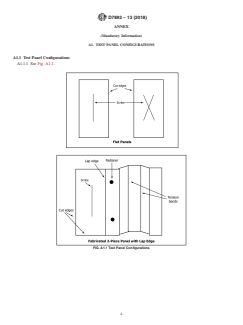
6.4 The test panel configuration and features are chosen to
simulate real building panels. These might include cut edges,
4. Summary of Guide
lap edges, scribe lines (to simulate damage), holes with or
4.1 Test panels may be collected from coil line clips and
without fasteners, tension bends, impact dimples, and other
formed building panels, or may be laboratory-prepared.
forming operations (see Fig. A1.1).
4.2 Test panels are prepared for testing in a specific con-
6.5 In addition to test panel configuration, the laboratory
figuration that simulates conditions on buildings.
accelerated corrosion tests, exposure sites, and panel orienta-
4.3 Test panels are exposed to specific conditions in accor-
tions should be considered. Exposure sites represent unique
dance with standard practices and methods.
environments that cyclically expose the test panels to many
conditions such as temperature variation, moisture, salt
4.4 After testing, corrosion is measured in a way that relates
concentrations, industrial pollutants, and solar radiation. Expo-
to building performance and allows performance ranking
sure angles such as 1°, 5°, and 45° from horizontal might be
among samples, for example, by the corrosion creep distance
chosen for roof simulation, while vertical exposures would be
from test panel edges.
used for side walls. Exposure directions, north, south, east, or
5. Significance and Use west, can be chosen as can the degree of shade or shelter. A
sheltered exposure may offer increased time of wetness for test
5.1 Coil-coated metals are subjected to a wide range of
panels.
environmental stresses. Corrosion at cut edges, damage points,
and fabricated areas can occur and lead to premature failure.
6.6 Use of coil line-coated test panels (line clips) is pre-
Proper preparation and rating of test panels produces meaning-
ferred to best represent the commercial product’s performance.
ful test results that allows comparisons between metal sub-
Often, however, where a number of variables are tested in a
strates and their pretreatments as well as between coating
screening experiment, it is not practical or economical to test
systems.
line clips. In such cases, laboratory test panels may be
prepared. For laboratory-prepared test panels, heating rate and
5.2 Laboratory-prepared test panels give a relative compari-
peak metal temperature should be as close as possible to coil
son of the substrates and coating systems under test, but may
line conditions.
not duplicate all of the stresses imposed on manufactured
components.Validation of results on a manufactured product is
6.7 Pretreatments are applied to a cleaned surface by
recommended.
immersion, spray, drawdown, or rollcoater as appropriate in
accordance with manufacturer specification.
5.3 Laboratory accelerated corrosion testing is useful in
evaluating relative performance of new and existing metal
6.8 For laboratory-prepared test panels, coil primers and
coatings, pretreatments, and paints. It is up to the participating
topcoats are typically applied to test panels by wire wound rod.
parties to agree on the significance of these tests to actual use.
The wire number selected is critical for dry film thickness
(DFT) accuracy. DFT must be established for each coating/rod
6. Test Panel Preparation
number combination because the same rod can produce differ-
6.1 An experiment is planned to evaluate the effects of
ent DFTs with different coatings. Typical methods for measur-
specific variables in the coated metal system on corrosion
ing the dry film thickness of coil coatings include Practices
performance.These variables typically include metal substrate,
D4138, D7091, and Test Method D5796.
cleaning, pretreatment, primer, topcoat, forming, and other
6.9 For laboratory-prepared test panels, when the backside
appropriate stresses.
has not been line-primed or backed, a backer coating should be
6.2 The number of replicates in a test is determined by
applied to test panels. This may be accomplished with room
availability of substrate, time, resource constraints, and statis-
temperature-c
...