

ASTM C1366-19
(Test Method)Standard Test Method for Tensile Strength of Monolithic Advanced Ceramics at Elevated Temperatures
General Information
- Abstract
SIGNIFICANCE AND USE
4.1 This test method may be used for material development, material comparison, quality assurance, characterization, reliability assessment, and design data generation.
4.2 High-strength, monolithic advanced ceramic materials are generally characterized by small grain sizes (
4.3 Because of the probabilistic strength distributions of brittle materials such as advanced ceramics, a sufficient number of test specimens at each testing condition is required for statistical analysis and eventual design with guidelines for sufficient numbers provided in this test method. Size-scaling effects as discussed in Practice C1239 will affect the strength values. Therefore, strengths obtained using different recommended tensile test specimen geometries with different volumes or surface areas of material in the gage sections will be different due to these size differences. Resulting strength values can, in principle, be scaled to an effective volume or effective surface area of unity as discussed in Practice C1239.
4.4 Tensile tests provide information on the strength and deformation of materials under uniaxial stresses. Uniform stress states are required to effectively evaluate any nonlinear stress-strain behavior which may develop as the result of testing mode, testing rate, processing or alloying effects, environmental influences, or elevated temperatures. These effects may be consequences of stress corrosion or sub-critical (slow) crack growth which can be minimized by testing at appropriately rapid rates as outlined in this test method.
4.5 The results of tensile tests of specimens fabricated to standardized dimensions from a particular material or selected portions of a part, or both, may not totally represent the strength and deformation properties of the entire full-size end product or its in-service behavior in different environments.
4.6 For quality control purposes, results derived from standardized tensile test specimens can be considered to be indicative ...
SCOPE
1.1 This test method covers the determination of tensile strength under uniaxial loading of monolithic advanced ceramics at elevated temperatures. This test method addresses, but is not restricted to, various suggested test specimen geometries as listed in the appendix. In addition, test specimen fabrication methods, testing modes (force, displacement, or strain control), testing rates (force rate, stress rate, displacement rate, or strain rate), allowable bending, and data collection and reporting procedures are addressed. Tensile strength as used in this test method refers to the tensile strength obtained under uniaxial loading.
1.2 This test method applies primarily to advanced ceramics which macroscopically exhibit isotropic, homogeneous, continuous behavior. While this test method applies primarily to monolithic advanced ceramics, certain whisker- or particle-reinforced composite ceramics as well as certain discontinuous fiber-reinforced composite ceramics may also meet these macroscopic behavior assumptions. Generally, continuous fiber ceramic composites (CFCCs) do not macroscopically exhibit isotropic, homogeneous, continuous behavior and application of this test method to these materials is not recommended.
1.3 The values stated in SI units are to be regarded as the standard and are in accordance with IEEE/ASTM SI 10.
1.4 This standard does not purport to address all of the safety concerns, if any, associated with its use. It is the responsibility of the user of this standard to establish appropriate safety, health, and environmental practices and determine the applicability of regulatory limitations prior to use. Refer to Section 7 for specific precautions.
1.5 This international standard was developed in accordance with internationally recognized principles on standardization established in the Decision on Principles for the Development of International Standards, Guides and Recommendations issued b...
- Status
- Published
- Publication Date
- 31-Jul-2019
- Technical Committee
- C28 - Advanced Ceramics
- Drafting Committee
- C28.01 - Mechanical Properties and Performance
Buy Documents
ASTM C1366-19 - Standard Test Method for Tensile Strength of Monolithic Advanced Ceramics at Elevated Temperatures
REDLINE ASTM C1366-19 - Standard Test Method for Tensile Strength of Monolithic Advanced Ceramics at Elevated Temperatures
Overview
ASTM C1366-19 is the standard test method developed by ASTM International for determining the tensile strength of monolithic advanced ceramics at elevated temperatures. This test method provides procedures for uniaxial loading of advanced ceramics to evaluate their tensile strength, addressing various testing geometries, fabrication methods, and data reporting protocols. The method is particularly valuable for material development, comparison, quality assurance, reliability assessment, and generating design data essential for engineering applications.
Testing the tensile strength of advanced ceramics is critical due to their widespread use in demanding, high-temperature environments where structural integrity and mechanical performance are paramount. This standard ensures consistency, reliability, and repeatability in evaluating advanced ceramic materials' tensile properties.
Key Topics
- Applicability: Targets monolithic advanced ceramics that exhibit isotropic, homogeneous, continuous behavior. While focused on monolithic ceramics, it may also apply to select whisker-, particle-, or discontinuous fiber-reinforced composite ceramics meeting certain criteria.
- Test Conditions: Covers test specimen geometries, fabrication, test modes (force, displacement, or strain control), and testing rates relevant to the determination of tensile strength under uniaxial loading at high temperatures.
- Statistical Relevance: Recognizes the probabilistic nature of strength in brittle materials, requiring sufficient specimen numbers and consideration of size-scaling effects as referenced in ASTM C1239.
- Data Collection: Emphasizes thorough documentation of material, processing history, test geometry, and environmental conditions to ensure reliable and comparable results.
- Quality Control: Standardized procedures provide a basis for quality assurance, allowing producers and users to assess ongoing material performance.
- Limitations: Notes that results from standardized specimens may not fully represent the behavior of complex or full-sized engineered parts.
Applications
The ASTM C1366-19 test method supports a range of practical applications, including:
- Material Development and Comparison: Enables researchers and manufacturers to develop and compare novel advanced ceramics under simulated service conditions.
- Quality Assurance in Manufacturing: Ensures consistent mechanical properties in ceramic products, supporting high-reliability requirements in sectors such as aerospace, automotive, industrial, and energy.
- Design Data Generation: Provides critical input for design engineers when specifying advanced ceramics for structural components operating at elevated temperatures.
- Reliability Assessment: Assists in predicting in-service performance and failure modes, supporting risk management and product development life cycles.
- Characterization and Certification: Used by certification bodies and regulatory agencies to verify compliance with performance standards for advanced ceramic materials.
Related Standards
When applying ASTM C1366-19, it is important to be familiar with related and referenced standards for comprehensive material testing and reporting:
- ASTM C1145 - Terminology of Advanced Ceramics
- ASTM C1161 - Flexural Strength of Advanced Ceramics at Ambient Temperature
- ASTM C1239 - Reporting Uniaxial Strength Data and Estimating Weibull Distribution Parameters for Advanced Ceramics
- ASTM C1322 - Fractography and Characterization of Fracture Origins in Advanced Ceramics
- ASTM E4 - Force Verification of Testing Machines
- ASTM E21 - Elevated Temperature Tension Tests of Metallic Materials
- ASTM E83 - Verification and Classification of Extensometer Systems
- ASTM E220 - Calibration of Thermocouples By Comparison Techniques
Understanding these interrelated ASTM standards ensures correct test implementation, accurate data acquisition, and meaningful material property evaluation essential for the reliable use of advanced ceramics in high-temperature applications.
Keywords: ASTM C1366-19, tensile strength, advanced ceramics, elevated temperature, uniaxial testing, quality assurance, material testing, mechanical properties, standard test method, ceramics reliability, statistical analysis, material development, engineering design data.
Relations
- Effective Date
- 01-Aug-2019
- Effective Date
- 01-Jul-2019
- Effective Date
- 01-Jul-2019
- Effective Date
- 01-Jul-2018
- Effective Date
- 01-Jul-2015
- Effective Date
- 01-Jun-2014
- Effective Date
- 01-Nov-2013
- Effective Date
- 01-Aug-2013
- Effective Date
- 01-Aug-2013
- Effective Date
- 01-Feb-2013
- Effective Date
- 01-Feb-2013
- Effective Date
- 01-Jun-2012
- Effective Date
- 01-Jun-2012
- Effective Date
- 15-Jul-2010
- Effective Date
- 01-Jun-2010
Buy Documents
ASTM C1366-19 - Standard Test Method for Tensile Strength of Monolithic Advanced Ceramics at Elevated Temperatures
REDLINE ASTM C1366-19 - Standard Test Method for Tensile Strength of Monolithic Advanced Ceramics at Elevated Temperatures
Frequently Asked Questions
ASTM C1366-19 is a standard published by ASTM International. Its full title is "Standard Test Method for Tensile Strength of Monolithic Advanced Ceramics at Elevated Temperatures". This standard covers: SIGNIFICANCE AND USE 4.1 This test method may be used for material development, material comparison, quality assurance, characterization, reliability assessment, and design data generation. 4.2 High-strength, monolithic advanced ceramic materials are generally characterized by small grain sizes ( 4.3 Because of the probabilistic strength distributions of brittle materials such as advanced ceramics, a sufficient number of test specimens at each testing condition is required for statistical analysis and eventual design with guidelines for sufficient numbers provided in this test method. Size-scaling effects as discussed in Practice C1239 will affect the strength values. Therefore, strengths obtained using different recommended tensile test specimen geometries with different volumes or surface areas of material in the gage sections will be different due to these size differences. Resulting strength values can, in principle, be scaled to an effective volume or effective surface area of unity as discussed in Practice C1239. 4.4 Tensile tests provide information on the strength and deformation of materials under uniaxial stresses. Uniform stress states are required to effectively evaluate any nonlinear stress-strain behavior which may develop as the result of testing mode, testing rate, processing or alloying effects, environmental influences, or elevated temperatures. These effects may be consequences of stress corrosion or sub-critical (slow) crack growth which can be minimized by testing at appropriately rapid rates as outlined in this test method. 4.5 The results of tensile tests of specimens fabricated to standardized dimensions from a particular material or selected portions of a part, or both, may not totally represent the strength and deformation properties of the entire full-size end product or its in-service behavior in different environments. 4.6 For quality control purposes, results derived from standardized tensile test specimens can be considered to be indicative ... SCOPE 1.1 This test method covers the determination of tensile strength under uniaxial loading of monolithic advanced ceramics at elevated temperatures. This test method addresses, but is not restricted to, various suggested test specimen geometries as listed in the appendix. In addition, test specimen fabrication methods, testing modes (force, displacement, or strain control), testing rates (force rate, stress rate, displacement rate, or strain rate), allowable bending, and data collection and reporting procedures are addressed. Tensile strength as used in this test method refers to the tensile strength obtained under uniaxial loading. 1.2 This test method applies primarily to advanced ceramics which macroscopically exhibit isotropic, homogeneous, continuous behavior. While this test method applies primarily to monolithic advanced ceramics, certain whisker- or particle-reinforced composite ceramics as well as certain discontinuous fiber-reinforced composite ceramics may also meet these macroscopic behavior assumptions. Generally, continuous fiber ceramic composites (CFCCs) do not macroscopically exhibit isotropic, homogeneous, continuous behavior and application of this test method to these materials is not recommended. 1.3 The values stated in SI units are to be regarded as the standard and are in accordance with IEEE/ASTM SI 10. 1.4 This standard does not purport to address all of the safety concerns, if any, associated with its use. It is the responsibility of the user of this standard to establish appropriate safety, health, and environmental practices and determine the applicability of regulatory limitations prior to use. Refer to Section 7 for specific precautions. 1.5 This international standard was developed in accordance with internationally recognized principles on standardization established in the Decision on Principles for the Development of International Standards, Guides and Recommendations issued b...
SIGNIFICANCE AND USE 4.1 This test method may be used for material development, material comparison, quality assurance, characterization, reliability assessment, and design data generation. 4.2 High-strength, monolithic advanced ceramic materials are generally characterized by small grain sizes ( 4.3 Because of the probabilistic strength distributions of brittle materials such as advanced ceramics, a sufficient number of test specimens at each testing condition is required for statistical analysis and eventual design with guidelines for sufficient numbers provided in this test method. Size-scaling effects as discussed in Practice C1239 will affect the strength values. Therefore, strengths obtained using different recommended tensile test specimen geometries with different volumes or surface areas of material in the gage sections will be different due to these size differences. Resulting strength values can, in principle, be scaled to an effective volume or effective surface area of unity as discussed in Practice C1239. 4.4 Tensile tests provide information on the strength and deformation of materials under uniaxial stresses. Uniform stress states are required to effectively evaluate any nonlinear stress-strain behavior which may develop as the result of testing mode, testing rate, processing or alloying effects, environmental influences, or elevated temperatures. These effects may be consequences of stress corrosion or sub-critical (slow) crack growth which can be minimized by testing at appropriately rapid rates as outlined in this test method. 4.5 The results of tensile tests of specimens fabricated to standardized dimensions from a particular material or selected portions of a part, or both, may not totally represent the strength and deformation properties of the entire full-size end product or its in-service behavior in different environments. 4.6 For quality control purposes, results derived from standardized tensile test specimens can be considered to be indicative ... SCOPE 1.1 This test method covers the determination of tensile strength under uniaxial loading of monolithic advanced ceramics at elevated temperatures. This test method addresses, but is not restricted to, various suggested test specimen geometries as listed in the appendix. In addition, test specimen fabrication methods, testing modes (force, displacement, or strain control), testing rates (force rate, stress rate, displacement rate, or strain rate), allowable bending, and data collection and reporting procedures are addressed. Tensile strength as used in this test method refers to the tensile strength obtained under uniaxial loading. 1.2 This test method applies primarily to advanced ceramics which macroscopically exhibit isotropic, homogeneous, continuous behavior. While this test method applies primarily to monolithic advanced ceramics, certain whisker- or particle-reinforced composite ceramics as well as certain discontinuous fiber-reinforced composite ceramics may also meet these macroscopic behavior assumptions. Generally, continuous fiber ceramic composites (CFCCs) do not macroscopically exhibit isotropic, homogeneous, continuous behavior and application of this test method to these materials is not recommended. 1.3 The values stated in SI units are to be regarded as the standard and are in accordance with IEEE/ASTM SI 10. 1.4 This standard does not purport to address all of the safety concerns, if any, associated with its use. It is the responsibility of the user of this standard to establish appropriate safety, health, and environmental practices and determine the applicability of regulatory limitations prior to use. Refer to Section 7 for specific precautions. 1.5 This international standard was developed in accordance with internationally recognized principles on standardization established in the Decision on Principles for the Development of International Standards, Guides and Recommendations issued b...
ASTM C1366-19 is classified under the following ICS (International Classification for Standards) categories: 81.060.30 - Advanced ceramics. The ICS classification helps identify the subject area and facilitates finding related standards.
ASTM C1366-19 has the following relationships with other standards: It is inter standard links to ASTM C1366-04(2013), ASTM C1322-15(2019), ASTM C1145-19, ASTM C1239-13(2018), ASTM C1322-15, ASTM E4-14, ASTM E220-13, ASTM C1239-13, ASTM C1161-13, ASTM C1145-06(2013), ASTM C1145-06(2013)e1, ASTM E1012-12e1, ASTM E1012-12, ASTM C1322-05b(2010), ASTM E83-10a. Understanding these relationships helps ensure you are using the most current and applicable version of the standard.
ASTM C1366-19 is available in PDF format for immediate download after purchase. The document can be added to your cart and obtained through the secure checkout process. Digital delivery ensures instant access to the complete standard document.
Standards Content (Sample)
This international standard was developed in accordance with internationally recognized principles on standardization established in the Decision on Principles for the
Development of International Standards, Guides and Recommendations issued by the World Trade Organization Technical Barriers to Trade (TBT) Committee.
Designation: C1366 − 19
Standard Test Method for
Tensile Strength of Monolithic Advanced Ceramics at
Elevated Temperatures
This standard is issued under the fixed designation C1366; the number immediately following the designation indicates the year of
original adoption or, in the case of revision, the year of last revision. A number in parentheses indicates the year of last reapproval. A
superscript epsilon (´) indicates an editorial change since the last revision or reapproval.
1. Scope mendations issued by the World Trade Organization Technical
Barriers to Trade (TBT) Committee.
1.1 This test method covers the determination of tensile
strength under uniaxial loading of monolithic advanced ceram-
2. Referenced Documents
ics at elevated temperatures. This test method addresses, but is
2.1 ASTM Standards:
notrestrictedto,varioussuggestedtestspecimengeometriesas
C1145 Terminology of Advanced Ceramics
listed in the appendix. In addition, test specimen fabrication
C1161 Test Method for Flexural Strength of Advanced
methods,testingmodes(force,displacement,orstraincontrol),
Ceramics at Ambient Temperature
testing rates (force rate, stress rate, displacement rate, or strain
C1239 Practice for Reporting Uniaxial Strength Data and
rate), allowable bending, and data collection and reporting
Estimating Weibull Distribution Parameters forAdvanced
procedures are addressed. Tensile strength as used in this test
Ceramics
method refers to the tensile strength obtained under uniaxial
C1322 Practice for Fractography and Characterization of
loading.
Fracture Origins in Advanced Ceramics
1.2 Thistestmethodappliesprimarilytoadvancedceramics
D3379 Test Method forTensile Strength andYoung’s Modu-
which macroscopically exhibit isotropic, homogeneous, con-
lus for High-Modulus Single-Filament Materials
tinuous behavior. While this test method applies primarily to
E4 Practices for Force Verification of Testing Machines
monolithic advanced ceramics, certain whisker- or particle-
E6 Terminology Relating to Methods of Mechanical Testing
reinforced composite ceramics as well as certain discontinuous
E21 TestMethodsforElevatedTemperatureTensionTestsof
fiber-reinforced composite ceramics may also meet these
Metallic Materials
macroscopicbehaviorassumptions.Generally,continuousfiber
E83 Practice for Verification and Classification of Exten-
ceramic composites (CFCCs) do not macroscopically exhibit
someter Systems
isotropic, homogeneous, continuous behavior and application
E220 Test Method for Calibration of Thermocouples By
of this test method to these materials is not recommended.
Comparison Techniques
1.3 The values stated in SI units are to be regarded as the E337 Test Method for Measuring Humidity with a Psy-
standard and are in accordance with IEEE/ASTM SI 10. chrometer (the Measurement of Wet- and Dry-Bulb Tem-
peratures)
1.4 This standard does not purport to address all of the
E1012 Practice for Verification of Testing Frame and Speci-
safety concerns, if any, associated with its use. It is the
men Alignment Under Tensile and Compressive Axial
responsibility of the user of this standard to establish appro-
Force Application
priate safety, health, and environmental practices and deter-
IEEE/ASTM SI 10 American National Standard for Metric
mine the applicability of regulatory limitations prior to use.
Practice
Refer to Section 7 for specific precautions.
1.5 This international standard was developed in accor-
3. Terminology
dance with internationally recognized principles on standard-
3.1 Definitions:
ization established in the Decision on Principles for the
3.1.1 Definitions of terms relating to tensile testing and
Development of International Standards, Guides and Recom-
advanced ceramics as they appear in Terminology E6 and
Terminology C1145, respectively, apply to the terms used in
This test method is under the jurisdiction of ASTM Committee C28 on
Advanced Ceramics and is the direct responsibility of Subcommittee C28.01 on
Mechanical Properties and Performance. For referenced ASTM standards, visit the ASTM website, www.astm.org, or
Current edition approved Aug. 1, 2019. Published September 2019. Originally contact ASTM Customer Service at service@astm.org. For Annual Book of ASTM
approved in 1997. Last previous edition approved in 2013 as C1366 – 04 (2013). Standards volume information, refer to the standard’s Document Summary page on
DOI: 10.1520/C1366-19. the ASTM website.
Copyright © ASTM International, 100 Barr Harbor Drive, PO Box C700, West Conshohocken, PA 19428-2959. United States
C1366 − 19
this test method. Pertinent definitions are shown in the follow- sufficient numbers provided in this test method. Size-scaling
ing with the appropriate source given in parentheses. Addi- effects as discussed in Practice C1239 will affect the strength
tional terms used in conjunction with this test method are values. Therefore, strengths obtained using different recom-
defined in the following. mended tensile test specimen geometries with different vol-
3.1.2 advanced ceramic, n—a highly engineered, high- umes or surface areas of material in the gage sections will be
performance, predominately non-metallic, inorganic, ceramic different due to these size differences. Resulting strength
material having specific functional attributes. (See Terminol- values can, in principle, be scaled to an effective volume or
ogy C1145.) effective surface area of unity as discussed in Practice C1239.
–1
3.1.3 axial strain [LL ], n—theaveragelongitudinalstrains
4.4 Tensile tests provide information on the strength and
measured at the surface on opposite sides of the longitudinal
deformation of materials under uniaxial stresses. Uniform
axis of symmetry of the specimen by two strain-sensing
stress states are required to effectively evaluate any nonlinear
devices located at the mid length of the reduced section. (See
stress-strain behavior which may develop as the result of
Practice E1012.)
testing mode, testing rate, processing or alloying effects,
–1
environmental influences, or elevated temperatures. These
3.1.4 bending strain [LL ], n—the difference between the
effects may be consequences of stress corrosion or sub-critical
strainatthesurfaceandtheaxialstrain.Ingeneral,thebending
(slow) crack growth which can be minimized by testing at
strain varies from point to point around and along the reduced
appropriately rapid rates as outlined in this test method.
section of the specimen. (See Practice E1012.)
4.5 The results of tensile tests of specimens fabricated to
3.1.5 breaking load [F], n—the load at which fracture
standardized dimensions from a particular material or selected
occurs. (See Terminology E6.)
portions of a part, or both, may not totally represent the
3.1.6 fractography, n—the means and methods for charac-
strength and deformation properties of the entire full-size end
terizing a fractured specimen or component. (See Terminology
product or its in-service behavior in different environments.
C1145.)
4.6 For quality control purposes, results derived from stan-
3.1.7 fracture origin, n—the source from which brittle
dardized tensile test specimens can be considered to be
fracture commences. (See Terminology C1145).
indicativeoftheresponseofthematerialfromwhichtheywere
3.1.8 percent bending, n—the bending strain times 100
taken for particular primary processing conditions and post-
divided by the axial strain. (See Practice E1012.)
processing heat treatments.
3.1.9 slow crack growth, n—sub-critical crack growth (ex-
4.7 The tensile strength of a ceramic material is dependent
tension) that may result from, but is not restricted to, such
on both its inherent resistance to fracture and the presence of
mechanisms as environmentally assisted stress corrosion or
flaws. Analysis of fracture surfaces and fractography as de-
diffusive crack growth.
scribed in Practice C1322 and MIL-HDBK-790, though be-
3.1.10 tensile strength, S [FL ], n—the maximum tensile
u
yond the scope of this test method, are recommended for all
stress which a material is capable of sustaining. Tensile
purposes, especially for design data.
strength is calculated from the maximum load during a tension
test carried to rupture and the original cross-sectional area of
5. Interferences
the specimen. (See Terminology E6.)
5.1 Test environment (vacuum, inert gas, ambient air, etc.),
including moisture content (for example relative humidity),
4. Significance and Use
may have an influence on the measured tensile strength. In
4.1 This test method may be used for material development,
particular, the behavior of materials susceptible to slow crack
material comparison, quality assurance, characterization, reli-
growth fracture will be strongly influenced by test
ability assessment, and design data generation.
environment,testingrate,andelevatedtemperatures.Testingto
4.2 High-strength, monolithic advanced ceramic materials evaluate the maximum strength potential of a material should
are generally characterized by small grain sizes (<50 µm) and be conducted in inert environments or at sufficiently rapid
bulk densities near the theoretical density. These materials are testing rates, or both, to minimize slow crack growth effects.
candidates for load-bearing structural applications requiring Conversely, testing can be conducted in environments and
high degrees of wear and corrosion resistance and elevated- testing modes and rates representative of service conditions to
temperature strength. Although flexural test methods are com- evaluate material performance under use conditions. When
monly used to evaluate strength of advanced ceramics, the testing is conducted in uncontrolled ambient air with the intent
nonuniform stress distribution of the flexure specimen limits of evaluating maximum strength potential, monitor and report
the volume of material subjected to the maximum applied relativehumidityandambienttemperature.Testingathumidity
stress at fracture. Uniaxially loaded tensile strength tests levels >65 % relative humidity (RH) is not recommended.
provide information on strength-limiting flaws from a greater
5.2 Surface preparation of test specimens can introduce
volume of uniformly stressed material.
fabrication flaws that may have pronounced effects on tensile
4.3 Because of the probabilistic strength distributions of strength. Machining damage introduced during test specimen
brittle materials such as advanced ceramics, a sufficient num- preparation can be either a random interfering factor in the
ber of test specimens at each testing condition is required for determination of ultimate strength of pristine material (that is,
statistical analysis and eventual design with guidelines for increased frequency of surface-initiated fractures compared to
C1366 − 19
volume-initiated fractures), or an inherent part of the strength 6.2.1 General—Various types of gripping devices may be
characteristics. Surface preparation can also lead to the intro- used to transmit the measured load applied by the testing
duction of residual stresses. Universal or standardized test machine to the test specimen. The brittle nature of advanced
methods of surface preparation do not exist. Final machining ceramics requires a uniform interface between the grip com-
steps may or may not negate machining damage introduced ponents and the gripped section of the test specimen. Line or
duringtheearlycoarseorintermediatemachining.Thus,report point contacts and nonuniform pressure can produce Hertzian-
testspecimenfabricationhistorysinceitmayplayanimportant type stress leading to crack initiation and fracture of the test
role in the measured strength distributions. specimen in the gripped section. Gripping devices can be
classed generally as those employing active and those employ-
5.3 Bending in uniaxial tensile tests can cause or promote
ing passive grip interfaces as discussed in the following
nonuniform stress distributions with maximum stresses occur-
sections. Uncooled grips located inside the heated zone are
ring at the test specimen surface, leading to nonrepresentative
termed “hot grips” and generally produce almost no thermal
fracturesoriginatingatsurfacesorneargeometricaltransitions.
gradient in the test specimen but at the relative expense of grip
Bending may be introduced from several sources including
materials of at least the same temperature capability as the test
misaligned load trains, eccentric or misshaped test specimens,
materialandincreaseddegradationofthegripsduetoexposure
and nonuniformly heated test specimens or grips. In addition,
to the elevated-temperature oxidizing environment. Grips lo-
if strains or deformations are measured at surfaces where
cated outside the heated zone surrounding the test specimen
maximum or minimum stresses occur, bending may introduce
may or may not employ cooling. Uncooled grips located
over or under measurement of strains. Similarly, fracture from
outside the heated zone are termed “warm grips” and generally
surface flaws may be accentuated or muted by the presence of
induce a mild thermal gradient in the test specimen but at the
the nonuniform stresses caused by bending.
relativeexpenseofelevated-temperaturealloysinthegripsand
increased degradation of the grips due to exposure to the
6. Apparatus
elevated-temperature oxidizing environment. Cooled grips lo-
6.1 Testing Machines—Machines used for tensile testing
cated outside the heated zone are termed “cold grips” and
shall conform to the requirements of Practices E4. The forces
generally induce a steep thermal gradient in the test specimen
used in determining tensile strength shall be accurate within
at a greater relative expense because of grip cooling equipment
61%atanyforcewithintheselectedforcerangeofthetesting
and allowances, although with the advantage of consistent
machine as defined in Practices E4. A schematic showing
alignment and little degradation from exposure to elevated
pertinent features of a possible tensile testing apparatus is
temperatures.
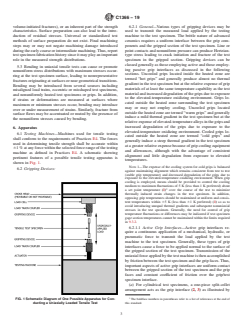
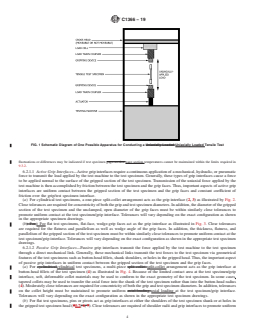
shown in Fig. 1.
NOTE 1—The expense of the cooling system for cold grips is balanced
6.2 Gripping Devices:
against maintaining alignment which remains consistent from test to test
(stable grip temperature) and decreased degradation of the grips due to
exposure to the elevated-temperature oxidizing environment. When grip
cooling is employed, means should be provided to control the cooling
medium to maximum fluctuations of 5 K (less than 1 K preferred) about
a set point temperature (1) over the course of the test to minimize
thermally induced strain changes in the test specimen. In addition,
opposing grip temperatures should be maintained at uniform and consis-
tent temperatures within 65 K (less than 61 K preferred) (1) so as to
avoid introducing unequal thermal gradients and subsequent nonuniaxial
stresses in the test specimen. Generally, the need for control of grip
temperature fluctuations or differences may be indicated if test specimen
gage section temperatures cannot be maintained within the limits required
in 9.3.2.
6.2.1.1 Active Grip Interfaces—Active grip interfaces re-
quire a continuous application of a mechanical, hydraulic, or
pneumatic force to transmit the load applied by the test
machine to the test specimen. Generally, these types of grip
interfaces cause a force to be applied normal to the surface of
the gripped section of the test specimen. Transmission of the
uniaxialforceappliedbythetestmachineisthenaccomplished
by friction between the test specimen and the grip faces. Thus,
important aspects of active grip interfaces are uniform contact
between the gripped section of the test specimen and the grip
faces and constant coefficient of friction over the grip/test
specimen interface.
(a) For cylindrical test specimens, a one-piece split-collet
arrangement acts as the grip interface (2, 3) as illustrated by
FIG. 1 Schematic Diagram of One Possible Apparatus for Con- The boldface numbers in parentheses refer to a list of references at the end of
ducting a Uniaxially Loaded Tensile Test this standard.
C1366 − 19
Fig. 2. Close tolerances are required for concentricity of both
the grip and test specimen diameters. In addition, the diameter
of the gripped section of the test specimen and the unclamped,
open diameter of the grip faces must be within similarly close
tolerances to promote uniform contact at the test specimen/grip
interface.Tolerances will vary depending on the exact configu-
ration as shown in the appropriate specimen drawings.
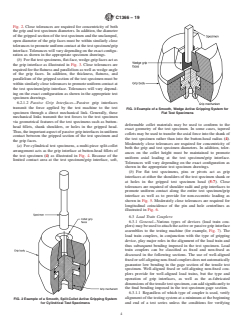
(b) For flat test specimens, flat-face, wedge-grip faces act as
the grip interface as illustrated in Fig. 3. Close tolerances are
required for the flatness and parallelism as well as wedge angle
of the grip faces. In addition, the thickness, flatness, and
parallelism of the gripped section of the test specimen must be
within similarly close tolerances to promote uniform contact at
the test specimen/grip interface. Tolerances will vary depend-
ing on the exact configuration as shown in the appropriate test
specimen drawings.
6.2.1.2 Passive Grip Interfaces—Passive grip interfaces
transmit the force applied by the test machine to the test
FIG. 3 Example of a Smooth, Wedge Active Gripping System for
specimen through a direct mechanical link. Generally, these
Flat Test Specimens
mechanical links transmit the test forces to the test specimen
via geometrical features of the test specimens such as button-
deformable collet materials may be used to conform to the
head fillets, shank shoulders, or holes in the gripped head.
exact geometry of the test specimen. In some cases, tapered
Thus,theimportantaspectofpassivegripinterfacesinuniform
collets may be used to transfer the axial force into the shank of
contact between the gripped section of the test specimen and
the test specimen rather than into the button-head radius (4).
the grip faces.
Moderately close tolerances are required for concentricity of
(a) For cylindrical test specimens, a multi-piece split-collet
both the grip and test specimen diameters. In addition, toler-
arrangement acts as the grip interface at button-head fillets of
ances on the collet height must be maintained to promote
the test specimen (4) as illustrated in Fig. 4. Because of the
uniform axial loading at the test specimen/grip interface.
limited contact area at the test specimen/grip interface, soft,
Tolerances will vary depending on the exact configuration as
shown in the appropriate test specimen drawings.
(b) For flat test specimens, pins or pivots act as grip
interfaces at either the shoulders of the test specimen shank or
at holes in the gripped test specimen head (5-7). Close
tolerances are required of shoulder radii and grip interfaces to
promote uniform contact along the entire test specimen/grip
interface as well as to provide for non-eccentric loading as
shown in Fig. 5. Moderately close tolerances are required for
longitudinal coincidence of the pin and hole centerlines as
illustrated in Fig. 6.
6.3 Load Train Couplers:
6.3.1 General—Various types of devices (load train cou-
plers) may be used to attach the active or passive grip interface
assemblies to the testing machine (for example, Fig. 7). The
load train couplers, in conjunction with the type of gripping
device, play major roles in the alignment of the load train and
thus subsequent bending imposed in the test specimen. Load
train couplers can be classified as fixed and non-fixed as
discussed in the following sections. The use of well-aligned
fixedorself-aligningnon-fixedcouplersdoesnotautomatically
guarantee low bending in the gage section of the tensile test
specimen. Well-aligned fixed or self-aligning non-fixed cou-
plers provide for well-aligned load trains, but the type and
operation of grip interfaces, as well as the as-fabricated
dimensionsofthetensiletestspecimen,canaddsignificantlyto
the final bending imposed in the test specimen gage section.
6.3.1.1 Regardless of which type of coupler is used, verify
alignment of the testing system at a minimum at the beginning
FIG. 2 Example of a Smooth, Split-Collet Active Gripping System
for Cylindrical Test Specimens and end of a test series unless the conditions for verifying
C1366 − 19
FIG. 4 Examples of Straight- and Tapered-Collet Passive Gripping Systems for Cylindrical Test Specimens (4)
C1366 − 19
FIG. 5 Examples of Shoulder-Loaded, Passive Gripping Systems for Flat Test Specimens (5, 6)
FIG. 6 Example of a Pin-Loaded, Passive Gripping System for Flat Test Specimens (6)
alignment are otherwise met. An additional verification of comprising ten test specimens of geometry B tested at a fixed
alignment is recommended, although not required, at the rate in strain control to final fracture in ambient air).
middle of the test series. Use either a dummy or actual test
NOTE 2—Tensile test specimens used for alignment verification should
specimen. Allowable bending requirements are discussed in
be equipped with a recommended eight separate longitudinal strain gages
6.5. See Practice E1012 for discussions of alignment and
to determine bending contributions from both eccentric and angular
Appendix X1 for suggested procedures specific to this test misalignment of the grip heads.Although it is possible to use a minimum
of six separate longitudinal strain gages for test specimens with circular
method.Atest series is interpreted to mean a discrete group of
cross sections, eight strain gages are recommended here for simplicity and
tests on individual test specimens conducted within a discrete
consistency in describing the technique for both circular and rectangular
period of time on a particular material configuration, test
cross sections. Dummy test specimens used for alignment verification
specimen geometry, test condition, or other uniquely definable
should have the same geometry and dimensions of the actual test
qualifier (for example, a test series composed of material A specimens, as well as similar mechanical properties (for example, elastic
C1366 − 19
FIG. 7 Examples of Hydraulic, Self-Aligning, Non-Fixed Load Train Couplers (8, 9)
modulus, hardness, etc.) as the test material to ensure similar axial and
eliminate the need to evaluate the bending in the test specimen
bending stiffness characteristics as the actual test specimen and material.
for each test, verify the operation of the couplers and their
6.3.2 Fixed Load Train Couplers—Fixed couplers may effect on alignment as discussed in 6.3.1.1.
incorporate devices that require either a one-time, pre-test
6.4 Strain Measurement—Although strain measurement
alignment adjustment of the load train which remains constant
techniques are not required in this test method, their use is
for all subsequent tests or an in-situ, pre-test alignment of the
recommended. Strain at elevated temperatures should be de-
load train which is conducted separately for each test specimen
termined by means of a suitable extensometer. Appropriate
and each test. Such devices (10, 11) usually employ angularity
strain measurements can be used to determine elastic constants
and concentricity adjusters to accommodate inherent load train
in the linear region of the stress-strain curves and can serve to
misalignments. Regardless of which method is used, perform
indicate underlying fracture mechanisms manifested as nonlin-
an alignment verification as discussed in 6.3.1.1.
ear stress-strain behavior.
6.3.3 Non-Fixed Load Train Couplers—Non-fixed couplers
6.4.1 Extensometers shall satisfy Practice E83, Class B-1
may incorporate devices that promote self-alignment of the
requirements. Calibrate extensometers periodically in accor-
load train during the movement of the crosshead or actuator.
dance with Practice E83. For extensometers mechanically
Generally, such devices rely upon freely moving linkages to
attached to or in contact with the test specimen, the attachment
eliminate applied moments as the load train components are
should be such so as to cause no mechanical damage to the test
loaded. Knife edges, universal joints, hydraulic couplers, or air
bearings are examples (5, 8-10, 12) of such devices. Examples specimensurface.Extensometercontactprobesmustbechosen
to be chemically compatible with the test material (for
of two such devices are shown in Fig. 7. Although non-fixed
load train couplers are intended to be self-aligning and thus example, alumina extensometer extensions and an SiC test
C1366 − 19
specimen are incompatible). In addition, the weight of the brate representative thermocouples from each lot of wires used
extensometer should be supported so as not to introduce for making noble (for example, Pt or Rh/Pt) metal thermo-
bending greater than that allowed in 6.5. couples. Except for relatively low temperatures of exposure,
noble-metalthermocouplesareeventuallysubjecttoerrorupon
6.5 Allowable Bending—Analytical and empirical studies
reuse,unlessthedepthofimmersionandtemperaturegradients
(4) have concluded that for negligible effects on the estimates
of the initial exposure are reproduced. Consequently, calibrate
of the strength distribution parameters (for example, Weibull
noble-metal thermocouples using representative thermo-
modulus, mˆ, and characteristic strength, σˆ ), allowable percent
θ
couples. Do not reuse degraded noble-metal thermocouples
bending as defined in Practice E1012 should not exceed five.
without proper treatment. This treatment includes clipping
These conclusions (4) assume that tensile strength fractures are
back the wire exposed to the hot zone, rewelding a thermo-
due to fracture origins in the volume of the material, all tensile
couple bead, and properly annealing the rewelded thermo-
test specimens experienced the same level of bending, and that
couplebeadandwire.Anyreuseofnoble-metalthermocouples
Weibull modulus, mˆ, was constant. Thus, the maximum allow-
(except after relatively low-temperature use) without this
able percent bending at fracture for test specimens tested under
precautionary treatment shall be accompanied by recalibration
this test method shall not exceed five.Verify the testing system
data demonstrating that calibration of the temperature reading
such that percent bending does not exceed five at a mean strain
system was not unduly affected by the conditions of exposure.
equal to either one half the anticipated strain at the onset of the
6.7.1.2 Measurement of the drift in calibration of thermo-
cumulative fracture process (for example, matrix-cracking
couples during use is difficult. When drift is a problem during
stress) or a strain of 0.0005 (500 micro strain), whichever is
tests, devise a method to check the readings of the thermo-
greater. Unless all test specimens are properly strain gaged and
couples on the test specimen during the test. For reliable
percent bending monitored until the onset of the cumulative
calibration of thermocouples after use, reproduce the tempera-
fracture process, there will be no record of percent bending at
ture gradient of the test furnace during the recalibration.
the onset of fracture for each test specimen. Therefore, verify
6.7.1.3 Thermocouples containing Pt are also subject to
the alignment of the testing system. See Practice E1012 for
degradation in the presence of silicon and silicon-containing
discussions of alignment and Appendix X1 for suggested
compounds. Platinum silicides may form, leading to several
procedures specific to this test method.
possible outcomes. One outcome is the embrittlement of the
6.6 Heating Apparatus—The apparatus for, and method of,
noble-metal thermocouple tips and their eventual degradation
heating the test specimens shall provide the temperature
and breakage. Another outcome is the degradation of the
control necessary to satisfy the requirement of 9.3.2.
silicon-containing material (for example, test specimen, fur-
6.6.1 Heating can be by indirect electrical resistance (heat-
nace heating elements, or refractory furnace materials). In all
ing elements), direct induction, indirect induction through a
cases, do not allow platinum-containing materials to contact
susceptor, radiant lamp, or direct resistance with the test
silicon-containing materials. In particular, do not allow noble-
specimen in ambient air at atmospheric pressure unless other
metalthermocouplestocontactsilicon-basedtestmaterials(for
environments are specifically applied and reported.
example, SiC or Si N ). In some cases (for example, when
3 4
NOTE 3—While direct resistance heating may be possible in some types
using SiC heating elements), it is advisable to use ceramic-
of electrically conductive ceramics, it is not recommended in this test
shielded noble-metal thermocouples to avoid the reaction of
method since the potential exists for uneven heating or arcing, or both, at
the Pt-alloy thermocouples with the SiO gas generated by the
fracture.
volatilization of the SiO protective layers of SiC heating
6.7 Temperature-Measuring Apparatus—The method of
elements.
temperature measurement shall be sufficiently sensitive and
6.7.1.4 Calibrate temperature-measuring, controlling, and
reliabletoensurethatthetemperatureofthespecimeniswithin
recording instruments versus a secondary standard, such as
the limits specified in 9.3.2.
precision potentiometer, optical pyrometer, or black-body thy-
6.7.1 For test temperatures less than 2000 K, make primary
ristor. Check lead-wire error with the lead wires in place as
temperature measurements with noble-metal thermocouples in
they normally are used.
conjunction with potentiometers, millivoltmeters, or electronic
6.7.2 For test temperatures greater than 2000 K, less-
temperature controllers or readout units, or both. Such mea-
common temperature measurement devices such as thermo-
surements are subject to two types of error as discussed in
couples of elevated-temperature, non-noble-metal alloys (for
MNL12 (12). Firstly, thermocouple calibration and instrument
example, W-Re) or optical pyrometry may be used. Since
measuring errors initially produce uncertainty as to the exact
widely recognized standards do not exist for these less-
temperature. Secondly, both thermocouples and measuring
common devices, report the type of measurement device, its
instruments may be subject to variations over time. Common
method of calibration, and its accuracy and precision.
errors encountered in the use of thermocouples to measure
temperatures include: calibration error, drift in calibration due 6.8 DataAcquisition—Ataminimum,obtainanautographic
to contamination or deterioration with use, lead-wire error, record of applied force versus time. Either analog chart
error arising from method of attachment to the test specimen, recorders or digital data acquisition systems can be used for
direct radiation of heat to the bead, heat conduction along thispurpose,althoughadigitalrecordisrecommendedforease
thermocouple wires, etc. of later data analysis. Ideally, an analog chart recorder or
6.7.1.1 Measure temperature with thermocouples of known plotter should be used in conjunction with the digital data
calibration (calibrated according to Test Method E220). Cali- acquisitionsystemtoprovideanimmediaterecordofthetestas
C1366 − 19
a supplement to the digital record. Recording devices shall be conductedtoensurethatstressconcentrationswhichcouldlead
accurate to within 61 % of the selected range for the testing to undesired fractures outside the gage sections do not exist.
system including readout unit, as specified in Practices E4, and Additionally, the success of an elevated-temperature tensile
should have a minimum data acquisition rate of 10 Hz, with a test will depend on the type of heating system, extent of test
response of 50 Hz deemed more than sufficient. specimen heating, and test specimen geometry since these
6.8.1 Where strain or elongation of the gage section is also factors are all interrelated. For example, thermal gradients may
measured, these values should be recorded either similarly to introduce additional stress gradients in test specimens which
the force or as independent variables of force. Crosshead may already exhibit stress gradients at ambient temperatures
displacement of the test machine may also be recorded but due to geometric transitions. Therefore, untried test configura-
should not be used to define displacement or strain in the gage tions should be simultaneously analyzed for both loading-
section. induced stress gradients and thermally induced temperature
6.8.2 At a minimum, record temperature as single points at gradients to ascertain any adverse interactions.
the initiation and completion of the actual test. However,
NOTE 4—An example of such an analysis is shown in Fig. 9 for a
temperature can also be recorded similarly to force and strain,
monolithic silicon nitride cylindrical button-head tensile test specimen
except the record can begin at the start of the heating of the
with water-cooled grip heads and a resistance-heated furnace heating only
furnace (including ramp-up to test temperature) and ending at
the center 50 mm of the test specimen. This example is a finite element
analysis of a specific case for a specific material and test specimen test
the completion of the test.
configuration. Thus, Fig. 9 is intended only as an illustrative example and
6.9 Dimension-Measuring Devices—Micrometers and other
should not be construed as being representative of all cases with similar
devices used for measuring linear dimensions shall be accurate test configurations.
and precise to at least one half the smallest unit to which the
8.1.2 Cylindrical Tensile Test Specimens—Cylindrical test
individual dimension is measured. For the purposes of this test
specimens are generally fabricated from rods of material and
method, measure cross-sectional dimensions to within
offer the potential of testing the largest volume of the various
0.02 mm using dimension-measuring devices with accuracies
tensile test specimens. In addition, the size of the test specimen
of 0.01 mm.
lends itself to more readily evaluating the mechanical behavior
of a material for engineering purposes. Disadvantages include
7. Hazards
the relatively large amount of material required for the starting
7.1 Precaution—Duringtheconductofthistestmethod,the
billet, the large amount of material which must be removed
possibility of flying fragments of broken test material is quite
during test specimen fabrication, and the need to fabricate the
high.Thebrittlenatureofadvancedceramicsandthereleaseof
test specimen cylindrically, usually requiring numerically con-
strain energy contribute to the potential release of uncontrolled
trolled grinding machines, all of which may add substantially
fragments upon fracture. Means for containment and retention
to the total cost per test specimen. Gripped ends include
of these fragments for safety, as well as later fractographic
various types of button-heads (4, 8-11, 13) as shown in Figs.
reconstruction and analysis, is highly recommended.
X2.1-X2.3. In addition, straight-shank geometries have been
successfully used (2, 3) as shown in Figs. X2.4 and X2.5.
8. Test Specimen
Important tolerances for the cylindrical tensile test specimens
include concentricity and cylindricity that will vary depending
8.1 Test Specimen Geometry:
on the exact configuration as shown in the appropriate test
8.1.1 General—The geometry of a tensile test specimen is
specimen drawings.
dependent on the ultimate use of the tensile strength data. For
example, if the tensile strength of an as-fabricated component 8.1.3 Flat Tensile Test Specimens—Flat test specimens are
is required, the dimensions of the resulting tensile test speci- generally fabricated from plates or blocks of material and offer
men may reflect the thickness, width, and length restrictions of the potential for ease of material procurement, ease of
thecomponent.Ifitisdesiredtoevaluatetheeffectsofinherent fabrication, and subsequent lower cost per test specimen.
flaw distributions for a particular material manufactured from Disadvantages include the relatively small volume of material
a particular processing route, then the size of the test specimen tested and sensitivity of the test specimen to small dimensional
and resulting gage section will reflect the desired volume to be tolerances or disturbances in the load train. Gripped ends
sampled. In addition, grip interfaces and load train couplers as include various types of shoulder-loaded shanks (5, 6) as
discussed in Section 6 will influence the final design of the test shown in Figs. X2.6 and X2.7. In addition, pin-loaded gripped
specimen geometry. ends (7) have also been used successfully as shown in Fig.
8.1.1.1 Fig. 8 illustrates a range of tensile test specimen X2.8. Gage sections of flat tensile test specimens for strength
geometries which have been applied to testing advanced measurements are sometimes cylindrical. While this type of
ceramics. Fig. 8 provides only a sampling of possible tensile gage section adds to the difficulty of fabrication and therefore
test specimens for ceramics and by no means purports to cost of the flat tensile test specimen, it does not avoid the
represent all possible configurations past or present. The problem of fractures initiating at corners of non-cylindrical
following sections discuss the more common, and thus proven, gage sections. Corner fractures may be initiated by stress
of these test specimen geometries, although any geometry is concentrations due to the elastic constraint of the corners but
acceptableifitmeetsthegrippingandbendingrequirementsof are more generally initiated by damage (chipping, etc.) which
this test method. If deviations from the recommended geom- can be treated by chamfering the corners similar to that
etries are made, a stress analysis of the test specimen should be recommended for rectangular cross section bars used for
C1366 − 19
NOTE 1—All dimensions are in millemetres.
Acronyms: ORNAL = Oak Ridge National Laboratory; NGK = NGK Spark Plug Co.; SoRI = Southern Research Institute; ASEA = ASEA-Ceram;
NIST = National Institute of Standards and Technology; GIRI = Government Industrial Research Institute
FIG. 8 Examples of Variety of Tensile Test Specimens Used for Advanced Ceramics
flexure tests (seeTest MethodC1161). Important tolerances for as-cast, sintered, or injection-molded parts. No additional
the flat tensile test specimens include parallelism of faces and
machining specifications are relevant.As-processed test speci-
longitudinal alignment of load lines (pinhole centers or shoul-
mens might possess rough surface textures and non-parallel
der loading points), all of which will vary depending on the
edges and, as such, may cause excessive misalignment or be
exact configuration as shown in the appropriate test specimen
prone to non-gage section fractures, or both.
drawings.
8.2.3 Application-Matched Machining—The tensile test
8.2 Test Specimen Preparation:
specimen should have the same surface/edge preparation as
8.2.1 Dependingupontheintendedapplicationofthetensile
that given to the component. Unless the process is proprietary,
strength data, use one of the following test specimen prepara-
the report should be specific about the stages of material
tion procedures. Regardless of the preparation procedure used,
removal, diamond grits, diamond-grit bonding, amount of
report sufficient details regarding the procedure to allow
material removed per pass, and type of coolant used.
replication.
8.2.4 Customary Practices—Ininstanceswhereacustomary
8.2.2 As-Fabricated—The tensile test specimen should
machining procedure has been developed that is completely
stimulate the surface/edge conditions and processing route of
satisfactory for a class of materials (that is, it induces no
an application where no machining is used; for example,
C1366 − 19
the route of material removal due to the generation of subsur-
face damage during the material removal process.
8.2.5.6 Geometric features such as holes, button-head
radiuses, or transition radiuses require just as stringent atten-
tion to fabrication detail as that paid to the gage section.
Therefore, the minimum requirements outlined here should be
applied to these geometric features as well as to the gage
section.
8.2.6 Cylindrical Tensile Test Specimen Procedure—
Because of the axial symmetry of the button-head tensile test
specimen, fabrication of the test specimens is generally con-
ductedonalathe-typeapparatus.Inmanyinstances,thebulkof
the material is removed in a circumferential grinding operation
with a final longitudinal grinding operation performed in the
gage section to ensure that any residual grinding marks are
paralleltotheappliedstress.Beyondthoseguidelinesprovided
NOTE 1—The shaded area at the bottom of the graph represents a
section view of one fourth of the tensile specimen cross section from the here, Ref. (4) provides more specific details of recommended
button-head to the center of the gage section.
fabrication methods for cylindrical tensile test specimens.
8.2.6.1 Generally, computer numerical control (CNC) fab-
FIG. 9 Example of Superposed Stress and Temperature Results
rication methods are necessary to obtain consistent test speci-
from Finite Element Analyses of a Monolithic Silicon Nitride,
mens with the proper dimensions within the required toler-
Button-Head Tensile Test Specimen with Water-Cooled Grips and
Resistance-Heated Furnace Heating Only the Center 50 mm of ances. A necessary condition for this consistency is the
the Test Specimen
complete fabrication of the test specimen without removing it
from the grinding apparatus, thereby avoiding the introduction
of unacceptable tolerances into the finished test specimen.
8.2.6.2 Formed, resinoid-bonded, diamond-impregnated
unwanted surface/subsurface damage or residual stresses), this
wheels (minimum 320 grit in a resinoid bond) are necessary to
procedure should be used.
both fabricate critical shapes (for example, button-head radius)
8.2.5 Standard Procedure—In instances where 8.2.2 – 8.2.4
and to minimize grinding vibrations and subsurface damage in
are not appropriate, 8.2.5 should apply. This procedure should
the test material. The formed, resin-bonded wheels require
serve as minimum requirements and a more stringent proce-
periodic dressing and shaping (truing), which can be done
dure may be necessary.
dynamicallywithinthetestmachinetomaintainthecuttingand
8.2.5.1 All grinding or cutting should be done with ample
dimensional integrity.
supply of appropriate filtered coolant to keep the workpiece
8.2.6.3 The most serious concern is not necessarily the
and grinding wheel constantly flooded and particles flushed.
surface finish (on the order of R = 0.2 to 0.4 µm) which is a
a
Grinding should be done in at least two stages, ranging from
result of the final machining steps. Instead, the subsurface
coarse to fine rate of material removal.All cutting can be done
damage is critically important, although this damage is not
in one stage appropriate for the depth of cut. The direction of
readily observed or measured and therefore must be inferred as
the tangential velocity (due to angular velocity) of the grinding
the result of the grinding history. More details of this aspect
wheel at the point of contact with the test specimen surface
have been discussed elsewhere (4). In all cases, the final
shouldbeprincipallyparalleltothelongitudinalaxisofthetest
grinding operation (“spark out”) performed in the gage section
specimen.
is to be along the longitudinal axis of the test specimen to
8.2.5.2 Material removal rate should not exceed 0.03 mm
ensure that any residual grinding marks are parallel to the
per pass to the last 0.06 mm. Final finishing should be
applied stress.
performed with diamond tools that have between 320 and 600
8.3 Handling Precaution—Extreme care should be exer-
grit. No less than 0.06 mm per face should be removed during
cised in storage and handling of finished test specimens to
the final finishing phase, and at a rate not more than 0.002 mm
avoid the introduction of random and severe flaws (for
perpass.Removeequalstockfromeachfacewhereapplicable.
example, test specimens impact or scratc
...
This document is not an ASTM standard and is intended only to provide the user of an ASTM standard an indication of what changes have been made to the previous version. Because
it may not be technically possible to adequately depict all changes accurately, ASTM recommends that users consult prior editions as appropriate. In all cases only the current version
of the standard as published by ASTM is to be considered the official document.
Designation: C1366 − 04 (Reapproved 2013) C1366 − 19
Standard Test Method for
Tensile Strength of Monolithic Advanced Ceramics at
Elevated Temperatures
This standard is issued under the fixed designation C1366; the number immediately following the designation indicates the year of
original adoption or, in the case of revision, the year of last revision. A number in parentheses indicates the year of last reapproval. A
superscript epsilon (´) indicates an editorial change since the last revision or reapproval.
1. Scope
1.1 This test method covers the determination of tensile strength under uniaxial loading of monolithic advanced ceramics at
elevated temperatures. This test method addresses, but is not restricted to, various suggested test specimen geometries as listed in
the appendix. In addition, test specimen fabrication methods, testing modes (force, displacement, or strain control), testing rates
(force rate, stress rate, displacement rate, or strain rate), allowable bending, and data collection and reporting procedures are
addressed. Tensile strength as used in this test method refers to the tensile strength obtained under uniaxial loading.
1.2 This test method applies primarily to advanced ceramics which macroscopically exhibit isotropic, homogeneous, continuous
behavior. While this test method applies primarily to monolithic advanced ceramics, certain whisker,whisker- or particle-reinforced
composite ceramics as well as certain discontinuous fiber-reinforced composite ceramics may also meet these macroscopic
behavior assumptions. Generally, continuous fiber ceramic composites (CFCCs) do not macroscopically exhibit isotropic,
homogeneous, continuous behavior and application of this test method to these materials is not recommended.
1.3 The values stated in SI units are to be regarded as the standard and are in accordance with IEEE/ASTM SI 10.
1.4 This standard does not purport to address all of the safety concerns, if any, associated with its use. It is the responsibility
of the user of this standard to establish appropriate safety safety, health, and healthenvironmental practices and determine the
applicability of regulatory limitations prior to use. Refer to Section 7 for specific precautions.
1.5 This international standard was developed in accordance with internationally recognized principles on standardization
established in the Decision on Principles for the Development of International Standards, Guides and Recommendations issued
by the World Trade Organization Technical Barriers to Trade (TBT) Committee.
2. Referenced Documents
2.1 ASTM Standards:
C1145 Terminology of Advanced Ceramics
C1161 Test Method for Flexural Strength of Advanced Ceramics at Ambient Temperature
C1239 Practice for Reporting Uniaxial Strength Data and Estimating Weibull Distribution Parameters for Advanced Ceramics
C1322 Practice for Fractography and Characterization of Fracture Origins in Advanced Ceramics
D3379 Test Method for Tensile Strength and Young’s Modulus for High-Modulus Single-Filament Materials
E4 Practices for Force Verification of Testing Machines
E6 Terminology Relating to Methods of Mechanical Testing
E21 Test Methods for Elevated Temperature Tension Tests of Metallic Materials
E83 Practice for Verification and Classification of Extensometer Systems
E220 Test Method for Calibration of Thermocouples By Comparison Techniques
E337 Test Method for Measuring Humidity with a Psychrometer (the Measurement of Wet- and Dry-Bulb Temperatures)
E380 Practice for Use of the International System of Units (SI) (the Modernized Metric System) (Withdrawn 1997)
E1012 Practice for Verification of Testing Frame and Specimen Alignment Under Tensile and Compressive Axial Force
Application
This test method is under the jurisdiction of ASTM Committee C28 on Advanced Ceramics and is the direct responsibility of Subcommittee C28.01 on Mechanical
Properties and Performance.
Current edition approved Aug. 1, 2013Aug. 1, 2019. Published September 2013September 2019. Originally approved in 1997. Last previous edition approved in 20092013
as C1366 – 04 (2009).(2013). DOI: 10.1520/C1366-04R13.10.1520/C1366-19.
For referenced ASTM standards, visit the ASTM website, www.astm.org, or contact ASTM Customer Service at service@astm.org. For Annual Book of ASTM Standards
volume information, refer to the standard’s Document Summary page on the ASTM website.
Copyright © ASTM International, 100 Barr Harbor Drive, PO Box C700, West Conshohocken, PA 19428-2959. United States
C1366 − 19
IEEE/ASTM SI 10 Standard for Use of the International System of Units (SI) (The Modern Metric System)American National
Standard for Metric Practice
3. Terminology
3.1 Definitions:
3.1.1 Definitions of terms relating to tensile testing and advanced ceramics as they appear in Terminology E6 and Terminology
C1145, respectively, apply to the terms used in this test method. Pertinent definitions are shown in the following with the
appropriate source given in parenthesis.parentheses. Additional terms used in conjunction with this test method are defined in the
following.
3.1.2 advanced ceramic, n—a highly engineered, high performance high-performance, predominately non-metallic, inorganic,
ceramic material having specific functional attributes. (See Terminology C1145.)
–1
3.1.3 axial strain [LL ], n—the average longitudinal strains measured at the surface on opposite sides of the longitudinal axis
of symmetry of the specimen by two strain-sensing devices located at the mid length of the reduced section. (See Practice E1012.)
– 1–1
3.1.4 bending strain [LL ], n—the difference between the strain at the surface and the axial strain. In general, the bending
strain varies from point to point around and along the reduced section of the specimen. (See Practice E1012.)
3.1.5 breaking load [F], n—the load at which fracture occurs. (See Terminology E6.)
3.1.6 fractography, n—the means and methods for characterizing a fractured specimen or component. (See Terminology
C1145.)
3.1.7 fracture origin, n—the source from which brittle fracture commences. (See Terminology C1145).
3.1.8 percent binding,bending, n—the bending strain times 100 divided by the axial strain. (See Practice E1012.)
3.1.9 slow crack growth, n—sub critical sub-critical crack growth (extension) that may result from, but is not restricted to, such
mechanisms as environmentally-assisted environmentally assisted stress corrosion or diffusive crack growth.
3.1.10 tensile strength, S [FL ], n—the maximum tensile stress which a material is capable of sustaining. Tensile strength is
u
calculated from the maximum load during a tension test carried to rupture and the original cross-sectional area of the specimen.
(See Terminology E6.)
4. Significance and Use
4.1 This test method may be used for material development, material comparison, quality assurance, characterization, reliability
assessment, and design data generation.
4.2 High strength, High-strength, monolithic advanced ceramic materials are generally characterized by small grain sizes (< 50
(<50 μm) and bulk densities near the theoretical density. These materials are candidates for load-bearing structural applications
requiring high degrees of wear and corrosion resistance and elevated-temperature strength. Although flexural test methods are
commonly used to evaluate strength of advanced ceramics, the non uniform nonuniform stress distribution of the flexure specimen
limits the volume of material subjected to the maximum applied stress at fracture. Uniaxially-loaded Uniaxially loaded tensile
strength tests provide information on strength-limiting flaws from a greater volume of uniformly stressed material.
4.3 Because of the probabilistic strength distributions of brittle materials such as advanced ceramics, a sufficient number of test
specimens at each testing condition is required for statistical analysis and eventual design with guidelines for sufficient numbers
provided in this test method. Size-scaling effects as discussed in practicePractice C1239 will affect the strength values. Therefore,
strengths obtained using different recommended tensile test specimen geometries with different volumes or surface areas of
material in the gage sections will be different due to these size differences. Resulting strength values can, in principle, be scaled
to an effective volume or effective surface area of unity as discussed in Practice C1239.
4.4 Tensile tests provide information on the strength and deformation of materials under uniaxial stresses. Uniform stress states
are required to effectively evaluate any non-linearnonlinear stress-strain behavior which may develop as the result of testing mode,
testing rate, processing or alloying effects, environmental influences, or elevated temperatures. These effects may be consequences
of stress corrosion or sub critical sub-critical (slow) crack growth which can be minimized by testing at appropriately rapid rates
as outlined in this test method.
4.5 The results of tensile tests of specimens fabricated to standardized dimensions from a particular material or selected portions
of a part, or both, may not totally represent the strength and deformation properties of the entire,entire full-size end product or its
in-service behavior in different environments.
4.6 For quality control purposes, results derived from standardized tensile test specimens can be considered to be indicative of
the response of the material from which they were taken for particular primary processing conditions and post-processing heat
treatments.
C1366 − 19
4.7 The tensile strength of a ceramic material is dependent on both its inherent resistance to fracture and the presence of flaws.
Analysis of fracture surfaces and fractography as described in Practice C1322 and MIL-HDBK-790, though beyond the scope of
this test method, are recommended for all purposes, especially for design data.
5. Interferences
5.1 Test environment (vacuum, inert gas, ambient air, etc.)etc.), including moisture content for(for example relative
humidity)humidity), may have an influence on the measured tensile strength. In particular, the behavior of materials susceptible
to slow crack growth fracture will be strongly influenced by test environment, testing rate, and elevated temperatures. Testing to
evaluate the maximum strength potential of a material should be conducted in inert environments or at sufficiently rapid testing
rates, or both, to minimize slow crack growth effects. Conversely, testing can be conducted in environments and testing modes and
rates representative of service conditions to evaluate material performance under use conditions. When testing is conducted in
uncontrolled ambient air with the intent of evaluating maximum strength potential, monitor and report relative humidity and
ambient temperature. Testing at humidity levels >65 % relative humidity (RH) is not recommended.
5.2 Surface preparation of test specimens can introduce fabrication flaws that may have pronounced effects on tensile strength.
Machining damage introduced during test specimen preparation can be either a random interfering factor in the determination of
ultimate strength of pristine material (that is increaseis, increased frequency of surface initiated surface-initiated fractures
compared to volume initiated volume-initiated fractures), or an inherent part of the strength characteristics. Surface preparation can
also lead to the introduction of residual stresses. Universal or standardized test methods of surface preparation do not exist. Final
machining steps may,may or may not negate machining damage introduced during the early coarse or intermediate machining.
Thus, report test specimen fabrication history since it may play an important role in the measured strength distributions.
5.3 Bending in uniaxial tensile tests can cause or promote non uniform nonuniform stress distributions with maximum stresses
occurring at the test specimen surface, leading to non representative nonrepresentative fractures originating at surfaces or near
geometrical transitions. Bending may be introduced from several sources including misaligned load trains, eccentric or
mis-shapedmisshaped test specimens, and non-uniformlynonuniformly heated test specimens or grips. In addition, if strains or
deformations are measured at surfaces where maximum or minimum stresses occur, bending may introduce over or under
measurement of strains. Similarly, fracture from surface flaws may be accentuated or muted by the presence of the non uniform
nonuniform stresses caused by bending.
6. Apparatus
6.1 Testing Machines—Machines used for tensile testing shall conform to the requirements of PracticePractices E4. The forces
used in determining tensile strength shall be accurate within 61 % at any force within the selected force range of the testing
machine as defined in PracticePractices E4. A schematic showing pertinent features of a possible tensile testing apparatus is shown
in Fig. 1.
6.2 Gripping Devices:
6.2.1 General—Various types of gripping devices may be used to transmit the measured load applied by the testing machine
to the test specimen. The brittle nature of advanced ceramics requires a uniform interface between the grip components and the
gripped section of the test specimen. Line or point contacts and non uniform nonuniform pressure can produce Hertzian-type stress
leading to crack initiation and fracture of the test specimen in the gripped section. Gripping devices can be classed generally as
those employing active and those employing passive grip interfaces as discussed in the following sections. Uncooled grips located
inside the heated zone are termed “hot grips” and generally produce almost no thermal gradient in the test specimen but at the
relative expense of grip materials of at least the same temperature capability as the test material and increased degradation of the
grips due to exposure to the elevated-temperature oxidizing environment. Grips located outside the heated zone surrounding the
test specimen may or may not employ cooling. Uncooled grips located outside the heated zone are termed“ warmtermed “warm
grips” and generally induce a mild thermal gradient in the test specimen but at the relative expense of elevated-temperature alloys
in the grips and increased degradation of the grips due to exposure to the elevated-temperature oxidizing environment. Cooled grips
located outside the heated zone are termed“ coldtermed “cold grips” and generally induce a steep thermal gradient in the test
specimen at a greater relative expense because of grip cooling equipment and allowances, although with the advantage of
consistent alignment and little degradation from exposure to elevated temperatures.
NOTE 1—The expense of the cooling system for cold grips is balanced against maintaining alignment which remains consistent from test to test (stable
grip temperature) and decreased degradation of the grips due to exposure to the elevated-temperature oxidizing environment. When grip cooling is
employed, means should be provided to control the cooling medium to maximum fluctuations of 5 K (less than 1 K preferred) about a setpoint set point
temperature (1) over the course of the test to minimize thermally-induced thermally induced strain changes in the test specimen. In addition, opposing
grip temperatures should be maintained at uniform and consistent temperatures within 65 K (less than 61 K preferred) (1) so as to avoid introducing
unequal thermal gradients and subsequent non uniaxial nonuniaxial stresses in the test specimen. Generally, the need for control of grip temperature
The last approved version of this historical standard is referenced on www.astm.org.
The boldface numbers in parentheses refer to a list of references at the end of this standard.
C1366 − 19
FIG. 1 Schematic Diagram of One Possible Apparatus for Conducting a Uniaxially-Loaded Uniaxially Loaded Tensile Test
fluctuations or differences may be indicated if test specimen gage-section gage section temperatures cannot be maintained within the limits required in
9.3.2.
6.2.1.1 Active Grip Interfaces—Active grip interfaces require a continuous application of a mechanical, hydraulic, or pneumatic
force to transmit the load applied by the test machine to the test specimen. Generally, these types of grip interfaces cause a force
to be applied normal to the surface of the gripped section of the test specimen. Transmission of the uniaxial force applied by the
test machine is then accomplished by friction between the test specimen and the grip faces. Thus, important aspects of active grip
interfaces are uniform contact between the gripped section of the test specimen and the grip faces and constant coefficient of
friction over the grip/test specimen interface.
(a) For cylindrical test specimens, a one-piece split-collet arrangement acts as the grip interface (2, 3) as illustrated by Fig. 2.
Close tolerances are required for concentricity of both the grip and test specimen diameters. In addition, the diameter of the gripped
section of the test specimen and the unclamped, open diameter of the grip faces must be within similarly close tolerances to
promote uniform contact at the test specimen/grip interface. Tolerances will vary depending on the exact configuration as shown
in the appropriate specimen drawings.
(b) For,) For flat test specimens, flat-face, wedge-grip faces act as the grip interface as illustrated in Fig. 3. Close tolerances
are required for the flatness and parallelism as well as wedge angle of the grip faces. In addition, the thickness, flatness, and
parallelism of the gripped section of the test specimen must be within similarly close tolerances to promote uniform contact at the
test specimen/grip interface. Tolerances will vary depending on the exact configuration as shown in the appropriate test specimen
drawings.
6.2.1.2 Passive Grip Interfaces—Passive grip interfaces transmit the force applied by the test machine to the test specimen
through a direct mechanical link. Generally, these mechanical links transmit the test forces to the test specimen via geometrical
features of the test specimens such as button-head fillets, shank shoulders, or holes in the gripped head. Thus, the important aspect
of passive grip interfaces in uniform contact between the gripped section of the test specimen and the grip faces.
(a) For cyclindricalcylindrical test specimens, a multi-piece split collet split-collet arrangement acts as the grip interface at
button-head fillets of the test specimen (4) as illustrated in Fig. 4. Because of the limited contact area at the test specimen/grip
interface, soft, deformable collet materials may be used to conform to the exact geometry of the test specimen. In some cases,
tapered collets may be used to transfer the axial force into the shank of the test specimen rather than into the button-head radius
(4). Moderately close tolerances are required for concentricity of both the grip and test specimen diameters. In addition, tolerances
on the collet height must be maintained to promote uniform axial-loading axial loading at the test specimen/grip interface.
Tolerances will vary depending on the exact configuration as shown in the appropriate test specimen drawings.
(b) For flat test specimens, pins or pivots act as grip interfaces at either the shoulders of the test specimen shank or at holes in
the gripped test specimen head (55-7, 6, 7). Close tolerances are required of shoulder radii and grip interfaces to promote uniform
C1366 − 19
FIG. 2 Example of a Smooth, Split Collet Split-Collet Active Gripping System for Cylindrical Test Specimens
FIG. 3 Example of a Smooth, Wedge Active Gripping System for Flat Test Specimens
contact along the entire test specimen/grip interface as well as to provide for non eccentric non-eccentric loading as shown in Fig.
5. Moderately close tolerances are required for longitudinal coincidence of the pin and hole centerlines as illustrated in Fig. 6.
6.3 Load Train Couplers:
6.3.1 General—Various types of devices (load-train (load train couplers) may be used to attach the active or passive grip
interface assemblies to the testing machine (for example, Fig. 7). The load-train couplers load train couplers, in conjunction with
the type of gripping device, play major roles in the alignment of the load train and thus subsequent bending imposed in the test
specimen. Load train couplers can be classified,classified as fixed and non fixed non-fixed as discussed in the following sections.
The use of well-aligned fixed or self-aligning non fixed non-fixed couplers does not automatically guarantee low bending in the
gage section of the tensile test specimen. Well-aligned fixed or self-aligning non fixed non-fixed couplers provide for well-aligned
C1366 − 19
FIG. 4 Examples of Straight- and Tapered-Collet Passive Gripping Systems for Cylindrical Test Specimens (4)
C1366 − 19
FIG. 5 Examples of Shoulder-Loaded, Passive Gripping Systems for Flat Test Specimens (5, 6)
FIG. 6 Example of a Pin-Loaded, Passive Gripping systemSystem for Flat Test Specimens (6)
load trains, but the type and operation of grip interfaces, as well as the as-fabricated dimensions of the tensile test specimen, can
add significantly to the final bending imposed in the test specimen gage section.
6.3.1.1 Regardless of which type of coupler is used, verify alignment of the testing system at a minimum at the beginning and
end of a test series unless the conditions for verifying alignment are otherwise met. An additional verification of alignment is
recommended, although not required, at the middle of the test series. Use either a dummy or actual test specimen. Allowable
bending requirements are discussed in 6.5. See Practice E1012 for discussions of alignment and Appendix Appendix X1 for
suggested procedures specific to this test method. A test series is interpreted to mean a discrete group of tests on individual test
specimens conducted within a discrete period of time on a particular material configuration, test specimen geometry, test condition,
or other uniquely definable qualifier (for example, a test series composed of material A comprising ten test specimens of geometry
B tested at a fixed rate in strain control to final fracture in ambient air).
NOTE 2—Tensile test specimens used for alignment verification should be equipped with a recommended eight separate longitudinal strain gages to
C1366 − 19
FIG. 7 Examples of Hydraulic, Self-Aligning, Non-Fixed Load Train Couplers (8, 9)
determine bending contributions from both eccentric and angular misalignment of the grip heads. Although it is possible to use a minimum of six separate
longitudinal strain gages for test specimens with circular cross sections, eight strain gages are recommended here for simplicity and consistency in
describing the technique for both circular and rectangular cross sections. Dummy test specimens used for alignment verification,verification should have
the same geometry and dimensions of the actual test specimens, as well as similar mechanical properties (that is(for example, elastic modulus, hardness,
etc.) as the test material to ensure similar axial and bending stiffness characteristics as the actual test specimen and material.
6.3.2 Fixed Load-Train Load Train Couplers—Fixed couplers may incorporate devices that require either a one-time, pre-test
alignment adjustment of the load train which remains constant for all subsequent tests or an in-situ, pre-test alignment of the load
train which is conducted separately for each test specimen and each test. Such devices (10, 11) usually employ angularity and
concentricity adjusters to accommodate inherent load-train load train misalignments. Regardless of which method is used, perform
an alignment verification as discussed in 6.3.1.1.
6.3.3 Non Fixed Load-TrainNon-Fixed Load Train Couplers—Non fixed Non-fixed couplers may incorporate devices that
promote self-alignment of the load train during the movement of the crosshead or actuator. Generally, such devices rely upon freely
moving linkages to eliminate applied moments as the load-train load train components are loaded. Knife edges, universal joints,
hydraulic couplers, or air bearings are examples (5, 108-10, 12, 8, 9) of such devices. Examples of two such devices are shown
in Fig. 7. Although non fixed load-trainnon-fixed load train couplers are intended to be self-aligning and thus eliminate the need
to evaluate the bending in the test specimen for each test, verify the operation of the couplers and their effect on alignment as
discussed in 6.3.1.1.
6.4 Strain Measurement—Although strain measurement techniques are not required in this test method, their use is
recommended. Strain at elevated temperatures should be determined by means of a suitable extensometer. Appropriate strain
measurements can be used to determine elastic constants in the linear region of the stress strain stress-strain curves and can serve
to indicate underlying fracture mechanisms manifested as nonlinear stress-strain behavior.
C1366 − 19
6.4.1 Extensometers shall satisfy Test Method Practice E83, Class B-1 requirements. Calibrate extensometers periodically in
accordance with Test Method Practice E83. For extensometers mechanically attached to or in contact with the test specimen, the
attachment should be such so as to cause no mechanical damage to the test specimen surface. Extensometer contact probes must
be chosen to be chemically compatible with the test material (for example, alumina extensometer extensions and an SiC test
specimen are incompatible). In addition, the weight of the extensometer should be supported so as not to introduce bending greater
than that allowed in 6.5.
6.5 Allowable Bending—Analytical and empirical studies (4) have concluded that for negligible effects on the estimates of the
strength distribution parameters (for example, Weibull modulus, mˆ, and characteristic strength, σˆ ), allowable percent bending
θ
as defined in Practice E1012 should not exceed five. These conclusions (4) assume that tensile strength fractures are due to fracture
origins in the volume of the material, all tensile test specimens experienced forthe same level of bending, and that Weibull modulus,
mˆ, was constant. Thus, the maximum allowable percent bending at fracture for test specimens tested under this test method shall
not exceed five. Verify the testing system such that percent bending does not exceed five at a mean strain equal to either one half
the anticipated strain at the onset of the cumulative fracture process (for example: matrix cracking example, matrix-cracking stress)
or a strain of 0.0005 (500 micro strain)strain), whichever is greater. Unless all test specimens are properly strain gaged and percent
bending monitored until the onset of the cumulative fracture process, there will be no record of percent bending at the onset of
fracture for each test specimen. Therefore, verify the alignment of the testing system. See Practice E1012 for discussions of
alignment and Appendix Appendix X1 for suggested procedures specific to this test method.
6.6 Heating Apparatus—The apparatus for, and method of, heating the test specimens shall provide the temperature control
necessary to satisfy the requirement of 9.3.2.
6.6.1 Heating can be by indirect electrical resistance (heating elements), direct induction, indirect induction through a susceptor,
radiant lamp, or direct resistance with the test specimen in ambient air at atmospheric pressure unless other environments are
specifically applied and reported.
NOTE 3—While direct resistance heating may be possible in some types of electrically-conductive electrically conductive ceramics, it is not
recommended in this test method since the potential exists for uneven heating or arcing, or both, at fracture.
6.7 Temperature–MeasuringTemperature-Measuring Apparatus—The method of temperature measurement shall be sufficiently
sensitive and reliable to ensure that the temperature of the specimen is within the limits specified in 9.3.2.
6.7.1 For test temperatures less than 2000 K, make primary temperature measurements with noble-metal thermocouples in
conjunction with potentiometers, millivoltmeters, or electronic temperature controllers or readout units, or both. Such
measurements are subject to two types of error as discussed in MNL 12 (12). Firstly, thermocouple calibration and instrument
measuring errors initially produce uncertainty as to the exact temperature. Secondly, both thermocouples and measuring
instruments may be subject to variations over time. Common errors encountered in the use of thermocouples to measure
temperatures include: calibration error, drift in calibration due to contamination or deterioration with use, lead-wire error, error
arising from method of attachment to the test specimen, direct radiation of heat to the bead, heat-conduction heat conduction along
thermocouple wires, etc.
6.7.1.1 Measure temperature with thermocouples of known calibration (calibrated according to Test Method E220). Calibrate
representative thermocouples from each lot of wires used for making noble (for example, Pt or Rh/Pt) metal thermocouples. Except
for relatively low temperatures of exposure, noble-metal thermocouples are eventually subject to error upon reuse, unless the depth
of immersion and temperature gradients of the initial exposure are reproduced. Consequently, calibrate noble-metal thermocouples
using representative thermocouples. Do not reuse degraded noble-metal thermocouples without proper treatment. This treatment
includes clipping back the wire exposed to the hot zone, rewelding a thermocouple bead, and properly annealing the rewelded
thermocouple bead and wire. Any reuse of noble-metal thermocouples (except after relatively low-temperature use) without this
precautionary treatment shall be accompanied by recalibration data demonstrating that calibration of the temperature reading
system was not unduly affected by the conditions of exposure.
6.7.1.2 Measurement of the drift in calibration of thermocouples during use is difficult. When drift is a problem during tests,
devise a method to check the readings of the thermocouples on the test specimen during the test. For reliable calibration of
thermocouples after use, reproduce the temperature gradient of the test furnace during the recalibration.
6.7.1.3 Thermocouples containing Pt are also subject to degradation in the presence of silicon and silicon-containing
compounds. Platinum silicides may form, leading to several possible outcomes. One outcome is the embrittlement of the
noble-metal thermocouple tips and their eventual degradation and breakage. Another outcome is the degradation of the
silicon-containing material (for example, test specimen, furnace heating elements, or refractory furnace materials). In all cases, do
not allow platinum containing platinum-containing materials to contact silicon containing silicon-containing materials. In
particular, do not allow noble-metal thermocouples to contact silicon-based test materials (for example, SiC or Si N ). In some
3 4
cases (for example, when using SiC heating elements), it is advisable to use ceramic-shielded noble-metal thermocouples to avoid
the reaction of the Pt-alloy thermocouples with the SiO gas generated by the volatilization of the SiO protective layers of SiC
heating elements.
C1366 − 19
6.7.1.4 Calibrate temperature-measuring, controlling, and recording instruments versus a secondary standard, such as precision
potentiometer, optical pyrometer, or black-body thyristor. Check lead-wire error with the lead wires in place as they normally are
used.
6.7.2 For test temperatures greater than 2000 K, less-common temperature measurement devices such as thermocouples of
elevated-temperature, non noble-metal non-noble-metal alloys (for example, W-Re) or optical pyrometry may be used. Since
widely-recognized widely recognized standards do not exist for these less-common devices, report the type of measurement device,
its method of calibration, and its accuracy and precision.
6.8 Data Acquisition—At a minimum, obtain an autographic record of applied force versus time. Either analog chart recorders
or digital data acquisition systems can be used for this purpose, although a digital record is recommended for ease of later data
analysis. Ideally, an analog chart recorder or plotter should be used in conjunction with the digital data acquisition system to
provide an immediate record of the test as a supplement to the digital record. Recording devices shall be accurate to within 61 %
of the selected range for the testing system including readout unit, as specified in PracticePractices E4, and should have a minimum
data acquisition rate of 10 Hz, with a response of 50 Hz deemed more than sufficient.
6.8.1 Where strain or elongation of the gage section areis also measured, these values should be recorded either similarly to the
force or as independent variables of force. Cross-headCrosshead displacement of the test machine may also be recorded but should
not be used to define displacement or strain in the gage section.
6.8.2 At a minimum, record temperature as single points at the initiation and completion of the actual test. However,
temperature can also be recorded similarly to force and strain, except the record can begin at the start of the heating of the furnace
(including ramp-up to test temperature) and ending at the completion of the test.
6.9 Dimension-Measuring Devices—Micrometers and other devices used for measuring linear dimensions shall be accurate and
precise to at least one half the smallest unit to which the individual dimension is measured. For the purposes of this test method,
measure cross sectional cross-sectional dimensions to within 0.02 mm using dimension measuring 0.02 mm using dimension-
measuring devices with accuracies of 0.01 mm.0.01 mm.
7. Hazards
7.1 Precaution—During the conduct of this test method, the possibility of flying fragments of broken test material is quite high.
The brittle nature of advanced ceramics and the release of strain energy contribute to the potential release of uncontrolled fragments
upon fracture. Means for containment and retention of these fragments for safety, as well as later fractographic reconstruction and
analysis, is highly recommended.
8. Test Specimen
8.1 Test Specimen GeometryGeometry:
8.1.1 General—The geometry of a tensile test specimen is dependent on the ultimate use of the tensile strength data. For
example, if the tensile strength of an as-fabricated component is required, the dimensions of the resulting tensile test specimen may
reflect the thickness, width, and length restrictions of the component. If it is desired to evaluate the effects of inherent flaw
distributions for a particular material manufactured from a particular processing route, then the size of the test specimen and
resulting gage section will reflect the desired volume to be sampled. In addition, grip interfaces and load-train load train couplers
as discussed in Section 6 will influence the final design of the test specimen geometry.
8.1.1.1 Fig. 8 illustrates a range of tensile test specimen geometries which have been applied to testing advanced ceramics. Fig.
8 provides only a sampling of possible tensile test specimens for ceramics and by no means purports to represent all possible
configurations past or present. The following sections discuss the more common, and thus proven, of these test specimen
geometries, although any geometry is acceptable if it meets the gripping and bending requirements of this test method. If deviations
from the recommended geometries are made, a stress analysis of the test specimen should be conducted to ensure that stress
concentrations which could lead to undesired fractures outside the gage sections do not exist. Additionally, the success of an
elevated-temperature tensile test will depend on the type of heating system, extent of test specimen heating, and test specimen
geometry since these factors are all interrelated. For example, thermal gradients may introduce additional stress gradients in test
specimens which may already exhibit stress gradients at ambient temperatures due to geometric transitions. Therefore, untried test
configurations should be simultaneously analyzed for both loading-induced stress gradients and thermally-induced thermally
induced temperature gradients to ascertain any adverse interactions.
NOTE 4—An example of such an analysis is shown in Fig. 9 for a monolithic silicon nitride cylindrical button-head tensile test specimen with
water-cooled grip heads and a resistance-heated furnace heating only the center 50 mm of the test specimen. This example is a finite element analysis
of a specific case for a specific material and test specimen test configuration. Thus, Fig. 9 is intended only as an illustrative example and should not be
construed as being representative of all cases with similar test configurations.
8.1.2 Cylindrical Tensile Test Specimens—Cylindrical test specimens are generally fabricated from rods of material and offer
the potential of testing the largest volume of the various tensile test specimens. In addition, the size of the test specimen lends itself
to more readily evaluating the mechanical behavior of a material for engineering purposes. Disadvantages include the relatively
large amount of material required for the starting billet, the large amount of material which must be removed during test specimen
fabrication, and the need to fabricate the test specimen cylindrically, usually requiring numerically controlled grinding machines,
C1366 − 19
NOTE 1—All dimensions are in millemetres.
Acronyms: ORNAL = Oak Ridge National Laboratory; NGK = NGK Spark Plug Co.; SoRI = Southern Research Institute; ASEA = ASEA-Ceram;
NIST = National Institute of Standards and Technology; GIRI = Government Industrial Research Institute
FIG. 8 Examples of Variety of Tensile Test Specimens Used for Advanced Ceramics
all of which may add substantially to the total cost per test specimen. Gripped ends include various types of button-heads (4,
108-11, 11, 8, 9, 13) as shown in Fig. 10Figs. X2.1-X2.3, Fig. 11, and Fig. 12. In addition, straight shank straight-shank geometries
have been successfully used (2, 3) as shown in Fig. 13Figs. X2.4 and X2.5 and Fig. 14. Important tolerances for the cylindrical
tensile test specimens include concentricity and cylindricity that will vary depending on the exact configuration as shown in the
appropriate test specimen drawings.
8.1.3 Flat Tensile Test Specimens—Flat test specimens are generally fabricated from plates or blocks of material and offer the
potential for ease of material procurement, ease of fabrication, and subsequent lower cost per test specimen. Disadvantages include
the relatively small volume of material tested and sensitivity of the test specimen to small dimensional tolerances or disturbances
in the load train. Gripped ends include various types of shoulder-loaded shanks (5, 6) as shown in Fig. 15Figs. X2.6 and X2.7 and
Fig. 16. In addition, pin-loaded gripped ends (7) have also been used successfully as shown in Fig. 17X2.8. Gage sections of flat
tensile test specimens for strength measurements are sometimes cylindrical. While this type of gage section adds to the difficulty
of fabrication and therefore cost of the flat tensile test specimen, it does not avoid the problem of fractures initiating at corners
of non cylindrical non-cylindrical gage sections. Corner fractures may be initiated by stress concentrations due to the elastic
constraint of the corners but are more generally initiated by damage (chipping, etc.) which can be treated by chamfering the corners
similar to that recommended for rectangular cross section bars used for flexure tests (See Text(see Test Method C1161). Important
C1366 − 19
NOTE 1—The shaded area at the bottom of the graph represents a section view of one fourth of the tensile specimen cross section from the button headed
button-head to the center of the gage section.
FIG. 9 Example of Superposed Stress and Temperature Results from Finite Element Analyses of a Monolithic Silicon Nitride, Button-
Head Tensile Test Specimen with Water-Cooled Grips and Resistance-Heated Furnace Heating Only the Center 50 mm of the Test
Specimen
tolerances for the flat tensile test specimens include parallelism of faces and longitudinal alignment of load lines (pin hole (pinhole
centers or shoulder loading points)points), all of which will vary depending on the exact configuration as shown in the appropriate
test specimen drawings.
8.2 Test Specimen Preparation:
8.2.1 Depending upon the intended application of the tensile strength data, use one of the following test specimen preparation
procedures. Regardless of the preparation procedure used, report sufficient details regarding the procedure to allow replication.
8.2.2 As-Fabricated—The tensile test specimen should stimulate the surface/edge conditions and processing route of an
application where no machining is used; for example, as-cast, sintered, or injection molded injection-molded parts. No additional
machining specifications are relevant. As-processed test specimens might possess rough surface textures and non-parallel edges
and, as such, may cause excessive misalignment or be prone to non-gage section fractures, or both.
8.2.3 Application — Matched Application-Matched Machining—The tensile test specimen should have the same surface/edge
preparation as that given to the component. Unless the process is proprietary, the report should be specific about the stages of
material removal, diamond grits, diamond-grit bonding, amount of material removed per pass, and type of coolant used.
8.2.4 Customary Practices—In instances where a customary machining procedure has been developed that is completely
satisfactory for a class of materials (that is, it induces no unwanted surface/subsurface damage or residual stresses), this procedure
should be used.
8.2.5 Standard Procedure—In instances where 8.2.28.2.2 – 8.2.4 through 8.2.4are not appropriate, 8.2.5 should apply. This
procedure should serve as minimum requirements and a more stringent procedure may be necessary.
8.2.5.1 All grinding or cutting should be done with ample supply of appropriate filtered coolant to keep the workpiece and
grinding wheel constantly flooded and particles flushed. Grinding should be done in at least two stages, ranging from coarse to
fine rate of material removal. All cutting can be done in one stage appropriate for the depth of cut. The direction of the
targentaltangential velocity (due to angular velocity) of the grinding wheel at the point of contact with the test specimen surface
should be principally parallel to the longitudinal axis of the test specimen.
8.2.5.2 Material removal rate should not exceed 0.03 mm per pass to the last 0.06 mm. Final finishing should be performed with
diamond tools that have between 320 and 600 grit. No less than 0.06 mm per face should be removed during the final finishing
phase, and at a rate not more than 0.002 mm per pass. Remove equal stock from each face where applicable.
8.2.5.3 Edge finishing should be comparable to that applied to test specimen surfaces. In particular, the direction of machining
should be parallel to the longitudinal axis of the test specimen.
8.2.5.4 Materials with low fracture toughness and a greater susceptibility to grinding damage may require finer grinding wheels
at very low removal rates.
8.2.5.5 Generally, surface finishes on the order of average roughness, R , of 0.2–0.4 0.2 to 0.4 μm are recommended to minimize
a
surface fractures related to surface roughness. However, in some cases the final surface finish may not be as important as the route
of material removal due to the generation of subsurface damage during the mat
...